
Orthopedic surgery planning without the paperwork fog
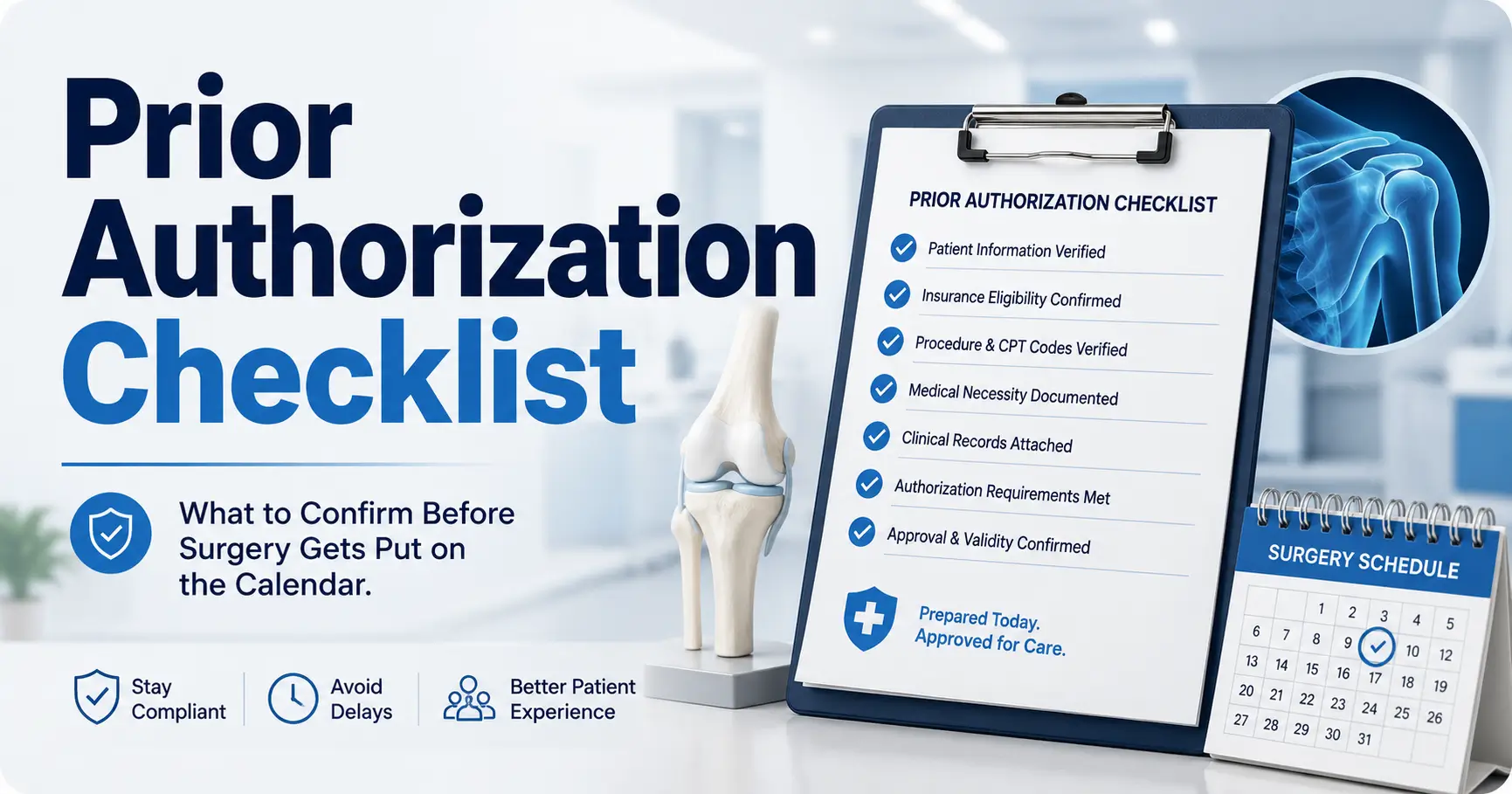
Prior Authorization Checklist for Orthopedic Procedures:
What to Confirm Before Surgery Gets Put on the Calendar
Orthopedic surgery has a strange quiet moment before the bright lights and discharge papers. It happens at a desk, on a phone, inside a portal, or in a fax queue. A knee, hip, shoulder, wrist, or spine procedure may feel medically clear, but the insurance file still has to pass through its own narrow doorway.
That doorway is prior authorization. It can protect the patient from a coverage surprise, or it can become the small missing screw that rattles the whole schedule. One wrong code, one unmatched facility, one expired approval window, or one undocumented physical therapy attempt can turn a clean surgery plan into a long week of hold music.
This guide gives patients, caregivers, and orthopedic office teams a practical way to confirm what is approved, what is still pending, and what needs to be written down before the surgery date starts feeling real.
Match the paperwork
Confirm procedure codes, diagnosis codes, laterality, provider details, and site of service before the request leaves the office.
Prevent timing trouble
Track submission dates, approval windows, decision deadlines, appeal rights, and surgery scheduling risk.
Prepare for a denial
Build an appeal-ready file with office notes, imaging, conservative-care records, and a clean contact log.
One careful tracker now can spare everyone a last-minute paperwork thunderstorm. 🧾
Snapshot
This article is for US patients, caregivers, surgery coordinators, and orthopedic practice teams preparing for elective orthopedic care. It helps you confirm what must be authorized, what proof should be gathered, what questions to ask before surgery, and how to stay ready if the plan says no.
Table of Contents
Before You Act: What This Checklist Can and Cannot Promise
This guide is educational. It can help you organize questions, documents, call notes, and timing before an orthopedic procedure. It cannot decide whether surgery is right for you, interpret your specific insurance contract, or guarantee that a health plan will approve or pay a claim.
Orthopedic care often touches several billing lanes at once: the surgeon, facility, anesthesia group, imaging provider, implants, durable medical equipment, home health, and physical therapy. Prior authorization may apply to one lane, several lanes, or none, depending on the plan and service.
For medical questions, ask your clinician. For plan-specific coverage questions, ask your insurer or benefits administrator. For repeated denials, major financial risk, or urgent access problems, consider a qualified patient advocate, attorney, insurance professional, case manager, or employer benefits team.
Before you treat this as paperwork only
If symptoms are worsening quickly, involve trauma, fever, infection concerns, loss of bladder or bowel control, new weakness, numbness in the groin area, chest pain, shortness of breath, or severe uncontrolled pain, contact a clinician or seek urgent care. Insurance timing should not be used to delay emergency evaluation.
The Quiet Gatekeeper Before Orthopedic Surgery
Prior authorization is plan approval that may be required before a service can be covered. In plain English, the health plan wants to review the request before the care happens.
For orthopedic procedures, that review may focus on whether the procedure is medically necessary, whether conservative treatment was attempted, whether imaging supports the plan, whether the provider is in network, and whether the surgery is happening in the approved setting.
Why it appears before knees, hips, shoulders, and spines
Elective orthopedic care can be expensive and complex. A single surgery may involve a surgeon, assistant surgeon, anesthesiologist, surgical facility, implants, imaging, prescriptions, a brace, a walker, and weeks of physical therapy.
Plans often use prior authorization to check whether the requested service matches their medical policy. That policy may ask for proof such as X-ray findings, MRI results, failed physical therapy, functional limits, medication trials, or prior injections.
What “approved” does and does not mean
Approved does not always mean fully paid. It usually means the plan reviewed a specific request before care. Final payment may still depend on eligibility on the service date, network status, coding, medical necessity, deductible, coinsurance, exclusions, and whether the billed claim matches the approved authorization.
That is why the best prior authorization checklist for orthopedic procedures does not stop at “Did they approve it?” The better question is: “Exactly what did they approve, for whom, where, during which date range, under what code, and with what related services excluded?”
Preauthorization, precertification, referral: same neighborhood, different houses
Health plans may use words like prior authorization, preauthorization, precertification, prior approval, referral, or predetermination. They sound like cousins wearing the same coat, but they do not always mean the same thing.
A referral often means a primary care clinician or plan must route you to a specialist. Prior authorization usually means the plan must review a service before coverage. Predetermination may be a non-binding estimate or review, depending on the plan. Always ask the insurer what the word means under your specific policy.
Key takeaway
Do not ask only whether surgery is approved. Ask what service, code, provider, facility, date range, and related items are included. A vague yes is a paper umbrella in a billing storm.
The Procedure Match Problem: One Wrong Code Can Bend the Whole Claim
The fastest way for a prior authorization file to wobble is a mismatch between the planned surgery and the request sent to the insurer. In orthopedic care, the smallest code detail can carry a heavy backpack.
This is where patients and caregivers can help without pretending to be coders. You do not need to interpret CPT or diagnosis coding yourself. You do need to make sure the office, insurer, and facility are talking about the same procedure.
Confirm the CPT code before submission
The CPT code tells the plan what procedure is being requested. If the authorization request says one procedure and the surgeon later performs or bills another, the claim may face extra review or denial.
Ask the orthopedic office: “What CPT code is being submitted for prior authorization?” Then ask the insurer to read back the approved service once a decision is issued. The goal is not to challenge the code. The goal is to catch a mismatch early, while the file can still be corrected.
Match the diagnosis code to the reason for surgery
The diagnosis code should align with the documented reason for surgery. A knee meniscus tear, severe hip osteoarthritis, rotator cuff tear, spinal stenosis, or hardware complication may each require a different medical-necessity story.
If the denial says the procedure is not medically necessary, the issue may not be the procedure alone. It may be that the diagnosis code, imaging report, office note, and treatment history do not line up cleanly.
Ask whether laterality matters
Orthopedic procedures often involve left, right, bilateral, staged, revision, or repeat surgery details. A left shoulder approval may not protect a right shoulder claim. A primary hip replacement may not match a revision procedure. A single-side approval may not cover bilateral work.
Patients can ask one simple question: “Does the authorization identify the side of the body and whether this is primary, revision, staged, or bilateral?” It sounds fussy. It is also exactly the kind of fussiness that prevents expensive confusion.
| Code or detail | What to confirm | Why it matters |
|---|---|---|
| Procedure code | The CPT code submitted and approved | The claim should match the authorized service |
| Diagnosis code | The medical reason documented for surgery | Medical necessity depends on the clinical story |
| Laterality | Left, right, bilateral, or staged | Wrong-side authorization can create claim trouble |
| Procedure type | Primary, revision, repair, replacement, fusion, decompression, or hardware removal | Similar words can represent different coverage rules |
| Date range | Approved start and end date | An expired authorization may not protect the claim |
If you are still preparing for the first specialist visit, a simple orthopedic visit checklist can help you bring clearer symptoms, medication history, and functional details into the appointment before authorization is even discussed.

Site of Service: The Hidden Approval Trap
Many patients assume approval follows the surgeon like a loyal dog. It does not always work that way. The plan may approve the surgeon but not the facility, approve the procedure but not the inpatient stay, or approve a hospital outpatient department but not an ambulatory surgery center.
Site of service means where the procedure happens. For orthopedic surgery, that may be a hospital outpatient department, ambulatory surgery center, inpatient hospital, office-based procedure room, or imaging-guided procedure suite.
Hospital outpatient vs ASC vs inpatient
A hospital outpatient department and an ambulatory surgery center may feel similar to a patient. The billing may look very different. The authorization requirements may also differ.
Ask whether the request was submitted for the exact planned setting. If the surgeon moves the procedure from one facility to another, ask whether a new authorization or amendment is needed before the surgery date.
For cost planning, a related guide on hospital outpatient vs ASC facility fees can help patients understand why the building itself can change the bill.
Why the facility NPI can matter as much as the surgeon
The facility has its own identifiers, including an NPI and sometimes a tax ID. If the authorization only names the surgeon, that may not answer whether the facility is covered, in network, or separately authorized.
Patients should ask for both names to be confirmed: the surgeon or practice and the facility where the surgery will occur. If the insurer representative says, “The provider is in network,” ask whether they mean the surgeon, the facility, or both.
Anesthesia, implants, and imaging can split the path
Orthopedic surgery may include separate services that have their own authorization rules. Anesthesia may be billed by a separate group. Implants may have special documentation requirements. Post-op imaging or advanced imaging before surgery may need its own authorization.
That does not mean every related service needs separate approval. It means you should ask. A short call before surgery is cheaper than discovering a separate anesthesia bill or DME issue afterward.
If you want to understand why bills may arrive from different providers after one orthopedic procedure, review this plain-English guide to multiple providers on an orthopedic bill.
Key takeaway
Do not assume the surgery center is covered because the surgeon is. Confirm the surgeon, facility, anesthesia, implants, and post-op items separately when the plan requires it.
Medical Necessity Evidence: Build the File Like a Calm, Boring Fortress
Medical necessity is where orthopedic prior authorization becomes less about a form and more about a story. Not a dramatic story. A documented story.
The plan may want to see that symptoms, function limits, imaging, exam findings, and prior treatment attempts all point in the same direction. A strong file is not loud. It is orderly.
Office notes should show function, not just pain
Pain matters. But pain score alone may not be enough. Orthopedic notes are stronger when they show what the condition prevents: walking more than one block, climbing stairs, sleeping, dressing, driving, lifting, typing, bathing safely, or working a shift.
Patients can help by describing limits in concrete terms. “My knee hurts” is useful. “I stop halfway up the stairs and pull myself by the railing” gives the file legs.
Imaging reports need to be easy to find
X-rays, MRIs, CT scans, ultrasound reports, or fluoroscopy documentation may support the request. The key is not only that imaging exists. The key is whether the relevant report is attached, dated, legible, and tied to the same body part and diagnosis.
If the surgeon discusses imaging during the visit, ask whether the prior authorization packet includes the written radiology report or only the office note. Some plans prefer the actual report.
Conservative care needs dates, duration, and results
Many orthopedic medical policies ask about conservative treatment before surgery. This may include physical therapy, home exercise, medications, injections, bracing, rest, activity modification, weight-bearing changes, or work modification.
The weak phrase is “tried everything.” The stronger version is: “Physical therapy from March 4 to April 18, twelve visits, improved range of motion but pain still prevented stairs.” Plans need facts, not fog.
Show me the nerdy details
A payer reviewer often needs the authorization request to answer four quiet questions: What is the diagnosis? What is the requested service? Why is it medically necessary now? Why are lower-risk or lower-cost alternatives not enough?
The best orthopedic packets usually connect clinical notes, imaging, exam findings, function limits, and conservative-care history. If one part is missing, the file may still be clinically reasonable but administratively weak.
This is also why AI-generated letters, template letters, and patient summaries can be helpful only if someone verifies the administrative scaffolding: codes, provider identifiers, site of service, requested date range, attachments, and follow-up plan.
Real-world example: the missing physical therapy page
A patient is scheduled for shoulder surgery after months of pain, weakness, night waking, and failed home exercises. The surgeon’s note explains the tear and the planned repair. The MRI is attached. The request seems solid.
The plan denies it for lack of conservative-treatment documentation. Everyone is frustrated because the patient did attend physical therapy. The problem is not that therapy never happened. The problem is that the dates, visits, discharge note, and outcome were not in the packet.
The fix is not a louder appeal. It is a cleaner one: attach the therapy records, show the duration, explain the remaining functional limits, and ask the reviewer to reconsider based on the missing documentation.
Orthopedic Authorization Packet: What to Gather Before Submission
A good authorization packet is part medical file, part travel itinerary, part receipt folder. It tells the reviewer who the patient is, what is being requested, where it will happen, why it is needed, and how to contact the right people.
Patients do not need to assemble every item themselves, but they should know what belongs in the packet so they can spot missing pieces before the surgery date is close enough to breathe on their neck.
Patient and plan details
- Patient name and date of birth
- Member ID and group number
- Plan type, such as HMO, PPO, EPO, Medicare Advantage, Marketplace, employer plan, or secondary coverage
- Primary and secondary insurance order
- Coverage effective date
- Referral requirement, if any
- Insurer phone number and portal details, if available
Provider and facility details
- Surgeon name and NPI
- Practice name and tax ID, if required
- Facility name and NPI
- Facility network status
- Planned site of service
- Scheduled or tentative surgery date
- Anesthesia group information, if available
Clinical and administrative details
- Procedure code and description
- Diagnosis code and diagnosis description
- Laterality: left, right, bilateral, staged, or revision
- Office notes with symptoms, exam findings, and function limits
- Imaging reports
- Physical therapy records or home exercise documentation
- Medication, injection, bracing, and activity-modification history
- Implant or device details, if relevant
- Submission date and method
- Authorization number, approval date range, decision deadline, and appeal deadline
Orthopedic Prior Authorization Flow
1. Match
Procedure code, diagnosis code, laterality, and surgical plan
2. Verify
Surgeon, facility, network status, and site of service
3. Prove
Office notes, imaging, function limits, and conservative care
4. Submit
Request method, attachments, date, and contact person
5. Track
Decision deadline, approval window, denial reason, and appeal path
The Pre-Surgery Phone Call That Needs a Script
Phone calls can be useful. They can also evaporate. If a representative gives you important information, write it down while you are on the call and ask for a call reference number.
The purpose of the pre-surgery call is not to argue. It is to freeze the moving pieces long enough to see whether the authorization matches the plan.
Start with the approval basics
Use a calm, specific script:
Call script
“I am calling to confirm prior authorization for an upcoming orthopedic procedure. Please read back exactly what is approved, including the authorization number, approved service, procedure code if available, facility, provider, site of service, approval date range, and any excluded related services.”
“Can you also tell me whether anesthesia, implants, assistant surgeon, durable medical equipment, home health, and post-op physical therapy need separate authorization?”
Ask for the read-back, not the vibe
A representative saying, “It looks approved,” is not enough. Ask them to read back the approved service and date range. If the wording sounds different from the surgeon’s plan, call the orthopedic office before assuming all is well.
Also ask whether the approval is linked to the exact facility. If the representative cannot tell, ask the surgery coordinator whether the authorization letter or portal response shows the facility name or NPI.
Write down the contact log
Your contact log should include the date, time, phone number, representative name, call reference number, what was confirmed, what was unclear, and what follow-up is needed. This is the low-glamour tool that can become very powerful later.
If you are a caregiver, keep the tracker where siblings or helpers can see it. A shared note, printed sheet, or binder works. The best system is the one people actually use when everyone is tired.
| Question to ask | Why it matters | What to write down |
|---|---|---|
| What is the authorization number? | It helps track the request | Number, approval date, and representative |
| What exact service is approved? | Prevents code or procedure mismatch | Procedure description and code if available |
| Which facility is approved? | Facility mismatch can affect coverage | Facility name, NPI, and site of service |
| What is the approval window? | Surgery may be delayed or rescheduled | Start date and expiration date |
| Do related services need separate authorization? | DME, PT, home health, implants, or anesthesia may differ | Each related item and the answer given |
If the Plan Says No: Appeal Before Panic Takes the Wheel
A denial is not always the end of the road. Sometimes it is a locked drawer with the key taped underneath: missing records, wrong code, wrong site, expired date range, incomplete therapy history, or a policy requirement that was not answered directly.
The first move is not to rewrite everything. The first move is to read the denial reason carefully.
Separate missing documentation from medical-necessity disagreement
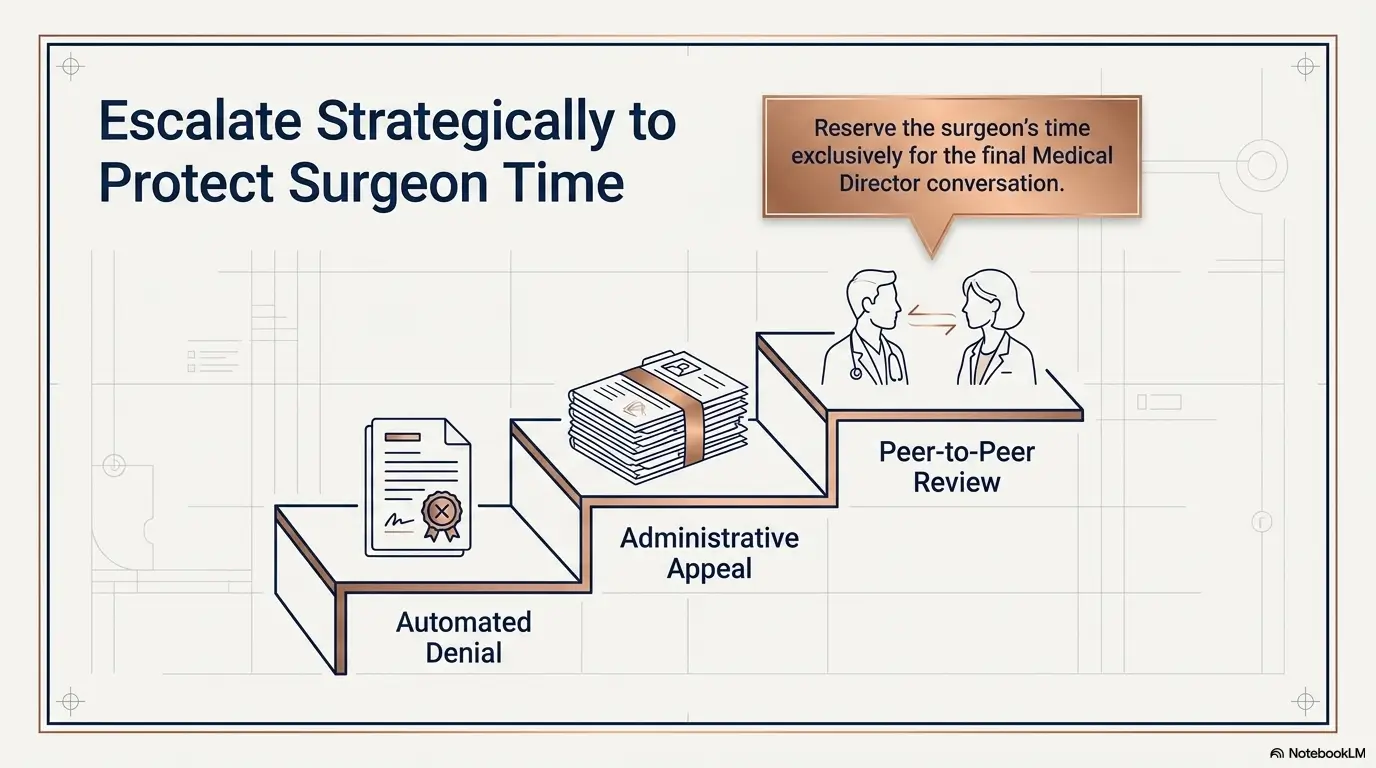
If the denial says records were missing, the appeal may need a cleaner packet. If it says the service was not medically necessary, the surgeon may need to address the plan’s medical policy more directly.
Ask the orthopedic office: “What evidence directly answers the denial reason?” This keeps the appeal from becoming a large, emotional stack of paper that still misses the point.
Watch the clock
Appeal timing depends on the plan type, service type, and urgency. Marketplace and many commercial plan rules include written denial explanations and timeframes, but your exact rights may depend on your plan documents and state rules.
Write down the denial date, appeal deadline, how to submit the appeal, what documents are required, and whether an expedited process may apply. Urgent handling should be requested only when the clinical situation supports it.
Ask for the document, not just the decision
If someone tells you the request was denied, ask for the written denial letter or portal copy. The letter should explain the reason, appeal rights, and next steps. Without that, everyone is trying to repair a clock in the dark.
Key takeaway
A denial appeal should answer the denial reason, not every possible concern. First identify the problem: missing records, coding mismatch, site issue, medical necessity disagreement, network rule, or timing problem.
Medicare, Marketplace, and Commercial Rules: Similar Words, Different Doors
Prior authorization is not one universal system. A Medicare Advantage plan may behave differently from Original Medicare. A Marketplace plan may have different appeal steps than an employer plan. A self-funded employer plan may follow different administrative rules than a fully insured plan.
That is why the checklist should always begin with the actual plan. The card in your wallet is more useful than a general article when it is time to confirm requirements.
Medicare Advantage may not behave like Original Medicare
Medicare Advantage plans are private plans that administer Medicare benefits under plan rules. They may require prior authorization for services that feel routine to the patient. Original Medicare has its own rules, and certain outpatient department services may have specific prior authorization programs.
If you are comparing orthopedic care under Medicare Advantage, this guide on Medicare Advantage orthopedic care can help you prepare better questions about referrals, networks, and out-of-pocket exposure.
Commercial and Marketplace plans can define things differently
Employer plans, Marketplace plans, union plans, student plans, and COBRA coverage may each have their own prior authorization process. The same surgery can be handled differently under different plans.
Ask the insurer whether the request is pending, approved, denied, partially approved, approved with conditions, or requiring peer-to-peer review. These distinctions matter when surgery is close.
Electronic prior authorization may help, but it will not replace follow-up
Federal policy has been moving toward more electronic prior authorization processes, clearer documentation requirements, payer APIs, and public reporting for certain impacted payers. That may improve parts of the process over time.
Still, a patient facing a surgery date needs human follow-up. Portals and APIs do not fold the laundry, call the facility, or notice that the approval expires two days before the rescheduled procedure.
Free vs Paid Help: When a Simple Tracker Is Enough
You do not always need a paid service, software tool, attorney, or professional advocate to handle orthopedic prior authorization. Many patients can do enough with a phone, a folder, and a one-page tracker.
But some situations deserve more help: repeated denials, major out-of-network costs, a caregiver managing multiple providers, surgery close to cancellation, complex Medicare Advantage rules, workers’ compensation overlap, or a patient who cannot safely manage the calls alone.
Good / Better / Best authorization support
| Option | Best for | What it costs | What to verify |
|---|---|---|---|
| Good: free DIY tracker | Clear plan, responsive orthopedic office, simple elective procedure | Mostly time and organization | Authorization number, facility, code, date range, call log |
| Better: benefits administrator or case manager | Employer coverage, Medicare Advantage care coordination, caregiver support | Often included with coverage or employer benefits | Scope of help, response time, escalation process |
| Best: patient advocate or legal/insurance help | Repeated denials, high bills, out-of-network risk, serious access concern | May involve hourly fees, flat fees, or consultation costs | Credentials, fees, conflicts, written service scope |
Questions to ask before paying for help
- What exact problem will you help with: authorization, appeal, billing, network exception, or care coordination?
- What documents do you need from me?
- Do you charge hourly, flat fee, contingency, or by project?
- Will you communicate with the insurer, provider, or both?
- Can you explain what is realistic and what is not?
- Will I receive copies of everything submitted?
Common money-wasting mistakes
The most expensive mistakes often look ordinary at first: scheduling before approval is confirmed, assuming the facility is included, ignoring the approval window, paying for duplicate help without defining the task, or buying post-op equipment before checking coverage and medical necessity requirements.
If post-op supplies are part of your planning, ask whether braces, walkers, ice therapy devices, raised toilet seats, home health, or therapy visits require separate approval or documentation. You can also use this orthopedic home care equipment guide to prepare a more practical conversation before buying items out of pocket.
Key takeaway
Free organization is enough for many straightforward cases. Paid help may be worth comparing when the denial is repeated, the financial exposure is high, or the patient cannot safely manage the process alone.
FAQ
Do orthopedic surgeries usually need prior authorization?
Many elective orthopedic procedures may require prior authorization, especially when they involve surgery, advanced imaging, implants, inpatient admission, or high-cost outpatient care. The exact requirement depends on the plan, procedure code, provider, and site of service.
Is prior authorization the same as payment approval?
No. Prior authorization means the plan reviewed a service before care. It may not guarantee final payment. Final coverage can still depend on eligibility, coding, network status, plan rules, deductible, coinsurance, and whether the claim matches the approved service.
Who submits the prior authorization for orthopedic surgery?
Usually the orthopedic surgeon’s office or surgery coordinator submits it. Patients should still verify the status, authorization number, approved facility, approved service, and approval date range.
What documents help support an orthopedic authorization?
Helpful documents often include office notes, diagnosis codes, procedure codes, imaging reports, physical therapy records, medication history, injection history, functional limitations, and the surgeon’s treatment plan.
Can surgery be denied after prior authorization?
Yes, it can happen. Problems may arise if the billed service differs from the approved service, the facility is out of network, the authorization expired, eligibility changed, or the claim is coded differently from the authorization.
What should I ask my insurer before orthopedic surgery?
Ask whether the procedure, facility, anesthesia, implants, assistant surgeon, post-op physical therapy, brace, walker, home health, or prescription items need separate authorization. Also ask for the authorization number, approval window, and call reference number.
What happens if prior authorization is denied?
The denial letter should explain why. The next step is to identify whether the denial involves missing records, coding mismatch, lack of medical necessity, network rules, timing, or site-of-service issues. Then coordinate with the orthopedic office for appeal, correction, or resubmission.
How long does a prior authorization appeal take?
Timing depends on the plan, request type, and urgency. Ask your insurer for the deadline that applies to your case, and request urgent handling only when the clinical situation supports it.
Make One Authorization Tracker Today
The best next step is not heroic. It is fifteen minutes with a blank page, a portal login, or a notes app. Create one orthopedic authorization tracker and fill in what you already know.
Start with the patient name, insurer, member ID, surgeon, facility, planned procedure, CPT code if available, diagnosis, laterality, tentative surgery date, authorization number, approval window, insurer phone number, submission date, decision deadline, appeal deadline, and every call reference number.
Then circle the blanks. Those blanks are your next calls. The tracker turns a vague fear into a list of answerable questions, which is how most paperwork dragons are politely escorted out of the room.
15-minute tracker starter
- Write the planned procedure and body side in plain English.
- Add the surgeon, facility, and tentative date.
- Ask the office for the submitted procedure code, diagnosis code, and submission date.
- Call the insurer and ask them to read back exactly what is approved or pending.
- Record the authorization number, approval date range, representative name, and call reference number.
Last reviewed: 2026-08