
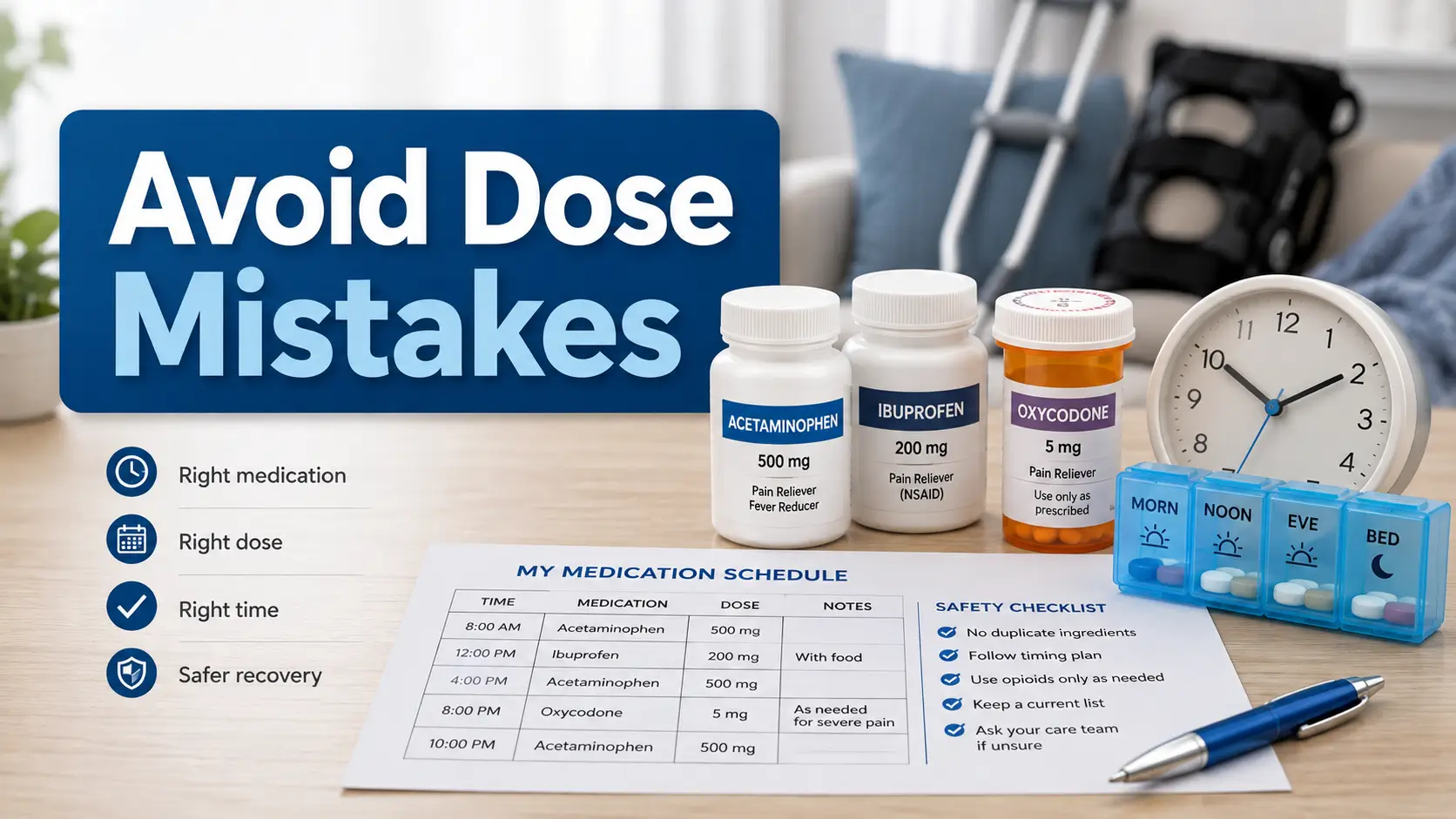
Orthopedic Recovery Medication Safety
Pain Medicine Schedule MistakesAfter Orthopedic Surgery
You are home from surgery, the discharge papers are on the counter, and suddenly four perfectly ordinary medication bottles seem to require the air-traffic control skills of a small airport. One says “every six hours.” Another says “as needed.” A third may contain an ingredient that is also sitting in your bathroom cabinet.
The biggest postoperative medication mistakes are often not dramatic acts of recklessness. They are tired-person mistakes: forgetting what the surgery center already gave you, taking a dose early because pain returned, treating a PRN medicine as automatic, or unknowingly counting the same active ingredient twice.
This guide will not invent a dosing schedule for you. Instead, it shows how to read your own instructions, build one reliable medication record, spot conflicts before they become dosing errors, and recognize the moments when a pharmacist, surgical team, Poison Control, or emergency care should enter the picture.
The goal is not a prettier pill chart. It is one trustworthy timeline that survives fatigue, pain, and 3 a.m. arithmetic. 🕒
Snapshot
Who this is for: adults recovering from orthopedic surgery and the people helping them at home. What it solves: confusing dose timing, duplicate ingredients, PRN misunderstandings, and caregiver handoff errors. What you can do next: turn your discharge instructions into one shared medication map without changing the prescribed plan.
Before You Act
This article explains medication-scheduling principles, not your personal dosing instructions. Your postoperative plan can vary with the procedure, other prescriptions, age, kidney or liver function, bleeding risk, sleep-related breathing problems, allergies, and other medical factors. Follow the written instructions from your surgeon or prescriber. If those instructions conflict, are incomplete, or do not control your pain, contact the surgical team or pharmacist rather than rewriting the plan yourself.
Table of Contents
Why the Schedule Gets Complicated at Home
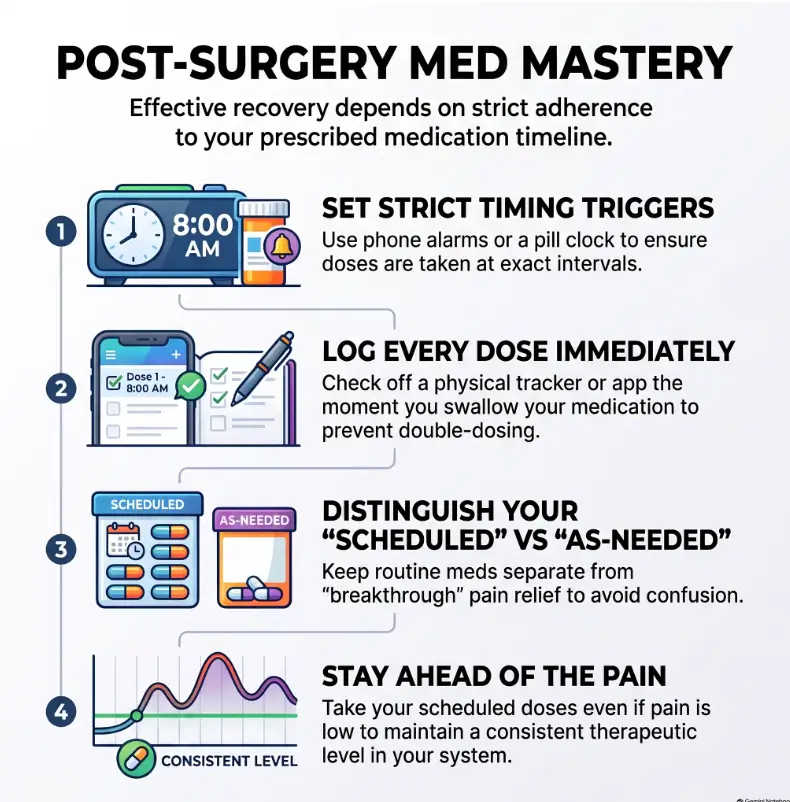
Three instructions can mean three different things
A medication label may describe a fixed schedule, a permitted interval, an “as needed” instruction, or a combination of these ideas. They are not interchangeable.
A medicine intended on a planned schedule is generally being used according to specific written timing instructions. A medicine labeled “as needed,” often shortened to PRN in clinical language, introduces another question: do you actually need it now, and do the prescription directions permit another dose yet?
The common trap is reading the maximum permitted frequency as a target. If a prescription says a medicine may be taken at certain intervals as needed, that does not necessarily mean every possible dose must be taken.
Key takeaway: Before asking “What time is the next pill?” first ask, “Is this medicine scheduled, PRN, or governed by a minimum interval plus a specific reason for taking it?”
The discharge-day trap nobody expects
The first evening at home can be the hardest time to reconstruct a medication schedule. You may still be sleepy from anesthesia or sedation. A regional nerve block may be reducing pain. Medications may have been administered before you left the hospital or surgery center.
That means “I have not taken this bottle since I got home” is not always the same as “I have not received this medication recently.” Your home timeline should begin with the last confirmed dose, including relevant medication administered before discharge.
If that time is missing, do not manufacture one from memory. Check the discharge paperwork, patient portal, medication administration record if supplied, or call the facility or pharmacist for clarification.
A neat handwritten schedule can still be wrong
A beautifully organized chart built from incomplete information is still incomplete. Before filling tomorrow with pill times, establish what happened today.
This is especially useful for caregivers. If you are helping a parent or partner, compare the medication list with the actual pill bottles. The site’s guide to reading pill bottle labels after surgery can help when the pharmacy label and discharge paperwork look frustratingly different.
Mistake #1: Taking the Next Dose Too Soon Because the Pain Came Back
Minimum intervals are not pain targets
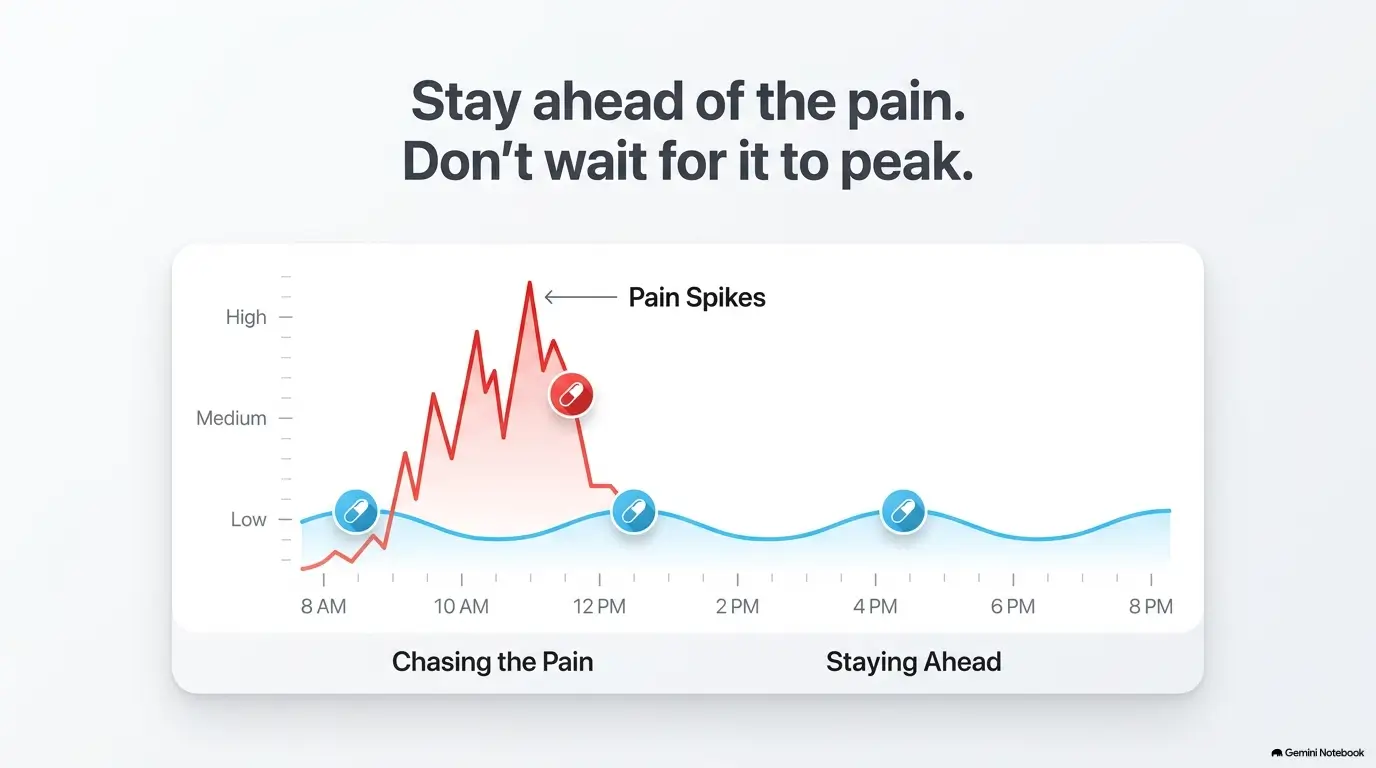
Postoperative pain can rise and fall between doses. That is miserable, but the return of pain does not automatically change the timing printed on the prescription.
If pain becomes severe before the next permitted dose, treat that as a reason to review the plan or contact the surgical team, not as permission to squeeze the timeline. The problem may be inadequate pain control, misunderstanding of the instructions, a medication side effect, or something related to the surgery itself.
“Every six hours” does not shrink when you are exhausted
Sleep disruption makes time strangely elastic. A 10 p.m. dose, a brief nap, and a glance at a glowing bedside clock can feel like half a night has passed when it has not.
Record doses immediately rather than planning to “remember in the morning.” Write the medication name, strength, amount taken, and actual time. A checked box beside a preprinted future time is less useful if the medicine was really taken 40 minutes later.
Build forward from the last actual dose
- Find the last confirmed administration time.
- Check the exact prescription directions.
- Record the time the medication was actually swallowed, not merely offered.
- Calculate nothing from memory when a written record exists.
- If the interval is unclear, stop the calculation and ask a pharmacist or prescriber.
If worsening nighttime pain is the reason you are tempted to change the schedule, the separate guide to night pain after surgery can help you organize what is changing before you call the surgical team.
Mistake #2: Double-Counting Acetaminophen Without Realizing It
The hidden-ingredient problem
Acetaminophen can appear in both over-the-counter products and prescription combination medicines. The FDA advises consumers to read every label and avoid using more than one acetaminophen-containing product at the same time because accidental duplication can lead to taking too much.
You may also encounter “APAP” on some medication information. Do not assume a prescription pain medicine contains only the opioid or other ingredient named most prominently in conversation. Check the full active-ingredient line.
One total matters: everything taken during the full day
For adults, the FDA lists 4,000 mg per day as the current maximum recommended acetaminophen dose from all medicines combined. Your own clinician may set a lower limit, so the number on your discharge plan or instructions from your medical team governs your situation.
This is why a medication schedule should not merely say “pain pill” and “Tylenol.” Write the amount of acetaminophen contained in each relevant product beside the product name, then track the combined total according to the instructions you were given.
Ingredient check before the next dose
Look at every prescription and OTC label on the counter. If two products contain acetaminophen, do not treat them as unrelated medicines when calculating the day’s exposure. If you cannot determine what is in a product, ask the pharmacist before adding it.
Do not fix this with mental math
Pain, interrupted sleep, and multiple caregivers are poor ingredients for arithmetic. Put the numbers on paper, in a shared phone note, or in a medication-tracking tool that everyone actually uses.
If the family is already noticing forgotten doses, repeated questions, or uncertainty about whether medication was taken, review this practical guide to monitoring medication confusion.
Around-the-Clock vs “As Needed”: The Two Instructions Patients Mix Up
Scheduled medicine has a different job
Orthopedic pain plans often use more than one method of pain control. AAOS describes multimodal pain management as using different medication or treatment approaches together to manage pain while potentially reducing reliance on any single method.
If a nonopioid medicine is included on a planned schedule in your written instructions, follow that plan rather than converting it to PRN on your own because you happen to feel better for a few hours.
PRN adds a decision point
“As needed” is not the same as “whenever available.” Think of PRN medication as requiring two green lights: the reason for taking it fits the prescription, and the directions permit another dose.
That distinction matters for caregivers too. “It has been long enough” is only half the question when the medication is not meant to be automatic.
Should you wake up for a dose?
There is no sensible universal internet answer to that question. It depends on the medicine, whether it is scheduled or PRN, the surgeon’s plan, the procedure, and the patient’s medical situation.
Before the first night, circle any instruction that leaves you wondering whether sleep changes the plan. That is a useful question for the surgeon’s office or pharmacist, especially if the answer determines whether someone needs to set an alarm.
Show me the nerdy details
A medication instruction can contain several independent constraints: dose amount, minimum interval, maximum frequency or total, indication, duration, and special conditions such as taking it with food or avoiding another drug.
A safe home log does not reinterpret those constraints. It simply makes them visible. Think of each medicine as carrying its own rule set rather than fitting every bottle into one universal clock.
The Alternating-Medicine Puzzle: Where Good Intentions Create Bad Timelines
Alternating does not reset either medicine’s clock
If your clinician has specifically instructed you to alternate two medicines, the important idea is that each medication still retains its own directions. Taking medicine B between doses of medicine A does not shorten medicine A’s permitted interval.
This sounds obvious at noon. At 3 a.m., with a swollen joint and two nearly identical alarms, it becomes pharmaceutical Sudoku.
Use two clocks, not one
Keep a separate running line for every medication instead of creating one master sequence that merely says “take something every few hours.” That preserves each drug’s dose history.
| Weak tracking method | Safer alternative | Why it helps |
|---|---|---|
| “Pain pill at 8” | Full medication name, strength, amount, 8:07 p.m. | Reduces ambiguity |
| One alternating timeline | Separate row for each medicine | Preserves each interval |
| Checking a planned time in advance | Record only after administration | Separates intention from reality |
| Two caregiver notebooks | One shared log | Reduces duplicate dosing risk |
Free paper, phone note, or paid medication tool?
You do not need an expensive device to create a useful medication record. For a short, uncomplicated recovery, a printed sheet or shared phone note may be enough.
| Setup | Best for | Main strength | Watch for |
|---|---|---|---|
| Good: paper log | One patient, one main caregiver | Cheap, visible, simple | Can be misplaced or updated late |
| Better: shared digital note | Two or more helpers | Everyone sees one record | Notifications can become noisy |
| Best when complexity warrants it: medication-management service or app | Many prescriptions, multiple caregivers, longer recovery | May add reminders and structured records | Cost, setup effort, privacy, and whether it fits the actual prescription instructions |
The best tool is not the one with the most features. It is the one that everyone will update immediately and consistently.
Opioid Schedule Mistakes That Need Extra Caution
More pain does not automatically mean more opioid
CDC guidance for acute pain recommends that clinicians use the lowest effective dose of immediate-release opioids when opioids are started and prescribe no greater quantity than needed for the expected duration of pain severe enough to require them. The guidance also stresses individualized, patient-centered decision-making.
For the patient at home, the practical translation is simpler: take an opioid only according to the prescription. If pain is breaking through despite following the plan, report that problem rather than escalating the amount or frequency yourself.
Do not casually stack sedating substances
CDC recommends particular caution when opioids are prescribed with benzodiazepines and asks clinicians to consider the risks of opioids used with other central nervous system depressants. AAOS likewise advises patients to take opioids only as prescribed and warns against unsafe combinations such as opioids with alcohol or certain sedating medications.
If you already use a sleep medication, anxiety medication, muscle relaxant, or another medicine that makes you drowsy, do not guess whether it belongs beside the postoperative opioid. Ask the prescriber or pharmacist specifically about the combination.
The “one more before bed” mistake
An opioid should not become a sleep aid simply because pain and sleep happen to live in the same bedroom after surgery. AAOS advises taking opioids only as prescribed and not using them simply to help with sleep.
When the Nerve Block Wears Off: What Changes Next?
The quiet hours can create false confidence
Regional anesthesia and nerve blocks can provide temporary pain relief around orthopedic procedures. That can make the early hours after surgery feel deceptively easy, especially while other medications from the procedure are still active.
The issue is not that every patient should take medication before a block wears off. The issue is that the transition should come from your surgical team’s plan, not from an improvised response after pain becomes intense.
Do not invent a catch-up schedule
If sensation returns and the pain rises quickly, do not compress intervals in an attempt to “catch up.” Check the written transition instructions. If they do not answer what is happening, contact the surgical team.
One question worth asking before surgery
Ask: “What should I take, and when, as the nerve block begins wearing off?”
Then write the answer in your orthopedic appointment notes. A specific answer documented before surgery is much more useful than a vague memory after midnight.
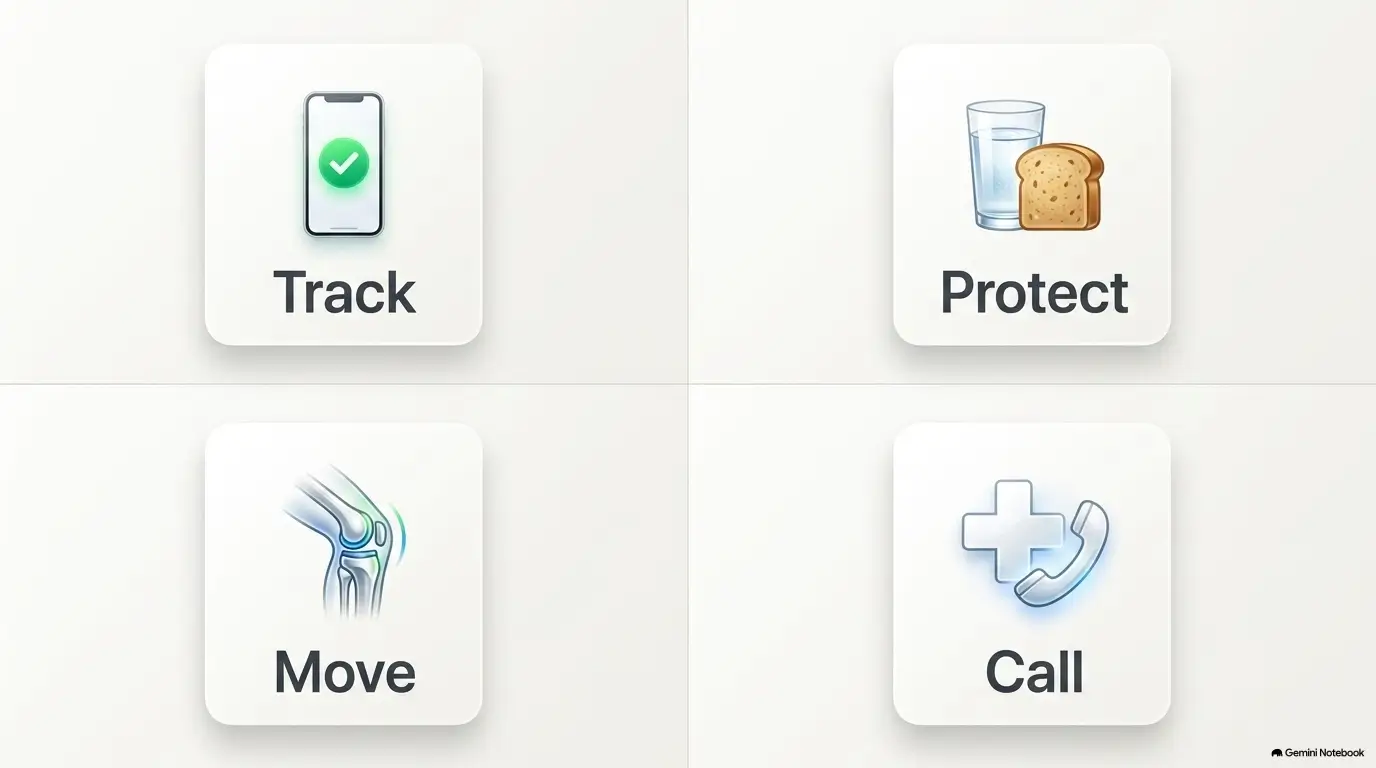
The Four-Check Medication Flow
7 Errors Worth Checking Before Tonight’s Dose
A fast medication-safety check before the evening becomes blurry can prevent several ordinary but consequential mistakes.
| Mistake | Why it happens | Safer move |
|---|---|---|
| 1. Guessing the hospital’s last dose | The home bottle feels like the beginning of the timeline | Confirm discharge medication times first |
| 2. Taking two products with the same ingredient | Brand names hide the overlap | Compare active ingredients |
| 3. Treating PRN medicine as automatic | The interval is mistaken for a schedule | Check both need and permitted timing |
| 4. Shortening the interval during breakthrough pain | Pain feels urgent | Stay within instructions and call if control is inadequate |
| 5. Adding OTC pain medicine without checking | “OTC” sounds automatically compatible | Confirm it fits the postoperative plan |
| 6. Combining opioids with alcohol or sedating drugs | Other medicines feel unrelated | Review combinations with the prescriber or pharmacist |
| 7. Maintaining separate caregiver records | Everyone is trying to help | Use one shared source of truth |
AAOS recommends following an agreed pain-management plan, taking opioids only as prescribed, and discussing other prescription drugs, over-the-counter medications, and supplements with the treating clinician.
Real-world example: two caregivers, one dangerous blank space
Imagine Maya has knee surgery and her husband manages the medications overnight. At 7 a.m., her sister arrives so he can sleep. He says, “She had the pain medicine sometime after four.”
The sister sees that another dose may be allowed after a certain interval, but she does not know whether the last dose was at 4:05 or 4:55. Maya is groggy and cannot remember.
The unsafe solution is to choose a convenient time and hope. The useful solution is to check the shared log, medication paperwork, or obtain professional guidance if the last administration cannot be established.
The lesson is wonderfully unglamorous: caregiver communication is part of medication safety. If several people are helping, one shared record beats three conscientious memories. A caregiver group chat after surgery can also help with handoffs, provided the actual medication record remains clear and centralized.
When to Seek Help: Sometimes Pain Is Not a Scheduling Problem
Call the surgical team when the plan stops making sense
Contact the surgical team, prescriber, or pharmacist when you cannot reconcile the instructions, when pain is unexpectedly worsening despite following the plan, when vomiting prevents medications from staying down, when you suspect a duplicate dose, or when a new medication reaction or side effect concerns you.
For pain itself, describing the pattern is more useful than saying only “it hurts a lot.” Note what changed, when it changed, whether the pain is constant or comes in waves, and what happened after the last medication. The guide to explaining pain that comes and goes can help you organize that call.
Severe sleepiness is not simply “good pain control”
Opioids can cause dangerous sedation and breathing problems. If a person collapses, has a seizure, has trouble breathing, or cannot be awakened, Poison Control advises calling 911 immediately.
Emergency line in the sand
Difficulty breathing, collapse, seizure, or inability to wake the person is not a “watch and see” medication question. In the U.S., call 911. If poisoning or an overdose may have occurred and the person is awake and breathing, Poison Control can provide case-specific guidance.
Suspect too much acetaminophen? Do not wait for symptoms
Acetaminophen overdose can cause serious liver injury, and early symptoms may be absent. Poison Control advises seeking guidance immediately when too much may have been taken instead of waiting to see whether the person feels ill.
In the United States, Poison Control can be reached at 1-800-222-1222 and also offers an online tool for poison exposures.
Pain plus surgical warning signs needs clinical assessment
Your surgeon’s discharge instructions should identify symptoms that require a call or urgent evaluation after your particular procedure. Do not automatically respond to unexpectedly escalating pain by taking extra medication. Pain can sometimes be part of a postoperative complication rather than simply a signal that another pill is due.
Key takeaway: A medication schedule answers “when may I take this according to my instructions?” It does not answer “why did my pain suddenly change?” Those are different questions.
Build a Safer Medication Map Without Inventing a New Schedule
Start with the discharge medication list
Gather the discharge instructions, prescription bottles, regular home medications, and any OTC pain relievers you were considering. Do this before creating alarms.
For each medicine, capture exactly what the label says rather than paraphrasing it into “morning pill” or “strong pain pill.”
| Field | What to record |
|---|---|
| Medication | Full name and active ingredient if relevant |
| Strength | Strength shown on the label |
| Prescribed amount | Exact amount specified per dose |
| Purpose | Why it was prescribed |
| Timing wording | Scheduled, PRN, and the exact interval language |
| Last confirmed dose | Actual administration time |
| Special warnings | Food, sedation, interactions, duplicate ingredients, or other instructions |
| Question? | Anything you cannot reconcile |
Add the last confirmed dose before calculating anything
This is the bridge between the hospital and home. Without it, the first evening’s schedule can be built on sand.
If the patient had several medications at the facility, you do not necessarily need to understand every anesthetic drug. You do need clarity about the medications relevant to the home plan and when the next home dose is permitted according to the discharge instructions.
Track doses in real time
- Keep the medication map where the medicine is actually administered.
- Have one person read the label and record each dose.
- Write the actual administration time immediately.
- Use the same log during caregiver handoffs.
- Recheck active ingredients before adding any OTC product.
- Write unresolved questions in a separate “call” column.
Leave uncertainty visible
A blank marked “confirm with pharmacist” is safer than an elegant guess. If two documents appear to conflict, do not quietly choose the version you prefer.
For NSAIDs such as ibuprofen or naproxen, procedure-specific factors and individual medical conditions can matter. If your discharge plan does not clearly include them, check before adding them. For more background, see the site’s guide to NSAIDs for joint pain, then confirm what applies after your surgery with your treating clinician.
DIY or professional help?
The written plan is clear, there are few medications, one log is maintained, and no instructions conflict.
You need ingredient reconciliation, interaction review, label clarification, or help comparing prescription and OTC products.
Pain control is inadequate, instructions conflict with the surgical plan, symptoms are changing unexpectedly, or the procedure itself affects what is appropriate.
FAQ: Pain Medicine Timing After Orthopedic Surgery
Can I take my pain medicine early if the pain becomes severe?
Severe breakthrough pain does not automatically override the prescribed interval. Check the directions and contact the surgical team if the current plan is not controlling pain rather than shortening the timing yourself.
Should I wake up overnight to take postoperative pain medicine?
That depends on your specific postoperative instructions and whether the medicine is scheduled or PRN. Do not turn an “as needed” prescription into a universal overnight schedule based on generic advice online.
Can I take Tylenol with my prescription pain medicine?
First check whether the prescription already contains acetaminophen, the active ingredient in Tylenol. The FDA warns against taking more than one acetaminophen-containing product at the same time unless specifically directed, because the combined amount counts toward the daily total.
Can I alternate acetaminophen and ibuprofen after orthopedic surgery?
Some orthopedic pain plans use multiple nonopioid medicines, but NSAIDs are not appropriate for every patient or every postoperative plan. Alternate them only if that approach fits instructions from your surgical team.
What if I accidentally miss a pain-medicine dose?
Check the medication’s specific instructions. Do not automatically double the next dose or shift every future dose without confirming what the prescription directs. If the instructions do not explain what to do, ask a pharmacist or prescriber.
How do I know when to stop taking an opioid?
Follow the plan provided by the prescriber and discuss tapering or stopping questions if they arise. CDC guidance emphasizes using opioids for acute pain only when their expected benefits justify the risks and limiting the quantity to what is needed for the expected period of severe pain.
What if two doctors gave me different pain prescriptions?
Reconcile them before combining anything. Give the surgeon, prescribing clinician, or pharmacist the complete list and ask which instructions should govern the postoperative period.
What if I cannot remember whether I already took a dose?
Do not take another dose merely because you cannot remember. Check your medication record, caregiver notes, and available documentation. If you still cannot determine what happened, obtain professional guidance rather than resolving the uncertainty with another pill.
Your 15-Minute Next Step: Make One Medication Map Before the Next Dose
You do not need to redesign your recovery tonight. Give yourself 15 minutes and make the medication situation boring. Boring is excellent here.
- Put every current prescription and relevant OTC medicine in one place.
- Copy each medicine’s name, active ingredients, strength, and exact directions.
- Add the last confirmed dose, including relevant medication received before discharge.
- Circle products containing the same active ingredient.
- Choose one shared log for everyone helping with recovery.
- Write a question mark beside anything you cannot reconcile.
- Call the pharmacist or surgical team before changing timing, adding an OTC drug, or guessing about a duplicate dose.
The safest medication map is not the one with the most alarms. It is the one that accurately reflects the prescription, shows what has already been taken, exposes duplicate ingredients, and makes uncertainty obvious before someone acts on it.
If you suspect that too much medication may already have been taken, do not spend the next hour perfecting the spreadsheet. Get case-specific help. In the U.S., Poison Control provides free, confidential guidance online or by phone at 1-800-222-1222.
The quiet victory after orthopedic surgery is not perfect pain control at every minute. It is a recovery plan that stays understandable even when everyone is tired. One bottle, one instruction, one recorded dose at a time.
Last reviewed: 2026-09