

Medicare Advantage orthopedic care involves two connected questions: what care is needed now, and what the exact plan has actually confirmed for the particular service. A network reply, referral receipt, authorization decision, estimate and clinical instruction answer different questions. Keep each response with its source and limits instead of treating “covered” or “paperwork handled” as a complete care plan.
Use the actual-status comparison, follow seven essential checks, read two fictional examples, or download the free offline service-and-answer record. Start with one unresolved service. There is no required call sequence, ten-minute review, approval score or waiting interval.
This guide is for a person or family supporter tracking one Medicare Advantage orthopedic service across plan replies, provider replies and clinical handoff. It does not choose insurance, diagnose pain, prescribe treatment, predict approval or determine a final bill. The operator writes from a family-caregiver perspective and is not a medical, insurance, financial or legal adviser. No independent professional review is claimed.
Table of Contents
Clinical care must not wait for an administrative record
Breathing difficulty, chest pain, inability to wake normally, new confusion, sudden severe pain or other serious acute symptoms require immediate medical help. Use local emergency services—911 for a U.S. emergency. Do not wait for a network check, authorization reply or completed worksheet. These are selected examples from MedlinePlus emergency guidance, not a complete triage checklist.
After a fall, seek emergency help if the person cannot get up or may have injured the head, neck, back or hip. Do not improvise a lift or repeat a difficult movement for documentation. See NHS falls guidance. This source supplies symptom education here, not U.S. coverage rules.
For a new or worsening concern, unclear instructions, medicine-use problem or unavailable necessary assistance, seek appropriate individual clinical advice. “Not an emergency” does not establish that waiting for insurance is appropriate. Report the actual concern to the treating team while administrative questions are addressed. This page sets no universal primary-care-to-specialist-to-test sequence and no safe period to remain without care.
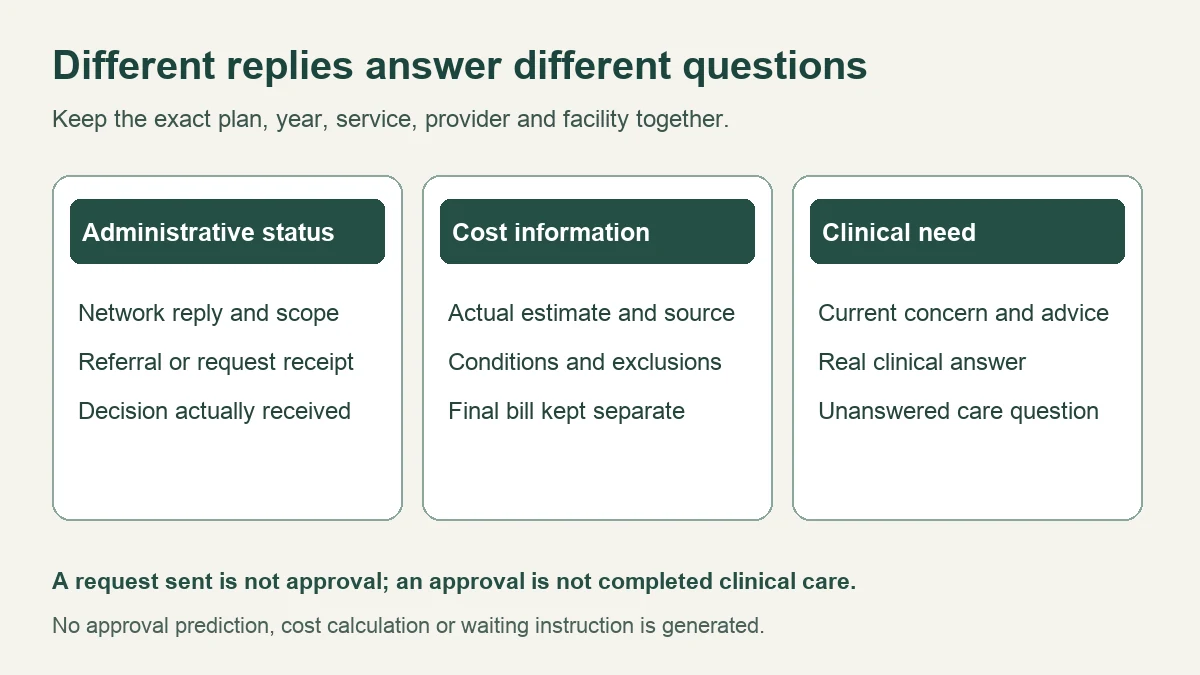
Compare the actual status of the orthopedic service
| Information or event | What to retain | What it does not establish |
|---|---|---|
| Network participation reply | Exact plan/year, provider, facility, service and source of reply. | Every service, location, date or cost condition is covered. |
| Referral reportedly sent | Sending office, destination and actual receipt if confirmed. | Referral accepted, appointment completed or authorization issued. |
| Authorization request submitted | Submission and plan receipt status, service scope and real owner. | Approval, clinical advice or an appointment date. |
| Formal coverage decision received | Actual decision, conditions, affected service and notice instructions. | A final bill or resolution of a separate clinical question. |
| Cost estimate supplied | Source, service/setting, included items, assumptions and exclusions. | Guaranteed final out-of-pocket cost. |
| Appointment booked or records forwarded | Actual booking or receipt, responsible role and unanswered issue. | Assessment performed, results explained or clinical handoff completed. |
| Clinical answer received | The real recommendation and source, including what remains uncertain. | An insurance decision or execution of the next step. |
Use “unknown,” “reported sent,” “receipt confirmed,” “decision received” and “not yet explained” accurately. They are descriptions, not an approval ladder every person must complete. Some questions do not apply to a particular service. Keep that status only when the relevant answer actually establishes it; silence does not mean approval or denial.
An exact plan matters. Medicare’s plan-type comparison shows that network and specialist-referral arrangements differ across Medicare Advantage types. A carrier name, “accepts Medicare” sign or an answer about another plan does not settle this service. Verify current details with the plan and provider, and retain both answers if they differ.
Medicare Advantage: seven essential service checks
Keep the person’s concern and current clinical advice visible
Record existing pain, sleep, activity, medicine or support concerns in the person’s own words, alongside actual professional instructions. No function-first ranking applies. No demonstration of a difficult movement, worse pain score or failed treatment is required to prepare a question. A benefits representative cannot replace clinical assessment.
Identify the exact plan, year and service conditions
Use current plan documents and the precise service already proposed, if known. Keep the provider, facility, setting and relevant change distinct. In public-page use, use fictional labels only; actual member identifiers and complete notices do not belong here. If a detail is missing, ask the appropriate office rather than guessing a code or selecting a treatment.
Separate network, referral and authorization questions
Ask what each role has actually confirmed. A provider may participate while a referral has not arrived. A referral can arrive while an authorization request remains unreceived. Do not rewrite an office acknowledgement as plan approval, or a plan answer as permission to change clinical instructions.
Record the actual request and formal decision
Distinguish a request prepared, sent and received from a decision. Retain the real notice privately, including its scope and instructions, and ask which formal process applies if the answer is incomplete or disputed. A call reference supports tracing a conversation; it is not itself a clinical finding or coverage determination.
Keep estimate conditions with the quoted information
Ask which provider, facility and service the estimate concerns, what is included or excluded and which assumptions apply. A visit copay, percentage share and estimate answer different cost questions. Do not calculate total liability from a generic schedule, combine medical and drug spending without checking the rules, or infer entitlement from a general benefit description.
Address changed conditions and conflicting replies
If the location, service, plan year or other relevant condition changes, ask whether the earlier answer still applies. Retain both versions and their sources. Do not resolve a disagreement by choosing whichever answer permits booking or buying. A clinical change belongs with the clinical team, even when a coverage question remains open.
Confirm the next owner and actual clinical handoff
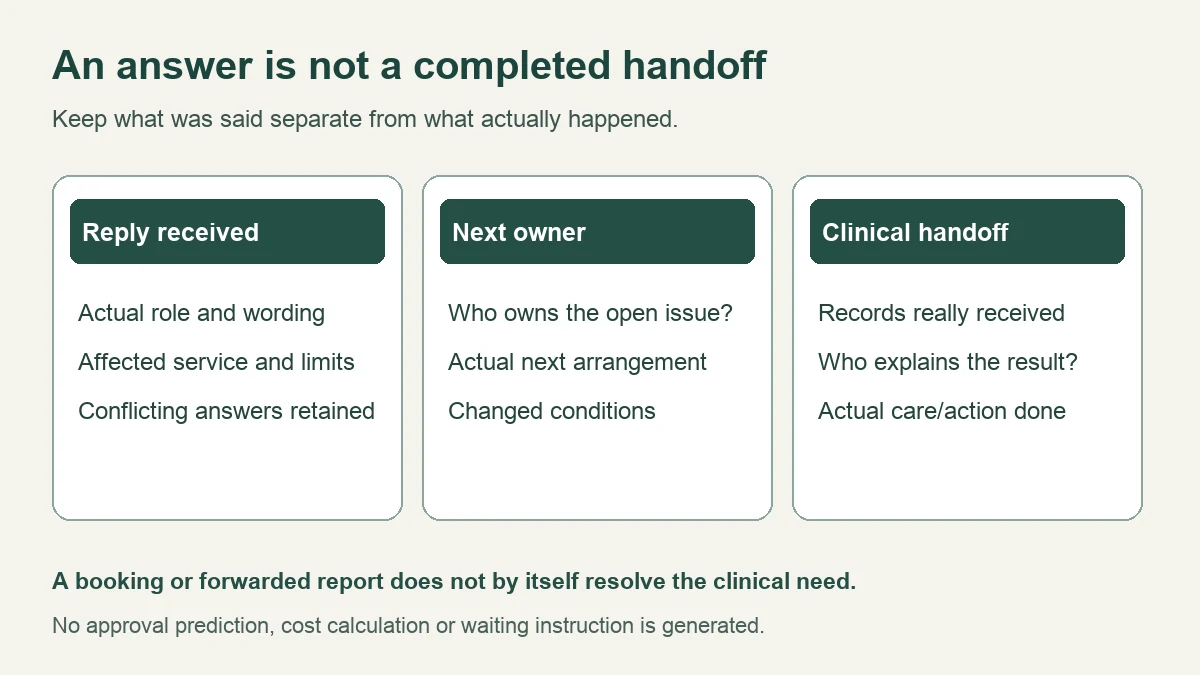
Record the real next arrangement and responsible role. Was relevant information received? Who will explain a result and address an unresolved care need? A booking, uploaded report, approved request or forwarded message is not completed care. No universal call order, review timer or instruction to wait is supplied.
Formal decisions and timeframes: match the process first
Medicare calls Medicare Advantage coverage decisions “Organization Determinations.” A member, representative or provider can request one. Ask the plan which process applies when a general benefits explanation has not answered whether the particular service is covered. Keep an actual determination separate from a directory entry, scheduling reply or informal estimate.
For 2026 prior authorization of medical items and services under the applicable CMS rule, the standard decision timeframe is generally seven calendar days and the expedited timeframe 72 hours. The rule excludes drug authorizations. These are decision timeframes, not appointment promises or instructions to wait; applicable extensions and request circumstances need checking. Ask about actual receipt and expedited review where appropriate. See CMS prior authorization guidance.
For a first Medicare Advantage appeal, Medicare generally specifies filing within 65 days of the initial denial notice date. Standard pre-service reconsideration is generally 30 days; a qualifying fast appeal is 72 hours. Payment and Part B drug appeals have different periods, and extensions can apply. Follow the actual notice and obtain timely appropriate help; do not wait for a complete diary. Medicare’s appeal page explains the distinctions. The worksheet calculates no deadline or legal strategy.
No case is classified by this article as a fast-review case. Raise the current clinical concern with the treating professional and the applicable review question with the plan. The supplied timeframes do not mean a person can safely postpone care, that every request needs authorization or that a denial is the only way to obtain a formal answer.
Keep costs, drug questions and support scope separate
The previous copay-times-visits formula is not retained as an estimate of actual liability. Even correct arithmetic only describes the assumptions entered. Instead, retain the real quoted amount or cost-sharing explanation, its source, the affected service and conditions that could change it. If no estimate has been received, write that; do not replace it with a typical price.
| Question to clarify | Record the actual reply | Keep separate |
|---|---|---|
| What exactly does the estimate cover? | Provider, facility, service, setting, included/excluded charges and stated assumptions. | An estimate versus a claim processed or final amount owed. |
| Is the charge a fixed amount or percentage? | Actual applicable explanation and calculation basis, if supplied. | A per-visit copay versus coinsurance, deductible or a different service charge. |
| Which spending limit applies? | Actual plan explanation for the particular benefit and year. | Medical-service and Part D drug rules; do not merge them into one assumed limit. |
| Is this medication covered under the relevant benefit? | Exact product and current plan/pharmacy response through private channels. | Clinical suitability, Part B versus Part D handling and a generic tier illustration. |
| What does a transport or equipment benefit provide? | Actual scope, relevant conditions, supplier/service and assistance limits. | An eligible ride or item versus the practical help or clinical assessment still needed. |
Medicare’s outpatient physical-therapy page explains Part B coverage and costs. It does not establish the cost sharing for a particular Medicare Advantage service. Do not import its Original Medicare percentage into a plan estimate or infer that a review point is an automatic end to medically necessary care. Ask the actual plan and provider about the proposed service.
For treatment-plan, certification and therapy-estimate questions, use the separate Medicare Part B Physical Therapy: 6 Essential Checks. This page adds plan-specific replies and actual service status; it does not set therapy frequency, treatment goals or a number of visits to complete before asking for help.
Medicare’s drug-cost guidance describes separate Part D cost stages and annual rules. A general tier map cannot establish the exact prescription’s cost or conditions. Keep the plan or pharmacy answer separate from the prescriber’s advice. Ask the prescriber or pharmacist about an access or medication-use problem; this guide does not recommend stopping, substituting, stretching or adding doses.
An equipment benefit answer does not decide what aid is appropriate. No bathroom, bed or chair transfer test is requested. Use existing instructions and ask the relevant professional about suitability, fitting, education and required help. Likewise, a transport benefit or booking does not establish that the assistance required to reach and use the service is actually provided.
Close the gap between an answer and the next clinical step
A Medicare Advantage administrative reply may resolve one question while leaving another untouched. For example, confirmation that a facility participates does not explain current worsening symptoms. A scan authorization does not identify who will review the result. An appointment accepted by one office does not establish that the relevant records arrived.
Ask a short paired question: “What exactly has your role confirmed for this service, and who owns the remaining question?” Then keep the real clinical arrangement separately: who has been told about the current concern, what answer was actually given and who will explain the next assessment or result. Do not assign a clinical role to a scheduling or benefits representative.
Use records of actual events. If a request was prepared but not sent, say prepared. If a letter was received but its meaning is unclear, retain that uncertainty. If one office says a request is sent and another says it is absent, preserve both replies and ask the responsible roles to clarify. An unanswered question remains unanswered even when a call reference exists.
If care or necessary support is currently unavailable, communicate the practical gap as well as the administrative status. Ask the appropriate team for an actual plan for the current need. The record must not become a requirement to collect more evidence before seeking help, or a reason to continue an unsuitable arrangement while showing it has failed.
For MRI-specific denial notices and the distinction between an appeal and ongoing clinical care, see MRI Denial Appeal: 6 Essential Care Checks. This article is the service-status overview. It does not duplicate appeal drafting, try to improve a case through stronger wording or recommend changing coverage after a denial.
Insurance changes require a separate, individual review of applicable enrollment and coverage conditions with appropriate qualified help. This worksheet recommends no plan, cancellation or switch. A promising benefit, current frustration or one service reply cannot by itself establish that a different coverage arrangement meets the person’s needs.
Two fictional service-status writing examples
These are invented records, not actual members, plans, successful approvals, clinical instructions or treatment outcomes. They show how to preserve missing answers. Neither creates a safe waiting interval, final price, service sequence or recommendation to proceed.
Example A: participation confirmed, request receipt unknown
| Record | Fictional entry |
|---|---|
| Service / current need | An orthopedic consultation is proposed. Individual care instructions are not reproduced. |
| Plan reply | The plan reportedly confirmed this provider participates. The exact service conditions are not supplied. |
| Office reply / status | An authorization request was reportedly sent. Plan receipt, referral receipt and decision are not confirmed. |
| Unresolved question | Which actual request was received, which decision applies, and who addresses the current clinical concern? |
| Actual answer / handoff | No new professional answer, completed visit or result explanation supplied. No waiting advice invented. |
A question could read: “The provider participation reply is recorded, but receipt and decision status are unclear. Could the appropriate roles clarify these separately and confirm who will address the current clinical need?” A sent request is retained without being rewritten as approval.
Example B: the facility changes after an earlier answer
| Record | Fictional entry |
|---|---|
| Earlier scope | An earlier network answer and reported authorization concerned an imaging service at one facility; actual notice wording is not supplied. |
| Changed condition | A different facility is now proposed. |
| What remains unknown | Whether the earlier replies apply to the new setting and whether any request needs updating. |
| Cost question | The earlier estimate does not establish the new facility cost. No amount is invented. |
| Actual answer / handoff | Clarification is not supplied. No new approval, scan, clinical advice or completed handoff claimed. |
A question could read: “Please clarify whether the earlier decision and estimate apply to this changed facility and service, what remains unconfirmed, and who owns the actual next clinical arrangement.” The example does not tell the person to cancel care or wait for a particular number of calls.
Private service, actual-answer and clinical-handoff record
Download the offline tool before entering actual health or insurance details. Use fictional entries on this webpage because surrounding ads and analytics may be present. The tool itself makes no network requests, uses no browser storage and does not automatically save. Its offline export has no external assets or automatic network requests.
Use a short service label and one unresolved question. Leave unknown fields blank; they generate optional clarification questions, not an eligibility score, approval prediction or deadline. Omit names, addresses, member and Medicare numbers, private contacts and full letters. Keep official notices separately and use agreed private channels for relevant information. Paper with the same headings works.
Medicare Advantage service, actual-answer and handoff record
Begin with one service and one unresolved question. You can leave any field blank.
Download the offline tool before entering actual health or insurance details. Use fictional entries here; surrounding ads and analytics may be present.
Offline copy. No ads, analytics, external assets or automatic network requests.
The tool makes no network requests, uses no browser storage and does not save automatically. Refreshing may lose entries. Omit names, addresses, member numbers, Medicare numbers, private contacts and full notices. Needed care must not wait for this record.
Start with the fictional example or download a blank offline copy.
Paper alternative: exact plan and service; clinical need; network and referral replies; actual request status; formal decision; estimate scope; conflicting replies; next owner; actual clinical handoff.
My Medicare Advantage service and handoff record
Unverified personal record for discussion. Entries verify no diagnosis, advice, completed change or treatment outcome.
Guide: living.kioptrix.com/medicare-advantage-orthopedic-care/
Build again after editing; the previous result hides until rebuilt. Copy, download text or print/save PDF. Example buttons replace entries and mark output fictional. Offline exports include current entries and must be kept private. Refreshing or closing can lose unsaved notes. Nothing is sent, booked, medically assessed, legally verified or approved by this tool.
Common Medicare Advantage service questions
Does “in network” settle the whole service?
No. Keep the exact scope of the answer and unresolved service, referral, decision and cost conditions separate.
Should every person call the plan before seeking care?
No universal sequence is supplied. Needed clinical care must not wait for this record. Address the actual clinical need and applicable administrative questions with the appropriate roles.
Can a call reference replace a formal decision?
No automatic equivalence follows. Keep the actual kind of reply, its source and any decision or notice received.
Does the tool calculate a denial deadline or copay total?
No. Follow applicable official notices and obtain appropriate help. The tool records entries and asks optional questions; it supplies no deadline, price or coverage outcome.
What if the office and plan disagree?
Preserve both replies and ask the responsible roles to clarify the exact service and issue. A worksheet cannot resolve the dispute or replace clinical advice.
When is clinical handoff complete?
Record actual receipt, explanation, responsibility and action as confirmed. A booking, forwarded report or approved request alone does not establish all of these.
Sources, corrections and editorial limits
Editorial revision and source check: October 30, 2026. This revision removes insurance-first scheduling rules, fixed call/review timers, function-first language, the static copay formula, device self-tests, unverified experience claims and promotional promises. The earlier 2027 rule link is not used to imply that every provision applies to a current-year service. The actual service year and applicable official documents must be checked.
- Medicare: Compare types of Medicare Advantage plans — general plan-type differences, not an exact network or coverage answer.
- CMS: Interoperability and Prior Authorization Final Rule — selected 2026 medical authorization decision timeframes; excludes drugs and is not an appointment timetable.
- Medicare: Appeals in Medicare health plans — organization determinations and selected first-appeal distinctions; actual notices and process still matter.
- Medicare: Physical therapy services — Part B background, not a Medicare Advantage member-specific estimate.
- Medicare: Drug coverage costs — separate drug benefit stages and year-specific rules, not an individual prescription quote.
- MedlinePlus: Recognizing medical emergencies and NHS: Falls — selected warning examples, not a complete triage or U.S. coverage instrument.
The seven checks, tables and tool are editorial communication aids, not validated coverage, legal, clinical or cost instruments. No actual plan document, individual decision, network participation, quote or completed clinical handoff has been verified for a reader. Independent qualified review and real reader usability evidence would strengthen this resource.
The representative image is an AI-generated fictional document discussion, not an actual member, adviser, assessment or coverage decision. Two editorial diagrams explain distinct replies and unresolved handoff. No insurer endorsement, approval success, lower bill or clinical outcome is implied.