
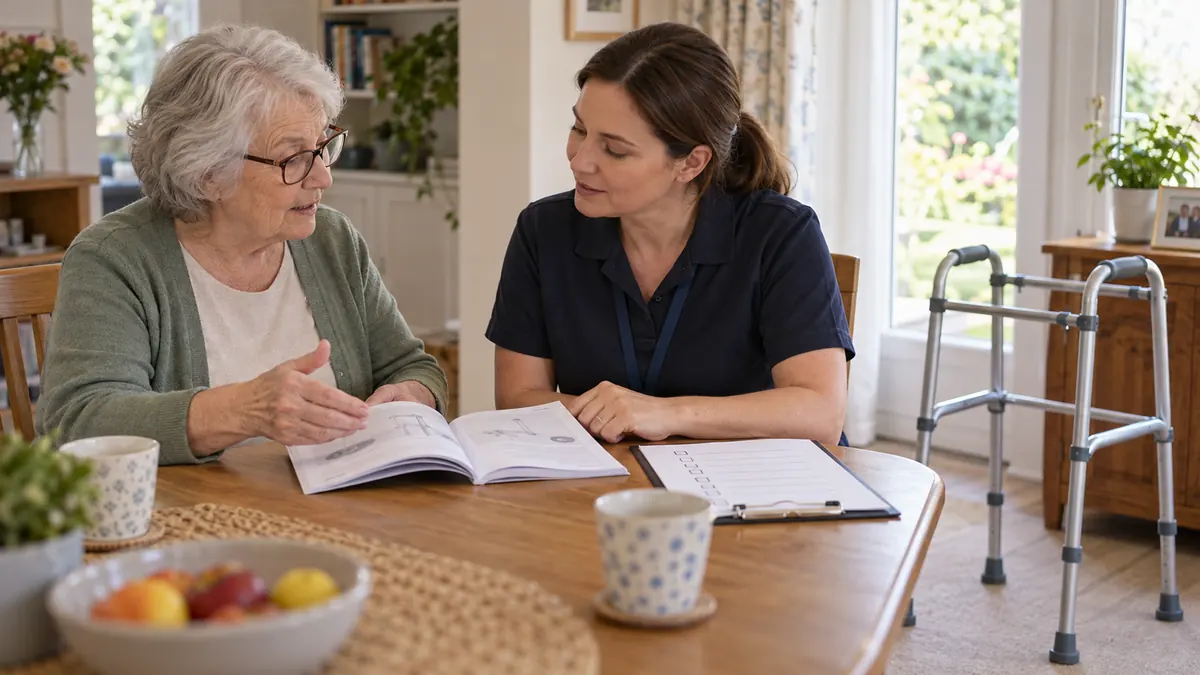
Home care equipment delivery is not the same as completed setup, individual fit review or user teaching. This guide helps you check what actually happened after a daily-living aid arrived: the supplied item, installation, fit/environment review, education, real answers, completed correction and remaining handover. It does not recommend a product or certify readiness to use it.
Start with seven essential handover checks, compare delivery with actual completion, read two fictional examples, or use the private equipment handover record. Existing paperwork and observations are enough. Do not perform a load test, difficult transfer or new movement to complete a record.
Immediate danger or serious symptoms come before supplier paperwork. Breathing difficulty, inability to wake normally, new confusion, bleeding that will not stop, head/spine injury or other serious acute symptoms require immediate medical help. Use local emergency services; call 911 for a U.S. emergency. Do not wait for a replacement delivery, repair appointment or completed checklist. MedlinePlus emergency guidance supports these selected examples; this is not a complete triage checklist.
For an apparent equipment fault, missing part, unstable arrangement or use problem, do not recreate the failure or improvise repairs or furniture substitutes. Obtain appropriate supplier and clinical guidance for the actual item and the care task that remains unsupported. This guide supplies no universal stop/unplug instruction, emergency transfer method, temporary substitute or safe waiting interval.
Scope: orthopedic daily-living aids, such as mobility, bathroom or transfer-related equipment, and their handover. This is not an operating guide for oxygen, ventilation, infusion or other life-support equipment. Actual product instructions, individual care restrictions and appropriate professional assessment remain necessary. The family-caregiver site operator is not a medical professional; no independent clinical review is claimed.
Table of Contents
Home care equipment: seven essential handover checks
| Check | Actual fact to retain | Keep the gap visible |
|---|---|---|
| 1. Intended item | Actual recommendation, task and instruction source. | Which product or component is still unconfirmed? |
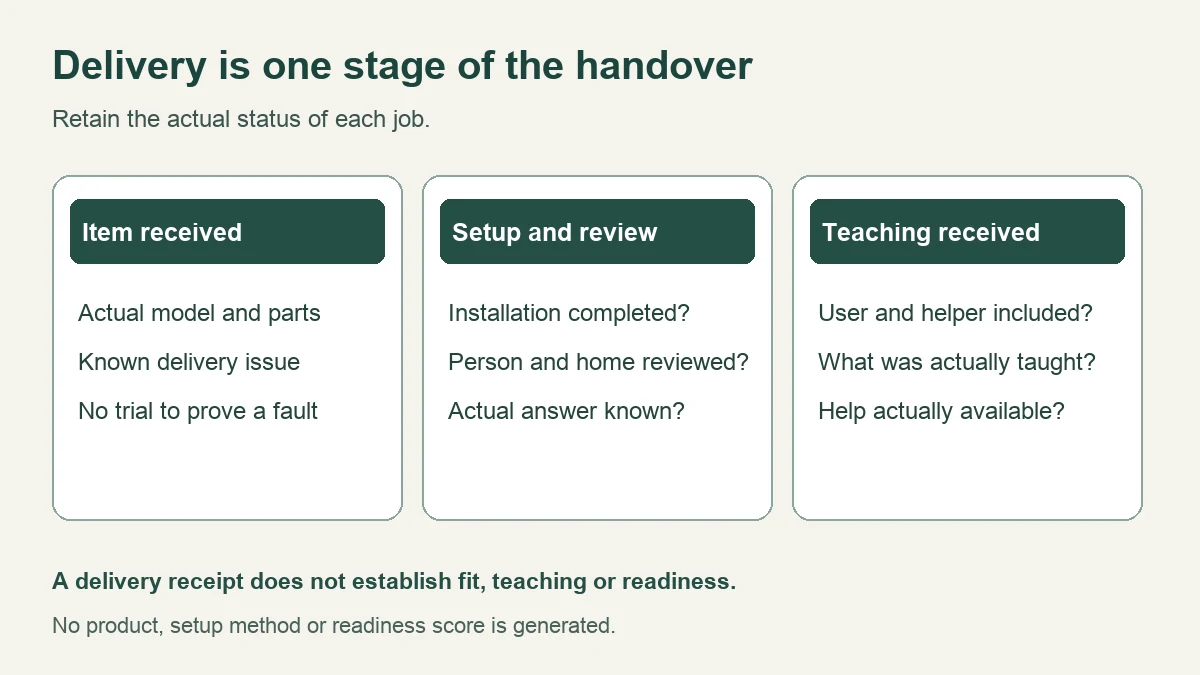
| 2. Delivery | Model and components actually supplied; already known damage or missing item. | Received does not mean correct or complete. |
| 3. Setup | Assembly/installation actually done and by whom. | A delivery receipt is not installation confirmation. |
| 4. Fit and environment | Actual review of the person, task and intended setting. | Assembly is not individual suitability. |
| 5. Teaching and help | Education actually received; assistance accepted and available. | A leaflet or appointment is not completed teaching. |
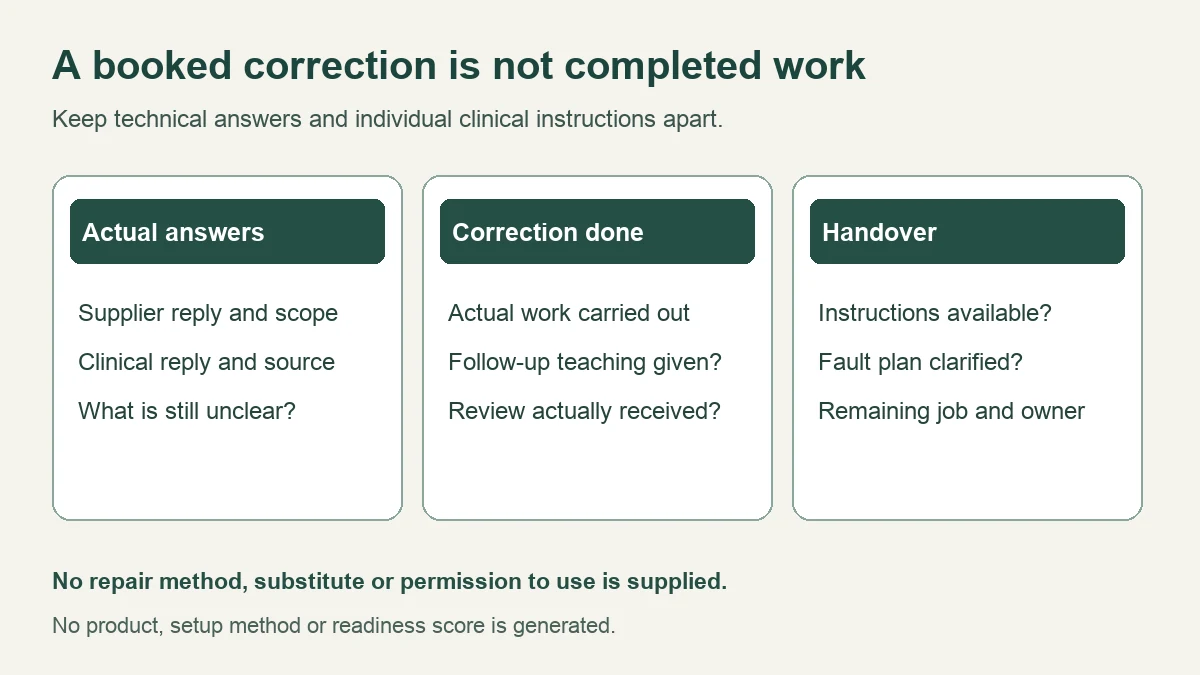
| 6. Real answers | Supplier and clinical replies, with source and scope. | A dispatch answer is not clinical clearance. |
| 7. Correction and handover | Correction actually carried out, follow-up education/review and remaining owner. | A repair booking is not completed correction. |
These checks organize facts and questions; they are not pass/fail points or a safety score. A completed-looking record cannot verify product match, fit or independent use. Unknown and pending are valid entries. Keep the person’s own concerns separate from a helper’s observation, and share with consent through the agreed private channel.
Compare delivery, setup, fit review, teaching and completed correction
| Stage | Record what actually happened | What it does not establish |
|---|---|---|
| Order accepted | Actual item or service arranged, as known. | That anything arrived. |
| Item delivered | Supplied model, parts and existing delivery issue. | Prescription match, assembly or installation. |
| Setup completed | Who actually assembled/installed what and what explanation was given. | Individual suitability or user competence. |
| Fit/environment reviewed | Actual professional review, scope and answer for the person/task/location. | Teaching or required help being available. |
| Teaching received | Who was taught, what was covered and which question remained. | Permission to use alone or to change restrictions. |
| Problem communicated | Actual concern, recipient and receipt/review if confirmed. | That a reply or correction happened. |
| Correction completed | Actual service action and follow-up review/teaching as supplied. | That every care task or support gap is resolved. |
| Handover updated | Current instructions, fault/maintenance contact and owner of remaining work. | A guarantee of safety or continuing service availability. |
Use separate entries when different events happened on different occasions. For example, the item may arrive before teaching, or an installation visit may leave a room-access issue unresolved. Preserve that partial status rather than marking every stage complete from one signature or conversation.
Confirm the supplied item and setup without turning unboxing into a test
Keep the actual recommendation or order description and the supplied model information already available. Record components and any problem already noticed. If the product name differs, ask whether the actual model and components match the recommendation. A package label alone proves neither match nor mismatch.
Describe the issue without engineering a demonstration: “This part appears absent,” “The item delivered differs from the wording I have,” or “Installation has not been confirmed.” Do not dismantle equipment, tighten unfamiliar parts, load it or attempt a transfer to prove a defect for the record.
Ask the supplying service what assembly or installation was included and what has actually been completed. Retain the actual answer, not an assumption based on the delivery method. A boxed item at the door and a completed home installation are different events. A technician’s visit may resolve setup while leaving individual-use questions open.
Keep the relevant instructions available in a form the intended user can understand. The FDA home-device checklist supports asking questions about operation, home suitability, instructions and problems. It is broad device education, not a model-specific assembly manual or personal equipment recommendation.
Separate individual fit, the actual home and the teaching received
A device can be assembled and still raise a question about the actual user, location or intended task. Ask who is responsible for assessing or clarifying that point in this service. Do not copy a height, clearance, weight limit or setup from another home or infer fit from a product photograph.
The NHS home-adaptations guide describes assessment around actual everyday difficulties and the home. This supports discussing the person and environment together. Its council pathways and funding rules are UK-specific; they do not establish U.S. access, payment or entitlement.
Record the actual review: who reviewed what, the explanation received, limitations and the unanswered question. A sales description, installation confirmation and individualized clinical advice have different scopes. If two instructions conflict, preserve both sources and ask the responsible service/team which applies; do not combine fragments into a new method.
Record education separately: was a leaflet supplied, was a demonstration actually given, and who received it? Ask what teaching remains for the intended user and helper. Any practice or teach-back involving the device should occur under appropriate professional guidance and actual restrictions, not as a self-test required by this webpage.
For physical assistance with moving someone, the NHS moving-and-handling guide supports training and relevant assessment. A helper’s willingness or presence does not establish that a task can be managed. Keep required help in the real plan; equipment arrival alone does not remove that need.
Keep supplier replies, clinical answers and correction jobs separate
| Question or job | What an actual answer may cover | What still needs clarification |
|---|---|---|
| Delivery/model/components | Supplied item, dispatch status or missing parts. | Whether the item matches the actual clinical recommendation. |
| Assembly/installation | Work actually performed and product-specific technical explanation. | Individual suitability and required assistance. |
| Use and care instructions | Actual model instructions, maintenance and fault contact. | Unclear or conflicting individual restrictions. |
| Person/task/environment concern | Appropriate review and actual clinical answer if received. | Any point outside the encounter or still unresolved. |
| Repair/replacement | Actual service arrangement and work completed. | Whether correction and any needed education/review actually occurred. |
| Coordination | Who accepted responsibility for the remaining task. | Whether that person/service has actually carried it out. |
The exact responsibilities vary by service. Ask who owns each job rather than assuming every supplier can give clinical clearance or every clinician controls dispatch. Attribute the real reply to its role and scope. An administrative acknowledgement should not be rewritten as professional assessment.
If a reply resolves one point, keep other issues open. The right model may still lack teaching. A replacement order may not address an inaccessible location. A repair visit may leave a new instruction unclear. One answered question is not a completed handover.
Describe the task left unsupported while a job is pending and ask the appropriate team for an actual interim plan. This guide chooses no furniture substitute, repair technique, movement method or reduction in care. Necessary care must not wait for a routine supplier reply or evidence that the equipment failed again.
Confirm correction actually happened and the remaining handover owner
Record the actual correction, person/service involved and any follow-up explanation or review. A date offered, booking accepted, item dispatched or promise to return is not the work completed. If completion is not known, leave it unconfirmed rather than inferring it from a closed message thread.
Ask which maintenance instructions, fault contact and backup arrangements apply to the actual item. Keep those actual answers separate from emergency clinical contact. The record does not generate cleaning intervals, inspection schedules or replacement deadlines. Use the real instructions and seek clarification when they cannot be followed.
If the person, task, home or required help changes, communicate that change to the relevant professional/service rather than assuming the earlier arrangement still applies. Record the actual response and what was really changed. No new movement trial or deliberate fault recreation is needed for this record.
This is a delivery-to-correction handover guide. The separate Comparing Home Care Equipment: Assessment Before Buying article concerns purchase-stage questions. This page does not rank products, calculate savings, compare caregiver hours or promise pain relief. Its purpose is to make unfinished handover work visible after an item is supplied.
Two fictional equipment handover writing examples
These examples are invented documentation, not verified patients, assessments, repairs or outcomes. Tool example buttons replace entries and label output fictional. Neither example establishes permission to use equipment or a safe time to wait.
Example A: delivered item, setup and teaching still unconfirmed
| Record category | Fictional entry |
|---|---|
| Recommendation / delivery | An item was reportedly arranged and arrived. Exact recommendation/model/components are not fully supplied here. |
| Setup / education | Installation completion and use teaching not confirmed. |
| Actual answers | Question prepared, not sent. No supplier or clinical reply supplied. |
| Correction / handover | No completed setup or correction claimed. Remaining owner and actual response unconfirmed. |
The record acknowledges delivery without claiming readiness. It does not ask the person to try the equipment while teaching is pending or invent a temporary workaround. The missing information is the actual setup/education response and what follows it.
Example B: correction booked, actual completion unknown
| Record category | Fictional entry |
|---|---|
| Setup / education | Setup reportedly completed and an explanation received; exact content not reproduced. |
| Existing issue | A person/task/environment difficulty remains; no fault or fit verdict invented. |
| Actual reply | Service offered a correction appointment. No clinical answer supplied. |
| Actual completion | Appointment arranged, correction not confirmed as carried out. No pain, safety or support outcome claimed. |
A clarification can read: “The appointment is booked, but the issue remains. What is the actual plan for the unsupported task, who owns the correction, and what review or teaching follows?” This avoids treating scheduling as resolution.
Private delivery, setup, teaching, answers and correction handover tool
Download the offline copy before entering actual health or care details. Use fictional notes on this page because surrounding ads and analytics may be present. The tool makes no network requests, uses no browser storage and does not automatically save. Its offline export has no external assets or automatic network requests.
Use one item or unresolved issue. Omit names, addresses, personal contact details, order/account numbers, access codes and full reports. Keep exports private. Blank fields create optional clarification questions, not equipment recommendations or readiness points. Paper with the same headings works; this record is never a prerequisite for help.
Delivery, setup, fit review, teaching, answers and correction record
Keep equipment received, setup, actual education, real answers and a completed correction separate.
Download the offline tool before entering actual health or care details. Use fictional entries here; surrounding ads and analytics may be present.
Offline copy. No ads, analytics, external assets or automatic network requests.
The tool makes no network requests, uses no browser storage and does not automatically save. Refreshing may lose entries. Omit identifiers, addresses, contact details, order/account numbers and access codes. Needed care must not wait for this record.
Start with the fictional example or download a blank offline copy.
Paper alternative: recommendation; delivery; setup; fit/environment review; teaching; assistance; issue; contact; supplier reply; clinical reply; actual correction; remaining handover.
My equipment delivery and correction handover record
Unverified personal record for discussion. Entries verify no setup, fit, teaching, correction or handover completion.
Guide: living.kioptrix.com/orthopedic-home-care-equipment/
Build, then copy, download text or print/save PDF. Editing hides the old result until rebuilt. Offline exports include current entries; refreshing/closing may lose unsaved notes. Filled fields remain unverified personal records. Nothing is sent, repaired, assessed or clinically cleared by the tool.
Common questions about home care equipment handover
Does delivery mean I can use the equipment?
Not by itself. Clarify the actual setup, individual instructions, education and required help; the page cannot clear use.
Who is responsible for fit?
Ask the actual service which qualified role owns the person/task/environment review. Do not assume a delivery visit included it.
Should I test a missing or unstable part?
No test is requested here. Report what is already known and obtain appropriate guidance; do not recreate a failure.
Does a repair booking close the issue?
No. Keep the actual work, follow-up education/review and remaining gap separate from the appointment.
Can equipment replace helper time?
Arrival or price cannot decide that required assistance is unnecessary. Keep actual help needs and professional instructions visible.
Does this apply to every home medical device?
No. It focuses on orthopedic daily-living aids and their handover, not operation or troubleshooting of life-support equipment.
Sources, image correction and editorial limits
Sources checked: October 30, 2026. This expansion preserves the earlier no-improvised-repair principle and adds separate handover stages, answers and actual correction status. The representative image no longer promises less pain, safer transfers or better days; it depicts a fictional discussion, not a fitting or transfer demonstration.
- FDA: Home Healthcare Medical Devices — A Checklist — broad device education, home suitability, instructions, maintenance and backup questions. It does not validate this worksheet, endorse a product or confirm personal fit.
- NHS: Home adaptations — assessment of actual daily difficulties and the environment; UK service/funding rules are not generalized to U.S. readers.
- NHS: Moving, lifting and handling someone else — hands-on help, training and assessment; not a universal installation or repair standard.
- MedlinePlus: Recognizing medical emergencies — selected warning examples and immediate help, not a full triage assessment.
The seven checks and workflow are editorial communication aids, not a validated readiness, fitting, repair or clinical decision instrument. No independent clinical review, direct product test, real patient success story or reader-outcome study is claimed. Actual device instructions, professional assessment and appropriate assistance remain necessary.