
Post-Surgery Appointment Guide
How to Choose Shoes for Medical Appointments
After Surgery
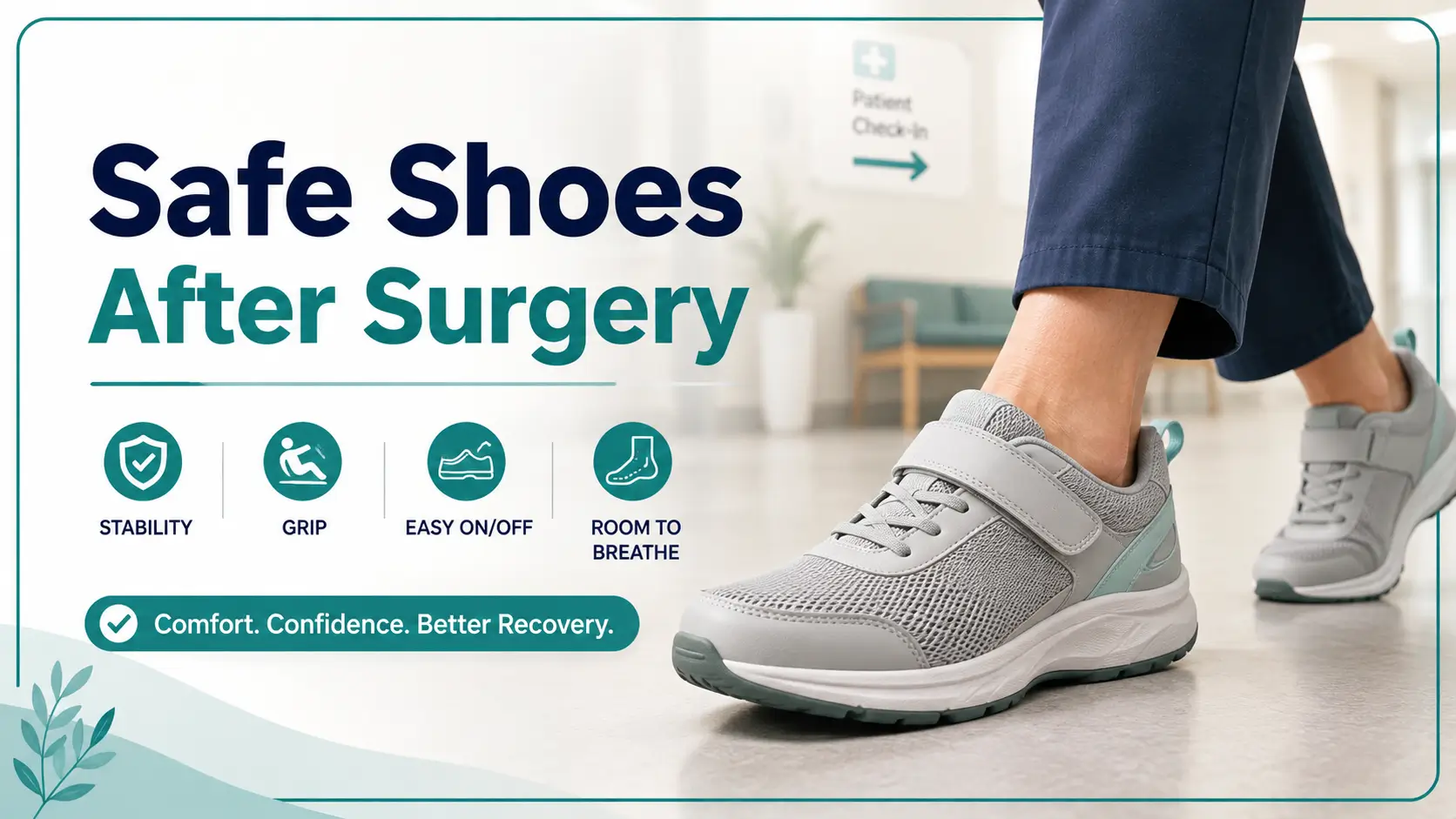
The safest appointment-day shoe is rarely the pair that simply feels softest. After surgery, your normal walking pattern may be temporarily rewritten by swelling, weakness, a brace, a walking aid, limited bending, or instructions about how much weight you may place through one leg.
That matters because a medical appointment is not just ten quiet minutes in an exam room. There may be a sloped parking lot, wet pavement, curbs, long corridors, standing at check-in, getting on and off an exam table, or the charming hospital tradition of placing radiology exactly three counties away from orthopedics.
This guide gives you a practical way to choose footwear without turning recovery into a shoe-shopping project. You will learn what features matter, which convenient-looking choices can backfire, how walking boots and mobility aids change the calculation, and when the problem is no longer something a different shoe should be expected to fix.
The goal is not the “perfect recovery shoe.” It is a shoe that creates fewer problems between your front door and the clinic. 👟
Snapshot
This guide is for adults attending follow-up appointments after orthopedic, abdominal, cardiac, spine, or other surgery when walking is permitted but may be slower or less steady than usual. By the end, you should be able to evaluate the shoes you already own, decide whether a different closure or fit would help, and know which questions belong with your surgical team rather than the shoe aisle.
Table of Contents
Before You Act
General footwear guidance cannot replace your discharge instructions, surgeon, physical therapist, or other treating clinician. A prescribed cast, postoperative shoe, walking boot, brace, weight-bearing restriction, or movement precaution should guide what you wear and how you travel. If your mobility or swelling has changed substantially since discharge, confirm the plan instead of trying to solve the change by squeezing into a different shoe.
For example, MedlinePlus advises patients recovering from knee replacement to use walkers or crutches as directed and to wear well-fitting shoes with nonskid soles rather than high heels or slippers. AAOS likewise emphasizes correct use of crutches, canes, and walkers when those devices are part of recovery.

Start With the Appointment, Not the Shoe
A five-minute clinic walk can be harder than it sounds
At home, you may move between a bed, bathroom, kitchen, and favorite chair using familiar surfaces and predictable furniture. A medical visit removes that familiarity. You may meet cracked pavement, automatic doors, polished floors, elevator thresholds, low waiting-room chairs, crowded corridors, and turns made while someone is talking to you.
That is why choosing shoes for a medical appointment after surgery should start with the journey rather than the brand, material, or style. The shoe is one small piece of a temporary mobility system that includes your body, any prescribed device, the environment, and the person helping you.
Estimate the real walking distance, including the annoying bits
Think through the trip from the car door to reception, not merely from the building entrance to the exam room. If you use a walker, the site’s guide to parking-lot safety with a walker can help you think through the outdoor portion before appointment day.
- How far is the likely parking space from the entrance?
- Will there be a curb, ramp, revolving door, or wet entrance mat?
- Could you need imaging, lab work, pharmacy pickup, or another department?
- Can you sit while checking in?
- Who will carry your bag, paperwork, or coat if both hands are needed for an assistive device?
- Is wheelchair assistance available if the distance exceeds what your clinical team has recommended?
Key takeaway
The safest shoe for fifty steps in your kitchen is not automatically the safest shoe for a half-hour outing with curbs, standing, turns, and transfers.
Who this guidance fits, and who needs individual instructions
This article is most useful when you have already been cleared to walk at the level needed for the appointment, whether independently or with a cane, crutches, or walker. If you are non-weight-bearing, wearing a cast or postoperative boot, or have substantial swelling or a dressing that prevents ordinary footwear, the surgeon’s specific plan comes first.
After ankle or foot injuries, for instance, MedlinePlus notes that patients may be restricted from bearing weight and may later use a special walking boot as healing progresses. If you are unsure whether your situation calls for a brace, boot, or ordinary shoe, review the differences in this ankle brace versus walking boot guide and then confirm the actual device with your clinician.

The 5 Shoe Features That Matter More After Surgery
1. A sole that grips without becoming another obstacle
Look for an outsole that gives you dependable contact with indoor flooring and outdoor pavement. Smooth, worn soles deserve more suspicion than they did before surgery, particularly if your stride is shorter or you are turning cautiously.
For older adults, CDC fall-prevention materials specifically include foot care and safe footwear among practical fall-risk considerations. The point is not that one magical tread pattern prevents falls. It is that footwear is part of the larger stability picture.
2. A heel that stays with your foot
When you lift your foot, the shoe should come with it rather than lagging behind. A secure heel counter or adjustable back can reduce the need to shuffle, curl your toes, or unconsciously work to keep the shoe attached.
This is one reason a backless house slipper can feel wonderfully easy while seated and strangely demanding once you cross a parking lot. Convenience at the moment of dressing should not create instability during the next hour.
3. Enough room for swelling, but not enough to slide
Extra room can be useful when swelling is present, but “bigger” is not the same as “safer.” Excess length can create heel movement, delayed foot control, or toe-catching. A shoe should accommodate the foot you have today without turning into a small boat.
4 and 5. A stable platform plus a closure you can manage
Favor a low, broad base that feels predictable underfoot. Very narrow heels, strongly elevated soles, or extremely soft platforms may demand more balance than you want to spend on appointment day.
Then consider the closure. Conventional laces can work perfectly when bending and hand use are unrestricted. Elastic laces, hook-and-loop straps, or other adjustable closures may be easier when reaching, hand strength, chest movement, or hip motion is temporarily limited.
| Feature | What to look for | What can go wrong |
|---|---|---|
| Outsole | Good contact and useful tread | Smooth or badly worn sole |
| Heel | Foot stays securely inside | Heel lifts or shoe flaps |
| Fit | Room for approved socks or swelling | Pinching or excessive sliding |
| Platform | Low and stable | Narrow, tall, or wobbly base |
| Closure | Adjustable without prohibited movement | Requires straining, twisting, or balancing |
Short Story: The shoe that was fine in the kitchen
Imagine a patient two weeks into knee-surgery recovery. At breakfast, a loose slip-on feels ideal. It goes on without much bending, the sole feels soft, and the walk from counter to table is uneventful.
At the clinic, the arithmetic changes. The shoe lifts slightly at the heel while stepping off a curb. Inside, the patient shortens each step to keep it attached. By the time radiology sends them down another corridor, the “easy” shoe is demanding constant attention.
The next visit, the patient wears a pair already owned, but with a secure heel, adjustable closure, and nonslip sole. Nothing about the shoe is exciting. That is precisely its charm.
The lesson is simple: post-surgery footwear should disappear into the background. If you are thinking about the shoe every third step, it may be asking too much of you.
The Swelling Trap: Your Morning Shoe May Not Fit Later
Fit the foot you have today, not the one you remember
Postoperative swelling varies by procedure, activity, time since surgery, medications, positioning, and individual recovery. That makes a fixed rule such as “buy one size larger” too crude to be useful.
A better approach is to assess the actual fit with the socks, compression garments, orthotics, dressings, or supports that your clinical team has approved. Do not loosen, remove, fold, or rearrange prescribed dressings simply to fit an ordinary shoe.
A pleasantly loose seated fit can become sloppy once you stand
Test the shoe while standing within your permitted activity level. Check whether the heel moves, whether your toes are forced forward, and whether swelling creates pressure around the upper or closure.
The 30-second fit check
- Wear the exact approved socks, support, or dressing planned for the visit.
- Secure the shoe without forcing the foot inside.
- Stand with your usual prescribed walking aid if applicable.
- Take several safe steps on a dry, uncluttered surface.
- Stop if you notice painful pressure, substantial heel slip, or a new feeling of instability.
Before buying new shoes just for swelling
First check whether an adjustable pair you already own can accommodate the current setup safely. Temporary recovery is a poor time to spend heavily on footwear that may fit for only a short phase.
| Approach | Best when | What to verify |
|---|---|---|
| Use an existing shoe | Fit, traction, and closure already work | No new pressure or heel slip |
| Adapt an existing shoe | Only the closure is difficult | Elastic laces or another aid still secures the foot |
| Buy a different shoe | Current footwear cannot safely accommodate approved swelling or access needs | Return policy, adjustable fit, heel security, outsole, and ease of entry |
When shopping is necessary, treat adjustability and returnability as valuable features. Your postoperative foot may change faster than your taste in shoes does.
6 Shoe Choices That Can Complicate the Trip
Backless, loose, or elevated footwear deserves extra scrutiny
- Backless slippers: easy to enter, but the foot may need to work harder to keep them on.
- Flip-flops: loose attachment and foot movement make them a poor match for cautious postoperative walking.
- Loose sandals: straps that do not hold the heel securely can shift during turns.
- High heels: elevated, narrow bases add unnecessary balance demands.
- Shoes that are too tight: these can become uncomfortable as swelling changes.
- Oversized shoes: extra room can create sliding rather than useful accommodation.
MedlinePlus guidance for knee-replacement discharge specifically advises well-fitting footwear with nonskid soles and says to avoid high heels and slippers during recovery.
Brand-new shoes create an experiment you do not need
Appointment day is a poor time to discover that a seam rubs, the tongue presses on swelling, or a closure is surprisingly difficult with one hand. If you do buy something new, test it at home within your activity restrictions before making it part of a longer outing.
Soft is not automatically stable
Softness can feel comforting, especially when you are sore. But a shoe can be cushioned and still allow too much side-to-side movement or feel vague underneath the foot. Comfort and stability belong in the same conversation.
The appointment-day footwear filter
Bending Hurts: Choose Shoes You Can Actually Put On
Sometimes the foot is fine. Reaching it is the problem.
After hip, spine, abdominal, chest, shoulder, or other surgery, the hardest part of footwear may be getting your hands to your feet. A perfectly supportive lace-up shoe is not very practical if putting it on requires an awkward one-legged stance, forceful bending, or twisting that you were told to avoid.
For some hip and knee surgery patients, MedlinePlus recommends dressing aids such as long-handled shoehorns and elastic shoelaces to reduce bending.
If hip precautions are part of your recovery, this site’s guide to putting on socks after hip surgery addresses the same everyday access problem.
Elastic laces, straps, slip-ons, and ordinary laces each have a job
| Closure | Potential advantage | Check before using |
|---|---|---|
| Traditional laces | Highly adjustable and secure | Can you reach and tie them safely? |
| Elastic laces | May reduce repeated tying | Do they still hold the heel securely? |
| Hook-and-loop straps | Easy adjustment for changing fit | Can the strap close without compressing swelling? |
| Slip-on with secure heel | Fast entry | Does it stay attached during walking? |
| Backless style | Very easy entry | Often trades access for foot retention |
A simple dressing aid may beat buying another pair
A long-handled shoehorn, sock aid, reacher, or help from a caregiver may solve the real problem at far lower cost than replacing otherwise suitable shoes. The right answer is sometimes a $0 change in technique, not a premium pair of “recovery” footwear.
Key takeaway
If putting a shoe on makes you hold your breath, twist toward the surgical area, balance on one leg, or repeatedly reach farther than your instructions allow, solve the dressing problem before blaming the shoe itself.
Review MedlinePlus Hip-Recovery Guidance
Walking With a Cane, Walker, or Crutches Changes the Equation
When your hands are busy, small footwear problems become larger
Using a walker or crutches means your attention and upper body are already participating in every step. A slipping heel, loose sole, or unpredictable surface under one foot becomes one more task competing for your concentration.
AAOS provides specific instructions for using crutches, canes, and walkers, including walking and stair techniques. If a walker is part of the appointment, this walker appointment checklist can help you prepare the device, belongings, and trip rather than thinking about footwear in isolation.
Match footwear to the slower postoperative gait
Recovery walking often involves shorter steps, more deliberate turns, and careful sit-to-stand transfers. You want footwear that behaves predictably during those slow movements, not a shoe that only feels secure when walking briskly.
The overlooked problem: one side may suddenly be taller
A walking boot or thick postoperative device on one side can alter how level you feel. Do not improvise a homemade lift or stack inserts on the other side without guidance. Ask the surgical or rehabilitation team whether a balancing strategy is appropriate for your specific device, leg, and stage of recovery.
Walking-aid departure check
- The aid is adjusted and used as instructed.
- Both footwear and mobility device contact points are dry and in good condition.
- Your bag can be carried without taking a hand off the device unexpectedly.
- You know where you can sit between the car and the clinic if needed.
- A companion knows whether you need physical help or simply extra time.
Show me the nerdy details
Postoperative footwear affects several small mechanical tasks at once: friction between outsole and floor, control of the heel inside the shoe, the width and height of the support surface, the amount of movement allowed inside the upper, and the effort needed to clear the foot during swing.
That is why “comfortable” is too broad a criterion. Two shoes may feel equally soft while one lets the heel move, has a badly worn outsole, or requires more toe gripping to stay attached. After surgery, reducing unnecessary tasks can matter more than maximizing softness.
Foot, Knee, Hip, Spine, and Abdominal Surgery Need Different Priorities
Foot or ankle surgery: the prescribed device wins
If your surgeon has prescribed a postoperative shoe, boot, cast, or specific weight-bearing status, ordinary shoe-selection advice does not overrule it. The first question is not “Which sneaker is best?” It is “What am I permitted to wear and how am I permitted to load this foot?”
Knee surgery: prioritize grip, swelling room, and easy entry
A knee that is stiff or weak can make standing on one leg to put on the opposite shoe particularly unhelpful. Sit on a stable surface if that matches your instructions, use the dressing method your rehabilitation team taught you, and avoid turning shoe application into an unsolicited balance test.
AAOS notes that falls in the early weeks after total knee replacement can jeopardize the new joint and recommends assistive support until balance, flexibility, and strength improve.
Hip surgery: bending rules may decide the closure
Some hip-replacement recovery instructions restrict particular movements during dressing, depending on the surgical approach and individual plan. MedlinePlus describes the use of reachers, long-handled shoehorns, elastic shoelaces, and sock aids for some patients.
Follow the precautions you were actually given rather than borrowing someone else’s rules from a forum, friend, or previous generation of surgical advice.
Spine, abdominal, or cardiac recovery: access may matter more than the foot
If bending, twisting, breath-holding, or forceful reaching is uncomfortable or restricted, an easy-entry closure can be valuable even though the operation was nowhere near your feet. The useful question becomes, “Can I put this on while respecting my movement instructions?”
Do not modify the medical plan to fit the shoe
Never remove or rearrange a prescribed brace, dressing, splint, or compression garment merely because your preferred shoe will not fit over it. Ask what footwear or device is appropriate instead.
The Night-Before Shoe Test
Put on the complete appointment-day setup
Wear the clothes, approved socks, brace, compression garment, and footwear you expect to use. Bring out the cane, crutches, or walker too. Testing a shoe without the rest of the system can hide exactly the conflict you want to discover at home.
- Sit or stand for dressing according to your recovery instructions.
- Put the shoes on without rushing.
- Check for painful pressure, crowding, or heel movement.
- Walk a short, safe route within your permitted activity level.
- Make one or two careful turns.
- Sit down and stand again using the method you have been taught.
- Remove the footwear and check whether it was unusually difficult to take off.
The 60-second doorway test catches most practical mistakes
At minimum, ask four questions: Does the heel stay put? Is there adequate room? Does the sole grip? Can I put the shoe on without prohibited or painful movement?
Then zoom out to the rest of the visit. The site’s orthopedic appointment checklist can help you prepare questions, documents, medication information, and logistics so shoe choice does not consume all your preparation time.
Pack a Plan B, but do not create a mobile shoe closet
If your swelling fluctuates and your clinical team has approved more than one footwear option, having an alternative in the car may be reasonable. The backup should also meet the same stability and restriction requirements. “Plan B” should not mean an old pair of floppy slippers rescued from the trunk.
| Good | Better | Best for a more complex trip |
|---|---|---|
| Stable familiar shoe that passes the doorway test | Stable shoe plus suitable dressing aid or adjustable closure | Clinician-approved footwear plus mobility aid, route plan, and companion help when needed |
| Best for straightforward recovery | Useful when bending or swelling complicates dressing | Useful when walking distance, balance, or medical restrictions add complexity |
See CDC Fall-Prevention Resources
When Footwear Is Not the Problem Anymore
New weakness, numbness, or inability to walk as expected deserves attention
If your mobility is suddenly worse than it was, a shoe change should not become a substitute for medical guidance. Contact the surgical team according to your discharge instructions when you develop a significant or unexpected change in strength, sensation, weight-bearing ability, or function.
Rapidly changing swelling or a suddenly painful fit is a different problem
Do not force a swollen foot into a shoe simply because you need to leave for the appointment. If swelling has changed substantially or is accompanied by symptoms your discharge paperwork identified as concerning, contact the surgical team or seek the level of care you were instructed to use.
Repeated near-falls are useful information, not something to hide
If you keep losing balance, catching your foot, or grabbing furniture, tell the clinician. The answer may involve a mobility assessment, assistive-device adjustment, rehabilitation plan, medication review, or another factor beyond footwear.
For broader context, see this guide to fall risk in older adults. CDC also identifies poor footwear among multiple factors that can contribute to fall risk in older adults.
Key takeaway
A shoe can solve fit and traction problems. It cannot diagnose or safely explain a sudden change in postoperative mobility.

FAQ: Choosing Shoes After Surgery
What shoes are easiest to wear to a doctor’s appointment after surgery?
For many patients who are permitted to wear ordinary footwear, a stable low-profile shoe with a secure heel, nonslip outsole, adequate room, and a closure that can be managed without difficult bending is a practical choice. Your surgical restrictions still come first.
Are slip-on shoes safe after surgery?
They can be appropriate if they hold the heel securely, fit correctly, provide useful traction, and do not interfere with a brace or dressing. “Slip-on” describes how the shoe goes on, not how securely it behaves once you are walking.
Should postoperative shoes be one size larger because of swelling?
Not automatically. Swelling varies, and simply buying a longer shoe may create heel slip or excess movement. Look for adequate room and adjustability, and ask your clinical team what to use if swelling or dressings prevent normal footwear.
Can I wear sneakers to a surgical follow-up appointment?
Often, yes, if ordinary shoes are permitted and the sneakers fit the postoperative foot, grip well, remain stable, and can be put on without violating precautions. A familiar pair that already works can be preferable to untested new footwear.
What shoes work best when using crutches or a walker?
Look for secure heel retention, reliable traction, a stable low sole, and predictable fit. Because your hands and attention are already involved in using the device, avoid footwear that requires shuffling or frequent adjustment.
What should I wear if I cannot bend down to tie shoes?
Ask whether elastic laces, hook-and-loop closures, a secure slip-on, long-handled shoehorn, sock aid, or caregiver assistance fits your restrictions. A dressing aid may allow you to keep using stable footwear you already own.
Can I wear my normal shoe with a walking boot on the other foot?
Ask the clinician or rehabilitation professional managing the boot. The difference in sole height may affect how level you feel, and any balancing strategy should match the prescribed device rather than being improvised.
Should I buy new shoes before surgery or wait until afterward?
If you already own stable, easy-to-manage footwear, buying something new may be unnecessary. When possible, discuss postoperative footwear before surgery if you know you will have a boot, dressing, or movement restriction. Otherwise, waiting to see your actual recovery needs can prevent waste.
What if no regular shoe fits over postoperative swelling or a dressing?
Do not alter the dressing to make a regular shoe fit. Contact the surgical team and ask what approved postoperative footwear or mobility arrangement you should use for the appointment.
Your 15-Minute Next Step Before Appointment Day
You do not need to solve postoperative footwear with a shopping spree. Tonight, take the pair you are most likely to wear, add the exact approved socks, brace, compression garment, or support, and test the full setup within your permitted activity level.
Your four-point doorway test
Heel: Does the shoe stay securely attached?
Room: Is there space for the approved recovery setup without painful pressure?
Grip: Does the outsole feel predictable on a clean, dry walking surface?
Access: Can you put it on and remove it without prohibited bending, twisting, or unsafe balancing?
If all four answers are yes, you may already own the right appointment shoe. Then spend the rest of your preparation on things that matter just as much: the route, your walking aid, transportation, questions for the clinician, and any notes about how recovery has changed since your last visit. The orthopedic appointment notes guide can help organize that final piece.
If you have a cast, boot, brace, major swelling, unusual difficulty walking, or weight-bearing restriction, skip the guesswork and ask one clean question: “What footwear or mobility setup should I use to get from the car to my appointment?”
That question is small, but useful. Recovery is already asking your body to solve enough problems. Your shoes do not need to add another one.
Review AAOS Walking-Aid Guidance
Last reviewed: 2026-09