

Post-surgery night pain guide
When Night Pain Should Be Reported After Surgery
and when not to wait until morning
Night changes the sound of pain. The house goes quiet, the clock gets rude, and a sore incision can suddenly feel like the only thing in the room. After surgery, some nighttime discomfort is expected. What matters is whether the pain is following the recovery pattern you were told to expect, or whether it has become new, sharper, wider, more stubborn, or paired with other warning signs.
This guide is built for the patient awake at 2:17 a.m. and the caregiver standing in the hallway wondering whether to call. It will help you sort normal healing pain from symptoms worth reporting tonight, describe the problem clearly, and avoid common medication and wound-care mistakes that can muddy the picture.
It is not a diagnosis machine. It is a calm decision aid: headlights on, hands steady, no heroic guessing. When symptoms are severe, rapidly changing, or tied to breathing, chest pain, confusion, uncontrolled bleeding, wound opening, infection signs, or one-sided leg swelling, the safest move is to contact the right medical help promptly.
Know the line
Separate expected soreness from reportable pain pattern changes.
Call with clarity
Use a 60-second script that gives the on-call team useful details fast.
Avoid costly mistakes
Spot medication, wound-care, and delay traps before they become expensive problems.
If pain feels suddenly worse, uncontrolled, or paired with red flags, do not treat the night like a waiting room. 🌙
Snapshot
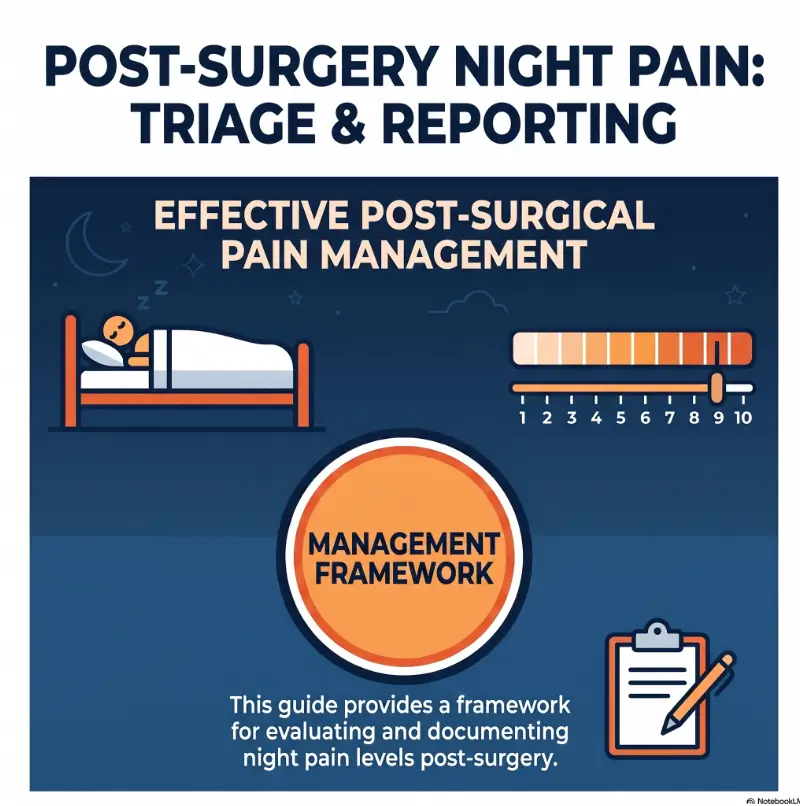
This article is for adults recovering at home after surgery and caregivers deciding whether night pain should be reported. You will learn which symptoms deserve urgent attention, what information to gather before calling, which common mistakes to avoid, and how to make a one-minute pain report that helps the surgical team make a safer decision.
Table of Contents
Before You Act: Night Pain Is a Signal, Not a Diagnosis
This article can help you decide what to report and how urgently to report it. It cannot examine your incision, measure your circulation, check your oxygen level, review your medication interactions, or know what your surgeon saw in the operating room.
That matters because postoperative pain has context. A dull ache after knee replacement, a burning pull after shoulder surgery, and deep belly pain after abdominal surgery do not carry the same meaning. Your procedure, age, health history, anesthesia, medication plan, and discharge instructions all change the decision.
Use your discharge papers first. If your paperwork says to call for a symptom, call. If your symptoms are severe, rapidly changing, or frightening in a way you cannot explain, it is reasonable to seek urgent help rather than trying to prove you are “not overreacting.” Recovery is not a courtroom.
Key takeaway
Report night pain after surgery when it is new, suddenly worse, not controlled by prescribed medicine, spreading, linked with fever or chills, paired with wound changes, or connected to chest pain, shortness of breath, confusion, weakness, calf swelling, numbness, or a pale, blue, cold, or unusually swollen limb.
Use the right level of help
Most surgical practices have an after-hours number. Some discharge packets also list a nurse line, urgent care instructions, or reasons to go directly to the emergency department. Keep those numbers visible, not buried under insurance papers and pharmacy receipts.
For US readers, call 911 for symptoms that feel immediately dangerous, such as severe chest pain, trouble breathing, fainting, signs of stroke, severe confusion, or uncontrolled bleeding. In the UK, use emergency services for the same level of immediate danger and follow your discharge instructions for surgical team contact.
Caregivers should report patterns, not just pain scores
A caregiver may notice what the patient cannot: new confusion, unusual sleepiness, a wound that looks angrier than yesterday, a foot that feels cold, or a pain pattern that has changed from “sore but manageable” to “something is wrong.” Those observations are useful. Write them down before the call.
If you are helping an older parent, the guide on signs a parent needs more help after surgery can help you notice broader recovery problems beyond pain alone.
Night Pain After Surgery: The Normal vs Reportable Line
Normal postoperative pain usually has a rhythm. It may rise when medication wears off, when swelling builds during the day, when you move awkwardly, or when you finally lie still and notice every little signal. Annoying? Absolutely. Automatically dangerous? Not always.
Reportable pain is different. It breaks the expected pattern. It gets suddenly worse after it had been improving, spreads beyond the surgical area, ignores the medication plan, or appears with warning signs like fever, chills, drainage, spreading redness, wound opening, chest symptoms, breathing trouble, calf swelling, numbness, weakness, or confusion.
Expected pain usually follows a pattern
After many surgeries, pain is often strongest in the first few days, then slowly becomes easier to manage. It may still flare when you change position, cough, use the bathroom, start physical therapy, or miss a dose window.
A stable pattern might sound like this: “My pain is usually a 4 at rest and a 6 when I move. It settles after medication and has been slowly improving.” That sentence gives your surgical team something to work with.
Reportable pain breaks the pattern
A reportable pattern sounds more like this: “It was improving, but tonight it jumped from a 4 to an 8, the incision is more swollen, and I have chills.” That is not just a pain number. That is a change in the story.
Another reportable pattern: “The medication used to help for four hours, but now it barely helps at all.” If you are taking medicine exactly as prescribed and pain is still escalating, that deserves attention.
The 3-question filter: worse, weirder, or wider?
When you are tired and unsure, ask three simple questions:
- Worse: Is the pain suddenly more intense than it was earlier today or yesterday?
- Weirder: Does it feel different, such as crushing, burning, electric, deep, tight, or associated with numbness?
- Wider: Is it spreading beyond the incision, into the calf, chest, abdomen, back, or a whole limb?
One “yes” does not always mean an emergency. But one “yes” plus fever, wound changes, breathing symptoms, one-sided leg swelling, weakness, confusion, or poor medication response is a stronger reason to call tonight.
Night pain decision flow
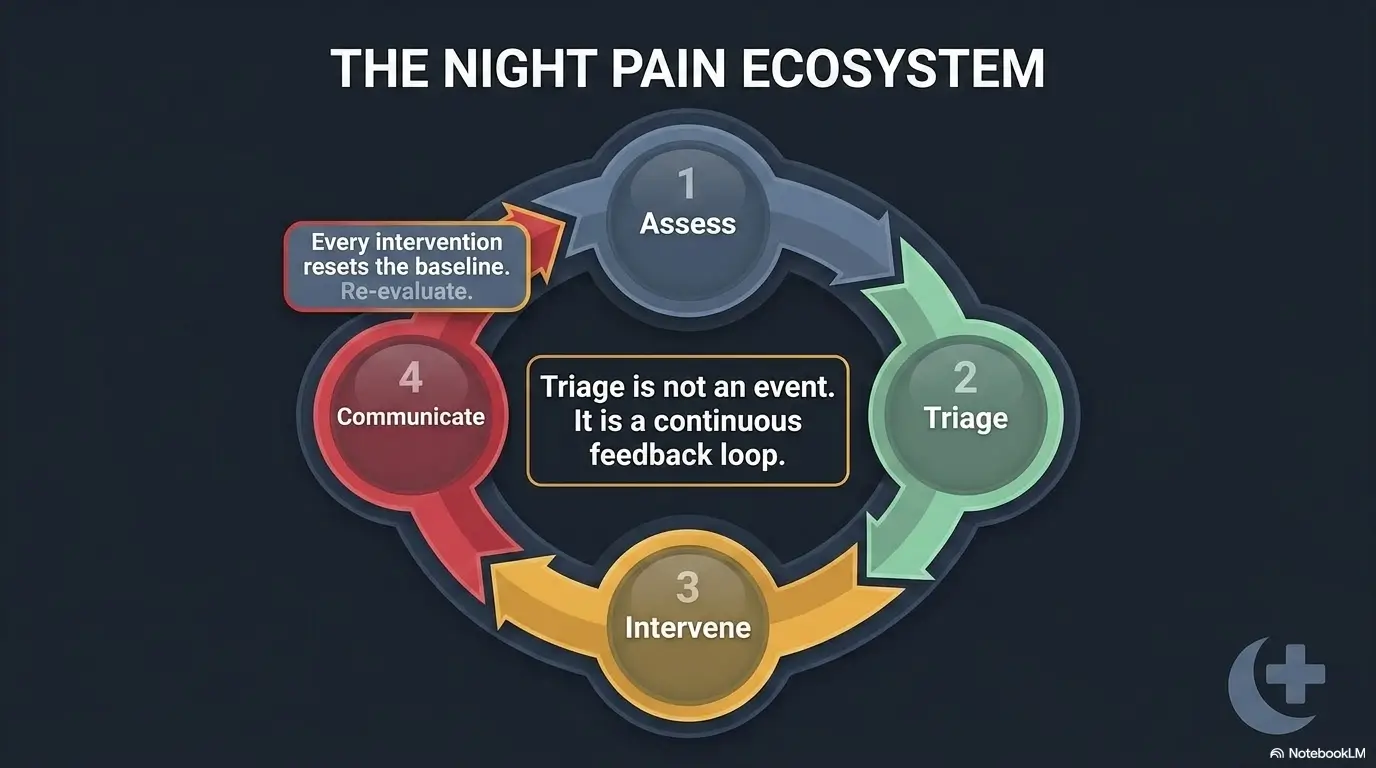
The 5-check midnight map
1. Danger
Chest pain, breathing trouble, fainting, severe confusion, stroke signs, uncontrolled bleeding.
2. Pattern
Suddenly worse, new, wider, or no longer controlled by the plan.
3. Wound
Redness, warmth, pus-like drainage, foul odor, wound opening, swelling.
4. Medicine
Check timing, dose, missed doses, and unsafe mixing before guessing.
5. Call
Emergency care now, surgeon line tonight, or office-hours follow-up.
The Pain Pattern Shift That Should Make You Call
The single most useful word in postoperative pain reporting is “change.” Your care team wants to know not only how bad it is, but how it compares with your recent baseline.
A pain score is a snapshot. A pain pattern is the movie. The movie helps the clinician decide whether this sounds like normal healing, a medication issue, a wound problem, nerve irritation, clot concern, bleeding, infection, or another complication that needs evaluation.
Pain that suddenly spikes after improving
If pain had been getting better and then suddenly becomes much worse, report that clearly. This is especially important if the spike follows no obvious cause, such as a fall, missed medication dose, unusually hard therapy session, or accidental strain.
Example: “I was doing better for three days, but tonight the pain abruptly doubled and the area feels tight and swollen.” That is a different call than “I overdid my exercises and feel sore.”
Pain that wakes you repeatedly despite medication
Night waking by itself can happen after surgery. But repeated waking despite taking prescribed medication correctly is worth reporting, especially if the pain is worsening or paired with new symptoms.
Before you call, check the schedule. Did you take the medicine at the time prescribed? Did you skip a non-opioid medicine your doctor told you to use? Did you accidentally stretch a four-hour plan into eight hours because you finally fell asleep? The answer helps the on-call team decide whether this is uncontrolled pain or a timing problem.
Pain that spreads beyond the incision or surgical area
Pain that stays near the expected surgical area is usually easier to interpret. Pain that spreads deserves more caution. Calf pain after surgery, chest pain, new belly pain, new back pain, or pain traveling with numbness or weakness should not be brushed aside.
If you already keep a recovery note, update it. The guide on using a pain flare trigger log can help you separate a predictable activity-related flare from a symptom pattern that needs a call.
Timing matters more than people think
“It hurts tonight” is useful. “It started two hours ago, one hour after my last dose, and it is worse than yesterday” is far more useful.
Write down the time the pain changed, what you were doing, when you last took each medication, your temperature, and any wound or limb changes. In a half-awake call, paper beats memory. Memory at 3 a.m. tends to wear socks on its hands.
Key takeaway
When calling about night pain, lead with the pattern: what changed, when it changed, whether medicine helped, and what other symptoms appeared. A pain score alone is too thin to steer the ship.
Fever Plus Pain: The Combination to Respect
Fever and worsening pain after surgery belong in the same sentence. One can be harmless in some situations, but together they deserve attention, especially when wound redness, swelling, drainage, chills, or a foul odor enters the room.
Do not try to diagnose an infection at home. Instead, report the combination. Your job is not to solve the medical mystery. Your job is to send up the right flare.
Fever, chills, and wound pain belong together
If you have a temperature reading, write the number down. If you took fever-reducing medicine, write down when. If you have chills, shaking, unusual sweating, or feel suddenly unwell, include that too.
Wound pain that does not improve after prescribed medicine, especially with fever or chills, should be reported. The American College of Surgeons offers patient guidance on surgical wound warning signs, including pain or pressure not controlled by medication, increased redness, swelling, drainage, and possible wound separation.
Why “I’ll sleep it off” can be risky
Sleep is healing. Delay is not always healing. If pain is suddenly worse and paired with fever, chills, wound drainage, spreading redness, confusion, or weakness, waiting until morning can make the situation harder to treat if a complication is developing.
This does not mean every mild temperature or sore incision is an emergency. It means the combination of worsening pain plus systemic symptoms should be treated with respect.
What to write down before calling
- Your surgery type and date.
- Your current temperature and when you measured it.
- Your pain score now and earlier today.
- Medication name, dose, and time taken.
- Whether the incision has redness, warmth, swelling, odor, drainage, or opening.
- Whether you have chills, shortness of breath, chest pain, calf swelling, confusion, or weakness.
For a longer documentation routine, pair this with a doctor visit summary template for caregivers. A caregiver who tracks symptoms cleanly can save the whole family from the fog machine of “I think it started yesterday?”
Wound Pain Clues: When the Incision Is Talking Too Loudly
An incision can look dramatic and still be healing normally. Bruising, mild swelling, tightness, and tenderness may be expected depending on the procedure. But certain wound changes should be reported, especially when they come with worsening pain.
The Centers for Disease Control and Prevention lists redness and pain around the surgical area, cloudy fluid draining from the wound, and fever among possible surgical site infection symptoms. That does not mean you should diagnose yourself from a mirror. It means these details belong in the call.
Spreading redness around the incision
A small rim of irritation can happen. Redness that spreads outward, gets hotter, becomes more swollen, or grows along with pain is more concerning.
One practical trick: if your care team allows it, take a clear photo in the same lighting each day. Do not press on the wound or remove dressings against instructions. A photo can help show whether redness is stable or spreading.
For a simple photo routine, see how to take orthopedic visit photos. The same principles can help with postoperative wound photos when your surgeon permits them.
Cloudy fluid, pus-like drainage, foul odor, or new drainage
Some drainage can be expected after certain procedures, especially early on. But drainage that becomes cloudy, thick, pus-like, foul-smelling, increasing, or new after a dry period should be reported.
Describe drainage plainly: color, amount, smell, timing, and whether it soaked a dressing. Avoid vague phrases like “gross” or “bad.” The surgical team needs the boring details. Boring details are gold with hospital socks on.
Wound edges pulling apart
If wound edges appear to be separating, follow your discharge instructions and contact your surgical team promptly. If there is uncontrolled bleeding, visible deep tissue, or a severe opening, seek urgent care according to your discharge plan or emergency instructions.
Do not try to close a wound yourself with household tape, glue, or extra pressure unless your care team has told you exactly what to do. A kitchen-drawer repair plan is not a medical plan.
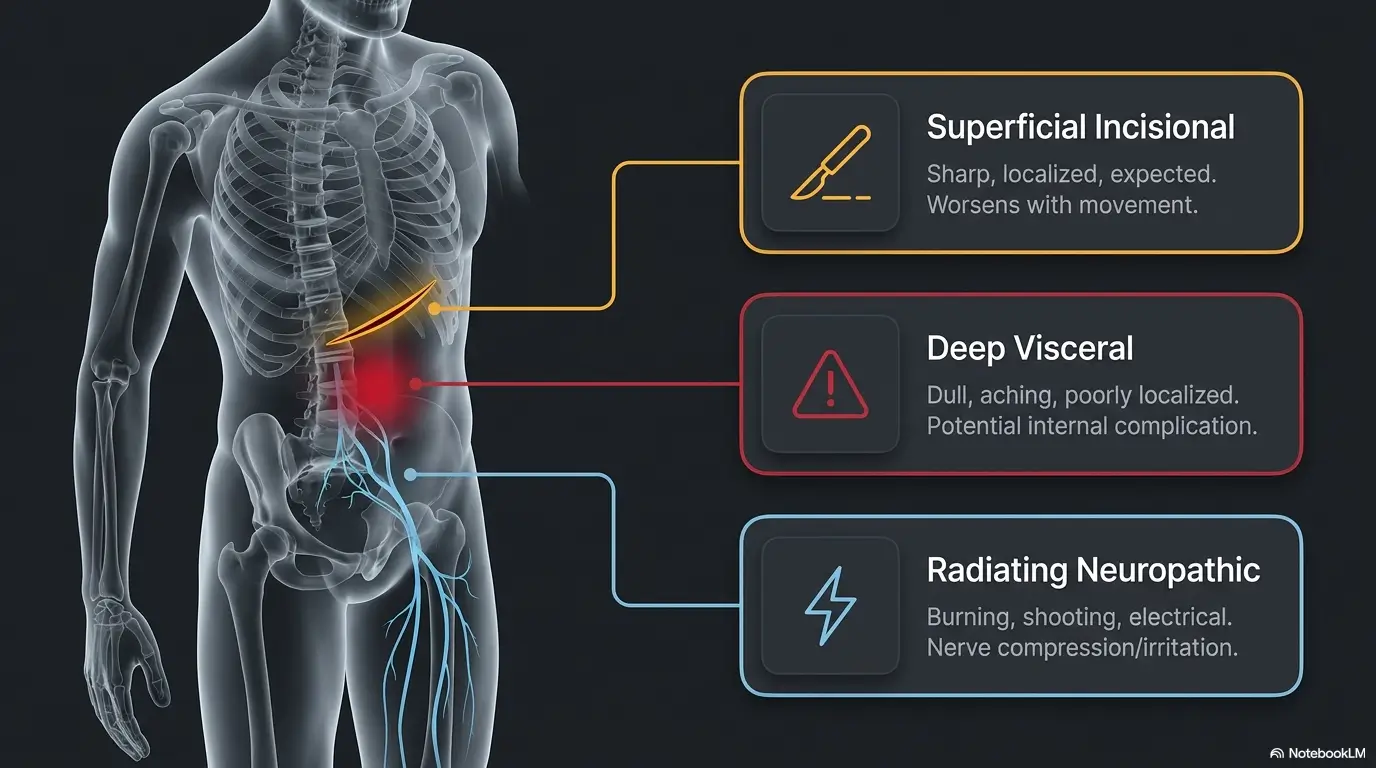
Pain that feels deeper than the skin
Incision tenderness often feels surface-level. Pain that feels deep, pressurized, rapidly tightening, or dramatically worse with swelling deserves a call, especially after orthopedic, abdominal, vascular, or complex reconstructive procedures.
Say what you feel without trying to name the diagnosis: “deep pressure,” “tight swelling,” “burning,” “electric,” “pulling,” “throbbing,” or “crushing.” The words help.
| Wound clue | What to notice | Why to report it |
|---|---|---|
| Spreading redness | Red area growing, hotter skin, more swelling | Can help the team assess possible infection or inflammation |
| New drainage | Cloudy, thick, pus-like, foul-smelling, or soaking dressing | Drainage changes can matter more than pain score alone |
| Wound opening | Edges pulling apart, bleeding, deeper tissue visible | May need direct wound-care instructions or urgent evaluation |
| Deep pressure pain | Tight, expanding, or sharply worse pain under the skin | Can signal swelling, bleeding, or another issue that needs triage |
Show me the nerdy details
Pain after surgery is interpreted through clusters, not single clues. Worsening pain plus fever suggests a different concern than stable pain without fever. Incision pain plus spreading redness suggests a different concern than soreness after physical therapy. Calf pain plus one-sided swelling suggests a different concern than both legs feeling tired after walking. The more clearly you describe the cluster, the less the on-call team has to guess.
That is why a good call report includes timing, trend, medication response, visible changes, and associated symptoms. It turns a blurry “something hurts” into a usable triage picture.
Leg, Chest, Breathing, or Confusion: Do Not Gamble With These
Some postoperative symptoms should push you out of the “wait and see” mindset. Chest pain, trouble breathing, fainting, severe confusion, one-sided leg swelling with pain, new weakness, or a limb that looks pale, blue, cold, numb, or severely swollen deserves urgent attention.
This section is not here to frighten you. It is here because serious complications can be time-sensitive, and night is when people talk themselves into silence.
Calf pain with swelling or warmth
Calf soreness can happen after surgery from positioning, altered walking, physical therapy, or muscle strain. But calf pain with one-sided swelling, warmth, redness, tenderness, or sudden shortness of breath should be reported urgently.
MedlinePlus describes deep vein thrombosis symptoms as including swelling, warmth, redness, and pain or tenderness in a leg or arm. It also advises contacting a provider for pale, blue, or cold skin, more swelling in either or both legs, fever or chills, shortness of breath, chest pain, or coughing blood after DVT-related discharge guidance.
Chest pain and shortness of breath need urgent attention
Do not wait until morning for chest pain, trouble breathing, fainting, coughing blood, or severe weakness after surgery. These symptoms need urgent medical guidance now.
If you are alone, do not drive yourself while you are short of breath, faint, severely weak, confused, or taking sedating pain medication. Call emergency services or follow your discharge instructions for urgent care.
Confusion, fainting, or severe weakness changes the plan
New confusion after surgery can come from many causes, including medication effects, infection, dehydration, low oxygen, low blood pressure, or other problems. The cause is not for you to determine at home in the dark.
Caregivers should report confusion in concrete terms: “She is asking the same question every minute,” “He cannot stay awake,” “She does not know where she is,” or “He nearly fainted walking to the bathroom.” This is more useful than simply saying “off.”
This is not the moment to be polite
Many patients delay because they do not want to bother the surgeon. But after-hours medical systems exist because bodies do not respect office hours. If the symptom is severe or linked with red flags, politeness should not be the driver.
Key takeaway
Call emergency services or seek urgent care for severe chest pain, trouble breathing, fainting, severe confusion, stroke-like symptoms, uncontrolled bleeding, or a limb that becomes cold, blue, numb, or severely swollen.
Medication Mistakes That Can Hide the Real Problem
Pain medicine is supposed to make recovery safer and more tolerable. But medication confusion at night can create new risks, hide important symptoms, or make a normal pain flare look like a crisis.
The goal is not to be perfect. The goal is to be accurate enough that your surgical team can tell whether pain is uncontrolled despite the plan, or whether the plan was accidentally not followed.
Do not double-dose to “catch up” at night
If you missed a dose, do not automatically take extra medication unless your discharge instructions specifically allow it. Many pain medicines have timing limits, side effects, and interaction risks.
This is especially important with opioid pain medicines, sedatives, sleep aids, muscle relaxers, and products that contain acetaminophen. Some prescription pain medicines already include acetaminophen, so adding extra over-the-counter products can accidentally push the total higher than intended.
Do not mix pain pills with alcohol or sedatives unless approved
Alcohol, sleep medicines, anxiety medicines, muscle relaxers, and opioid pain medicines can combine in dangerous ways, including excessive sedation and breathing problems. If your medication plan allows certain combinations, follow it exactly. If not, ask before mixing.
The FDA provides safety information about opioid pain medicines, including the importance of careful use, disposal, and patient-specific dosing. For postoperative patients, the practical rule is simple: do not improvise with sedating substances at night.
Do not judge pain control without checking the schedule
Before saying “my pain medicine is not working,” check the timeline. When was the last dose? Did you take the right medicine? Did you take it with food if instructed? Did you skip a scheduled non-opioid medicine? Did you confuse “every six hours” with “six pills per day”?
If pill instructions are hard to follow, the guide on pill bottle labels after surgery can help you make the schedule easier to read. For caregivers worried about mix-ups, monitoring medication confusion is also worth reviewing.
The refill trap: running out over the weekend
Running out of prescribed pain medication on a Friday night can turn a manageable recovery into a messy after-hours scramble. Some medicines cannot be refilled casually, and your team may need time to review your chart.
Do not wait until the bottle is empty. If pain is still significant and you are using medication as prescribed, contact the office before the weekend when possible. Also ask what to do if pain worsens after hours.
| Medication mistake | Why it can backfire | Safer alternative |
|---|---|---|
| Taking extra doses to catch up | Can increase side effects or overdose risk | Follow the label and call a pharmacist or clinician if unsure |
| Mixing with alcohol or sleep aids | Can worsen sedation and breathing risk | Use only combinations approved in your discharge plan |
| Forgetting acetaminophen overlap | Some prescription pain pills already contain it | Track total daily acetaminophen from all products |
| Waiting until empty for refills | After-hours refills can be difficult or delayed | Call during office hours before the supply runs out |
When to Seek Help: A Practical Nighttime Triage Ladder
At night, decision fatigue can make every option feel wrong. This ladder gives you a practical starting point. It does not replace your discharge instructions, but it can help you stop circling the same question.
Call emergency services or go to the ER now
Seek emergency help now for severe chest pain, trouble breathing, fainting, severe confusion, signs of stroke, uncontrolled bleeding, severe allergic reaction symptoms, or a limb that becomes cold, blue, numb, or severely swollen.
Also seek urgent help if your discharge instructions specifically say a symptom requires emergency care. Do not downgrade the instruction because it is inconvenient. Surgery recovery is not the time for bargain-bin bravery.
Call the surgeon’s after-hours line tonight
Call the on-call surgical team tonight if pain is suddenly worse, not controlled with prescribed medication, paired with fever or chills, linked with spreading redness, pus-like drainage, foul odor, wound opening, worsening swelling, one-sided calf pain, new numbness, weakness, or concerning medication side effects.
If you have a portal message option, do not rely on it for urgent symptoms unless your discharge instructions say that portal messages are monitored after hours. A message sitting unread in the portal is not the same as a call.
Message or call during office hours
Mild pain that is stable, expected for the procedure, improving overall, and controlled by the medication plan can often be discussed during office hours, unless your discharge instructions say otherwise.
Even then, document it. If you are trying to explain recurring nighttime pain at a follow-up visit, the article on how to explain night pain to a doctor can help you turn vague discomfort into a clear report.
| Level | Use this when | Best next step |
|---|---|---|
| Emergency now | Chest pain, breathing trouble, fainting, severe confusion, stroke signs, uncontrolled bleeding, cold or blue limb | Call emergency services or go to the ER |
| Call tonight | Suddenly worse pain, uncontrolled pain, fever or chills, wound changes, calf swelling, new numbness or weakness | Use the surgeon’s after-hours line or urgent instructions |
| Office hours | Stable, expected pain that is improving and controlled | Call or message during normal office hours |
| Track and discuss | Mild recurring discomfort without red flags | Document timing, triggers, medication response, and function |
Key takeaway
When in doubt, do not ask, “Can I tolerate this?” Ask, “Is this symptom severe, new, spreading, uncontrolled, or paired with a red flag?” That question makes the next step clearer.
What to Say When You Call: The 60-Second Script
A good after-hours call is not a speech. It is a clean handoff. You want to give enough information for the nurse, resident, surgeon, or on-call clinician to decide what should happen next.
Do not start with an apology. Start with the facts. The person on the other end is trying to triage risk, not judge your midnight manners.
Start with surgery type and date
Say: “I had a [procedure] on [date] with Dr. [name]. I am calling because my pain changed tonight.”
This immediately tells the on-call team where you are in the recovery timeline. Pain on the first night after surgery may be interpreted differently from pain that suddenly worsens on day eight.
Describe the pain in one clean sentence
Use this pattern: “The pain is [location], feels [quality], is [score] out of 10, started or worsened at [time], and is [better, worse, unchanged] after medication.”
Example: “The pain is around my knee incision, feels deep and tight, is an 8 out of 10, got worse around 1 a.m., and did not improve much after the medication I took at midnight.”
Add red-flag symptoms, even if they feel unrelated
Tell them about fever, chills, drainage, odor, spreading redness, swelling, calf pain, chest pain, shortness of breath, dizziness, fainting, confusion, numbness, weakness, medication timing, and any fall or new injury.
Do not decide which details “count.” Let the clinician decide. Your job is to hand over the puzzle pieces without hiding the weird-shaped ones.
Ask the decision question: “Should I be seen tonight?”
End with: “Based on this, should I be seen tonight, call back if it changes, or follow up during office hours?”
That question forces a practical answer. It also helps you document the instruction you were given.
Copy-and-use call script
“Hi, I had [surgery] on [date] with [surgeon]. I’m calling because my pain changed tonight. It is in [location], feels [quality], is [score] out of 10, and started or worsened at [time]. I took [medicine] at [time], and it [helped/did not help]. I also have [fever, chills, drainage, redness, swelling, calf pain, chest pain, breathing trouble, numbness, weakness, confusion, or none]. Should I be seen tonight?”
Keep this on your phone or printed near your medication schedule. It is small, but at night small systems can act like railings.
Tools, Costs, and Paid Help: What Is Worth Comparing?
Most post-surgery night pain decisions do not require fancy gear. A thermometer, medication list, clean lighting, and clear notes often do more good than a drawer full of recovery gadgets.
Still, some tools and services can make home recovery safer, especially for older adults, people living alone, and caregivers juggling work, distance, and anxiety. The trick is to spend money on clarity, access, and safety, not on recovery theater.
Free tools that are often enough
- A written medication schedule.
- Your discharge instructions and after-hours number.
- A simple pain and temperature log.
- Daily wound photos if your team allows them.
- A caregiver note shared by text or in a notebook.
- A nightstand setup with water, phone charger, glasses, light, and safe walking path.
For joint surgery recovery, a thoughtful knee replacement nightstand setup can reduce risky nighttime reaching and unnecessary trips across the room.
When paid help may be worth considering
Paid support may be worth comparing when the patient is older, lives alone, is confused by medications, has a high fall risk, needs mobility help, has limited English, or has a complex surgery with frequent wound checks or therapy instructions.
Examples may include a home health visit, private-duty caregiver hours, medication organizer service, medical alert system, transport service, or a pharmacist consultation. The best choice depends on the actual problem. Do not buy a device when the real issue is no one checking the wound. Do not hire overnight help when the real issue is an unreadable medication schedule.
Good, Better, Best recovery support comparison
| Setup | What it includes | Best for | What to compare before paying |
|---|---|---|---|
| Good | Printed discharge papers, medication schedule, thermometer, pain log, after-hours number | Independent patients with stable recovery and reliable support | Whether instructions are clear and accessible at night |
| Better | Good setup plus caregiver check-ins, wound photo routine, fall-risk home setup, pharmacy review | Patients with mobility limits, multiple medicines, or caregiver coordination needs | Who checks what, when, and how symptoms are reported |
| Best | Better setup plus home health, private caregiver hours, medical alert plan, transport backup | Older adults, people living alone, high-risk recoveries, or complex post-op care | Licensing, scope of service, cost, cancellation rules, and how urgent symptoms are escalated |
Questions to ask before paying for help
- What problem am I trying to solve: falls, medication confusion, wound monitoring, transport, or anxiety?
- Does this service provide medical care, personal care, reminders, transportation, or only equipment?
- Who is available at night?
- How are urgent symptoms escalated?
- What is the cancellation policy?
- Does insurance, Medicare, or a health plan cover any part of this?
- Can the service communicate with the surgical team if needed?
If fall risk is part of the concern, review a fall risk checklist before surgery or a post-op home safety checklist. Pain at night becomes more dangerous when the path to the bathroom is a small obstacle course wearing slippers.
Key takeaway
Spend first on systems that reduce confusion: medication clarity, symptom tracking, safe walking paths, and reliable contact with the surgical team. Premium support is most useful when it solves a specific recovery risk.
FAQ
Is it normal for surgical pain to feel worse at night?
It can be. At night, there are fewer distractions, swelling from the day may be more noticeable, and medication timing may stretch longer while you sleep. Report it if the pain is suddenly worse, new, spreading, not controlled by prescribed medicine, or paired with red flags.
When should I call my surgeon about pain after surgery?
Call if pain is suddenly worse, not controlled by the plan, linked with fever or chills, paired with wound redness, swelling, drainage, odor, wound opening, new numbness or weakness, one-sided calf swelling, or any symptom your discharge instructions say to report.
What level of pain is too high after surgery?
A number alone is not enough. A pain score of 8 that is new, worsening, or not responding to medication is more concerning than a predictable temporary spike after movement that settles as expected. Report the score together with timing, location, medication response, and other symptoms.
Should I go to the ER for pain after surgery?
Seek emergency help for severe chest pain, trouble breathing, fainting, severe confusion, stroke-like symptoms, uncontrolled bleeding, or a cold, blue, numb, or severely swollen limb. For other concerning symptoms, call your surgeon’s after-hours line or follow your discharge instructions.
Can infection pain get worse at night?
Pain from an infection may become more noticeable at night, but night itself does not diagnose infection. Report worsening wound pain with fever, chills, spreading redness, warmth, swelling, pus-like drainage, cloudy fluid, foul odor, or wound separation.
What if my pain medicine is not working?
First, check that you took the medicine exactly as prescribed. Then report uncontrolled pain, especially if it is worsening or paired with fever, wound changes, swelling, numbness, weakness, or other red flags. Do not double-dose unless your clinician specifically instructs you to do so.
Is calf pain after surgery always serious?
No. Calf discomfort can come from muscle strain, altered walking, or positioning. But calf pain with one-sided swelling, warmth, redness, tenderness, chest pain, or shortness of breath should be treated as urgent and reported promptly.
What symptoms should I report with incision pain?
Report fever, chills, spreading redness, swelling, warmth, cloudy or pus-like drainage, foul odor, wound edges pulling apart, increased bleeding, deep pressure, worsening pain, or pain not controlled by prescribed medication.
Make a One-Minute Pain Report Before You Decide
If you are reading this because pain woke you up, do one calm thing now. Make a one-minute pain report. It will either reassure you that the symptom is stable enough to track, or it will give you clean information for the call you should make.
Do not spend the next hour scrolling horror stories. Your body does not need a courtroom drama. It needs a light, a thermometer, a medication list, and a clear next step.
The 15-minute night pain check
- Write your surgery type and surgery date.
- Write your pain score now and what it was two hours ago or earlier today.
- Write where the pain is and whether it is spreading.
- Write when you last took each pain medicine and whether it helped.
- Take your temperature if you can do so safely.
- Look for wound changes only as allowed by your discharge instructions.
- Check for red flags: chest pain, shortness of breath, calf swelling, numbness, weakness, confusion, fainting, uncontrolled bleeding, or a cold, blue, pale, or severely swollen limb.
- Use the triage ladder: emergency now, surgeon line tonight, or office-hours follow-up.
The final decision question
Ask yourself: “Is this pain new, suddenly worse, uncontrolled, spreading, or paired with another warning sign?”
If yes, report it. If the symptom is severe or immediately dangerous, seek emergency help. If no, and the pain is stable, expected, improving, and controlled, document it and contact the office during normal hours if you still have concerns.
Night pain can make the room feel smaller. A simple report makes the decision bigger than fear. Write it down, make the right call, and let the professionals who know your surgery help you decide what happens next.
One concrete next step
Before you go back to bed, save your surgeon’s after-hours number in your phone under “Surgery Night Call.” Add your surgery date in the contact notes. Tiny preparation, large peace of mind.
Last reviewed: 2026-08