

Small Bedroom Safety Guide
Best Place to Put a Walker in a Small Bedroom:
Reachable, Visible, and Not in the Way
A walker in a small bedroom is not just another thing to “store.” It is the first tool a person may reach for in the dark, half-awake, stiff from sleep, or recovering from surgery. Put it in the right spot and the room quietly supports them. Put it in the wrong spot and the walker becomes a polite-looking obstacle with rubber feet.
The safest place is usually beside the bed on the person’s usual exit side, close enough to reach before standing, but not blocking the route to the bathroom, door, closet, or caregiver access. That small phrase, “reachable but not blocking,” is the whole puzzle. It sounds simple until you add a nightstand, slippers, oxygen tubing, a charging cord, a laundry basket, and one innocent throw rug waiting like a trapdoor.
This guide walks through the safest walker placement logic for older adults, caregivers, post-surgery patients, and anyone trying to make a compact bedroom safer without turning it into a hospital room. We will use practical tests, layout examples, budget-friendly fixes, and a 15-minute reset you can do tonight.
Safer first step
Place the walker where support begins, not where storage looks neat.
Clear night route
Protect the bed-to-bathroom path from rugs, cords, clutter, and awkward turns.
Better caregiver checks
Use simple tests before buying more equipment or rearranging the whole room.
Tiny bedroom changes can do large quiet work when the lights go out. 🌙
Snapshot
This article is for caregivers, older adults, post-surgery patients, and small-apartment dwellers who need a walker close at night without creating a trip hazard. You will learn where to place it, what zones to avoid, how to test the route, when low-cost fixes are enough, and when to ask a physical therapist, occupational therapist, or home-safety professional for help.
Table of Contents
Before You Move the Walker: Safety Reality Check
A bedroom layout can reduce fall risk, but it is not a medical evaluation. Walker placement depends on strength, balance, vision, cognition, medication effects, flooring, bed height, bathroom location, and whether the person transfers from bed independently.
Use this guide as a practical home-safety planning tool. If there have been recent falls, surgery, dizziness, fainting, stroke symptoms, Parkinson’s symptoms, dementia, new weakness, poor vision, or unclear weight-bearing instructions, treat the bedroom layout as one piece of a larger care plan.
What this guide can do
It can help you decide where the walker should sit overnight, what clutter to remove, how to test the first standing movement, and how to avoid buying gadgets before solving the basic layout problem.
It can also help caregivers ask better questions. Instead of “Where does the walker fit?” the better question is, “Where does the walker help before the first unsupported step?”
What this guide cannot do
It cannot tell someone how much weight to put through an injured leg, whether they should use a walker instead of a cane, or whether they are safe to transfer alone. Those decisions should be confirmed with a qualified clinician.
A walker should not be used as a grab bar, bed rail, or pulling post. It is a walking aid, not a wall-mounted safety fixture. That distinction matters when someone is tired, medicated, or rushing to the bathroom.
Key takeaway
Safe walker placement is not about hiding the walker. It is about making the first movement from bed more controlled while keeping the path open for walking, caregiving, and emergency access.
Best Place to Put a Walker in a Small Bedroom
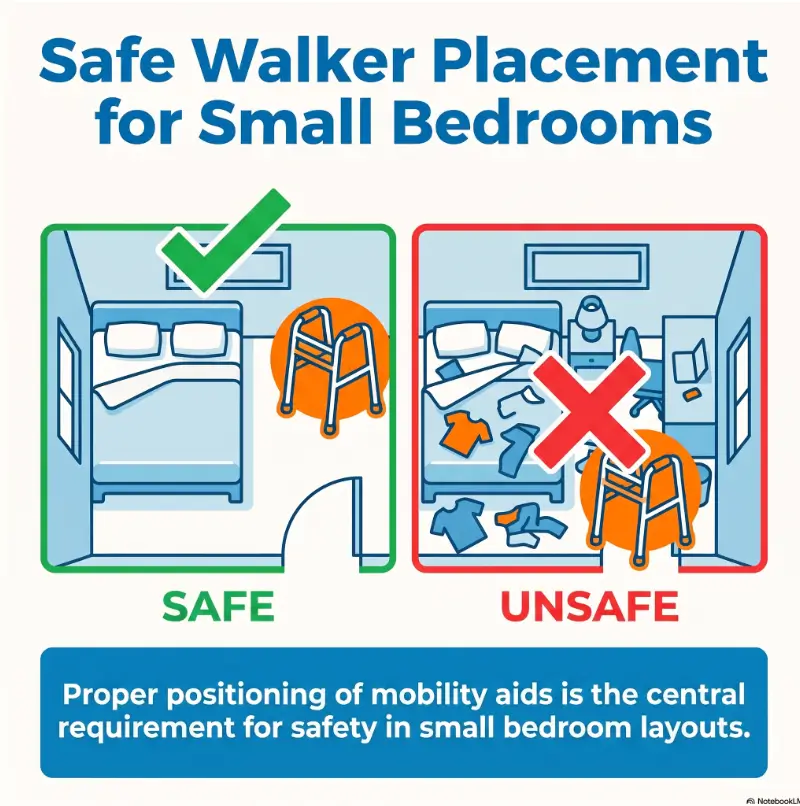
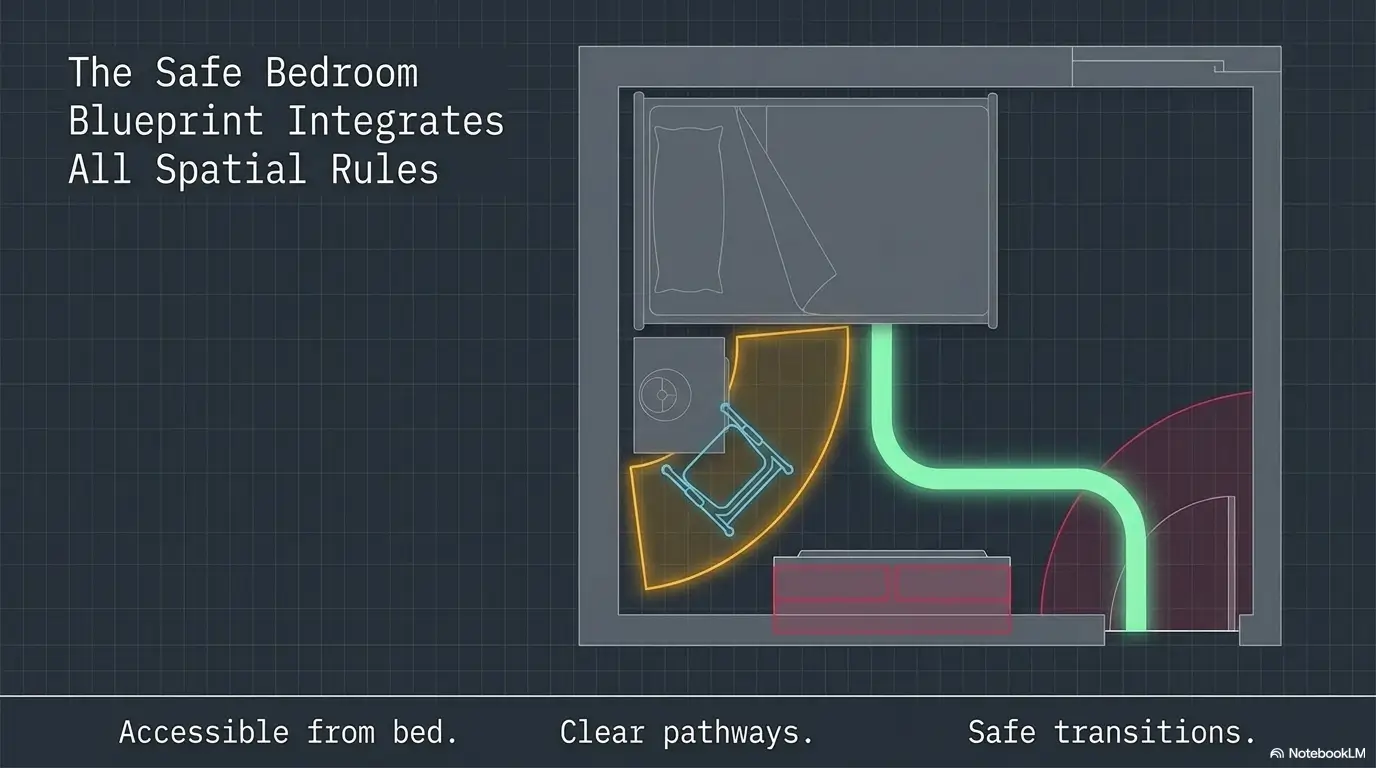
The best place to put a walker in a small bedroom is beside the bed on the person’s usual exit side, close enough to reach while seated, unfolded, stable, visible, and outside the main walking path. In most rooms, that means near the head-to-middle section of the mattress rather than parked at the foot of the bed.
The goal is not to make the walker look tidy. The goal is to make the first safe action obvious: sit up, place feet, reach for the walker, confirm it is stable, stand, then move.
Use the exit-side rule first
Put the walker on the side of the bed the person normally uses to get up. This is often the side closest to the bathroom, but not always. Sometimes the safer side is the one with more floor clearance, better lighting, or stronger body mechanics.
For a post-surgery patient, the correct exit side may depend on surgical instructions or the stronger leg. After hip, knee, spine, or shoulder surgery, confirm transfer guidance before rearranging the room around guesswork.
Reachable before standing beats reachable after standing
If the person must stand, lean, twist, or take a step to reach the walker, the placement is already too far away. A walker that waits across the room is not bedroom safety. It is furniture with handles.
The walker should be reachable after sitting up on the side of the bed. Not buried behind a nightstand. Not folded against the wall. Not tucked under the bed like a secret.
Close does not mean tangled
The walker should usually be close to the bed, but not pressed into blankets, robes, bed skirts, oxygen tubing, slippers, or charging cords. Wheels, tennis balls, and rear legs can catch soft items at exactly the wrong moment.
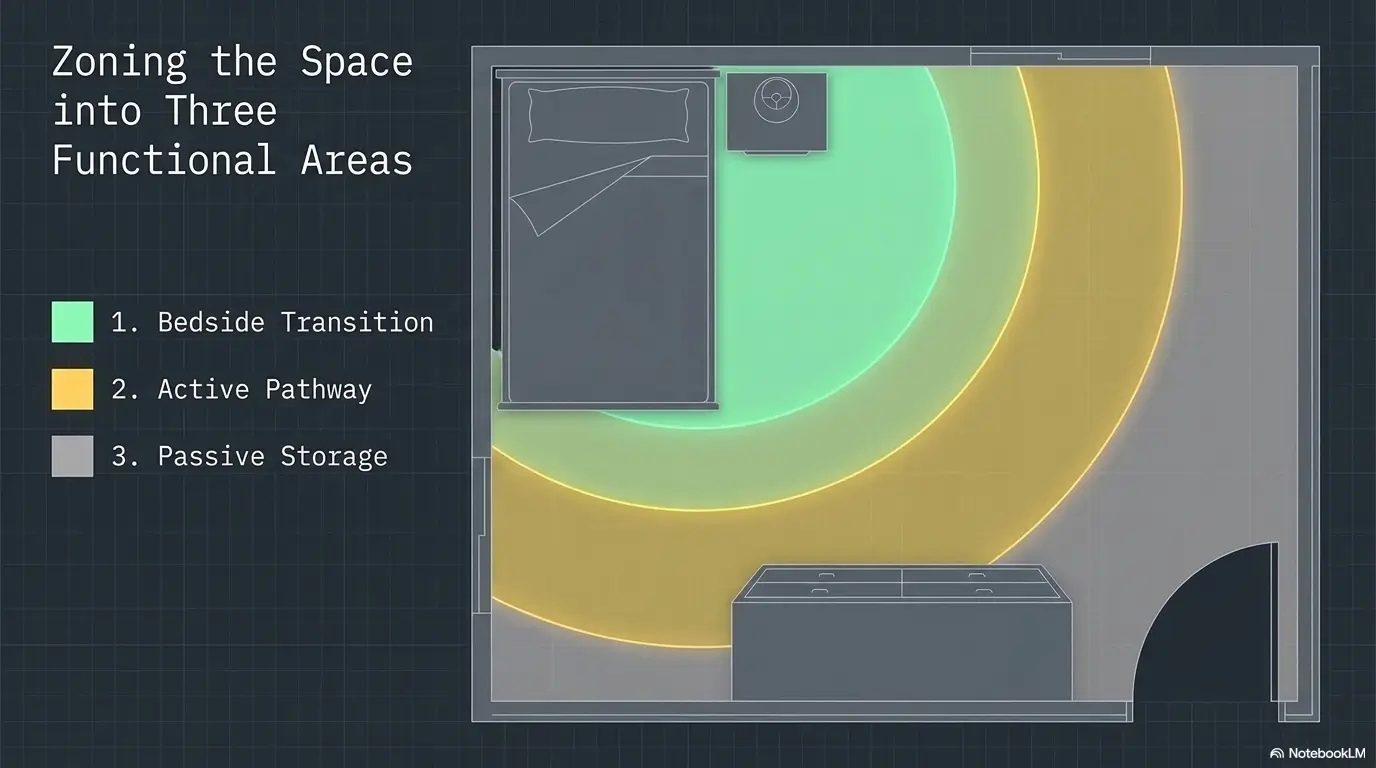
Give it a small “parking bay” beside the bed. Think of it as a clear landing strip, not a storage corner.
The three-part placement test
- Reach: Can the person touch the walker while seated on the bed without a risky lean?
- Stability: Does it stay steady when lightly contacted from a seated position?
- Path: Can the person turn toward the bathroom or door without the walker blocking the route?
The Night Route Test Most Bedrooms Fail
A walker location that works beautifully at noon may fail at 2:17 a.m. Nighttime is when rooms change personality. Shadows get thicker. Slippers migrate. A laundry basket becomes a boulder. The body is stiff, and the brain has not fully returned from sleep.
That is why the safest walker spot is often decided by the bed-to-bathroom route, not by how the room looks during the day.
Map the first route, not the whole room
Start with the route the person uses most often at night. For many older adults and post-surgery patients, that route is bed to bathroom. For others, it may be bed to door, bed to recliner, or bed to caregiver call area.
Walk the route in daylight first. Then look at it again with the lights low. Ask: What is the first object the person might touch? What is the first turn? Where could a walker leg catch? What item on the floor would be invisible in dim light?
Lighting is part of walker placement
A walker is safer when the person can see it before moving. Good lighting, night lights, and clear walking areas are common home fall-prevention basics recommended by major health and aging organizations.
Place a lamp, touch light, or motion-activated night light so the walker and first few steps are visible from bed. The light should help the person see before standing, not after they are already searching with their feet.
Short Story: Mrs. Harris and the Perfect Corner
Mrs. Harris had a walker, a narrow bedroom, and a daughter who loved neat rooms. Every evening, the walker went into the “perfect corner” beside the dresser. It looked calm there, almost decorative.
Then Mrs. Harris started waking twice a night. To reach the walker, she had to stand, take two careful steps, and turn past a footstool. Nothing dramatic happened at first. Just a wobble. Then another.
Her daughter finally sat on the bed and tried the route herself in dim light. The perfect corner suddenly looked less perfect. They moved the walker beside the bed, removed the footstool, and added a small night light.
The lesson was plain: a safe room is not the one that photographs well. It is the one that supports the body at the exact moment support is needed.
Helpful official resources
For broader home fall-prevention ideas, compare your bedroom reset with room-by-room safety guidance from trusted health and aging organizations.
Read NIA Fall Prevention Tips Open CDC Home Safety ChecklistSmall Bedroom Layouts: Where the Walker Goes
Small bedrooms are not all small in the same way. One room has a bed against the wall. Another has two tight aisles. A studio apartment may have the bed, dresser, TV, and dining table negotiating peace treaties over 90 square feet.
The safest walker location changes with the room shape, but the logic stays the same: reachable from bed, stable for the first movement, and not blocking the route.
Bed against one wall
When one side of the bed is against a wall, place the walker on the open side. Angle it slightly outward if needed, but avoid parking it so the person has to step sideways into a narrow gap.
If the open side is too narrow, remove or shrink the nightstand before compromising the walker position. A smaller bedside table is usually safer than a walker parked out of reach.
Bed centered with two narrow aisles
Choose the wider aisle, not the prettier side. The walker should not create a squeeze point between bed and dresser, especially if the person needs to turn toward the bathroom.
If both aisles are tight, consider moving the bed slightly off-center. Symmetry is pleasant. Safe turning space is better.
Bed near the bathroom door
If the bed is close to the bathroom, it is tempting to park the walker near the bathroom doorway. That only works if the person can reach it before standing. If they need unsupported steps to get there, the walker is too far away.
Place the walker beside the bed so it supports the first turn toward the bathroom without becoming a gate across the doorway.
Studio or shared room setup
In a studio or shared room, create a dedicated walker parking bay using furniture boundaries, floor contrast, or a low-profile bedside organizer. The parking bay should be boring in the best possible way: same spot, every night, nothing else living there.
Caregivers can use painter’s tape temporarily to mark the walker zone while testing the layout. Avoid raised tape edges or anything that could peel up and become another hazard.
| Room setup | Safer walker spot | Watch out for |
|---|---|---|
| Bed against wall | Open side near head-to-middle of mattress | Too-narrow gap beside bed |
| Centered bed | Wider aisle, not necessarily the preferred decorative side | Walker wedged between bed and dresser |
| Bathroom nearby | Beside bed, angled toward bathroom route | Walker blocking bathroom doorway |
| Studio apartment | Dedicated bedside parking bay | Mixed-use clutter around the walker |
| Shared bedroom | User’s exit side with caregiver access preserved | Partner’s slippers, cords, or furniture in the route |
Walker Placement Framework
The four-step “Reach Before Rise” flow
1. Sit
Can the person sit on the bed and reach the walker without leaning dangerously?
2. Stand
Is the walker stable and positioned for support before the first step?
3. Turn
Can the person turn toward the bathroom, door, or hallway without a squeeze point?
4. See
Is the walker visible in low light, with cords, rugs, and loose items out of the route?
Common Mistakes That Turn Walkers Into Trip Hazards
Most walker placement mistakes are not dramatic. They are small acts of tidiness, convenience, or optimism. A walker gets folded because the room is cramped. A rug stays because it “has always been there.” Slippers wait beside the bed like sleepy little boats.
The safer approach is to design for the worst normal moment: tired, dim room, urgent bathroom trip, stiff joints, and no one fully awake.
Mistake 1: Parking it where it looks neat
A walker behind the door, at the foot of the bed, or tucked beside a dresser may look tidy during the day. But if the person cannot reach it before standing, neatness has won the wrong argument.
Ask one question: “Can the person use it at the moment they need support?” If not, the spot is storage, not safety.
Mistake 2: Folding it every night
A folded walker can save inches, but it may cost time, balance, and confidence. If the walker is needed during the night, keeping it unfolded is usually more practical.
Fold it only if the person does not need it overnight or if a clinician has confirmed a different plan. A folded walker across the room is a poor companion for a 3 a.m. bathroom trip.
Mistake 3: Letting clutter share the walker zone
The walker zone should not also be the phone-charging zone, slipper zone, robe zone, laundry zone, and tissue-box overflow zone. Once the walker area becomes a tiny warehouse, the risk rises.
Move cords along walls, remove loose rugs from the route, and keep shoes, books, baskets, and bedding away from the walker’s legs and wheels.
Mistake 4: Blocking emergency access
A walker should not block the bedroom door, bathroom door, hallway, or caregiver entry. In a small room, this can be tricky. The walker must be reachable without becoming a barricade.
Open the bedroom door fully during your test. Then check whether a caregiver could enter quickly and whether the person could exit without wrestling the walker around furniture.
| Common mistake | Why it is risky | Safer alternative |
|---|---|---|
| Walker at foot of bed | May require unsupported steps | Place beside the exit side of the bed |
| Walker folded overnight | Harder to use quickly | Keep unfolded if needed at night |
| Walker behind door | Can block exit or become unreachable | Use bedside parking bay |
| Loose rug near walker | Legs or wheels may catch | Remove rug or secure route professionally |
| Cords near bed path | Creates invisible nighttime trip line | Route cords along walls |
Good, Better, Best Walker Parking Setups
You do not need a showroom bedroom to make walker placement safer. In many homes, the best improvement is free: move the walker closer, remove a rug, shift a nightstand, and add lighting.
Still, some rooms benefit from small purchases or professional guidance. Here is a practical comparison that keeps the focus on safety rather than buying a cart full of gadgets.
| Setup level | What it includes | Best for | Cost mindset |
|---|---|---|---|
| Good | Walker beside bed, clutter removed, clear path to bathroom | Budget-conscious caregivers and temporary recovery | Mostly free |
| Better | Good setup plus night light, smaller nightstand, cord management, contrast near walker zone | Older adults waking often at night | Low-cost improvements |
| Best | Better setup plus clinician-reviewed transfer plan, home-safety check, bed height review, bathroom route review | Recent falls, surgery, complex mobility, cognitive changes | Professional help may be worth comparing |
Good: make the safest free changes first
Start by placing the walker beside the bed on the exit side. Remove the obvious hazards: loose rug, cord, laundry basket, shoes, and extra furniture in the first few steps.
This is enough for many temporary situations, especially when a person is recovering well, follows clinician instructions, and has no recent fall history.
Better: add visibility and consistency
Add a motion night light or bedside lamp that can be turned on before standing. Use a dedicated landing zone for glasses, phone, water, and tissues so those items do not migrate onto the walker handles or seat.
If the walker blends into the wall or carpet, contrast can help. This may be as simple as a darker wall-side organizer, a visible parking mat with flat edges, or better lighting. Avoid raised edges that create a new trip hazard.
Best: bring in professional eyes when risk is higher
If the person has fallen recently, has changing strength, or is recovering from major surgery, a physical therapist or occupational therapist can evaluate transfers, bed height, walker height, bathroom access, and turning space.
The best setup may not be the most expensive. It is the one matched to the person’s actual movement pattern.
Key takeaway
Do the free safety fixes before buying equipment. If the first step from bed is still awkward, unclear, or unstable, paid help may be better spent on a professional home-safety review than another gadget.
Low-Cost Tools, Paid Help, and What Not to Waste Money On
Walker placement is a safety issue, but it also becomes a spending issue. Families often buy organizers, trays, bed rails, lights, rugs, and “senior safety” products before solving the simple route problem.
The best way to choose bedroom safety tools is to ask what problem you are actually solving: reach, visibility, clutter, transfer safety, bathroom access, or caregiver response.
Low-cost items that may help
- Motion-activated night lights: Useful when the route is safe but hard to see.
- Cord clips or cord covers placed along walls: Helpful when lamp or phone cords cross the route.
- Small bedside organizer: Keeps essentials off the walker and floor.
- Smaller nightstand: Often safer than squeezing a walker into a narrow aisle.
- Non-slip footwear: Worth discussing if slippers slide, twist, or get left in the path.
Items to question before buying
Be cautious with thick bedside rugs, raised mats, bulky over-bed tables, decorative baskets, and oversized nightstands. They may look helpful online but crowd the exact space the person needs for turning.
Also be careful with bed rails or transfer poles. For some people, they may help. For others, they may be inappropriate or create new risks. Ask a clinician before using transfer equipment when balance, cognition, surgery restrictions, or repeated falls are involved.
When paid help may be worth it
A professional home-safety assessment, physical therapy visit, or occupational therapy review may be worth comparing if the person has fallen, nearly fallen, changed medications, started using a walker recently, or struggles with bed transfers.
Before paying, ask what the visit includes. A useful provider should look at bed height, transfer technique, walker fit, night route, bathroom doorway, lighting, footwear, and clutter patterns. A quick glance at the bedroom is not enough.
Show me the nerdy details
Walker placement is a transfer-and-route problem. The person must move from lying to sitting, sitting to standing, standing to turning, and turning to walking. Each phase has different risk points.
A walker that is too far away increases unsupported movement. A walker that is too close to bedding can snag. A walker in the route creates a trip or squeeze hazard. A walker behind a door can interfere with emergency access.
The safest setup reduces the number of decisions the person must make while tired. The walker lives in one predictable place. The light is easy to activate. The floor is boring. Boring floors are underrated poetry.
More official fall-prevention guidance
If you are comparing DIY changes with a professional review, it helps to understand the broader home hazards that often show up around older adults and recovery patients.
Review Mayo Clinic Fall Prevention Tips See AARP Home Safety TipsThe 10-Minute Caregiver Setup Checklist
Caregivers often inherit a bedroom layout that grew slowly over years: a nightstand here, a basket there, a rug that nobody sees anymore because memory has wallpapered over it. The checklist below makes the room visible again.
Do this when the person is rested, wearing usual footwear, and able to give feedback. Do not force a test if they feel dizzy, weak, confused, or unsafe.
Step 1: Sit like it is 3 a.m.
Have the person sit on the edge of the bed as they normally would at night. Can they reach the walker without leaning forward, twisting, or stretching? Are their feet placed securely?
If not, move the walker closer or adjust the surrounding furniture. Do not accept “I can probably manage.” Safety should not rely on probably.
Step 2: Test the first turn
After standing safely, test the first turn toward the bathroom or door. Does the walker allow a natural turn? Or does it force a sideways shuffle, tight pivot, or awkward backing-up move?
If the first turn feels clumsy, the walker may be too close to another object or angled poorly.
Step 3: Check doors and caregiver access
Open the bedroom door and bathroom door fully. Make sure the walker does not block the swing path, hallway, or caregiver entry. Emergency access matters even in a room that feels calm today.
Step 4: Remove three hazards
Remove one loose floor item, one cord problem, and one soft snag hazard. This might mean a rug, phone charger, slipper pile, long robe, bed skirt, blanket edge, or laundry basket.
10-minute bedroom test
- Can the walker be reached while seated?
- Is it unfolded and stable?
- Is the bed-to-bathroom path clear?
- Can the bedroom door open fully?
- Can a caregiver enter without moving furniture first?
- Are cords routed away from the walking path?
- Are loose rugs removed from the route?
- Is the walker visible in low light?
- Are slippers and shoes parked outside the path?
- Does the setup work the same way every night?
For a related next step, you may also want to review a broader walker path safety guide or a fall risk checklist before surgery if the bedroom reset is part of a recovery plan.
When to Ask a Physical Therapist or Occupational Therapist
Some bedroom setups should not be solved by furniture shuffling alone. If the person’s mobility has changed, the safest answer may require a clinician who can watch the actual transfer and walking pattern.
Professional input is not a sign of failure. It is often the fastest way to stop guessing, especially when the room is small and the risks are not.
Red flags for professional help
- Recent fall, near fall, or fear of falling
- New walker use after surgery or hospitalization
- Dizziness, fainting, confusion, or medication changes
- Weakness on one side, stroke history, or new balance problems
- Difficulty standing from bed without pulling on furniture
- Unclear weight-bearing instructions
- Dementia, poor night vision, or frequent nighttime wandering
- Bathroom doorway too narrow for comfortable walker movement
What to ask before paying for help
Whether you are comparing home-safety services, asking a physical therapist, or speaking with an occupational therapist, use specific questions. Vague requests produce vague answers.
| Question to ask | Why it matters |
|---|---|
| Can you assess bed transfers and the first turn from bed? | Walker placement depends on movement, not just room size. |
| Will you check walker height and fit? | A poorly fitted walker can make a good layout less safe. |
| Can you review the bathroom route? | Nighttime bathroom trips are a common reason the walker is needed. |
| Will you look at lighting, rugs, cords, and footwear? | Fall risk often comes from ordinary household details. |
| Can you suggest low-cost changes first? | Good advice should not begin with unnecessary purchases. |
How to prepare for a home-safety visit
Before the visit, take photos of the bedroom in daytime and nighttime lighting. Note when the person usually wakes, which side of the bed they exit, whether they use the bathroom at night, and any recent stumbles.
If the person recently had surgery, keep discharge instructions nearby. Weight-bearing rules, movement restrictions, and medication side effects can all affect what “safe” means.
If you are coordinating medical conversations, this doctor visit summary template for caregivers can help organize notes before an appointment.
Key takeaway
If the person is pulling on the walker to stand, taking unsupported steps to reach it, or weaving around furniture at night, treat that as a signal to reassess the setup. The room is giving you feedback.
FAQ
Should a walker be kept folded in a small bedroom?
Usually no, not if the person needs it at night. An unfolded walker is easier to reach and use quickly. Folding may save space, but it can add delay and awkward movement during a nighttime bathroom trip.
Which side of the bed should the walker be on?
Usually the side the person naturally exits from, provided that side has enough room and does not conflict with clinical instructions. After surgery or injury, confirm the safest transfer side with a qualified clinician.
Can a walker go at the foot of the bed?
Only if the person can reach it before standing and it does not require unsupported steps. In many small bedrooms, the foot of the bed is tidy but too far away for safe nighttime use.
Is it safe to keep a walker by the bathroom door?
It can be safe if the person can reach it from bed before standing. If the walker waits by the bathroom door and the person must walk to it unsupported, it is too far away for bedroom safety.
What if the bedroom is too narrow?
Remove or replace nonessential furniture before moving the walker out of reach. A smaller nightstand, relocated chair, or cleared basket may create enough space without compromising safety.
Should the walker touch the bed?
Not usually. It should be close enough to reach but not tangled with blankets, bed skirts, robes, tubing, or slippers. Leave enough space so it remains stable and clear.
What lighting helps most at night?
Motion-activated night lights, reachable bedside lamps, and clear switches can help the person see the walker and first steps before standing. Lighting should reveal the route, not glare into the person’s eyes.
What is the biggest walker placement mistake?
The biggest mistake is placing the walker where it stores well instead of where the person needs it before standing. A walker that is neat but unreachable is not doing its job.
The 15-Minute Walker Reset Tonight
The safest bedroom does not need to look clinical. It needs to be calm, predictable, and honest about what happens when someone wakes in the dark and wants to move before they are fully awake.
Tonight, choose one route: bed to bathroom or bed to door. Park the walker beside the bed on the exit side. Sit on the mattress and confirm it can be reached before standing. Remove one rug, one cord, and one loose floor item from the route.
Then turn off the bright lights and look again. Can the person see the walker? Can the door open? Can the first turn happen without a shuffle? If yes, you have made the room quieter in the best sense. If no, the room has kindly shown you where to work next.
One small promise for tonight
Do not try to fix the whole bedroom first. Fix the first movement. A safe first movement can change the whole night.
Last reviewed: 2026-08