

Brace Coverage and Cost Guide
How to Check If a Brace Is Covered Before Buying It
A brace can look wonderfully simple on the counter: straps, hinges, padding, perhaps a reassuringly medical shade of gray. The bill behind it may be less simple. Insurance coverage can depend on the exact billing code, diagnosis, supplier, written order, network rules, documentation, and whether authorization happened before the brace changed hands.
The safest approach is to make three descriptions match before you pay: the brace your clinician intends, the brace the supplier plans to bill, and the brace your health plan says it will consider. A broad promise that “braces are covered” is not enough. You need an answer tied to the actual item, patient, supplier, and date.
This guide gives patients and caregivers a practical way to verify coverage, estimate out-of-pocket cost, compare insurance with self-pay, preserve appeal documents, and recognize situations where medical or billing help is worth the extra phone call.
Identify the item
Get the precise brace description, model, fitting type, and expected HCPCS code.
Verify the rules
Check medical necessity, authorization, network, order, and documentation requirements.
Estimate the bill
Compare the allowed amount, deductible, coinsurance, upgrades, and self-pay price.
The goal is not another vague “probably covered.” It is a documented answer you can use before checkout. 🧾
Snapshot
This article is for U.S. patients and caregivers comparing orthopedic braces before purchase. It explains how to identify the billable item, verify plan and supplier requirements, estimate the real cost, and create a small coverage file that may prevent a denial or support an appeal.
Table of Contents
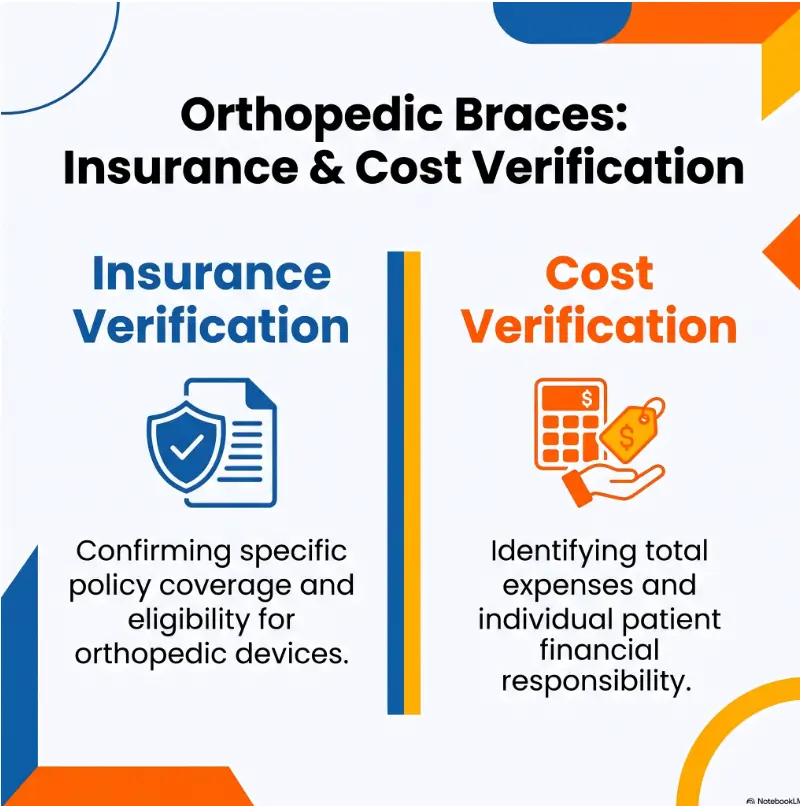
Before You Buy, Make Four Descriptions Match
Brace coverage is rarely decided by one yes-or-no rule. A claim usually survives only when several moving parts describe the same medically appropriate item.
Think of the process as four locks on one door. The brace may be a covered benefit, but the claim can still fail if the medical record is weak, authorization is missing, or the supplier is not eligible under your plan.
Before You Act
This guide provides general educational information, not medical, insurance, billing, or legal advice. Coverage depends on your current plan, diagnosis, clinical record, supplier, code, and policy rules. A coverage quote or prior authorization may support payment, but neither guarantees that a submitted claim will be paid. Confirm important decisions with your clinician, insurer, and supplier before accepting delivery.
The four coverage gates
GATE 1
Eligible benefit
Is the item covered as an orthosis, medical supply, postoperative device, or another benefit category?
GATE 2
Medical necessity
Does the medical record explain the diagnosis, functional problem, and reason this brace is appropriate?
GATE 3
Plan rules
Were the order, referral, encounter, prior authorization, and documentation rules followed on time?
GATE 4
Eligible supplier
Can this supplier bill your plan, and will the plan treat the supplier and location as in network?
Who this process fits
The process is useful for knee, ankle, wrist, elbow, back, neck, and other orthopedic supports prescribed after injury, surgery, instability, weakness, deformity, or chronic joint problems. It applies whether the brace comes from a clinic, orthotics practice, pharmacy, hospital department, or medical-equipment supplier.
It is especially helpful for people with high deductibles and for caregivers coordinating equipment after surgery. Both groups can be under pressure to make a quick decision, precisely when the fine print is most expensive.
Pause when the diagnosis or device choice is unclear
An athletic sleeve purchased for comfort is not automatically the same as a medically billed orthosis. Dental braces, prosthetic limbs, implants, therapeutic shoes, compression garments, and mobility devices may also follow different coverage rules.
A brace should not become a substitute for evaluation when pain, swelling, weakness, numbness, or loss of movement has not been medically assessed. The correct coverage question comes after the correct clinical question: what is the brace intended to do?
Key takeaway
Do not begin with “Does my plan cover braces?” Begin with “What exact brace is being prescribed, what code will be billed, and what conditions apply to this patient and supplier?”
Find the Brace’s Billing Identity, Not Just Its Product Name
A product name such as “hinged knee brace” sounds specific in ordinary conversation. To an insurer, it may still be fog. Similar-looking braces can differ by construction, fitting requirements, joints, materials, accessories, and billing code.
Collect the exact product description
Ask the prescriber or supplier for enough information to identify the actual item. Keep it in a note on your phone or in a secure message so everyone is working from the same description.
- Body part and side, such as right knee or left wrist
- Manufacturer and model, when available
- Custom-fabricated, custom-fitted, prefabricated, or off-the-shelf construction
- Rigid, semi-rigid, or soft design
- Hinges, joints, straps, pads, liners, or other additions
- Whether professional fitting or adjustment is expected
- The medical purpose, such as limiting motion, supporting instability, or protecting a surgical repair
When you are unsure whether the proposed equipment is even the right category, compare the clinical purpose first. For example, an ankle brace and a walking boot serve different levels of support and restriction, which can affect both the medical decision and the billing route.
Ask for the expected HCPCS code
Orthopedic braces are commonly billed with HCPCS Level II codes that begin with the letter L. People often call these “L-codes.” The code may describe the body region, construction method, fitting level, and included features.
Ask the supplier, “Which HCPCS code or codes do you expect to submit for this brace?” If the answer is not available, ask when it will be available and who can provide it before delivery.
Readers who are new to medical claims may find it useful to review common orthopedic billing terms in plain English before calling the insurer. Knowing the difference between a billed charge, allowed amount, deductible, and coinsurance turns an opaque phone call into a manageable checklist.
One brace may arrive with more than one code
The base brace may not be the entire claim. A supplier could expect separate billing for additions, replacement components, fitting, adjustments, or related services. This does not automatically mean the bill is wrong, but it means a single-code coverage quote may be incomplete.
- Ask whether accessories are included in the main code.
- Ask whether fitting is bundled or billed separately.
- Ask whether future adjustments are included.
- Ask whether replacement pads, straps, or liners have their own limits.
- Ask whether the brace is purchased, rented, or supplied under another arrangement.
Key takeaway
Two braces can look nearly identical on a shelf yet create different documentation requirements and patient costs. Verify the code that will actually appear on the claim.
Show me the nerdy details
A useful coverage check connects at least four identifiers: the HCPCS code for the orthosis, the diagnosis information supporting medical necessity, the supplier’s billing identity, and the member’s benefit plan. The manufacturer’s retail name may help identify the product, but it is rarely the only information used to adjudicate the claim.
Coverage criteria can also distinguish custom fabrication from custom fitting. A brace adjusted from a prefabricated item is not necessarily treated the same as one created from a patient-specific model. Ask the supplier to state the construction and fitting category in writing rather than relying on casual terms such as “customized.”
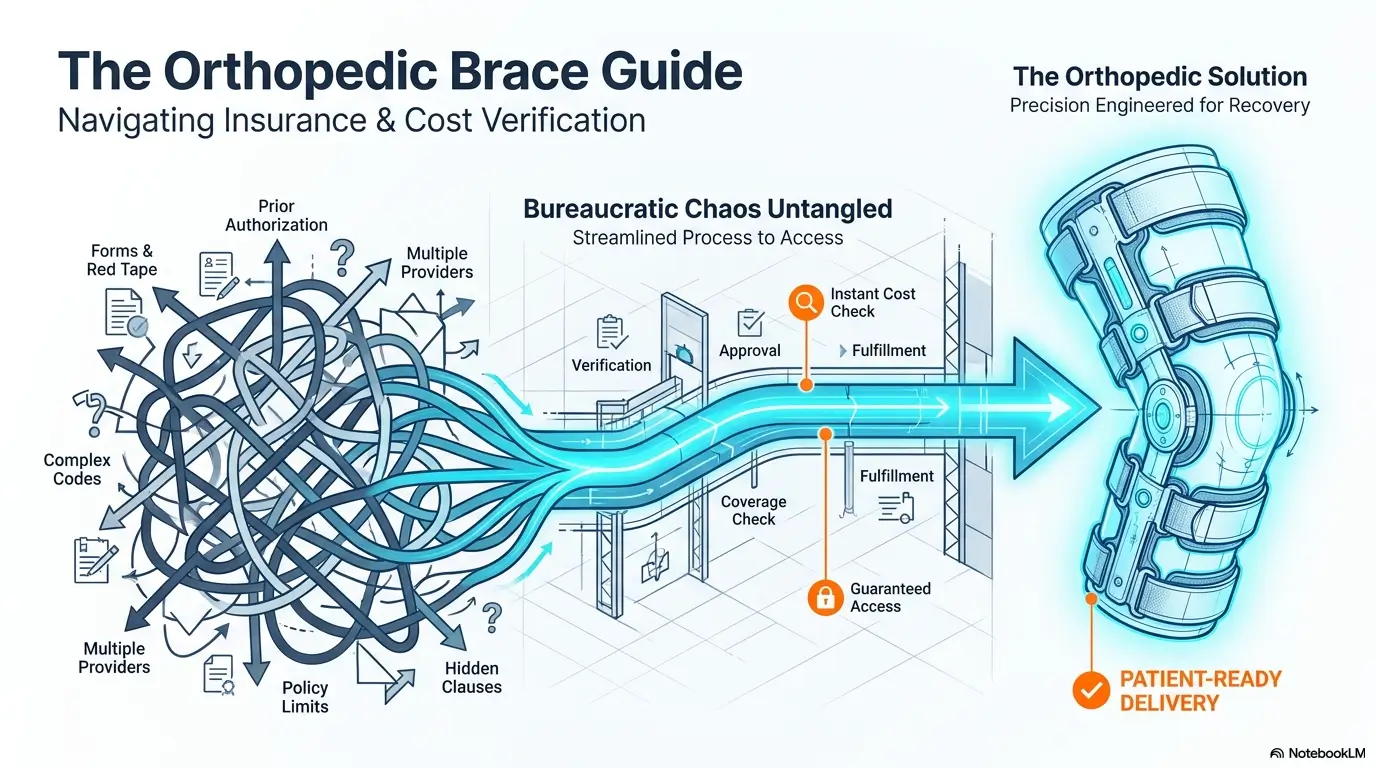
Ask the Insurer Questions That Produce Usable Answers
Calling the number on the insurance card is sensible. Asking only “Are knee braces covered?” is not. The representative may answer accurately about the general benefit while missing the code, diagnosis, authorization, or supplier rule that later controls the claim.
Prepare five pieces of information before calling
- Your member identification and current plan name
- The expected HCPCS code or complete brace description
- The diagnosis code, when the clinical office can provide it
- The supplier’s legal name, location, NPI, or tax identification details
- The date the brace is expected to be ordered or delivered
The diagnosis code may not be finalized when you first ask. In that case, request the applicable medical-necessity criteria for the brace code and ask what diagnosis information must accompany the claim.
Use this ten-question verification sequence
- Is HCPCS code [your code] an eligible benefit under my current plan?
- Is it covered for the diagnosis and clinical reason documented by my prescriber?
- Does it require a prescription, written order, referral, or prior authorization?
- Is a recent in-person or telehealth encounter required?
- Are there specific medical-record elements the plan must receive?
- Must the brace be custom-fitted or supplied by a particular type of provider?
- Is the named supplier and service location in network for this benefit?
- What deductible, copay, or coinsurance applies to the allowed amount?
- Are fitting, adjustments, accessories, and replacement parts included?
- Are there frequency, quantity, replacement, or same-or-similar equipment limits?
Finish with one question that often clears the smoke: “What is the most common reason this brace code is denied under my plan?” The answer may reveal an authorization rule, diagnosis restriction, documentation requirement, or supplier limitation that the standard benefit summary does not make obvious.
Move the answer from the phone into writing
Record the date, time, representative’s name, department, and call-reference number. Then request the answer through the member portal, secure message system, email process, or mailed benefit response when available.
Copy-and-send insurer message
Please confirm the coverage requirements and estimated member responsibility for HCPCS code [code], ordered for [diagnosis or medical purpose], and supplied by [supplier legal name, location, and NPI]. Please identify any prior authorization, written-order, encounter, network, documentation, fitting, frequency, replacement, or quantity requirements.
A written response is still not a guarantee of payment. It is evidence of what you asked, what information you supplied, and what the plan told you before purchase. That can be useful when a later claim result does not match the verification.
Avoid the Supplier Trap: Covered Item, Wrong Vendor
A medically necessary brace can still produce a denial or a much larger bill when it comes from the wrong supplier. This is one of the least visible parts of the purchase because the person fitting the brace may work inside a familiar clinic.
Verify the supplier twice
First, search the insurer’s current directory. Second, confirm with a live representative using the supplier’s legal name, physical location, NPI, and the benefit category under which the brace will be processed.
Directories can be out of date, and a company may participate at one address but not another. A supplier may also be in network for some services but not for the orthotics or durable-medical-equipment benefit used for your brace.
- Confirm the billing entity, not only the clinic’s public name.
- Confirm the exact service location.
- Confirm that the supplier can bill the relevant equipment benefit.
- Ask whether the supplier will accept the plan’s allowed amount as payment in full.
- Ask whether another company will appear on the claim or invoice.
The clinic may not be the brace vendor
A brace can be handed to you in an exam room and still be supplied by an outside orthotics or equipment company. The clinician may order it, a technician may fit it, and a separate company may submit the claim.
Ask a wonderfully unglamorous question before signing: “Which legal entity will bill my insurance for this brace?” It is not poetry, but it may save you from a very sour envelope.
For Medicare, ask about enrollment and assignment
People with Original Medicare should confirm that the supplier is enrolled in Medicare and ask whether it participates in Medicare or will accept assignment for the claim. Assignment affects whether the supplier agrees to the Medicare-approved amount and what the patient may be charged.
Do not assume that “takes Medicare” answers every question. Ask whether the supplier is enrolled, whether it accepts assignment for this item, and whether there are any charges Medicare is not expected to cover.
Short Story: The brace at the checkout desk
After a knee appointment, Elena was offered a hinged brace at the clinic. The fitting took ten minutes. A staff member said her insurance “normally covered these,” and the brace was already strapped comfortably around her leg.
Elena’s daughter asked for the billing code and the name of the company submitting the claim. The clinic name was not the answer. An outside supplier would bill for the brace, and that supplier was not in Elena’s plan network.
They paused the delivery, called the insurer, and found an in-network supplier carrying a clinically comparable brace. The prescriber sent the order there instead.
The lesson was not that clinic-supplied braces are bad. It was that location, convenience, and network status are three different facts. A brace can be fitted in the right room by the right person and still be billed by the wrong company.
“Covered” Is Not the Same as Affordable
Coverage means the plan may process an eligible claim under its rules. It does not mean the plan pays the entire bill, and it certainly does not mean the brace will cost less than every self-pay option.
Estimate cost from the allowed amount
The retail sticker price and the supplier’s billed charge may not be the number used to calculate your responsibility. Ask for the insurer’s estimated allowed amount and how your deductible, copay, or coinsurance applies.
- Supplier’s billed charge
- Estimated in-network allowed amount
- Remaining deductible
- Copay or coinsurance percentage
- Fitting or adjustment charges
- Noncovered accessories or upgrades
- Estimated total patient responsibility
Suppose a plan covers 80 percent after the deductible, but you still have a large deductible remaining. The claim may be fully eligible while the patient pays most or all of the allowed amount. That is covered, yes, but it may not feel particularly covered when the card reader chirps.
Compare insurance and self-pay before delivery
Ask the supplier for both estimates when self-pay is permitted. Then ask the insurer whether a direct purchase can be submitted by the member and whether an accepted member-submitted claim would count toward the deductible or out-of-pocket limit.
| Option | What to verify | Possible advantage | Main caution |
|---|---|---|---|
| Use insurance | Network, authorization, allowed amount, documentation | May count toward plan cost sharing and preserve appeal rights | High deductible or coinsurance may leave a large bill |
| Pay the supplier directly | Written cash price, return terms, fitting, follow-up | May be simpler or less expensive in some situations | May not count toward insurance limits or qualify for reimbursement |
| Submit your own claim | Member claim rules, required receipt, eligible seller | May allow partial reimbursement under some plans | Some plans require an enrolled or participating supplier |
| Use tax-advantaged funds | Current account rules and documentation | May reduce the effective cost of an eligible expense | Tax eligibility does not prove insurance coverage |
Insurance coverage and tax eligibility are separate questions. A brace may qualify as an eligible health expense under certain circumstances even when your insurance does not pay for it. Review the documentation issues in this guide to HSA-eligible braces and supports before using account funds.
Good, better, best ways to verify before buying
| Approach | What you confirm | Best for | Remaining risk |
|---|---|---|---|
| Good | General brace benefit and supplier estimate | Low-cost standard brace with simple plan rules | The actual code or network details may be missed |
| Better | Code, diagnosis, supplier network, deductible, and authorization | Most prescribed prefabricated or custom-fitted braces | Medical documentation may still be incomplete |
| Best | Written order, code, diagnosis, supplier, authorization, documentation criteria, and written cost estimate | Custom, costly, postoperative, or frequently denied items | Final payment still depends on correct claim submission and eligibility |
Treat the return policy as part of the price
Medical products may become nonreturnable after fitting, wear, customization, or opening. Ask what happens if authorization is denied, the brace does not fit, the prescriber changes the plan, or the claim processes differently from the estimate.
Key takeaway
Compare the expected patient cost, not the retail price and not the word “covered.” Include the allowed amount, remaining deductible, fitting, upgrades, and return restrictions.
Build the Coverage File Before the Box Is Opened
A small paper trail can prevent confusion among the prescriber, supplier, insurer, and patient. It can also turn an appeal from “Someone told me it would be covered” into a documented sequence with names, dates, codes, and approvals.
Get a complete written order
The order should clearly identify the patient, brace, ordering practitioner, order date, and medical purpose. Depending on the plan and item, additional elements may be required.
For Medicare DMEPOS orders, standardized elements generally include the beneficiary, item description, quantity when applicable, treating practitioner, order date, and practitioner signature. Certain items may also require a qualifying encounter, written order before delivery, or prior authorization.
Make sure the medical record tells the same story
A prescription can request a brace without fully explaining why a particular design meets the patient’s needs. The medical record may need to support the diagnosis, physical findings, functional limitation, and reason a standard or less complex option is not sufficient.
- Diagnosis and affected body part
- Right, left, or bilateral use
- Instability, weakness, deformity, pain, or restricted movement
- Relevant examination findings
- Functional limits at home, work, or during recovery
- Prior treatments and their results
- Reason the selected brace design is appropriate
- Reason custom fabrication is needed, when applicable
Patients preparing for an appointment can use an orthopedic visit checklist to organize symptoms, functional problems, medications, questions, and records before asking the clinician to document the brace need.
Do not confuse the order with authorization
The clinician’s order establishes the medical request. Prior authorization is the insurer’s review process. They are connected, but one does not automatically create the other.
Ask who is submitting the authorization, which code is being requested, which supplier is named, when it was sent, what documents were included, and whether approval must be received before fitting or delivery.
Your one-folder brace checklist
Save these before delivery
- Written order or prescription
- Brace description, model, and expected HCPCS code or codes
- Prior-authorization request and approval details
- Supplier estimate and cash-price quote
- Insurer secure messages and call-reference numbers
- Network verification using the supplier’s legal identity
- Return, exchange, fitting, and adjustment policies
- Delivery document, receipt, claim, and explanation of benefits
Prevent Common Denials and Prepare for an Appeal
Most expensive brace mistakes are not dramatic. They are small gaps that appear harmless at the counter: the authorization was still pending, the wrong supplier address was checked, or the record said “knee pain” without describing instability or functional need.
Seven mistakes that become costly
| Common mistake | Why it causes trouble | Safer alternative |
|---|---|---|
| Buying before authorization | Retroactive approval may be unavailable | Confirm approval timing before delivery |
| Trusting only the seller’s benefit check | The check may use general benefits or incomplete codes | Verify independently with the insurer |
| Using an out-of-network supplier | The item may be eligible while the vendor is not | Confirm legal entity, location, and NPI |
| Confusing a prescription with approval | A medical order does not complete insurer review | Track the authorization separately |
| Weak custom-brace documentation | The record may not explain why a standard brace is inadequate | Ask the prescriber to document the specific need |
| Accepting an unlisted upgrade | Premium materials or features may be excluded | Request a written upgrade price before signing |
| Discarding denial documents | Reason codes and deadlines may be lost | Save the notice, claim, order, and medical record |
Start an appeal by decoding the denial
Read the explanation of benefits and formal denial notice. Look for the reason code, benefit exclusion, medical-necessity finding, authorization issue, coding problem, supplier problem, and appeal deadline.
Call the insurer and request the exact rule used to make the decision. Ask whether the claim was denied because the item was excluded, the documentation was insufficient, the supplier was ineligible, or a procedural requirement was missed.
Build an appeal packet that answers the stated reason
- A copy of the denial and explanation of benefits
- The written order and authorization history
- Relevant medical records and examination findings
- A letter from the prescriber explaining medical necessity
- The product description and billed HCPCS code
- Supplier network or enrollment evidence
- Written insurer messages and call-reference numbers
- A concise timeline of what occurred before purchase
Address the reason given rather than sending a mountain of unrelated paperwork. A denial for missing authorization requires a different response from a denial stating that custom fabrication was not medically necessary.
Key takeaway
Keep the denial paperwork. It contains the insurer’s reason, review path, and deadline. An appeal works best when every document answers that specific reason.
When the denial creates an immediate bill
Ask the supplier to place the account on hold while a timely appeal or corrected claim is reviewed. Request an itemized statement and ask whether the supplier can correct coding, network, or documentation errors before treating the amount as final.
When a balance remains, compare available arrangements carefully rather than agreeing under pressure. This overview of orthopedic payment-plan questions can help you review fees, interest, due dates, and alternatives before signing.
Know When Medical, Billing, or Insurance Help Matters
A coverage problem is sometimes only a paperwork problem. At other times, it signals that the medical purpose, product choice, or treatment plan needs clarification. Knowing which person to contact can save several loops through telephone-menu purgatory.
Seek prompt medical guidance for warning signs
Contact an appropriate healthcare professional promptly when an injury or new brace is associated with severe or worsening pain, visible deformity, inability to bear weight, rapidly increasing swelling, new weakness, loss of sensation, skin-color change, coldness, suspected fracture, or pressure injury.
A brace that feels intolerably tight, causes numbness, produces new discoloration, or worsens symptoms should not be treated as merely an insurance inconvenience. Ask the clinician or fitting professional for guidance.
Match the problem to the right helper
| Problem | First contact | Useful request |
|---|---|---|
| Brace type or fit is unclear | Prescriber or qualified fitting professional | Clarify the medical goal, size, restrictions, and adjustment plan |
| Medical record lacks detail | Prescriber’s office | Add diagnosis, findings, function, body side, and custom-brace rationale |
| Authorization is missing | Supplier, prescriber, and insurer | Identify who submits it and whether delivery must wait |
| Supplier appears out of network | Insurer | Confirm eligible in-network suppliers and any exception process |
| Claim coding seems wrong | Supplier billing department | Review the code, item description, and claim submission |
| Appeal has stalled | Plan appeal unit or benefits administrator | Confirm status, missing documents, level of review, and deadline |
Use formal assistance when the dispute does not move
Depending on the type of coverage, additional help may be available through an employer benefits administrator, plan grievance department, state insurance department, Medicare, a State Health Insurance Assistance Program, a state Medicaid agency, or a qualified patient advocate or billing specialist.
Medicaid benefits and equipment administration vary by state. Confirm coverage, supplier participation, authorization, and appeal rules with the member’s state program or managed-care plan rather than assuming another state’s process applies.

Frequently Asked Questions
Does health insurance cover orthopedic braces?
Many plans cover certain medically necessary orthopedic braces. Coverage depends on the brace code, diagnosis, clinical documentation, supplier, benefit category, authorization rules, and member eligibility on the date of service.
Do I need a prescription for insurance to cover a brace?
A written order is commonly required when an orthosis is billed to insurance. The required order elements, timing, clinical encounter, and authorization process vary by plan and code.
Will insurance cover a brace bought from an online store or pharmacy?
Possibly, but many retail sellers cannot bill the medical benefit or satisfy supplier-network and documentation requirements. Before buying, ask whether the seller is eligible, whether member-submitted claims are allowed, and what records the plan requires.
Does Medicare cover knee, back, wrist, or neck braces?
Medicare Part B may cover medically necessary arm, leg, back, and neck braces ordered by an eligible healthcare provider. Deductible, coinsurance, supplier, assignment, coding, documentation, encounter, and authorization requirements may still apply.
What is an HCPCS code for a brace?
It is a billing code used to identify the type and features of an orthosis. Orthopedic braces are commonly associated with HCPCS Level II codes beginning with L. The code gives an insurer a more precise basis for checking coverage than the product’s retail name alone.
Does prior authorization guarantee that the brace claim will be paid?
No. Authorization supports coverage of the requested item under stated conditions, but final payment may still depend on member eligibility, correct coding, medical documentation, supplier status, timely delivery, and accurate claim submission.
Can I submit the brace receipt to insurance myself?
Some plans allow member-submitted claims. Others require an eligible supplier to submit the claim directly. Confirm the process, filing deadline, required form, itemized receipt, code, prescription, and reimbursement method before purchasing.
Why was my brace denied as not medically necessary?
Common causes include incomplete clinical findings, an uncovered diagnosis, failure to meet custom-brace criteria, missing functional information, lack of required conservative treatment, or a mismatch between the record and the billed code.
Can I appeal a denied brace claim?
Most health plans provide an appeal or grievance process. Request the denial reason and governing criteria, then submit relevant orders, clinical records, authorization history, supplier information, and a concise explanation before the stated deadline.
Run This 15-Minute Brace Coverage Check
Before you pay, place the proposed brace at the center of a three-way match: the prescriber’s order, the supplier’s billing plan, and the insurer’s coverage response.
One concrete action to complete now
Send the insurer a secure message containing the exact brace code, medical purpose, supplier identity, and expected delivery date. Ask for authorization, network, documentation, cost-sharing, fitting, and replacement requirements in writing.
The 15-Minute Final Check
- Write down the exact brace description and HCPCS code.
- Confirm the diagnosis or documented medical purpose.
- Identify the legal supplier, location, and NPI.
- Ask whether authorization or a recent encounter is required.
- Calculate the estimated patient cost from the allowed amount.
- Save the written order, insurer response, estimate, and return policy.
Do not complete the purchase until the order, code, supplier, and coverage answer describe the same brace.
A brace should support the body, not ambush the household budget. A few precise questions before delivery can replace guesswork with a usable record, a clearer cost estimate, and a far better chance of resolving problems before they harden into a denied claim.
Last reviewed: 2026-08