

Patient billing clarity guide
Orthopedic Billing Terms Patients Actually Need:
Decode the Bill Before You Pay
An orthopedic bill can arrive with the emotional warmth of a parking ticket and the readability of a submarine manual. You may recognize the doctor’s name, the visit date, or the MRI charge, but then the page starts whispering in codes: CPT, modifier, allowed amount, coinsurance, facility fee, provider adjustment.
This guide translates the billing language patients actually need, especially after an orthopedic visit, imaging study, injection, surgery, brace fitting, or physical therapy plan. It is not built for coders arguing payer contracts in a fluorescent back office. It is built for the person at the kitchen table wondering whether to pay, call insurance, ask for an itemized statement, or push back before the bill hardens into debt.
The central rule is simple: compare the EOB, provider bill, insurance portal, and itemized statement before paying anything you cannot explain. A bill may sound official. But in healthcare, official-looking paper can still be wrong, incomplete, premature, duplicated, or missing the one adjustment that changes the whole balance.
Read the numbers
Know which amount is billed, allowed, paid, adjusted, denied, or assigned to you.
Question the codes
Spot when imaging, braces, anesthesia, therapy, or surgery charges need a closer look.
Call smarter
Use precise questions instead of getting trapped in the fog machine of “that’s just your plan.”
Bring the bill, the EOB, and a calm pencil. We are going line by line. 🧾
Snapshot
This article is for US patients, caregivers, and recently insured readers trying to understand orthopedic bills before paying. You will learn which documents to compare, which billing terms affect your wallet, what questions to ask insurance and the provider, and when a billing problem may need professional help.
Table of Contents
Before You Act: What This Guide Can and Cannot Do
Orthopedic billing can affect real money, medical access, credit stress, and household decisions. A confusing bill is not just paperwork. It can feel like a second injury, only this one comes with hold music.
This guide is practical billing education, not medical, legal, tax, or insurance advice. It can help you understand common terms, organize your documents, ask better questions, and spot issues worth reviewing. It cannot tell you whether a treatment was medically necessary, whether your insurer must pay a specific claim, or whether you have a legal case.
For large bills, urgent collection threats, denied care, workers’ compensation, Medicare Advantage disputes, or possible surprise billing protections, consider getting help from the provider’s billing office, your insurer, a patient advocate, your state insurance department, or a qualified attorney when appropriate.
Key takeaway
Do not let a bill’s serious tone rush you. Before paying, ask whether the claim has processed, whether the EOB matches the provider bill, and whether you have the itemized statement.
Why billing help is not medical advice
A charge can look wrong for several reasons. The provider may have billed an unexpected code. The insurer may have processed the claim under your deductible. A facility may have submitted a separate claim. A prior authorization may have existed but not covered every part of care. None of those details tells you whether the care itself was clinically appropriate.
Keep billing questions and medical questions in separate lanes. For medical concerns, ask your clinician. For claim processing, ask your insurer. For charge details, ask the provider or facility billing office. For legal rights, ask a qualified professional or the appropriate regulator.
When a bill problem becomes a medical access problem
A billing issue becomes more serious when it delays needed follow-up care, blocks surgery scheduling, interrupts physical therapy, or pushes a patient toward collections while a claim is still being reviewed. This is especially common after orthopedic care because one injury can create several bills: surgeon, facility, imaging center, anesthesia, durable medical equipment, and rehab.
If care may be delayed because of a bill, ask both the provider and insurer for the written reason. Written records matter. A phone call can evaporate. A dated message, portal note, claim letter, or reference number has shoes.
Keep records before emotions take the wheel
Create one folder for the date of service. Save the provider bill, EOB, screenshots from the insurance portal, itemized statement, prior authorization letter, referral if required, payment receipts, and call notes.
Use a simple naming system: date-provider-document. For example: 2026-04-12-knee-mri-eob. It is not glamorous. Neither is flossing. Both save pain later.
Compare the First Three Documents Before Paying
The first real move is not calling insurance. It is gathering the right documents so you do not enter the call empty-handed. Orthopedic billing often looks confusing because multiple organizations touch the same episode of care.
For one shoulder injury, you might see charges from the orthopedic clinic, radiology group, imaging facility, brace supplier, surgery center, anesthesiologist, pathologist, physical therapy clinic, and pharmacy. The bill is not one scroll. It is a small paper orchestra, and everyone brought a different instrument.
EOB: the not-a-bill document that still matters
An Explanation of Benefits, usually called an EOB, is the insurer’s explanation of how a claim was processed. It often lists the billed amount, allowed amount, insurance payment, adjustments, denials, and patient responsibility.
The most important phrase: an EOB is not a bill. It helps you predict what a provider may bill you, but you usually pay the provider, not the EOB itself.
Helpful official resource
CMS provides a plain-English guide to reading an Explanation of Benefits and understanding why it is different from a provider bill.
Provider bill: what the clinic or hospital says you owe
The provider bill is the payment request from the clinic, hospital, surgery center, imaging center, anesthesia group, or equipment supplier. It may arrive before your insurance finishes processing. That does not always mean it is final.
Match the provider bill against the EOB. The provider bill should generally reflect the patient responsibility shown after insurance processing, unless there are multiple claims, secondary insurance, non-covered items, or timing differences.
Itemized statement: the line-by-line truth serum
An itemized statement breaks the charge into individual services, dates, codes, units, supplies, medications, and adjustments. It is the document you want when a bill feels too round, too vague, or too confident.
Ask for the itemized statement before disputing a mystery balance. “Orthopedic services: $1,842” gives you nothing to inspect. “Office visit, X-ray, brace, injection administration, imaging guidance” gives you a map.
| Document | Who sends it | What it tells you | What to check first |
|---|---|---|---|
| EOB | Insurance plan | How the claim was processed | Patient responsibility, denial reason, allowed amount |
| Provider bill | Clinic, hospital, facility, or supplier | What they say you owe | Whether the amount matches the EOB |
| Itemized statement | Billing office | Line-by-line charges and codes | Duplicate items, units, supplies, dates, unexpected services |
| Insurance portal | Insurance plan | Claim status and digital EOB details | Whether claim is pending, denied, adjusted, or finalized |
Why the numbers rarely match on the first pass
The billed amount is the provider’s starting charge. The allowed amount is the rate the plan recognizes for covered in-network care. The provider adjustment is often the discount or write-off between those numbers. The patient responsibility is what your plan says you owe after deductible, copay, coinsurance, exclusions, or denials.
When people say, “My insurance paid nothing,” they may mean several different things. The claim may have been denied. Or the allowed amount may have been applied to the deductible. Or the plan may have adjusted the charge but made the patient pay the allowed amount because the deductible was not met.
The Money Terms That Actually Hit Your Wallet
Some billing terms are decorative wallpaper. Others determine how much leaves your bank account. Start with the wallet words: deductible, copay, coinsurance, allowed amount, out-of-pocket maximum, non-covered service, and patient responsibility.
These terms matter more in orthopedic care because costs can stack quickly. A knee problem may involve an office visit, X-ray, MRI, brace, injection, surgery consult, physical therapy, and follow-up visits. Small misunderstandings become expensive when repeated across multiple claims.
Deductible: what you pay before insurance meaningfully joins the room
A deductible is the amount you pay for covered services before your plan begins paying more fully. If you have a high-deductible health plan, you may still get the insurer’s negotiated rate, but you may owe much of the allowed amount until the deductible is met.
That distinction matters. “Covered” does not mean “free.” It may mean the claim is eligible under the plan and priced at the allowed amount, but still assigned to your deductible.
Copay and coinsurance: fixed fee versus percentage
A copay is usually a fixed amount, such as a set fee for an office visit. Coinsurance is a percentage of the allowed amount. A 20% coinsurance charge can be modest for a short visit and painful for surgery, advanced imaging, or hospital outpatient care.
When comparing orthopedic costs, ask whether your responsibility is a copay, coinsurance, deductible amount, or non-covered charge. The same $300 balance can mean very different things depending on which bucket created it.
Allowed amount: the negotiated number hiding under the sticker price
The allowed amount is one of the most important terms on an orthopedic EOB. It is the amount the plan recognizes for the service under its rules. For in-network care, the provider usually agrees to accept the allowed amount plus any proper patient responsibility.
When the billed charge is $1,200 and the allowed amount is $420, your deductible or coinsurance is usually calculated from the allowed amount, not the sticker price. That is why you should never argue only from the billed charge. Follow the allowed amount.
Out-of-pocket maximum: the ceiling patients forget to check
The out-of-pocket maximum is the most you should pay for covered in-network benefits during the plan year, excluding things like premiums and certain non-covered services. Once reached, the plan generally pays 100% of covered in-network benefits for the rest of the plan year.
If you are facing surgery, ask where you stand against your deductible and out-of-pocket maximum before the procedure. A patient who already met most of the maximum may face a different decision than someone starting from zero.
Key takeaway
When reviewing an orthopedic bill, circle the allowed amount and patient responsibility first. The biggest sticker price on the page is not always the number that matters.
| Term | Plain-English meaning | Patient question to ask |
|---|---|---|
| Deductible | Amount you pay before plan payment increases | Was this applied to my deductible? |
| Copay | Fixed cost for a covered service | Was this visit supposed to be a specialist copay? |
| Coinsurance | Your percentage of the allowed amount | What percentage was used, and on what allowed amount? |
| Allowed amount | Plan-recognized amount for the service | Is the patient balance based on this number? |
| Out-of-pocket maximum | Annual ceiling for covered in-network cost sharing | How much have I accumulated so far? |
| Non-covered service | Service the plan does not cover under its rules | What plan language says this is not covered? |
Helpful official resource
HealthCare.gov explains common out-of-pocket cost terms, including deductibles, coinsurance, and copayments.

The Code Words Behind Orthopedic Charges
You do not need to become a medical coder to question an orthopedic bill intelligently. You do need to know what the main code families are doing on the page.
Think of the bill as a receipt written in shorthand. The CPT code says what service was billed. The diagnosis code says why the service was billed. A modifier may explain a special circumstance. Units tell how many times something was charged. Place of service tells where the care happened.
CPT code: what service was billed
A CPT code identifies the service or procedure billed, such as an office visit, X-ray, injection administration, physical therapy service, surgery, or imaging guidance. Patients usually do not need to memorize codes. They need to ask what a code represents and whether it matches what happened.
Example: if your itemized statement shows a charge for injection guidance, ask whether ultrasound or fluoroscopic guidance was actually used and whether it was separately billable under your plan.
ICD-10 diagnosis code: why the service was billed
An ICD-10 diagnosis code explains the medical reason attached to the service, such as knee pain, osteoarthritis, shoulder injury, fracture, spinal stenosis, or back pain with sciatica. The diagnosis code can affect whether a service is considered medically necessary under plan rules.
If an MRI or injection was denied, ask whether the diagnosis code submitted matches the doctor’s note and the payer’s medical policy. Sometimes the dispute is not about whether you were in pain. It is about whether the paperwork told the same story as the chart.
Modifier: the tiny add-on that can change payment logic
A modifier is a small code attached to a service code to explain a special circumstance. It may indicate a separate service, a professional component, a technical component, a repeat procedure, a distinct anatomical site, or another billing distinction.
Patients should not assume every modifier is wrong. But if one line is denied while another is paid, or if a service seems duplicated, ask whether a modifier affected the result.
Units and place of service: when one visit multiplies
Units show how many times a service, supply, or time-based service was billed. This matters for physical therapy, medications, supplies, anesthesia time, and some procedure-related charges.
Place of service matters because care in a hospital outpatient department may process differently from care in a physician office or ambulatory surgery center. The same clinical service can create a different bill depending on where the service was performed.
Orthopedic Bill Review Flow
1. Collect
Bill, EOB, portal screenshot, itemized statement.
2. Match
Date, provider, code, allowed amount, patient balance.
3. Question
Ask what code, denial, deductible, or non-covered rule created the balance.
4. Document
Save names, dates, reference numbers, and written next steps.
Orthopedic Charges Patients Misread Most
Orthopedic bills are unusually good at making separate charges look like duplicate charges. Sometimes they are duplicates. Often they are separate components of one episode of care.
Your job is not to accuse first. Your job is to identify which part of the service each charge represents.
X-ray, MRI, CT, and ultrasound billing terms
Imaging may involve a technical component and a professional component. The technical side covers the equipment, facility, staff, and image capture. The professional side covers the physician interpretation.
This is why a patient may receive one bill from an imaging center and another from a radiology group. It feels like buying one cup of coffee and receiving separate invoices for the beans and the barista’s eyebrows. Annoying, yes. Automatically wrong, no.
Injection charges: medication, administration, and guidance may be separate
Joint injections, spine injections, steroid injections, and other orthopedic procedures may create several lines: the medication, the injection procedure, imaging guidance, facility fees, supplies, and sometimes separate consultation charges.
If the total feels high, ask whether the charge includes the medication itself, the administration, the guidance, and the facility. Then ask which lines insurance allowed, denied, or applied to your deductible.
Braces, boots, slings, and DME billing surprises
Durable medical equipment, often shortened to DME, includes items like braces, boots, slings, walkers, crutches, and certain supports. DME may be billed by the clinic, a supplier, or a separate equipment company.
Before accepting a brace or boot in the office, ask whether it is billed through insurance, whether it requires prior authorization, whether a cash price exists, and whether your plan considers it covered. You do not need to turn the exam room into a courtroom. A calm question before the item is dispensed can prevent an unpleasant envelope later.
Physical therapy codes after surgery or injury
Physical therapy billing can include evaluation, therapeutic exercise, manual therapy, neuromuscular reeducation, gait training, and other time-based services. Multiple units may appear for one visit.
Ask whether your plan has visit limits, authorization rules, copays per visit, coinsurance, or separate deductible treatment. For patients attending therapy two or three times per week, a small misunderstanding can multiply faster than socks in a dryer.
| Charge type | Why it surprises patients | What to ask before paying |
|---|---|---|
| MRI or CT | Facility and physician interpretation may bill separately | Are these separate components of the same imaging study? |
| Injection | Medication, procedure, guidance, and facility may be separate | Which line created my balance? |
| Brace or boot | DME may process under different plan rules | Was this covered, denied, or applied to deductible? |
| Physical therapy | Multiple units can appear for one session | How many units were billed and for which services? |
| Facility fee | Hospital outpatient settings can add separate facility charges | Was this billed as office, ASC, or hospital outpatient care? |
The One Word That Changes the Bill: Network Status
Network status is one of the most powerful billing terms in healthcare. In-network care usually gives you the plan’s contracted rate and limits the provider’s ability to bill beyond your proper cost sharing. Out-of-network care can be more expensive and more complicated.
The trap is that “the hospital is in network” does not always mean every clinician, lab, anesthesia group, imaging reader, or assistant involved is also in network. Orthopedic surgery is especially prone to this confusion.
In-network: usually better, but not always simple
In-network generally means the provider or facility has a contract with your health plan. Your cost sharing is usually based on the plan’s allowed amount, and the provider typically accepts that amount plus your deductible, copay, or coinsurance.
Still, confirm network status for the exact provider, facility, and date of service. A surgeon may be in network at one location but not another. A facility may be in network under one plan product but not a similar-sounding plan.
Out-of-network: where surprise costs can grow teeth
Out-of-network care may involve higher deductibles, higher coinsurance, no coverage, or balance billing. Balance billing happens when a provider bills you for the difference between the provider’s charge and what the plan pays or allows.
Do not assume every out-of-network balance is valid. Some situations may have special protections, especially emergency care and certain out-of-network services at in-network facilities. But do not assume protections apply automatically to every bill either. Ask for the rule, not the vibe.
Prior authorization: approval before care, not a guarantee of full payment
Prior authorization means the plan reviewed and approved a service before it happened, such as an MRI, surgery, injection, or hospital-based procedure. It is important, but it is not the same as a promise that you owe nothing.
A prior authorization may confirm medical review, while your final cost still depends on deductible, coinsurance, network status, coding, benefit limits, and whether every billed component was included.
No Surprises Act basics for orthopedic patients
The No Surprises Act provides protections for many insured patients against certain unexpected out-of-network bills, including most emergency services and some non-emergency out-of-network services at in-network facilities. It may also affect certain air ambulance bills.
For orthopedic patients, this may matter after emergency fracture care, surgery at an in-network facility, anesthesia involvement, or other services where you did not choose every clinician. If a surprise bill appears, ask whether No Surprises Act protections were reviewed.
Key takeaway
When a bill mentions out-of-network care, do not jump straight to payment. Ask who was out of network, whether you chose them, where the care occurred, and whether surprise billing protections were considered.
Surgery Billing Terms That Deserve Their Own Flashlight
Orthopedic surgery billing is not one bill wearing a neat little hat. It is usually a bundle of related claims: surgeon, facility, anesthesia, implants, imaging, assistant surgeon, pathology when relevant, post-op care, medications, equipment, and therapy.
Before surgery, ask for an estimate that separates the professional fee, facility fee, anesthesia estimate, implant or hardware estimate, and expected post-op costs. Estimates are not perfect, but they are better than walking into the financial forest with a candle made of hope.
Global surgical period: what may already be bundled
A global surgical period is a period around a procedure during which certain related services may be bundled into the surgical payment. Follow-up visits related to the surgery may be included, while unrelated issues or complications may be billed separately depending on the situation and payer rules.
If you receive a post-op visit bill that seems unexpected, ask whether the visit was inside the global surgical period and whether it was billed as related or unrelated to the surgery.
Assistant surgeon and anesthesia: why extra names appear
An assistant surgeon, physician assistant, nurse anesthetist, anesthesiologist, or anesthesia group may appear on the bill even if you do not remember meeting them. Operating rooms are team environments, and billing often follows each role separately.
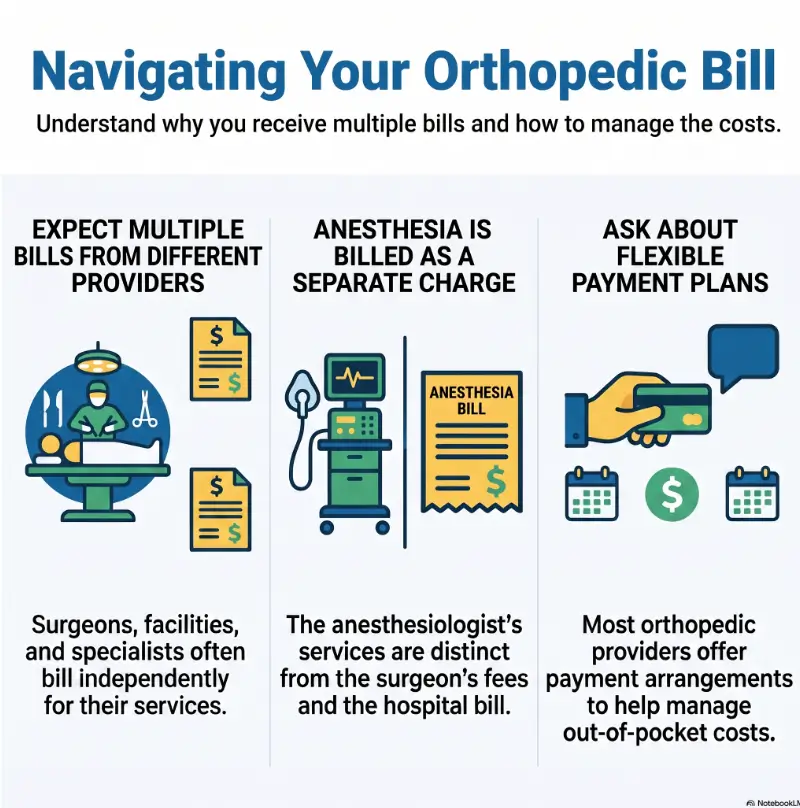
Anesthesia billing may include base units, time, and modifiers. If your anesthesia bill is separate from the surgery bill, ask whether the anesthesia group was in network, how the claim processed, and whether any surprise billing protections apply.
Ambulatory surgery center vs hospital outpatient department
An ambulatory surgery center, often called an ASC, is a facility designed for outpatient procedures. A hospital outpatient department is connected to or owned by a hospital. The setting can affect facility fees, insurance processing, and patient responsibility.
When comparing options, ask where the procedure will be performed, whether that location is in network, and whether your estimate includes facility and anesthesia charges. This is one of the most practical “best way to compare orthopedic surgery costs” questions a patient can ask.
Implants and hardware: screws, plates, anchors, and mystery math
Orthopedic procedures may involve implants or hardware such as plates, screws, rods, anchors, cages, artificial joints, or graft materials. These charges may appear under facility billing, supply lines, or implant categories.
If implant charges look large, ask whether they are included in the facility estimate, whether they were separately billed, and whether insurance allowed the amount. Do not expect the billing office to explain surgical technique, but they should be able to explain the charge category.
| Cost-check level | Good | Better | Best |
|---|---|---|---|
| Before orthopedic surgery | Ask whether the surgeon and facility are in network | Request separate estimates for surgeon, facility, anesthesia, and implants | Compare estimate, benefits, deductible status, out-of-pocket maximum, and surprise billing risks |
| Before MRI or CT | Ask if prior authorization is required | Compare imaging location options allowed by your plan | Confirm technical and professional billing, network status, and expected patient responsibility |
| Before brace or boot | Ask if insurance will be billed | Ask about cash price and DME coverage | Confirm supplier, authorization, allowed amount, return policy, and plan rules before accepting |
Call Insurance With a Script, Not a Sigh
Most patients call insurance with a perfectly human question: “Why is this so expensive?” The problem is that this question is too broad. It invites a broad answer, and broad answers are where clarity goes to nap.
Use precise questions that identify the claim, code, denial reason, and patient responsibility. The goal is not to win an argument on the first call. The goal is to leave with one written next step.
Start with the date of service, claim number, and provider
Begin with the basics. Say: “I’m calling about a claim for orthopedic care on [date of service] from [provider or facility]. The claim number is [claim number]. I’m comparing the EOB to the provider bill and need to understand the patient responsibility.”
This opener tells the representative you are not asking for general philosophy. You are asking for claim mechanics.
Ask which code created the charge
Ask: “Which service code created the amount I owe?” Then follow with: “Was that amount applied to deductible, coinsurance, copay, non-covered care, or an out-of-network charge?”
If the answer is “deductible,” ask for the allowed amount. If the answer is “denied,” ask for the denial reason and the appeal deadline. If the answer is “out of network,” ask whether surprise billing protections were reviewed.
Request a reference number before you hang up
Every important call should end with a reference number, representative name or ID if provided, date, time, and the next document needed. Keep the notes in your billing folder.
A reference number does not guarantee a result. It does give you a trail if the next representative says something different.
Call script: copy this before you dial
“I’m reviewing an orthopedic bill and matching it to my EOB. For claim number [claim number], what code created the patient responsibility, and was that amount due to deductible, coinsurance, copay, denial, non-covered care, or out-of-network processing?”
“If it was denied, what is the denial reason, what document is needed next, and what is the appeal deadline?”
“May I have a reference number for this call and confirmation of the next step?”
Real-world example: the MRI that looked denied but was not
A patient receives a $780 MRI bill after being told the scan was “covered.” The EOB shows the insurer paid $0. That sounds like a denial, so the patient prepares for battle.
But after comparing the EOB, the patient sees an allowed amount of $780 and a note saying the amount was applied to the deductible. The provider bill matches the EOB. No denial occurred. The care was covered, but the patient had not met the deductible.
That is still painful. But it changes the next step. Instead of filing an appeal, the patient asks whether the imaging center offers a payment plan, confirms HSA eligibility with their own tax professional if needed, and checks remaining deductible before scheduling follow-up services.
Common Mistakes That Cost Patients Money
Most billing mistakes patients make are understandable. You are not reviewing claims for sport. You are trying to heal, work, sleep, drive, care for someone, or get through a day without the knee doing its angry little maraca solo.
Still, a few habits can protect you from paying too early, disputing the wrong thing, or missing a deadline.
Mistake 1: paying the first bill before the EOB arrives
If the provider bill arrives before insurance finishes processing, ask the billing office whether the claim is finalized. Paying too early can create refund headaches if the claim later adjusts.
There are exceptions, such as known copays, pre-service deposits, cash-pay arrangements, or payment deadlines you choose to meet. But for unclear balances, compare first.
Mistake 2: assuming covered means free
Covered care can still create deductible, copay, or coinsurance costs. This is one of the most common and most painful insurance misunderstandings.
Before imaging, surgery, injections, or physical therapy, ask for an estimate of your cost sharing. The answer may not be exact, but it can prevent financial whiplash.
Mistake 3: fighting by phone without a paper trail
Phone calls are useful for speed. Written records are useful for memory, escalation, and appeals. Use both.
After a call, send a portal message or written note summarizing what you were told: “On June 28, I called about claim X. I was told the denial reason was Y and the next step is Z.” This gives the conversation a spine.
Mistake 4: missing the appeal deadline
If a claim is denied, the EOB or denial letter should explain appeal rights and deadlines. Put the deadline on your calendar immediately, even if you are still gathering records.
Ask exactly what documentation is needed. A successful appeal often depends less on outrage and more on boring, specific evidence: medical records, referral, prior authorization, provider letter, correct diagnosis code, or proof of network status.
| Common mistake | Why it hurts | Safer alternative |
|---|---|---|
| Paying before insurance processes | You may pay a balance that later changes | Wait for EOB or ask if claim is finalized |
| Asking only “Why so expensive?” | You get vague answers | Ask which code and cost-sharing rule created the balance |
| Ignoring small code differences | One modifier or unit can change processing | Request itemized statement and compare line by line |
| Relying only on phone calls | No durable record | Save reference numbers and send written follow-up |
| Missing appeal deadline | You may lose review rights | Calendar the deadline the day you receive denial |
Key takeaway
The bill often sounds more confident than it deserves to be. Confidence is not accuracy. Compare, question, document, then decide.
Show me the nerdy details
Orthopedic bills can change because of claim sequencing, coordination of benefits, corrected claims, modifier review, medical necessity review, network repricing, bundling edits, global surgery rules, and secondary insurance processing. A corrected claim may replace the original claim, not simply add to it. That is why a bill, EOB, and portal screenshot from three different dates may not match.
When the numbers disagree, ask the insurer whether the claim was finalized, adjusted, denied, reprocessed, or replaced by a corrected claim. Ask the provider whether their balance is based on the most recent EOB. The phrase “most recent processed claim” is your tiny lantern in the cave.
When to Seek Help Before the Bill Gets Louder
Many orthopedic billing questions can be handled with a calm document review and two or three precise calls. Others deserve help sooner, especially when the bill is large, urgent, disputed, or connected to ongoing care.
The right kind of help depends on the problem. You may need the provider’s billing supervisor, insurer appeal department, employer benefits team, patient advocate, state insurance department, Medicare plan support, workers’ compensation adjuster, or legal guidance.
The bill is large, urgent, or headed to collections
If a bill is headed to collections while a claim is still being reviewed, ask the provider in writing to pause collection activity during review. Not every provider will agree, but asking creates a record.
If you cannot pay in full, ask for a billing review before setting up a payment plan. Once you agree to a payment plan, it can become psychologically harder to keep questioning the underlying charge.
The insurer and provider blame each other
This is the classic billing ping-pong match. The insurer says the provider coded it wrong. The provider says the insurer processed it wrong. Meanwhile, you are standing there holding the paddle and the invoice.
Ask both sides for the issue in writing. Then ask for a three-way call if available. On that call, stay anchored to the claim number, code, denial reason, and requested correction.
A denied claim affects ongoing treatment
If a denial may delay surgery, imaging, injections, physical therapy, or specialist follow-up, ask the treating provider whether they can submit additional documentation, a letter of medical necessity, corrected diagnosis information, or peer-to-peer review when appropriate.
Keep the tone practical. “What documentation does the plan need to review this?” usually works better than “How dare they?” even when “How dare they?” feels emotionally accurate.
Free help versus paid help: what to compare
Start with free options when the issue is simple: provider billing office, insurer member services, employer benefits team, patient portal messages, and official consumer resources. Consider paid help or professional guidance when the bill is large, the appeal is complex, or collection risk is real.
| Option | Best for | What to verify |
|---|---|---|
| Provider billing office | Itemized statements, coding questions, payment plans | Whether the balance matches the latest EOB |
| Insurer member services | Claim processing, deductible, network, appeals | Denial reason, appeal deadline, reference number |
| Employer benefits team | Employer-sponsored plans and confusing plan rules | Whether they can escalate with the plan administrator |
| Patient advocate | Large bills, complex multi-provider disputes | Fees, scope, experience with medical billing disputes |
| Attorney or regulator | Possible legal rights, collections, surprise billing disputes | Jurisdiction, deadlines, documentation needed |
Helpful official resource
CMS explains federal surprise billing protections and where insured patients may have rights against certain unexpected out-of-network bills.

FAQ
Is an orthopedic EOB the same as a bill?
No. An EOB explains how your insurance processed a claim. A provider bill is the payment request. Compare them before paying, especially if the bill arrives before the EOB or shows a different amount.
Why did I get separate bills for one orthopedic visit?
One episode of care can involve multiple billing entities, such as the orthopedic clinician, imaging facility, radiologist, anesthesia group, surgery center, brace supplier, or physical therapy clinic. Separate bills are common, but each should still match a service you can identify.
What is a CPT code on an orthopedic bill?
A CPT code identifies the service or procedure billed. Patients do not need to memorize the codes, but they should ask what each code means if a charge is unclear, denied, duplicated, or unexpectedly expensive.
Why was my MRI covered but still expensive?
Covered does not always mean free. Your MRI may have been covered but applied to your deductible or coinsurance. The EOB should show the allowed amount, plan payment, adjustment, and patient responsibility.
Can an in-network orthopedic surgeon still create out-of-network charges?
Sometimes. The surgeon may be in network while another involved party, such as an anesthesiology group, assistant surgeon, facility, or imaging interpreter, is out of network. Ask which entity was out of network and whether surprise billing protections apply.
What does allowed amount mean on my EOB?
The allowed amount is the amount your plan recognizes for a covered service under its rules. For in-network care, your deductible or coinsurance is usually based on the allowed amount rather than the provider’s full billed charge.
Why am I billed for a brace or boot separately?
Braces, boots, slings, and similar supports may be billed as durable medical equipment. They may process under different plan rules than the office visit. Ask whether the item was covered, denied, applied to deductible, or billed through a separate supplier.
What should I do before paying a surprise orthopedic bill?
Request the itemized statement, compare it with your EOB, confirm network status, ask which code created the balance, and ask whether surprise billing protections were reviewed. Save every document and call reference number.
- Why One Orthopedic Visit Can Lead to Multiple Medical Bills
- Why You Received a Separate Anesthesia Bill After Surgery
- How to Ask for an Orthopedic Payment Plan Before a Bill Goes to Collections
Your 15-Minute Next Step Before You Pay
Set a timer for 15 minutes. Gather the provider bill, EOB, and insurance portal claim screen for the same date of service. If you do not have the itemized statement, request it before the timer ends.
Then circle five things: provider name, date of service, claim number, allowed amount, and patient responsibility. If any one of those does not match across documents, do not pay the mystery balance yet. Ask for a billing review.
The goal is not to become fluent in every billing dialect. The goal is to stop being rushed by a document you cannot read. Once you can name the charge, you can question it. Once you can question it, you can decide with a steadier hand.
15-minute checklist
- Find the EOB for the same date of service.
- Match the provider bill to the EOB patient responsibility.
- Request an itemized statement if any charge is vague.
- Circle the allowed amount, denial reason, and deductible or coinsurance line.
- Write one question for the provider and one question for the insurer.
Last reviewed: 2026-07