

HSA braces questions start with three separate facts: what the product claims, what medical purpose actually applies to you and what individual use advice you have received. A retail HSA label, a clinical recommendation and a successful card payment do not answer the same question. This guide helps prepare questions and preserve actual replies before a purchase decision; it selects no brace and makes no tax determination.
Use the six essential prepurchase checks, compare product claims, medical purpose and use instructions, read two fictional writing examples, or build the product, purpose, instructions and actual-answer record. For purchases already made, compensation, HSA payments, returns or refunds, use the separate brace and HSA transaction record guide. This article focuses on uncertainty before buying, not another payment ledger.
Symptoms need assessment before a shopping or HSA answer. MedlinePlus advises contacting a provider for substantial joint pain, swelling or numbness, inability to put weight on the joint, or an old injury becoming more swollen or unstable. A suspected dislocation is an emergency. With back pain, new bladder/bowel changes, loss of feeling around the genitals or anus, symptoms in both legs such as weakness or numbness, or pain after a serious accident needs emergency assessment. Use appropriate local urgent/emergency services, including 911 for U.S. emergencies. These selected examples are not a complete triage list. Do not wait for a product comparison, tax answer or routine reply. MedlinePlus joint guidance; NHS back-pain guidance.
This is caregiver-written education, not individual medical, insurance, legal or tax advice. The operator is not a professional adviser. HSA discussion concerns U.S. federal rules; personal circumstances and the applicable tax year need appropriate review. A helper should respect the person’s permission and preferences. An incomplete symptom description or unanswered question does not make pain less credible or prevent asking for help.
Table of Contents
HSA braces: six essential questions before buying
| Check | Known fact to record | Question when unresolved |
|---|---|---|
| 1. Exact product | Model, source and whether the device is proposed, supplied or already in use. | Which exact item are we discussing? |
| 2. Product claim | Seller/manufacturer wording and source/date, kept separate from individual advice. | What does the claim actually say, and what does it not establish? |
| 3. Individual medical purpose | Your concern and any actual clinical explanation, with their sources distinct. | What purpose has been explained for my situation? |
| 4. Actual use instructions | Individual device, fit, settings and use advice actually received. | What instructions are missing or need clarification? |
| 5. Product difference or uncertain HSA point | A/B model differences, proposed substitution and separate clinical/tax questions. | Who can explain this difference within their role? |
| 6. Real answer and next owner | Answering role, date, product scope, remaining question and actual agreement. | What was answered, what remains open and who acts next? |
These are question prompts, not eligibility criteria or a mandatory buying sequence. No completed checklist means “buy,” “wait 24 hours,” “wear for a week” or “HSA approved.” A missing item is a question to clarify. You do not have to describe a particular symptom pattern, prove a treatment failed or complete an activity test to ask for assessment.
Compare product claims, medical purpose and actual instructions
| Information layer | What it can tell you | What it cannot establish |
|---|---|---|
| Seller or manufacturer statement | The intended use, specifications or marketing wording for an exact model. | That the item is suitable for you or your expense qualifies for tax-free HSA treatment. |
| Personal concern | The problem you want help with and experiences already noticed. | A diagnosis, required support level or permission to change movement restrictions. |
| Actual clinical explanation | Purpose and individual recommendation actually provided by the relevant team. | That a different model is equivalent or every HSA condition is met. |
| Individual use advice | Real instructions about the device and its use, with source/date. | A generic product leaflet can safely replace missing or conflicting personal advice. |
| HSA guidance or actual tax advice | The applicable rule or an adviser’s answer within its real scope. | Clinical suitability, a wearing schedule, insurance approval or a product endorsement. |
| Card accepted at checkout | A payment transaction was accepted. | Final clinical or tax qualification of the expense. |
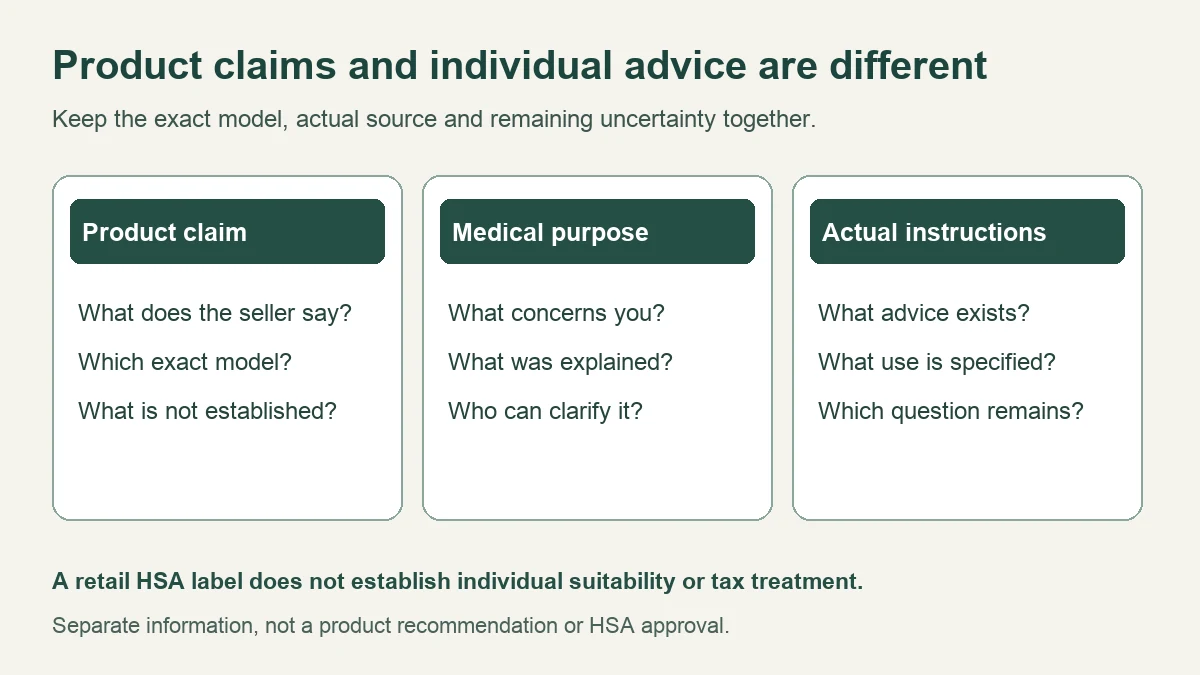
Use the exact model when asking questions. “Knee brace” or “back support” may hide important differences. If several items are involved, label them A/B and keep the same labels in the product, instruction and reply fields. Do not infer equivalence from similar photographs, “medical grade” language, shared branding or a lower price.
Save a product claim accurately rather than strengthening it. A screenshot may help identify what was advertised, but it cannot create an individual medical purpose. A person’s memory of a clinical conversation is also different from the actual document or the clinician’s new explanation. Mark the source and uncertainty instead of rewriting either to sound more persuasive.
Ask about individual suitability without selecting a brace from symptoms
Describe your concern and ordinary experiences already noticed, then ask what evaluation or support advice fits the situation. This article does not match knee pain to compression, instability to hinges or typing discomfort to a particular splint. A body part and activity trigger are useful context, not enough information to prescribe a device.
A practical question is: “This is the exact product I am considering. Does it match the purpose and advice you have explained, and what is still unclear?” If you have no individual recommendation, say that rather than inventing one. Ask for clinical help when appropriate; there is no requirement here to obtain a prescription or a tax adviser’s opinion for every ordinary purchase.
Keep fit, model, settings, activity restrictions, wearing/removal advice and follow-up questions together when they are relevant. Ask who can explain or demonstrate the actual device and what to do if instructions conflict. Do not change a prescribed stabilizing device or load an injured area to see whether a substitute “works.” A product review or completed form cannot give that clearance.
Longer use is not automatically harmful, and shorter use is not automatically enough. The need and schedule depend on the actual situation and instructions. No three-to-seven-day flare window, universal one-week trial, walking-distance target or typing test is supplied here. Record existing experience rather than testing endurance to justify a purchase or improve cost per wear.
If you already use a support and develop increased pain, numbness, tingling, burning, marked swelling or loss of active finger/toe movement, obtain appropriate clinical advice promptly; loss of active movement needs urgent evaluation. AAOS describes these warnings for casts and splints, not every retail brace. For a prescribed stabilizing device, use the treating team’s urgent instructions; this guide cannot decide whether removal or adjustment is safe. Concerning changes should not wait for an HSA answer.
A proposed alternative needs its own question and actual answer
When the advised model is unavailable or difficult to afford, preserve the problem without silently replacing the recommendation. Ask the treating or fitting team what differences matter and whether the proposed alternative matches the individual plan. Ask the seller for factual product details within its role; do not ask it to override clinical restrictions.
| Proposed difference | What to preserve | Question to take to the relevant role |
|---|---|---|
| Different model or support construction | Model A advice, proposed Model B and actual known specifications. | Does this change matter for the purpose and use instructions? |
| Different sizing or fitting process | Actual manufacturer information and fitting help offered or unavailable. | Who should clarify the fit for this device and person? |
| Different availability, price or return terms | Real offer and conditions, without treating price as a clinical comparison. | What practical options can be discussed without changing the recommendation on my own? |
| Different use leaflet or seller advice | Both sources and the exact point of disagreement. | Who can clarify the individual instruction before I infer a replacement rule? |
These are uncertainties, not a ranking of brace types. A rigid-looking product is not automatically better or worse; the relevant question is whether the exact item fits the actual purpose and advice. Availability, returnability or successful payment does not settle that question. Keep the unresolved clinical point visible even when a purchasing option appears convenient.
What the IRS sources establish about HSA expenses
IRS Publication 502 explains the general medical-expense purpose standard, including equipment and supplies needed for medical care, and distinguishes medical purposes from general health benefit. It is not a catalog approving every brace. Do not turn a seller’s “support,” “recovery” or “stability” wording into an individual tax conclusion.
IRS Publication 969 explains HSA distributions and recordkeeping. Tax-free use concerns qualified expenses incurred after the HSA was established; records must support the expense and avoid reimbursement from another source or a duplicated itemized deduction. HSA contribution eligibility is a separate question. The relevant person, timing and circumstances still matter.
Ask about an uncertain item with its exact description and truthful personal purpose, not a request to create an approval-friendly story. A clinical recommendation may be relevant evidence, but it is not a universal tax ruling. This guide does not impose a medical-necessity letter on every brace purchase or promise that obtaining one makes any item qualified. Ask a qualified tax adviser about uncertainty in the actual circumstances.
Keep HSA administration, insurance benefits and clinical advice separate. An account contact can explain its transaction or document process; the plan can answer relevant insurance questions; the clinician addresses individual suitability and use. Record each actual answer within that role’s scope. Neither a store label nor an accepted HSA card resolves all of these questions.
| Source or role | Appropriate use here | Boundary |
|---|---|---|
| IRS Publication 502 | General medical-purpose concepts. | Its itemized-deduction guidance is not a complete HSA procedure or product clearance. |
| IRS Publication 969 | HSA-specific distribution and recordkeeping context. | Not a clinical guide to choosing, fitting or wearing a brace. |
| Qualified tax adviser | Clarification about a real expense and relevant circumstances. | No diagnosis, product fitting or movement restriction. |
| Treating/fitting team | Individual purpose, suitability and actual use questions. | No blanket promise of HSA treatment or insurer payment. |
The title “HSA braces” is a topic label, not a claim that every device discussed is eligible. General guidance and writing examples do not establish a personal result. Preserve an unanswered tax question as unanswered; do not let it become a reason to delay needed assessment or to use a device outside actual instructions.
Prepare a short question and preserve the real reply
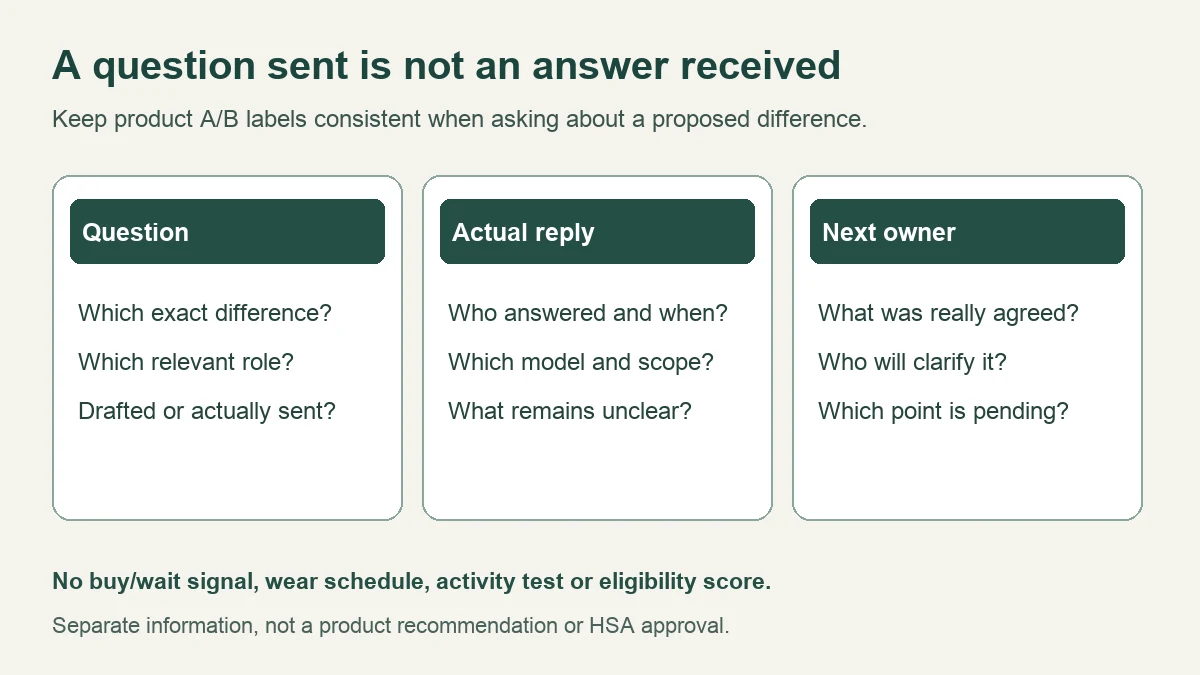
A useful question has an exact item, the actual information you already have and one unresolved point. For example: “Product B is being proposed instead of the model named in my advice. Which differences need checking, and who can clarify the use instructions?” That is a request for clarification, not an assertion that the two devices are interchangeable.
For an uncertain HSA issue, a separate question can identify the actual item, purpose, expense context and missing rule. Omit account identifiers from public tools. Keep clinical records and tax documents in appropriate private channels, sharing only what the relevant professional actually needs. Do not paste full records into public comments or the on-page demonstration.
| Actual status | Record it as | Avoid inferring |
|---|---|---|
| Question prepared | Draft; not sent. | A professional has reviewed it. |
| Contact made or question sent | Actual contact and date if known. | Receipt, an answer or approval. |
| Reply received | Real wording, answering role, date and exact product scope. | That another role or model is covered by the same answer. |
| Some points remain unclear | Unanswered item or conflict with both sources. | Silence means agreement or that a general webpage is a personal answer. |
| Next action agreed | Actual owner, action and follow-up arrangement. | A purchase, payment or device change has been carried out. |
After a reply, update the matching product entry. If advice changes, preserve the date and source instead of overwriting the old context without explanation. An answer about use does not silently answer a tax question, and a tax answer does not clear a substitute device. No standard callback deadline or mandatory waiting period is created by this record.
Two fictional prepurchase writing examples
These examples demonstrate recording only. They are not real cases, product recommendations, prescriptions, tax opinions or HSA approvals. Neither example supplies a use schedule, symptom test, buy-now signal or instruction to wait. The tool’s example buttons replace entries and clearly label the output fictional.
Example A: HSA label, individual purpose still unconfirmed
| Record area | Fictional entry |
|---|---|
| Product / claim | Retail back support, exact model not supplied. Seller displays an HSA eligible label in this fictional example. |
| Purpose / instructions | Reader has a support concern. No actual individual medical-purpose explanation or use advice supplied. |
| Question / contact | Separate clinical and uncertain tax questions prepared for the relevant roles; not sent. |
| Actual reply / next owner | No real answer supplied. Preserve what remains unknown and record actual replies. No device, purchase or tax result selected. |
The useful result is recognizing that a retail label answers less than the reader needs. Do not invent a diagnosis or start a wear trial to make the record sound medical. Seek appropriate assessment for concerns without waiting to complete a shopping form.
Example B: similar lower-priced model, reply pending
| Record area | Fictional entry |
|---|---|
| Products A/B | Model A is named in existing advice in this fictional example. Model B is a proposed alternative; actual models are not supplied. |
| Known difference | Model B looks similar and costs less in the fictional example. Equivalence and any changed instructions remain unconfirmed. |
| Question / contact | Question about relevant differences and individual instructions sent to the treating/fitting team; receipt unconfirmed and reply pending. |
| Actual reply / next action | No professional answer received. Record the real reply and actual agreement; no substitution, purchase or change to instructions selected. |
A practical barrier can be discussed without turning it into permission to substitute. Keep the clinical question separate from any HSA question. A lower price, return policy or similar appearance does not fill the unanswered fields.
Private prepurchase question and actual-answer tool
Download the offline tool before entering actual health, tax or personal notes. Use fictional entries here because the surrounding page may contain ads and analytics. The tool sends nothing, uses no browser storage and does not automatically save. Its offline copy contains no external assets or automatic network requests. Keep completed files and exports private.
Use matching A/B labels for products across the fields. Unknown, not asked and reply pending are valid. A paper note with the same headings works. This is a question organizer, not a clinical assessment, shopping recommendation or eligibility calculator. Do not enter names, account numbers or full records in the public demonstration.
Before buying a brace: product, purpose, instructions and actual-answer record
Keep the product claim, individual medical purpose, actual use instructions and unanswered question separate. Use matching A/B labels for products. This organizer recommends no device or purchase and makes no HSA tax determination.
Download the offline tool before entering actual health, tax or personal notes. Use fictional entries here; the surrounding site may contain ads and analytics.
Offline copy. This file has no ads, analytics, external assets or automatic network requests.
The tool uses no network requests, browser storage or automatic saving. Refreshing or closing may lose entries. Keep exports private; omit names, account numbers and complete medical or financial records. Needed assessment must not wait for a purchase decision, paperwork or a routine reply.
Start with the fictional example or download a blank offline copy.
Paper alternative: exact product; claim/source; actual medical purpose; individual instructions; A/B differences; fitting/help question; uncertain HSA question; existing documentation; contact; real reply; unresolved point; next owner. Unknown and pending are valid.
My brace product, purpose, instructions and actual-answer record
Unverified personal record for discussion. Entries verify no product suitability, individual instruction, purchase recommendation or HSA qualification.
Guide: living.kioptrix.com/hsa-eligible-braces-and-supports/
After an edit, rebuild the record, then copy, download text or print it. An offline download includes current entries, so keep it private. Exporting does not contact a professional, order a product, pay with an HSA or submit a claim. A fully filled record still verifies no clinical or tax fact.
Once there is an actual purchase or financial change, use the brace instructions, purchase, compensation and HSA payment record. That companion tracks transactions and later changes. This page remains the prepurchase place to compare claims with actual advice and unresolved questions.
Common HSA braces questions before buying
Does an HSA eligible label mean this brace is right for me?
No. Individual suitability and tax treatment are separate. Record the exact item, actual purpose and use advice, then ask the relevant role about the missing point.
Does a successful HSA card payment settle tax qualification?
No. A payment transaction does not replace the applicable expense rules or supporting records. Keep the uncertain question separate from card acceptance.
Should I try the brace for a week to prove it helps?
This guide supplies no universal trial or activity test. Follow actual individual instructions and seek appropriate help for new concerns. Do not provoke symptoms or change a prescribed schedule to improve cost per wear.
Can I buy a similar model instead of the advised one?
Similarity and price alone do not establish equivalence. Ask the relevant treating/fitting team about exact differences and instructions; this organizer chooses no substitute.
Do I always need a prescription or medical-necessity letter for HSA braces?
This article creates no blanket documentation requirement. The exact expense and circumstances matter; ask an appropriate tax professional about uncertainty. A document does not turn an unrelated general-wellness expense into medical care.
Can this tool decide whether I should buy or wait?
No. It preserves unverified claims, actual advice, questions and real replies. It gives no buy/wait result, fitting clearance, tax-free amount or HSA approval.
Sources, corrections and review limits
- IRS Publication 502: Medical and Dental Expenses — general medical-purpose context; not a product recommendation.
- IRS Publication 969: Health Savings Accounts and Other Tax-Favored Health Plans — HSA distributions, expense conditions and records; not orthopedic treatment guidance.
- MedlinePlus: Joint Disorders — selected joint-assessment warnings, not a brace-selection table.
- AAOS: Care of Casts and Splints — specific immobilization context and warning signs, not a universal retail-brace protocol.
- NHS: Back pain — selected emergency warnings, not U.S. tax rules.
Source check and editorial update: October 29, 2026. Removed the arbitrary purchase pause, eligibility checklist, coverage tiers, wear-day calculator, fixed use windows and activity tests. Replaced symptom-to-product shopping advice and misleading source labels with separate claims, individual purpose, actual instructions and real replies. The existing URL, original publication date, author and classification are retained.
This caregiver-created organizer is not a validated clinical or tax instrument. No independent medical/tax review, reader usability study, product testing, tax approval or health outcome is claimed. The featured image is AI-generated fictional artwork; diagrams distinguish information rather than endorse a product or buying sequence. Our background and editorial approach.