
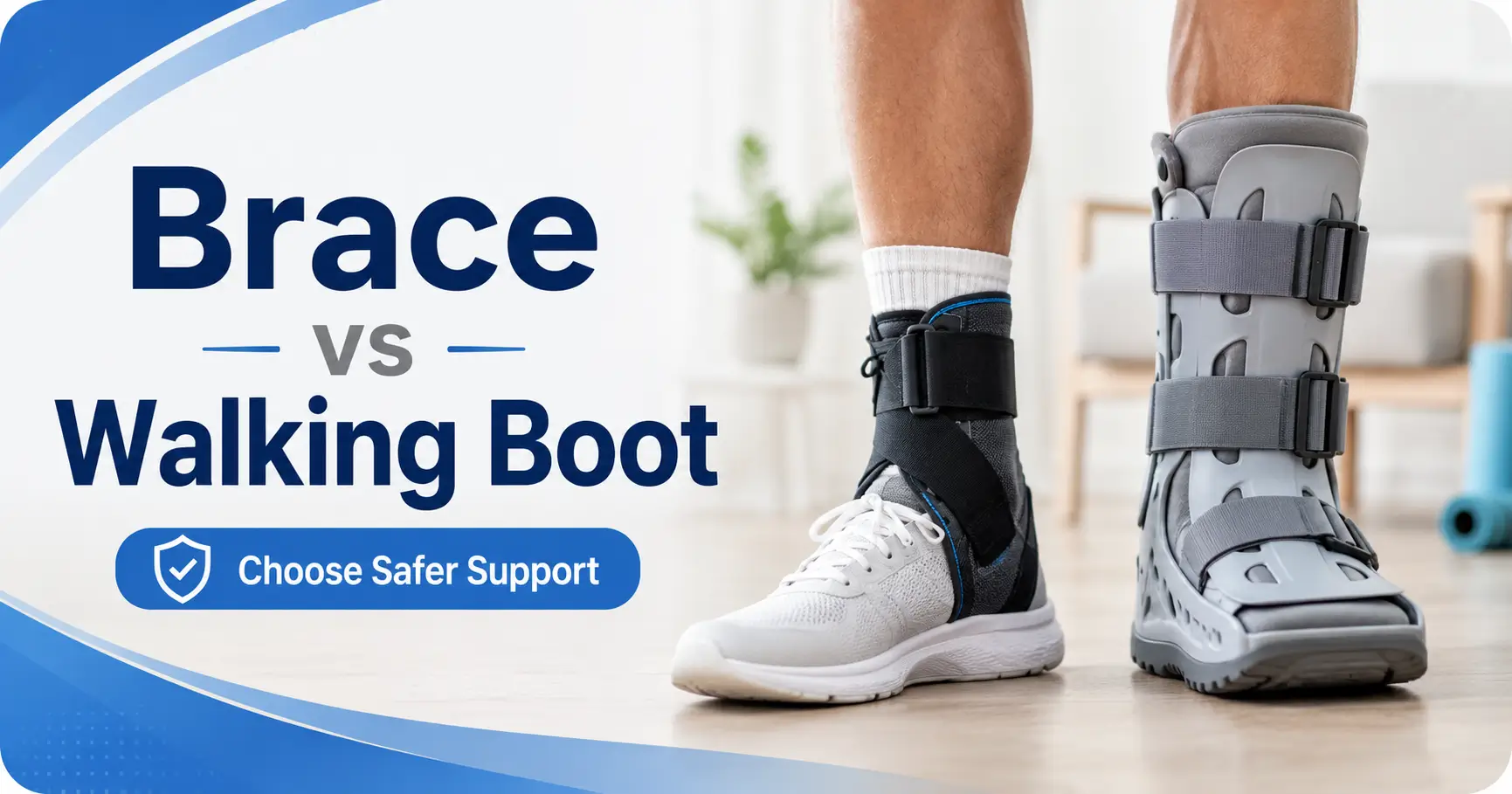
Daily walking support without the guesswork
Ankle Brace vs Walking Boot for Daily Tasks:
Choose the Safer Support
A sore ankle has a way of shrinking the world. The grocery aisle feels longer. The stairs gain a personality. A normal commute becomes a small negotiation between pain, pride, and the quiet hope that today will not make tomorrow worse.
The hard part is that both an ankle brace and a walking boot can look sensible from the outside. One feels lighter and more normal. The other feels more protective and official. But the safer choice depends on what your ankle is telling you, what your day requires, and whether your injury needs movement, protection, or medical evaluation first.
This guide compares an ankle brace vs walking boot for everyday walking, errands, school, chores, and work. It will not diagnose your injury. It will help you avoid the classic ankle-recovery trap: buying the thing that feels reassuring while missing the signs that your ankle needs a different plan.
Choose with context
Match the device to pain, swelling, walking quality, and the tasks you actually do.
Avoid costly mistakes
Know when a simple brace is enough and when buying a boot is not the clever shortcut.
Walk smarter tomorrow
Use a task pain log to decide whether daily life is improving or quietly poking the bruise.
The best support is not the stiffest support. It is the support that matches the injury, the task, and the next safe step. 🦶
Snapshot
This article is for adults comparing an ankle brace vs walking boot after a mild-to-moderate ankle injury. It helps you sort daily tasks, safety signals, fit issues, cost questions, and when to ask a clinician before choosing. By the end, you will have a simple 15-minute task pain log to guide your next move.
Table of Contents
Before You Choose: Don’t Guess Through Pain
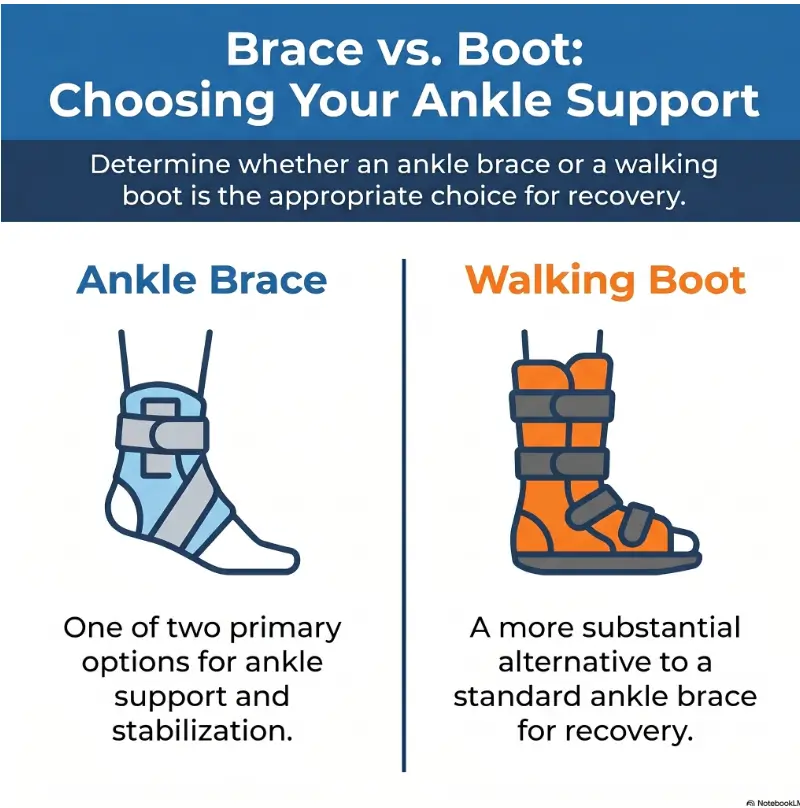
An ankle brace usually works better when the ankle can move safely but needs support. A walking boot is more restrictive and is often used when protection matters more than normal motion.
That sounds simple until you are standing in your kitchen, one sock half-on, trying to decide whether the day calls for a brace, a boot, or a phone call. Ankles are small architecture. When the foundation complains, the whole building changes how it walks.
Before you act
This article is educational and cannot diagnose a sprain, fracture, tendon injury, nerve issue, infection, or post-surgical complication. Use it to organize your thinking, compare support options, and prepare better questions. Confirm important decisions with a qualified clinician, especially if pain, swelling, bruising, instability, numbness, or weight-bearing problems persist.
When self-care is reasonable for a short window
Self-care may be reasonable for a short window when the injury seems mild, you can bear weight without limping badly, swelling is not dramatic, and symptoms improve with rest, elevation, compression, and careful activity reduction.
In that setting, a supportive ankle brace can act like a handrail for daily tasks. It does not erase the injury. It simply gives the ankle a calmer boundary while swelling settles and walking becomes more normal.
When swelling, bruising, or instability changes the decision
More swelling, deeper bruising, sharp pain over bone, or a feeling that the ankle may buckle changes the whole conversation. At that point, the question is not “Which support feels better?” It is “Do I need an evaluation before I keep walking on this?”
A boot may be part of the plan for a more serious sprain or protected weight-bearing, but it should not be used as a costume for certainty. If the injury is more than mild, the safer move is often to check first, then choose the device.
When to seek help before choosing brace or boot
Seek urgent care for severe pain, severe swelling, obvious deformity, an open wound, signs of infection, numbness, coldness, or inability to put weight on the foot. Schedule care when swelling is not improving after several days, pain persists, or daily walking keeps getting worse instead of better.
The Mayo Clinic ankle pain guidance is a useful reference for deciding when ankle pain needs medical attention.
If you are preparing for an appointment, this related guide can help you bring better notes instead of a foggy memory: orthopedic visit checklist.
Brace, Boot, or Call First? The 30-Second Choice
Here is the practical split: a brace supports movement; a boot limits movement. That difference matters during daily tasks because your ankle is not just healing while you sit. It is being tested by stairs, parking lots, kitchen corners, pets, school pickup, office floors, and the ancient athletic event known as “carrying groceries in one trip.”
Choose a brace when movement is safe but support is missing
An ankle brace may fit best when you can walk without major compensation, pain is mild-to-moderate and improving, swelling is manageable, and the main issue is that the ankle feels untrustworthy during normal tasks.
For example, a desk worker who can walk across the room but feels nervous on uneven sidewalks may do better with a lace-up or semi-rigid brace than with a boot. The brace allows more normal motion while adding structure.
Choose a boot when protection matters more than normal motion
A walking boot may make sense when a clinician recommends protected weight-bearing, when a sprain is more significant, or when the injury involves a stable fracture, tendon issue, or post-injury plan that needs immobilization.
The key word is “plan.” A boot is not automatically safer because it looks serious. It is safer when the injury needs restriction and the boot fits properly, is used as directed, and does not create new problems up the chain in the knee, hip, or back.
Call first when walking changes your face
If every step makes you wince, twist your body, hold your breath, or negotiate with furniture, do not turn the living room into a private obstacle course. Call a clinician, urgent care, or orthopedic office and ask what level of evaluation is appropriate.
For US readers deciding where to go, this comparison may help: urgent care vs orthopedic clinic.
Key takeaway
Brace when safe movement needs support. Boot when the ankle needs protection and restricted motion. Call first when weight-bearing, swelling, bruising, instability, or pain makes the choice feel like guesswork.
| Situation | Usually points toward | Why it matters |
|---|---|---|
| Mild sprain, improving, can walk mostly normally | Ankle brace | Supports daily movement without fully freezing the joint |
| More painful sprain, protected weight-bearing plan | Walking boot or clinician-directed support | Limits motion while the injury calms down |
| Cannot bear weight, deformity, severe swelling, numbness, open wound | Medical evaluation first | May require imaging, urgent care, or a different treatment plan |
| Recovery stage, ankle feels weak on uneven ground | Brace plus rehab guidance | Provides confidence while strength and balance return |
Daily Task Scorecard: What Each Device Makes Easier
The right support can look different at 8 a.m. and 8 p.m. A brace may be perfect for short walks around the house but too light for a long shift. A boot may protect the ankle in a parking lot but turn stairs into a small engineering project.
Walking around the house
For mild injuries, a brace usually feels less clunky indoors. It allows a more natural step, which may reduce compensation through the knee, hip, and lower back.
A boot can be useful when you are supposed to limit ankle motion, but it is bulky. Rugs, thresholds, pets, laundry piles, and bathroom tile can become tiny villains. Clear your walking path before you trust the boot to do all the protecting.
Grocery runs, errands, and parking lots
A brace may be enough for a short errand if you are walking evenly and pain is controlled. A boot may provide better protection if the errand includes long distances, unpredictable crowds, or uneven pavement.
The hidden issue is fatigue. A device that feels fine for ten minutes can feel very different after forty minutes, especially when you are carrying bags or pushing a cart. That is where a task pain log becomes more useful than memory.
Work shifts, school, and commutes
A teacher, nurse, retail worker, warehouse employee, college student, and remote worker do not have the same ankle day. Standing time, floor type, commute length, and ability to sit matter as much as the device itself.
If you must stand for hours, ask whether modified duties, a stool, shorter shifts, remote work, or a temporary parking adjustment is possible. The brace vs boot decision should not carry the whole day on its little plastic shoulders.
Driving, stairs, and showering
Driving in a walking boot can be unsafe, especially if the boot is on the right foot or affects your ability to brake quickly. Ask your clinician and check your local rules and insurance expectations before driving.
Stairs also change the math. A brace may allow more normal stair mechanics if the injury is mild. A boot may require slower steps, handrail use, and possibly help carrying items. For bathroom safety, treat wet floors with deep suspicion. Tile is not sentimental.
| Daily task | Ankle brace | Walking boot | Safer planning note |
|---|---|---|---|
| Household walking | Usually easier for mild injuries | More protective but bulkier | Remove trip hazards before testing longer walks |
| Groceries | Good for short, controlled trips | Better if protection is needed | Use delivery or smaller trips if pain rises |
| Standing work | May be more tolerable for motion | May protect but can fatigue the leg | Ask about modified duties or sitting options |
| Stairs | Can feel more natural | Often slower and awkward | Use the handrail and avoid carrying heavy items |
| Driving | May still affect control if painful | Often a red flag without clearance | Get clinician guidance before driving in a boot |
The Hidden Trade-Off: Stability vs Stiffness
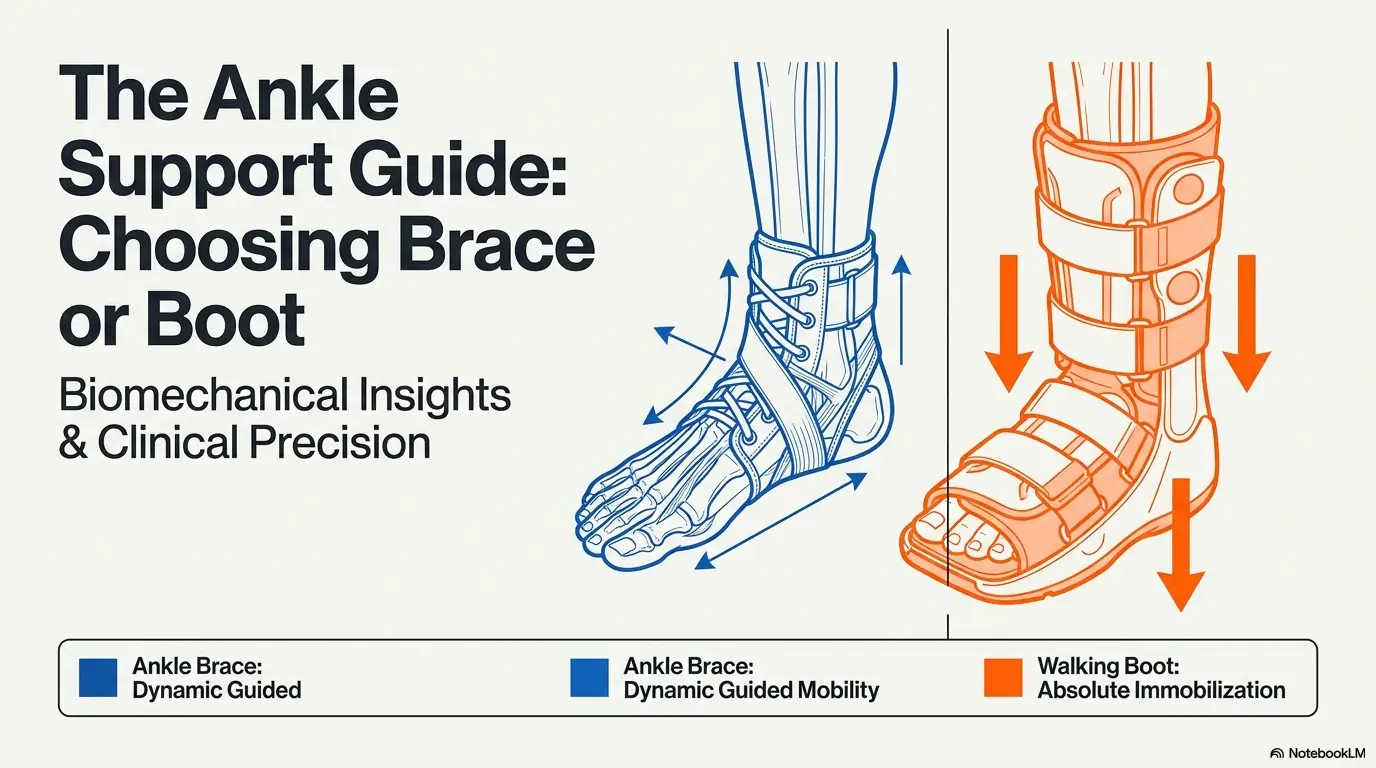
The brace vs boot comparison is really a trade-off between stability and stiffness. More restriction can protect an irritated injury. Too much restriction for too long can make normal movement feel rusty, especially if rehab work is ignored after swelling improves.
Why a boot can protect today but feel awkward later
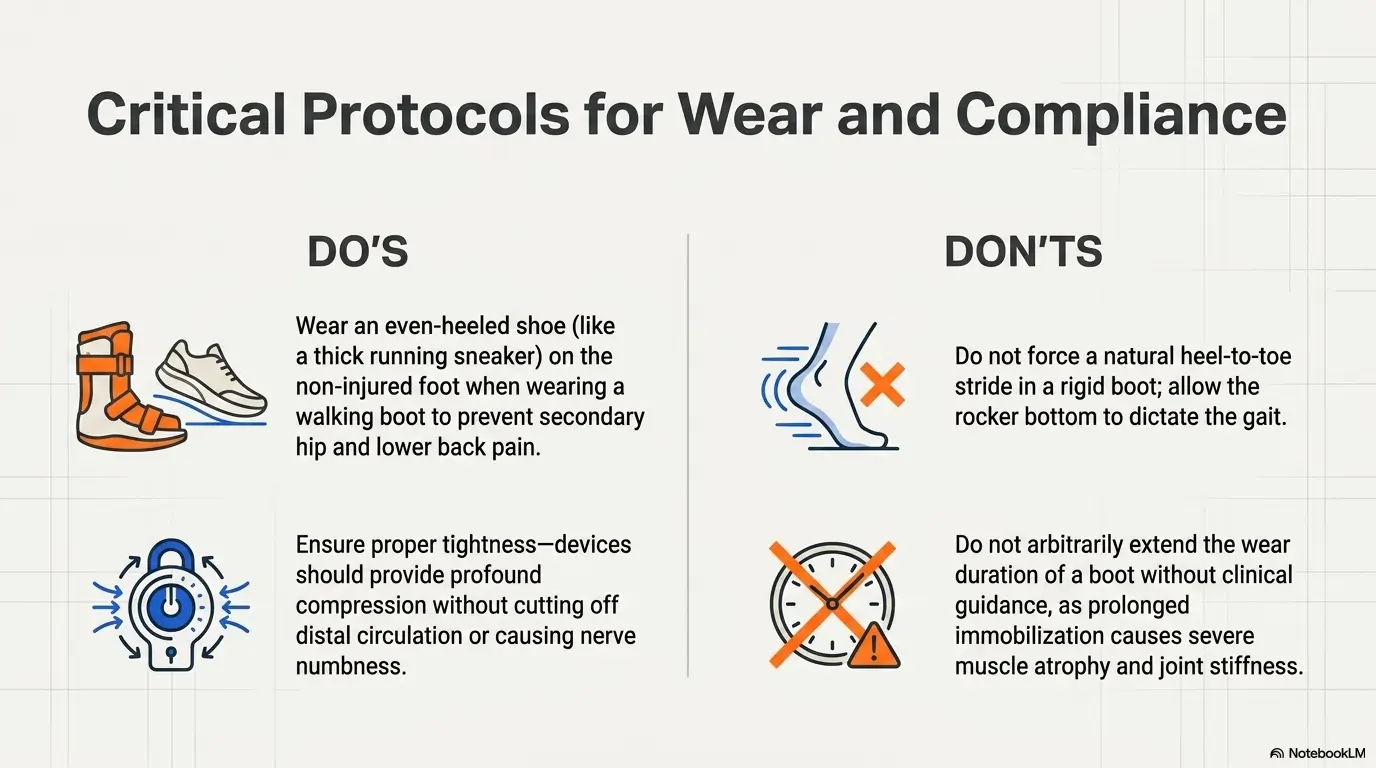
A walking boot reduces ankle motion. That can be helpful when the ankle needs a quiet room. But walking in a boot can also change stride length, foot position, and leg height. The other leg may need a taller, stable shoe to reduce lopsided walking.
This does not mean boots are bad. It means they are tools, not furniture. Use one when it fits the clinical reason, and ask how long you should wear it, when to remove it, and what signs mean the plan needs review.
Why a brace can support healing without freezing the joint
A brace limits risky movement while still allowing some ankle motion. That can be useful when symptoms are improving and you are returning to ordinary walking, errands, and work tasks.
Lace-up braces and semi-rigid braces often provide more control than a soft sleeve. A compression sleeve may feel nice, but for a wobbly ankle, it may be more cozy sweater than safety rail.
Comfortable is not the same as safe
Comfort matters, but it is not the final judge. A brace can feel comfortable because it is too loose. A boot can feel safe because it is stiff, even when it is causing a limp or rubbing your skin raw.
The better question is: “After this device, do I walk more evenly, swell less by evening, and recover better the next morning?” That is the quiet truth-teller.
Show me the nerdy details
Ankle sprains often affect ligaments that help resist unwanted rolling or twisting. Support devices manage force in different ways. A brace allows controlled motion while resisting excessive inversion, eversion, or rotation depending on design. A boot reduces ankle motion more broadly and changes how forces travel through the foot, ankle, knee, hip, and back.
That is why “more support” is not automatically better. The safest amount of support is tied to injury severity, weight-bearing tolerance, swelling, task load, and recovery phase.
Once pain and swelling improve, many recovery plans shift toward range of motion, strength, balance, and gradual return to activity. Ask your clinician which phase you are in before treating the boot or brace as a permanent answer.
For general medical guidance on sprained ankle care and treatment options, the Mayo Clinic sprained ankle treatment page is a helpful reference.
When an Ankle Brace Fits Daily Life Better
An ankle brace is often the more practical daily-task choice when the injury is mild, walking is improving, and the ankle needs confidence rather than full restriction.
Mild sprain errands: the brace as a confidence rail
Think of the brace as a portable boundary. It can remind your ankle not to wander into risky positions while still letting you move through the day with less clatter and less bulk.
This can be useful for short errands, light chores, school walking, desk work, and calm household movement. It is not permission to mow the lawn, sprint to a bus, or test your ankle against a suspicious curb.
Uneven sidewalks, school pickup, and office hallways
Daily life is full of ankle ambushes: uneven sidewalks, parking-lot slopes, hallway turns, elevator thresholds, loose gravel, and backpacks abandoned in hallways like tiny land mines.
A brace can be useful in these settings if your ankle is already tolerating basic walking. It may reduce the chance of rolling the ankle again during the vulnerable recovery phase.
When a lace-up brace beats a soft sleeve
A soft sleeve may provide compression and warmth, but it may not offer enough mechanical control for an ankle that feels unstable. A lace-up brace, stirrup-style brace, or semi-rigid brace may provide more support during walking tasks.
Budget-conscious readers should compare support level before price. Buying the cheapest sleeve twice can cost more than buying the right level of support once.
Key takeaway
An ankle brace is usually best for daily tasks when you can walk safely but need extra support, especially during recovery-stage errands, office movement, school walking, or uneven surfaces.
When a Walking Boot Makes More Sense
A walking boot may be the better option when normal ankle motion is not your friend yet. It gives the ankle a protected frame, which can be useful for more significant injuries or specific clinician-directed recovery plans.
More serious sprains: protected weight-bearing without heroics
For more painful sprains, a boot can reduce motion and make protected walking more manageable. This is especially relevant when a clinician tells you to bear weight only as tolerated, use crutches, or avoid certain ankle movements.
The American Academy of Orthopaedic Surgeons notes that support options vary with sprain severity, and more serious sprains may require a period of immobilization or a supportive device.
Stable fracture or tendon-injury scenarios
Some stable fractures, tendon injuries, or post-injury plans may involve a walking boot. Those are not “brace or boot?” shopping decisions. They are medical-plan decisions.
If a clinician has already prescribed a boot, ask whether you should wear it indoors, outdoors, at work, during sleep, or only while walking. Also ask when to transition out of it and what symptoms should prompt a follow-up.
The big shoe problem
A walking boot often raises one side of your body. If the other shoe is too low, you may walk unevenly, which can irritate the knee, hip, or back.
Ask whether you need a stable shoe on the other foot, a temporary shoe leveler, crutches, or a different plan for longer walking days. Do not solve one ankle problem by starting a hip-and-back group chat.
Short Story: The boot that made the errand too big
Marla put on a walking boot for her sore ankle because it made the injury feel official. She planned one small grocery run. Milk, eggs, apples, and out.
Twenty minutes later, the boot felt heavy, her other hip felt annoyed, and she was leaning on the cart like it had become a ship railing. Her ankle hurt less, but the rest of her body had filed complaints.
The next morning, she called her clinic. The advice was simple: shorter walking, better shoe height on the other foot, and a clear plan for when to use the boot. The lesson was not that the boot was wrong. The lesson was that a support device is only one part of the day. The errand, the floor, the distance, and the other leg all get a vote.
Fit, Comfort, and Cost: What to Compare Before Buying
Buying ankle support is one of those small purchases that can become oddly expensive if you guess wrong. The goal is not to buy the most intense device. The goal is to buy the least complicated support that safely matches your situation.
Brace fit: snug support without numbness
A brace should feel snug and supportive, not sharp, pinching, or circulation-stealing. Your toes should not tingle, turn cold, or change color. Swelling may change through the day, so fit can change too.
Try the brace with the shoes you actually wear. A bulky brace that only fits into one old sneaker may fail the real-life test before it reaches the driveway.
Boot fit: heel seated, straps secure, toes visible
In a walking boot, your heel should sit back in the boot, straps should be secure, and your toes should remain visible and comfortable. Sharp rubbing, heel lift, slipping, or pressure sores are not normal background music.
If the boot was provided by a clinic, ask them to check fit. If you bought one yourself, be extra cautious. A poorly fitted boot can make you limp differently and may irritate skin or joints.
Good / Better / Best support comparison
Cost varies by type, materials, adjustability, and where you buy. Insurance, HSA, FSA, and clinic billing can also change the real out-of-pocket price. Before paying, compare function first and price second.
| Option | Best fit | What to compare before paying | Watch out for |
|---|---|---|---|
| Good: compression sleeve | Mild swelling, light support, comfort | Compression level, fabric, shoe fit | May not control instability enough |
| Better: lace-up ankle brace | Mild-to-moderate support during walking | Adjustability, side support, ease of use | Can be too loose or bulky in shoes |
| Best for more control: semi-rigid brace | Recovery-stage instability, uneven ground | Side stays, hinge design, shoe compatibility | May feel stiff if too much support is chosen |
| Clinician-directed: walking boot | Protected weight-bearing or immobilization plan | Fit, height, liner, return policy, provider guidance | Can alter gait and daily function |
For tax-advantaged spending questions, this internal guide may be useful: HSA-eligible braces and supports.
Questions to ask before buying
- Is this device meant for mild support, moderate stability, or immobilization?
- Can I wear it with my normal shoe?
- Will it work for stairs, work, and errands, or only sitting at home?
- Can it be adjusted as swelling changes?
- What is the return policy if fit is wrong?
- Should a clinician check my ankle before I rely on this?
- Will insurance, HSA, or FSA rules affect the true cost?
Buyer checklist
- Bring or wear the shoe you plan to use with the brace.
- Check return rules before opening or wearing the device outside.
- Look for pressure points after 10 to 15 minutes of walking.
- Track swelling at night, not only comfort at purchase time.
- Ask your clinician whether the device matches your injury phase.
Common Mistakes That Delay Recovery
Ankle recovery can be derailed by very ordinary decisions. Not dramatic ones. Not mountain-rescue decisions. Small, domestic choices: one more errand, one loose brace, one boot worn because it feels safer than asking questions.
Mistake 1: wearing a brace so loose it becomes ankle jewelry
A loose brace may feel comfortable but provide little useful support. It should not slide around, bunch under your foot, or create the illusion of care without actually guiding the ankle.
Mistake 2: using a boot because it feels serious
A boot can be the right tool, but seriousness is not the same as fit. If you use a boot without understanding why, when, and for how long, you may protect the ankle poorly and stress the rest of the body.
Mistake 3: skipping range-of-motion after swelling improves
After pain and swelling improve, recovery often involves gradually restoring motion, strength, flexibility, and balance. Do not assume that the absence of dramatic pain means the ankle is ready for everything.
The AAOS foot and ankle conditioning program gives general examples of exercises often used to rebuild function after injury or surgery. Ask your clinician which movements are safe for your specific ankle.
Key takeaway
Do not use painkillers, a brace, or a boot to force a full normal day. If symptoms climb after daily tasks, the ankle is voting against the schedule.
Mistake 4: ignoring pain that gets worse after daily tasks
Some soreness can happen during recovery. But pain that worsens after each errand, swelling that rebounds at night, or a limp that becomes more obvious is useful data.
Use a log instead of arguing with your ankle from memory. This related guide gives a practical way to track flare patterns: pain flare trigger log.
Brace vs Boot Decision Flow
1. Check red flags
Severe pain, deformity, numbness, open wound, infection signs, or inability to bear weight means call first.
2. Watch walking quality
If you can walk evenly and symptoms improve, a brace may fit daily tasks better.
3. Protect when needed
If motion worsens pain or a clinician recommends protected weight-bearing, a boot may be appropriate.
4. Track the day
Use a task pain log to see whether support is helping or merely hiding the problem.
Recovery Timeline and the Task Pain Log
Recovery is not a perfect staircase. It is more like weather. You look for trends, not one dramatic sunrise. The device that makes sense in the first few days may not be the right device two weeks later.
First few days: pain, swelling, and protection
Early on, the priority is usually reducing pain and swelling while avoiding further injury. Some people need rest, compression, elevation, crutches, a brace, a boot, or evaluation depending on severity.
If you are not sure whether the injury is mild, do not use the first few days to prove toughness. Use them to gather information. Can you bear weight? Is swelling improving? Is bruising spreading? Is walking becoming more normal?
First 1 to 2 weeks: support choice often changes
During the first one to two weeks, support needs may change as swelling drops and walking improves. A boot may transition to a brace if a clinician clears more movement. A brace may need adjustment if swelling changes.
If symptoms are not improving, it is worth seeking care rather than continuing to rotate devices like ankle astrology.
After swelling improves: strength, balance, and motion matter
Once swelling and pain improve, the next phase often includes range of motion, strength, balance, and gradual return to daily tasks. This is where “I can walk” and “my ankle is ready” are not always the same sentence.
Ask your clinician or physical therapist when to begin specific exercises and how to progress. If you are paying for physical therapy, ask for a home plan you can actually follow, not a parchment scroll of impossible intentions.
The task pain log template
A task pain log turns “I think it is better” into usable evidence. Track three daily tasks for two or three days: one easy, one moderate, and one that usually irritates the ankle.
| Task | Device used | Pain before | Pain during | Pain 2 hours later | Swelling at night | Walking quality |
|---|---|---|---|---|---|---|
| Walk to mailbox | Brace / boot / none | 0 to 10 | 0 to 10 | 0 to 10 | Same / more / less | Even / slight limp / heavy limp |
| Grocery trip | Brace / boot / none | 0 to 10 | 0 to 10 | 0 to 10 | Same / more / less | Even / slight limp / heavy limp |
| Stairs | Brace / boot / none | 0 to 10 | 0 to 10 | 0 to 10 | Same / more / less | Even / slight limp / heavy limp |
Bring this log to a clinician if symptoms persist, worsen, or interfere with work, school, caregiving, sleep, or basic walking.
FAQ: Ankle Brace vs Walking Boot for Daily Tasks
Is an ankle brace better than a walking boot for daily walking?
An ankle brace is often better for daily walking when the injury is mild, symptoms are improving, and you can walk without major compensation. A walking boot may be better when the ankle needs more protection or a clinician recommends restricted motion.
Can I wear an ankle brace instead of a boot?
Sometimes, but not always. If a boot was prescribed, ask before switching. A brace and boot do different jobs. A brace supports movement; a boot restricts motion more strongly.
Is a walking boot overkill for a mild ankle sprain?
It can be. Mild sprains often need support, swelling control, and gradual return to movement rather than full immobilization. However, you should not assume an injury is mild if weight-bearing is difficult, swelling is severe, or pain is worsening.
How long should I wear an ankle brace during the day?
It depends on injury severity, symptoms, task demands, and clinician advice. Many people use a brace during higher-risk daily tasks, such as errands, work shifts, or uneven walking, then remove it during safe rest periods if advised.
Should I wear a walking boot around the house?
Follow the plan given by your clinician. Some people are told to wear a boot whenever walking. Others may remove it for rest, hygiene, or exercises. Ask clearly, because house walking still counts as walking.
Can a boot make my ankle weaker?
A boot can reduce ankle movement while it is worn. That can be useful for protection, but longer or unnecessary use may contribute to stiffness or deconditioning. Ask when to transition and what rehab steps are appropriate.
What should I wear on the other foot with a walking boot?
Wear a stable shoe with enough height and support to reduce uneven walking. Ask your clinician whether you need a shoe leveler or assistive device if you feel lopsided.
When should ankle pain be checked by a doctor?
Get checked if you cannot bear weight, have severe swelling, deformity, numbness, an open wound, infection signs, pain over bone, worsening symptoms, or symptoms that do not improve with a short period of appropriate self-care.
Your 15-Minute Next Step: Make the Ankle Decision Less Fuzzy
Do this today: choose three tasks you actually need to do, then write down pain before, during, and two hours after each task. Add swelling at night and whether your walking was even or limp-heavy.
If the numbers stay low, swelling improves, and walking gets smoother, a brace may be enough for many mild daily-task situations. If pain rises, swelling rebounds, or you keep compensating, pause the self-experiment and ask for clinical guidance before buying more support gear.
For appointment preparation, pair your task log with this functional pain assessment. It helps turn “my ankle hurts” into specific, useful details about what daily life can and cannot tolerate.
Final practical reminder
The safer support is not the one that looks most medical. It is the one that helps you walk more evenly, recover more calmly, and notice when your ankle is asking for professional help instead of another brave errand.
Last reviewed: 2026-07