

U.S. Knee Replacement Cost Guide • Reviewed August 2026
Knee Replacement Cost: What Actually Changes Your Bill
There is no single useful “price of a knee replacement.” Your actual bill can change because of your insurance benefits, where the surgery happens, whether every clinician is in network, the type of knee replacement, and which recovery services sit outside the surgical estimate.
That means the better question is not simply, “What does knee replacement cost?” It is, “Which parts of this cost can I identify and verify before I schedule surgery?” A hospital charge, an insurer’s allowed amount, and the amount you personally owe are three very different numbers.
This guide focuses on U.S. patients planning a knee replacement. It will help you separate the surgical price from your out-of-pocket exposure, find the missing pieces in an estimate, and ask better questions before money starts moving.
This article is for U.S. patients and caregivers trying to predict the personal cost of knee replacement. The biggest limitation is that the answer depends on the specific health plan, facility, surgeon, surgical setting, and recovery plan. By the end, you should be able to audit an estimate, identify likely separate bills, and know what to ask your insurer and provider before scheduling.
Cost matters, but the least expensive surgical setting is not automatically the medically appropriate one. Your surgeon and care team should determine what setting and procedure fit your health, surgical complexity, and recovery needs. Insurance coverage and prior authorization also vary by plan. Use the financial questions below to clarify a clinical plan, not to replace one.
Table of Contents
How Much Does Knee Replacement Cost if You Are Trying to Predict Your Bill?
The most useful answer is this: your knee replacement bill is not the hospital’s advertised charge or even the procedure’s total allowed cost. What matters to your household is the amount left after your payer’s rules, network contracts, deductible, copays or coinsurance, and any services that fall outside the estimate.
For an insured patient, a simplified version of the calculation looks like this:
This is why an “average knee replacement cost” can be intellectually interesting and financially useless. Two people having the same operation at the same hospital can owe very different amounts because their benefit designs are different.
It also helps to distinguish the terms on your paperwork. If words such as charge, allowed amount, adjustment, coinsurance, and patient responsibility are blurring together, this guide to orthopedic billing terms can make the estimate easier to read.
Before accepting a verbal number from a scheduler, ask for a written, itemized estimate. You can also use this orthopedic surgery estimate checklist to identify the pieces that are often omitted.
Do not ask only, “What does the surgery cost?” Ask, “What is my estimated total patient responsibility for the facility, surgeon, anesthesia, and expected recovery services?”
What Changes Your Knee Replacement Cost the Most?
Six variables usually matter more than any headline average: your benefit design, surgical setting, network status, procedure complexity, what the estimate includes, and what happens during recovery.
| Cost driver | Why it matters | What to verify | Can you influence it? |
|---|---|---|---|
| Insurance benefits | Deductible, copay, coinsurance, and benefit rules determine your share | Remaining deductible and estimated patient responsibility | Usually not for the current plan year |
| Site of surgery | Hospital inpatient, hospital outpatient, and ASC payment structures differ | Exact facility and patient status | Sometimes, if clinically appropriate |
| Network status | Contracted rates and cost sharing can change sharply | Facility, surgeon, anesthesia, assistant, therapy | Often |
| Procedure | Primary, partial, revision, and bilateral procedures are not financially interchangeable | Expected procedure and billing code | Clinical decision |
| Estimate scope | A low quote may exclude major professional or recovery charges | What is included and excluded | Yes |
| Recovery needs | Therapy, equipment, home health, rehab, complications, or readmission can add costs | Expected discharge and rehabilitation plan | Partly |
If you have commercial insurance
Your plan’s negotiated rate and benefit structure matter more than the provider’s sticker price. One patient may be early in a high-deductible plan year and owe a large share of the contracted amount, while another may already be near the plan’s applicable out-of-pocket limit.
If you are paying without insurance
The relevant comparison shifts toward the provider’s self-pay price, any package arrangement, what is excluded from that package, and whether separate physicians will send their own estimates. A surprisingly attractive facility quote can lose its shine when anesthesia, imaging, or rehabilitation arrives on another sheet of paper.
Hospital vs ASC vs Inpatient: Why the Setting Changes the Math
Total knee arthroplasty can be furnished in different settings when clinically appropriate. CMS materials recognize total knee arthroplasty across inpatient hospitals, outpatient hospitals, ambulatory surgical centers, and professional services, and Medicare notes that inpatient versus outpatient hospital status can change how services are paid and what the beneficiary owes.
An ambulatory surgical center, or ASC, may have a lower facility cost than a hospital outpatient department for some procedures. But lower total system cost does not automatically mean lower patient cost under every benefit design. Medicare, for example, applies setting-specific payment and cost-sharing rules, so compare your own patient estimate rather than assuming the lower facility charge wins.
For Original Medicare beneficiaries, the official Procedure Price Lookup lets you compare national-average outpatient costs for total knee arthroplasty under code 27447. Medicare also explains that total knee replacement is treated as a comprehensive outpatient service, with Part B cost-sharing rules applying to the episode. These figures are useful benchmarks, not personalized quotes.
Check Medicare’s Knee Replacement Price Lookup
Hospitals must also publish pricing information under federal hospital price transparency requirements, including machine-readable charges and consumer-friendly information for shoppable services. Treat that data as a starting point and ask the hospital for a personalized estimate using your actual insurance information.
Use the CMS Hospital Price Transparency Resource
A lower-cost facility can still produce a higher personal bill if your benefit rules differ. Compare the patient estimate after insurance, not the facility fee in isolation.
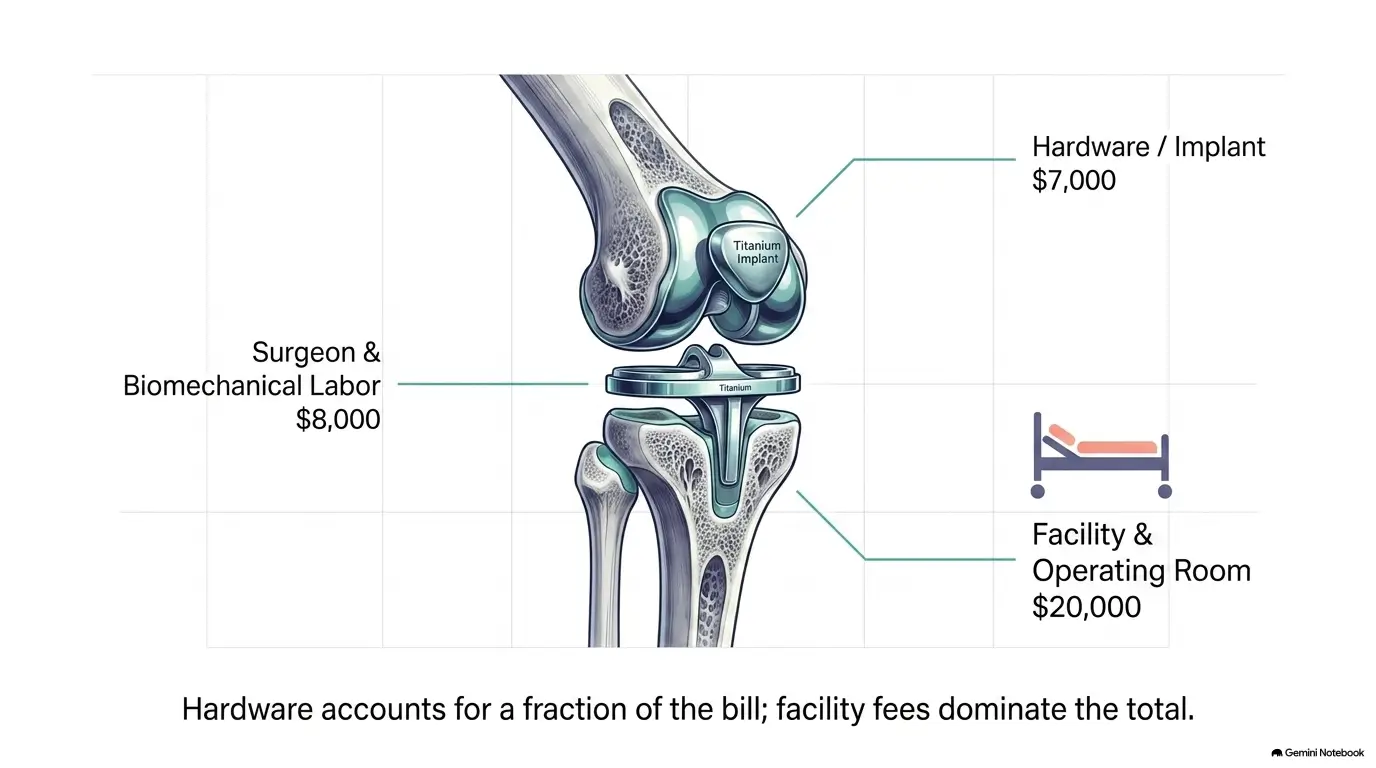
What Is Actually on a Knee Replacement Bill?
A knee replacement may feel like one event on your calendar, but financially it can behave more like a small orchestra. The surgeon is only one instrument.
- Facility services: operating room, nursing, recovery area, supplies, medications furnished by the facility, and other hospital or ASC resources.
- Surgeon services: the professional work associated with performing the operation.
- Anesthesia: often billed by a separate anesthesia practice.
- Assistant or other clinicians: depending on the case and billing arrangement.
- Laboratory and imaging services: some may occur before, during, or after the operative episode.
- Physical therapy: outpatient therapy, home-based care, or another rehabilitation setting may have separate benefits and cost sharing.
- Durable medical equipment: a walker or other prescribed equipment may be processed separately.
- Post-discharge care: home health, skilled nursing, rehabilitation, follow-up tests, or treatment of complications may not be included in the facility’s original estimate.
This is exactly why receiving a separate anesthesia bill or statements from several clinicians can be confusing even when nothing improper occurred. If multiple statements have already started arriving, the guide to orthopedic bills from multiple providers can help you sort them by entity and Explanation of Benefits.
Technical note: why CPT 27447 does not equal your entire episode cost
CPT 27447 identifies total knee arthroplasty in Medicare’s procedure lookup and Medicare coverage materials. That code helps identify the core operation, but a patient’s financial episode can involve facility and professional services plus other clinicians or later services. CMS specifically notes on its price lookup that additional doctors and additional costs may apply.
For cost comparison, the useful question is therefore not only, “What is the price for 27447?” It is, “Which expected services around 27447 are included in this estimate, and which organizations will bill me separately?”
Insurance, Medicare, and Prior Authorization: What Should You Verify?
Insurance coverage should be checked at three levels: Is the procedure covered? Is the planned provider and facility arrangement covered? And what is your expected cost sharing? A yes to the first question does not automatically answer the other two.
What to ask your insurer
- Is the planned total knee replacement covered under my current plan?
- Is prior authorization required, and has it been approved for the exact facility?
- What procedure code and site-of-service information should I use when requesting a cost estimate?
- Is the surgeon in network?
- Is the hospital or ambulatory surgical center in network?
- How should I verify the anesthesia group and any assistant surgeon?
- How much of my deductible remains?
- What copay or coinsurance applies to the facility and professional services?
- What is my remaining applicable out-of-pocket exposure under the plan?
- How are physical therapy, home health, rehabilitation, and durable medical equipment covered after discharge?
If your plan requires authorization, use a written checklist rather than assuming the surgeon’s office and insurer have synchronized every detail. The orthopedic prior authorization checklist is designed for that handoff.
For Original Medicare outpatient services, Medicare states that Part B covers approved outpatient medical and surgical services. After the Part B deductible, beneficiaries generally pay 20% of the Medicare-approved amount for provider services, while hospital outpatient cost-sharing rules also apply. Total knee replacement is specifically identified as a comprehensive outpatient service. Exact responsibility still depends on the services received and other coverage you may have.
Medicare Advantage works differently because cost sharing, provider networks, referral rules, and authorization requirements are plan specific. If that is your coverage, review the separate guide to Medicare Advantage orthopedic care.
What about surprise anesthesia bills?
For people with many employer and individual private health plans, federal No Surprises Act protections restrict certain out-of-network bills for non-emergency services received from out-of-network clinicians, including anesthesiology, at an in-network facility. Those protections are important, but they are not a reason to skip network verification or assume every service will be covered.
Prior authorization answers a coverage-administration question. It is not the same thing as a written guarantee of your final out-of-pocket cost.
Cash Price vs Insurance Price: Which Number Should You Compare?
If you are uninsured or considering paying without using insurance, compare the complete self-pay episode with the amount you expect to owe through your plan. Do not compare a hospital’s cash facility quote with an insured all-in estimate. Those are different baskets of services.
| Payment route | Potential advantage | Main limitation | What to verify |
|---|---|---|---|
| Use insurance | Plan-negotiated rates and covered-benefit protections may reduce exposure | Deductible, coinsurance, network, and authorization rules apply | Written insurer estimate and network status |
| Self-pay | Some providers offer a defined cash or package price | The package may omit other clinicians or recovery services | Every included and excluded item |
| Compare both first | Shows which route is financially clearer for your situation | Requires more phone calls and written estimates | Whether self-pay spending affects any insurance benefit or deductible |
Federal rules give uninsured and self-pay patients a particularly useful tool. CMS says that if you are not using insurance, providers generally must give you a good faith estimate when you request one or when qualifying care is scheduled at least three business days in advance. The estimate should identify expected charges, but CMS warns that separate providers or facilities may require separate estimates.
CMS also says an uninsured or self-pay patient may qualify for the federal patient-provider dispute process when a provider’s bill is at least $400 above that provider’s good faith estimate and the other eligibility requirements are met. The current CMS guidance includes a 120-calendar-day filing window measured from the initial bill.
You can review the official CMS guide to good faith estimates before requesting one.
For self-pay surgery, one written estimate may not capture every organization involved. Ask separately about the facility, surgeon, anesthesia, and expected post-surgery care.
How Procedure Type and Surgical Complexity Change Cost
“Knee replacement” is not one uniform procedure. A primary total knee replacement, partial knee replacement, revision operation, and replacement of both knees involve different clinical work and resource needs.
Primary total knee replacement
This is the standard procedure most people mean when they search for knee replacement cost. AAOS describes total knee replacement as an option that may be considered when severe knee damage causes substantial pain or functional limitation and nonsurgical treatments are no longer sufficiently helpful.
Partial knee replacement
A partial replacement is a different operation. Do not use a partial-knee quote as a proxy for total knee replacement simply because both contain the words “knee replacement.” Ask for the actual planned procedure before comparing prices.
Revision knee replacement
Revision surgery involves replacing some or all components from a previous knee replacement and can require a different surgical plan and additional resources. AAOS treats revision total knee replacement as a distinct procedure rather than a routine repeat of the original operation.
Bilateral procedures
If both knees are involved, ask how the surgeon plans to stage the operations and how that decision changes facility, rehabilitation, home support, therapy, and benefit calculations. Do not assume that doubling the number of knees simply doubles or halves the price. The cost structure is more complicated than supermarket arithmetic.
Robotic or technology-assisted surgery
If robotic assistance or another technology is proposed, ask two separate questions: Why is it being recommended clinically, and does it change what I will owe? AAOS specifically suggests that patients discuss the pros and cons of robotic-assisted joint replacement with their surgeon rather than assuming the technology itself determines the better operation.
Before agreeing to any separate technology fee, ask whether it is part of the covered surgical payment, an optional charge, a facility-specific fee, or something your insurer considers noncovered.
When the Cheaper Option Is Enough and When Paying More Can Make Sense
Spending more does not automatically buy a better knee replacement. If your surgeon considers an outpatient setting clinically appropriate, the facility and clinicians are in network, the outcome and safety questions are satisfactory, and you have a workable recovery plan at home, a lower-cost setting may be perfectly reasonable.
That is an important money-saving point: you do not need the most expensive building simply because the surgery is important. You need the appropriate setting, qualified team, clear coverage, and a realistic discharge plan.
Paying more, or using a hospital setting that carries higher costs, may make sense when the medical team believes your health status or surgical needs require resources, monitoring, or postoperative support that a lower-acuity setting is not designed to provide. The decision should come from clinical need, not from the idea that “premium” always means safer.
Questions worth asking the surgeon
- Do you regularly perform this type of knee replacement?
- Why are you recommending this surgical setting for me?
- Could the operation reasonably be performed in another covered setting, or is there a medical reason not to?
- What complications or health issues would make same-day discharge inappropriate?
- What usually happens after discharge for patients with my planned procedure?
- Will I need a walker, home assistance, outpatient therapy, home health, or rehabilitation?
- Who should I call if recovery does not follow the expected path?
AAOS likewise encourages joint replacement patients to ask about surgeon and facility experience, surgical approach, use of robotics, expected hospital stay, mobility aids, physical therapy, complications, and recovery.
Your recovery plan is also part of the financial decision. If discharge options are still fuzzy, compare them with the guide to choosing rehabilitation after surgery.
Knee Replacement Cost Mistakes That Make an Estimate Look Cheaper
The most expensive mistakes are often not dramatic. They are small omissions that sit quietly in the estimate until separate bills begin arriving.
| Mistake | Why it costs money | Safer move |
|---|---|---|
| Comparing sticker prices | Gross charges may have little relationship to your negotiated or self-pay responsibility | Compare written patient estimates |
| Checking only the surgeon’s network | The facility or other clinicians may have separate contracts | Verify every expected billing entity |
| Assuming prior authorization equals full coverage | Authorization does not define every cost-sharing detail | Ask separately for benefit and cost estimates |
| Ignoring anesthesia | Anesthesia may be a separate professional bill | Ask for the anesthesia group before surgery |
| Forgetting rehabilitation | Therapy, home health, rehab, or equipment may sit outside the surgical estimate | Price the first phase of recovery too |
| Choosing a facility only by price | A setting may not be appropriate for your clinical needs | Confirm clinical fit first, then compare cost |
| Assuming the estimate is all-inclusive | Some estimates cover only one provider or facility | Ask for an explicit exclusions list |
Facility charges are particularly easy to underestimate because they may dwarf smaller professional line items while remaining hard to decode. If that term is appearing on your paperwork, see the explanation of facility fees in orthopedic care.
How to Compare Two Knee Replacement Estimates
Do not compare two estimates by circling the smaller bold number. Normalize them first. The goal is to make both quotes describe the same episode.
Use this comparison worksheet
- Procedure: Is each estimate for the same planned operation?
- Setting: Hospital inpatient, hospital outpatient, or ASC?
- Facility: In network under your exact plan?
- Surgeon: In network?
- Anesthesia: Included in the estimate or separate?
- Other clinicians: Any expected assistant, radiology, pathology, or other professional charge?
- Implant and supplies: Included in the facility estimate?
- Preoperative testing: Included or separately billed?
- Postoperative therapy: Included, bundled, or separate?
- Equipment: Walker or other prescribed equipment included?
- Home care or rehabilitation: Expected after discharge?
- Patient responsibility: Is the number based on current deductible and benefit information?
- Expiration: How long is the estimate valid?
Good / Better / Best estimate preparation
| Approach | Best for | What it includes | Main limitation | Cost consideration |
|---|---|---|---|---|
| Good | Straightforward in-network primary surgery | Written facility estimate plus insurer benefit estimate | May miss separate professionals | Little or no extra cost to obtain |
| Better | Most patients comparing sites | Facility, surgeon, anesthesia, therapy, and equipment checks | Takes more calls | Often the best value for the time spent |
| Best for complexity | Revision surgery, multiple providers, uncertain discharge, or difficult benefits | Reconciled estimates with insurer case management or provider financial counseling | Still cannot predict unforeseen complications perfectly | Useful when an omitted service could materially change the bill |
A provider call script
You can say: “I am trying to calculate my total patient responsibility for the planned knee replacement. Please tell me what this estimate includes, which providers may bill separately, whether the estimate uses my current insurance benefits, and which expected services before or after surgery are not included.”
Then ask the same question of the insurer from the other side: “I have a planned total knee replacement at this facility with this surgeon. Can you confirm network status, prior authorization, the expected site of service, my remaining deductible, and how I can obtain an estimated member responsibility?”

Frequently Asked Questions
Does Medicare cover knee replacement?
Medicare can cover medically necessary total knee arthroplasty when applicable coverage and documentation requirements are met. CMS maintains medical-necessity and documentation guidance for knee arthroplasty, and the procedure may be furnished in inpatient, hospital outpatient, or ASC settings when appropriate. Your personal costs depend on the setting, Medicare coverage, other insurance, and the services you receive.
Is outpatient knee replacement always cheaper?
No. The total allowed cost of one setting may be lower while your personal cost-sharing behaves differently. Compare the actual patient estimate for each clinically appropriate setting rather than assuming “outpatient” or “ASC” automatically means the smallest bill. Medicare’s own procedure price lookup displays setting-specific amounts for outpatient knee replacement.
Can a hospital tell me exactly what I will owe before surgery?
A provider or insurer can often give you a useful estimate, but an estimate is not always a final bill. Unexpected clinical needs, additional services, changes in benefits, and separate billing entities can alter the total. Ask whether the estimate incorporates your current insurance benefits and request its exclusions in writing.
Why did I receive a separate anesthesia bill?
The anesthesia clinician or group may bill professional services separately from the hospital or ASC. Ask before surgery which anesthesia organization is expected to participate and how its network status will be handled.
Does reaching my insurance out-of-pocket limit mean every knee replacement expense is free?
Do not assume so. The way an out-of-pocket limit applies depends on your plan and the type of charge. Noncovered services, premiums, or certain out-of-network expenses may be treated differently. Ask your insurer what counts toward your applicable limit and what does not.
Is physical therapy included in the surgery price?
Not necessarily. Therapy may be billed separately and may have its own copay, coinsurance, visit rules, provider network, or authorization requirements. Ask how therapy is expected to be delivered after discharge and then check that benefit separately.
Should I choose a surgeon based on price?
Price belongs in the decision, but it should not stand alone. Ask about the surgeon’s experience with your planned procedure, why a particular surgical approach and setting are being recommended, expected complications and recovery, and how the team handles follow-up. AAOS recommends discussing many of these questions before joint replacement.
Your 15-Minute Knee Replacement Cost Check
You do not need to solve the entire medical billing system this afternoon. You need to remove the largest unknowns.
- Write down the exact surgeon and facility.
- Ask the surgeon’s office for the planned procedure code and surgical setting. For a standard total knee arthroplasty, Medicare’s current price tool identifies CPT 27447.
- Call the number on your insurance card. Verify the surgeon and facility network status.
- Ask whether prior authorization is required and whether it is already approved.
- Ask for your remaining deductible and an estimated patient responsibility.
- Ask who is expected to provide anesthesia and whether that organization can be verified.
- Request the facility’s written estimate and exclusions.
- Add one final line to your notes: “What will I probably pay for therapy, equipment, or post-discharge care that is not on this estimate?”
If those eight items are answered, the financial fog usually thins considerably. The number may still be an estimate, but it becomes an estimate with edges, names, and assumptions you can challenge.
If the resulting amount is difficult to manage, ask the provider about available financial assistance or payment arrangements before the procedure rather than after bills become overdue. You can also review the practical guide to orthopedic payment plans.
The aim is not to make a major surgery feel cheap. It is to make the bill less mysterious. When you know the setting, the network, the benefit rules, the excluded services, and the recovery plan, “knee replacement cost” stops being one enormous unknowable number and becomes a series of questions you can actually answer.