

Orthopedic billing clarity
What Is a Facility Fee in Orthopedic Care?
The Hidden Bill Before the X-Ray
You book an orthopedic appointment because your knee complains on stairs, your shoulder has become a tiny weather station, or your back has started negotiating with gravity. The visit feels ordinary. The waiting room has the usual chairs, the usual clipboard, the usual quiet hum of fluorescent patience. Then the bill arrives with a second charge that looks less like medicine and more like a trapdoor.
That second charge may be a facility fee. In orthopedic care, it can appear around hospital outpatient clinics, imaging suites, injection rooms, ambulatory surgery centers, and hospital-owned practices that look like regular offices but bill differently. The tricky part is not only the amount. It is the timing. Most patients discover the fee after the appointment, when the paperwork has already grown teeth.
This guide gives you plain-English billing literacy before you book: what a facility fee is, where it hides, what to ask your clinic and insurer, when surprise billing rules may help, and how to document the answer so your future self is not left arguing with a stack of statements at 10:47 p.m.
Compare care sites
Office, hospital clinic, imaging center, or surgery center can mean different billing math.
Ask better questions
Use a five-minute phone script before the appointment, not after the bill lands.
Spot appeal clues
Separate ordinary charges, coding issues, network problems, and possible surprise bill protections.
One careful call before booking can save hours of billing fog later. 🧾
Snapshot
This article is for U.S. patients, caregivers, Medicare beneficiaries, high-deductible plan members, and anyone comparing orthopedic clinics, imaging centers, hospital outpatient departments, or surgery centers. You will learn how facility fees work, what to ask before booking, how to compare care-site costs, and when to escalate a confusing orthopedic bill.
Table of Contents
Before You Act: Billing Advice Is Not Medical Advice
Facility fee questions are money questions, paperwork questions, and sometimes insurance appeal questions. They are not a substitute for medical advice. If your orthopedic symptoms are urgent, the bill can wait in the hallway while the body gets the front seat.
Use this guide for bill literacy, not diagnosis
This guide helps you understand orthopedic billing language, compare care-site options, prepare cost-estimate questions, and organize records if a bill seems wrong. It does not diagnose pain, decide where you should receive care, interpret your insurance contract for your exact case, or replace advice from a licensed clinician, attorney, benefits administrator, patient advocate, or insurance professional.
Use it as a map. Before making high-stakes decisions, confirm details with your insurer, the clinic billing team, your employer benefits office if you have job-based coverage, Medicare resources if you are enrolled, or a qualified professional who can review your exact paperwork.
Do not delay urgent orthopedic care over billing fear
Severe pain after trauma, suspected fracture, fever with joint pain, spreading redness, new numbness, weakness, loss of bladder or bowel control, loss of function, blue or cold limbs, or circulation changes deserve medical attention first. A facility fee is unpleasant. A missed emergency is worse.
Key takeaway
If the problem is medically urgent, seek care first. Use billing questions for planned appointments, imaging, injections, and non-emergency procedures where you have time to compare settings.
When the bill becomes a paperwork problem
If a facility fee feels wrong, start with documents rather than emotion. Ask for the itemized bill, the Explanation of Benefits, the clinic’s estimate if one was given, the facility name, the billing location, and the claim numbers. A billing dispute without documents is a foggy room. A billing dispute with dates, names, and codes becomes a file someone can actually review.
Depending on your situation, useful helpers may include the hospital billing office, insurer member services, your state insurance department, a Medicare counselor, your employer benefits administrator, a hospital patient advocate, or a nonprofit medical billing advocate.
Facility Fee Meaning: The Second Bill Patients Miss
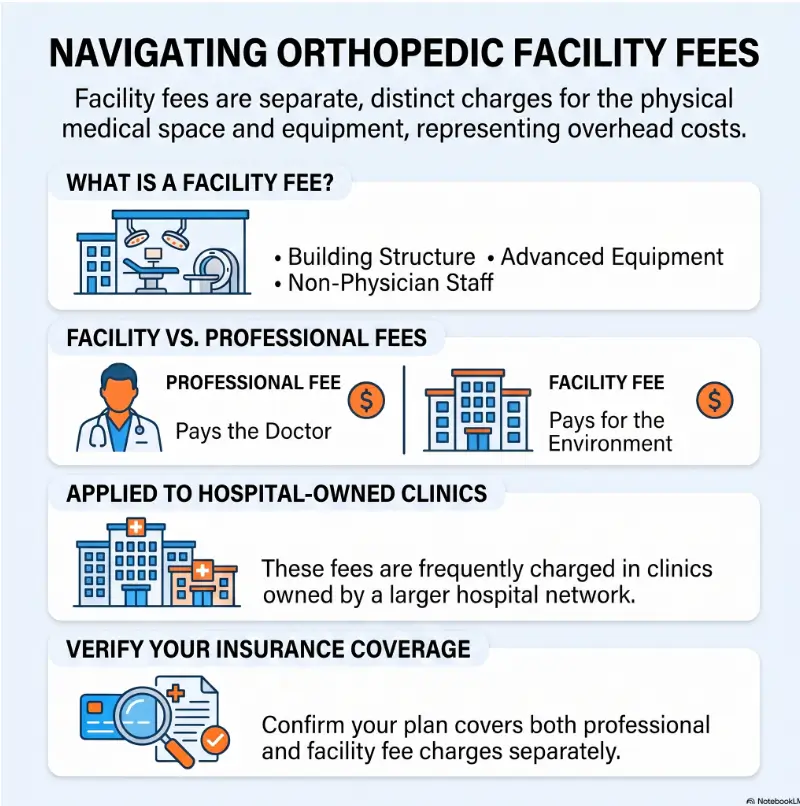
A facility fee in orthopedic care is a separate charge tied to the place where care is delivered. It is different from the doctor’s professional fee. The professional fee pays for the clinician’s work. The facility fee is connected to the room, staff, equipment, supplies, administrative systems, and overhead of the hospital outpatient department, surgery center, imaging area, or other facility.
The frustrating part is that the experience may not feel “facility-like.” You may sit in an exam room, get an X-ray down the hall, and leave with a brace and a follow-up plan. Later, the bill may separate the physician visit from the facility charge, even though the appointment felt like one event.
The doctor bill is not the whole bill
Think of an orthopedic visit as two possible invoices wearing the same coat. One invoice may come from the doctor, physician group, or clinician who evaluates you, orders imaging, reviews your symptoms, performs a procedure, or interprets results. The other may come from the hospital outpatient department or facility where the visit or procedure happened.
Your insurance plan may process these charges differently. One part may apply to your specialist copay. Another may apply to your deductible or coinsurance. This is why the words “in network” do not always translate into “small bill.”
Why orthopedic care triggers facility charges
Orthopedic care often involves more than a conversation. A single patient path may include an exam, X-ray, MRI referral, splinting, bracing, cortisone injection, ultrasound guidance, fluoroscopy, lab work before surgery, anesthesia, or a minor procedure. Each step can have its own billing trail.
Facility charges are especially common when services happen in hospital outpatient departments, hospital-owned clinics, ambulatory surgery centers, imaging suites, injection rooms, or procedure areas. For patients, the magic trick is not very charming: one appointment enters the room, several claims leave it.
Here is what no one tells you
The same orthopedic doctor may provide similar care in two different settings, and the patient cost can change because of the site of service. A visit in an independent physician office may bill one way. A visit in a hospital outpatient department may bill another way. A procedure in an ambulatory surgery center may involve facility billing even if it is less expensive than a hospital outpatient setting for certain services.
The key question is not only “Is my doctor covered?” It is also “How is this location billed?” That small sentence can be the flashlight in the drawer.
Key takeaway
A facility fee is not the same as a copay. It is a billed charge connected to the care site, and your plan may apply deductible or coinsurance to it.
Orthopedic Visit Settings: Where the Fee Hides
Orthopedic care can happen in several places that look similar from the patient’s side of the clipboard. Billing departments, however, see different worlds. The site of service can affect what your insurer allows, what your deductible absorbs, and how many separate statements arrive.
Independent office, hospital clinic, surgery center
An independent orthopedic office often bills as a physician office visit. A hospital outpatient clinic may bill a physician professional fee plus a hospital outpatient facility fee. An ambulatory surgery center may charge a facility fee for procedures performed there, along with separate professional charges from the surgeon, anesthesiology group, pathology, imaging, or other providers.
None of these settings is automatically good or bad. A hospital outpatient department may be medically appropriate for a patient with complex needs. An independent imaging center may be enough for a routine MRI. A surgery center may be appropriate for some outpatient procedures. The point is to compare the setting before the setting compares your wallet to a lemon and squeezes.
| Orthopedic care setting | What it may feel like | Billing issue to ask about | Best question before booking |
|---|---|---|---|
| Independent orthopedic office | Regular specialist visit | Professional fee, imaging or supplies may still be separate | “Will this be billed only as an office visit?” |
| Hospital outpatient clinic | Regular clinic appointment | Possible separate facility fee | “Is this location billed as a hospital outpatient department or provider-based clinic?” |
| Independent imaging center | X-ray, MRI, CT, or ultrasound visit | Facility or technical component plus radiology interpretation | “Is the center in network, and what is my estimated allowed amount?” |
| Ambulatory surgery center | Outpatient procedure | Facility fee, surgeon fee, anesthesia fee, supply charges | “Which providers and facility entities will bill separately?” |
| Hospital outpatient department | Procedure or clinic care connected to a hospital | Hospital outpatient facility charge may be higher | “Can you give me the facility billing code and expected setting?” |
The name on the building may mislead you
A clinic can look like a regular medical office and still be owned by or billed through a hospital system. The sign may feature the orthopedic group’s familiar name, while the claim form tells a different story. This is common after health system acquisitions, office conversions, or provider-based billing arrangements.
Before assuming, ask. The words you are listening for include “hospital outpatient department,” “provider-based clinic,” “facility charge,” “campus,” “off-campus,” “technical component,” and “separate facility billing.”
The same doctor trap
Patients often check whether the orthopedic surgeon or physician assistant is in network, then stop there. That is understandable. It is also incomplete.
The facility may have separate network status. The imaging provider may bill separately. The anesthesiology group may be separate. A brace or splint may come through durable medical equipment billing. For a related next step, you may want to review how an orthopedic bill can involve multiple providers so the paper trail does not feel like a flock of startled birds.

Before You Book: The 5-Minute Phone Script
The best time to ask about facility fees is before the appointment. The second-best time is before you pay the bill. The worst time is after you have already paid, lost the estimate, forgotten the representative’s name, and tossed the envelope into the kitchen drawer of doom.
Ask this exact question first
Call the orthopedic clinic and ask:
Phone script
“Will this visit be billed as a hospital outpatient department, provider-based clinic, or regular office visit? Will there be a separate facility fee?”
Then pause. Let the representative answer. If the answer is vague, ask whether there is a billing department or estimate team that can confirm. Be polite, boring, and persistent. Billing clarity rarely arrives on horseback. It usually arrives after the third transfer.
Ask for both codes
Ask for the expected CPT or HCPCS code for the service, plus any facility billing code if available. Codes are not perfect crystal balls. The final code can change after the clinician evaluates you. Still, expected codes help your insurer produce a better estimate than “It depends,” which is technically true and emotionally useless.
For a planned orthopedic visit, injection, MRI, X-ray, brace, or outpatient procedure, write down the service description and expected setting. If the clinic gives you an estimate number, keep it. If they send it through the patient portal, save a screenshot or PDF.
Ask your insurer, not just the clinic
The clinic can estimate billed charges and setting. Your insurer determines the allowed amount, network status, deductible, copay, coinsurance, prior authorization rules, and what counts toward your out-of-pocket maximum. You need both voices in the room.
When you call your insurer, provide the clinic name, facility name, address, tax ID or NPI if available, expected codes, and planned setting. Ask whether both the professional provider and the facility are in network. Then ask how your plan would process the charge if it is billed as a hospital outpatient department.
- “Is the orthopedic clinician in network?”
- “Is the facility or hospital outpatient department in network?”
- “Does this service apply to my deductible, copay, or coinsurance?”
- “Is prior authorization required?”
- “Would a different in-network care site cost less for the same medically appropriate service?”
- “Can you give me a reference number for this call?”
The Bill Anatomy: Facility Fee vs Professional Fee
Once you understand the bill anatomy, orthopedic statements become less mysterious. Still annoying, perhaps, but less mysterious. The main split is professional fee versus facility fee.
Professional fee: the clinician’s work
The professional fee is tied to the clinician’s work. That can include the evaluation, diagnosis, medical decision-making, reviewing imaging, interpreting symptoms, performing a procedure, documenting the visit, and planning next steps. It may come from the physician, physician assistant, nurse practitioner, surgeon, radiologist, anesthesiologist, or other professional involved in your care.
For example, if you receive a knee injection, the professional fee may reflect the clinician’s work performing the injection and making treatment decisions. The medication, imaging guidance, facility charge, and supplies may be separate.
Facility fee: the room, staff, equipment, and overhead
The facility fee is tied to the care site. Hospitals and facilities often describe it as supporting the non-physician costs of delivering care: rooms, nurses, technicians, equipment, registration systems, sterilization, safety processes, supplies, compliance requirements, and building operations.
Whether that explanation feels satisfying depends on the bill in your hand. Still, it helps to know what the charge is claiming to represent. You are not being billed twice for the exact same thing in theory. You may be billed separately for the clinician’s work and the facility’s role.
Why two claim forms may appear
Physician services and hospital outpatient facility services may be submitted on different claim forms. You do not need to memorize medical billing forms, but you should know that two claims can come from one day of care.
This matters when you compare the Explanation of Benefits from your insurer. One EOB may show the professional charge. Another may show the facility or technical charge. If you only look at one, you may underestimate your total patient responsibility.
Key takeaway
For one orthopedic encounter, ask whether you should expect one claim or multiple claims. Multiple claims are common for imaging, injections, surgery, anesthesia, braces, and hospital outpatient care.
Show me the nerdy details
Show me the nerdy details
Orthopedic billing often separates the professional component from the technical or facility component. The professional component is the clinician’s cognitive and procedural work. The technical or facility component may involve equipment, staff, room use, imaging machinery, supplies, recovery space, and facility operations.
For imaging, the scan itself and the radiologist’s interpretation may be billed separately. For injections, the bill may include the office or facility encounter, the injection procedure, medication, imaging guidance, and supplies. For surgery, the facility, surgeon, anesthesia, implants, pathology, and post-operative equipment may create separate charges.
The practical move is not to become a coder overnight. It is to ask for expected service codes, facility status, network status, and plan cost-sharing before care when the service is non-urgent.
Cost Shock Zones: Imaging, Injections, and Minor Procedures
Facility fees are most painful when patients expected a simple visit and accidentally walked into a billing cluster. Orthopedic care has several cost shock zones worth checking before you book.
X-rays and MRIs
X-rays in an orthopedic clinic may feel like a quick add-on. MRIs may feel like a separate appointment. In both cases, the location matters. Imaging performed in a hospital outpatient department may cost more than imaging at an independent imaging center, depending on your plan, network, deductible, and local contracting.
If your doctor orders an MRI and the situation is not urgent, ask whether the order can be sent to an in-network independent imaging center or another lower-cost site when medically appropriate. Your insurer may have a cost-estimator tool, but call to confirm network status before relying on a website alone.
If you have a high-deductible plan, this step matters even more. You may also find it useful to compare questions in this HDHP imaging cost estimate guide.
Cortisone shots and guided injections
A cortisone shot may sound simple, but the bill can have layers: medication, procedure, clinician work, imaging guidance, supplies, and facility billing. Injections performed under ultrasound or fluoroscopy may involve additional technical charges.
Ask where the injection will happen. An exam room, procedure suite, hospital outpatient department, and surgery center may produce different billing structures. For related planning, review what can appear in a joint injection consultation cost discussion before assuming the injection is “just a shot.”
Braces, splints, and supplies
Braces, splints, boots, slings, crutches, and other supports may be billed separately as durable medical equipment or supplies. Sometimes patients accept an item in the clinic without realizing it may be more expensive than a retail alternative or may require special insurance processing.
Do not refuse needed medical support just because billing is confusing. But do ask: “Is this item covered by my insurance? What is the estimated patient cost? Can I choose to buy it elsewhere if medically acceptable?”
| Service | Possible separate charges | Smart pre-visit question |
|---|---|---|
| Orthopedic visit with X-ray | Clinician fee, imaging technical charge, radiology interpretation, facility fee | “Will the X-ray be billed through the office or hospital outpatient facility?” |
| MRI | Imaging facility charge, radiologist interpretation, contrast if used | “Can I compare in-network imaging locations before scheduling?” |
| Cortisone injection | Procedure, medication, imaging guidance, facility charge | “Where will the injection be performed and what codes are expected?” |
| Brace or walking boot | Durable medical equipment, fitting, supply charge | “What is my estimated patient cost if I receive it today?” |
| Outpatient surgery | Facility, surgeon, anesthesia, implants, pathology, medication | “Who will bill separately, and are all entities in network?” |
Common Mistakes: Do Not Assume In-Network Means Cheap
Most patients do not make billing mistakes because they are careless. They make them because healthcare billing is built like a hallway with too many doors. Here are the doors to check before you walk through.
Mistake 1: Checking only the doctor
A doctor can be in network while the facility, imaging provider, anesthesia group, lab, or supply vendor creates a separate cost. For orthopedic surgery or injections, this is especially important. Ask about each billing entity, not just the surgeon or clinic brand.
For surgery planning, a separate anesthesia bill can surprise patients even when the surgeon is in network. This separate anesthesia bill guide can help you build a better question list before a procedure.
Mistake 2: Ignoring the site of service
The same service may be billed differently in an office, hospital outpatient department, independent imaging center, or ambulatory surgery center. Site of service is not a small detail. It is often the hinge on the door.
Ask whether your care can be done safely in a lower-cost setting. Do not push for a different site if your medical situation needs hospital resources. But for routine, non-urgent, low-complexity services, comparing settings may be reasonable.
Mistake 3: Waiting until the bill arrives
After the bill arrives, your options narrow. Before the appointment, you can compare locations, ask for estimates, confirm network status, and document answers. After the appointment, you can still dispute errors, ask for financial assistance, request itemization, or appeal coverage decisions, but the room has fewer windows.
Mistake checklist
- Checking the orthopedic doctor but not the facility.
- Assuming a referral equals a cost estimate.
- Accepting a brace or supply without asking how it bills.
- Booking imaging at the first available location without comparing in-network options.
- Paying a confusing bill before reviewing the EOB and itemized statement.
Good, better, best: a practical cost-control setup
| Approach | What you do | Best for | Limitation |
|---|---|---|---|
| Good | Ask the clinic if a facility fee applies | Busy patients booking a first visit | May not reveal insurer cost-sharing |
| Better | Ask clinic for expected codes, then call insurer | High-deductible plan members and budget-conscious patients | Final billing may still change after evaluation |
| Best | Compare medically appropriate in-network sites before scheduling | Planned imaging, injections, and outpatient procedures | Takes more time and may not be possible for urgent care |
Surprise Billing Rules: What They Do and Do Not Fix
A facility fee can feel like a surprise bill. That does not always mean it qualifies for legal surprise billing protection. This is where patients need careful language.
The No Surprises Act helps in specific situations
The federal No Surprises Act generally focuses on many emergency services and certain out-of-network services provided at in-network facilities. It can protect patients from some out-of-network balance bills when they did not have a meaningful choice of provider.
For the official overview, start with the CMS No Surprises Act resource. It is one of the best places to check the current federal explanation before you spend energy arguing in circles.
Facility fees can still be expected bills
A facility fee may feel surprising because no one explained it clearly. But it may still be a permitted charge if the facility was in network, the service was covered, and the plan applied normal deductible or coinsurance rules. In other words, “I did not expect this” and “this violates surprise billing rules” are not always the same sentence.
That does not mean you have no options. It means your next step should be precise: check for coding errors, network errors, missing disclosure requirements, estimate conflicts, plan-rule issues, financial assistance eligibility, or possible appeal rights.
Do not confuse unfair with appealable
Some bills are emotionally unfair but technically allowed. Some bills are technically wrong but emotionally easy to miss. Your job is to sort them.
Appeal grounds may include denied coverage, wrong network status, incorrect coding, lack of required notice, authorization mismatch, duplicate billing, services you did not receive, or charges that do not match the estimate rules that applied to your case.
Key takeaway
Do not argue only that a bill is surprising. Ask what rule, estimate, network status, code, disclosure, or plan term makes the charge incorrect or reviewable.
Medicare and Facility Fees: The 20 Percent Puzzle
Medicare beneficiaries often face a special version of the facility fee question. A hospital outpatient visit can involve charges that look different from a physician office visit, and Original Medicare and Medicare Advantage may handle patient costs differently.
Original Medicare may cover facility fees
For covered outpatient hospital services under Original Medicare, patients often owe coinsurance. Medicare also warns that outpatient services received in a hospital outpatient setting may cost more than the same care in a doctor’s office. That is the sentence worth taping to the refrigerator before a non-urgent orthopedic appointment.
For official patient-facing details, review Medicare’s outpatient hospital services coverage page.
Medicare Advantage may feel different
Medicare Advantage plans must cover Medicare-covered services, but plan networks, prior authorization, copays, referrals, and cost-sharing rules can vary. A Medicare Advantage patient should call the plan before a planned orthopedic visit, imaging appointment, injection, or outpatient procedure.
Ask whether the orthopedic provider, facility, imaging center, anesthesiology group, and surgery center are in network. If you are comparing plans or care access, this Medicare Advantage orthopedic care guide can help you build a more complete checklist.
The referral is not the estimate
A referral may help you access care. An authorization may confirm that a service meets plan rules. Neither one guarantees your final out-of-pocket amount. Before a planned service, ask for a cost estimate and confirm how the setting will be billed.
For Medicare patients and caregivers, the most useful phone notes include the plan representative’s name, date, reference number, provider name, facility name, service description, and any expected copay or coinsurance language.
Caregiver note
If you are helping a parent, do not ask only “Is it covered?” Ask “How will this location bill, and what will the patient likely owe under this plan?”
Hospital-Owned Clinics: The Rebrand That Changes the Bill
One of the most confusing facility fee scenarios happens when a clinic changes ownership or billing status. The doctor may be the same. The parking lot may be the same. The front desk may still have the same plant bravely surviving by the copier. But the bill may change.
Provider-based billing in plain English
Provider-based billing generally refers to certain hospital-owned or hospital-operated outpatient locations that bill as part of the hospital. In practice, a patient may receive separate professional and facility charges for care that feels like an ordinary clinic visit.
Rules and disclosures can vary by payer, state, location, and facility status. That is why the best patient question is simple: “Is this clinic billed as a hospital outpatient department or provider-based clinic?”
The clinic did not move, but the bill did
A common scenario looks like this: a patient has seen the same orthopedic provider for years. The practice becomes part of a hospital system. The next visit includes a facility charge the patient has never seen before.
When that happens, call the billing office and ask what changed. Was the clinic acquired? Did its billing status change? Was the visit billed as hospital outpatient care? Is there a disclosure policy? Is there a lower-cost office location for follow-up care if medically appropriate?
Tiny label, big consequence
Look for phrases on appointment confirmations, patient portals, estimates, and bills: “hospital outpatient department,” “provider-based,” “campus,” “off-campus,” “facility charge,” “technical fee,” or “outpatient hospital.” These phrases are not decoration. They may signal how your insurer will process the claim.
Facility fee decision flow
1. Identify the setting
Office, hospital outpatient clinic, imaging center, or surgery center?
2. Ask how it bills
Office visit only, provider-based clinic, or separate facility charge?
3. Confirm with insurer
Check provider, facility, codes, deductible, copay, and coinsurance.
4. Save proof
Keep names, dates, call reference numbers, estimates, and portal messages.
When to Seek Help: Red Flags Worth Escalating
Not every facility fee can be removed. But some bills deserve a closer look. The trick is to escalate with a clean file, not a thundercloud.
You were quoted one setting, billed another
If you were told the appointment would bill as a regular office visit and it later billed as hospital outpatient care, gather the estimate, appointment confirmation, portal messages, representative name, date, and itemized bill. Call both the billing office and insurer. Ask for a review based on the mismatch.
Use calm wording: “I am asking for a billing review because the setting I was quoted does not match the setting on the claim.” That sentence is plain enough to travel through departments without losing its shoes.
The facility was out of network
If the facility was out of network but you believed you were receiving in-network care, ask whether federal or state surprise billing protections apply. Also ask whether your plan has an appeal process, network adequacy review, gap exception, or single-case agreement process for certain situations.
For official help on medical bill rights and estimate issues, review the CMS medical bill rights resource.
You cannot afford the bill
If the bill is correct but unaffordable, ask about financial assistance, charity care, hardship discounts, prompt-pay policies, payment plans, and hospital patient advocates. Nonprofit hospitals often have financial assistance policies, and some for-profit facilities also offer hardship options.
Do not agree to a payment plan you cannot realistically maintain. A smaller sustainable plan is better than a heroic promise that collapses by the second month. For a practical next step, this orthopedic payment plan guide can help you prepare questions before calling billing.
The bill went to collections fast
If a bill goes to collections while you are disputing it, ask the provider and collector to note the dispute status. Keep written records. Do not ignore letters. Do not pay blindly if you genuinely need an itemized review, but do not let mail pile up like autumn leaves either.
- Request the itemized bill.
- Compare it with the Explanation of Benefits.
- Ask the provider to pause collections during review if available.
- Document every call with date, time, name, and reference number.
- Escalate to insurer appeals, state insurance department, employer benefits team, or patient advocate when appropriate.
Real-world example: the X-ray that became two bills
Maria schedules an orthopedic visit for knee pain after months of stairs feeling like a negotiation. She checks that the doctor is in network. At the visit, the clinic takes X-rays down the hall. The doctor reviews them and recommends physical therapy.
Three weeks later, Maria receives two statements. One is for the clinician. The other is from the hospital outpatient department. She calls billing and learns the clinic is hospital-owned and bills with a facility component.
For her follow-up, Maria asks whether a different office location bills as a regular physician office. She also calls her insurer with the address and expected visit code. The original bill still needs review, but her next appointment no longer feels like a mystery envelope.
The lesson is not that hospital-owned clinics are always wrong. The lesson is that the building’s billing identity matters before you sit in the chair.

FAQ: Facility Fee Answers Orthopedic Patients Need
What is a facility fee for an orthopedic appointment?
A facility fee for an orthopedic appointment is a separate charge connected to the place where care is delivered, such as a hospital outpatient clinic, procedure area, imaging suite, or surgery center. It is different from the professional fee for the doctor or clinician’s work.
Can I be charged a facility fee for a regular office visit?
Yes, it can happen if the clinic bills as a hospital outpatient department or provider-based clinic. The appointment may feel like a regular office visit, but the billing status of the location can create a separate facility charge.
Is a facility fee the same as a copay?
No. A copay is a fixed cost-sharing amount under your insurance plan. A facility fee is a billed charge from the care site. Depending on your plan, it may affect your deductible, coinsurance, or other patient responsibility.
Can I avoid facility fees by choosing another location?
Sometimes. If your care is non-urgent and medically appropriate for another setting, you can ask whether the service is available in an independent orthopedic office, independent imaging center, or ambulatory surgery center. Always confirm network status and cost-sharing with your insurer before switching locations.
Why did my orthopedic X-ray cost more at the hospital clinic?
Hospital outpatient settings may bill differently from independent offices or imaging centers. Your X-ray bill may include a technical or facility component, radiology interpretation, and the clinician’s professional charge. The exact cost depends on your insurance plan, network rules, and allowed amounts.
Can I appeal a facility fee?
You may be able to appeal or request review if there is a coding error, network problem, denied coverage, duplicate charge, estimate mismatch, missing required disclosure, or plan-rule conflict. A fee that feels unfair is not always removable, so focus on specific review reasons and documents.
Does insurance cover facility fees?
Coverage depends on the plan, service, network status, deductible, copay, coinsurance, prior authorization rules, and whether the service is covered. Call your insurer with the provider name, facility name, location, and expected codes before planned care.
Should I pay before requesting an itemized bill?
If the bill is confusing, request an itemized bill and review the Explanation of Benefits before assuming the amount is correct. If a due date is approaching, call billing and ask whether the account can be placed under review while you compare documents.
Next Step: Make One Call Before the Appointment
The simplest next step is not a spreadsheet, a three-ring binder, or a heroic evening of insurance-policy archaeology. It is one call before you book orthopedic care.
The one concrete action
Call the orthopedic clinic and ask: “Will this be billed as an office visit or a hospital outpatient facility visit, and will there be a separate facility fee?”
If the answer is yes or unclear, ask for the expected codes and the facility name. Then call your insurer and ask how the professional provider and facility would be processed under your plan.
Save the answer
Write down the date, time, representative name, exact wording, location, estimate number, and call reference number. If the answer comes through the portal, save it. If you receive a written estimate, keep it with your appointment confirmation.
15-minute facility fee checklist
- Call the clinic and ask how the visit will be billed.
- Ask whether a separate facility fee may apply.
- Request expected service codes if available.
- Call your insurer with the provider, facility, address, and codes.
- Save the representative names, dates, estimates, and reference numbers.
Then call the insurer
Use the clinic’s answer to ask your insurer about deductible, copay, coinsurance, network status, prior authorization, and whether a lower-cost in-network location is available for the same medically appropriate service. This is not about being difficult. It is about refusing to walk blindfolded into a bill.
Facility fees are not always avoidable. But they are often more understandable when you ask the right question early. In orthopedic care, that one question can turn the hidden bill before the X-ray into a known variable before the appointment.
Last reviewed: 2026-07