
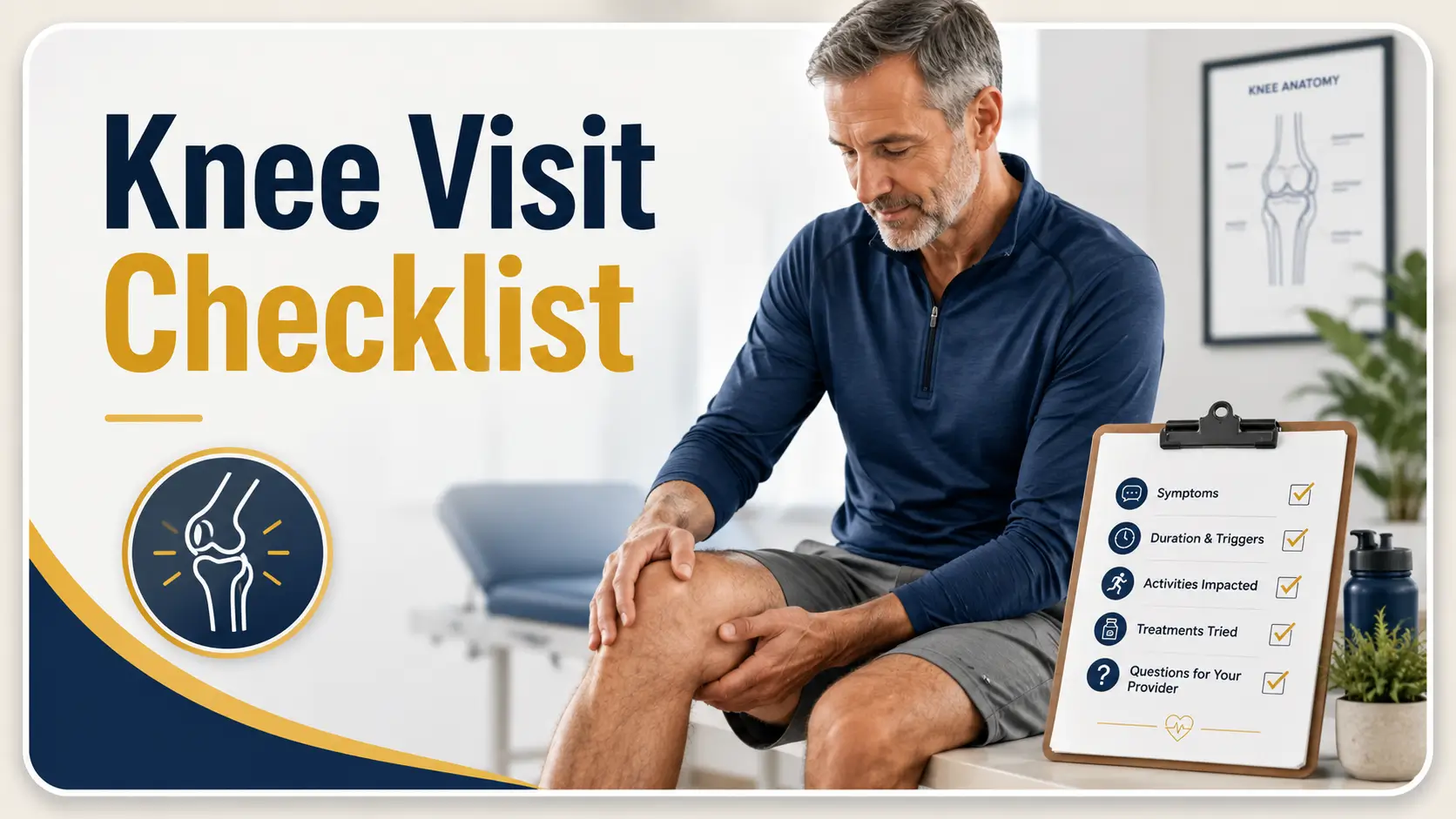
Knee pain appointment prep
How to Prepare for a Knee Pain Appointment:
Walk In With a Better Story
A knee pain appointment can feel strangely high-pressure. You have ten minutes, one noisy joint, and a foggy memory of when the problem actually started. The clinician needs a clear picture. Your knee, meanwhile, prefers cryptic theater: swelling on Tuesday, silence on Wednesday, sharp stair pain by Saturday.
This guide helps you turn that messy symptom cloud into a practical visit plan. You will learn what to bring, what to write down, what symptoms deserve earlier care, how to ask about imaging without getting trapped in the “just order an MRI” loop, and how to leave with next steps you can actually use.
The goal is not to diagnose yourself before the visit. The goal is to arrive prepared enough that your clinician can spend less time excavating basic details and more time deciding what your knee needs next.
Build your pain timeline
Capture start date, injury details, swelling, triggers, and daily limits.
Avoid wasted visit time
Bring medication lists, prior imaging, braces, shoes, and top questions.
Know when to act sooner
Recognize red flags that should not wait for a routine appointment.
Bring one page, three questions, and the truth about what your knee is stealing from daily life. 🦵
Snapshot
This article is for US and UK adults preparing for a primary care, orthopedic, sports medicine, or physical therapy visit for knee pain. It helps you organize symptoms, avoid common appointment mistakes, compare next-step options, ask better questions, and decide when symptoms should be checked before a routine appointment.
Table of Contents
Before You Act: What This Checklist Can and Cannot Do
Knee pain is common, but it is not all the same kind of common. One person has a sore knee after gardening. Another has sudden swelling after a twist. Another has warmth, fever, or trouble putting weight on the leg. Those are very different stories, and your appointment prep should respect that difference.
This article can help you organize your symptoms, prepare questions, compare visit options, and avoid losing the first half of the appointment to scattered memory. It cannot diagnose the cause of your pain, replace a clinician’s exam, or tell you whether you personally need imaging, medication, injections, physical therapy, or surgery.
Before you act
If you have severe pain after an injury, cannot bear weight, see obvious deformity, have a hot swollen knee with fever, cannot bend or straighten the knee, or notice calf swelling, numbness, tingling, or bluish discoloration, do not treat this as ordinary appointment prep. Seek timely medical care.
For non-emergency knee pain, the smartest preparation is surprisingly low-tech. A one-page symptom sheet, a medication list, and a few clear questions often do more than a folder full of vague worry. If you already keep notes about pain flares, this pain timeline before an orthopedic visit can also help you shape the details into a cleaner story.
The goal is better communication, not self-diagnosis
A good visit is not a courtroom where you prove your knee is guilty. It is a workshop where the clinician listens, examines, rules out urgent problems, and decides what information is needed next.
Your job is to bring the facts only you can provide: when pain began, where it hurts, what changed, what makes it worse, what helps, and what the pain prevents you from doing.
What a clinician may need from you
Knee pain evaluation often begins with history and physical exam. Depending on symptoms, exam findings, and timing, the clinician may consider X-ray, ultrasound, MRI, lab tests, physical therapy, medication options, bracing, activity changes, referral, or follow-up monitoring.
That means your symptom story is not decoration. It is part of the diagnostic material. Treat it like the boarding pass for the appointment.
Who This Visit Checklist Is For, and When It Is Not Enough
This guide is for the person who finally booked the appointment after several weeks of “maybe it will calm down.” It is also for the caregiver helping a parent, spouse, or friend explain symptoms without turning the visit into a scavenger hunt through old texts and pharmacy labels.
It also fits active adults with sports injuries, desk workers who feel pain after sitting, older adults worried about arthritis, people with stair pain, and anyone trying to decide whether primary care, sports medicine, orthopedics, urgent care, or physical therapy is the better first door.
For the “I finally booked it” patient
You may not need a dramatic story. You need a clear one. “My knee hurts” is a fogbank. “My right inner knee started hurting after a long walk three weeks ago, swells by evening, and stairs are worse than flat ground” gives the clinician something to work with.
If describing pain feels awkward, use the plain-language structure in this guide on how to describe pain to a doctor. A few concrete phrases can spare you the exam-room freeze.
For caregivers preparing for someone else’s visit
Caregivers often notice what patients normalize. A parent may say, “It is fine,” while avoiding stairs, skipping errands, using furniture for balance, or sleeping badly because turning over hurts.
Before the visit, write down what has changed in daily life. Can they get into the car? Carry groceries? Stand long enough to cook? Shower safely? These details help the clinician understand function, not just discomfort.
When a routine visit may not be the right first step
If symptoms are severe, sudden, injury-related, feverish, unstable, or paired with concerning calf changes, a routine appointment may be too slow. In that case, compare urgent care, emergency care, or a same-day clinic call. This urgent care vs orthopedic clinic guide can help you think through the first step, but severe symptoms deserve direct medical guidance.
Key takeaway
A routine knee appointment is best for stable, non-emergency symptoms. Sudden inability to bear weight, fever with swelling, deformity, or concerning calf symptoms should be checked sooner.
The 3-Minute Pain Story That Changes the Visit
The fastest way to improve a knee pain appointment is to prepare a short pain story. Not a speech. Not a medical essay. A three-minute version that explains what happened, what changed, and what life looks like now.
Think of it as giving your clinician a map with street names, not a dramatic weather report.
Start with the first “something changed” moment
Write one sentence about when the pain began. Use a date or an anchor event: “the weekend after moving boxes,” “two days after pickleball,” “about six weeks after increasing my walking,” or “the morning after I twisted it stepping off a curb.”
Then say whether symptoms came on suddenly or gradually. Sudden pain after twisting, popping, or trauma tells a different story from gradual aching after months of stairs, kneeling, or running.
Map the pain, not just the number
Pain scores can help, but they are blunt instruments. Location, timing, and function are sharper.
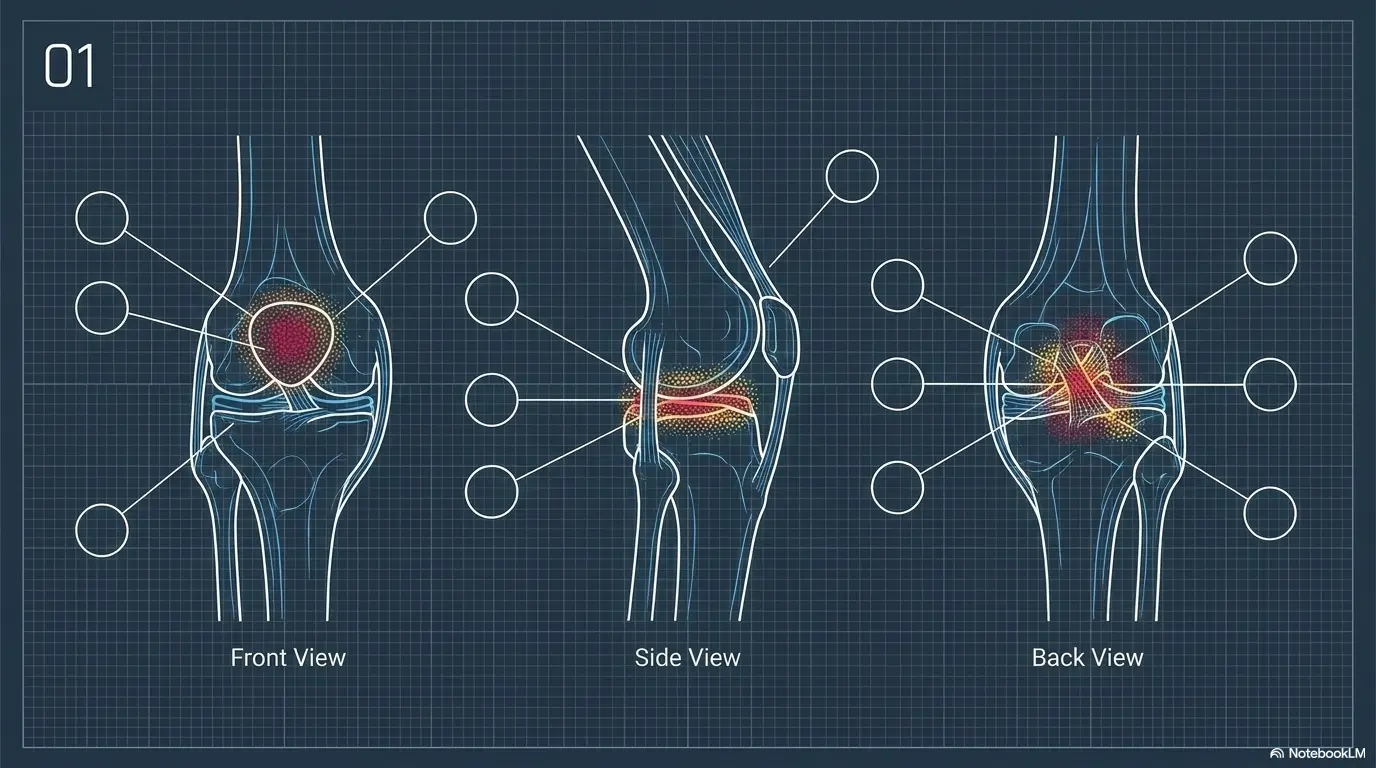
Write whether pain is at the front of the knee, behind the kneecap, inside, outside, back of the knee, above the kneecap, below the kneecap, or deep inside the joint. Add whether it feels sharp, aching, burning, tight, unstable, catching, or pressure-like.
Translate pain into function
A sentence about function is often more useful than a lonely number. Try this format: “I can do X, but Y causes Z.”
- “I can walk on flat ground for 15 minutes, but stairs cause sharp pain after five steps.”
- “I can stand at work, but my knee swells by evening.”
- “I can bend it partway, but kneeling feels impossible.”
- “I can sleep, but turning over wakes me if the knee twists.”
Short Story: Martha brought a timeline, not a mystery
Martha had been saying “my knee is acting up” for two months. Her daughter heard the phrase so often it started to sound like household weather, ordinary and unhelpful.
The night before the appointment, they wrote three lines: pain began after a long airport walk, swelling appeared by evening, and stairs were worse than flat ground. They added one photo of the swollen knee beside the other knee.
At the visit, Martha did not need to remember everything under fluorescent lights. She handed over the page. The clinician asked better follow-up questions within minutes.
The lesson was not that Martha solved her knee pain on paper. The lesson was that a clear timeline turned a vague complaint into a usable clinical conversation.
Key takeaway
Your best appointment prep is not a perfect diagnosis. It is a clear timeline, a pain map, and a functional example that shows what the knee is preventing.
Bring the Evidence Your Knee Cannot Say Out Loud
Knee symptoms have terrible manners. They may swell at night, calm down by morning, and then act innocent in the exam room. That is why evidence matters.
You do not need to arrive with a museum archive. You need the handful of details that help the clinician see the pattern.
Take photos of swelling
If swelling comes and goes, take photos when it is visible. Photograph both knees from the same angle, in similar lighting, with the legs positioned the same way. A comparison photo can be surprisingly useful.
Do not press, poke, or aggressively test the knee to make swelling appear. Capture the usual pattern. Your job is documentation, not provoking the dragon.
Record the pattern for one week
If your appointment is several days away, track symptoms briefly once or twice a day. Keep it simple enough that you will actually do it.
- Morning stiffness: none, mild, moderate, severe
- Swelling: none, small, obvious, worsening
- Warmth or redness: yes or no
- Locking, catching, or buckling: yes or no
- Worst trigger: stairs, sitting, standing, walking, kneeling, running, twisting, work shift
- What helped: rest, ice, heat, brace, medication, shoe change, elevation, activity change
Pack your paper trail
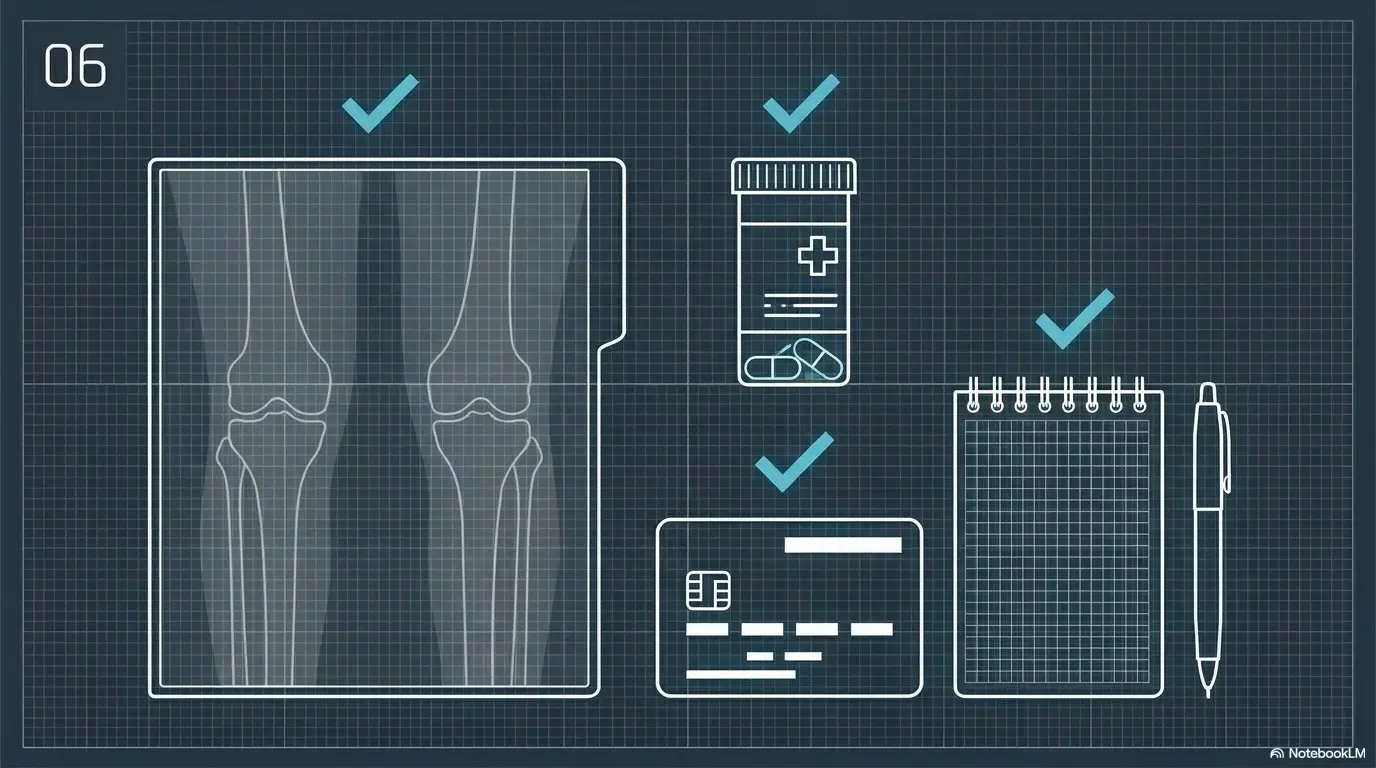
Bring prior X-ray or MRI reports, surgery notes, injection records, physical therapy notes, medication lists, allergies, and relevant diagnoses. If you have actual images on a disc or patient portal, ask the clinic in advance how they prefer to receive them.
Also bring the brace, sleeve, cane, shoe insert, or walking aid you use. The clinician may want to see how it fits, when you use it, and whether it helps or simply gives your knee a false sense of security in neoprene.
| Bring this | Why it helps | Quick tip |
|---|---|---|
| Medication list | Helps avoid unsafe combinations and repeated prescriptions | Include dose, timing, and side effects |
| Prior imaging reports | Prevents duplicate testing and shows history | Bring reports, not only screenshots |
| Swelling photos | Shows symptoms that may disappear during the visit | Compare both knees from the same angle |
| Brace, sleeve, cane, or shoe insert | Shows what support you already use | Tell when it helps and when it does not |
| Activity notes | Connects pain to daily function | Use examples: stairs, sleep, work, dog walks |
What the Clinician May Check in the Exam Room
The exam room is where your notes meet movement. Depending on the visit type and your symptoms, the clinician may look at how you stand, walk, bend, straighten, rotate, and tolerate pressure around the knee.
This is why appointment clothing matters. Shorts or loose pants make the exam easier. Tight jeans can turn a medical visit into a fabric lawsuit.
Expect history plus movement testing
A knee exam may include inspection for swelling, bruising, warmth, redness, deformity, tenderness, range of motion, strength, gait, joint stability, and neurovascular signs. The clinician may compare both knees, because your “normal” side can provide useful context.
If a movement hurts, say where and how. “That hurts at the inner joint line” is more useful than a polite grimace.
Know what not to hide
Patients often minimize symptoms because they do not want to sound dramatic. Please do not soften the important details. Buckling, locking, inability to straighten, fever, warmth, redness, rapid swelling, numbness, tingling, and calf changes all belong in the conversation.
Also mention falls, near-falls, work injuries, sports injuries, recent surgery, blood thinner use, immune problems, and prior joint infection if relevant.
Ask what the exam finding means
When the clinician presses, bends, or tests stability, ask what they are checking. You do not need a medical lecture. A simple explanation can help you understand why the next step is rest, physical therapy, imaging, medication review, injection discussion, or referral.
Visit phrase to use
“Can you tell me what that movement or test is checking, and how it changes what we do next?”
The knee visit prep flow
1
Story
When it started, where it hurts, what changed.
2
Evidence
Photos, medication list, imaging reports, braces, activity notes.
3
Exam
Movement, tenderness, swelling, stability, function, red flags.
4
Next step
Treatment trial, imaging, referral, follow-up, call-sooner signs.
The MRI Trap: Ask for the Plan, Not Just the Scan
Many patients walk into a knee pain appointment wanting one thing: an MRI. That desire is understandable. A scan feels like certainty. It feels like proof. It feels like someone finally turning on the lights in a dark hallway.
But knee pain evaluation does not always begin with MRI, and a scan without a clear clinical question can create confusion, delays, insurance problems, or findings that do not explain your symptoms.
Why “I need an MRI” can backfire
Imaging decisions often depend on injury type, duration, exam findings, severity, function, prior treatment, and whether the result would change management. X-rays may be considered for certain injuries or longer-lasting pain. MRI may be more useful when soft-tissue injury, surgical planning, or persistent symptoms after appropriate conservative care are part of the picture.
If you want a deeper cost and referral view, this guide on MRI referral for orthopedic pain pairs well with this appointment checklist.
Ask the question that unlocks the reasoning
Instead of asking only for a test, ask what the test would change.
- “What findings would make imaging useful in my case?”
- “Would an X-ray, ultrasound, MRI, or lab work answer different questions?”
- “If imaging is normal but pain continues, what would we do next?”
- “If imaging shows a finding, how will we know whether it matches my symptoms?”
Show me the nerdy details: imaging and clinical questions
Show me the nerdy details
Different tests answer different questions. An X-ray can help evaluate bone alignment, fracture concerns, and arthritis-type changes. Ultrasound may be useful for fluid collections or superficial soft-tissue questions. MRI can show many soft-tissue structures, but it is usually most helpful when the result will change the treatment plan.
The tricky part is that imaging can show changes that are not the main pain source. That is why clinicians often match imaging with history, exam, function, and symptom pattern.
A practical patient question is: “What are we trying to rule in, rule out, or monitor, and how would the result change what I do next?”
Common Mistakes That Waste Time and Money
A knee visit can go sideways for very ordinary reasons. The patient forgets what they tried. The pain behaves better that morning. The medication list is incomplete. The main question appears in the parking lot after the appointment ends, naturally, because brains enjoy comic timing.
Here are the avoidable mistakes that quietly drain value from the visit.
Mistake: saying “it just hurts”
Replace vague pain with timing, location, triggers, swelling, mechanical symptoms, and functional limits. The phrase “it hurts” is a locked door. Details are the key.
| Instead of saying | Say this |
|---|---|
| “It hurts when I move.” | “Stairs and squats cause front-of-knee pain, but flat walking is tolerable.” |
| “It swells sometimes.” | “It swells by evening after work and improves overnight.” |
| “It feels weird.” | “It catches when I turn, and twice it felt like it might give way.” |
| “Medicine did not help.” | “Ibuprofen helped for four hours, but upset my stomach, so I stopped.” |
Mistake: forgetting what you already tried
Write down rest, ice, heat, compression, elevation, over-the-counter medication, topical creams, stretching, physical therapy exercises, braces, shoe changes, supplements, massage, activity changes, and home remedies.
For each one, note whether it helped, hurt, did nothing, or helped temporarily. This prevents repeat advice and helps the clinician judge whether a conservative-care trial has already happened.
Mistake: hiding your real activity goal
Tell the clinician what you want back. Walking the dog. Kneeling in the garden. Returning to pickleball. Sleeping without pain. Working a warehouse shift. Climbing stairs at home. Sitting through a flight. These goals shape the plan.
A runner, a caregiver, a retiree in a second-floor apartment, and a nurse on twelve-hour shifts may all say “knee pain,” but their treatment priorities are not identical.
Key takeaway
The appointment gets better when you name the activity you want to protect. “I want to get back to stairs safely” is more useful than “I want my knee fixed.”
Costs, Referrals, and Provider Options to Compare
Knee pain care can involve more than one bill. A visit may lead to imaging, physical therapy, a brace, medication, injections, lab work, or referral. Preparing for those possibilities does not make you cynical. It makes you less likely to be surprised by paperwork dressed as confetti.
The best way to choose a knee pain provider is often based on severity, access, insurance rules, and what decision needs to be made next.
Compare the first door, not just the specialist name
Primary care may be a practical first step for non-urgent symptoms, medication review, referral routing, and broad health context. Sports medicine may fit activity-related injuries or return-to-play questions. Orthopedics may be appropriate when structural injury, persistent pain, surgical questions, or advanced imaging decisions are more likely. Physical therapy may be central when strength, mobility, balance, or movement mechanics need attention.
If you already have an orthopedic visit scheduled, this orthopedic visit checklist can help you refine what to bring.
Good, better, best prep for different budgets
| Prep level | What it includes | Best for | Cost-conscious note |
|---|---|---|---|
| Good | One-page symptom sheet, medication list, top three questions | Most routine first visits | Free and often enough to improve the visit |
| Better | Good prep plus swelling photos, prior records, brace or shoe details | Recurring swelling, older injuries, prior treatment | May reduce duplicate testing or repeated advice |
| Best | Better prep plus insurance questions, imaging facility check, PT coverage check | High-deductible plans, referrals, possible imaging or therapy | Helps avoid surprise bills and wrong-location imaging |
Questions to ask before paying for next steps
If the clinician recommends imaging, physical therapy, a brace, injection consultation, or a specialist referral, ask practical questions before you leave.
- “Does my insurance require prior authorization for this?”
- “Do I need to use a specific imaging center or therapy clinic?”
- “Is there a lower-cost facility option for the same ordered test?”
- “What should I try while waiting for the next appointment?”
- “What symptoms mean I should call sooner?”
- “Can I get a written visit summary and diagnosis codes if available?”
For high-deductible plans, imaging costs can vary by site. This HDHP imaging cost estimate guide can help you prepare smarter questions before scheduling a scan.
Key takeaway
A knee pain appointment is also a decision point. Before you pay for imaging, therapy, braces, or referrals, ask what the next step should change and what your lower-cost options are.
When to Seek Help Before the Appointment
Some knee symptoms should not wait politely in line behind a routine appointment. The goal here is not to panic. It is to notice when the story changes from “prepare well” to “call now.”
Same-day or urgent evaluation signs
Seek timely medical help if you cannot bear weight, have severe pain after an injury, have marked swelling, see an obvious deformity, have fever with redness or warmth, cannot fully bend or straighten the knee, or have a knee that locks or gives way.
Do not bury these details at the end of the appointment. Lead with them when you call the clinic, urgent care, or medical advice line.
Calf symptoms deserve respect
Pain, swelling, numbness, tingling, or bluish color below the painful knee should not be treated as ordinary soreness without medical input. Calf symptoms can come from different causes, and some require prompt evaluation.
Persistent pain after home care
If pain continues after several days of reasonable home care, or keeps returning whenever you resume normal activity, contact a healthcare provider. Persistent pain is not a moral failure. It is information.
Build a One-Page Knee Visit Sheet
Your one-page knee visit sheet is the quiet hero of this whole operation. It keeps your story from dissolving under appointment pressure and gives your clinician a clean starting point.
Keep it to one page if possible. A concise sheet is more likely to be read, scanned, and used.
The fill-in template
One-page knee visit sheet
- Start date or first event: When did the pain begin?
- Injury story: Twist, fall, pop, overuse, new activity, or gradual onset?
- Pain location: Front, inside, outside, back, above, below, or deep inside?
- Pain quality: Sharp, aching, burning, tight, unstable, catching, pressure?
- Swelling pattern: When does it appear, and what reduces it?
- Mechanical symptoms: Locking, catching, buckling, giving way, unable to straighten?
- Triggers: Stairs, walking, kneeling, sitting, standing, running, twisting, work?
- What helps: Rest, ice, heat, compression, elevation, brace, medication, shoes?
- What you tried: Include dose, timing, side effects, and results.
- Daily-life limits: Sleep, work, driving, stairs, exercise, caregiving, errands?
- Top three questions: Diagnosis, treatment, follow-up.
The three questions to carry in
Do not bring nineteen questions unless you enjoy watching minutes evaporate. Bring three priority questions, then keep extras below them.
- “What are the most likely causes of my symptoms, and what findings support each one?”
- “What should I try first, what should I avoid, and how long before we know whether it is working?”
- “What symptoms mean I should call sooner, and when should I come back if nothing improves?”
What to do after the visit
Before you leave, ask for a written visit summary if available. Save imaging orders, referral papers, prescriptions, physical therapy instructions, work restrictions, and follow-up timing in one folder.
After the visit, update your sheet with the plan. What are you trying? For how long? What should improve first? What should make you call? This turns the appointment into a usable plan instead of a fading memory.
FAQ: Brief Answer Cards, Without PAA Targeting
What should I expect at a first knee pain appointment?
Expect questions about when pain started, whether there was an injury, where it hurts, what triggers it, what helps, and what daily activities are affected. The clinician may examine swelling, tenderness, range of motion, strength, stability, walking pattern, and related symptoms.
Should I ask for an MRI right away?
You can ask whether imaging is appropriate, but it is usually better to ask what each test would change about the plan. MRI is not automatically the first step for every knee pain visit. The right test depends on your symptoms, exam findings, injury history, and prior treatment.
What medication details should I bring?
Bring medication names, doses, timing, side effects, allergies, and any medical conditions that affect medication safety. Include over-the-counter pain relievers, topical creams, supplements, blood thinners, and medications you stopped because they did not help or caused problems.
Will I be sent to physical therapy?
Physical therapy may be recommended when strength, flexibility, balance, pain control, gait, or movement patterns are part of the problem. Ask what therapy is meant to improve, how long to try it, and what signs suggest the plan needs adjustment.
How do I ask about work or activity limits?
Be specific about your job, commute, stairs, lifting, kneeling, standing time, sports, caregiving, and home responsibilities. Ask what to avoid, what is safe to continue, and whether you need written work restrictions or modified activity guidance.
When should I follow up if nothing improves?
Ask before you leave. You should know how long to try the plan, what improvement should look like, what symptoms mean you should call sooner, and whether the next step would be imaging, referral, medication review, therapy adjustment, or another exam.
Your 15-Minute Next Step Before the Visit
Set a timer for 15 minutes and build your knee visit sheet. Do not make it beautiful. Make it useful.
Write the first day something changed, where the pain is, what makes it worse, what helps, what you already tried, whether swelling, locking, buckling, warmth, redness, or calf symptoms appeared, and your top three questions. Add medication details. Save photos if swelling comes and goes. Put prior reports in the same folder.
That one page will not fix your knee. But it can steady the appointment, sharpen the questions, reduce repeat confusion, and help your clinician see the pattern faster. In a medical visit, clarity is not glamour. It is traction.
Last reviewed: 2026-07