

An MRI referral discussion is a chance to clarify the clinical question, bring existing information together and agree who follows up. You do not need a complete symptom log, a particular number of treatments or an eligibility score to ask for assessment. This guide helps you preserve what is actually known; it cannot decide whether you need a scan.
Start with the six essential checks, compare reports, images and confirmed receipt, read two fictional writing examples, or use the MRI purpose, existing-material, referral-progress and actual-answer record. This article focuses on preparing the discussion and closing communication gaps. It does not teach you to build an approval-friendly history.
Urgent symptoms come before paperwork. With back pain, new bladder or bowel changes, loss of sensation around the genitals or anus, symptoms in both legs such as weakness or numbness, chest pain or pain after a serious accident need emergency assessment. Sudden severe joint pain, swelling, heat or difficulty moving needs urgent assessment; fever may be absent. Use appropriate local urgent or emergency services, including 911 for U.S. emergencies. These selected warnings are not a complete triage list. Do not wait for old images, an MRI referral, approval, a completed record or a routine reply when urgent assessment is needed. NHS back-pain guidance; NHS joint-infection guidance.
This is caregiver-written education, not individual medical, insurance or financial advice. The operator is not a medical professional. Clinical decisions belong with the relevant treating team; processes vary by health system, facility and plan. A family helper should work with the person’s permission and preferences. Incomplete information and difficulty describing pain are valid reasons to ask for help, not evidence that pain is less credible.
Table of Contents
Six essential MRI referral checks
| Check | What to preserve | Question to ask |
|---|---|---|
| 1. Purpose | Your concern and the clinical purpose actually explained, kept separate. | What question might MRI answer, and how could the result affect my care? |
| 2. Existing material | Previous examination details; report and image availability; actual receipt. | Which previous materials do you need, and have you received them? |
| 3. Actual changes and care | Changes since earlier assessment; actual care, response and barriers. | Does this new information change the assessment or plan? |
| 4. Exact referral status | Recommendation, order, sending and confirmed receipt, when known. | What was ordered, where was it sent and who can confirm receipt? |
| 5. Applicable arrangements | Any actual authorization requirement, decision, booking and facility instructions. | Which requirements apply to this exact service, and what remains unconfirmed? |
| 6. Result explanation | Who explains the report, how contact occurs and the next action actually agreed. | Who will explain the result, and whom should I contact if that does not happen? |
These are organization checks, not six mandatory steps before care. Some may not apply, and several may happen in parallel. “Unknown,” “not yet asked” and “reply pending” are useful entries. No checklist completion, treatment count or fixed waiting period establishes MRI suitability, approval or safety.
Start with the clinical question, not an MRI eligibility score
A useful MRI referral conversation can begin with: “I am worried about this change. What do you need to assess, and would imaging help answer that question?” Record your own concern separately from any explanation the clinician actually gives. Do not fill in a diagnosis, suspected structure or management plan that has not been discussed.
AAOS explains that X-ray, CT and MRI provide different kinds of information. The relevant examination depends on what the clinician needs to investigate. MRI is not automatically the best next test because pain is severe, a previous image exists or a treatment has not helped. Equally, this article cannot rule out imaging because a first-line treatment has not been completed.
Ask what a possible result would change and what uncertainty would remain. If imaging is not recommended now, ask what the actual plan is, which changes should prompt reassessment and how to obtain help. Record the answer rather than interpreting “not now” as “never” or using this article to overrule the clinician. If the plan remains unclear, asking for an explanation is appropriate.
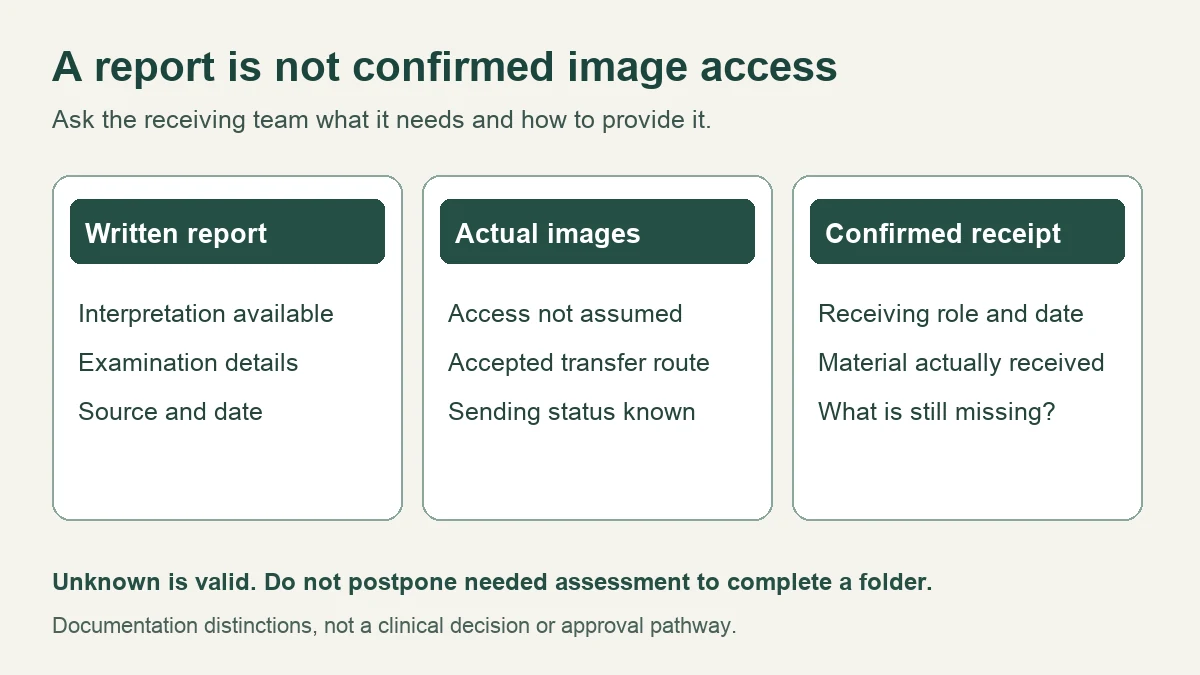
Previous reports, actual images and receipt are different facts
For each previous examination, use a simple A/B label and write the body area and side, examination type, date and institution if known. Keep the label consistent when you discuss its report and images. An approximate date or an unknown detail is more useful than an invented one. This organizer is not a place to upload a complete medical record.
| Item or status | What it actually tells you | Remaining question |
|---|---|---|
| Report available | You have the written interpretation, or know where it can be requested. | Does the current team need the report, actual images or both? |
| Images available somewhere | The prior institution or another source may hold the examination images. | What access or transfer method does the receiving team accept? |
| Transfer requested | Someone has asked for material to be provided. | Who is handling it, and has anything actually been sent? |
| Transfer sent | Material was sent by a known source, if confirmed. | Has the receiving service confirmed usable access? |
| Receipt or access confirmed | A named receiving role confirmed the stated material, on a stated date. | Is anything still missing for the planned review? |
Ask the receiving team what it needs and how to provide it through the approved private route. Do not assume that institutions share images, that bringing a report transfers the images, or that a sent file has been received. You do not need to choose a technical file format from a blog. Keep any identifying record numbers outside the public tool.
If the clinical question has changed, ask what the earlier examination can and cannot answer. Existing material may help the assessment, but this worksheet cannot decide that an old scan is sufficient or that another scan is needed. Do not cancel a recommended examination or postpone assessment while waiting for historical records without discussing the situation with the team.
Describe actual changes and actual care without earning a referral
Use ordinary experiences already noticed: what changed, when you first noticed it if known, the effect on daily life and what concerns you. Pain, sleep and ability to do ordinary tasks all matter. Difficulty identifying a pattern does not invalidate pain. No diary quality score is needed for an MRI referral discussion.
Do not repeatedly perform painful movements, test strength or try to distinguish “true weakness” from pain-limited effort yourself. Describe the actual change and seek appropriate assessment. A newly concerning symptom deserves attention even when the previous record is incomplete. A routine documentation question is not a reason to wait.
Record care that was actually recommended and received, the instructions and source if known, any benefit, unwanted effects and practical barriers. Include treatments not started or only partly available, with the real reason: cost, transport, unclear instructions, contraindication or another concern. No three-treatment rule, required session count or universal trial duration is supplied here.
Keep the person’s report, a helper’s observation and the clinician’s reasoning distinguishable. Do not invent a treatment, exaggerate a limitation or borrow another person’s history to make the MRI referral sound stronger. If instructions conflict, ask the relevant treating professionals to clarify them; this article supplies no replacement exercise, medicine or continue/stop instruction.
Use imaging evidence within its actual scope
| Source | What it supports here | Limit to keep |
|---|---|---|
| ACR Appropriateness Criteria: Low Back Pain | Variant 3 concerns subacute/chronic low back pain, with or without radiculopathy, in a surgery/intervention candidate with persistent or progressive symptoms during or after six weeks of optimal management. | That conditional scenario is not a universal six-week waiting rule for every joint, every symptom or an urgent presentation. It is not an insurance approval promise. |
| NICE NG226: Osteoarthritis | The guideline advises against routine diagnostic imaging for osteoarthritis unless atypical features or an alternative/additional diagnosis are suspected. | This is condition-specific UK guidance, not a ban on imaging all orthopedic pain or a U.S. payer rule. |
| AAOS: X-rays, CT and MRI | Different modalities answer different questions about the body. | General patient education does not select an examination for an individual or determine coverage. |
| RadiologyInfo: Shoulder MRI | Explains a shoulder examination, screening/preparation and report communication. | Its shoulder-specific detail is not a protocol for every body area; the actual facility and clinical team give personal instructions. |
Ask the treating clinician which guidance and clinical circumstances apply to your situation. A broad internet rule cannot replace assessment. An insurer’s request for documentation and a clinical imaging recommendation also answer different questions; neither should be silently substituted for the other.
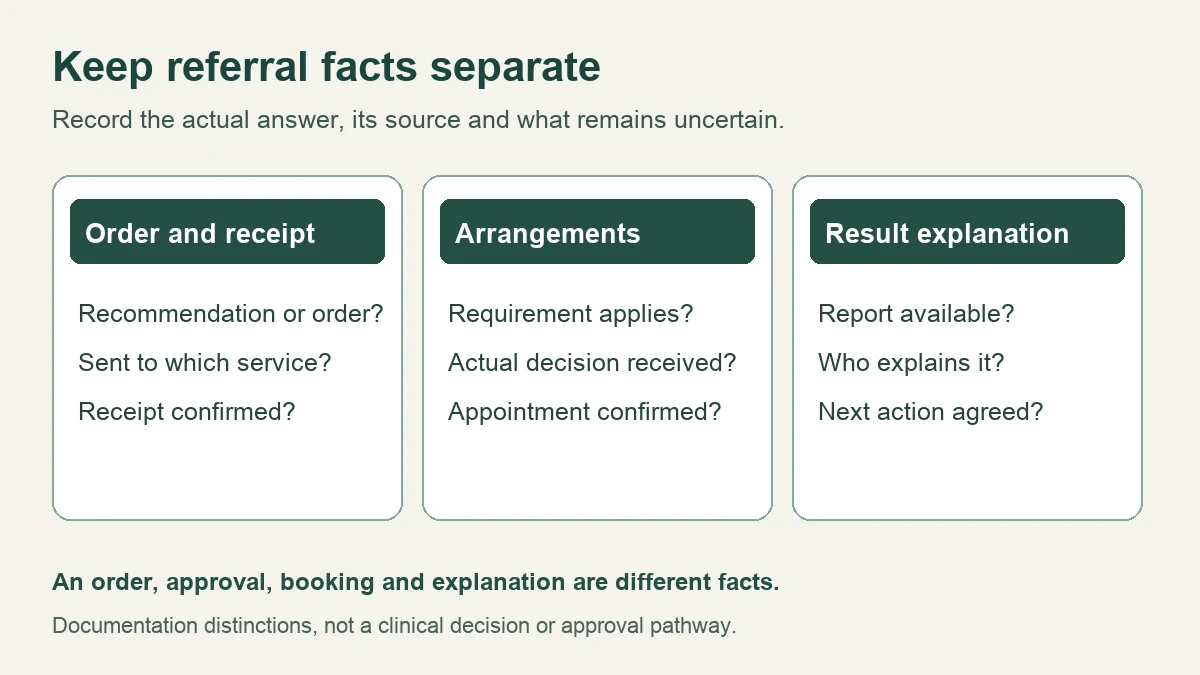
Track the order, applicable requirements and actual booking separately
| Fact | Useful record | Avoid this assumption |
|---|---|---|
| Discussion or recommendation | What was actually said, by whom and when. | An electronic order already exists. |
| Actual order | The real order details and ordering source, if known. | It was sent to or received by the intended facility. |
| Sending and receipt | Known sending details and actual receiving confirmation. | Sending alone means review or booking is complete. |
| Applicable authorization | Whether it is required for the exact service, source of that answer and any real decision. | All MRI referrals need prior approval, or approval guarantees all charges. |
| Booking | Actual appointment confirmation and facility instructions. | An order or authorization is an appointment. |
| Result and explanation | Report availability plus who actually explained it and the agreed plan. | A portal notification means the result has been explained. |
Keep questions with the appropriate role. The ordering clinician can explain the clinical question and order; the receiving facility can clarify receipt, booking and its preparation process; the applicable plan or administrative contact can explain service-specific requirements. Record the real answering role, date and scope rather than treating one answer as confirmation of everything.
For MRI preparation, tell the imaging team about implants or devices, previous surgery, possible pregnancy and other issues requested in its screening process. An implant is not automatically permission or prohibition: the team needs the specific information to assess the examination. Do not select contrast, fasting, sedation or medicine changes from this article; follow and clarify the actual instructions. RadiologyInfo’s shoulder MRI information explains why screening matters.
If the exact proposed study changes, ask what that changes for the order, facility arrangements and any applicable authorization or estimate. This guide does not determine a price or recommend paying privately. For a separate care-documentation question, see MRI authorization: accurate care records. This article’s distinct purpose is the existing-material and referral communication record, not proving treatment failure.
Agree who explains the result and handles the unanswered question
Before the examination or next review, ask who will explain the result, how that contact is arranged and what to do if the expected contact does not happen. Record only an actually agreed date or plan. Do not invent a general turnaround time or assume silence means a normal result.
RadiologyInfo describes a radiologist interpreting the study and sending a signed report to the referring clinician, who discusses the result. Confirm your own service’s arrangements. A report may appear before a conversation; unfamiliar words should be discussed in the context of symptoms, examination and the care plan. RadiologyInfo: report communication.
After a reply, preserve the answer in the source’s actual scope and note what remains unresolved. “The report is available” does not answer “what does it mean for my care?” If contact fails, use the agreed alternative route or ask the service who now owns the follow-up. Concerning changes should receive appropriate assessment rather than waiting for an administrative callback.
Two fictional MRI referral writing examples
These examples demonstrate documentation only. They are not real cases, clinical advice, approvals or proof that an MRI is needed. Neither supplies a diagnosis, a treatment prescription or a successful outcome. The tool’s example buttons replace existing entries and label the generated record fictional.
Example A: report available, actual images not confirmed
| Record area | Fictional entry |
|---|---|
| Purpose | “Can my earlier imaging help answer the current question, and what would a new study add?” No clinician explanation supplied in the example. |
| Existing material | Previous knee examination reported. Written report available; exact examination details need checking. Current team has not confirmed receipt of actual images. |
| Contact | Question about the material needed and accepted transfer method prepared; not sent. |
| Actual answer / next owner | No real reply supplied. Record the receiving team’s answer and actual receipt status when known. No repeat-MRI decision is made. |
The improvement is a clearer material-transfer question, not a conclusion that old imaging replaces a new examination. Keep unconfirmed receipt visible and ask for help with the existing details. Do not delay a needed assessment to perfect the folder.
Example B: order exists, receipt and follow-up not confirmed
| Record area | Fictional entry |
|---|---|
| Actual order | An order exists in this fictional example. Its real clinical purpose and exact wording must come from the actual team. |
| Progress | Sending reported; facility receipt unconfirmed. Whether authorization applies remains unknown. No appointment confirmation supplied. |
| Contact / actual answer | Question about receipt, booking and result explanation sent in the fictional example; reply pending. No actual answer received. |
| Result plan | Explanation owner and contact plan not yet agreed. Record the real reply; do not turn a portal report into an explanation. |
This example preserves several independent unknowns without calling them a denial, approval or booking. When an actual answer arrives, attach it to the matching question and retain its source and date. The record does not create a permission requirement or tell the reader to wait when assessment is needed.
Private MRI purpose, material, progress and actual-answer tool
Download the offline tool before entering actual health or personal notes. Use fictional entries on this public page because its surrounding services may include ads and analytics. The tool sends nothing, uses no browser storage and does not automatically save. The downloaded offline copy contains no external assets or automatic network requests. Keep completed files and exports private.
Use one MRI referral discussion per record. For several earlier examinations, use matching A/B labels across the material fields. A paper note with the same headings is equally valid. You can leave a field blank or write unknown, not asked or reply pending; no eligibility score or automatic recommendation is produced.
MRI purpose, existing-material, referral-progress and actual-answer record
Keep the clinical question, previous reports and images, actual referral status and real replies separate. This organizer does not decide whether you need MRI or whether it is approved.
Download the offline tool before entering actual health or personal notes. Use fictional entries here; the surrounding site may contain ads and analytics.
Offline copy. This file has no ads, analytics, external assets or automatic network requests.
The tool uses no network requests, browser storage or automatic saving. Refreshing or closing may lose entries. Keep exports private; omit names, identifying numbers and full records. Do not delay assessment for this form, old images or a routine reply.
Start with the fictional example or download a blank offline copy.
Paper alternative: purpose; previous examination; reports/images and receipt; existing changes; actual care/barriers; order; order receipt; applicable requirement; booking; contact; real answer; result explanation owner. Unknown and pending are valid.
My MRI purpose, materials, progress and actual-answer record
Unverified personal record for discussion. Entries verify no clinical purpose, image receipt, order, approval, booking or answer.
Guide: living.kioptrix.com/mri-referral-for-orthopedic-pain/
After editing, rebuild the record, then copy, download text or print it. You can also download an offline copy with the current entries, so keep it private. Exporting does not send a request, transfer images, order a test, obtain authorization or book an appointment. Even a completely filled record remains unverified personal notes.
Common MRI referral questions
Do I need six weeks of treatment before asking about MRI?
No universal waiting period applies across orthopedic pain. The ACR low-back scenario above has specific conditions. Ask for assessment when concerned; urgent symptoms should not wait for treatment history or paperwork.
Does an earlier report mean the clinician has my images?
No. Record the report and actual image access separately, then ask the receiving team what it needs and whether it has received it.
Does a referral mean insurance approval or a booking?
No. Record the actual order, applicable administrative requirement, real decision and appointment confirmation as separate facts. Do not assume every service requires prior authorization.
Can this tool decide whether I need MRI?
No. It organizes unverified information, missing questions and actual replies. It does not diagnose, select a scan, clear MRI safety or decide coverage.
What if I cannot describe a clear symptom pattern?
Say what you do know and what worries you. Incomplete recall or an unclear pattern does not make pain less credible. Do not test painful movements or strength to earn a more complete entry.
Sources, corrections and editorial limits
- ACR Appropriateness Criteria: Low Back Pain — indication-specific imaging guidance; the conditional six-week scenario is not a universal eligibility rule.
- NICE NG226 recommendations — osteoarthritis diagnosis and imaging limits within that condition.
- AAOS: X-rays, CT Scans and MRI Scans — imaging modality background.
- RadiologyInfo (ACR/RSNA): Shoulder MRI — shoulder-specific examination, screening and report communication.
- NHS: Back pain; NHS: Septic arthritis — selected warning symptoms, not U.S. referral or insurance rules.
Source check and editorial update: October 29, 2026. Removed the eligibility calculator, unvalidated tiers, arbitrary treatment counts, approval-oriented language, unsupported clinical anecdote and unverified video. Replaced repeated generic MRI arguments with material receipt, exact referral status, actual replies and result-explanation ownership. The existing URL, original publication date, author and classification are retained.
This is a caregiver-created organizer, not a validated clinical instrument or comprehensive imaging guideline. No independent clinical review, real-reader study or improvement in diagnosis, approvals or health outcomes is claimed. The featured image is AI-generated fictional artwork; the diagrams explain documentation distinctions. Our background and editorial approach.