

An urgent care vs orthopedic clinic comparison should check actual access, the assessment received, test-result responsibility and follow-up. A service name does not establish how serious a problem is, which tests are needed or whether it is safe to wait. The useful record connects what a location can provide with the actual visit, real instructions and onward care that was really arranged.
Use the six essential follow-up checks, compare actual capabilities, read two fictional writing examples, or build the access, assessment, result and handoff record. This page focuses on keeping the first assessment, pending results and next service connected. It does not recommend a clinic from a symptom checklist.
Urgent care is not the hospital emergency department (ED/ER). Emergency care is needed for serious or potentially disabling problems; call 911 for potentially life-threatening symptoms such as severe breathing difficulty, stroke signs or severe chest pain, or when emergency assistance is needed. Severe injury, uncontrolled bleeding, an open suspected fracture or a newly cold, discoloured, numb injured limb must not wait for an office comparison. MedlinePlus explains emergency and urgent-care options; NHS injury warning guidance. These are selected examples, not a complete triage list.
With back pain, new difficulty urinating or bladder/bowel control changes, loss of feeling around the genitals or anus, symptoms such as weakness or numbness in both legs, chest pain or pain after a serious accident need emergency assessment. A suddenly very painful, swollen or hot joint needs urgent assessment even without fever. New or worsening symptoms need appropriate assessment rather than a routine booking rule. NHS back-pain warnings; NHS joint-infection guidance.
This is U.S.-focused caregiver-written education, not individual medical, insurance or financial advice. The operator is not a medical professional. A booking reply and this worksheet cannot triage a person, interpret a scan or clear an activity. Needed assessment must not wait for a complete timeline, cost check, clinic reply or referral. If uncertain without an apparent emergency, contact an appropriate clinician or nurse advice service; do not use uncertainty as permission to postpone care.
Table of Contents
Urgent care vs orthopedic clinic: six essential follow-up checks
| Check | Actual fact to keep | Clarification question |
|---|---|---|
| 1. Access and capability | What the specific location said it could assess or provide, with source/date. | Can this actual service address the concern, and what are its limits? |
| 2. Assessment received | Where the visit occurred, what was assessed and what explanation was given. | What remains uncertain after this assessment? |
| 3. Instructions | Actual treatment/activity advice and return precautions. | What should be clarified with the treating service? |
| 4. Tests and results | Ordered/performed, report status, real explanation and result owner. | Who checks and explains pending or final results? |
| 5. Onward care | Referral purpose, sending, receipt, acceptance and booking. | Has the next service actually accepted or scheduled the referral? |
| 6. Actual reply and owner | Real answer, remaining point and next action actually agreed. | Who is responsible for the outstanding task? |
These are record categories, not required clinical stages or a referral score. Some visits need no test or onward referral; the actual clinical assessment determines that. Complete only what applies and leave uncertainty visible. No duration of symptoms, number of yes answers or normal-image label generates a place-to-go decision or a waiting period.
Compare actual capabilities rather than speed or depth rankings
MedlinePlus describes urgent care as an option for non-life-threatening problems when a person is concerned and cannot see their provider soon enough. That general role is not a guarantee of imaging, specialist assessment or suitability at a particular location. Its emergency guidance takes priority over an administrative service comparison.
MedlinePlus describes orthopedic services across musculoskeletal diagnosis and treatment. It does not rank every orthopedic office above every urgent care visit or guarantee a particular appointment schedule. Some practices advertise walk-in injury services, while actual hours, staffing and capabilities must be checked locally. Primary care or another appropriate service may also be involved according to clinical needs.
| Capability to confirm | Actual reply from the location | Do not infer |
|---|---|---|
| Assessment offered today | Which concern, body region or service is actually accepted; any stated limit. | That an open door, clinic title or short wait determines safety or fit. |
| Clinician and service | Who evaluates the patient and the scope of this visit. | That all urgent care is shallow or all orthopedic care is more thorough. |
| Imaging when clinically needed | What is available at this location and how a needed service is arranged if unavailable. | That an X-ray is required or that availability establishes need. |
| Initial treatment and limits | What this service actually provides and how it handles needs beyond its scope. | That a sprain label, support device or visit receipt rules out a serious problem. |
| Results and follow-up | Who checks reports, explains findings and responds to outstanding questions. | That an onward referral automatically transfers responsibility. |
| Non-emergency access/cost question | Exact service, clinician/site and actual office/plan conditions. | That insurance permission, price or convenience decides clinical urgency. |
For a non-emergency administrative question, ask the actual office rather than relying only on a general website. A staff answer about opening hours or X-ray availability is not a clinical assessment. If a location cannot provide the necessary assessment promptly, obtain appropriate clinical guidance or emergency care when indicated; this table cannot select a safe fallback or tell you to wait.
The AAOS sprain and strain article explains soft-tissue injuries and treatment. It is not an official urgent-care-versus-orthopedic routing guideline. Likewise, ACR/RSNA low-back imaging information applies to particular low-back situations; it is not evidence that one institution label always offers better diagnosis or planning.
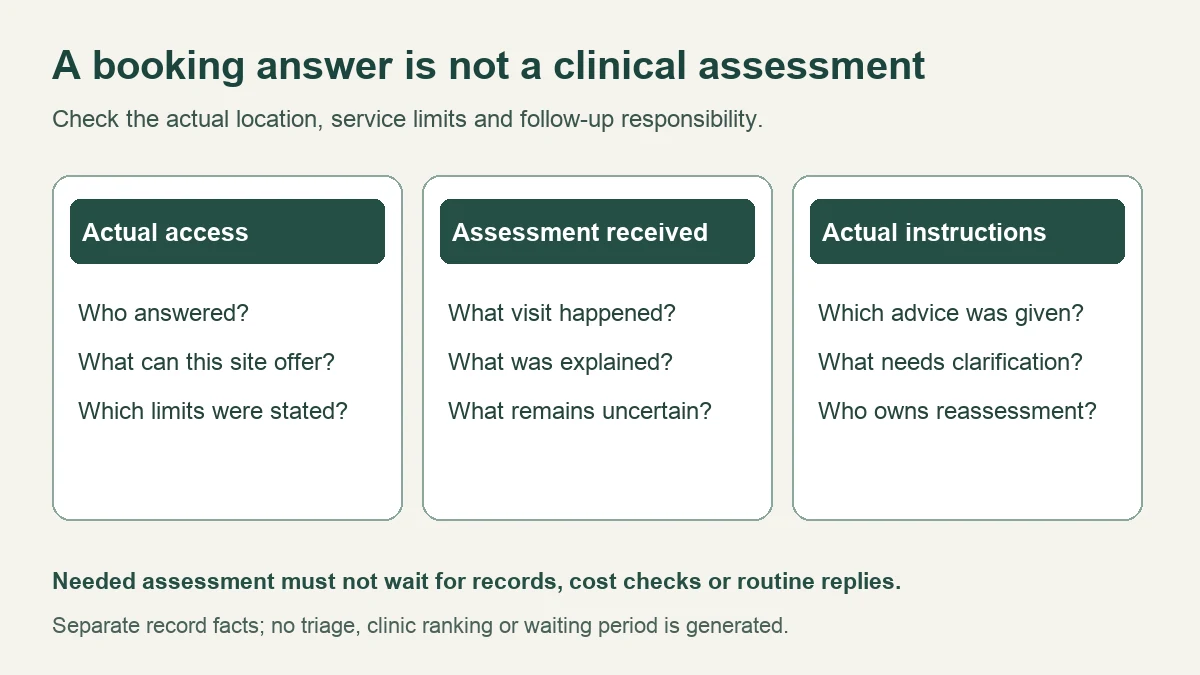
Record the assessment received without turning it into clearance
After a visit, preserve the visit summary and actual explanation. Separate what the clinician assessed from your own symptom description and any remaining uncertainty. A diagnosis may be provisional or a question may remain unresolved; record the real wording rather than changing it to “everything ruled out” or “nothing wrong.”
Useful existing facts include when the concern started if known, injury or changes already experienced, prior relevant care and current instructions. Approximate dates and incomplete recall are acceptable. Pain intensity matters alongside sleep, ordinary activity and mobility. Being able to function does not make pain less important. Do not test weight bearing, provoke a symptom or repeat an activity to generate better documentation.
Keep actual medicine, support-device, activity and reassessment instructions with their source. A summary in your words is different from the original written instruction. If advice is unclear or conflicting, ask the relevant treating professionals rather than choosing a plan from this page. The worksheet supplies no dose, brace schedule, loading progression or instruction to stop or continue treatment.
An additional evaluation is not automatically duplicate or failed care. It may address another question or a change in symptoms. Conversely, a referral slip is not proof that a needed next assessment happened. The useful task is to preserve the actual reason for follow-up and who agreed to arrange it, without promising fewer visits, faster recovery or lower cost.
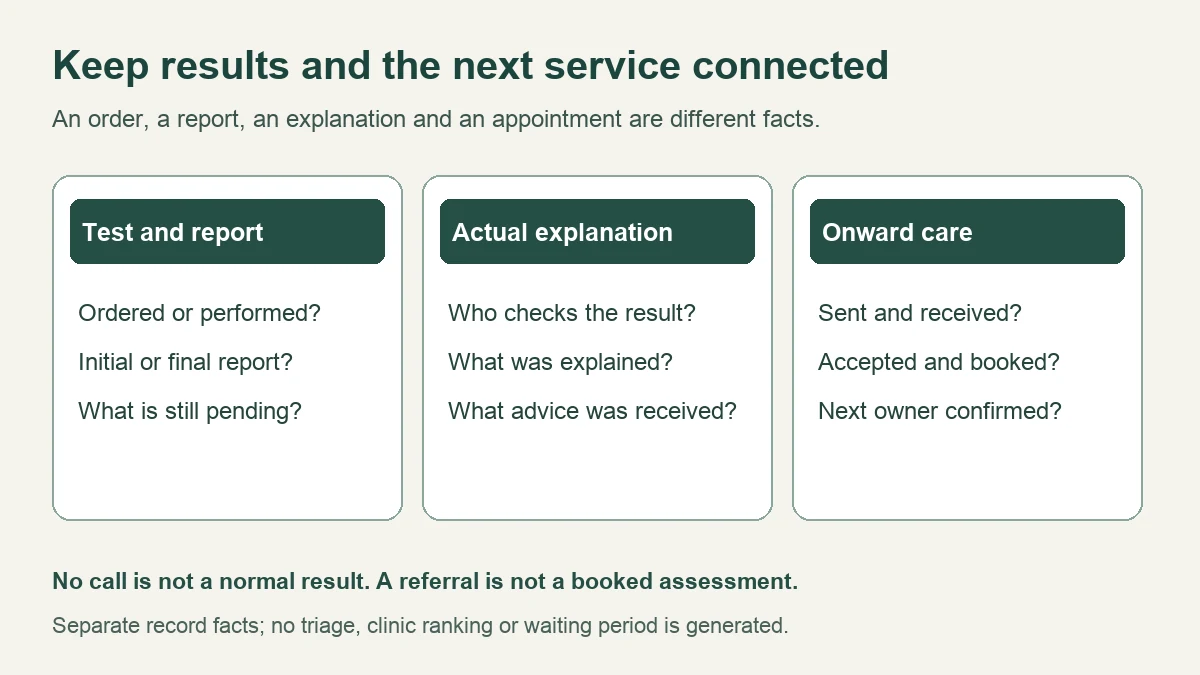
Track tests, final reports, actual explanation and result ownership
A test order is not a completed test. A completed test is not a final report, and a report available in a portal is not proof that someone explained it or changed the plan. Keep the stages distinct. Ask the treating service who checks pending/final results, how the explanation will reach you and what actual contact advice applies if that communication does not occur.
| Result-related fact | What to record | Question if unclear |
|---|---|---|
| Order / performance | Which test was ordered or actually performed and when, if known. | Is the planned test complete, pending or no longer proposed? |
| Initial explanation | Who gave an early interpretation and its actual scope. | Is a further or final report expected, and who will review it? |
| Report availability | Actual report status and source; not your interpretation of its meaning. | Does the treating service have the relevant result? |
| Explanation and plan | What a clinician actually explained and any actual instruction update. | What remains unanswered about the result or next plan? |
| Owner and contact | Role responsible, actual communication arrangement and contact instructions. | Who should be contacted if the expected explanation has not arrived? |
No message should not be treated as a normal result. Nor does a normal X-ray automatically exclude every injury or clear return to loading. The ACR ankle-trauma guidance includes situations involving continuing pain after negative initial radiographs. This supports the need for clinical reassessment in the appropriate context; it does not require every reader to obtain an MRI or wait a fixed interval.
If a report or later explanation differs from what you first understood, keep both sources and ask the responsible clinical team to explain the actual effect on care. Do not self-interpret a report, change activity, remove a support or alter medicines based on a portal phrase. Concerning changes need appropriate assessment without waiting for a final report or routine call.
Keep actual return advice separate from an arbitrary timetable
Record the return precautions and follow-up advice actually given: which changes require contact, where to seek help and who owns reassessment. Ask for clarification when you do not understand. If no advice was provided or you cannot locate it, write that down and contact the relevant service; a blank field does not generate permission to continue or wait.
There is no two-week threshold, two-out-of-three score or “new injury first / persistent pain second” rule in this guide. A planned appointment does not decide what to do about a new concern. Symptom duration, function, medical history and examination may all affect clinical decisions; the tool cannot combine them into a safe waiting limit.
Emergency symptoms override routine arrangements. For other new or worsening concerns, obtain appropriate clinical assessment rather than assuming that persistent symptoms belong only in a booked orthopedic clinic. Do not wait to complete the record, get insurance approval or confirm an administrative referral before seeking needed care.
An onward referral needs more than a piece of paper
Keep the actual referral purpose with the visit summary. It might ask another service to assess a particular uncertainty or provide follow-up, but the article does not decide that every urgent care visit must lead to orthopedics. The relevant clinician determines what follow-up is appropriate. Preserve the specific question and real instructions, not a universal sequence.
| Stage | Actual evidence or answer | What remains distinct |
|---|---|---|
| Proposed / ordered | Referral discussed or order issued, with the actual purpose. | No sending, acceptance or appointment inferred. |
| Sent | What material was actually sent, by whom and through which permitted route. | Sending does not establish receipt. |
| Received | Which office confirmed receipt of which material. | Receipt does not establish review, acceptance or booking. |
| Accepted / booked | Actual service acceptance and appointment confirmation, if received. | A scheduled visit is not a completed assessment or a substitute for current care advice. |
| Handoff explained | What the next team received, actual discussion and agreed responsibilities. | Delivery alone does not transfer every clinical task. |
Existing image access and a written report may be different transfer tasks. Ask the relevant service what material it needs and the permitted method. Keep identifying records private and share only with authorized recipients through appropriate channels. This worksheet neither transfers records nor establishes a helper’s authority to do so.
If the referral has not been accepted, the office needs more material or the actual appointment is unclear, preserve that answer and ask the referring team about the unresolved handoff. Record who owns the next action. Do not label a proposed referral “complete,” independently change a clinical plan or assume that the referring service has stopped being involved.
This is the distinct purpose of this page: connect actual access and assessment to pending results and onward care. Our pain clinic and orthopedist service guide compares consultation scope and service configuration. Our MRI referral guide focuses on the imaging question and existing material. Neither replaces result ownership or confirmed follow-up after an initial visit.
Two fictional access, results and handoff examples
These are invented writing examples, not real cases or clinical advice. They supply no diagnosis, deadline, test requirement or safe waiting interval. The tool’s example buttons replace current entries and mark the resulting record fictional. Unknown and pending remain visible rather than being filled with a likely answer.
Example A: initial imaging discussed, final explanation unclear
| Record area | Fictional entry |
|---|---|
| Assessment / test | Initial assessment occurred. An early imaging explanation is recorded; final report status remains unknown. No diagnosis or emergency exclusion supplied by the example. |
| Result / owner | No actual final-result explanation provided. Who checks and explains a pending/final report is unconfirmed. |
| Instructions / question | Check the actual treatment and return advice with the treating service. Question about report status and the result owner prepared, not sent. |
| Actual reply / next action | No real reply supplied. Record actual advice and responsible role. No normal-result activity clearance or waiting interval generated. |
The practical improvement is identifying the missing explanation and owner. It does not establish that another scan is needed, that an initial finding was wrong or that it is safe to wait for routine communication.
Example B: referral proposed, acceptance and booking unconfirmed
| Record area | Fictional entry |
|---|---|
| Referral | Onward orthopedic referral proposed; sending, receipt, acceptance and booking not confirmed. |
| Material | Relevant report and access to images need checking through permitted routes. No actual transfer confirmed. |
| Question / reply | Question about referral status and follow-up responsibility sent; receipt unconfirmed. No actual answer received. |
| Current advice / next owner | Existing instructions and real return advice remain relevant. Record actual replies and next owner without assuming the handoff is complete or waiting for a new appointment is safe. |
An order, a fax confirmation and a scheduled appointment answer different questions. This example does not select another facility or replace clinical advice. It helps preserve an unresolved administrative task while needed assessment remains separate.
Private access, assessment, result and handoff tool
Download the offline copy before entering actual health or personal details. Use fictional entries on this page because the surrounding site may contain ads and analytics. The tool makes no network requests and uses no browser storage or automatic saving. Its offline copy contains no external assets or automatic network requests. Keep completed copies private.
Use one actual episode or follow-up question per record and keep short matching labels if several tests or referrals are involved. Unknown, not asked, reply pending and not applicable according to an actual answer are useful entries. Omit names, account numbers and complete reports. A paper note with the same headings works; a complete record is not required before asking for help.
Same-day access, assessment, test-result and follow-up handoff record
Keep an actual service reply, the assessment received, real instructions, result explanation and referral acceptance distinct. No triage or clinic recommendation is generated.
Download the offline tool before entering actual health or personal details. Use fictional entries here; the surrounding page may contain ads and analytics.
Offline copy. No ads, analytics, external assets or automatic network requests.
The tool makes no network requests and uses no browser storage or automatic saving. Closing or refreshing may lose entries. Omit names, identifiers and full reports; keep completed copies private. Needed care must not wait for a record, cost check or routine reply.
Start with the fictional example or download a blank offline copy.
Paper alternative: existing concern/advice; actual access; assessment received; real instructions; tests/report status; result explanation; result owner; return advice; referral stages; records transfer; actual reply; next owner. Unknown and pending are valid.
My access, assessment, result and follow-up handoff record
Unverified personal record for discussion. Entries verify no clinical fact, result or handoff and recommend no clinic, treatment or waiting period.
Guide: living.kioptrix.com/urgent-care-vs-orthopedic-clinic/
Rebuild after edits, then copy, download text or print the summary. An offline download includes current entries. Blank fields add optional questions, not a risk score. No request is submitted, appointment booked, result verified or instruction changed. Closing or refreshing may lose entries; nothing is automatically saved. Keep private exports secure and share only through an appropriate permitted route.
Common urgent care vs orthopedic clinic questions
Is urgent care the same as the emergency department?
No. Urgent care generally addresses non-emergency problems; hospital emergency services handle serious emergencies. This comparison cannot exclude an emergency or decide urgency. Use appropriate emergency services when indicated.
Does every new injury need urgent care before orthopedics?
No universal sequence applies. Actual clinical needs, availability and service capabilities matter. A booking reply is not triage; the worksheet recommends no first facility.
Does a normal X-ray mean I can resume normal activity?
No automatic clearance follows. Keep the actual explanation and activity instructions; persistent or concerning changes may need reassessment. Do not test loading to fill the record.
Does no call mean the final result was normal?
Do not infer that. Ask the responsible service about the actual report status, explanation and agreed contact process. Needed assessment for concerning changes must not wait for a routine reply.
Is an orthopedic referral the same as a booked appointment?
No. Proposed, ordered, sent, received, accepted and booked are distinct statuses. Keep actual confirmations and ask the referring service about unresolved follow-up.
Should I wait two weeks before reassessment?
This guide supplies no waiting interval. Follow actual clinical advice and seek appropriate assessment for concerning changes. An appointment date, administrative delay or incomplete record does not create permission to wait.
How should I compare costs without delaying care?
Needed assessment comes first. For a non-emergency financial question, keep the exact service, site and actual office/plan conditions separately. No speculative repeat-visit multiplier or saving is calculated. The care-access guide organizes affordability barriers without choosing treatment.
Sources, corrections and review limits
- MedlinePlus: When to use the emergency room — adult emergency/urgent-care distinctions and uncertainty support, not local capability confirmation.
- MedlinePlus: Orthopedic services — scope of musculoskeletal care, not institutional quality rankings.
- AAOS: Sprains, strains and other soft-tissue injuries — injury education, not an official comparison of care settings.
- ACR: Acute trauma to the ankle; ACR/RSNA: Low-back imaging — situation-specific imaging guidance, not universal scan or referral instructions.
- NHS: Back pain; NHS: Septic arthritis; NHS: Sprains and strains — selected warning symptoms, not U.S. coverage rules.
Source check and editorial update: October 30, 2026. Removed arbitrary clinic sequence and two-week prompts, unverified friend stories, dismissive pain language and unsupported time/cost-saving claims. Corrected the scope of the AAOS and imaging sources. Added actual access, assessment, report/explanation ownership and referral acceptance distinctions, two fictional examples and a private record tool. Original URL, publication date, author and category are retained.
This caregiver-created organizer has not been independently clinically reviewed or validated with real readers. No actual facility comparison, diagnostic accuracy, cost saving or recovery benefit is claimed. The featured image is AI-generated fictional artwork; diagrams illustrate separate record facts, not a triage pathway. Our background and editorial approach.