
This site is written from a family-caregiver perspective. The operator is not a medical professional or an insurance, legal or financial adviser. Use this guide to organize questions for the relevant service.
Keep the payment route explicit
Use this follow-up record alongside the guide below. It does not determine medical suitability, insurance eligibility or legal rights, and it does not guarantee a price.
- Keep together
- Same service and billers, cash terms, insured estimate and what each party says about claim submission.
- Unanswered question
- Is this cash offer available in this situation and how would this payment be treated under my plan?
- Next contact and owner
- Confirm terms with both provider and insurer before assuming a cash amount counts toward plan spending.
- Recheck when
- Scope, claim submission or payment terms change.
For each response, record its date, source, reference number and what remains uncertain. Agree the next follow-up date instead of treating silence as confirmation. Use official contact channels and keep identifying health, account and policy information out of public comments.

In U.S. health care, a cash price and an insurance rate are usually two different prices created through two different payment paths. A provider may offer a self-pay price directly to a patient while separately accepting a negotiated rate under an insurer contract. Either one can be lower.
The number that matters most is not the provider’s sticker price or even the negotiated insurance rate. It is what you will actually owe under each option. Before choosing cash, compare the written self-pay price with your insurer’s estimated patient responsibility for the same service, billing code, provider, and location. Also check whether a cash payment would count toward your deductible or out-of-pocket maximum. It often will not unless the plan recognizes the expense through its claims process.
This article addresses U.S. medical care and commercial health insurance. Medicare, Medicaid, employer plans, and individual policies can have different payment and claims rules.
Table of Contents
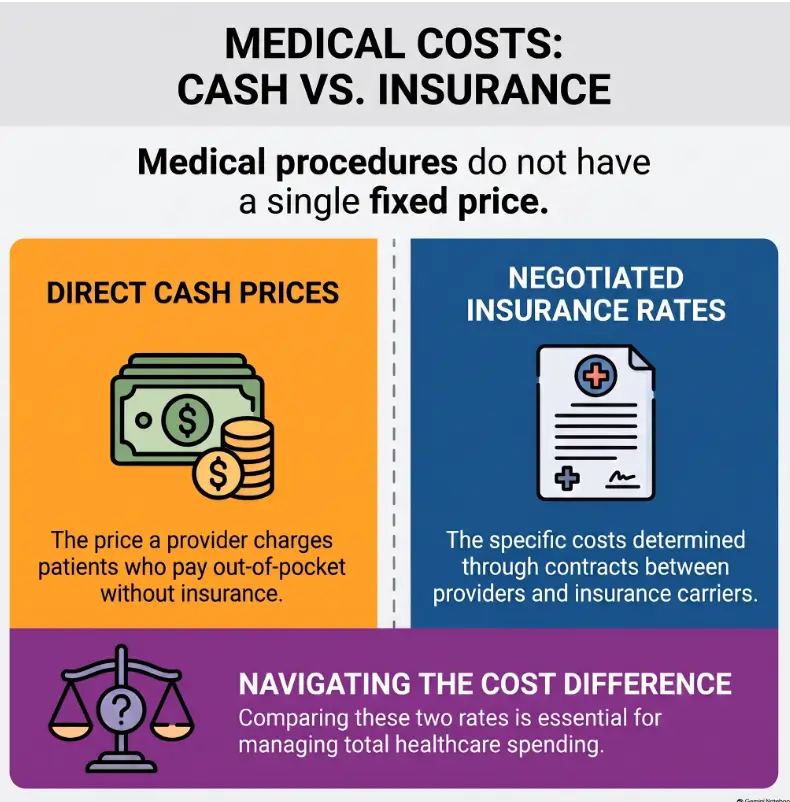
The Cash Price and Insurance Rate Are Not the Same Number
A medical service can carry several legitimate prices at the same time. That is one reason a billing screen can look less like a price tag and more like an airline fare chart.
| Price | What It Usually Means | Why It Matters |
|---|---|---|
| Gross charge | The provider’s undiscounted charge before contractual adjustments or discounts | Often not the amount either an insured or self-pay patient ultimately owes |
| Cash or self-pay price | The amount offered when the service is paid without submitting it through insurance | May be lower or higher than your plan’s negotiated rate |
| Negotiated or allowed amount | The amount recognized under the insurer-provider agreement for a covered service | Your deductible and coinsurance are often calculated from this amount |
| Patient responsibility | The portion you owe after plan rules are applied | This is the most useful number for comparing insurance with cash |
HealthCare.gov describes an allowed amount as the maximum amount a plan will recognize for a covered health care service, sometimes called the negotiated rate or payment allowance.
Suppose a clinic lists a service at $1,500. Its cash price might be $600, while your insurer’s negotiated amount might be $775. None of those figures alone tells you what using insurance will cost. Your deductible, copay, coinsurance, network status, and accumulated spending still have to be applied.
Why a Provider Might Offer a Different Cash Price
Cash prices are not simply insurance rates with the insurer removed. Providers can establish self-pay pricing separately from the contracts they negotiate with health plans.
Different insurers negotiate different rates
A hospital or clinic may have one negotiated amount with one insurer and another amount with a different insurer. Even plans carrying the same insurance company’s name can use different networks or contracts.
This means there is no single universal “insurance price” sitting behind every medical service.
Self-pay pricing can follow a separate discount policy
A provider may offer a lower price for prompt payment, payment before service, or a transaction that will not require normal insurance claims processing. The size and availability of that discount are provider-specific. Some providers may not make the same self-pay offer available to every insured patient, so confirm the rules before assuming you can simply choose whichever posted number is lowest.
The two quotes may not include the same services
This is where apparently spectacular savings sometimes evaporate. A cash quote may cover the main procedure but exclude a facility fee, radiologist interpretation, anesthesia, laboratory work, pathology, supplies, or another professional charge.
For orthopedic care in particular, it helps to understand how facility fees can enter the bill before comparing two numbers that appear to describe the same treatment.
Location can change the contracted amount
The physician may be the same while the billing setting changes. A service performed in an independent office, imaging center, ambulatory facility, or hospital outpatient department may generate different charges and insurance cost sharing.
When comparing prices, match not only the doctor and procedure but also the actual facility and billing location.
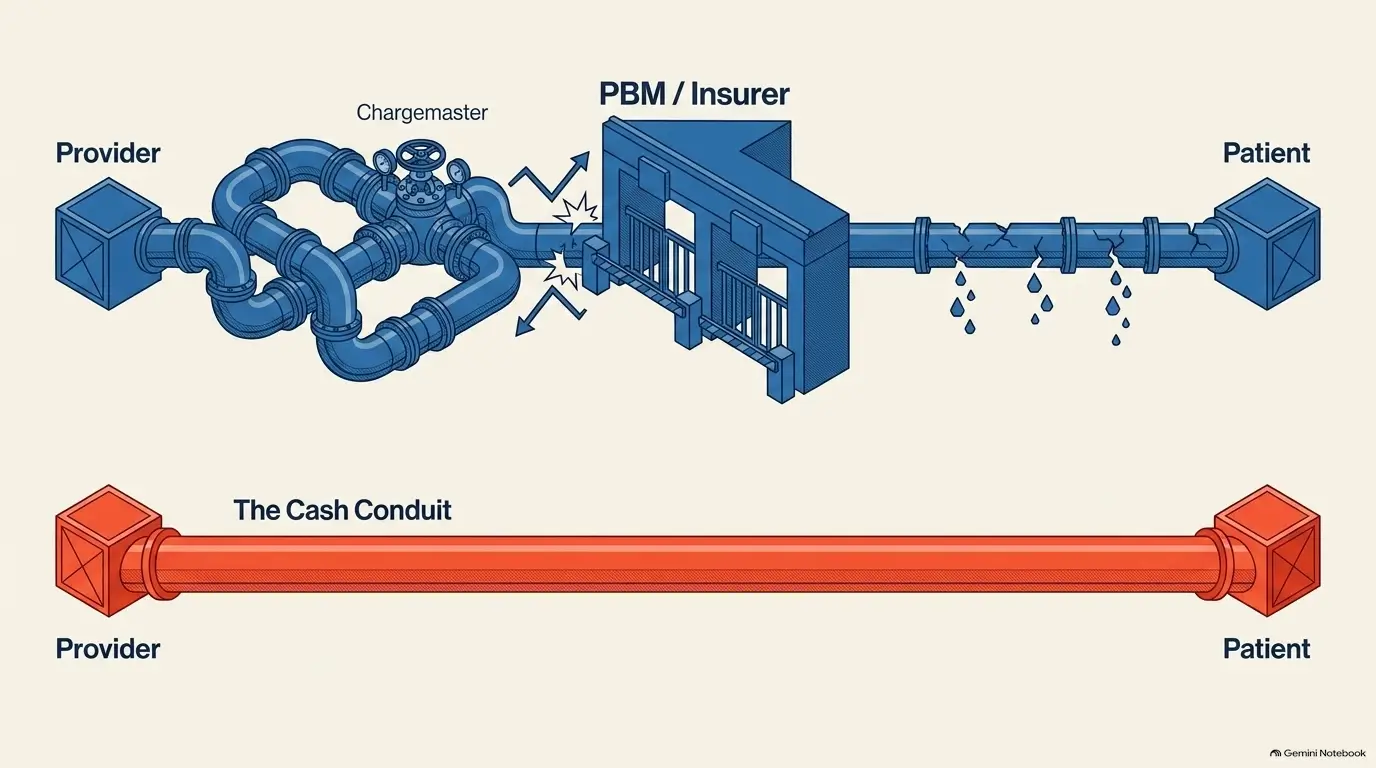
A Lower Cash Price Does Not Always Mean a Lower Total Cost
Cash is most attractive when the self-pay price is below your insurance responsibility and giving up insurance credit has little value. That final condition is easy to overlook.
Consider two very different insurance situations.
Illustrative example: you have not met your deductible
Assume the same outpatient test has a $475 cash price and a $720 in-network allowed amount. You still have more than $720 remaining on your deductible, so your plan’s estimate says you would owe the full $720 allowed amount.
- Cash option: $475
- Insurance option: $720
- Immediate cash savings: $245
If you expect little additional medical spending during the plan year, the $475 option may be economically attractive, assuming the quotes cover the same services.
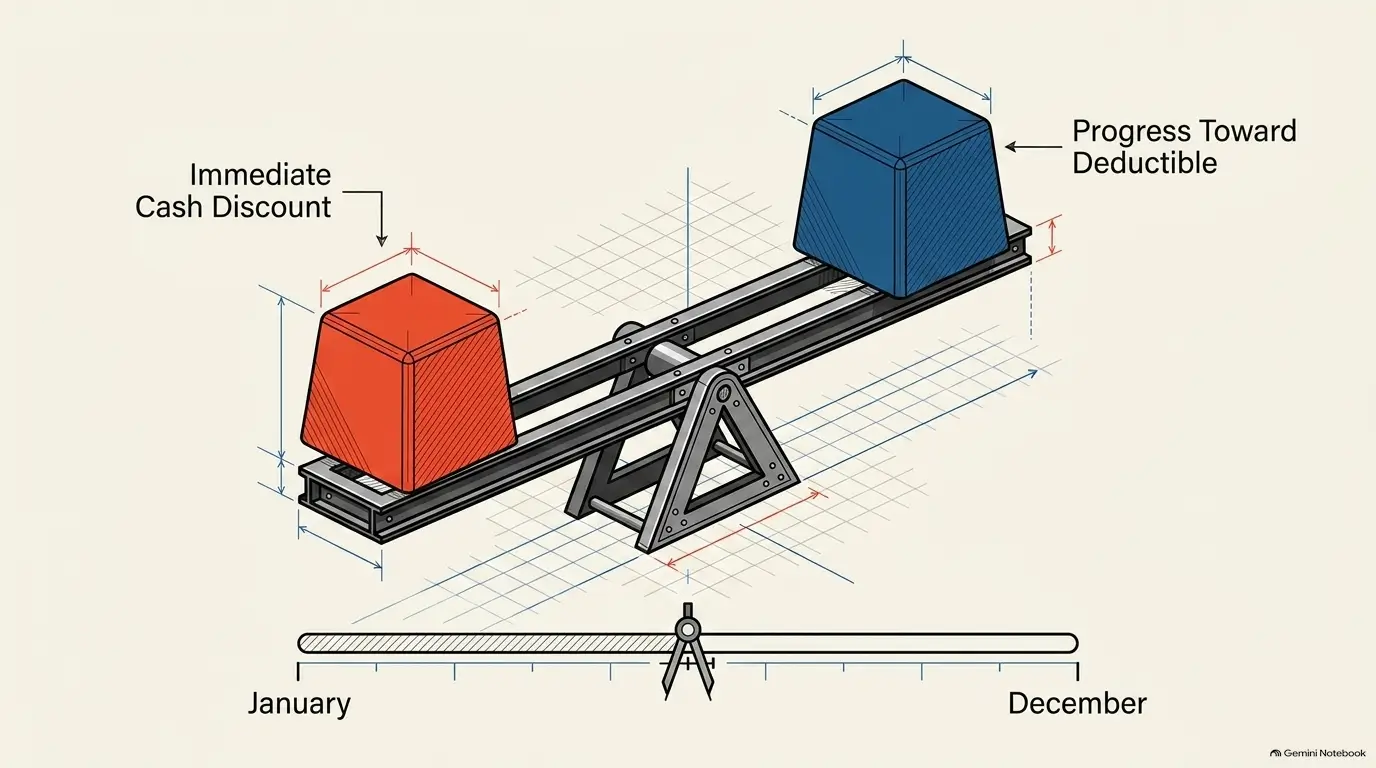
But suppose you expect surgery or substantial treatment later in the year. The $720 processed through insurance may reduce the deductible amount you still need to satisfy. A $475 self-pay transaction completed outside the plan may not. The true comparison is therefore not simply $475 versus $720. It includes the future value of insurance accumulator credit.
Compare the two visits together, not just today’s price. Here is a separate hypothetical scenario using the same $475 cash price and $720 allowed amount. Assume $1,000 of deductible remains, another covered in-network service later in the same benefit year has a $3,000 allowed amount, and both claims use 20% coinsurance after the deductible. Assume no copays, other claims, exclusions or out-of-pocket-limit adjustment, and no credit for the cash payment.
- Insurance for both: pay $720 now. The later service costs $280 remaining deductible plus 20% of $2,720 ($544), or $824. Combined cost: $1,544.
- Cash first, insurance later: pay $475 now. The later service costs $1,000 deductible plus 20% of $2,000 ($400), or $1,400. Combined cost: $1,875.
Under those invented assumptions, insurance is $331 cheaper across both visits even though cash is $245 cheaper today. Deductible credit is not a dollar-for-dollar refund. If the later service never occurs, the original cash saving may remain. Check actual benefits and expected care rather than treating either scenario as a forecast; the price-transparency guide’s limit example explains another variable that can change the comparison.
Illustrative example: your deductible is already met
Now assume the allowed amount is still $720, but your deductible has been met and your plan applies 20% coinsurance.
Your estimated responsibility would be $144, calculated as 20% of the $720 allowed amount. Against a $475 cash price, insurance is clearly cheaper in this example.
This is why comparing the cash price with the insurer’s negotiated amount alone can produce the wrong decision. You need the insurer’s estimate of your share.
Will a Cash Payment Count Toward Your Deductible?
Do not assume it will. A deductible and out-of-pocket maximum are plan accounting mechanisms, and credit generally depends on whether an eligible expense is recognized through the plan’s claims process. Paying a provider directly outside insurance does not guarantee that the amount will be credited.
Some circumstances may allow a member to submit documentation or a claim, while other plan rules may prevent or limit credit. Ask your insurer before paying, preferably through a channel that leaves a written record.
Use this wording:
“If I choose this provider’s self-pay price and no claim is submitted at the time of service, can I submit it afterward, and will any approved amount count toward my deductible and in-network out-of-pocket maximum?”
Also ask what documentation would be required and whether the provider must submit the claim instead. A verbal “probably” from the front desk is not a substitute for your plan’s rules.
Use Your Insurer’s Price Tool Before Comparing Cash
Most people should compare the self-pay quote against the plan’s personalized cost estimate, not against a generic insurer discount. CMS explains that applicable health plans make price-comparison information available so members can see estimated cost sharing for covered services. You can review CMS guidance on health-plan price comparison tools.
When searching your insurer’s tool, make the comparison as specific as possible. Enter the exact provider or facility and, when available, the billing code. A generic search for “MRI” or “injection” can hide important differences in body part, contrast use, facility, professional interpretation, and procedure type.
If medical billing language is slowing you down, this guide to common orthopedic billing terms can help separate the billed charge, allowed amount, adjustment, deductible, coinsurance, and patient responsibility.
Your Five-Minute Cash-vs-Insurance Check
Before choosing either payment path, collect two comparable estimates. The goal is to make both quotes describe the same care.
- Identify the exact service. Ask for the expected CPT or HCPCS code when available, plus any related services likely to be billed separately.
- Get the cash price in writing. Ask whether it includes professional fees, facility fees, interpretation, contrast, supplies, anesthesia, pathology, or other likely components.
- Get the insurance estimate. Use your plan’s estimator or contact member services using the same code, provider, facility, and date or plan year.
- Ask what insurance credit you would lose. Confirm whether paying cash would count toward your deductible or out-of-pocket maximum.
- Compare final responsibility, not headline prices. Include any likely separate bill before choosing the lower-cost route.
For imaging, where self-pay pricing is frequently advertised, use the same discipline described in this cash-pay orthopedic imaging guide. The price difference is useful only when the underlying service really matches.
Hospital Price Transparency Can Show Why the Numbers Differ
U.S. hospital price transparency rules make the multiple-price structure unusually visible. Hospitals subject to the federal requirements publish standard-charge information that includes discounted cash prices and payer-specific negotiated charges. CMS explains the current requirements on its hospital price transparency page.
Seeing several prices for one service is therefore not necessarily evidence that one of them is an error. It can reflect separate contractual payment arrangements.
Transparency data still require careful interpretation. A posted price may not perfectly predict your final bill if the service changes, additional items are needed, another clinician bills separately, or your personalized insurance benefits differ from the assumptions behind the displayed figure.
If You Choose Self-Pay, Ask for a Good Faith Estimate
If you have no insurance or choose not to use your insurance for the service, federal protections may give you access to a written good faith estimate of expected charges. CMS states that, in most cases, a provider must provide one when qualifying self-pay care is scheduled at least three business days in advance or when an eligible consumer requests an estimate.
Keep the estimate. Under the federal patient-provider dispute process, an uninsured or self-pay patient may be able to dispute a provider’s bill when it is at least $400 above that provider’s good faith estimate, subject to the program’s eligibility requirements. CMS explains the rules in its medical-bill guidance for people not using insurance.
A good faith estimate should not be mistaken for a universal package price covering every entity involved in your care. Separate providers or facilities can generate separate charges. For a more focused preparation process, see the orthopedic good faith estimate checklist.
Four Mistakes That Can Make the Cash Price Look Better Than It Is
The largest billing mistakes usually happen before the arithmetic, when two unlike services are compared as though they were identical.
| Mistake | Why It Matters | Safer Move |
|---|---|---|
| Comparing cash with the gross charge | The gross charge may bear little resemblance to your insurance responsibility | Compare cash with the personalized plan estimate |
| Ignoring separate bills | A cheap procedure quote can exclude professional or facility charges | Ask what is included and who else may bill |
| Ignoring deductible credit | Saving now can sacrifice progress toward annual cost-sharing limits | Ask the insurer whether self-pay spending will be recognized |
| Comparing different locations or codes | The service may not actually be equivalent | Match code, provider, facility, and expected add-ons |
When Paying Cash Is More Likely to Make Sense
Cash becomes more compelling when the written self-pay price is materially below your estimated insurance responsibility, the service is comparable, you do not expect valuable deductible or out-of-pocket credit from processing the claim, and the cash quote does not omit important components.
You probably do not need to pay more through insurance solely because you have coverage. Insurance is a financing and risk-sharing system, not a promise that its negotiated route is the cheapest way to purchase every individual service.
Conversely, paying extra through insurance may be rational when your plan already covers much of the allowed amount, you are close to meeting your deductible or out-of-pocket maximum, the cash quote excludes meaningful charges, or future medical spending makes accumulator credit valuable.
Frequently Asked Questions
Can I pay the cash price even though I have health insurance?
Sometimes. A person with insurance can qualify as self-pay for federal good faith estimate purposes when they do not intend to have the claim submitted to their health plan. Whether a particular provider will offer its advertised cash price to an insured patient can still depend on the provider’s policies and contractual arrangements. Confirm before receiving care.
Why is my insurance negotiated rate higher than a cash price?
The two prices can arise from different agreements. The insurance amount reflects a payer-provider contract, while the cash amount may come from a separate self-pay discount policy. Neither price is required to be the lower one in every situation.
Should I compare the cash price with the amount shown on my EOB?
For care already received, the Explanation of Benefits can help identify the allowed amount and patient responsibility. Before scheduled care, however, use your insurer’s current cost estimator or member services because prior claims may involve different providers, locations, codes, or benefit-year conditions.
Does a good faith estimate guarantee the cash price?
No. It is an estimate of expected charges rather than an absolute guarantee of the final bill. For eligible uninsured or self-pay patients, however, federal rules provide a dispute mechanism when a provider’s bill reaches the applicable threshold above that provider’s estimate.
Run This Price Check Before You Pay
Call the provider and insurer before the appointment. Write down four things: the billing code, the complete cash price, your estimated insurance responsibility, and whether choosing self-pay would receive deductible or out-of-pocket credit.
If one side cannot tell you whether its quote includes facility and professional charges, the comparison is not finished yet. Once both numbers describe the same service, the cheaper path is often surprisingly easy to see.
Last reviewed: 2026-10
Targeted update: 17 October 2026. Added a hypothetical two-visit comparison showing how deductible credit can change total cost. This is arithmetic under stated assumptions, not a prediction of treatment or insurance payment. Other sections retain their existing review scope.
Targeted editorial update: October 21, 2026. Added a topic-specific follow-up record and recheck triggers, revised the title and search description, and removed unverified first-person claims or clarified selected wording where found. The existing body was retained. This update is not a complete legal, coverage or clinical review; confirm current rules and individual decisions with the relevant official source or service.