

Orthopedic pain management with HDHP coverage starts with two separate questions: what care is appropriate, and what will the same service cost under each payment route? A lower headline quote may cover fewer components. An insurance estimate may change before claims are processed. Compare the service, included items, estimated member payment and actual benefits answer before treating two figures as alternatives.
Use the six scope checks, insurance versus self-pay table, two fictional writing examples, and free quote and unanswered-question record. The aim is a clearer conversation, not a price-based medical decision or a promise of savings.
Emergency care must not wait for price comparison. With back or leg symptoms, new difficulty starting urination or inability to urinate, new bladder or bowel control changes, saddle-area numbness, or severe/worsening weakness or numbness in both legs needs emergency assessment immediately. Do not drive yourself to emergency care. This is a back/leg warning context, not a complete orthopedic triage list; other severe or rapidly changing symptoms or significant injury also require appropriate assessment. NHS sciatica guidance explains the spinal warning context. A cost worksheet cannot rule out an emergency.
This U.S.-focused guide is general education from a family-caregiver-run site. Its operator is not a medical, insurance, legal or tax professional. The treating team determines clinical appropriateness; the applicable plan and actual claim processing determine benefits. You do not need a completed worksheet before asking for care or financial assistance.
Table of Contents
Orthopedic HDHP quotes: 6 essential scope checks
Ask the treating team which service or clinically appropriate alternatives are being discussed. Then use the same description when contacting providers and the plan. An evaluation, MRI, injection and therapy course answer different questions and are not interchangeable price options. Do not choose a setting solely from a symptom-to-price chart.
| Check | What to match between quotes | Question when unclear |
|---|---|---|
| 1. Service | Evaluation versus procedure or imaging; body part and contrast if relevant; supplied service code and description. | Are these quotes for the same service? Ask the ordering/billing team to clarify the description rather than inventing a code. |
| 2. Place and entities | Actual location, facility and separately billing clinicians or readers. | Who may bill separately? Which specific entities and location did the plan check? |
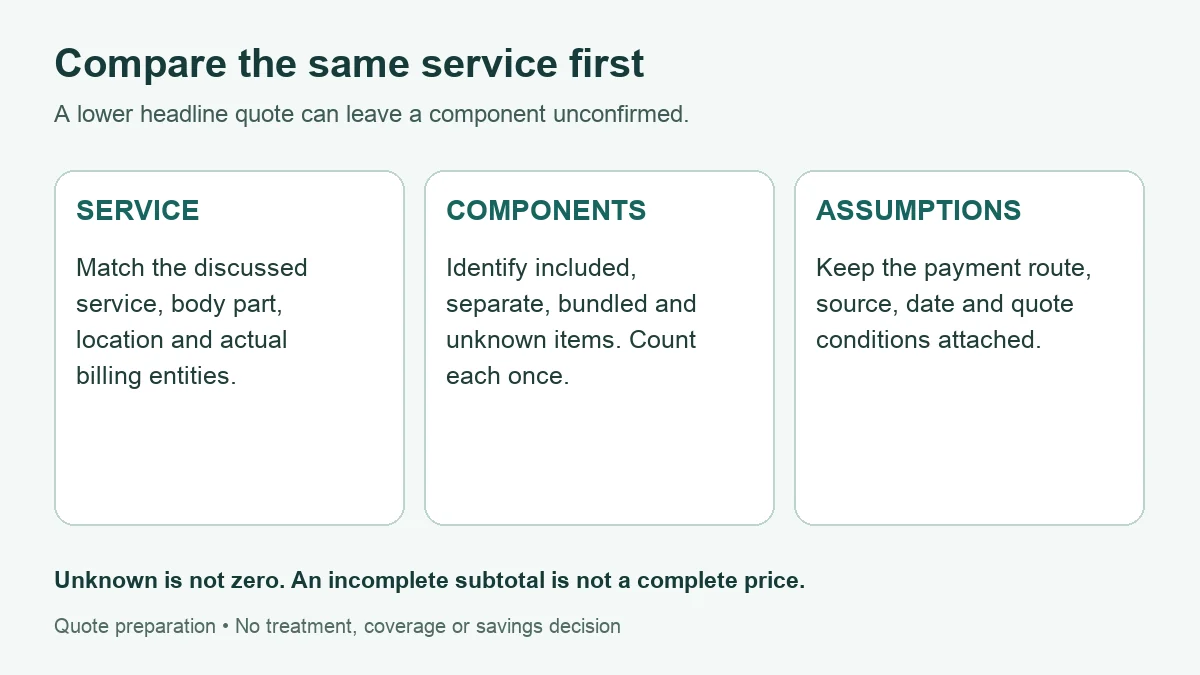
| 3. Included components | Professional work, facility charges, interpretation, relevant supplies or medications. | Which components are included, excluded or unconfirmed? A bundle must not be counted again as separate items. |
| 4. Follow-up scope | Whether a quoted visit includes a review; what a therapy quote describes and how additional services would be priced. | Is this one service, one visit or a quoted group of services? No fixed number of visits is recommended here. |
| 5. Payment route | Insurance member estimate or self-pay quote, payment timing and actual conditions. | Is the figure a provider charge, negotiated amount, estimated member liability, deposit or cash price? |
| 6. Date and assumptions | Quote date, validity, service date assumptions, benefit period and balances used. | Which assumptions may change, and who can explain a revised estimate? |
If these checks are incomplete, write “not yet comparable.” That describes the information gap; it is not a clinical reason to postpone needed care. A clinic can explain its quote, while the insurer must clarify plan-specific benefit questions. Keep each answer attached to its source and date.
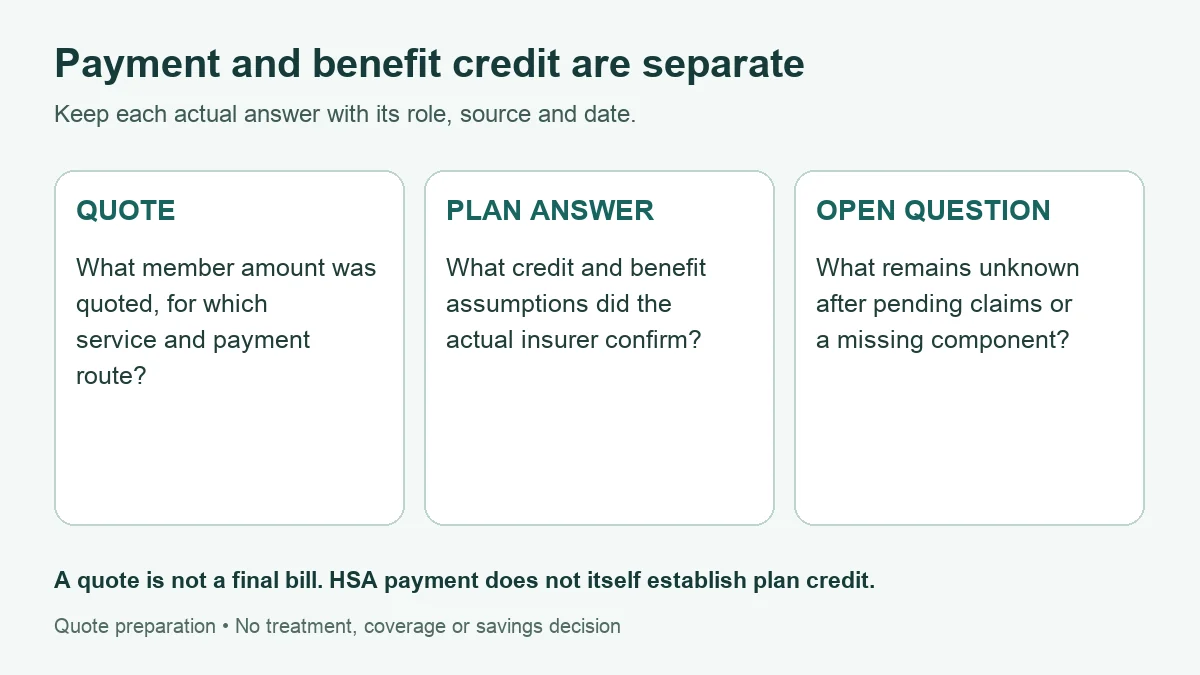
Insurance versus self-pay: separate payment now from benefit credit
| Question | Using insurance | Self-pay / not using insurance |
|---|---|---|
| Amount now | Ask for estimated member liability and any deposit; distinguish it from raw billed charges. | Ask for the written self-pay quote and what must be paid when. |
| Service completeness | Check all relevant billing entities and components; one estimate may cover only one bill. | A cash package may still exclude another entity, interpretation or follow-up. |
| Deductible and out-of-pocket credit | Ask how the actual covered claim is expected to apply under the plan. An estimate is not adjudication. | Do not assume a cash payment counts. Ask about the actual plan policy and any claim-submission requirements or limitations before relying on credit. |
| Network / coverage / authorization | Confirm the particular service, location and billing entities with the plan; a clinician order or authorization is not a payment guarantee. | A payment arrangement does not establish network status or benefit eligibility. Clarify whether a claim will be submitted and whether choosing self-pay affects it. |
| Later costs | Pending claims and benefit balances may change the estimate; no future care total is guaranteed. | A smaller initial figure alone does not establish lower overall spending. Credit uncertainty remains separate. |
| Relevant written information | Plan documents, dated member estimate, actual insurer answer and later explanation of benefits. | Written quote, included/excluded items and, when applicable, a good faith estimate. |
HealthCare.gov’s out-of-pocket-limit explanation describes the limit for covered in-network benefits within a plan year. Premiums, noncovered services and other excluded charges do not simply become part of that limit. Ask the plan how its actual terms apply rather than assuming every dollar spent is credited. The article does not calculate your remaining limit or predict later claims.
Record the actual benefit period rather than assuming it starts in January. With family coverage, ask which individual and family balances apply to the service. A portal balance can be incomplete while claims are pending. Note the date and source; do not subtract unrelated or unprocessed charges yourself and present that as a verified balance.
What belongs in a quote, and what stays unknown?
| Component record | Safe interpretation | Avoid |
|---|---|---|
| Quoted member amount for a defined component | A dated estimate for that component and payment route. | Treating the full provider charge as your member payment. |
| Written bundled amount | Record the included items once and identify exclusions. | Adding the same facility or reader charge again. |
| Unconfirmed component | Mark unknown; ask the relevant billing office. | Entering zero because no price has been supplied. |
| Confirmed no separate member charge | Record the source and conditions supporting zero. | Generalizing that answer to a different location or payment route. |
| Known quoted subtotal | Sum only non-overlapping member amounts for the same service and route; explicitly list missing components. | Calling an incomplete subtotal a complete price or adding alternative cash and insured prices together. |
| Final processed claim | Compare the explanation of benefits with the bill and ask about discrepancies. | Assuming a prior estimate proves the final bill is correct. |
Arithmetic illustration only: suppose two fictional, separate quoted member components are $300 and $50. Their known quoted subtotal is $350. If another relevant component is unknown, $350 is not the complete price. If the $300 already includes the $50 component, adding them would double count. These numbers are invented to show arithmetic, not typical prices or a recommendation.
The record tool below deliberately does not parse free-text dollar amounts or select a winner. It preserves quote scope, assumptions and unanswered questions. This prevents a superficially precise total from hiding an unconfirmed component or mixing payment routes.
Ask the right contact without repeating the entire story
| Contact | Useful question | What that answer does not establish |
|---|---|---|
| Treating / ordering team | What is this service intended to answer, and what clinically appropriate alternatives or follow-up should we discuss? | A clinical recommendation alone is not coverage approval or a member price. |
| Provider billing / estimate team | Which service, location and entities does the quote include? What is excluded and what are the actual payment conditions? | A provider accepting your insurance does not alone verify network status or plan benefits. |
| Insurer / applicable benefits contact | For this service and these entities, what coverage, network, authorization and member-cost assumptions apply? What actual credit applies to each route? | A telephone estimate is not a final processed claim or a guarantee of future costs. |
| HSA/FSA administrator or qualified tax help | Is this expense eligible under the relevant rules, and what records or reimbursement conditions apply? | Paying with an HSA/FSA is not the insurer processing a claim or crediting a deductible. |
| Financial assistance / scheduling office | What assistance, payment arrangement or accessible scheduling option is actually available? | A conversation does not guarantee assistance or replace necessary care. |
Use a short summary: “I am comparing the same described service. Here are the location and billing entities I have. These components are confirmed; these are unknown. Please answer this specific question and identify the source and conditions.” Keep actual replies separate from an appointment request or an unanswered message.
Cost, transport, language, caregiving and time away from work can be real barriers. Record what is unavailable without blaming yourself or claiming that careful notes guarantee a lower bill. Ask about assistance early when useful; an incomplete record does not disqualify you from help.
Good faith estimates and HSA/FSA: keep the rules separate
CMS explains good faith estimate rights when uninsured or not using insurance, subject to the applicable requirements. Ask about an estimate when scheduling eligible care. Do not assume one office’s estimate includes every separately billing provider or facility; ask each relevant office what its estimate covers. This guide does not promise an all-inclusive bundle or apply scheduled-care shopping steps to an emergency.
An insurer’s estimate and a good faith estimate for applicable uninsured/self-pay care are different documents. If an actual bill differs, retain the estimate and bill and use the relevant official guidance or assistance. The worksheet does not decide dispute eligibility or calculate a filing deadline.
For account questions, separate four issues: eligibility to contribute to an HSA; whether a particular expense qualifies; how payment or reimbursement is funded; and whether a health-plan claim receives benefit credit. A high deductible alone does not settle all four. HSA and FSA rules are not interchangeable.
IRS Publication 969 (2025) explains HSA qualified-expense and recordkeeping rules, including the relationship to account establishment and avoiding duplicate reimbursement or tax treatment. Keep receipts and the actual account-administrator answer. FSA reimbursement and timing rules require their own review. This article offers no contribution-limit calculation, investment recommendation or individual tax determination.
Rules about HSA-compatible coverage have also changed for 2026. Use the current IRS guidance on HSA changes and ask about your actual plan and individual eligibility. Paying an eligible expense with HSA funds still does not by itself establish insurance deductible credit.
Two fictional examples: a useful record includes what is missing
These are invented writing examples, not real patient cases, actual quotes or evidence of savings. Neither selects a payment route or recommends imaging.
Example A: a self-pay quote leaves reading unconfirmed
| Record | Fictional entry |
|---|---|
| Service | A particular imaging service has already been discussed clinically. No service is recommended by this example. |
| Comparison gap | The self-pay headline quote does not confirm whether professional interpretation is included. The insured estimate’s exact scope also needs matching. |
| Actual answer | No written reading-fee answer has been received. |
| Question | Does each quote include the professional reading? If separate, which entity bills it and what is its quoted member amount for this route? |
| Conclusion for the record | Not yet comparable. No total, zero reading fee or preferred payment route is assumed. |
Writing sample: “I have a self-pay quote for the described service, but interpretation is unconfirmed. Please identify included components, separate billers and the written quote conditions so I can compare the same scope.”
Example B: pending claims may change the insured estimate
| Record | Fictional entry |
|---|---|
| Estimate status | An insured member estimate was reported; it is not a final bill. |
| Balance uncertainty | Other family claims are pending. The relevant plan period and balance assumptions need a dated source. |
| Credit uncertainty | No actual answer has been received about credit for the self-pay alternative. |
| Question | Which individual/family balances and plan period were used, what is pending, and how would the actual plan treat each payment route? |
| Conclusion for the record | No guaranteed final payment or overall savings comparison is available from these incomplete facts. |
Writing sample: “Please explain the balances and assumptions used in this estimate and what could change after pending claims. Separately, please clarify the actual deductible and out-of-pocket credit policy if I do not use insurance.”
Free orthopedic quote and unanswered-question record
Use the tool to separate the discussed service, each quote’s scope, payment conditions, actual plan answers and the next open question. Blank fields generate optional questions. Text in every field remains unverified; completion does not prove completeness, eligibility or coverage.
Try fictional examples on this page. Download the offline HTML copy before entering actual health or insurance notes. The live website may use site services. The downloaded tool contains no ads, analytics, external assets, automatic network requests or browser storage. It needs no account or email. Exports contain your entries; keep them private. Avoid names, member/claim identifiers and full medical or insurance documents.
You can copy the generated record, download plain text, or print/save PDF through your browser. Entries are not saved automatically. Editing hides the old output until rebuilt. Nothing is sent to a clinic or insurer. If the tool does not load, use paper with the same headings. Do not delay appropriate care or a time-sensitive actual process to finish it.
Orthopedic quote and benefits-answer record
Compare service scope, payment route and actual answers. No medical choice, coverage decision, savings prediction or price winner is generated.
For actual health or insurance notes, download the offline tool first. Try the fictional example here. The offline copy contains no site ads, analytics or external assets and needs no account.
Offline copy. This file contains no ads, analytics, external assets or automatic network requests.
The tool uses no network requests or browser storage. Unsaved changes can be lost on refresh or close. Exported files contain your entries; keep them private. Avoid names, member or claim identifiers, full notices and medical records.
Start with the fictional example or download a blank offline copy.
If the tool does not load, use paper: same service; included and missing items; each payment route; actual benefits answer and source; remaining question. Do not delay appropriate care to complete a worksheet.
My orthopedic quote and benefits-answer record
Unverified personal record for discussion. These are unverified preparation notes, not a complete quote, final bill, clinical recommendation or insurance determination. Filled fields do not establish completeness or coverage.
Guide: living.kioptrix.com/orthopedic-pain-management-with-hdhp/
Common orthopedic HDHP comparison questions
Is self-pay always cheaper before meeting a deductible?
No universal result follows. Compare the same service scope, actual member amounts, conditions and any confirmed benefit credit. This article does not predict future care or rank the routes.
Does prior authorization guarantee payment?
No. Clarify the actual authorization requirements and benefit terms with the applicable plan. Keep a clinical order, authorization answer, member estimate and processed claim separate.
Should I begin with the cheapest care setting?
Use the appropriate care service for the clinical situation. Once appropriate options have been discussed, compare their actual scope and costs. A price table cannot determine urgency, rule out an emergency or prescribe a care pathway.
Does HSA payment count toward my deductible?
Payment from an account and insurance claim adjudication are different. Ask the actual plan about credit and the relevant account contact about expense eligibility; neither answer substitutes for the other.
Can I use one low-back-pain guide for every orthopedic complaint?
No. Clinical sources have a specific scope. The spinal warning source here supports that warning context; it does not establish knee, shoulder or hip treatment rules or insurance criteria.
What if I cannot obtain all the information?
Mark the gap and ask the relevant contact a focused question. Use available financial-assistance and care routes when needed. No completed diary, quote comparison or worksheet is a prerequisite for asking for help.
Sources, corrections and review limits
- HealthCare.gov: Out-of-pocket maximum/limit — covered-benefit limit context and exclusions; individual plan terms still matter.
- CMS: Medical bill rights when not using insurance — applicable good faith estimate information; not a promise that one quote covers all providers.
- IRS Publication 969 (2025) and the IRS HSA-change guidance — account and current-rule context, not individual tax advice.
- NHS: Sciatica — back/leg emergency symptom education, not U.S. insurance guidance.
Editorial correction and source check: October 29, 2026. Replaced price-first care-setting instructions, unsupported savings and timing claims, the unofficial coverage-tier map and blaming language. Removed the Medicare fee-for-service prior-authorization link from commercial-plan guidance, the narrow addition calculator, repeated images, empty heading and embedded video. The new framework distinguishes same-scope quotes, missing components, payment and benefit credit. The original URL is retained.
The hero is AI-generated fictional editorial artwork. The body diagrams explain this guide’s comparison framework, not clinical pathways, verified quotes or insurance decisions. No independent clinical, insurance, legal or tax review or real-user outcome validation is claimed. Our background and editorial approach. For a related administrative question, see the care and MRI denial appeal record guide; it does not determine coverage.