

Some knee braces require prior authorization under Original Medicare before the supplier delivers the brace, but the rule does not apply to every knee brace. Whether prior authorization is required depends heavily on the HCPCS billing code, the type of orthosis, the documentation supporting medical necessity, and whether the claim is being handled through Original Medicare or a Medicare Advantage plan.
As of October 2, 2026, several commonly billed knee orthosis codes are already on Medicare’s nationwide Required Prior Authorization List. Another important change is approaching: HCPCS code L1833 is scheduled to become subject to required prior authorization nationwide on October 28, 2026.
If you are still at the earlier stage of determining whether the device itself may be covered, start with this guide on how to check whether an orthopedic brace is covered before accepting or buying it. Prior authorization is only one layer of the coverage decision.
Table of Contents
The Fast Answer: Does a Medicare Knee Brace Need Prior Authorization?
Not necessarily. Medicare Part B can cover medically necessary leg braces when ordered by a doctor or other eligible healthcare provider, but only selected brace codes are subject to the additional prior authorization requirement.
The first question therefore should not be simply, “Does Medicare cover knee braces?” A more useful question is:
“What HCPCS code will the supplier bill for this knee brace, and is that code currently subject to Medicare prior authorization?”
Medicare’s official brace coverage guidance states that Part B covers medically necessary arm, leg, back, and neck braces when ordered by an appropriate healthcare provider. Coverage, however, does not eliminate coding, medical-necessity, supplier, order, encounter, or prior-authorization requirements.
Knee Brace Codes Currently Requiring Medicare Prior Authorization
For Original Medicare fee-for-service, CMS maintains a Required Prior Authorization List for selected Durable Medical Equipment, Prosthetics, Orthotics, and Supplies, commonly shortened to DMEPOS.
As of October 2, 2026, the following knee orthosis codes are among those subject to nationwide required prior authorization:
| HCPCS code | General brace category | Nationwide prior authorization |
|---|---|---|
| L1832 | Prefabricated adjustable-joint positional knee orthosis requiring specialized fitting | Yes |
| L1843 | Single-upright prefabricated knee orthosis requiring specialized fitting | Yes |
| L1844 | Single-upright custom-fabricated knee orthosis | Yes |
| L1845 | Double-upright prefabricated knee orthosis requiring specialized fitting | Yes |
| L1846 | Double-upright custom-fabricated knee orthosis | Yes |
| L1851 | Single-upright prefabricated off-the-shelf knee orthosis | Yes |
| L1852 | Double-upright prefabricated off-the-shelf knee orthosis | Yes |
The safest source for checking the current list is the CMS DMEPOS Prior Authorization program page. The table describes the item-level requirement; qualifying suppliers may have a CMS prior-authorization exemption effective June 1, 2026. Ask whether an exemption applies to your supplier and jurisdiction. It does not remove the underlying coverage, order, clinical documentation, or delivery requirements. Medicare uses the billed HCPCS code, not the retail product name alone.
Important October 28, 2026 Change for L1833
HCPCS L1833 deserves special attention because its prior-authorization status has changed over time.
CMS removed L1833 from the Required Prior Authorization List effective August 12, 2024. CMS has now selected the code again, with nationwide required prior authorization scheduled to begin on October 28, 2026.
L1833 describes a prefabricated, off-the-shelf knee orthosis with adjustable knee joints and rigid positional support. Someone receiving an L1833 brace before October 28, 2026 therefore should not mechanically apply the rule scheduled for deliveries on or after that date.
This date distinction matters because Medicare policy changes can turn an otherwise accurate article into stale advice surprisingly quickly. When delivery is close to a policy-change date, ask the supplier to verify the requirement for the actual expected date of delivery.
Prior Authorization Is Not the Same as a Prescription
A prescription or written order and prior authorization perform different jobs.
- The order tells the supplier what the treating practitioner is prescribing.
- Medical documentation explains why the brace meets Medicare coverage requirements.
- Prior authorization allows the DME Medicare Administrative Contractor, or DME MAC, to review applicable coverage, coding, and payment requirements before delivery.
A doctor’s recommendation therefore does not automatically mean the prior authorization has been completed. Likewise, an authorization does not erase every other Medicare payment requirement.
If several parties are involved and nobody seems sure who owns the paperwork, the site’s orthopedic prior authorization checklist can help you organize the code, documentation, submission status, approval information, and follow-up questions in one place.
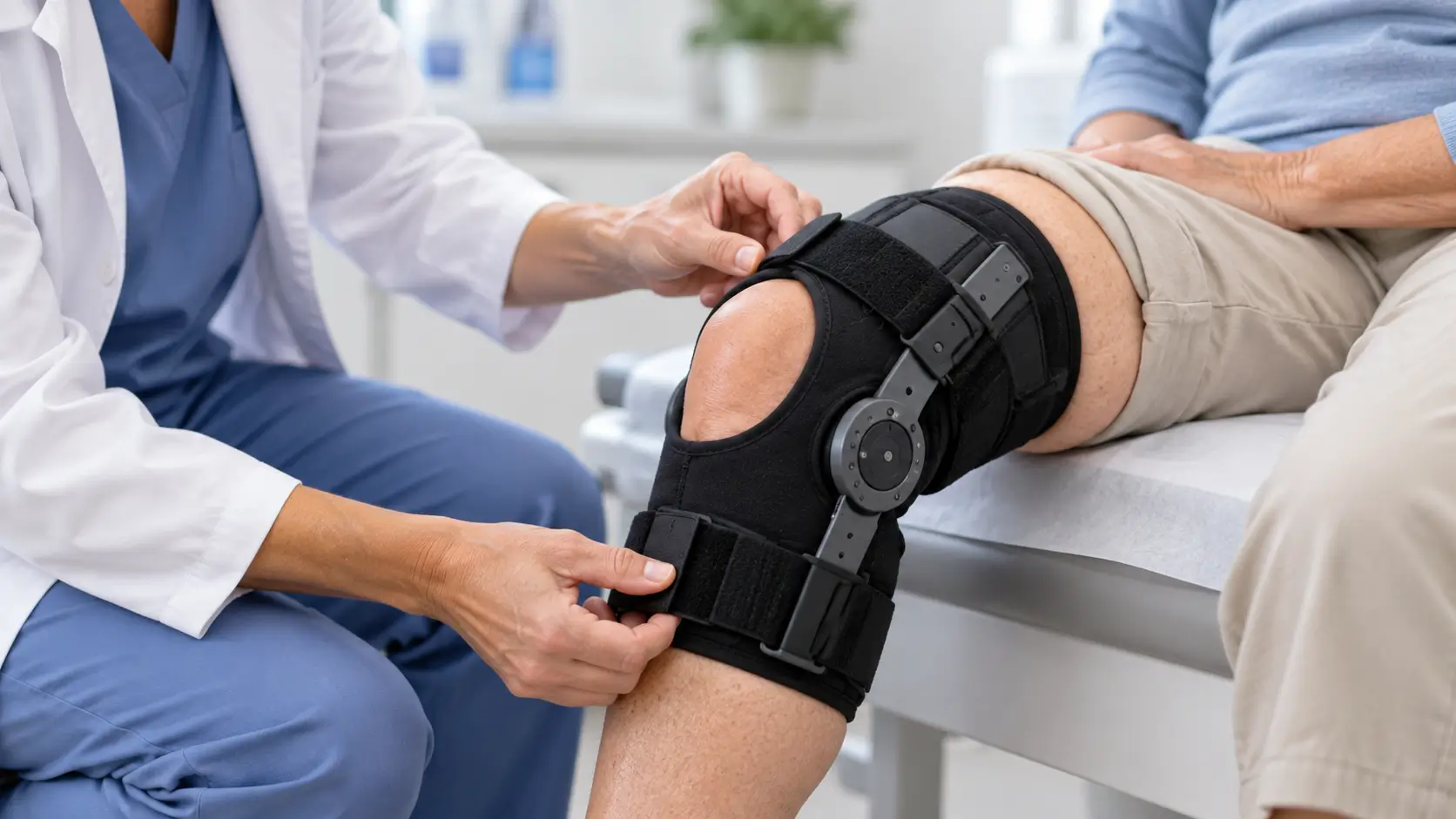
Step 1: Ask the Supplier for the Exact HCPCS Code
“Hinged knee brace” is not precise enough for a Medicare authorization check. Two braces that look similar may be billed under different L-codes because one is off the shelf, another requires substantial fitting by an individual with expertise, and another is custom fabricated.
Before delivery, ask the supplier:
- What is the base HCPCS code?
- Is the brace off the shelf, custom fitted, or custom fabricated?
- Are any additional HCPCS codes expected on the claim?
- Does this code require prior authorization today?
- Does it also require a face-to-face encounter and written order before delivery?
Do not rely only on the manufacturer’s model name or a photo of the brace. Medicare’s coding rules distinguish products by construction, fitting, function, and other characteristics that may not be obvious from appearance.
Step 2: Check the Face-to-Face and Written-Order Requirements
Prior authorization is not the only pre-delivery rule that may apply. Certain DMEPOS items also require a qualifying face-to-face encounter and a written order before delivery.
CMS’s DMEPOS order requirements explain the standardized elements used for written orders, including the beneficiary, item description, quantity when applicable, treating practitioner, order date, and practitioner signature.
For codes subject to the face-to-face requirement, the qualifying encounter must occur within the six months before the written order. The supplier must receive the complete written order before delivery when WOPD applies. These are separate timing checks; do not substitute the delivery date for the order date when calculating the encounter window. Knee orthosis codes L1844 and L1846 require a Standard Written Order under the current DMEPOS operational guide, but do not have the same additional face-to-face/WOPD requirement as the other selected knee codes.
That is why “I saw my doctor earlier this year” is not enough information. Ask the supplier whether the exact code requires a face-to-face encounter, what time window applies, and whether the medical record from that encounter has actually been received.
Step 3: Make Sure the Medical Record Supports the Exact Brace
Prior authorization is a documentation review, not simply a form asking whether the beneficiary owns a Medicare card.
The medical record may need to explain the diagnosis, examination findings, ambulatory status, instability, recent injury or surgery, osteoarthritis criteria, and why the particular brace design is reasonable and necessary.
For certain knee orthoses used for instability, Medicare’s knee orthosis policy requires documentation of the physical examination and objective joint laxity findings. For custom-fabricated devices, the record must support why a prefabricated orthosis would not adequately meet the beneficiary’s needs.
The practical lesson is simple: the documentation should describe the knee problem and the reason for the particular brace, not merely contain a generic sentence such as “patient has knee pain.”
Step 4: The Prior Authorization Request Goes to the DME MAC
For Original Medicare’s required DMEPOS prior authorization program, the request is reviewed by the appropriate DME MAC. In routine practice, the supplier commonly manages the submission because it has the product code and will eventually submit the Medicare claim.
The submission should include the documentation needed to demonstrate that applicable coverage, coding, and payment requirements are satisfied. The goal is to obtain a provisional affirmation before the brace is furnished.
If the request receives a non-affirmation, that does not necessarily mean the beneficiary can never receive Medicare coverage for the brace. The supplier can review the explanation, obtain missing or corrected documentation when appropriate, and resubmit the prior authorization request.
How Long Does Medicare Knee Brace Prior Authorization Take?
CMS currently states that DME MACs complete review of initial and resubmitted DMEPOS prior authorization requests by the fifth business day, with the timeframe not exceeding seven calendar days after receipt.
An expedited review may be available when waiting for the standard process could jeopardize the beneficiary’s life or health. When the DME MAC determines that expedited review is appropriate, CMS says it will make reasonable efforts to communicate a decision within two business days.
An upcoming surgery date, travel plan, or personal preference for faster delivery does not automatically establish that the medical standard for expedited processing has been met.
How Long Is an Affirmed Prior Authorization Valid?
CMS’s DMEPOS operational guidance states that an affirmed prior authorization decision for the covered orthosis codes generally remains valid for 60 calendar days.
If the brace is not furnished within that period, the supplier may need to submit a new prior authorization request. This can matter when a brace is ordered well before surgery, when fitting is postponed, or when the medical plan changes.
Ask the supplier for the affirmation date and the last date on which the item can be furnished under that decision. Paperwork has a calendar, even when the knee would rather not.
Does Prior Authorization Guarantee Medicare Will Pay?
No. A provisional affirmation is an important step, but it is not an unconditional promise that every later claim will be paid.
Payment can still depend on requirements such as beneficiary eligibility, accurate coding, the item actually furnished, supplier eligibility, documentation, the timing of delivery, and correct claim submission.
That distinction is useful before signing for an expensive brace. The safer question is not merely, “Was it approved?” Ask, “Was the exact HCPCS code affirmed for this beneficiary, and are there any remaining Medicare requirements before delivery?”
What Will You Pay for a Medicare-Covered Knee Brace?
Medicare Part B generally covers medically necessary leg braces when coverage requirements are met. After the Part B deductible, the beneficiary generally pays 20% of the Medicare-approved amount.
The actual amount can still depend on the Medicare-approved amount, other insurance, supplier participation, assignment, and whether any component or upgrade is not covered.
Before accepting delivery, ask the supplier for:
- The HCPCS code or codes being billed
- The Medicare-approved or expected allowed amount, if available
- Your estimated deductible and coinsurance responsibility
- Whether the supplier accepts Medicare assignment
- Any feature, upgrade, accessory, or service expected to be noncovered
A prior authorization answers an approval question. It does not by itself tell you the final dollar amount.
Original Medicare and Medicare Advantage Are Different Authorization Lanes
The CMS DMEPOS Required Prior Authorization List discussed above applies to the Original Medicare fee-for-service process. A Medicare Advantage member should not assume that checking the Original Medicare list is enough to determine the plan’s authorization procedure.
Medicare Advantage plans can use their own utilization-management procedures, provider and supplier networks, and authorization workflows while remaining subject to applicable Medicare requirements.
If you have Medicare Advantage, confirm the exact knee-brace code with your plan and ask whether the supplier is in network, whether prior authorization is required, who must submit it, and whether the approval is tied to a particular supplier or date range.
For a broader look at those plan-specific complications, see the site’s Medicare Advantage orthopedic care guide, which covers networks, referrals, equipment, imaging, therapy, and other checkpoints that can surround the same knee problem.

What If Medicare Does Not Affirm the Request?
A non-affirmation should trigger a diagnosis of the paperwork before anyone diagnoses the entire case as hopeless.
Ask for the specific reason. Common categories can include missing documentation, failure to establish medical necessity, an order problem, insufficient examination findings, a mismatch between the requested code and the records, or documentation that does not support a custom-fabricated device.
Then determine whether the issue can be corrected and the prior authorization request resubmitted before delivery. Correcting a missing record during the prior-authorization stage is usually cleaner than discovering the same problem after a claim has already been denied.
What If the Brace Claim Is Ultimately Denied?
A prior-authorization non-affirmation and a claim denial are related but not identical events. If a claim is denied, preserve the Medicare notice, supplier records, written order, prior-authorization history, medical records, proof of delivery, and any communication explaining the decision.
For a practical framework for sorting medical-necessity, coding, supplier, and authorization problems after a denial, use this guide to appealing a denied brace or orthopedic support.
Appeal deadlines matter, so use the instructions on the actual Medicare notice or plan determination rather than assuming that a general internet deadline applies to your case.
A 10-Minute Medicare Knee Brace Authorization Check
Before accepting a knee brace, work through this sequence:
- Identify your Medicare type. Confirm whether you have Original Medicare or a Medicare Advantage plan.
- Get the HCPCS code. Ask the supplier for the exact code expected on the claim.
- Check current prior-authorization status. Do not rely on an old list, especially around the October 28, 2026 L1833 change.
- Verify the order. Confirm that the supplier has the complete written order.
- Check the encounter requirement. Verify whether a qualifying face-to-face visit is required and whether it occurred within the applicable period.
- Check the medical record. Make sure it supports the diagnosis, physical findings, function, and selected brace type.
- Confirm submission status. Ask whether the prior authorization request has actually been sent rather than merely “started.”
- Ask for the decision. Get the affirmation or non-affirmation status and relevant reference information.
- Check the validity window. Confirm that delivery will occur while the affirmation remains valid.
- Estimate your cost. Ask about the Medicare-approved amount, assignment, deductible, coinsurance, and noncovered charges.
Questions to Ask the Knee Brace Supplier
- What exact HCPCS code will you bill?
- Is this brace off the shelf, custom fitted, or custom fabricated?
- Does this code currently require Medicare prior authorization?
- Does it require a face-to-face encounter and written order before delivery?
- Have you received the treating practitioner’s medical records?
- When was the prior authorization request submitted?
- Was the decision affirmed or non-affirmed?
- What is the authorization’s valid delivery period?
- Are you enrolled in Medicare?
- Do you accept assignment for this item?
- What do you estimate I will owe?
Frequently Asked Questions
Does every Medicare knee brace require prior authorization?
No. Required prior authorization applies to selected HCPCS codes. Identifying the actual code is therefore essential.
Does L1851 require Medicare prior authorization?
Yes. L1851 is currently subject to required prior authorization nationwide under Original Medicare.
Does L1833 require prior authorization?
Timing matters. L1833 was removed from the required list effective August 12, 2024, but CMS has selected it again for nationwide required prior authorization beginning October 28, 2026.
How long does Original Medicare knee brace prior authorization take?
CMS currently provides for review of initial and resubmitted DMEPOS requests by the fifth business day, not to exceed seven calendar days after receipt. Qualifying expedited requests may receive a decision within approximately two business days.
Can I take the brace home while authorization is pending?
For an item subject to required prior authorization, routine delivery before the required review can create serious payment risk. Limited urgent circumstances have separate CMS rules. Ask the supplier to explain the rule applying to the exact code and situation before accepting the item.
Does prior authorization mean Medicare considers the claim guaranteed?
No. An affirmed request is important, but final payment remains dependent on other applicable Medicare coverage, coding, supplier, delivery, eligibility, and claim requirements.
The Bottom Line
The most useful piece of information in a Medicare knee brace prior authorization check is the exact HCPCS code. Once you have it, you can determine whether the brace is on the current required list, whether a qualifying encounter and written order are needed, and what documentation the supplier should have before submitting the request.
As of October 2, 2026, L1832, L1843, L1844, L1845, L1846, L1851, and L1852 are among the knee orthosis codes subject to nationwide required prior authorization. L1833 is scheduled to join the nationwide required list on October 28, 2026.
If you remember only one workflow, make it this: code → order → encounter → medical record → authorization → delivery → claim. When those pieces describe the same medically necessary brace, there is far less room for an administrative surprise to sneak in between the exam room and the bill.
This article provides general educational information about U.S. Medicare coverage and prior authorization. It is not medical, legal, or individualized insurance advice. Medicare rules, HCPCS coding, plan requirements, and patient circumstances can change. Confirm the current requirements for the exact brace, beneficiary, supplier, and date of delivery with Medicare, the applicable DME MAC, your Medicare Advantage plan when applicable, and the treating healthcare professionals.
Last updated: October 15, 2026