
This site is written from a family-caregiver perspective. The operator is not a medical professional or an insurance, legal or financial adviser. Use this guide to organize questions for the relevant service.
Compare complete options, not headline prices
Use this follow-up record alongside the guide below. It does not determine medical suitability, insurance eligibility or legal rights, and it does not guarantee a price.
- Keep together
- Matched service details, included billers, payment terms, insured estimate and plan response.
- Unanswered question
- What is excluded from each option, and what happens if the planned service changes?
- Next contact and owner
- Request clarification of exclusions and claim treatment before choosing a payment route.
- Recheck when
- The ordered care, plan benefits or offer terms change.
For each response, record its date, source, reference number and what remains uncertain. Agree the next follow-up date instead of treating silence as confirmation. Use official contact channels and keep identifying health, account and policy information out of public comments.

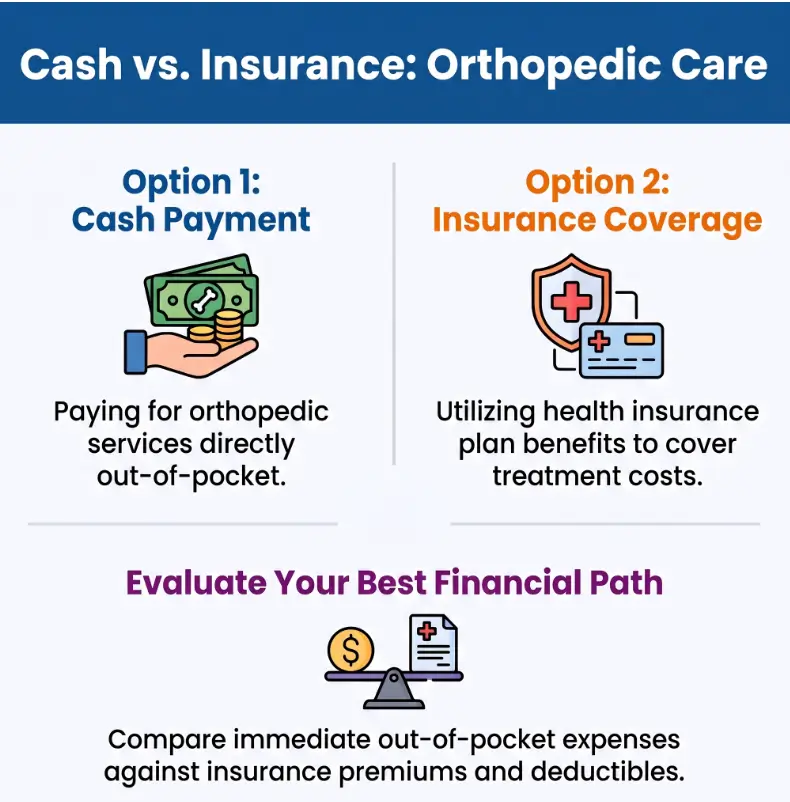
Paying cash for orthopedic care can sometimes cost less than using insurance, especially when you have a large deductible and are comparing a planned office visit, imaging study, injection, or other shoppable service. But the number that matters is not simply “cash price versus billed price.” Compare the provider’s complete self-pay price with your insurer’s estimated out-of-pocket cost for the same service, provider, and location.
Then check one more thing before choosing cash: whether bypassing insurance means the payment will not count toward your deductible or out-of-pocket maximum. A $200 saving today can become expensive if you expect surgery or substantial covered care later in the same plan year. Your best first move is to obtain both estimates before the appointment and compare them on an all-in basis.
This guide focuses primarily on U.S. employer-sponsored, Marketplace, and other commercial health insurance. Medicare and Medicaid have different billing and participation rules.
Table of Contents
Cash Price and Insurance Price Are Not the Same Kind of Number
An orthopedic practice may have several prices attached to the same service. That is why a statement such as “the MRI costs $1,800” often tells you surprisingly little about what you will actually pay.
| Price | What It Usually Represents | Why It Matters |
|---|---|---|
| Gross or billed charge | The provider’s listed charge before contractual adjustments | Often a poor basis for comparing your actual cost |
| Cash or self-pay price | The amount offered when insurance is not used | This is the number to compare with your insurance responsibility |
| Negotiated or allowed amount | The amount recognized under the insurer-provider agreement for a covered service | Your deductible or coinsurance may be calculated from this amount |
| Estimated patient responsibility | Your expected deductible, copay, or coinsurance after plan rules are applied | This is usually the most useful insurance-side comparison number |
If terms such as allowed amount, coinsurance, adjustment, and patient responsibility blur together on a bill, this orthopedic billing terms guide can help you separate them before comparing prices.
For many health plans, the insurer’s price-comparison tool is a useful starting point. Federal transparency requirements require most plans and issuers subject to the rules to provide personalized cost-sharing information for covered services. CMS explains how these tools work in its health plan price transparency guidance for consumers.
When Paying Cash May Cost Less
Cash is most attractive when the service is planned, reasonably predictable, and inexpensive enough that insurance’s financial protection adds little to the transaction.
- You still have a substantial deductible remaining.
- The insurer’s negotiated amount is higher than the provider’s self-pay offer.
- You do not expect enough additional covered care this year for deductible accumulation to become valuable.
- The cash quote includes the complete service rather than just one component.
- The service does not need insurance authorization to protect coverage for related care.
These conditions can occur with orthopedic consultations, X-rays, MRIs, physical therapy visits, some office procedures, and certain injections. They can also occur at independent imaging or therapy facilities where self-pay pricing is straightforward.
Hospitals subject to federal hospital price-transparency rules publish discounted cash prices as well as payer-specific pricing information. CMS provides a consumer guide to hospital price transparency that can help when the orthopedic service is hospital-based.
When Insurance May Be Cheaper Even With a Higher Price Today
Insurance becomes more valuable when today’s orthopedic bill is part of a larger episode of care. The critical question is not merely, “Which option saves money on this appointment?” It is, “Which option leaves me spending less by the end of the plan year?”
Amounts you pay as deductible, copayments, or coinsurance for qualifying covered in-network care generally contribute toward your plan’s applicable cost-sharing accumulators. HealthCare.gov explains the interaction between premiums, deductibles, cost sharing, and out-of-pocket limits in its guide to total health-care costs.
A payment made completely outside your insurance plan should not automatically be assumed to count toward those totals. Some plans may have a process for member-submitted claims or receipts, while others may not credit a cash transaction in the way you expect. Confirm this with your insurer before paying.
Illustrative example: the cheaper MRI
Suppose an orthopedic MRI has a $450 self-pay price. Your insurer’s negotiated amount for the same MRI at the same facility is $650, and you still have enough deductible remaining that you would owe the full $650.
If you expect little additional medical care before your plan year resets, paying $450 instead of $650 produces an immediate $200 saving, assuming the quotes include the same service and no separate charges appear.
Normalize the quote before calling the difference a saving. In a separate hypothetical version, the $450 cash quote covers scanning only. Add an omitted $100 interpretation fee and $25 for contrast, if contrast is actually ordered and billed separately. The all-in cash amount becomes $575. If the $650 insurance estimate already includes those same components, the immediate cash saving is $75, not $200. These are invented inputs, not current MRI prices. Do not add either component again when it is already included.
Also ask what happens if you later submit a claim: would the provider keep the cash price, remove that discount, or reconcile what you prepaid against a new balance? Get the provider’s answer separately from the insurer’s answer about claim credit. A receipt alone does not establish reimbursement, deductible credit, or the right to keep a particular self-pay discount.
Illustrative example: the same MRI before surgery
Now change one fact. Assume you have $3,000 remaining before reaching your applicable in-network out-of-pocket maximum, the $650 insurance responsibility would count toward that limit, and a covered in-network surgery later in the year would be expensive enough to reach the limit either way.
Under those assumptions, using insurance for the MRI could leave your total qualifying plan spending from this point at $3,000. If the $450 cash MRI does not count toward the plan limit, you could instead spend $450 outside the plan plus the remaining $3,000 inside it, or $3,450.
The cash price is lower at the MRI counter but higher across the full year. This is the small arithmetic trap hiding inside many high-deductible health plans.
Your 10-Minute Cash-vs-Insurance Check
Before committing to self-pay, collect two comparable estimates. Do not accept “approximately” from one side and an itemized number from the other.
Ask the orthopedic provider
- What is the self-pay price if I choose not to use my insurance?
- Is that price available only if I prepay?
- What procedure or billing codes are expected?
- Does the quote include the physician, facility, imaging, supplies, and medications?
- Could another provider send a separate bill?
- Is there a facility fee?
- If the planned service changes, how will the cash price change?
Facility charges deserve special attention because an orthopedic service performed in a hospital outpatient department can have a different billing structure from an apparently similar service in a physician office. See the guide to facility fees in orthopedic care if the location is unclear.
Ask the insurer
- Is this provider and this specific facility in network?
- What is my estimated out-of-pocket responsibility for the expected service?
- How much of my deductible and out-of-pocket maximum remains?
- Does this service require prior authorization or a referral?
- If I pay the provider’s cash price without having them bill the plan, can I submit the claim myself?
- If I can submit it, what amount, if any, would count toward my deductible or out-of-pocket maximum?
Keep a screenshot, reference number, secure message, or other record of the estimate when possible. An estimate is not a coverage guarantee, but documented answers are much more useful than remembering a phone conversation several months later.
If authorization is required, use an orthopedic prior authorization checklist before assuming that paying cash for one part of the episode removes insurance requirements for later care.
Compare the Whole Orthopedic Episode, Not One Line Item
The more complex the orthopedic treatment, the less useful a single cash number becomes. A surgeon’s fee is not necessarily the price of surgery.
| Orthopedic Service | What a Complete Quote May Need to Address |
|---|---|
| Office consultation | Visit, X-rays, brace or supply charges, separately ordered tests |
| MRI or CT | Technical/facility charge, professional interpretation, contrast if applicable |
| Joint or spine injection | Physician, medication, imaging guidance, facility charge, sedation if applicable |
| Physical therapy | Evaluation, individual visits, planned frequency, equipment or supplies |
| Outpatient surgery | Surgeon, facility, anesthesia, implants, imaging, pathology when applicable, assistant services, postoperative care |
A $2,000 “surgery cash price” can be useless if it represents only the surgeon while the facility and anesthesia bills remain outside the quote. Before comparing surgery prices, identify the billing entities and services expected. The orthopedic surgery estimate guide provides a deeper framework for assembling those pieces.
Self-Pay Patients Can Request a Good Faith Estimate
If you have health insurance but intentionally choose not to use it for scheduled care, federal rules generally treat you as self-pay for purposes of the Good Faith Estimate protections under the No Surprises Act.
CMS states that when you are not using insurance, a provider generally must provide a written Good Faith Estimate when you request one or when qualifying care is scheduled sufficiently in advance. You can review the current requirements in CMS’s Good Faith Estimate guidance.
For care scheduled three to nine business days ahead, the estimate generally must be provided within one business day. For care scheduled at least ten business days ahead, it generally must be provided within three business days. You can also request an estimate before scheduling.
An estimate from one provider does not necessarily capture every provider participating in an orthopedic episode. Surgery may involve the surgeon, facility, anesthesia group, imaging, and other separately billing parties. That is why an itemized estimate matters more than a headline number. For a more focused preparation process, see this orthopedic Good Faith Estimate guide.
What if the final self-pay bill is much higher?
If an individual provider or facility bills at least $400 more than its Good Faith Estimate, you may qualify for the federal patient-provider dispute resolution process. CMS currently requires the dispute to be started within 120 calendar days of the date on the initial bill and explains the process in its medical bill dispute guidance.
Keep the estimate and final bills. A photograph or PDF copy is much easier to produce during a billing dispute than a memory of what someone said at the front desk.
Three Ways a Cheap Cash Quote Can Become Expensive
The quote covers only one biller
Orthopedic care fragments easily into professional and facility bills. Ask who will bill you, not merely what “the procedure” costs. Multiple bills after orthopedic care are common enough to justify checking the billing structure before a procedure rather than after it.
You sacrifice valuable plan accumulation
If substantial covered treatment is likely later in the year, even a moderately higher insurance price may be worth paying if it meaningfully advances you toward your deductible or out-of-pocket limit. The closer you are to that limit, the more carefully a cash discount should be evaluated.
You assume self-pay solves authorization problems
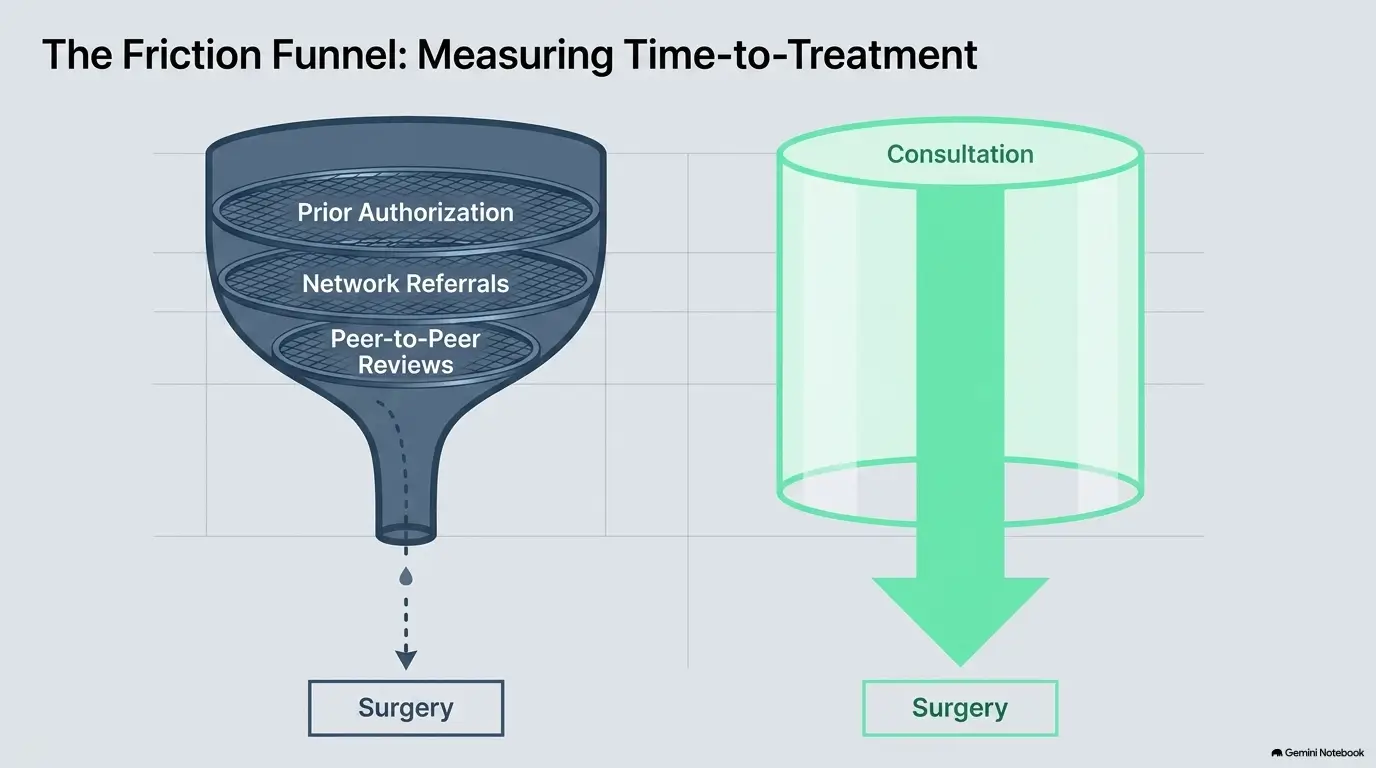
Paying cash for an MRI, injection, or consultation does not automatically mean your insurer must cover a later procedure that relies on it. Plans may still apply network, referral, prior-authorization, medical-necessity, or documentation requirements to subsequent covered services. Confirm downstream requirements before using cash specifically to avoid an insurance hurdle.
When Paying More Through Insurance Is Rational
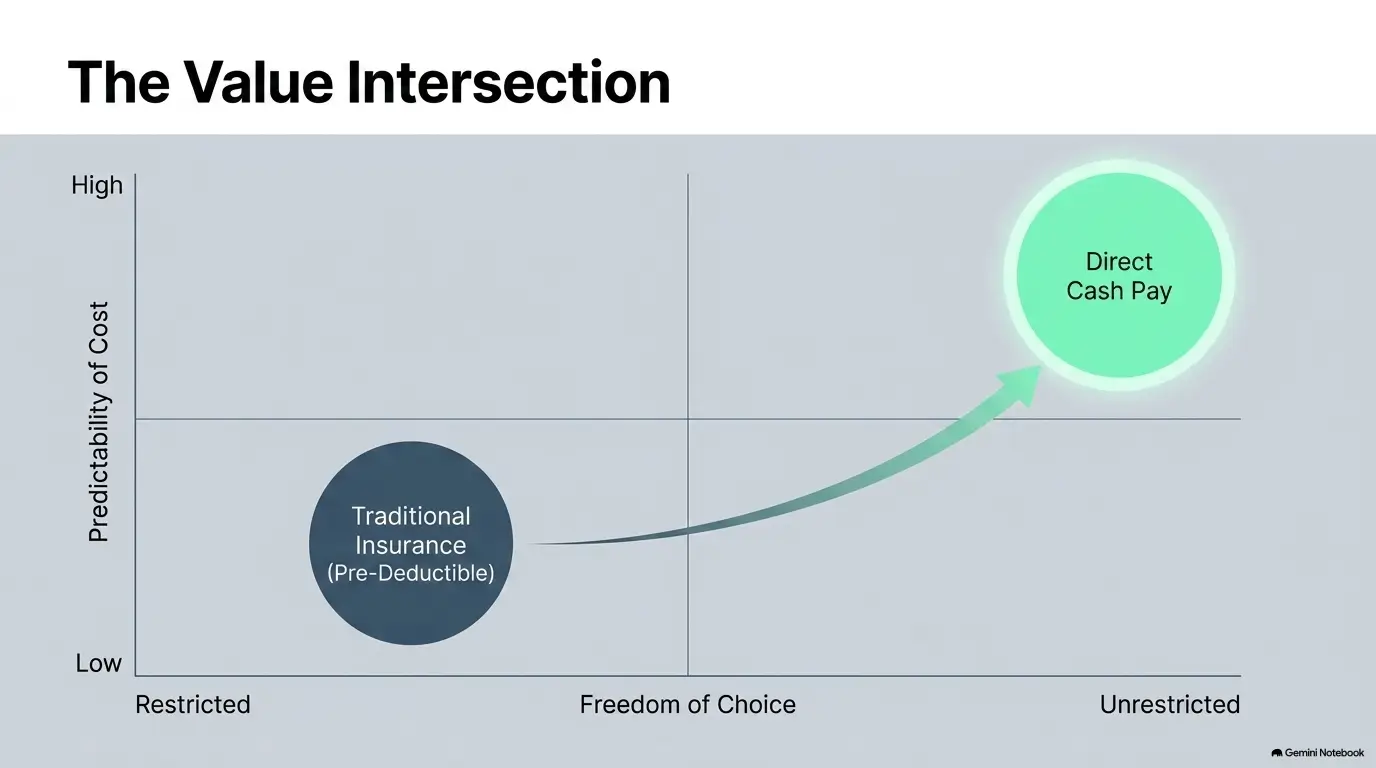
The case for insurance strengthens as financial uncertainty grows. A predictable $300 office service is fundamentally different from surgery whose final cost can involve several providers, implants, anesthesia, complications, or unplanned additional care.
- You are already close to your deductible or out-of-pocket maximum.
- You expect additional orthopedic treatment this plan year.
- The procedure could generate several bills.
- Your plan’s negotiated price is competitive with the cash price.
- You want applicable plan appeal and claim-processing mechanisms preserved.
- The treatment requires authorization or other plan coordination.
Insurance is not merely a coupon applied to each appointment. Its larger financial function appears when a series of expensive covered services arrives together. For a major procedure, comparing the entire episode usually matters more than squeezing the lowest price from one component.
Cash vs Insurance for Orthopedic Care: FAQ
Does this work the same way if I have Medicare?
No. Do not automatically apply commercial-insurance self-pay strategies to Medicare. With Original Medicare, participating, non-participating, and opted-out providers have different billing obligations and payment rules. Medicare explains these distinctions in its provider assignment guidance. Medicare Advantage plans also have their own network and coverage rules.
Can I pay cash for an MRI and use insurance for surgery later?
Possibly, but treat them as two separate coverage decisions. Before paying cash for the MRI, verify whether the later surgery has authorization, network, referral, or documentation requirements and whether the insurer needs the imaging obtained in a particular manner. Do not assume a self-paid test automatically satisfies the plan’s requirements for the next service.
Can I submit a cash receipt to insurance afterward?
That depends on your plan, the provider’s status, the service, claim-filing requirements, and applicable deadlines. Ask before paying. Specifically ask whether a member-filed claim is permitted, what documentation is required, what reimbursement is possible, and whether any amount would be credited to your deductible or out-of-pocket accumulation.
Should I choose the cheapest orthopedic provider?
Not on price alone. First establish that the proposed service, setting, and provider are appropriate for your medical needs. Price comparison is useful when you are choosing among clinically reasonable alternatives; it should not delay urgent or emergency evaluation after serious injury.
Run This Check Before You Pay
Open your insurer’s cost estimator or call member services while you have the orthopedic office’s cash quote in front of you. Write down four numbers: the all-in cash price, your estimated insurance responsibility, your remaining deductible, and your remaining out-of-pocket maximum.
Then ask the decisive question: If I pay cash, will any of this payment be recognized by my plan, and do I expect enough additional covered care this year for that difference to matter?
If the cash quote is clearly lower, complete, and you expect little additional care, paying cash may be perfectly sensible. If the price difference is modest and surgery or other expensive covered treatment is approaching, the insurance route may leave you spending less across the year.
The useful comparison is not “cash good, insurance expensive” or the reverse. It is the price of this service, plus the financial consequences of what happens next.
Last reviewed: 2026-09
Targeted review: October 17, 2026. Added an all-in quote reconciliation and questions about later claim submission. Other sections retain their stated review scope.
Targeted editorial update: October 21, 2026. Added a topic-specific follow-up record and recheck triggers, revised the title and search description, and removed unverified first-person claims or clarified selected wording where found. The existing body was retained. This update is not a complete legal, coverage or clinical review; confirm current rules and individual decisions with the relevant official source or service.