
This site is written from a family-caregiver perspective. The operator is not a medical professional. This article provides general education and preparation prompts rather than an individual assessment.
Make uncertain costs visible
Use these prompts to prepare questions and arrangements. They do not diagnose a condition, determine coverage or clear an activity.
- What to record
- Written estimates, prescribed therapy, medicine and equipment needs, transport, home help and work impact.
- What to ask
- Which items are confirmed, which depend on the care plan and who can quote each one?
- Next action and owner
- Record source and date for estimates, confirm benefits and revisit the budget when the actual plan changes. Write down who will act and when to follow up.
Keep personal records private. You can use the visit preparation organizer to arrange questions; do not post identifying health information in comments.

A rotator cuff surgery estimate rarely captures the full cost of recovery. Beyond the surgeon, anesthesia, and facility charges, you may still pay for physical therapy, a sling or immobilizer, prescriptions, follow-up services, transportation, household help, and time away from work.
The biggest variable is not simply the price of the operation. It is how your insurance treats the months of care surrounding it, particularly physical therapy, durable medical equipment, and care that crosses into a new plan year.
Before scheduling, ask for the planned procedure codes and build an episode-of-care estimate that extends through rehabilitation. A surgical quote can be correct while still leaving thousands of dollars of household exposure outside the quote.
Table of Contents
The Surgery Quote Is Not the Full Recovery Budget
The useful number is not just “What will surgery cost?” It is “What will I spend from the decision to operate until I am through the expensive part of recovery?”
Rotator cuff repairs are commonly performed as outpatient procedures, but outpatient does not mean financially self-contained. The American Academy of Orthopaedic Surgeons describes rehabilitation as an important part of recovery, with sling use and progressively more active rehabilitation extending well beyond the day of surgery. You can review the AAOS overview of rotator cuff surgical treatment and recovery.
| Cost bucket | What may appear | What to verify |
|---|---|---|
| Before surgery | Office visits, imaging, medical clearance, lab work | Which services are still needed and which providers are in-network |
| Surgical day | Surgeon, facility, anesthesia, related procedures | Whether every provider and facility is participating with your plan |
| Early recovery | Sling or immobilizer, prescriptions, wound supplies | Whether equipment is included, separately billed, rented, or purchased |
| Rehabilitation | Physical therapy evaluations and treatment visits | Copay versus coinsurance, visit rules, authorization, network |
| Later follow-up | Surgeon visits, imaging, additional treatment if recovery changes | What is bundled and what can generate a separate claim |
| Household costs | Transportation, help at home, meal delivery, work absence | What you actually need rather than what is merely convenient |
This distinction matters when comparing two surgical locations. A lower facility estimate may save money, but it does not automatically reduce your therapy copays, lost wages, equipment costs, or a deductible that resets while you are still recovering.
Physical Therapy Can Turn a One-Day Procedure Into a Months-Long Cost
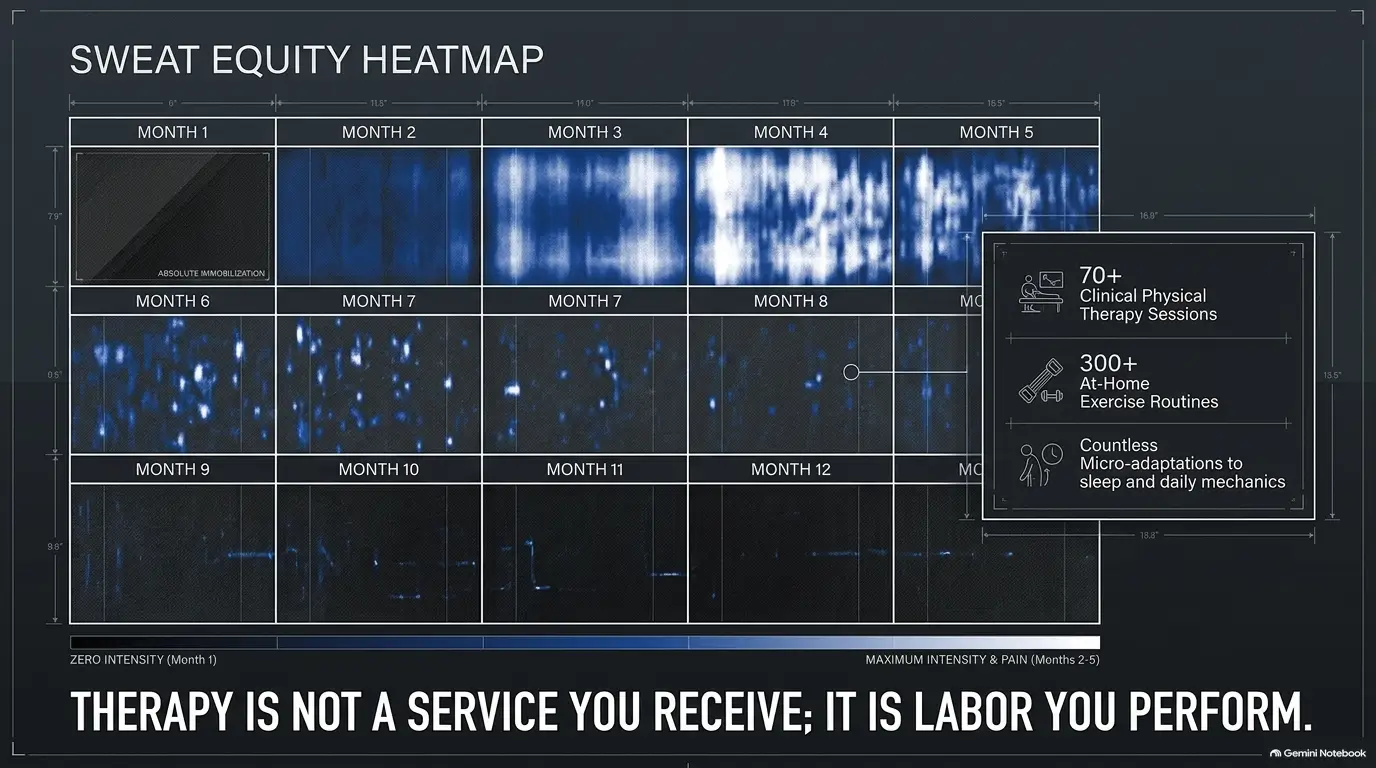
Rehabilitation is one of the most important costs to calculate separately because rotator cuff recovery unfolds in stages rather than ending when the incisions heal.
AAOS describes an initial protection period in which a sling is commonly used, followed by passive and then active motion, with strengthening introduced later. Functional motion and strength may take several months to return. Your actual schedule depends on the tear, tissue quality, repair technique, surgeon’s protocol, and your progress, so the number of therapy visits cannot be inferred from the diagnosis alone.
For cost planning, ask the surgeon or therapy office for the expected rehabilitation pattern rather than a guaranteed visit count. You want enough information to estimate your exposure without mistaking a typical protocol for a promise.
If therapy is billed with a fixed copayment, the arithmetic is straightforward:
Estimated therapy cost = expected patient charge per visit × expected number of visits
If your plan uses deductible plus coinsurance, the calculation changes. You may initially owe the plan’s allowed amount until the deductible is satisfied, then a percentage of the allowed amount afterward. That makes “20% coinsurance” much less useful until you know what amount the percentage is being applied to.
Budget the evaluation and each actual trip separately. As a planning example only, suppose a separate evaluation costs you $65, twelve later treatment appointments each cost $35, and thirteen round trips each cost $18. Patient-paid therapy is $65 + (12 × $35) = $485; travel is 13 × $18 = $234. The combined budget is $719. These amounts and visits are invented inputs, not typical prices or a recommended rehabilitation schedule.
Replace each input with your clinic’s estimate and the surgeon’s expected pathway. If evaluation and treatment occur at the same appointment, do not count two trips; ask how the combined visit is billed. Also distinguish visits requested by the clinical team, visits authorized so far, and visits actually scheduled. A preliminary authorization count should not be treated as a guarantee of payment or as a reason to stop or extend treatment yourself. Confirm the next review point with the clinic and plan.
Before the first appointment, ask the insurer and therapy provider these questions:
- Is this physical therapy clinic in-network for my exact plan?
- Do I have a copay, coinsurance, or deductible for outpatient therapy?
- Is prior authorization required?
- Are there visit limits or medical-necessity reviews?
- Does a new therapy evaluation have different cost sharing from treatment visits?
- What is the current negotiated or estimated patient amount per visit?
Do not automatically choose the cheapest therapy clinic. First confirm that the therapist can follow the surgeon’s postoperative restrictions and communicate when progress is slower or faster than expected. But if two clinically appropriate in-network options provide comparable access, comparing your negotiated cost is entirely reasonable.
The Calendar Can Create a Second Deductible Problem
A late-year operation can produce a particularly unpleasant piece of arithmetic: surgery may satisfy much of this year’s deductible, while therapy continues after the health plan resets for the next plan year.
Suppose the operation occurs in December and rehabilitation continues into January. Depending on your plan, January services may begin accumulating against a new deductible and out-of-pocket limit. That can make two otherwise similar surgery dates financially different even though the surgeon’s price is identical.
Your out-of-pocket maximum also needs careful reading. It generally protects you from unlimited cost sharing for covered in-network care, but it does not necessarily absorb premiums, non-covered services, or every out-of-network charge. HealthCare.gov explains the distinction in its out-of-pocket maximum guidance.
Before moving surgery simply for insurance reasons, discuss the timing with the surgeon. Clinical urgency and tendon characteristics can matter. Financial optimization should work around appropriate medical care, not replace the clinical decision.
A Sling, Prescriptions, and Home Equipment Can Quietly Stack Up
Most recovery purchases are individually smaller than the surgical bill, which makes them easy to ignore. Their importance comes from accumulation, and from buying things before you know whether you actually need them.
A sling or shoulder immobilizer may be supplied through the surgeon, facility, or a durable medical equipment company. Do not assume it is included in the surgical fee. Ask who supplies it, whether your insurer requires a particular vendor, and what your estimated patient responsibility will be.
The same restraint is useful with home-recovery shopping. A patient may find pillows, loose clothing, one-handed kitchen tools, shower adaptations, or a more upright sleeping arrangement useful, but that does not mean everyone needs a shopping cart full of postoperative gear.
If you are unsure whether you need a sling or a more restrictive device, the distinction is explained in shoulder immobilizer vs. sling. For the first nights at home, shoulder immobilizer sleep mistakes can also help you plan around the device you were actually prescribed rather than improvising after surgery.
When the cheaper setup is enough
You probably do not need to buy an expensive recliner solely because rotator cuff surgery is scheduled. If your surgeon permits your planned sleeping position and you can get in and out safely while protecting the operated arm, rearranging an existing bed or chair may be sufficient.
If your existing setup makes safe transfers or sleep genuinely difficult, spending more may become reasonable. The decision should be driven by function and postoperative restrictions, not by the assumption that a particular piece of furniture is part of rotator cuff recovery. The tradeoffs are discussed in recliner vs. bed after shoulder surgery.
Lost Work May Be the Largest Cost That Never Appears on a Medical Bill
Time away from work is not a medical charge, but for many households it is part of the real price of surgery.
The financial effect depends heavily on the job. Someone whose work can be performed with one hand at a computer faces a different problem from someone who lifts, carries, reaches overhead, drives professionally, or operates equipment. The date you can perform basic daily activities is not necessarily the date you can safely perform your job.
Before surgery, separate three questions that are often blurred together:
- When does the surgeon expect me to be medically able to resume some work?
- What physical restrictions are likely to remain at that point?
- Can my employer accommodate those restrictions, and how will the absence affect my pay?
Do not budget from a coworker’s recovery timeline. Tear size, procedure details, dominant arm, job demands, complications, pain control, rehabilitation progress, and surgeon restrictions can all change the answer. A more useful planning framework is available in returning to work after shoulder surgery.
Separate Medical Bills Are Normal, but They Still Deserve Scrutiny
A single operation can generate multiple claims. The surgeon, surgical facility, anesthesiology group, therapy provider, durable medical equipment supplier, pharmacy, and imaging provider may not bill through the same organization.
That means receiving several bills does not, by itself, prove that you were charged twice. Compare each bill with its Explanation of Benefits and identify the provider, date of service, service description, plan allowed amount, insurer payment, and patient responsibility before paying.
Routine postoperative surgeon visits may also be treated differently from unrelated services. For Medicare, many surgical procedures use a global surgical payment structure that includes certain postoperative visits, while services outside that package can be billed separately. Commercial insurance arrangements can differ, so ask the surgeon’s billing office what the quoted professional fee includes rather than assuming every follow-up is free or separately billable. CMS provides additional detail on Medicare global surgery payments.
If an anesthesia bill arrives separately, first identify whether it is simply a legitimate separate professional claim or an unexpected out-of-network charge. The billing mechanics are explained further in why anesthesia may arrive as a separate bill.
An In-Network Facility Does Not Mean You Should Ignore Every Other Provider
For privately insured patients, federal surprise-billing protections can apply when certain out-of-network clinicians provide non-emergency services connected with care at an in-network hospital, hospital outpatient department, or ambulatory surgical center. Anesthesiology is one important example. The protections are significant, but they do not turn every possible out-of-network service into an in-network service.
Before surgery, verify the surgeon and facility directly with your insurer and ask the facility which other groups may participate. If an unexpected out-of-network bill later appears, compare it with the insurer’s EOB before paying and review CMS medical bill protections.
If several unfamiliar names appear after surgery, understanding an orthopedic bill with multiple providers can help separate a multi-provider episode from an actual duplicate-charge problem.
Build a Full-Episode Estimate Instead of Guessing From the Deductible
Your remaining deductible is only one component of the calculation. A more useful pre-surgery worksheet looks like this:
Estimated household cost = surgery and other patient-paid medical costs + additional transportation and household help + net lost income. Use separate rows for therapy, equipment, medicines, and follow-up, but add them only when they are not already included in the surgical or medical estimate. Apply the plan’s covered-service out-of-pocket limit where relevant.
Subtract only reimbursements or other payments that will actually reduce the expense you bear, and only after confirming eligibility and approval. Track an HSA or FSA balance separately as a funding source; spending your own account money does not erase the underlying recovery cost. Paid leave or disability income belongs in the lost-income calculation, so do not subtract it again from the total.
The purpose is not to predict the final bill to the dollar. It is to expose missing categories while you still have time to ask questions.
Your 10-Minute Rotator Cuff Surgery Cost Check
Before comparing hospitals or committing to a date, collect enough information to price the whole episode. A one-page worksheet is enough to separate the main assumptions.
- Get the planned procedure information. Ask the surgeon’s office for the planned procedure name and billing codes, including any additional procedures they reasonably expect may be performed.
- Get separate estimates. Ask what the surgeon, facility, and anesthesia services are expected to cost you under your insurance.
- Check the network yourself. Verify the surgeon and facility with your insurer rather than relying only on a provider directory or verbal statement from one office.
- Price rehabilitation. Ask about the expected therapy pathway, authorization rules, your cost-sharing method, and the in-network therapy options available to you.
- Check equipment and prescriptions. Find out whether the sling or immobilizer is included and whether a particular durable medical equipment supplier is required.
- Look at the calendar. Determine whether a meaningful portion of rehabilitation could occur after your deductible or out-of-pocket accumulators reset.
- Add the non-medical column. Estimate transportation, household help, childcare if relevant, and income you realistically expect to lose.
If you want a separate framework for checking the surgical quote itself, use this orthopedic surgery estimate guide before adding the recovery costs above.
If You Are Paying Cash, Ask for More Than One Estimate
Uninsured patients and people choosing not to use insurance have additional federal estimate protections. In many scheduled-care situations, providers must furnish a written Good Faith Estimate when the requirements apply.
The trap is assuming one estimate represents everyone involved. CMS explains that a Good Faith Estimate may cover the expected charges from a particular provider or facility, and additional providers may require their own estimates. For surgery, that can mean separately checking the surgeon and facility and asking about other providers expected to participate. See the current CMS guidance for patients not using insurance.
Keep each written estimate. If the final bill is materially higher, the estimate is far more useful than a phone-call memory of what someone said weeks earlier.

Frequently Asked Questions
Does health insurance usually cover physical therapy after rotator cuff surgery?
Physical therapy may be covered when it meets your plan’s requirements, but coverage does not tell you what you will pay. Network status, deductible, copay or coinsurance, prior authorization, visit rules, and medical-necessity reviews can all affect your cost. Confirm the benefit for postoperative outpatient physical therapy with your insurer.
Is the sling included in the rotator cuff surgery price?
Do not assume it is. A sling or immobilizer may be supplied by the surgical practice, facility, or a separate durable medical equipment company and may generate its own claim. Ask who supplies the prescribed device and what your expected patient responsibility is before accepting additional equipment.
Will my postoperative appointments generate separate bills?
Some routine surgeon follow-up services may be included within a surgical payment arrangement, while unrelated visits, tests, other providers’ services, or additional treatment may be separately billable. Medicare has defined global surgery payment rules, but you should not assume your commercial plan follows the same billing arrangement. Ask the surgeon’s billing office what the professional estimate includes.
Is scheduling surgery after I meet my deductible always cheaper?
No. It may reduce cost sharing for covered services performed before the plan year ends, but rehabilitation can continue into the next plan year and encounter new cost sharing. More importantly, changing surgery timing should not conflict with the surgeon’s clinical recommendation. Compare the medical timing and the full recovery calendar together.
Should I buy recovery equipment before surgery?
Usually, buy only what has a clear purpose before the operation. First identify the prescribed sling or immobilizer, your sleeping and bathing limitations, and whether someone will be available to help. Add equipment only when it solves a specific problem. Recovery shopping has a remarkable talent for turning anxiety into cardboard boxes.
Run This Check Before You Schedule
Take the surgery estimate you already have and draw six additional lines beneath it: therapy, equipment, prescriptions, follow-up care, transportation/help, and lost income.
Then call the surgeon’s office and your insurer with one question: “What am I still missing from the total cost of this recovery?”
If either answer introduces a new provider, service, authorization requirement, or cost-sharing rule, add it to the page before paying a deposit or choosing between facilities. That small exercise turns a surgical quote into something far more useful: a working household budget for the months that follow.
Last updated: October 15, 2026
Targeted update: 17 October 2026. Added an illustrative therapy-evaluation and travel budget, with safeguards against double-counting trips or treating an authorization count as a treatment schedule. Other sections retain their existing review scope.
Targeted editorial update: October 21, 2026. Added a topic-specific record, question and follow-up guide and revised the title and search description. Existing useful material was retained; this update is not a complete medical, legal or insurance review. Confirm individual instructions, current prices and benefits with the relevant service.