
Postoperative Home Safety Guide
When Living Alone Becomes Unsafe After Joint Surgery
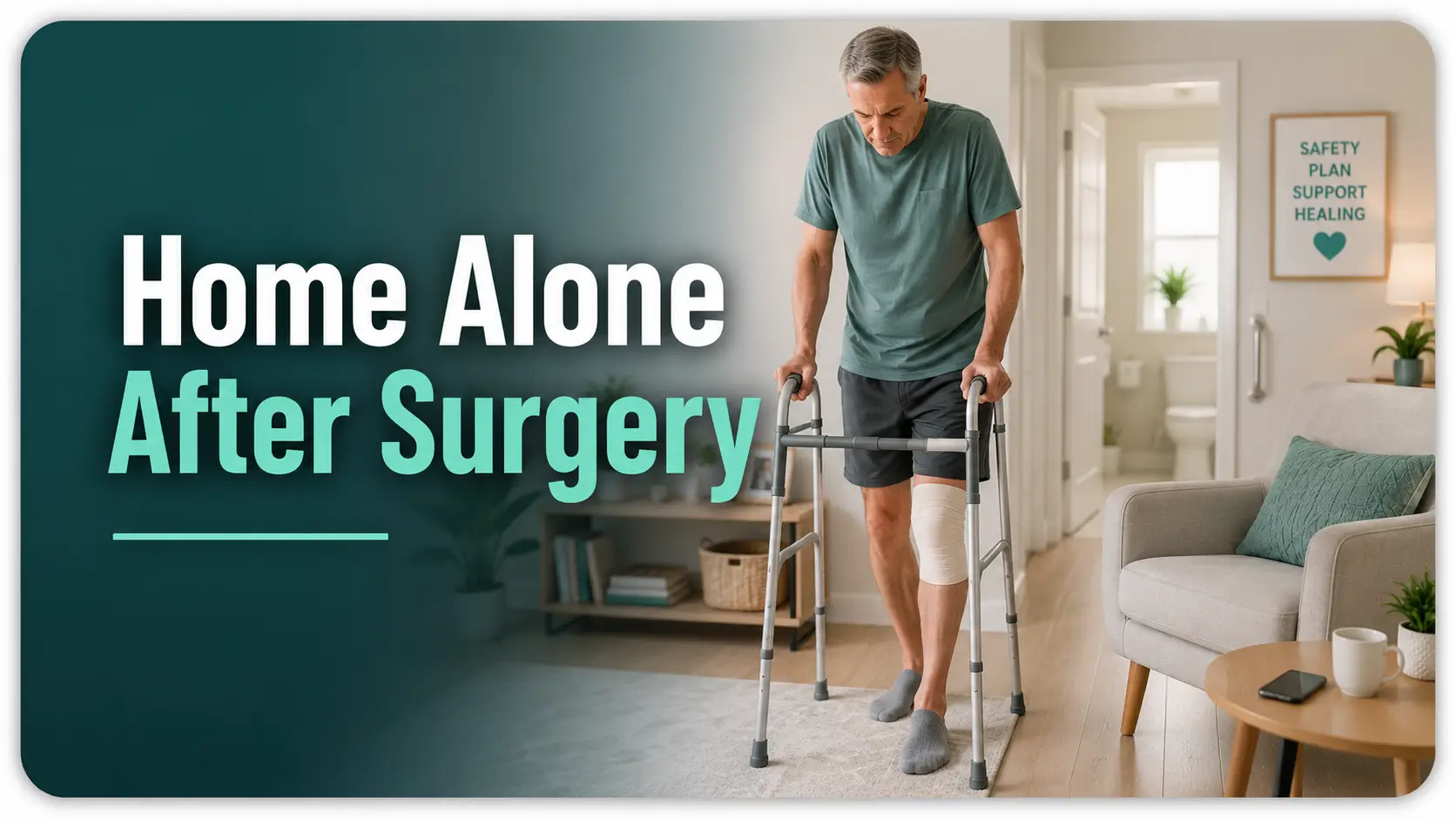
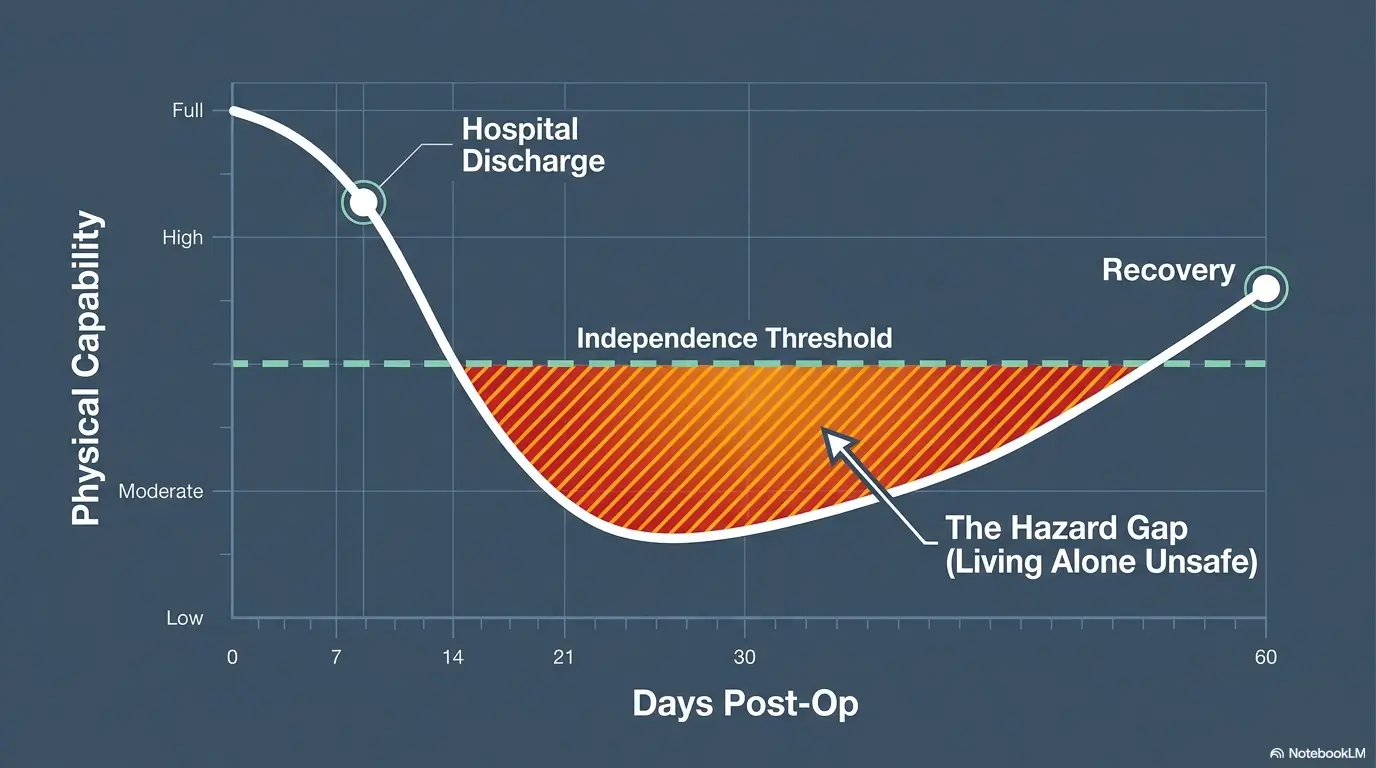
Going home after hip, knee, shoulder, or other major joint surgery can feel like crossing a finish line. In reality, discharge is the handoff point between a staffed clinical setting and a home where the bathroom may be twenty steps away, the milk is inconveniently heavy, and nobody notices when dizziness turns into a fall.
The important question is not simply, “Can I go home?” It is, “Can I repeat the essential tasks of the day safely when I am tired, swollen, medicated, and alone?” A person may walk well during therapy and still be unable to rise from a low chair, carry water while using a walker, open medication bottles, or reach help after a bathroom accident.
This guide turns that vague worry into a practical decision. You will test real-world function, identify the moments most likely to fail, compare support options, and prepare a discharge conversation based on observable needs rather than pride, age, or a hopeful shrug.
Test Function
Judge repeatable transfers, toileting, meals, medications, and emergency access.
Compare Support
Separate occasional check-ins from hands-on care and overnight supervision.
Plan the Handoff
Bring specific home barriers to the surgeon, therapist, nurse, or case manager.
Temporary help is not surrender. It is equipment for the part of recovery that cannot be carried in one hand. 🏠
Snapshot
This article is for adults expecting to recover at home after major joint surgery and for family members deciding whether that plan is realistic. It helps identify unsafe gaps in mobility, toileting, meals, medication management, nighttime routines, and emergency response so you can request the right equipment, services, or human support before discharge.
Table of Contents
Before You Rely on This Guide
Safety note
This article provides general education, not individualized medical advice. Postoperative restrictions vary by procedure, anesthesia, medications, health history, weight-bearing status, and surgeon protocol. Follow your discharge instructions. Contact your surgical team when your symptoms, function, or available home support does not match the plan discussed before surgery.

Who this guide fits
This guide is most useful for adults preparing for hip replacement, knee replacement, shoulder surgery, or another joint procedure that temporarily affects walking, balance, lifting, reaching, dressing, or weight-bearing.
It is also for spouses, adult children, siblings, neighbors, and friends trying to answer an uncomfortable question: Is this person genuinely ready to be alone, or are we mistaking determination for function?
Age alone does not answer that question. A younger patient can be unsafe because of medication effects, stairs, or one-handed restrictions. An older adult may recover safely with excellent preparation, appropriate equipment, and reliable support.
Who needs individualized planning
People with cognitive impairment, significant balance problems, serious heart or lung conditions, complex medication schedules, previous falls, major postoperative complications, or instructions requiring supervised care need a plan shaped by their clinical team.
The same is true when the home has unavoidable stairs, a distant bathroom, narrow walker routes, low furniture, an inaccessible shower, or nobody who can arrive quickly during an emergency.
Key takeaway
The safest discharge decision is based on what the patient can do repeatedly under realistic conditions, not what someone believes they should be able to do.
The First 24 Hours Reveal More Than the Calendar
Same-day discharge is not the same as safe alone
Outpatient or same-day surgery describes how long a person remains at the surgical facility. It does not automatically mean that unsupervised recovery is appropriate once the patient reaches home.
Clinical discharge criteria often focus on medical stability, basic mobility, pain control, and the absence of an immediate complication. Home independence asks a wider set of questions: Can the patient unlock the door, get into bed, reach the toilet, obtain water, follow a medication schedule, and respond if something goes wrong?
Discharge planning is safer when the patient and caregiver are actively included and when home support, medications, warning signs, and follow-up needs are discussed before departure.
The five-task independence test
Before someone stays alone, ask whether each task can be completed safely, consistently, and without improvised support.
| Essential task | What “safe enough” looks like | Warning that help is needed |
|---|---|---|
| Transfers | Rises from bed, toilet, and chair using the approved technique | Needs pulling, lifting, momentum, or unstable furniture |
| Mobility | Uses the prescribed device without rushing or abandoning it | Furniture-walks, loses balance, or cannot manage turns |
| Toileting | Manages clothing, hygiene, and standing without unsafe twisting | Cannot complete the full routine without hands-on help |
| Food and water | Can access, open, prepare, and carry enough fluids and meals | Skips intake because containers, shelves, or transport are difficult |
| Emergency contact | Keeps a working phone or alert device within reach | Leaves the device across the room or cannot use it while distressed |
The word repeatably matters. One successful walk down a quiet hallway with a therapist nearby does not prove that the same person can reach a dark bathroom at 2 a.m. after pain medication.
Fatigue often arrives after the observation window
Patients may look capable during a brief hospital assessment and struggle later as swelling, pain, nausea, stiffness, poor sleep, and medication effects accumulate. The best hour of the day is a poor foundation for a twenty-four-hour safety plan.
Try to evaluate the hardest predictable moment instead. For one person, that may be the first bathroom trip after waking. For another, it may be getting out of a recliner when the operative leg is swollen or preparing dinner with an immobilized shoulder.
Discharge conversation starter
“Please evaluate me using the tasks I will actually face at home: my bed height, bathroom route, stairs, medication schedule, meal access, and whether I can manage them at night.”
The Bathroom and Transfer Test
A small room can create a large risk
The bathroom compresses several difficult tasks into a narrow space: walking, turning, managing clothing, lowering the body, standing again, cleaning, and returning to bed. Add urgency, a damp floor, a walker that barely clears the doorway, or a towel bar that looks stronger than it is, and the margin for error becomes thin.
Evaluate the entire route, not merely the toilet. Check the distance from the bed, nighttime lighting, loose mats, thresholds, cords, door swing, pet access, and whether the mobility device can be positioned without forcing a sideways shuffle.
For a more detailed setup, review this guide to creating a safer night bathroom path after knee surgery and the practical issues involved in using the toilet with knee stiffness.
Transfers reveal the hidden gap
Walking attracts attention because it is easy to observe. Transfers are often the true weak link. A person may walk fifty feet with a walker yet be unable to rise safely from a low couch, reposition in bed, enter a car, or stand from the toilet without pulling on something unstable.
A transfer should be controlled from beginning to end. Watch for rocking repeatedly, holding the breath, collapsing into the seat, grabbing the walker before fully standing, or using momentum that cannot be reproduced when tired.
The chair-rise test guide can help families observe the mechanics of standing without turning the moment into an argument about toughness.
Shoulder surgery changes the everyday math
Lower-body surgery often makes walking and weight-bearing the central concern. Shoulder surgery creates a different problem: one-handed living.
A patient in a sling may struggle with dressing, bathing, opening containers, washing hair, cutting food, fastening clothing, managing bedding, and using a walker. The “good” arm may also be needed to push up from a chair, which can conflict with the prescribed precautions or simply overwhelm a painful body.
Anyone preparing for upper-body restrictions should review the practical realities of recovering alone after shoulder surgery and test one-handed tasks before the procedure.
Key takeaway
Do not ask only, “Can you walk?” Ask, “Can you complete the entire bathroom routine and every required transfer without grabbing, rushing, or improvising?”
Short Story: The trip that did not look dangerous
Martin could walk from the hospital bed to the doorway with a walker, so everyone felt relieved. His daughter stocked the refrigerator, placed his phone on the table, and drove home after dinner.
At 1:40 a.m., he woke with an urgent need to use the bathroom. The walker was beside the bed, but his phone was charging across the room. His knee was stiffer than it had been that afternoon, and the bathroom light switch sat beyond the doorway.
Nothing dramatic happened. He reached the toilet. But he had to grab the doorframe twice and could not stand without pulling on the sink.
The next morning, the family changed the plan. They added overnight help, moved the charger, installed a motion light, and raised the toilet seat. The lesson was simple: a safe hallway walk had answered the wrong question.
A Walker Is Not a Complete Safety Plan
Equipment cannot correct dizziness or poor judgment
A walker can improve stability when it is correctly fitted, used as instructed, and available at the exact moment it is needed. It cannot prevent a patient from standing too quickly, forgetting the device, rushing toward a ringing phone, or attempting a task while sedated.
Equipment also creates its own learning curve. Turns, thresholds, narrow rooms, backing up to a chair, and reaching for objects all require practice. The first attempt should not happen alone in a cluttered apartment.
Practice safe walker turns at home and create a clear walker path before surgery whenever possible.
Furniture-walking is a warning, not a technique
Countertops, towel bars, rolling office chairs, folding tables, and the backs of lightweight dining chairs are not substitutes for approved mobility support. They can move, tip, or force the body into an unsafe twist.
If a patient repeatedly abandons the walker because it feels inconvenient, that is useful information. The home may need wider pathways, a different device recommended by a clinician, closer supervision, or a simpler one-level recovery zone.
Stairs need a separate decision
Being able to walk on a level surface does not prove readiness for stairs. Safe stair use depends on the prescribed sequence, rail placement, leg strength, balance, weight-bearing restrictions, fatigue, and whether the person is tempted to carry items.
Pets add another variable. A small dog crossing the landing or a cat waiting on a dark step can undo an otherwise careful plan. Arrange gates, feeding help, walking assistance, or temporary pet care rather than expecting postoperative reflexes to win the contest.
The Four-Gate Home Safety Check
1. Body
Can the patient transfer, walk, turn, and toilet without hands-on rescue?
2. Home
Are routes clear, surfaces stable, supplies reachable, and stairs avoidable?
3. Routine
Can food, fluids, ice, medications, clothing, and hygiene be managed all day?
4. Backup
Can someone respond quickly, enter the home, and provide physical assistance?
Decision rule: A serious failure at any gate deserves a revised plan before the patient is left alone.
Food, Medication, and Fatigue Change the Equation
A stocked refrigerator is not a meal plan
Food still has to be reached, opened, prepared, heated, carried, eaten, and cleaned up. A walker may occupy both hands. A shoulder sling may make jars, foil seals, cartons, knives, and heavy cookware surprisingly difficult.
Test meals from beginning to end. Can the patient lift a container from the refrigerator, remove the lid, move it to the microwave, carry it to a stable eating area, and dispose of the waste without spilling?
A walker-friendly kitchen setup can reduce unnecessary reaching and carrying. For upper-body restrictions, use a one-handed meal preparation plan rather than relying on meals that are merely “easy” under normal conditions.
Pain relief may reduce pain while increasing functional risk
Postoperative medications may cause sleepiness, slowed reactions, nausea, constipation, dizziness, or confusion. Those effects can make a previously manageable bathroom route or transfer unsafe.
The living-alone decision should therefore be revisited after medications are taken, not judged only when the patient is alert and comfortable. A plan that works before a dose may fail during its strongest effect or after a poor night of sleep.
The medication system must work while the patient is tired
Common practical failures include missed doses, accidental duplicate doses, confusion between scheduled and as-needed medicines, and unplanned combinations with over-the-counter products.
Before discharge, ask for a clear written list that includes the medication name, purpose, amount, timing, maximum permitted use, major cautions, and whom to contact with questions. Do not reorganize pills in a way that removes labels or instructions unless the surgical team or pharmacist confirms the system is appropriate.
- Use one written schedule rather than several loose instruction sheets.
- Set alarms that identify the medication, not merely the time.
- Keep water and approved snacks within easy reach.
- Record each dose immediately after taking it.
- Choose one person to review the schedule during the first days.
- Keep the pharmacy and surgical-team numbers beside the medication list.
Families concerned about changes in attention or dosing can use this guide to monitor medication confusion after surgery.
Show me the nerdy details
Home independence is a chain, not a single ability. Each task includes several links: initiating movement, maintaining balance, remembering precautions, handling equipment, completing the task, and recovering from an unexpected problem.
A patient may pass five links and fail the sixth. For example, someone may reach the kitchen safely but be unable to transport a hot drink while using a walker. Another patient may remember every medication but lack the grip strength to open the bottle.
This is why functional planning works better than labels such as “independent” or “needs help.” Document the exact failed link, then match it with equipment, task redesign, hands-on assistance, or a different recovery setting.
Key takeaway
“There is food in the house” and “the patient can reliably eat and hydrate” are two different statements. Test the full chain.
When to Seek Help Instead of Waiting
Call the surgical team for concerning changes
Use the instructions supplied by the surgeon as the primary guide. Contact the clinical team promptly for symptoms outside the expected recovery pattern, increasing wound redness or drainage, pain that is worsening or not controlled as directed, medication problems, repeated vomiting, a new decline in mobility, or inability to eat, drink, urinate, or manage basic care.
Procedure-specific instructions may also identify changes in the operative limb, incision, temperature, circulation, or movement that require a call. MedlinePlus discharge guidance for hip and knee replacement lists falls, increased pain, walking difficulty, wound changes, calf symptoms, and chest symptoms among reasons to contact a clinician or seek urgent care.
Recognize urgent warning signs
Seek urgent medical attention for chest pain, difficulty breathing, fainting, sudden severe confusion, uncontrolled bleeding, a serious fall, or any symptom your discharge paperwork identifies as an emergency.
After surgery or hospitalization, symptoms of a possible blood clot may include unexplained limb swelling, pain or tenderness, warmth, or discoloration. Breathing difficulty, an unusually fast or irregular heartbeat, or chest discomfort can accompany a clot that has traveled to the lungs and requires immediate assessment.
“I do not feel safe alone” is useful clinical information
A patient does not need to wait for a dramatic complication before requesting help. Inability to toilet safely, repeated near-falls, confusion about medication, poor intake, uncontrolled nausea, or fear of being unable to summon assistance can justify a reassessment.
Describe the failure in concrete terms. “I am nervous” may be misunderstood. “I cannot stand from my toilet without pulling on the sink, and no one can stay overnight” gives the discharge team something specific to solve.
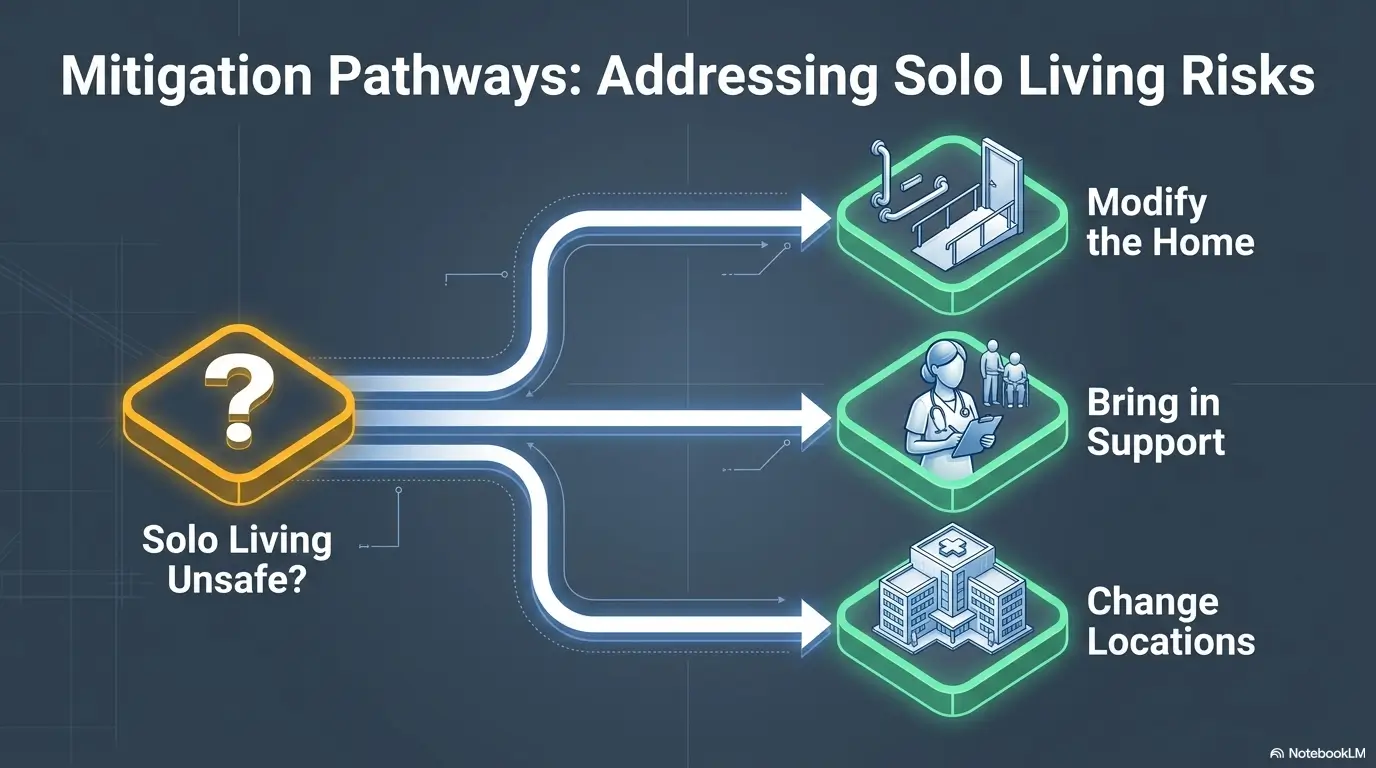
Safer Alternatives to Recovering Completely Alone
Match support to the task, not the family title
“My daughter will check on me” sounds reassuring but leaves important details unanswered. When will she arrive? Can she help with transfers? Does she have a key? Who covers the night? What happens if she is delayed?
Build support around tasks and time windows. One person may handle breakfast and medication. Another may cover transportation. A paid caregiver may assist with bathing. A neighbor may hold a spare key and provide rapid backup without being responsible for medical care.
A simple caregiver group chat after surgery can keep schedules, medication updates, meal needs, and unanswered concerns in one visible place.
Home health is not continuous supervision
Home health commonly refers to intermittent visits for eligible skilled services, such as nursing or therapy. It should not be assumed to provide a person who remains in the home throughout the day or night.
Ask exactly what is included, how often visits occur, how long they typically last, what happens outside visit hours, and whether nonmedical personal care is a separate service. Confirm coverage, eligibility, authorization, copays, and provider availability directly with the insurer and care team.
Good, better, or more structured support
| Support level | May fit when | What it can include | Important limitation |
|---|---|---|---|
| Prepared home plus check-ins | The patient passes all essential tasks and has low-risk access throughout the home | Meal setup, equipment, scheduled calls, nearby backup, transportation | A phone check cannot provide physical assistance |
| Rotating hands-on support | The patient needs help at predictable times but is safe between visits | Morning and evening help, meals, medication review, bathing, pet care | Gaps must be tested, especially overnight |
| Paid in-home assistance | Family is unavailable or personal-care needs are recurring | Scheduled caregiver hours, overnight presence, hygiene and meal help | Services, training, minimum shifts, and costs vary |
| Short-term rehabilitation or skilled setting | Mobility, transfers, medical needs, or home barriers cannot be safely managed | Structured nursing, therapy, meals, medication support, accessible facilities | Eligibility and insurance coverage require confirmation |
There is no universal “best” tier. The correct option is the least intensive arrangement that safely covers every important failure point. Compare the cost of equipment and caregiver hours using this home equipment versus caregiver-hours guide.
A temporary downstairs recovery zone can remove several risks at once
When the home allows it, moving sleep, medications, meals, charging devices, clothing, and bathroom access to one level can reduce unnecessary trips. The goal is not to build a miniature hospital room. It is to remove repeated decisions that become harder under pain and fatigue.
- Use a firm, appropriately high chair approved for the patient’s restrictions.
- Keep the mobility device on the side from which the patient actually stands.
- Place the phone and charger within reach from both bed and chair.
- Store medication instructions and emergency numbers together.
- Use closed containers for water and simple meals that require little handling.
- Create a clear route to the bathroom with reliable nighttime lighting.
- Move frequently used supplies between waist and shoulder height.
Official home-preparation guidance also emphasizes clearing tripping hazards, arranging commonly used items within reach, preparing meals, and planning assistance for activities such as bathing, toileting, cooking, errands, and appointments.
Key takeaway
Home health, family visits, paid caregivers, and rehabilitation solve different problems. Ask what each option actually provides during the hours when nobody else is present.
Common Mistakes That Turn Recovery Into a Crisis
Mistake 1: Planning around the best hour
A patient may look steady at noon and struggle after sunset. Support decisions should reflect medication peaks, poor sleep, swelling, urgency, stiffness, and the task that becomes hardest when energy is lowest.
Mistake 2: Counting phone access as physical help
A phone or medical alert device can summon assistance. It cannot prevent the fall, lift someone from the floor, open a meal container, stop a spill, or help with clothing during a bathroom emergency.
Mistake 3: Letting pride replace a backup plan
Temporary support is not evidence of permanent dependence. It is a bridge across a period when normal abilities are disrupted by healing, restrictions, fatigue, and medication.
Families can make the conversation less threatening by focusing on observable tasks: “You needed the sink to stand twice,” rather than “You cannot handle this.”
Mistake 4: Assuming insurance covers every support option
Coverage for equipment, transportation, home health, personal care, rehabilitation, and skilled nursing varies by plan, medical need, authorization rules, network status, and provider availability.
Verify early. Ask what requires prior authorization, which providers are in network, what documentation is needed, whether a hospital stay affects eligibility, and which services are considered custodial rather than skilled care.
| Common assumption | Safer question |
|---|---|
| “The hospital would not discharge me if home were unsafe.” | “Has the team evaluated my actual home barriers and unavailable support?” |
| “My walker will keep me from falling.” | “Can I use it correctly during turns, transfers, urgency, and fatigue?” |
| “Someone will call every day.” | “Who can enter the home and provide physical help within minutes?” |
| “I already bought the equipment.” | “Has it been fitted, positioned, and practiced under my restrictions?” |
| “Insurance should pay for help.” | “Which exact service is covered, for how long, and under what conditions?” |
Before surgery, use a structured fall-risk checklist rather than relying on memory while packing for the hospital.
FAQ: Living Alone After Joint Surgery
How long should someone stay with me after joint surgery?
There is no universal number of days that fits every patient. Base the decision on functional milestones, medication effects, procedure-specific restrictions, home hazards, emergency access, and the surgical team’s instructions.
Someone should continue providing support while you cannot consistently complete essential transfers, toileting, mobility, meals, medication management, and emergency communication without unsafe improvisation.
Can I go home alone after outpatient joint replacement?
Possibly, but outpatient status alone does not establish that an unsupervised home plan is safe. Your care team should consider your function, home setup, support availability, medical history, restrictions, and transportation.
What should I be able to do before staying alone?
You should be able to perform the tasks approved by your clinical team, including getting in and out of bed, standing from the toilet and chair, moving through the home, obtaining food and water, managing medications, following precautions, and contacting help.
These abilities should be repeatable during fatigue and after taking prescribed medication, not demonstrated only once under ideal conditions.
Is living alone more difficult after hip, knee, or shoulder surgery?
Each procedure creates a different pattern of difficulty. Hip and knee surgery may affect weight-bearing, balance, stiffness, stairs, toileting, and transfers. Shoulder surgery may make dressing, bathing, food preparation, container opening, bedding, and walker use difficult because one arm is restricted.
Is a medical alert device enough?
It can be a valuable emergency layer, particularly when worn consistently and connected to a reliable response system. It does not replace assistance with predictable high-risk tasks or guarantee that help can enter the home quickly.
What if no family member can stay with me?
Tell the surgeon’s office or hospital team before the procedure. Ask about case management, social work, home health, paid personal-care services, community resources, transportation, short-term rehabilitation, equipment, and whether the timing or recovery plan needs to change.
Do not hide the absence of support because you fear cancellation or judgment. The care team can plan only around the conditions it knows about.
Can I be discharged if my home setup is unsafe?
Raise the issue as early as possible and describe concrete barriers: unavoidable stairs, a bathroom the walker cannot enter, no suitable sleeping area, inability to prepare food, or nobody available after discharge.
Request reassessment of equipment, services, transportation, training, or the proposed recovery location. The available choices will depend on clinical need, local services, and insurance rules.
What happens if I fall and cannot get up?
Use your emergency communication plan and avoid risky self-rescue attempts that could worsen an injury. A significant fall after surgery should be reported and may require medical evaluation, especially when there is new pain, bleeding, head impact, confusion, or difficulty using the operated limb.
Key takeaway
The right time to ask for more help is when the plan stops matching reality, not after a preventable emergency proves the mismatch.
Run a 10-Minute Alone-at-Home Simulation
Before surgery, or before discharge when feasible, rehearse the hardest routine using the expected mobility device and restrictions. Do not test prohibited movements or ignore clinical instructions. The goal is to expose practical gaps, not to prove strength.
Rehearse the full chain
- Start from the bed or chair you plan to use.
- Place the phone where it will actually remain overnight.
- Stand using the approved technique and mobility device.
- Travel to the bathroom and complete a clothing-management simulation.
- Return to the recovery area without carrying loose objects.
- Obtain a drink and a prepared meal using the planned kitchen setup.
- Locate the medication list and explain the next scheduled dose.
- Demonstrate how you would call for help after a fall or sudden symptom.
Write down every failure point
Record each place where the patient needs lifting, steadying, reaching, carrying, opening, remembering, or coaching. Include near-misses. A hand that briefly touches the wall for balance is not meaningless just because the person did not fall.
| Task | What happened | Possible solution to discuss |
|---|---|---|
| Standing from toilet | Needed to pull on sink | Raised seat, approved support, transfer training, hands-on help |
| Carrying water | Both hands required for walker | Closed bottle, walker accessory if approved, staged drinks, caregiver help |
| Medication | Could not explain timing | Written chart, teach-back, alarms, caregiver review, pharmacist clarification |
| Night route | Could not reach light safely | Motion lighting, clear path, bedside option, overnight support |
| Bed transfer | Required leg lifting | Therapy instruction, approved aid, different sleep surface, assistance |
Send one concrete question to the discharge team
Take the list to the surgeon, nurse, physical therapist, occupational therapist, or case manager and ask:
“Based on these tasks and my actual home setup, what support must be in place before I can recover safely at home?”
That question closes the gap between a generic discharge plan and the life waiting behind your front door. In fifteen minutes, you can identify the one transfer, route, medication step, or missing person that deserves attention before it becomes the loudest moment of recovery.
Last reviewed: 2026-09