
Written from a family caregiver perspective. The operator cares for an older mother with rheumatic, spinal and knee problems and is not a medical professional. This article offers general information, not individual clinical clearance.

Solo recovery guide
How to Recover From Shoulder Surgery When You Live Alone:
A Safer Solo Plan
Shoulder surgery recovery has a strange way of making ordinary objects feel suddenly theatrical. A pill bottle becomes a puzzle box. A towel on the floor becomes a villain. The high shelf where you keep coffee filters starts behaving like a mountain ledge.
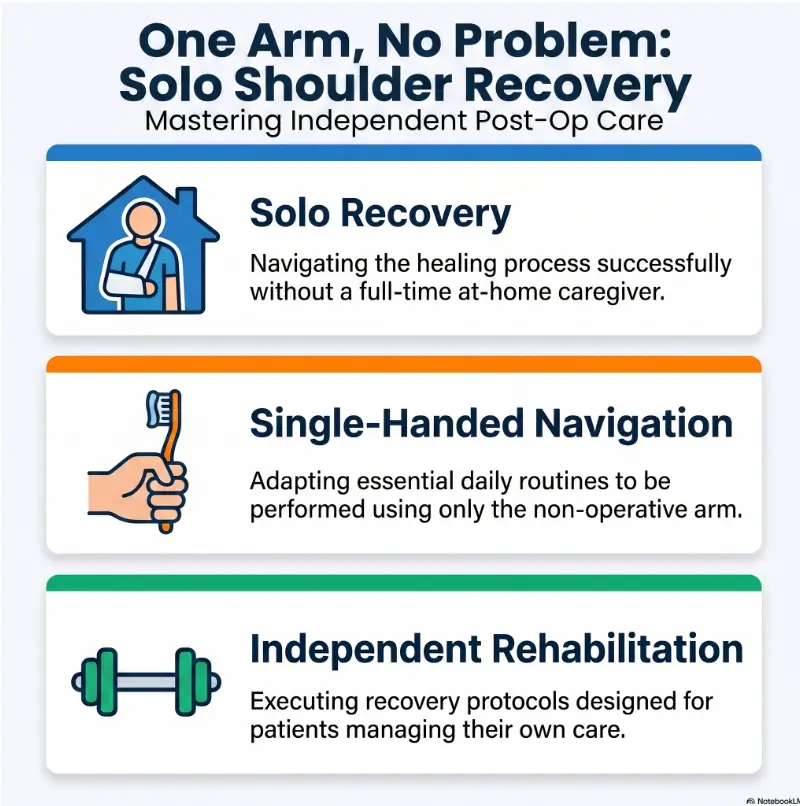
Recovering alone does not mean doing everything alone. The safer version is more like running a tiny command center: reachable supplies, planned check-ins, clear medication notes, food you can open with one hand, and a home that does not demand acrobatics while your shoulder is healing.
This guide is written for adults coming home after rotator cuff repair, labrum repair, shoulder replacement, arthroscopy, or another shoulder procedure who need practical help without panic. Your surgeon’s instructions still rule the kingdom, but this plan helps you make the house, the first week, and the awkward little details much easier to manage.
Set up your home
Build bed, bathroom, kitchen, and couch zones that work with one usable arm.
Avoid costly mistakes
Reduce risky reaching, missed doses, fall hazards, and premature “I feel fine” decisions.
Know when to call
Spot symptoms that deserve a surgeon call, urgent care, or emergency help.
The goal is not heroic independence. The goal is fewer 2 a.m. decisions, fewer preventable setbacks, and a recovery setup your future self will quietly thank you for. 🧊
Snapshot
This article is for adults recovering at home after shoulder surgery, especially those who live alone but can arrange rides, check-ins, and backup help. You will learn how to prepare your home, manage one-handed routines, compare recovery tools without overspending, avoid common solo-recovery mistakes, and make a one-page plan before surgery day.
Table of Contents
READER WORKSHEET
Solo shoulder recovery support roster
Assign essential help and a backup before relying on a solo plan.
Confirm and prepare
Add your working notes
Keep names, account numbers, member IDs, and other identifying details out of this worksheet.
Complete your worksheet to organize the next step. Blank amounts remain unknown.
How to use the result: Completing the roster does not certify living alone is safe. Review gaps with the discharge team.
This worksheet does not save entries between visits or send them to a provider. Download before leaving; the downloaded file may contain your notes. It is a planning aid, not a diagnosis, safety assessment, coverage decision, or final bill.
Before You Act: Your Surgeon’s Plan Comes First
Shoulder surgery recovery is not one tidy timeline. A rotator cuff repair, labrum repair, shoulder replacement, biceps procedure, and arthroscopic cleanup can all come with different sling rules, showering instructions, lifting limits, driving restrictions, wound-care steps, and physical therapy schedules.
This article gives a practical home setup and decision framework. It cannot tell you when your specific repair is safe for lifting, driving, typing, showering, cooking, or exercise. Your discharge paperwork, surgeon, anesthesia team, pharmacist, and physical therapist should guide those choices.
Before you act
Use this guide as a preparation tool, not a substitute for medical advice. Confirm medication timing, wound care, sling use, showering, driving, and exercise rules with your surgical team. If anything here conflicts with your discharge instructions, follow your discharge instructions.
What this guide can help with
It can help you build a safer home plan before surgery day, especially if you live alone and do not have someone hovering in the next room with soup, patience, and a fully charged phone.
It can also help you decide what to buy, what to borrow, what to skip, what to place within reach, and what questions to ask before you pay for recovery equipment or caregiver help.
What this guide cannot do
It cannot tell whether your shoulder repair is ready for a certain movement. Low pain does not always mean low risk. Some repairs need quiet protection long after the dramatic pain has eased.
It also cannot judge your fall risk, medication risk, anesthesia response, heart or lung symptoms, infection risk, or whether you need home health support. Those are clinician-level decisions.
Key takeaway
The safest solo recovery is not “I can manage everything.” It is “I know what I should not do, and I already built workarounds.”
For official patient education, you can review the American Academy of Orthopaedic Surgeons shoulder surgery exercise guide and MedlinePlus discharge guidance. Use them as general references, then ask your own care team what applies to you.
The First 72 Hours Alone: Build a No-Reach Recovery Zone
The first three days after shoulder surgery can feel oddly foggy. Pain may rise as a nerve block fades. Sleep may come in scraps. Medication schedules can blur. Your arm may be in a sling, your shoulder may be guarded, and the simple act of pulling a blanket up can require a small engineering department.
That is why the first 72 hours should be designed before surgery. Do not count on improvisation. Improvisation is charming in jazz, less charming when you are sleepy, sore, and staring at a charger that slid behind the couch.
Why the first three days are not the time to be brave
During the early window, your body is doing several jobs at once: clearing anesthesia, adjusting to pain control, protecting the surgical site, managing swelling, and learning to move without using one arm normally.
If you live alone, the danger is not only medical. It is logistical. You may forget when you took medication. You may reach too far for a plate. You may shuffle through a dark hallway to the bathroom. Tiny problems become bigger when nobody is nearby to hand you the thing you should have moved yesterday.
The waist-height rule for everything you touch
Before surgery, move the most important items between hip and chest height. Not overhead. Not under the sink. Not in the bottom drawer that requires a one-armed squat of doom.
- Medication bottles and a printed medication log
- Water bottles, crackers, and easy snacks
- Phone charger, power bank, remote controls, and glasses
- Ice packs or cold therapy supplies if approved by your care team
- Clean shirts, underwear, socks, and slip-on shoes
- Toiletries, pump soap, deodorant, and a reachable towel
- Discharge paperwork and emergency phone numbers
Think of this as building a “no-reach” apartment inside your apartment. The rest of the home can wait. Your recovery zone should carry the first week.
Let’s be honest: the floor becomes another planet
After shoulder surgery, dropped objects do not feel dropped. They feel gone. A sock on the floor, a medication cap under the bed, a phone cable behind the nightstand, or a spoon that slips from the counter may be surprisingly hard to retrieve safely.
Use a grabber tool if your clinician allows it, but do not treat it like a license to twist, bend, and lunge. The better plan is prevention: keep fewer loose items around, use trays, tape down cords, and place small objects in shallow baskets.
If clutter and floor hazards are already a concern, review a broader fall risk checklist before surgery so the house is not waiting with banana-peel energy.
One-handed stations: bed, bathroom, kitchen, couch
Make four mini-stations. Each station should have the items you need there, not items you need to fetch from somewhere else.
| Station | What to place there | Why it matters |
|---|---|---|
| Bed or recliner | Water, medication log, phone, charger, tissues, glasses, pillows | Reduces night wandering and forgotten doses |
| Bathroom | Pump soap, towel, nonslip mat, shower supplies, loose clothing | Protects against rushing, reaching, and wet-floor falls |
| Kitchen | Openable meals, mugs, paper plates, pre-cut food, waist-height pantry items | Makes eating possible without a wrestling match |
| Couch | Remote controls, light blanket, snacks, ice pack plan, reading glasses | Keeps recovery rest from becoming a scavenger hunt |
Solo recovery framework
The R.E.S.T. setup
Reach
Keep daily items at safe height.
Exit
Clear paths to bathroom and door.
Support
Schedule rides and check-ins.
Trigger
Know symptoms that mean call now.
Who Can Recover Alone, and Who Should Not Try to Wing It
Living alone is not the same as being unsupported. Many adults can recover at home after shoulder surgery with the right plan. But solo recovery has a line, and respecting that line is not weakness. It is good risk management.
A safer solo patient has a ride, a pharmacy plan, a reachable phone, someone checking in, and a clear way to get help quickly. An unsafe solo patient has none of those and is hoping grit will cover the gap.
Good fit: independent adults with a backup person
Your surgical team should approve the home support plan. After general anesthesia or sedation, discharge commonly requires an adult escort and a responsible adult staying with you for the first 24 hours or the period your team specifies. Daily calls do not replace required in-person care.
After required in-person supervision ends, a backup person may be a friend, relative, neighbor, or appropriately trained paid helper. Confirm what help you still need for medication, transfers, sling care, and bathing before relying on check-ins alone.
If family coordination is the hardest part, a guide on splitting help after joint replacement can also apply to shoulder surgery tasks: rides, meals, trash, pharmacy pickups, and short check-ins.
Not ideal: no ride, no check-ins, high fall risk
Solo recovery may be risky if you do not have transportation after anesthesia, live up many stairs, already fall easily, use sedating medications, have memory concerns, have major heart or lung conditions, or cannot get someone to check on you.
In those cases, ask your surgical team about overnight help, home health, a short-term stay with family, a recovery facility, or delaying surgery until support is arranged. That conversation may feel inconvenient. It is less inconvenient than getting stranded at home with a problem nobody knows about.
The “alone but not isolated” model
The sweet spot is prepared independence. You still sleep in your own home, follow your own rhythm, and keep your privacy. But the support scaffolding is already there.
- A designated ride to and from surgery
- A person who knows the surgery date and expected discharge time
- Required in-person postoperative supervision first, followed by an agreed check-in plan
- A pharmacy plan in case prescriptions change
- A plan for pet care, trash, laundry, groceries, and mail
- An emergency contact sheet placed where you can actually see it
Key takeaway
A safe solo plan has two ingredients: fewer tasks at home and faster access to help. Remove either one, and the plan gets wobbly.
Before Surgery: The Boring Errands That Save You at 2 A.M.
The best recovery work happens before the first incision. Not glamorous. Not cinematic. But deeply useful. You are trying to turn your home into a place where the easiest choice is also the safest choice.
One useful rule: anything you can solve before surgery should not be waiting for you after surgery. Future-you will not want to negotiate with a stubborn soup can.
Arrange the ride before you arrange the pillows
After anesthesia or sedation, do not drive yourself home. Confirm the required escort and how long a responsible adult must stay with you, commonly the first 24 hours. If this cannot be arranged, tell the surgical team before surgery so they can plan a safe alternative.
Plan the ride as a chain, not a single trip: home from surgery, pharmacy stop if needed, follow-up appointment, first physical therapy visit, and a backup ride in case the original helper gets sick or delayed.
Batch-cook the recovery menu
Shoulder surgery recovery is not the time to discover that every meal in your house requires chopping, draining, lifting, and opening a jar sealed by a medieval guild.
Choose foods you can open, hold, and eat with one hand. Prioritize protein, hydration, and low-effort cleanup.
- Soups in mugs or lightweight bowls
- Protein shakes or smoothies
- Greek yogurt, cottage cheese, eggs, and tuna packets
- Pre-cut fruit and vegetables
- Rotisserie chicken already pulled from the bone
- Microwave oatmeal or rice cups
- Frozen meals that do not require tray acrobatics
- Paper plates for the first week if dishes will become a burden
For more ideas, a dedicated guide to one-handed meal prep can help you build a simple grocery list before surgery.
Put adulting on autopilot
Pay bills, refill prescriptions, wash bedding, do laundry, empty trash, arrange pet care, set up grocery delivery, and move heavy packages before surgery day. This is where independence is won quietly, one boring task at a time.
If you work remotely, ask your surgeon what typing, desk posture, sling use, and breaks should look like. Returning to a laptop too early can turn your good arm, neck, and back into a chorus of complaints.
A related guide on remote work after surgery may help you plan a softer re-entry if your job can be adjusted.
The “open it now” checklist
Before surgery, test the things you use daily with one hand. If it makes you sigh now, it will make you mutter later.
- Loosen jar lids and bottle caps, if safe to do so
- Move cereal, coffee, mugs, and plates to waist height
- Open outer packaging on toiletries; keep sterile wound-care supplies sealed until needed
- Place shampoo, body wash, and soap in pump bottles
- Use easy-open containers for snacks and medication-adjacent crackers
- Set up a pill organizer only if your clinician or pharmacist says it is appropriate
- Put trash bags, laundry pods, and cleaning wipes where your good arm can reach them
If pill bottles are already difficult, read about opening pill bottles after hand surgery. The same one-handed logic often helps after shoulder surgery too.
Pain, Ice, and Medication: Avoid the “I’ll Remember” Trap
Medication management is one of the sneakiest solo-recovery problems. You may be tired. Your sleep may be chopped into odd little slices. You may be using prescription pain medication, over-the-counter medication, antibiotics, nausea medicine, stool softeners, or other medicines your team prescribed.
Memory is a poor pharmacist after midnight. Use a written log.
Use a medication log, not memory
Write down the medication name, dose, time taken, next allowed dose, and any side effect worth mentioning. Keep the log near your main resting spot. Do not bury it in an app if you are unlikely to open the app when sleepy.
This is especially important if instructions say one medicine can be taken every certain number of hours, while another has a daily maximum. When in doubt, call your pharmacist or surgical team rather than guessing.
Simple medication log template
| Time | Medication | Dose | Next allowed | Notes |
|---|---|---|---|---|
| 7:00 a.m. | As prescribed | Check label | Check instructions | Pain level, nausea, dizziness |
If you are worried about confusion, ask a support person to review the first day’s schedule with you. You can also use a medication confusion monitoring plan if you are caring for a parent or recovering with several prescriptions.
Ice safely without creating a leak disaster
Cold therapy may be part of your plan, but use it exactly as instructed. Ask whether you should use ice packs, a cold therapy machine, towel barriers, time limits, and skin checks.
Set up a rotation before surgery. Keep extra ice packs in reachable freezer space. Place a towel barrier nearby. If you use a cooler or cold therapy device, confirm how to lift, drain, and refill it safely with one hand or with help.
If you are comparing cold therapy items, think less about “premium” and more about whether you can use the item safely while alone. A simple reusable ice pack may be better than a fancy device you cannot refill without wrestling the kitchen sink.
Don’t leave the bottle beside the bed
Keeping medicine too close can make double-dosing easier when you are half awake. Keeping it too far can make you wander when sore or dizzy. Choose a visible, stable place near your main recovery chair or bed, but pair it with the log.
Keep water and crackers close if your instructions allow taking medicine with food. If you have children, pets, or visitors, store medication safely and out of casual reach.
Pain that breaks the plan
Some discomfort is expected after shoulder surgery. But pain that is severe, rapidly worsening, or not relieved by prescribed medication deserves a call to your surgical team. Do not wait alone while trying to “tough it out.”
If pain comes with chest pain, shortness of breath, fainting, confusion, or sudden severe symptoms, seek urgent help rather than sending a casual message and hoping for morning.
Show me the nerdy details
Solo recovery works best when you reduce cognitive load. Pain, poor sleep, anesthesia recovery, and medication can all make planning harder. A written medication log, repeated station setup, and visible “do not do yet” list turn recovery from memory-based to system-based. That matters because small errors often happen when the patient is tired, not when the plan is being made calmly before surgery.
Sling Life: Small Rules That Prevent Big Setbacks
A sling can feel annoying, hot, bulky, and oddly bossy. It gets in the way of shirts, sleep, doorways, and dignity. But if your surgeon prescribed it, the sling is part of the protection plan.
Do not treat it as decoration. Ask exactly when to wear it, when to remove it, how to position your hand, and what movements are forbidden.
Your sling is not a suggestion
Depending on the surgery, the sling may protect repaired tissue, reduce strain, support healing, and remind you not to move the shoulder too freely. The exact duration varies. Some patients wear a sling for weeks, while others have different instructions.
If you are comparing sling types, ask your surgical team whether a standard sling, immobilizer, abduction pillow, or specific fit is required. Do not swap equipment just because an online review says a different one is more comfortable.
A guide to shoulder immobilizer vs sling differences can help you understand terms, but your surgeon decides what belongs on your shoulder.
Sleeping, walking, and sitting with the sling
Keep your arm supported. Avoid letting it dangle. Make the hand visible if your instructions mention swelling or circulation checks. Use pillows to support the elbow and forearm so the shoulder is not quietly pulling downward while you rest.
When walking through narrow hallways, protect the surgical side. Doorframes are not malicious, but they do have sharp timing. Move slowly, turn your body instead of twisting your arm, and clear hallway clutter before surgery.
Here’s what no one tells you: your good arm gets tired
Your non-surgical arm becomes the household intern, the senior manager, and the night-shift crew. It opens doors, pulls blankets, carries mugs, brushes teeth, steadies you, and handles the phone. It may get sore.
Reduce the load before it rebels. Use lightweight dishes, crossbody-free clothing, rolling carts if safe, delivery services, voice commands, and reachable storage. Keep remote controls where they belong so you are not fishing between couch cushions like a raccoon with a medical bill.
If remote controls are a daily pain point, this oddly specific guide on remote controls after shoulder surgery is exactly the kind of small fix that makes a solo home easier.
Ask before removing it
Sling rules may change for showering, dressing, therapy, icing, or home exercises. Do not assume “remove briefly” is safe just because it feels practical.
Before discharge, ask: When do I wear it? Can I remove it to shower? Can I remove it while seated? What should I do if the strap rubs my neck? Should my hand be elevated? What movements are never allowed right now?
Bathroom, Shower, and Dressing: Where Solo Recovery Gets Real
The bathroom is where recovery stops being theoretical. Water, tile, towels, bandages, shampoo, and one working arm can create a small opera. Plan it before you are standing there wondering why the towel is twelve inches too far away.
Every shower rule starts with your wound-care instructions. Some patients must keep dressings dry. Some have specific timing. Some need help the first time. Ask clearly before surgery day.
Shower setup before the bandage drama
Consider a shower chair, nonslip mat, pump soap, reachable towels, and a handheld showerhead if your setup allows it. Keep items at waist height and avoid twisting to reach shelves behind you.
If you live alone, your first shower may be the moment when backup help is most valuable. Even if you do not need hands-on help, having someone nearby or on standby can make the first attempt safer.
For a deeper checklist, review bathroom setup after shoulder surgery and how to have a shower safety conversation with a family member or helper.
Clothes that do not fight back
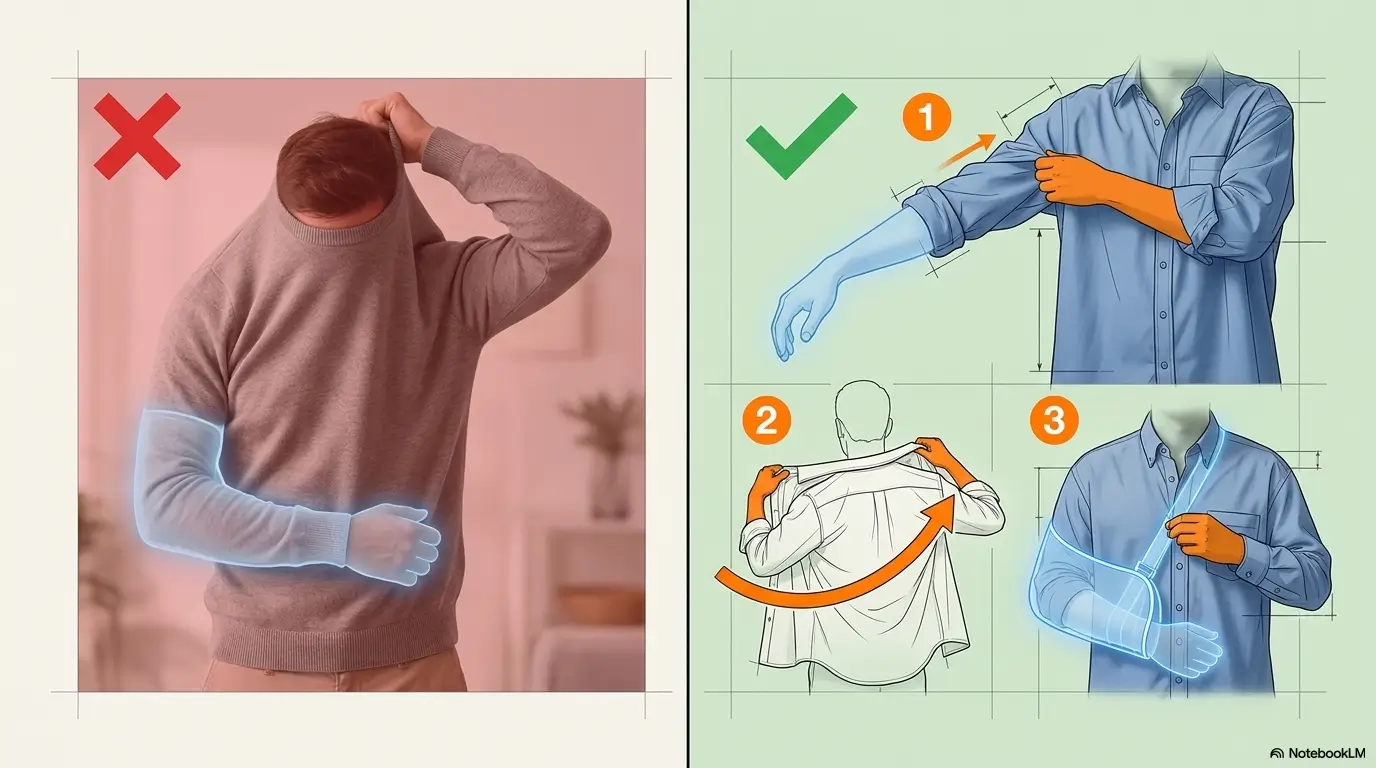
Front-opening shirts are your friend. Loose sleeves are polite. Elastic waistbands deserve a thank-you note. Slip-on shoes reduce bending and one-handed lace negotiations.
Avoid tight overhead clothing unless your surgical team specifically says it is safe and you can put it on without breaking movement restrictions. Button-downs, oversized zip hoodies, soft pajama pants, and easy bras or undershirts may be more practical than anything stylish in the first week.
Hair, deodorant, and tiny dignity problems
One-handed grooming can be surprisingly emotional. Hair gets awkward. Deodorant angles become geometry. Toothpaste slips. The mirror, rude as ever, reports everything.
Simplify. Use pump products, dry shampoo, a lightweight electric toothbrush if you already have one, pre-positioned towels, and clothing you can manage without overhead motion. If washing hair is the issue, see how to wash hair after shoulder surgery for practical options to discuss with your care team.
The wet-floor problem
Wet floors are one of the simplest hazards to underestimate. Add pain medication, poor sleep, and a sling, and the bathroom becomes a place to move slowly and deliberately.
- Place towels where you can reach them before you start
- Use a nonslip mat inside and outside the shower if appropriate
- Keep the path from shower to bedroom dry and clear
- Do not carry heavy laundry baskets
- Use night lighting for bathroom trips
- Ask for help if you feel dizzy, weak, or unsure
Food, Hydration, Constipation, and Sleep: The Quiet Recovery Bottlenecks
People often prepare for pain and forget the less dramatic bottlenecks: eating enough, drinking enough, going to the bathroom comfortably, and sleeping in a position that does not feel designed by a committee of elbows.
These basics are not decorative. They affect energy, medication tolerance, mood, and your ability to follow the plan.
Protein and fluids are not decorative
Ask your care team if you have special diet restrictions. For many people, the first goal is simple: regular fluids and easy meals with some protein.
Keep water within reach. Use bottles you can open. If a full jug is too heavy, use smaller containers. Add crackers, yogurt, fruit, or a simple protein option near your medication station if your prescriptions are better tolerated with food.
The constipation conversation nobody wants
Reduced movement, changed eating, dehydration, and some pain medicines can contribute to constipation. It is not glamorous, but it is common enough to plan for without embarrassment.
Ask your surgical team or pharmacist whether a stool softener, fiber plan, fluid target, walking schedule, or medication adjustment is appropriate for you. Do not add new remedies without checking if you have medical conditions or take other medication.
One-handed meal ideas that do not require heroics
A good recovery meal is not the one that wins a cooking show. It is the one you can safely prepare, eat, and clean up when tired.
| Meal moment | Easy options | Solo recovery tip |
|---|---|---|
| Breakfast | Oatmeal cup, yogurt, boiled eggs, smoothie | Pre-open packaging and use lightweight bowls |
| Lunch | Soup mug, tuna packet, pre-cut salad, rotisserie chicken | Keep cans and heavy pots out of the first-week plan |
| Dinner | Frozen meal, rice bowl, delivery, soft leftovers | Choose meals that do not require draining hot water |
| Medication snack | Crackers, applesauce, banana, toast | Keep beside water and the medication log |
Sleep after shoulder surgery: the recliner strategy
Sleeping flat may feel difficult after shoulder surgery. The sling can pull, the shoulder may throb, and rolling onto the surgical side can feel both painful and frightening.
Many people prefer a recliner, wedge pillow, or elevated pillow nest at first. The goal is support, not luxury. Put pillows behind the elbow and forearm if your team approves. Keep your phone, charger, medication log, water, and glasses nearby.
Compare a recliner, wedge, or stable chair that fits your approved positioning and transfer plan. Do not add a portable bed rail without a professional fit and compatibility assessment: entrapment is a risk, and it must not require weight-bearing through the operated arm.
For a deeper buying decision, compare recliner vs bed after shoulder surgery and wedge pillow options after surgery before spending money.
Good / Better / Best recovery setup comparison
| Tier | What it includes | Best for | What to avoid |
|---|---|---|---|
| Good | Pillows, ice packs, front-opening shirts, medication log, grocery delivery | Budget-conscious adults with reliable backup help | Buying gadgets before confirming restrictions |
| Better | Wedge pillow, shower chair, pump toiletries, grabber tool, meal prep, scheduled check-ins | People living alone who want fewer daily frictions | Assuming equipment replaces human help |
| Best | All of the above plus home safety review, transportation plan, caregiver notes; required postoperative supervision applies at every tier | Higher-risk patients or anyone anxious about the first week | Paying for services without asking what they actually do |
Physical Therapy Timeline: Don’t Freelance Your Shoulder
Shoulder rehab can be humbling because progress may not look like effort at first. Sometimes the “work” is protection. Sometimes the exercise is passive. Sometimes doing more is not dedication. It is a shortcut to a setback.
Follow your surgeon and physical therapist’s protocol. Generic online exercises are not a custom plan for your repair.
Passive, active, strengthening: the phases matter
Shoulder recovery often moves in stages. Early exercises may involve gentle motion without using the shoulder muscles aggressively. Later phases may add active movement, then strengthening. Your exact phase depends on the surgery and your surgeon’s protocol.
The reason phases matter is simple: tissue healing and muscle confidence do not always move at the same speed. Your shoulder may feel better before it is ready for lifting, reaching, driving, or household chores.
Your PT plan is the bridge, not the boss battle
Physical therapy is not a pain contest. It is controlled rebuilding. If the exercise sheet says a certain number of repetitions, do not double it because you are having a good day. If something feels sharp, strange, or suddenly worse, report it.
Keep your home exercise area boringly safe: good lighting, stable chair, no loose rugs, phone nearby, and enough space that you are not brushing the surgical arm against furniture.
For official general education, the American Academy of Orthopaedic Surgeons provides a shoulder surgery exercise guide. Your own protocol may differ, especially after a repair.
The dangerous optimism of “it feels fine today”
A low-pain day can be a blessing, but it can also whisper bad ideas. “Maybe I can reach that shelf.” “Maybe I can drive.” “Maybe I can carry one laundry basket.” This is how a good day becomes a regrettable afternoon.
Use your restrictions list, not your mood, to make decisions. If your surgeon has not cleared lifting, reaching, driving, pushing, pulling, or weight-bearing, do not let a temporary pain dip negotiate the rules.
What to ask at the first PT visit
- Which movements are safe right now?
- Which movements should I avoid completely?
- When should I wear the sling at home, outside, and while sleeping?
- How should I shower and dress without breaking precautions?
- What pain level during exercise is acceptable?
- What symptoms should make me stop and call?
- When can I type, drive, cook, lift, or return to desk work?
- How should I set up my home exercise space?
Key takeaway
Rehab is not a personality test. The best patient is not the one who does the most. It is the one who does the right thing at the right time.
Common Mistakes and Red Flags That Should Not Wait
Most solo-recovery trouble does not begin with a dramatic event. It begins with a tiny exception. One reach. One skipped log entry. One wet towel. One drive before clearance. One YouTube exercise that looked harmless.
The safer plan is to spot these traps while they still look ordinary.
Solo-recovery traps that look harmless
| Mistake | Why it happens | Safer alternative |
|---|---|---|
| Reaching “just once” for a high shelf | The item feels close enough | Move essentials to waist height before surgery |
| Driving before clearance | The appointment seems quick or nearby | Use rides, delivery, telehealth when appropriate, or reschedule |
| Letting clutter build up | Cleaning feels less urgent than resting | Clear walkways before surgery and ask for trash help |
| Skipping help out of embarrassment | Independence feels tied to pride | Assign small, specific tasks to helpers |
| Using generic rehab videos | The shoulder feels stiff and impatience grows | Ask your PT before adding anything |
If laundry is a known hazard in your home, especially with baskets, stairs, or bending, consider laundry basket alternatives before surgery. A small change there can prevent a large mistake.
Call the surgical team for wound, pain, or circulation concerns
Your discharge paperwork should list symptoms that require a call. Common examples include bleeding that soaks through a dressing, pain not relieved by prescribed medicine, increasing swelling, numbness or tingling, fingers that look darker or feel cool, wound redness, worsening swelling, yellow drainage, or fever.
Do not wait alone if symptoms are changing quickly. Call your surgeon’s office, the after-hours line, urgent care, or emergency services depending on severity and your discharge instructions.
Seek urgent help for chest pain or shortness of breath
Call emergency services for chest pain, breathlessness, collapse, sudden one-sided weakness or speech difficulty, or new confusion. Do not wait for morning or an office callback. New cold, pale or blue fingers, worsening numbness, or rapidly worsening arm pain also needs urgent assessment.
If you are not sure whether a symptom is urgent, use your discharge instructions and local emergency resources. A cautious call is better than a quiet gamble.
Illustrative planning example
Illustrative example, not a reported patient case: a household has an unanswered question about written supervision and assistance requirements. The useful next step is to record the uncertainty, identify who can answer it and agree on a follow-up action, rather than assume that a familiar routine is suitable.
FAQ
Can I recover from shoulder surgery if I live alone?
Living alone may be compatible with later recovery, but the surgical team must approve the plan. Arrange the required escort and in-person postoperative supervision, commonly 24 hours after anesthesia or sedation, before using daily check-ins and backup help.
How long will I need help after shoulder surgery?
Many people need the most help during the first few days, especially with transportation, meals, shower setup, medication tracking, trash, pets, and errands. Limits on driving, lifting, dressing, bathing, and household chores may last longer depending on the procedure and surgeon’s protocol.
What should I buy before shoulder surgery?
Useful items may include front-opening shirts, slip-on shoes, ice packs, a wedge pillow or recliner setup, pump toiletries, a medication log, easy meals, nonslip bathroom items, and a phone charger near your resting spot. Ask your care team before buying braces, slings, cold therapy machines, or rehab tools.
Can I sleep in bed after shoulder surgery?
Some people can sleep in bed, but many find an elevated setup more comfortable at first. A recliner, wedge pillow, or pillow nest may help you avoid rolling onto the surgical side. Confirm any positioning rules with your surgical team.
When can I drive after shoulder surgery?
Drive only after your surgeon clears you. Sling use, pain medication, reaction time, strength, range of motion, and the ability to control the vehicle all matter. Do not rely on distance alone. A short drive can still be unsafe before clearance.
What food is easiest after shoulder surgery?
Soft, pre-prepped, one-handed meals are usually easiest: soups, smoothies, yogurt, eggs, oatmeal, pre-cut fruit, frozen meals, rice bowls, and delivery options. Avoid meals that require heavy lifting, chopping, draining hot water, or stubborn packaging during the first days.
How do I shower after shoulder surgery alone?
Follow your wound-care and sling instructions first. Before showering, set up reachable towels, pump soap, nonslip surfaces, and a dry path. Consider having someone nearby or on standby for the first shower if your balance, pain, or confidence is uncertain.
What is the biggest mistake after shoulder surgery?
A common mistake is trying to resume normal chores too soon, especially reaching, lifting, driving, carrying laundry, or adding exercises without medical clearance. The safer approach is to follow restrictions even on days when pain is lower.
Make the One-Page Solo Recovery Map
The final step is small enough to do in 15 minutes and useful enough to change the tone of your first week: make a one-page solo recovery map.
It does not need to be pretty. It needs to be visible, specific, and boringly clear. Tape it near your bed, recliner, or kitchen counter. Put another copy in your surgery folder.
The four-box template
- Medication schedule: names, doses, timing, maximums, and who to call with questions.
- Emergency contacts: surgeon, after-hours line, pharmacy, ride, neighbor, family member, and local emergency number.
- Daily check-in person: who texts or calls, when they check in, and what they should ask.
- Do not do yet: driving, lifting, reaching, showering rules, sling rules, exercise limits, work limits, and any surgeon-specific restrictions.
If a caregiver or helper will attend appointments with you, use a doctor visit summary template for caregivers so instructions do not vanish into the fog of discharge day.
Your 15-minute next step
Before surgery, choose your main resting spot and place these six things there: medication log, water, charger, emergency contacts, sling instructions, and one snack you can open with one hand.
That small station is your recovery lighthouse. When the house feels too big and the shoulder feels too loud, it tells you where to begin.
Last updated: October 14, 2026
Separate living alone from recovering unsupported
Use these prompts for a private note or your next care-team conversation. Record what is known and mark unanswered questions; completing this table does not establish safety, independence or treatment eligibility.
| Record or clarify | Question and next action |
|---|---|
| Written supervision and assistance requirements | Who will be physically present for the required period and tasks? Remote messages cannot provide hands-on care. |
| One-handed daily needs | Who handles meals, bottles, clothing, washing and household chores within the surgical restrictions? |
| An uncovered shift | Who replaces the helper or discusses another discharge arrangement with the team? |
Keep the person’s own report separate from a helper’s observation. Share only with consent and only with people who need the information. Do not put identifying health details in public comments. The visit preparation tool can organize questions; it cannot assess symptoms or approve a task.
Background resource: NHS: moving and handling support. This resource supports general care planning; it does not validate every instruction elsewhere in this article.
Targeted caregiver edit: October 21, 2026. Added the topic-specific handover questions and clarified narrative examples and planning limits. Earlier clinical sections retain their previous review scope; this update is not a full medical review.