

Knee pain in public places
How to Sit in a Waiting Room With Knee Pain
Without Making It Worse
Waiting rooms are built for schedules, not knees. A clinic chair, an airport gate seat, a DMV bench, or a school office corner can turn a mild ache into a small private weather system: pressure behind the kneecap, stiffness after ten quiet minutes, and that awkward calculation of whether standing up will make everyone look.
The good news is not glamorous, but it is useful: your chair height, knee angle, foot placement, bag position, and tiny movement breaks can change how your knee tolerates the wait. This guide is not a diagnosis. It is a practical comfort map for those ordinary, fluorescent-lit moments when you still have to sit, sign forms, listen for your name, and get back up safely.
You will learn how to choose a better seat, avoid the sneaky positions that increase strain, ask staff for help without feeling dramatic, and turn waiting-room pain into useful notes for your clinician. Think of it as quiet choreography for an irritated knee.
Pick the better chair
Avoid low, soft seats that make standing harder.
Reduce knee compression
Use a soft bend, flat feet, and less twisting.
Know when to ask
Red flags deserve staff help, not silent endurance.
One small rule: do not let a waiting room bully your knee into a position it already dislikes. 🦵
Snapshot
This article is for adults with mild-to-moderate knee pain who must wait in a clinic, airport, office, school, hospital, DMV, or similar public space. You will learn how to sit with less knee strain, when to stand or shift, what positions to avoid, what to bring next time, and when symptoms are serious enough to ask for help right away.
Table of Contents
Safety First: When Waiting-Room Knee Pain Is Not Just Sitting
Before we talk about chair angles and footrests, we need to draw a bright line on the floor. Some knee pain is ordinary discomfort from sitting too long. Some knee pain is your body waving both arms in the lobby.
This guide can help with comfort positioning while you wait. It cannot diagnose a ligament tear, infection, fracture, blood clot, or post-surgical complication. If your symptoms are new, severe, rapidly worsening, or linked to an injury, treat the waiting room as part of the medical visit, not a test of toughness.
Before you act
Ask clinic, airport, event, or office staff for help if your knee is very swollen, hot, red, unstable, locked, visibly deformed, intensely painful, or unable to bear weight. If pain followed a fall, twist, pop, crash, or sudden injury, do not rely on seating tricks. Confirm next steps with a qualified medical professional.
Red flags before you pick a chair
Do not spend your energy trying to “find the perfect chair” if the real issue is urgent. A better seat may reduce strain, but it will not make a dangerous symptom safe.
- You cannot put weight on the painful leg.
- The knee feels unstable, gives way, or buckles.
- The knee became suddenly or markedly swollen.
- You cannot fully bend or straighten the knee.
- The joint looks bent, misshapen, or out of place.
- You have fever with redness, warmth, swelling, or severe pain.
- You heard or felt a pop during an injury.
- You have sudden calf pain, major calf swelling, chest pain, or shortness of breath.
Those symptoms do not automatically mean the worst. They do mean you should ask for help instead of sitting quietly in row four like a stoic marble statue.
Ask the front desk sooner, not later
If you are in a clinic or hospital waiting area, tell staff when the knee is worsening while you wait. Front-desk teams cannot read pain from across the room, especially when people are doing the classic patient performance: calm face, clenched soul.
You can ask for a different chair, a place to elevate your leg if appropriate, wheelchair assistance, help getting to the restroom, or guidance on whether your symptoms should be re-triaged. In airports, courthouses, government offices, schools, and event venues, ask about accessible seating or mobility assistance.
What to say if you need faster accommodation
Use plain language. You do not need a speech with dramatic lighting.
Simple scripts you can use
- “My knee pain is getting worse while I wait. Is there a firmer chair or a place with more leg room?”
- “I’m having trouble bearing weight. Can someone help me get to the exam room or advise what I should do?”
- “My knee is swollen and feels unstable. Should I stay seated here, or does someone need to reassess me?”
- “I may need extra time to stand when my name is called. Could you please note that?”
For a related pre-visit planning guide, see this practical orthopedic visit checklist. A few notes before the appointment can prevent a lot of lobby confusion.
Who This Guide Is For, And Who Should Not Use It
Waiting-room knee pain has many personalities. For one person, it is arthritis stiffness after a grocery trip. For another, it is front-of-knee pain after stairs. For a third, it is post-procedure soreness with very specific restrictions from a clinician.
The safest advice is not “everyone sit this way.” The safest advice is “match the sitting strategy to the situation, and stop when the knee objects.”
Good fit: mild stiffness, arthritis flares, soreness, and long-sit discomfort
This guide is a good fit if your pain is familiar, mild-to-moderate, and not tied to a recent major injury. It may help if your knee gets cranky after sitting, walking through a parking lot, climbing stairs, waiting at a gate, or sitting in a low chair.
Common examples include a busy parent waiting at urgent care with a child, an older adult sitting before an orthopedic visit, a traveler stuck at a boarding gate, or a desk worker whose knee stiffens after long periods of bent sitting.
Poor fit: trauma, fever, locked knees, major swelling, or sudden calf symptoms
This is not a substitute for care after a fall, sports injury, car accident, sudden twist, or post-surgical change. It is also not the right guide for fever with a hot, red joint or a knee that locks and will not move normally.
Sudden calf swelling or calf pain can have causes that need prompt medical attention. Do not stretch, massage, or “walk it off” without guidance if those symptoms are significant or paired with shortness of breath or chest pain.
The “I can still walk, but barely” gray zone
Many people sit in the gray zone: you can walk, but only with a limp, a wall touch, or a little bargaining with the furniture. In that case, make the wait easier, but also document what is happening.
- Can you walk four or five steps without grabbing support?
- Does the knee feel worse each time you stand?
- Is swelling increasing during the wait?
- Do you feel unsafe walking to the restroom?
- Would a wheelchair or staff escort reduce fall risk?
If the answer worries you, ask for help. Needing accommodation is not a character flaw. It is logistics.
Chair Choice: The Seat That Saves Your Knee
The best waiting-room chair is rarely the prettiest one. Your knee wants a seat that lets you sit down and stand up without a deep squat, a twist, or a heroic push through pain.
In a row of chairs, look for three things first: firmness, height, and armrests. These are not décor details. They are the little stagehands moving the whole pain scene.
Firm beats plush when your knee is angry
A soft lounge chair may look kind. Then it swallows your hips, folds your knees, and makes standing up feel like escaping a beanbag with legal paperwork.
Choose a firm chair when available. A stable seat keeps your hips from sinking too low, which reduces how sharply your knees bend. It also gives you a more predictable surface when you stand.
Armrests matter more than they look
Armrests can reduce the force your knees need to produce when you sit or stand. They let your arms share the job rather than making the painful knee do the whole performance.
When possible, sit in a chair with two solid armrests. Avoid leaning heavily on one side if it throws your body into a twist. Use both hands evenly, move slowly, and keep the painful foot close enough under you to stand without lunging.
The hidden problem with low lounge chairs
Low chairs create two problems at once. First, they increase knee bend while you sit. Second, they demand more knee and hip effort when you stand.
If you only have a low chair, sit closer to the front edge rather than sinking all the way back. Keep your feet under your knees, use armrests if present, and stand in stages: lean forward, press through both feet, then rise without twisting.
| Seat option | Usually better when | Watch out for |
|---|---|---|
| Firm chair with armrests | You need help standing safely | Armrests that wobble or sit too low |
| Standard office-style chair | It is stable and not rolling freely | Wheels, spinning, or low height |
| Bench seating | You need room to change foot position | No armrests for standing support |
| Low lounge chair | Almost no better option exists | Deep knee bend and harder standing |
| Tall stool or bar-height seat | Rarely ideal for knee pain | Dangling feet and fall risk |
Key takeaway: A boring firm chair with armrests often beats the softest seat in the room. Your future self, the one standing up when called, gets the vote.
Knee Angle: The Small Bend That Changes Everything
Knee angle is the quiet machinery behind waiting-room comfort. Too much bend can increase pressure and irritation for some knees. Too much straightening can make other knees stiff or guarded.
The goal is not a perfect textbook angle. It is a tolerable position you can change before pain climbs the ladder.
Why deep bending can turn waiting into a pressure cooker
When your knee is sharply bent, the tissues around the joint may feel more compressed. For some people with front-of-knee pain, arthritis, swelling, or post-activity soreness, deep flexion can make the ache build slowly and then arrive all at once.
This is why a low chair can feel fine for the first few minutes, then suddenly feel impossible. The pain was not late. It was simmering.
Aim for soft bend, not military-straight
For many waiting-room situations, a gentle knee bend is friendlier than a tightly folded knee or a fully locked straight leg. Think “resting bend,” not “kneecap under pressure.”
Try sitting with your knee slightly forward of a deep 90-degree bend if that feels better. Your foot should still reach the floor or a low support. If straightening the knee a little reduces pain, do it gently and change positions often.
Your foot position controls your knee
A knee rarely suffers alone. Your foot turns, your hip follows, and suddenly the knee is caught between two committee meetings.
Keep the foot of the painful leg pointing mostly forward rather than far inward or outward. This reduces twisting through the knee. If your foot naturally turns out a little, do not force it into a rigid position. Just avoid extreme angles.
30-second chair setup
- Sit on a firm chair, preferably with armrests.
- Place both feet flat or supported.
- Let the painful knee rest in a soft bend.
- Point the foot mostly forward.
- Shift before pain rises more than one level.
Foot Placement: Tiny Adjustments, Big Relief
Foot placement is the small hinge that changes the whole door. A dangling foot, a tucked foot, or a foot twisted sideways can make the knee feel worse even when the chair seems reasonable.
Start with the simplest setup: both feet grounded, knees relaxed, toes generally forward. Then adjust one variable at a time.
Keep both feet grounded when possible
Feet on the floor give your body feedback and stability. That matters when your knee already feels uncertain.
If only your toes reach the floor, the chair may be too tall. If your knees rise above your hips, the chair may be too low. Neither is automatically dangerous, but both can increase discomfort for some people.
Use a bag, book, or folded jacket as a low foot support
If your feet dangle, place a sturdy bag, book, or folded jacket under them. Keep it low. You are not building a throne. You are giving the foot a small landing pad.
A low support can reduce pull behind the knee and help you avoid letting the leg swing. Make sure the item will not slide away when you stand.
Avoid dangling feet, especially in tall chairs
Dangling feet can create pressure behind the knee and make standing less predictable. This is especially true for shorter adults, older adults, and anyone sitting on tall exam-room or airport-style seats.
If you cannot support your feet safely, ask for a lower chair or move to a bench where both feet can rest. A chair that looks convenient but leaves your feet floating is not really convenient.
| Position | What it may do | Safer adjustment |
|---|---|---|
| Feet flat, toes forward | Improves balance and reduces twisting | Use as your default starting point |
| Foot tucked under chair | Increases knee bend and may strain the joint | Bring foot forward into a softer bend |
| Foot turned far outward | May rotate knee and hip together | Point toes closer to forward |
| Legs crossed | Can twist the painful knee | Try ankle reset or gentle foot shift |
| Feet dangling | Can increase pressure behind knee | Use low support or change chairs |
Micro-Movement: The 20-Second Reset Nobody Teaches
The waiting-room mistake is not sitting. It is sitting in one exact shape until your knee files a formal complaint.
Small, quiet movement can help many people reduce stiffness. The trick is to move before pain peaks, not after. Once the knee is fully irritated, it becomes much less open to negotiation.
Gentle ankle pumps while seated
Keep your heel on the floor if comfortable. Slowly lift your toes, then lower them. Or gently point and flex the ankle if your foot is supported.
Do this for 10 to 20 seconds. Stop if it increases knee pain, calf pain, tingling, dizziness, or any symptom that feels wrong for you.
Slow heel slides under the chair
If your knee tolerates motion, slide your heel slightly forward, then back under you. Keep it small. This is not a gym rep hiding in public clothes.
Heel slides may help you avoid stiffness from staying locked in one angle. People with swelling, post-procedure restrictions, or sharp pain should follow clinician instructions first.
Stand, shift, sit: a quiet loop for long waits
If it is safe, stand every 10 to 20 minutes. Hold the armrests, stand slowly, shift weight gently, then sit again before fatigue or pain takes over.
If standing is unsafe, do not force it. Ask for help, a more supportive chair, or a wheelchair. Fall prevention beats posture perfection every time.
Key takeaway:
Use the “small before sore” rule. Adjust your feet, pump your ankles, or stand briefly while discomfort is still mild. Waiting until pain spikes is like waiting until toast becomes smoke.
Show me the nerdy details
Knee comfort during sitting is influenced by joint angle, muscle tension, swelling, kneecap tracking, hip rotation, and how load is shared through the feet. A deeply flexed knee can increase compression for some irritated joints. A fully locked leg can create stiffness or guarding for others. That is why one “perfect posture” rarely works for every knee.
Changing position slightly changes pressure and tissue loading. Gentle movement may also reduce the feeling of stiffness that appears after resting, especially in some arthritis patterns. The important part is restraint: movements should be slow, small, and symptom-guided.
Waiting-room knee comfort flow
1. Check safety
Swelling, locking, fever, injury, or no weight-bearing means ask for help.
2. Choose height
Firm, higher, stable chair beats low plush seating.
3. Soften bend
Avoid deep folding, locking straight, and twisting.
4. Ground feet
Flat feet or low support reduces dangling strain.
5. Reset early
Move gently every 10 to 20 minutes if safe.
6. Record clues
Note pain level, swelling, position, and walking ability.
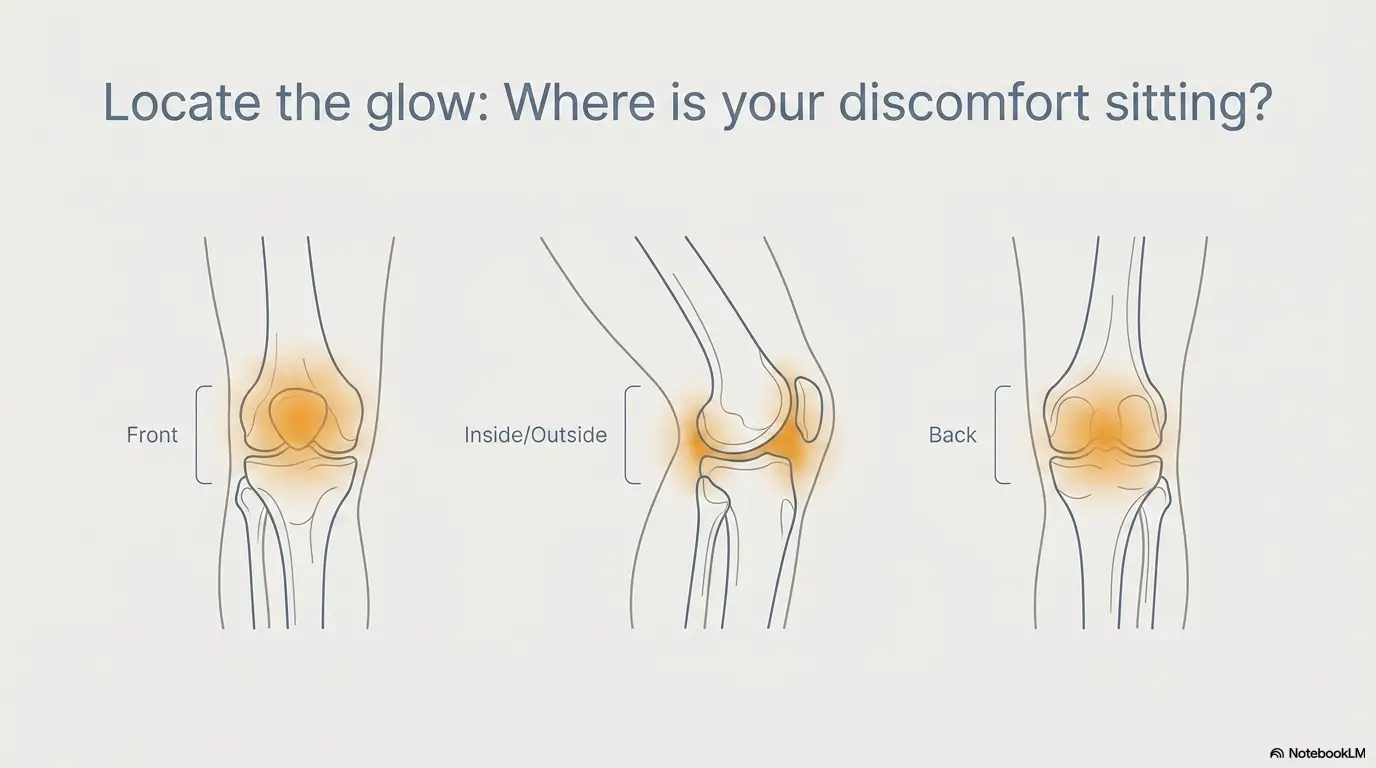
Pain Location Clues: What Your Knee May Be Telling You
Pain location does not give a diagnosis by itself. Still, noticing where pain shows up can help you choose a better sitting position and explain the problem more clearly at your appointment.
Use these clues as conversation starters, not labels. The knee is too clever to be solved by a lobby chair chart alone.
Front-of-knee ache after sitting
Front-of-knee pain may feel worse when the knee is bent for a long time, especially in low chairs, cars, theaters, and waiting rooms. Some people call this “movie-theater knee,” which sounds charming until you try to stand during the credits.
Try reducing the bend slightly, keeping the foot forward, and avoiding crossed legs. If symptoms are persistent, worsening, or paired with swelling or catching, bring that pattern to your clinician.
Inner-knee pressure when your foot turns out
If the inside of the knee feels worse when your foot drifts outward, the issue may be twisting rather than sitting alone. Bring your toes closer to forward and check whether the hip and knee feel less strained.
A heavy bag on the painful side can also pull your body into a slant. Move bags to the floor between your feet or to the non-painful side if that feels safer.
Back-of-knee tightness that dislikes deep bends
Back-of-knee tightness can show up when the knee is deeply bent or when your feet dangle. Try a low foot support, soften the bend, and avoid tucking the foot far under the chair.
If the back of the knee is swollen, very painful, warm, or paired with calf symptoms, ask for medical guidance. Do not assume it is only “tight muscles.”
Swelling changes the rules
A swollen knee may not tolerate the same positions that worked last week. Swelling can make bending feel blocked, heavy, or pressured.
If swelling is significant, sudden, or linked to injury, ask staff what to do. If swelling is familiar and mild, avoid deep bending and keep notes on when it increases. This pain timeline before an orthopedic visit can help you turn scattered symptoms into a clearer story.
Common Mistakes That Make Waiting-Room Knee Pain Worse
Most waiting-room knee mistakes are understandable. You choose the closest chair. You cross your legs without thinking. You keep still because you do not want to attract attention. Then your name is called and your knee acts like it has been personally insulted.
Here are the mistakes worth catching early.
Mistake 1: Sitting too low because the chair looks comfortable
Low soft seating often increases the knee bend and makes standing harder. If there is a firmer, slightly higher chair nearby, choose it before you settle in.
Mistake 2: Locking the knee straight for too long
Straightening the knee can feel good for a moment, especially if bending hurts. But holding it rigidly for too long may increase stiffness or make it harder to stand smoothly.
Use gentle variation: slightly bent, slightly straighter, foot supported, then reset again.
Mistake 3: Ignoring swelling because the appointment is almost next
“Almost next” has no reliable meaning in a waiting room. If swelling is significant or changing, tell staff. A swollen knee may need different handling, especially after injury or surgery.
Mistake 4: Carrying a heavy bag on the painful side
A bag can tug your body into a tilt while you sit and twist when you stand. Set it down before rising. If you use a cane, walker, or crutches, keep them within reach but not in the walkway.
| Common mistake | Why it backfires | Safer alternative |
|---|---|---|
| Choosing the lowest soft chair | More knee bend and harder standing | Pick firm, stable seating with armrests |
| Crossing legs | Twists knee and hip together | Keep both feet grounded or shift ankles briefly |
| Waiting motionless | Stiffness builds quietly | Use ankle pumps or safe standing breaks |
| Standing up fast | Can trigger pain or imbalance | Lean forward, press through armrests, rise slowly |
| Hiding severe symptoms | Delays help and increases fall risk | Tell staff clearly what changed |
Key takeaway:
Your best waiting-room posture is not one frozen pose. It is a small rotation of tolerable positions, changed before the knee gets loud.
Waiting With Different Knee Problems
Different knee problems have different pet peeves. One knee hates deep bending. Another hates twisting. Another hates long stillness. Your job in the waiting room is to reduce the obvious irritants without trying to treat the whole condition from a plastic chair.
Arthritis flare: reduce compression and avoid deep flexion
If your knee arthritis tends to stiffen after sitting, use a firm chair and change position before stiffness takes over. A soft bend may feel better than a deep bend. Standing briefly may help, but only if balance is safe.
For older adults or caregivers helping a parent, choose the chair before the person is exhausted. Waiting until pain is high can make the stand-up moment riskier. This is also where a walker, cane, or family member should be positioned thoughtfully, not parked across the room like forgotten stage scenery.
Runner’s knee or front-knee pain: protect the kneecap angle
Front-knee pain often dislikes long sitting with a sharp bend. Try moving the foot slightly forward, keeping the knee in a less compressed angle, and avoiding low chairs.
If the pain is tied to stairs, running, squatting, or long car rides, mention that pattern at your visit. It is more useful than simply saying, “My knee hurts.” For help organizing symptoms, use this guide on how to describe pain to a doctor.
Meniscus irritation: avoid twisting while seated
If twisting makes the knee catch, pinch, or feel stuck, be careful when turning in your chair. Do not plant the foot and rotate the body over it. Move the feet first, then turn your whole body.
When your name is called, resist the quick swivel. Stand slowly, turn with small steps, and avoid pivoting on the painful leg.
Post-procedure knee: follow your clinician’s restrictions first
After surgery, injection, injury care, or a procedure, the best waiting-room position is the one your care team has approved. Do not copy general internet advice over your discharge instructions.
If you are unsure whether you may bend, straighten, elevate, ice, or bear weight, ask the clinic. A five-second question can save you from a very long afternoon.
Short Story: The chair that looked harmless
Marian arrived twenty minutes early for an orthopedic appointment and chose the softest chair in the waiting room. It looked generous, wide, and forgiving. After a long walk from the parking garage, it felt like a reward.
Ten minutes later, her knee began to throb. She slid lower without noticing. Her foot tucked under the chair. Her bag stayed looped over the painful side, pulling her slightly sideways.
When her name was called, she needed both hands, a pause, and a nurse’s help to stand. Nothing dramatic had happened. That was the lesson. The chair did not injure her. It simply kept her knee in the wrong shape for too long.
At the next visit, she chose a firm chair with armrests, placed her bag on the floor, and stood once before being called. Same knee. Different wait.
What to Bring Next Time: A Tiny Knee-Pain Waiting Kit
You do not need a rolling suitcase of medical gear to survive a waiting room. A small kit can make public sitting easier, especially if you have arthritis, recent injury, recurring knee flares, or long appointments.
The goal is not to buy more things. The goal is to bring the few items that prevent the usual pain spiral.
Good, Better, Best setup
| Setup level | What to bring | Best for | Cost mindset |
|---|---|---|---|
| Good | Medication list, pain notes, small water bottle, easy shoes | Occasional knee discomfort | Mostly free using what you already own |
| Better | Folded jacket or firm pouch for foot support, light bag, compression sleeve if already recommended | Long waits, travel, arthritis stiffness | Low-cost comfort tools, no fancy gear needed |
| Best | Mobility aid if prescribed, appointment notes, caregiver plan, ice strategy approved by clinic | Older adults, post-procedure visits, fall risk | Worth discussing with a clinician before buying equipment |
Compression sleeve, only if it already suits your situation
A compression sleeve may help some people feel supported, but it is not for everyone. It should not be painfully tight, numb your foot, hide worsening swelling, or replace medical evaluation.
If you have circulation problems, significant swelling, skin changes, diabetes-related foot concerns, or post-surgical instructions, ask a clinician before using compression. For spending decisions, compare fit, return policy, sizing clarity, washability, and whether your clinician actually recommends it.
Small foldable footrest or firm pouch
A low foot support can help in tall chairs, exam rooms, and airport gates. It does not need to be medical equipment. A firm pouch, folded jacket, or small travel footrest can work if it is stable and not a trip hazard.
Budget-conscious readers should start with what is already in the bag. Frequent travelers or caregivers may find a lightweight support worth considering, but only if it solves a real problem and does not create clutter.
Medication timing notes for your provider
If you use over-the-counter pain relief, prescribed medication, topical products, or ice or heat at home, write down what you used and when. This helps your provider understand what is helping, what is not, and what might be unsafe to combine.
Do not take extra medication just because the wait is long unless your clinician has told you it is safe. Waiting-room pain is frustrating, but medication math should not be improvised under fluorescent lights.
Key takeaway:
The best knee-pain waiting kit is small, boring, and repeatable: notes, stable footwear, a light bag, optional support approved for you, and a plan for asking for help.
If your visit involves imaging, braces, injections, surgery planning, or multiple bills, photos can also help. This guide on orthopedic visit photos explains what may be useful to document before an appointment.
FAQ
Is it better to sit or stand with knee pain in a waiting room?
It depends on your symptoms and balance. Many people do best by alternating: sit in a supportive chair, then stand briefly every 10 to 20 minutes if safe. If standing increases pain, dizziness, instability, or fall risk, stay seated and ask staff for help.
Should I keep my painful knee straight while sitting?
Usually, do not lock it straight for a long time. A gentle bend often works better than a sharply bent knee or a rigid straight leg. If straightening briefly relieves pressure, use it as one position in a rotation rather than the only position.
Why does my knee hurt more after sitting for a while?
Long sitting can increase stiffness, keep the knee in a compressed angle, reduce comfortable movement, or reveal irritation from arthritis, kneecap pain, swelling, or other conditions. If it happens often, track the position, duration, swelling, and what helps.
Is crossing my legs bad for knee pain?
Crossing your legs can twist the knee and hip together. It may not bother everyone, but if your knee is painful, swollen, or irritated, it is usually safer to keep both feet grounded and change position gently.
Can I ask a clinic for a better chair or extra space?
Yes. Ask early and directly. You can say, “My knee pain is worsening while I wait. Is there a firmer chair, more leg room, or a place where I can sit safely?” In medical settings, also mention instability, swelling, or trouble bearing weight.
Should I elevate my knee in a waiting room?
Only if it is safe, allowed, and appropriate for your situation. Do not place your leg across walkways or unstable furniture. If your knee is swollen or post-procedure, ask staff what is appropriate while you wait.
What if my knee locks when I try to stand up?
Stop and ask for help. Do not force the knee through sharp pain or twisting. A locking knee, especially with swelling, injury, or inability to move normally, should be discussed with a medical professional.
When should knee pain in a waiting room become urgent?
Ask for urgent help if you cannot bear weight, have severe pain after injury, sudden swelling, deformity, fever with redness and swelling, major instability, or concerning calf symptoms. In a clinic or hospital, tell staff right away rather than waiting silently.
Do This Before Your Next Appointment
Waiting-room knee pain becomes more useful when you turn it into evidence. Not a novel. Not a spreadsheet with dramatic shading. Just a small snapshot your clinician can actually use.
Before your next appointment, take 15 minutes to prepare a “knee snapshot.” Write it in your phone notes or on paper. Bring it with you.
Your 15-minute knee snapshot
- Rate your pain at rest, while sitting, and when standing.
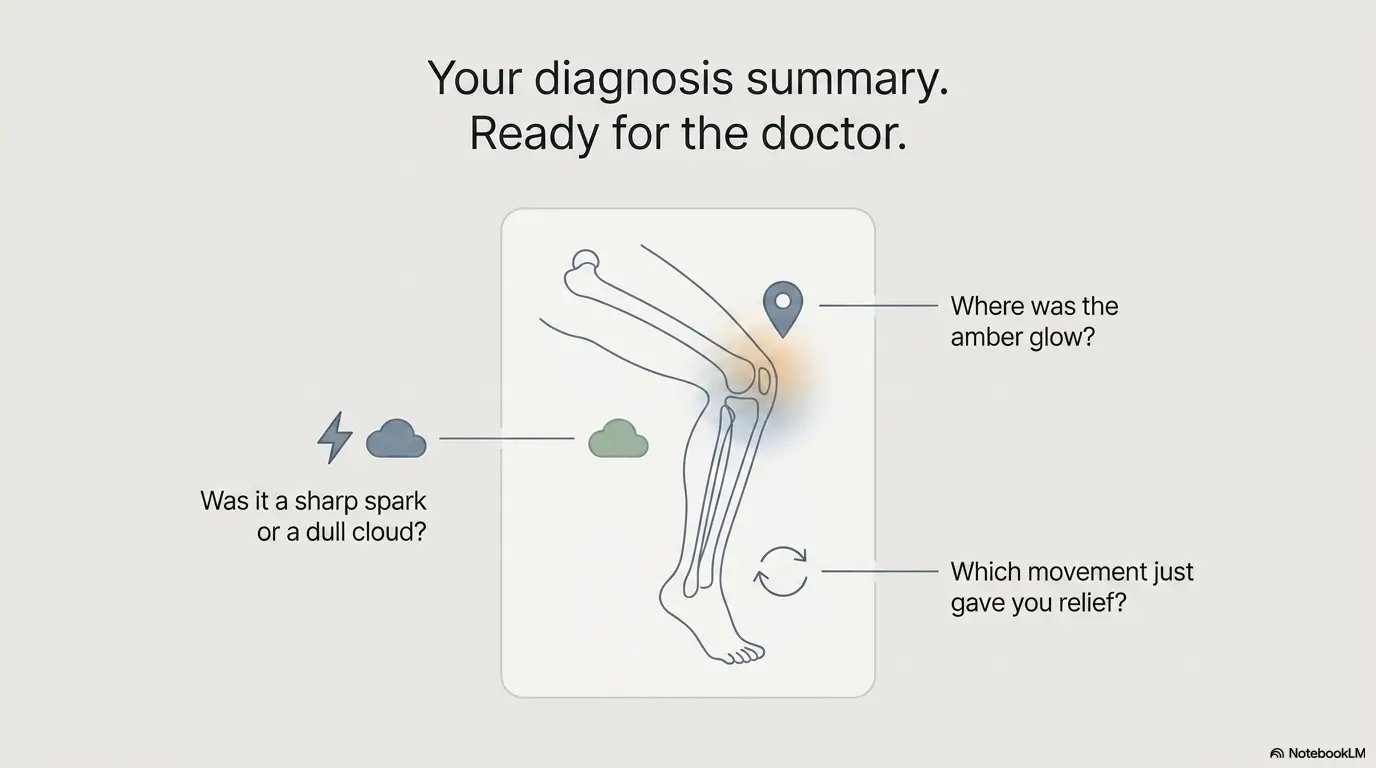
- Note where the pain sits: front, inside, outside, back, or all around.
- Write down swelling, warmth, locking, catching, giving way, or limping.
- Record what position helps: soft bend, leg straighter, foot supported, standing, walking, ice, heat, or rest.
- List medications, braces, sleeves, mobility aids, or home treatments you used.
- Take photos only if they show visible swelling, bruising, posture problems, or walking setup clearly.
During the wait itself, use the simplest comfort sequence: choose a firm chair, support your feet, keep the knee in a soft bend, avoid crossing your legs, move gently before stiffness spikes, and ask for help when symptoms are not ordinary.
That is the quiet win. You are not trying to cure knee pain in a waiting room. You are trying to leave the waiting room no worse than you entered it, with better notes, safer movement, and less guesswork for the next step.
For broader appointment prep, this orthopedic appointment checklist can help you gather questions, documents, and symptom details before the visit.
Last reviewed: 2026-08