
This site is written from a family-caregiver perspective. The operator is not a medical professional or an insurance, legal or financial adviser. Use this guide to organize questions for the relevant service.
Price required items before optional purchases
Use this follow-up record alongside the guide below. It does not determine medical suitability, insurance eligibility or legal rights, and it does not guarantee a price.
- Keep together
- Care-team equipment advice, existing items, fit or training needs, rental or purchase quotes and benefit enquiries.
- Unanswered question
- Which item is required, who checks it and what total costs remain after delivery or rental ends?
- Next contact and owner
- Confirm needs with the care team and obtain supplier terms rather than buying a generic package.
- Recheck when
- Restrictions, equipment, rental duration or help at home changes.
For each response, record its date, source, reference number and what remains uncertain. Agree the next follow-up date instead of treating silence as confirmation. Use official contact channels and keep identifying health, account and policy information out of public comments.
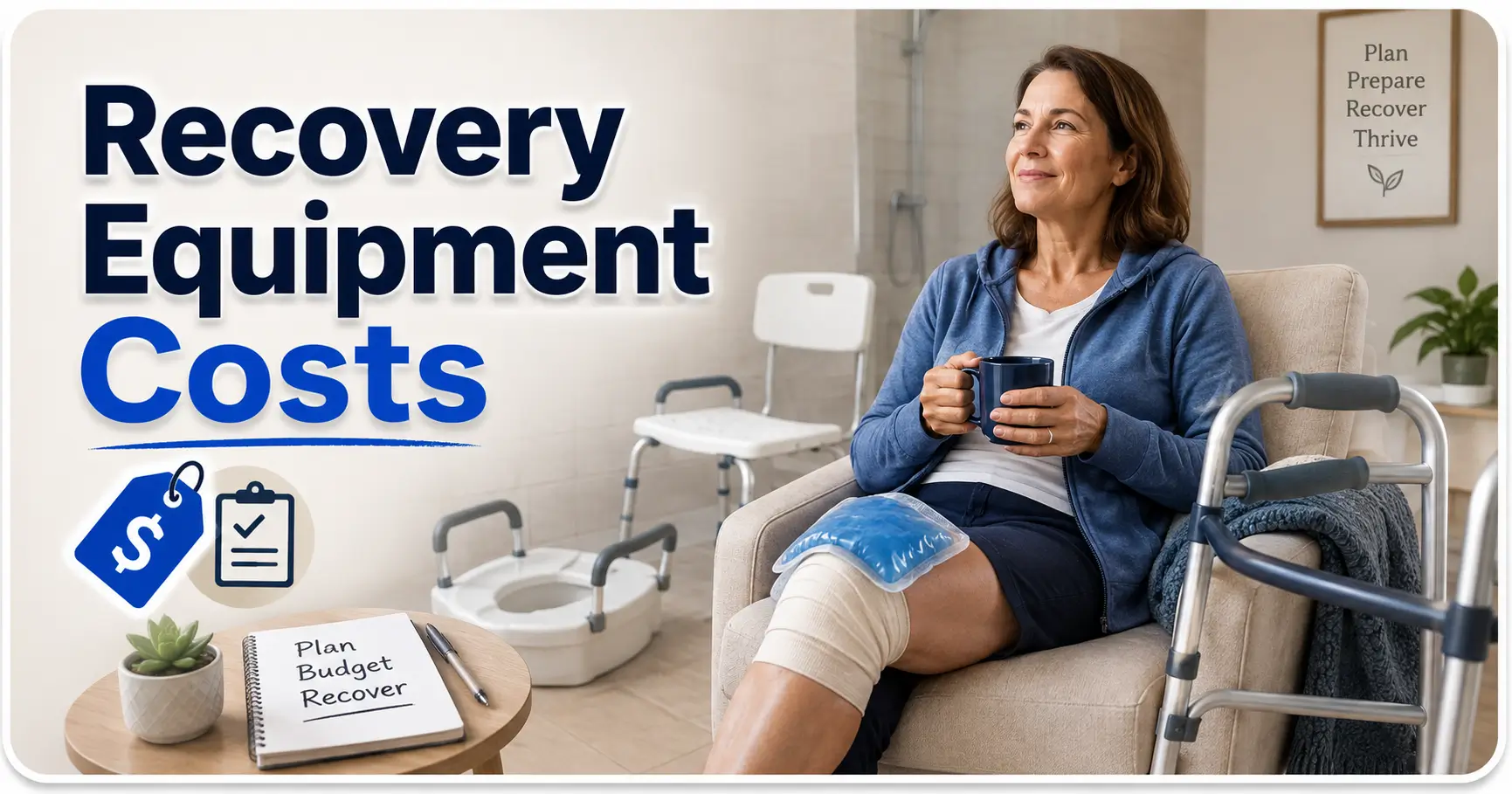
There is no single reliable equipment total for every knee replacement. Start with the equipment your clinical team recommends, then obtain current quotes and check what insurance, the hospital, a loan program, or your household can supply. The budget should show your confirmed share of those specific items, rather than an unsourced retail price range.
The number that matters most, however, is not the retail total. It is how much of the equipment you actually need to buy yourself. Your hospital may provide some items, insurance may cover medically necessary durable medical equipment, and friends, community loan programs, or short-term rental may eliminate several purchases.
Before ordering a recovery bundle, get the discharge equipment list from your surgeon, physical therapist, or occupational therapist. Confirm each item’s purpose before buying it.
Table of Contents
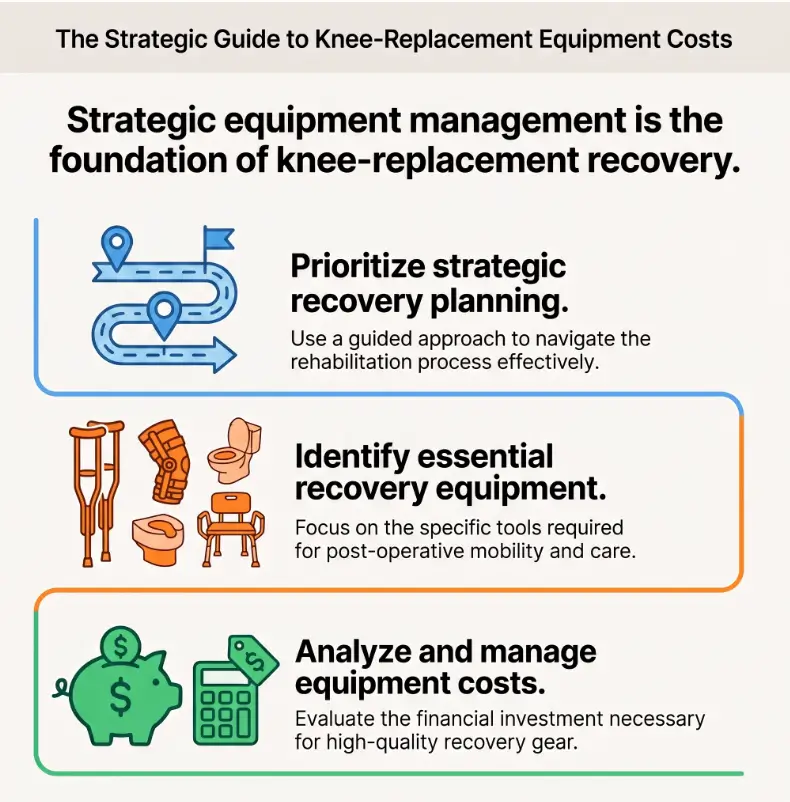
Build the Equipment Budget From Current Quotes
Use this table as a quote worksheet. Enter the exact model, delivered cost, and expected patient responsibility for each item you actually need. No price range in this worksheet represents a current U.S. market survey.
| Recovery item | Amount to record | When it may be useful |
|---|---|---|
| Folding or front-wheeled walker | Current quote and your share | Early walking when recommended by the therapy team |
| Cane | Current quote and your share | Often used later when transitioning away from a walker |
| Shower chair or bath bench | Current quote and your share | When standing to shower is difficult or unsafe |
| Tub transfer bench | Current quote and your share | When stepping over a bathtub edge is the bigger problem |
| Raised toilet seat | Current quote and your share | When a low toilet makes sitting or standing difficult |
| Reacher | Current quote and your share | Picking up or retrieving items without awkward reaching |
| Cold-therapy machine | Current quote and your share | Optional alternative to simpler cold packs when approved by the care team |
Use the delivered price and your confirmed share. Ask whether shipping, tax, setup, required accessories, and returns are included. If an item is rented, ask about the monthly charge, minimum term, delivery and collection fees, and how to document that billing should stop after return. For insurance-supplied items, use the confirmed patient amount rather than adding the full retail price as well.
Invented arithmetic example, not a quote: four recommended self-pay items at $60, $50, $40, and $15 total $165 before any extras. If the first item is safely supplied at no additional charge, the purchase subtotal becomes $105. Replace every input with a real quote; the example does not establish which items you need or what they should cost.
These items also should not be treated as one universal shopping list. The American Academy of Orthopaedic Surgeons’ knee replacement guidance describes walkers or canes, bathroom safety equipment, a stable chair, and home modifications as potentially useful, but individual needs depend on mobility, balance, home layout, and the rehabilitation plan.
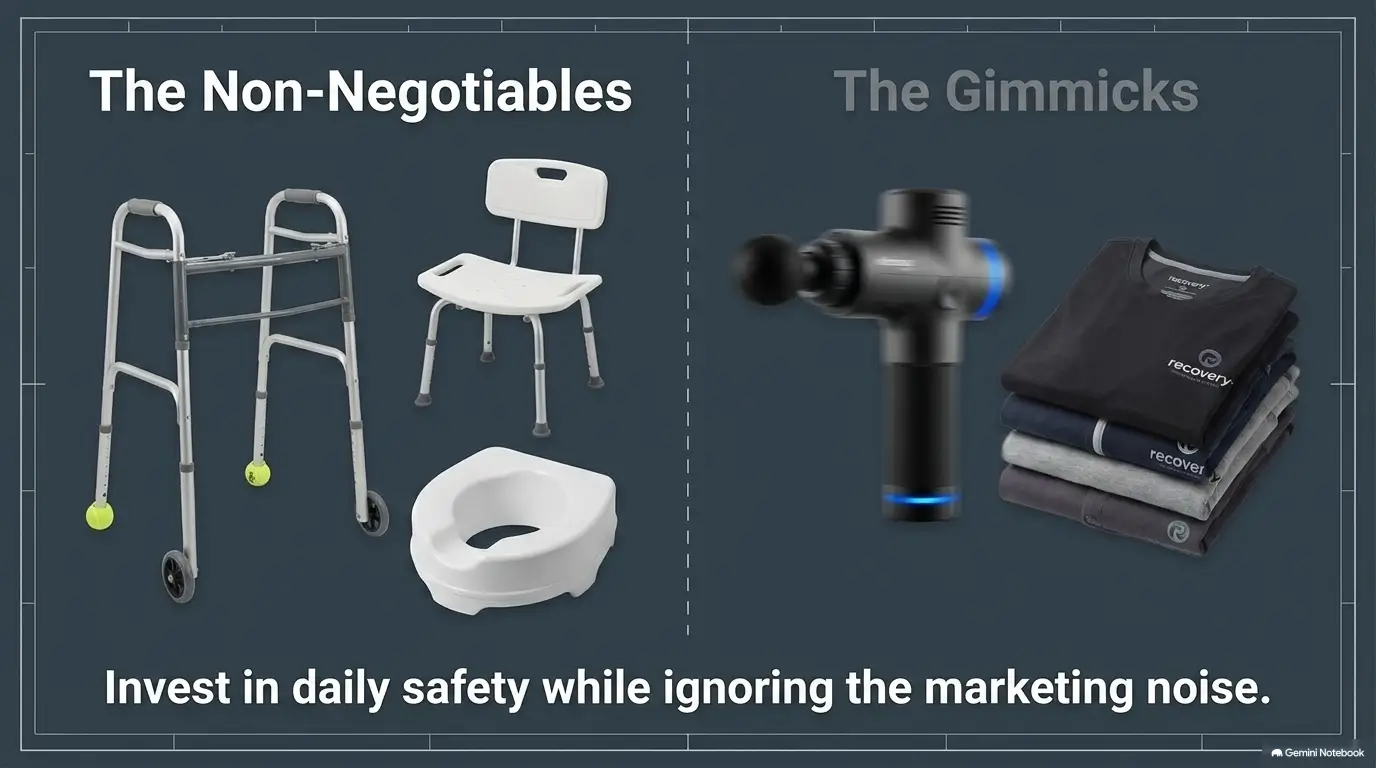
The Biggest Cost Difference Is Required Equipment Versus Convenient Equipment
The best way to control recovery-equipment spending is to separate what you need to move and transfer safely from what merely makes recovery more comfortable.
| Category | Examples | Buying approach |
|---|---|---|
| Potentially necessary | Walker, cane, commode or bathroom equipment recommended by PT/OT | Confirm before discharge and check insurance first |
| Useful depending on the home | Shower chair, transfer bench, toilet riser, reacher | Measure the actual room before buying |
| Comfort upgrade | Cold-therapy machine, specialty cushions, premium recovery chair | Buy only if the simpler option does not solve the problem |
| Do not pre-buy without a reason | Wheelchair, hospital bed, specialized brace, CPM machine | Wait for the clinical or discharge recommendation |
This distinction can easily save more money than finding a coupon. Avoiding an unnecessary purchase can save more than a small discount on equipment you need.
If you want a broader look at the equipment categories that can appear around orthopedic recovery, see this guide to orthopedic home-care equipment.
Check Insurance Before Buying a Walker, Cane, or Commode
For people with Original Medicare, the coverage distinction is especially important. Medicare Part B can cover medically necessary durable medical equipment prescribed for use in the home. Medicare lists equipment such as walkers, canes, crutches, wheelchairs, and qualifying commode chairs among covered DME categories.
Under Original Medicare, after the Part B deductible has been met, the beneficiary generally pays 20% of the Medicare-approved amount when the supplier accepts assignment. You can verify the current rules directly through Medicare’s durable medical equipment coverage guidance.
Coverage is not automatic merely because an item is useful after surgery. The equipment must meet Medicare’s requirements, be medically necessary, and be ordered for home use. Supplier participation also matters.
A raised toilet seat is not the same as a covered commode
This is a particularly useful distinction after knee replacement. Original Medicare does not treat a standard raised toilet seat as covered DME. CMS also treats bathtub seats as non-covered convenience or hygiene equipment.
A commode chair is different. It can qualify under specific medical-necessity circumstances, such as when a beneficiary cannot use regular toilet facilities. CMS explains those conditions in its current commode coverage policy.
Medicare Advantage and private insurance plans can operate differently. Network rules, prior authorization, DME vendors, deductibles, coinsurance, and supplemental over-the-counter benefits may change what you actually pay. Call the plan before buying rather than assuming reimbursement will appear afterward.
- Ask whether the exact equipment category is covered.
- Ask whether a prescription or order is required.
- Ask whether you must use a contracted DME supplier.
- Ask whether the item is purchased or rented.
- Ask for your estimated out-of-pocket amount.
Measure the Home Before You Spend Money
The wrong dimensions can turn inexpensive equipment into expensive clutter. Measure where the equipment will actually be used, not merely whether it fits through the front door.
For a walker, check the narrowest route between the bed, bathroom, recovery chair, and kitchen. Doorways, furniture, rugs, cords, and sharp turns may matter more than the advertised folded width. If space is tight, use this hallway and walker clearance check before choosing the device.
For bathroom equipment, measure the toilet, tub or shower opening, floor space, and any fixed doors or cabinets. A transfer bench that technically fits inside the bathroom may still block the door or make transfers awkward.
Bathroom safety deserves more attention than product features. If showering itself is becoming the difficult part of recovery, this guide to shower difficulty during recovery can help identify whether the issue is standing tolerance, transfers, reaching, or the room layout.
You Probably Do Not Need an Expensive Recovery Chair
A new recliner is not a universal knee-replacement requirement. AAOS recommends a stable chair for early recovery with a firm seat, firm back, and arms. Depending on your existing furniture and your therapist’s instructions, the chair you already own may be perfectly adequate.
Before spending several hundred dollars on specialized seating, test whether the existing chair provides a stable surface and allows you to stand using the technique your rehabilitation team teaches you. The practical comparison in choosing a chair after knee surgery can help you assess height, firmness, arm support, and surrounding space.
Paying more becomes reasonable when the existing furniture creates a genuine transfer problem that cannot be corrected safely with positioning or another clinically appropriate solution. Price alone does not determine whether a chair is suitable.
A Cold-Therapy Machine Is an Upgrade, Not an Automatic Requirement
Cold therapy may be included in postoperative instructions to help manage swelling or discomfort, but a powered cold-therapy machine is not something every knee-replacement patient must buy.
Simple reusable cold packs may be cheaper when they provide the method your clinical team recommends. For any cooling method, follow the prescribed duration and device instructions, protect the skin with the required barrier, check the skin during use, and stop for burning, unusual color change, or worsening symptoms. Do not sleep through cooling unless your clinical team and device instructions explicitly permit it. The FDA describes cold-therapy injury precautions.
A machine becomes easier to justify when repeated cold-pack changes are difficult, the prescribed setup works better with circulating cold therapy, or your care team specifically recommends a device for your situation. Follow the postoperative instructions you were given rather than relying on the machine manufacturer’s marketing claims.
Johns Hopkins also notes that patients may be instructed to use ice and that home modifications and assistive devices should reflect individual circumstances. Its knee replacement recovery guidance provides a useful clinical reference.
When Paying More for Equipment Actually Makes Sense
Extra spending is most defensible when it solves a specific safety, fit, capacity, or caregiving problem. Paying more because a product has “premium recovery” printed on the box is a weaker reason.
- A transfer bench instead of a shower chair: worthwhile when crossing the side of a bathtub is the difficult part.
- Higher-capacity equipment: worthwhile when standard products do not provide an appropriate weight capacity, seat width, or stability.
- Professional grab-bar installation: worthwhile when secure structural mounting is needed. A temporary suction handle should not automatically be treated as equivalent to a properly secured grab bar.
- Rental rather than purchase: sensible for equipment expected to be needed only briefly, particularly when a DME supplier or insurer already has a rental pathway.
- Equipment that reduces needed assistance: potentially valuable when the alternative is substantial paid caregiver time, provided the equipment is safe and appropriate.
That last comparison can be surprisingly important. A piece of equipment should not replace human help when assistance is clinically necessary, but the right setup can reduce unnecessary dependence for routine tasks. This home equipment versus caregiver-hours comparison explores that decision more closely.
What Not to Buy Before the Care Team Says You Need It
Do not assume that knee replacement requires a wheelchair, hospital bed, specialized knee brace, powered lift chair, or continuous passive motion machine. These are much more dependent on individual mobility, complications, restrictions, home conditions, and clinician orders.
Many knee-replacement patients begin walking with an assistive device soon after surgery. That makes buying a wheelchair “for backup” a poor default unless the discharge team identifies a reason for one.
The same principle applies to large preassembled recovery packages. Compare each bundle item with the clinical equipment list and price the needed items separately.
Use This Before-You-Pay Equipment Check
Run every proposed purchase through four questions. This is more useful than trying to predict the entire recovery from a product checklist.
- What problem does this solve? Walking, showering, toileting, reaching, transfers, or comfort?
- Did the surgeon, PT, or OT say I need it? Separate required equipment from optional convenience.
- Can I obtain it through insurance, the hospital, a DME supplier, rental, or a safe loan program first?
- Does it fit the person and the home? Check dimensions, weight capacity, adjustment, stability, and the actual path where it will be used.
If an item fails the first question, postpone the purchase. Recovery needs can change quickly, and buying later is often easier than returning bulky medical equipment.

FAQ About Knee-Replacement Recovery Equipment Costs
Can I borrow a walker instead of buying one?
Potentially, but the walker must be the correct type, be in good condition, and be adjusted appropriately for you. Have your physical therapist or another qualified member of the care team confirm the setup rather than assuming any borrowed walker will work.
Do I need a wheelchair after knee replacement?
Not routinely. Many patients begin walking with a walker and later transition to another assistive device as their function improves. A wheelchair may be appropriate in some circumstances, but that decision should come from the clinical and rehabilitation plan rather than a generic surgery checklist.
What if I live alone?
Equipment can make routine tasks easier, but it does not automatically replace assistance. Before discharge, discuss bathing, meals, medications, transportation, stairs, pets, and emergency contact arrangements with the care team. The need for help depends on function and home circumstances, not simply whether you own enough equipment.
What if the bathroom is on another floor?
Tell the discharge team before surgery when possible. Stair access and bathroom location can change equipment and home-planning recommendations. In some circumstances, a qualifying commode may be considered, while in others the safer solution may involve reorganizing where you spend the early recovery period.
Your Next 10 Minutes Before You Buy
Take the discharge paperwork or preoperative instructions and make two columns: ordered or recommended and optional. Then circle the walker, cane, or commode-related items that could qualify for insurance and call the plan or designated DME supplier before paying retail.
Next, measure the toilet, shower or tub, recovery chair, and narrowest walker route. Buy the least expensive equipment that safely meets the required fit, capacity, and clinical purpose. Leave the comfort upgrades in the cart until you know what problem they are actually solving.
This article provides general U.S.-focused educational information. Your surgeon, rehabilitation team, insurer, and equipment supplier may make different recommendations or coverage determinations based on your health, mobility, plan, and home environment.
Last updated: October 14, 2026
Targeted review: October 17, 2026. Replaced unsourced retail ranges with a current-quote worksheet and an explicitly invented arithmetic example; added delivered-price and rental questions.
Targeted editorial update: October 21, 2026. Added a topic-specific follow-up record and recheck triggers, revised the title and search description, and removed unverified first-person claims or clarified selected wording where found. The existing body was retained. This update is not a complete legal, coverage or clinical review; confirm current rules and individual decisions with the relevant official source or service.