
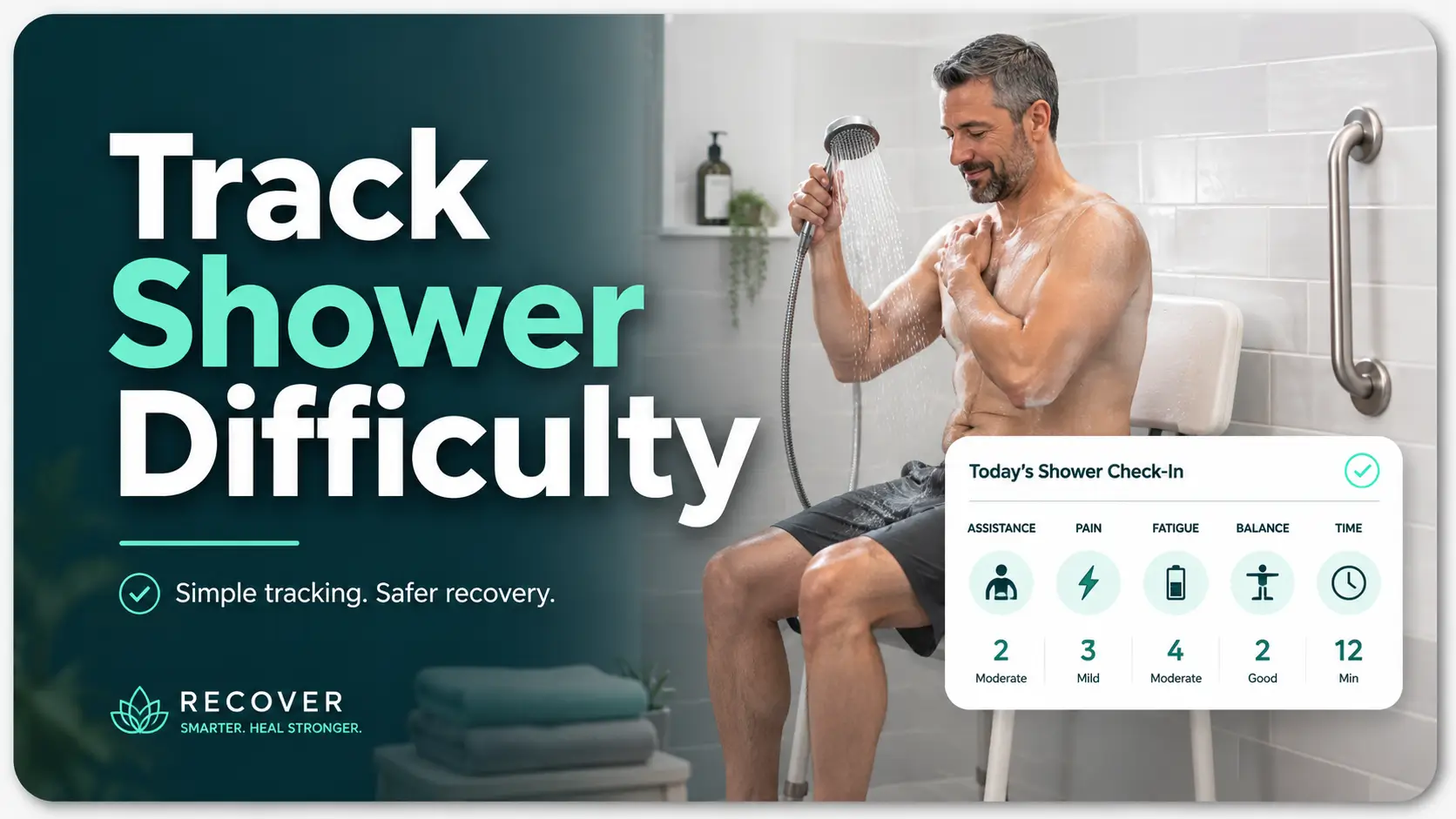
A clearer view of everyday recovery
How to Track Shower Difficulty During Recovery
A shower can look like a small household task until recovery turns it into a sequence of transfers, reaches, turns, temperature changes, slippery surfaces, and quiet calculations. “Can I shower?” is therefore not always the most useful question. A better question is, “What did this shower require from me today?”
Tracking shower difficulty gives patients and caregivers a practical way to notice progress without pretending recovery should improve in a perfectly straight line. It can also reveal a change that deserves attention, such as new dizziness, greater hands-on assistance, wound concerns, or exhaustion that continues long after the bathroom is dry.
This guide turns one complicated activity into a one-minute record built around five measures: assistance, pain, fatigue, balance, and time. You will also learn how to score the hardest step, compare several days fairly, document equipment, and prepare a care-team update that contains more than the famously unhelpful phrase, “It was kind of hard.”
Track the right things
Measure help, symptoms, steadiness, time, and delayed fatigue.
Spot meaningful change
Compare patterns without panicking over every difficult day.
Communicate clearly
Bring concise, useful observations to clinicians and therapists.
The goal is not to earn a perfect score. It is to make the next safe decision with better information. 🚿
Snapshot
Who this is for: Adults recovering from surgery, injury, illness, or hospitalization, plus family members helping them at home. What it solves: Vague descriptions of bathing ability that hide changes in balance, fatigue, assistance, or wound status. What you can do next: Create a baseline and complete a consistent shower difficulty record in about one minute.
Before You Track or Attempt a Shower
This article offers a general tracking method, not a diagnosis, clearance to shower, or personalized rehabilitation plan. Follow your surgeon’s, clinician’s, wound-care nurse’s, or therapist’s restrictions first, even when they differ from general advice.
Do not enter a shower alone when you have been told to avoid weight-bearing, cannot transfer safely, have significant dizziness, have recently fainted, or need hands-on support. A score is never a reason to continue an unsafe attempt.
Table of Contents
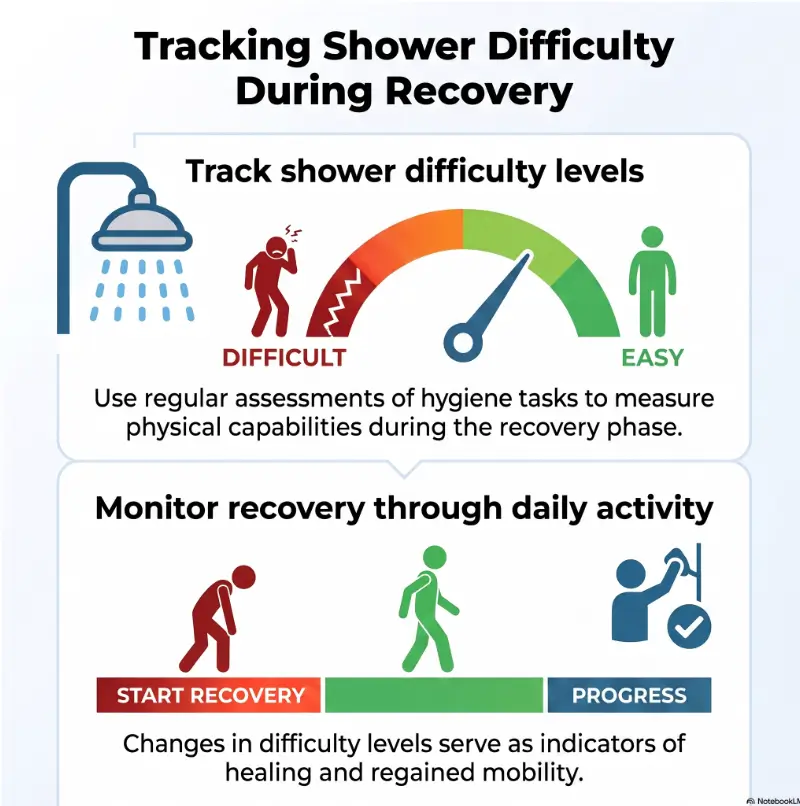
Build an Honest Shower Baseline Before Tracking Progress
A recovery log is useful only when the starting point is clear. Before scoring today’s shower, write down what showering looked like before the surgery, injury, illness, or hospital stay.
Someone who used a bench and handheld shower before surgery has a different baseline from someone who previously stood for 20 minutes without support. Neither baseline is better. They simply answer different questions.
Record your pre-recovery routine in practical terms
Do not settle for “independent.” That word can conceal several quiet workarounds, including leaning against the wall, avoiding hair washing, leaving the bathroom door open, or resting for an hour afterward.
- Usual shower duration
- Standing, sitting, or alternating between both
- Equipment used before recovery began
- Help needed with entry, washing, drying, or dressing
- Usual pain or fatigue after showering
- Any pre-existing balance, vision, shoulder, hip, knee, or hand limitations
Separate old limitations from new recovery problems
Suppose you always needed help washing your lower legs but could safely enter and exit the shower alone. If you now need hands-on support for the transfer, the important change is not the lower-leg assistance. It is the new transfer difficulty.
This distinction helps caregivers avoid reporting a long-standing limitation as a sudden decline. It also helps clinicians focus on what has actually changed.
Define “independent” more carefully
For tracking purposes, independent should mean the entire activity was completed without another person providing supervision, setup help, physical assistance, or rescue.
If a family member laid out towels, moved the walker, guarded the shower entrance, and steadied the person during one turn, the shower was not fully independent. That is not failure. It is accurate documentation.
Key Takeaway: Record the support that prevented trouble
A shower may look successful precisely because someone arranged the room, stayed nearby, or prevented a fall. That support belongs in the record.
For broader home safety context, review your route into the room as carefully as the shower itself. A narrow threshold, swinging door, loose mat, or poorly parked mobility aid may be the real bottleneck. The guides on bathroom doorway fall risks and fall risk in older adults can help identify hazards outside the stall.
The Five Shower Measures That Reveal More Than Pain
Pain matters, but pain alone cannot describe the physical demand of showering. A person may report mild pain while requiring substantial help with balance. Another may have moderate pain but remain steady and independent.
Use five measures after every attempt: assistance, pain, fatigue, balance, and time. Keep the definitions consistent so Tuesday’s “2” means the same thing as Friday’s “2.”
1. Assistance: what another person actually did
Record the highest level of help needed during any part of the shower. Nearby supervision is different from hands-on support, and occasional help is different from continuous assistance.
Name the task that required help. “Needed assistance” is vague. “Needed one hand at the trunk while stepping over the threshold” is useful.
2. Pain: before, during, and 30 minutes afterward
Record pain at three points when possible. Pain that rises during washing but settles quickly may tell a different story from pain that continues climbing after the shower.
- Before: Your starting pain level
- During: The highest level reached
- Thirty minutes after: Whether symptoms returned toward baseline
A functional description can be more useful than a number alone. Consider writing, “Shoulder pain increased when washing hair,” or “Knee pain rose during the exit step.” The functional pain assessment guide offers a similar activity-based approach.
3. Fatigue: the hidden recovery cost
Fatigue should reflect more than feeling tired inside the shower. Include how depleted you feel while drying, dressing, walking back to a chair, and recovering afterward.
A shower completed successfully may still be too demanding if it consumes the energy needed for meals, medication routines, therapy exercises, or safe walking later in the day.
4. Balance: record steadiness at four moments
- Entering the shower
- Standing or sitting during washing
- Turning or reaching
- Exiting onto the bathroom floor
Note any grab, sway, knee buckle, foot slip, or sudden need to sit. A near fall counts as a meaningful event even when no injury occurred.
5. Time: count the whole task, not only the water
Track preparation, entry, washing, exit, drying, dressing, and the first recovery period. There is no universal “correct” shower duration after surgery because procedures, restrictions, home layouts, and starting abilities vary.
| Measure | What to record | Useful detail |
|---|---|---|
| Assistance | Highest help level needed | Name the exact step |
| Pain | Before, peak, and 30 minutes after | Location and triggering movement |
| Fatigue | During and after the shower | Rest time required afterward |
| Balance | Steady, cautious, supported, or unsafe | Record slips, sways, or knee buckling |
| Time | Preparation through recovery | Note pauses and seated rests |
Key Takeaway: Do not let one comfortable number erase an unsafe event
Mild pain does not make a shower safe when balance worsened, hands-on help increased, or dizziness appeared.
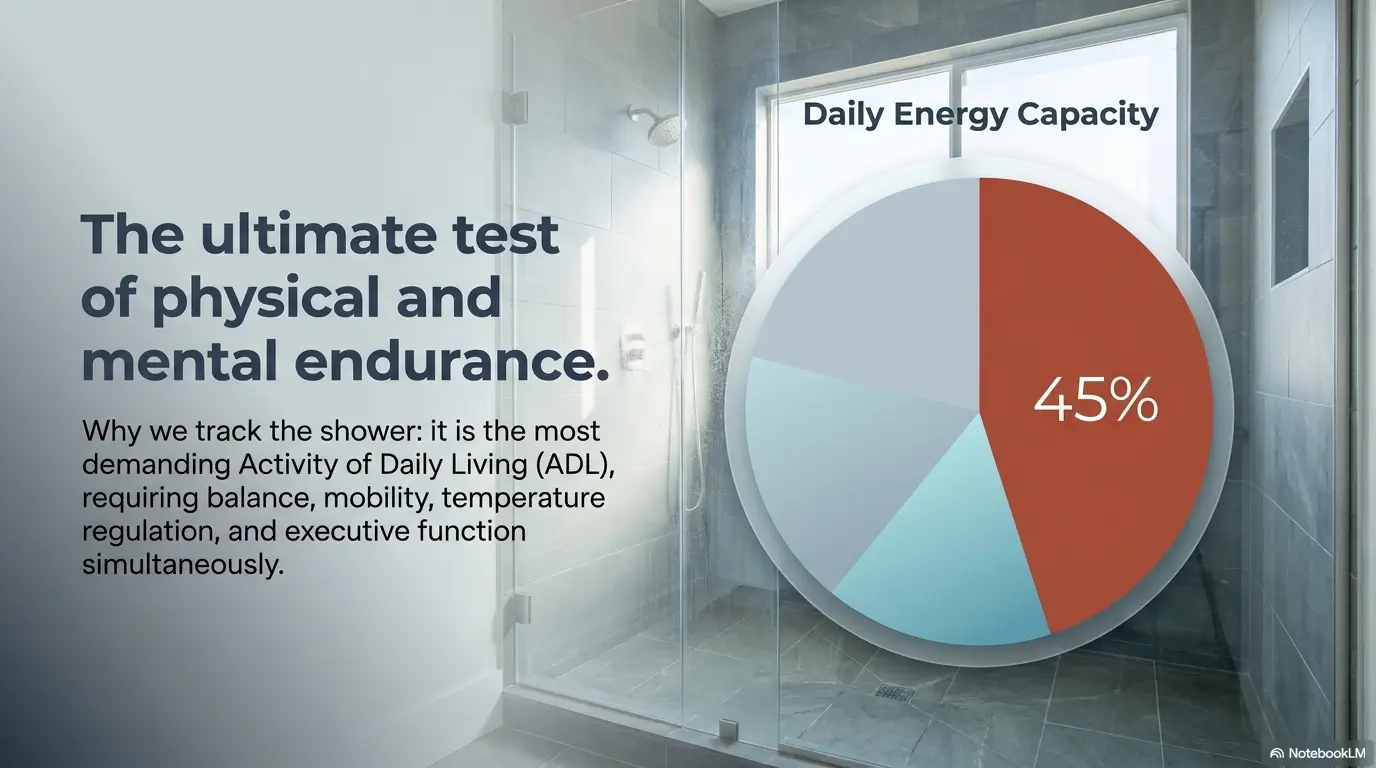
Track the Hardest Step, Not Just the Whole Shower
Showering is not one activity. It is a chain of smaller tasks, and the weakest link often holds the most useful recovery information.
Entry and exit may expose transfer limitations
Stepping over a threshold, backing toward a bench, lowering onto a seat, and moving from a wet surface to a dry one all require coordination. Record whether the person followed the approved transfer method and whether the equipment stayed stable.
Washing can expose reach, grip, and shoulder problems
Hair washing may be the first task to reveal limited shoulder motion, neck discomfort, one-handed difficulty, or low stamina. After upper-extremity procedures, compare the task with your clinician’s movement restrictions rather than improvising overhead reach.
For practical setup ideas that do not assume unrestricted arm use, see how to wash hair after shoulder surgery.
Drying and dressing may be harder than washing
Many logs end when the water stops. That misses bending to dry the lower body, balancing while pulling on clothing, reaching behind the back, and managing compression garments, braces, or slings.
Track the full sequence until the person is safely seated or standing in their next planned location.
Short Story: The “Successful” Shower That Needed a Better Description
Daniel told his daughter that his first shower after hospitalization had gone well. He had washed, dressed, and returned to his recliner without falling. On paper, it sounded like a clean little victory.
Later, she learned that he had gripped the towel rail during entry, sat suddenly when his legs began shaking, and needed her to pull a shirt over his head. He then slept for nearly two hours and skipped lunch because he felt drained.
Nothing about the shower was shameful, but “went well” had hidden three important facts: unsafe reliance on a fixture, increased assistance, and substantial post-shower fatigue.
The next time, they used a stable seat, placed clothing within reach, and recorded each difficult step. The lesson was simple: success is not merely finishing. It is finishing with the right support and an honest account of the cost.
The shower tracking chain
Find the weakest step before it becomes invisible
1. Prepare
Supplies, clothing, equipment, medication timing
2. Enter
Doorway, threshold, transfer, first turn
3. Wash
Reach, grip, standing tolerance, symptoms
4. Exit
Wet-to-dry transition, drying, dressing
5. Recover
Rest needed, delayed pain, fatigue, wound check
Build a One-Minute Shower Difficulty Score
A simple 0-to-4 scale can make day-to-day observations easier to compare. This is a personal tracking tool, not a validated medical test, diagnostic instrument, or substitute for clinical assessment.
Score each category separately. Do not allow a low total to cancel a dangerous symptom. A single episode of faintness, breathing trouble, new weakness, uncontrolled bleeding, or unsafe balance matters regardless of the arithmetic.
| Recovery measure | 0 | 1 | 2 | 3 | 4 |
|---|---|---|---|---|---|
| Assistance needed | None | Nearby supervision | Occasional help | Frequent hands-on help | Unable to complete safely |
| Pain | None | Mild | Moderate | Severe | Had to stop |
| Fatigue | None | Mild | Noticeable rest needed | Exhausted afterward | Unable to finish |
| Balance | Steady | Slight caution | Approved support needed | Hands-on support needed | Unsafe to continue |
Add time and the hardest step beside the score
Time does not need a 0-to-4 rating. Record the actual minutes and compare them with the same person’s previous attempts.
- Total task time: 34 minutes
- Rest afterward: 25 minutes seated
- Hardest step: Exiting over the threshold
- Equipment: Shower chair and handheld showerhead
- One-sentence change: Needed physical help today after two supervised-only showers
A copyable shower log template
Daily Shower Difficulty Record
Date and time: ____________________
Assistance: 0 1 2 3 4
Pain before / peak / 30 minutes after: ____ / ____ / ____
Fatigue: 0 1 2 3 4
Balance: 0 1 2 3 4
Total time and recovery time: ____________________
Hardest step: ____________________
Equipment used: ____________________
Symptoms or wound observations: ____________________
Show me the nerdy details
These scores are ordinal categories. The difference between 0 and 1 is not necessarily equal to the difference between 3 and 4. That is why the separate category pattern is usually more useful than a single combined total.
For example, a total score of 6 could represent moderate difficulty spread across several categories, or it could include one category rated 4. Those situations should not be treated as interchangeable.
Consistency improves usefulness. Use the same definitions, record at a similar point after the shower, and note major context changes such as medication timing, a therapy session, poor sleep, fever, or unusually heavy activity.
One Bad Shower or a Real Recovery Setback?
Recovery often moves in uneven phrases rather than a tidy upward melody. One difficult shower may follow poor sleep, a demanding therapy session, medication changes, constipation, low appetite, anxiety, or too much activity earlier in the day.
The safer response is neither panic nor dismissal. Compare the difficult attempt with the previous two or three showers, then look for a sudden change in a specific category.
Use a three-shower view
| Pattern | Possible interpretation | Practical response |
|---|---|---|
| One harder shower, then return to baseline | Temporary fluctuation may have contributed | Note context and continue tracking |
| Gradual improvement with occasional difficult days | Common uneven recovery pattern | Keep the setup consistent and discuss goals at follow-up |
| Two or three attempts with rising help or balance scores | Functional decline may be developing | Contact the care team for guidance |
| Sudden major loss of ability | New symptom, complication, illness, or medication effect may need review | Pause showering and seek timely clinical advice |
| Red-flag symptom during any attempt | Trend comparison is no longer the priority | Stop and follow urgent or emergency instructions |
Record context without explaining the problem away
- Pain medication taken earlier or later than usual
- New medication, dose change, or missed dose
- Poor sleep or reduced food and fluid intake
- Physical therapy or increased walking earlier that day
- Fever, stomach illness, coughing, or other new symptoms
- A different caregiver, bathroom, chair, or transfer method
Context helps the care team interpret the log. It should not be used to excuse repeated dizziness, growing weakness, increasing assistance, or unsafe transfers.
Key Takeaway: Follow the change, not the drama of a single number
A three-shower pattern often shows more than one isolated score. Sudden loss of ability or a red-flag symptom, however, deserves prompt attention without waiting for more data.
How Equipment and Paid Help Change the Score
A shower chair, transfer bench, handheld showerhead, approved grab bar, nonslip surface, or caregiver can reduce risk and physical demand. Record the support used every time, because an assistance score means little when the setup changes silently.
Needing equipment is not evidence that recovery has failed. A temporary support can conserve energy, improve positioning, and make an approved transfer more repeatable.
Distinguish temporary support from growing dependence
Ask whether equipment allowed the same task to be completed more safely, or whether the person’s underlying ability declined despite the same setup.
For example, using a shower chair from the first postoperative shower creates a stable baseline. Requiring a second person to prevent sliding after several chair-assisted showers is a new change.
Good, better, and best support options depend on the actual problem
| Setup level | May fit when | What to verify before paying |
|---|---|---|
| Good: Low-cost organization | The main difficulty is reaching supplies or managing clothing | Items are reachable without twisting, bending, or stepping on wet flooring |
| Better: Removable bathing equipment | Standing tolerance, reach, or fatigue is the main limit | Correct dimensions, weight rating, nonslip feet, cleaning needs, and compatibility with the bathroom |
| Best: Professionally assessed setup | Transfers are difficult, restrictions are complex, or a fall has occurred | Assessment by the appropriate therapist or clinician, installation quality, caregiver method, and follow-up plan |
Before buying equipment, measure the shower opening, interior width, threshold height, available turning space, toilet clearance, and the path used by a walker. Returns can be difficult for hygiene products, so measurements are cheaper than optimism.
When deciding between equipment and recurring paid assistance, compare the task, expected recovery period, caregiver availability, home layout, and whether the person can use the equipment correctly. The guide to home equipment versus caregiver hours provides a practical decision framework.
The National Institute on Aging recommends bathroom measures such as appropriately placed grab bars and nonskid surfaces as part of broader home fall prevention. Improvised towel bars are not substitutes for supports designed and installed for body weight.
Key Takeaway: Equipment changes the conditions, not the person’s worth
Record every chair, bench, grab bar, mobility aid, and helper. Support can be an intelligent bridge to independence rather than a verdict against it.
Keep Wounds, Dressings, and Restrictions in a Separate Log
Mobility tracking and wound tracking belong beside each other, but they should not be blended into one score. A person can move better while developing a dressing problem, or move poorly while the incision remains unchanged.
Follow procedure-specific bathing instructions first
Do not assume that a waterproof covering, surgical glue, staples, or a small incision makes showering automatically safe. Instructions vary by procedure, wound type, closure method, dressing, drain placement, infection risk, and clinician preference.
MedlinePlus advises following the surgeon’s directions regarding dressings and showering, avoiding rubbing or scrubbing a healing wound, and avoiding soaking unless the care team has approved it.
What to record after the shower
- Whether the dressing stayed dry when dryness was required
- Whether a waterproof covering loosened, leaked, or trapped water
- New or increasing drainage
- Bleeding that was new, increased, or difficult to stop
- New or spreading redness, warmth, swelling, or worsening pain
- Unusual odor
- Opening of the wound or separation of the edges
- Changes around a drain, staple, stitch, or adhesive closure
Do not remove, replace, reinforce, or photograph a dressing contrary to your instructions. Ask the care team how they prefer wound updates to be sent and whether photographs should include a date reference, measurement marker, or secure patient portal.
Do not improvise around a restriction
Plastic wrap, tape, household bags, and adhesive coverings can create new problems when used incorrectly. Confirm whether the wound should remain dry, may be gently rinsed, requires a specific covering, or should not be exposed to shower water yet.
If the shower attempt causes a dressing failure or an unexpected wound change, stop treating the log as an ordinary scorecard. Follow the postoperative contact instructions provided by the care team.
When Shower Difficulty Becomes a Medical Warning
The bathroom is warm, enclosed, and physically demanding. Symptoms that feel minor while seated may become more obvious during standing, turning, washing, and transferring.
Stop the shower immediately when safety changes
- Faintness, near-fainting, or loss of consciousness
- New chest pain or significant breathing difficulty
- Sudden new weakness, especially on one side
- New confusion, trouble speaking, or loss of coordination
- Uncontrolled bleeding
- A fall, head strike, or painful new injury
- Balance that becomes unsafe despite the planned support
Use emergency services for symptoms that may represent an immediate emergency, including severe breathing trouble, chest pain, fainting, stroke-like symptoms, major injury, or bleeding that will not stop. Do not attempt to finish washing first.
Contact the care team promptly for a sudden functional decline
A sudden change from supervision to hands-on help, new inability to transfer, repeated dizziness, growing exhaustion, or new wound concerns deserves clinical review. The important clue is the change from the person’s recent pattern.
Closed-wound guidance identifies worsening redness, pain, drainage, odor, fever, wound opening, and bleeding concerns as reasons to contact a provider according to the discharge plan.
Treat falls and blood-thinner use with extra care
If a person falls, hits their head, or develops unusual bleeding while taking an anticoagulant or other medication that increases bleeding risk, follow the medication and discharge instructions promptly. The Agency for Healthcare Research and Quality advises patients taking blood thinners to seek help for serious falls, head impacts, dizziness, weakness, and bleeding that does not stop.
Key Takeaway: Sudden loss of ability matters more than a stubborn score
Do not wait for a three-day trend when a person suddenly cannot perform a previously manageable transfer, develops a red-flag symptom, or needs substantially more support.
Turn the Log Into a Useful Care-Team Update
A clinician does not need a diary of every droplet. They need the change, the task, the help required, the associated symptoms, and the timeline.
Use a five-part update
- State the change: “Shower assistance increased from supervision to hands-on help.”
- Name the difficult step: “The problem occurred while stepping out.”
- Describe the symptom: “She became dizzy and her knees felt weak.”
- Give the timeline: “This happened during the last two showers.”
- Ask a focused question: “Should we pause showers, change equipment, or arrange an earlier assessment?”
Care-team message template
Concise Recovery Update
“During showers on [dates], assistance increased from [previous level] to [current level]. The hardest step was [step]. Symptoms included [pain, dizziness, weakness, fatigue, wound change] and continued for [duration] afterward. We used [equipment]. Should we change the bathing plan, equipment, restrictions, or timing of follow-up?”
Bring useful evidence without creating a paperwork avalanche
- The last three shower records
- The current bathing and weight-bearing restrictions
- A current medication list, including recent changes
- The name and dimensions of equipment used
- Approved wound photographs, when requested
- Questions about therapy goals, caregiver technique, and safe progression
A structured summary can also help a family caregiver avoid relying on memory during a rushed appointment. See the doctor visit summary template for caregivers for a broader format.

Shower Difficulty FAQ
How often should shower difficulty be recorded during recovery?
Record it after each shower during the period when ability, restrictions, symptoms, or assistance needs are changing. Once the routine is stable, less frequent tracking may be sufficient unless the care team asks for continued documentation.
Is needing a shower chair considered a setback?
Not by itself. A shower chair may be part of the planned recovery setup, a way to conserve energy, or a temporary method for following movement or weight-bearing restrictions. Record when it was introduced and whether it reduced risk, pain, or fatigue.
How long should a shower take after surgery?
There is no universal target. Compare the person with their own recent attempts and include preparation, drying, dressing, and recovery time. A shorter shower is not automatically safer if it involved rushing or poor technique.
Should pain be rated before or after showering?
Ideally, rate pain before the shower, record the highest level during the activity, and check again about 30 minutes afterward. Also describe which movement or step changed the pain.
What does sudden dizziness in the shower mean?
Dizziness can have many causes, and a home log cannot determine which one applies. Stop the attempt, sit or lie down safely with help, and follow the care team’s instructions. Seek urgent or emergency help for fainting, chest pain, breathing difficulty, stroke-like symptoms, serious injury, or persistent severe symptoms.
When is it safe to shower without another person nearby?
That decision should follow the person’s restrictions, transfer ability, balance, cognition, medication effects, home layout, and clinician or therapist guidance. A recent near fall, dizziness episode, or increase in physical assistance is a reason to pause independent showering until the plan is reviewed.
Can shower fatigue mean recovery is moving too quickly?
It may show that the activity is consuming more energy than expected, especially when fatigue interferes with eating, medication, walking, therapy, or alertness afterward. Record the recovery time and discuss repeated or worsening exhaustion with the care team.
Should wound changes after showering be photographed?
Ask the care team whether photographs are appropriate and how they should be submitted securely. Do not delay urgent contact while trying to obtain the perfect image, and do not remove dressings solely to take a photograph unless instructed.
Create Your Baseline in the Next 15 Minutes
Before the next shower, sit somewhere dry and write down the current rules of the road. This small pause can prevent the tracking log from becoming a blurry account written after everyone is tired.
Your 15-minute plan
- Minutes 1 to 3: Copy the current bathing, wound, movement, and weight-bearing restrictions.
- Minutes 4 to 6: List the approved equipment and who will be present.
- Minutes 7 to 9: Write the pre-recovery baseline.
- Minutes 10 to 12: Copy the assistance, pain, fatigue, balance, and time template.
- Minutes 13 to 15: Decide which symptoms mean stop, call the care team, or seek emergency help.
After the next attempt, circle the single step that felt least safe. That one circle may be more useful than a page of adjectives because it points toward a concrete question: Does the person need a different method, better setup, more assistance, or a clinical review?
A shower log is not a report card. It is a small lantern carried through an uneven part of recovery, bright enough to show what changed and where the next careful step belongs.
Today’s clearest next step
Write one baseline, use one consistent scale, and share the record promptly when it shows a sudden decline, new warning symptom, wound concern, fall, or unsafe loss of independence.
Last reviewed: 2026-08