
This site is written from a family-caregiver perspective. The operator is not a medical professional or an insurance, legal or financial adviser. Use this guide to organize questions for the relevant service.
Close the order-to-supplier handoff
Use this follow-up record alongside the guide below. It does not determine medical suitability, insurance eligibility or legal rights, and it does not guarantee a price.
- Keep together
- Prescribed item, supplier, delivery date, requirements and estimated patient cost.
- Unanswered question
- Do the order, fitted device, code and proposed delivery all describe the same item?
- Next contact and owner
- Ask the prescribing team and supplier to resolve inconsistencies and clarify outstanding coverage questions.
- Recheck when
- Device, supplier or delivery arrangement changes.
For each response, record its date, source, reference number and what remains uncertain. Agree the next follow-up date instead of treating silence as confirmation. Use official contact channels and keep identifying health, account and policy information out of public comments.
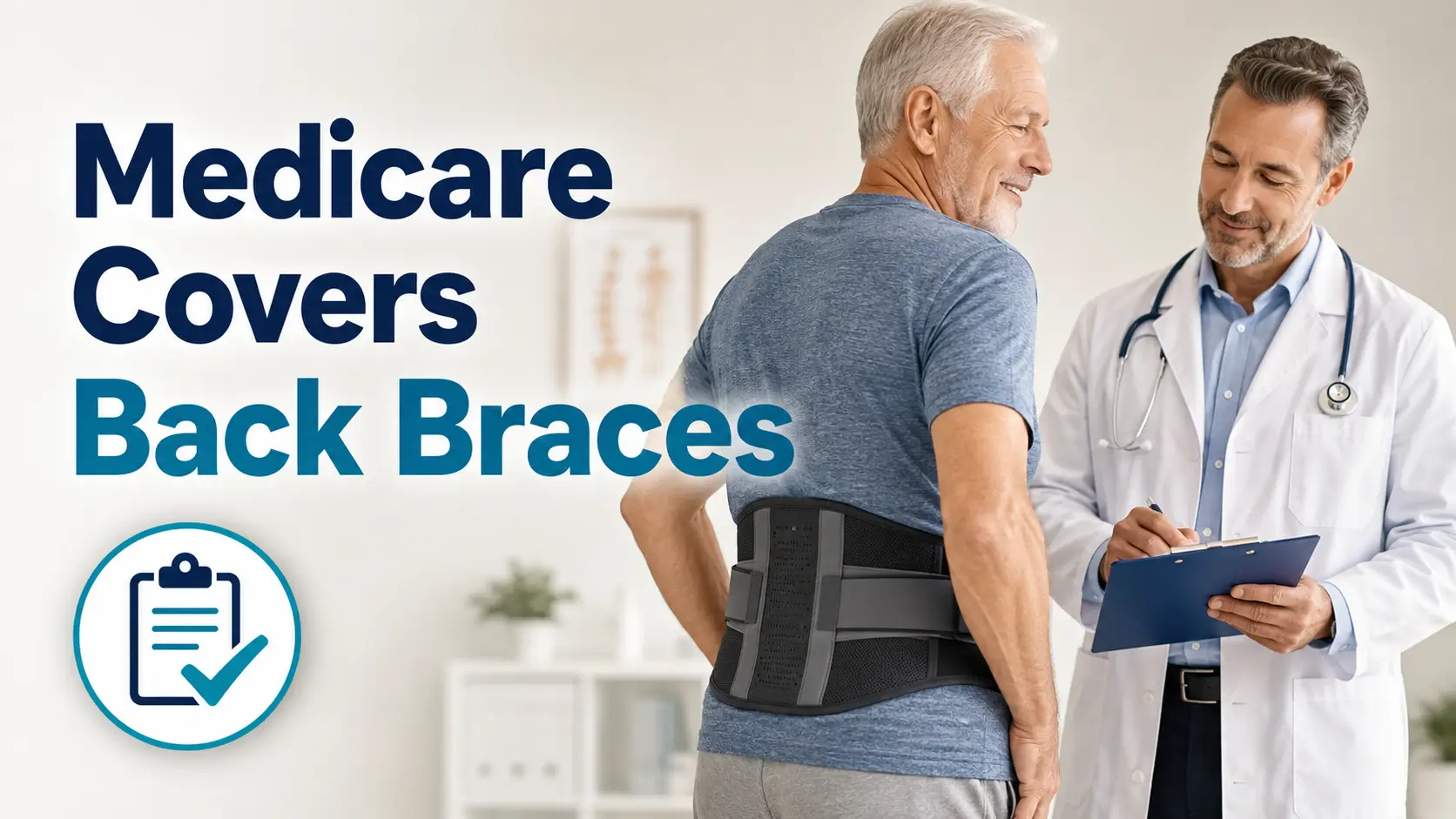
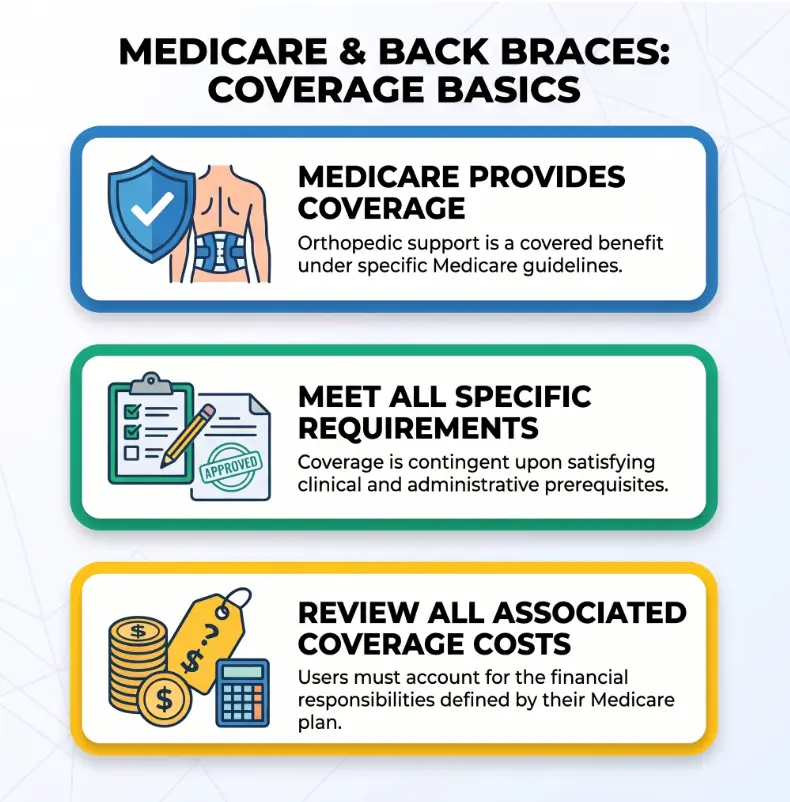
Yes. Medicare Part B can cover a back brace when the brace is medically necessary and ordered by a doctor or other qualified health care provider. Medicare’s brace benefit generally applies to rigid or semi-rigid spinal orthoses used to support the spine or restrict movement, not simply any lumbar support sold online or at a pharmacy.
With Original Medicare, the key questions are whether the specific brace meets Medicare’s coverage criteria, whether the medical record supports why you need it, and whether the supplier is properly enrolled in Medicare. After the Part B deductible, you generally pay 20% of the Medicare-approved amount when the supplier accepts assignment. If you have Medicare Advantage, the brace must still be covered when medically necessary, but network, authorization, and cost-sharing rules can differ.
Table of Contents
When Medicare Will Cover a Back Brace
Medicare does not cover a back brace merely because you have back pain. The brace itself and the medical reason for using it must satisfy Medicare requirements.
Medicare describes covered braces as rigid or semi-rigid devices that support a weak or deformed body part or restrict movement of an injured or diseased body part. You can confirm the basic rule on Medicare’s current coverage page for back and other medical braces.
CMS coverage criteria for lumbar-sacral and thoracic-lumbar-sacral orthoses recognize several medical purposes for a spinal brace, including:
- reducing pain by restricting movement of the trunk,
- supporting healing after an injury to the spine or related soft tissue,
- supporting healing after spinal surgery or surgery involving related soft tissue, and
- supporting weak spinal muscles or a deformed spine.
These are coverage criteria, not a promise that every brace prescribed for one of these reasons will be paid. The order, medical documentation, correct brace classification, supplier requirements, and any applicable authorization rules still matter. CMS provides the underlying spinal orthosis coverage and documentation criteria.
The Biggest Distinction: A Medical Brace Is Not the Same as a Back Support
A common and potentially expensive misunderstanding is assuming that every product marketed as a “back brace” qualifies for Medicare coverage.
It does not.
Under Medicare’s braces benefit, the device generally must be sufficiently rigid or semi-rigid to provide the required support or restriction of movement. CMS specifically distinguishes qualifying orthoses from elastic or fabric support garments that do not provide enough rigidity to meet the statutory definition of a brace.
| Item or situation | Medicare implication | What to verify |
|---|---|---|
| Rigid or semi-rigid spinal orthosis | May qualify when medically necessary | Order, diagnosis, medical record, HCPCS code |
| Elastic lumbar support or compression garment | May not meet Medicare’s definition of a covered brace | Ask for the billing code before buying |
| Off-the-shelf qualifying orthosis | Can potentially be covered | Correct coding and Medicare supplier |
| Custom-fitted brace | Can potentially be covered | Whether the fitting and documentation justify the billed classification |
| Brace bought independently for comfort | Coverage is uncertain and may be unavailable | Confirm coverage before paying |
This distinction is why buying a $50 or $100 support first and asking Medicare to reimburse you afterward can fail. The retail label on the box does not determine Medicare coverage.
How Much Does a Back Brace Cost With Original Medicare?
For a covered back brace under Original Medicare, you generally pay the Part B deductible first and then 20% of the Medicare-approved amount when the supplier accepts assignment.
The 2026 Medicare Part B deductible is $283. Medicare publishes current deductible and coinsurance figures on its Medicare cost page.
Illustrative example if your deductible is already met
Suppose the Medicare-approved amount for a covered brace is $600, the supplier accepts assignment, and you have already met your Part B deductible for the year.
- Medicare-approved amount: $600
- Your usual 20% coinsurance: $120
- Medicare’s share: $480
This is an illustration, not a price estimate for a particular brace. The approved amount depends on the item and billing code.
Illustrative example if none of the deductible has been met
Using the same $600 Medicare-approved amount and assuming the full 2026 deductible applies:
- You first satisfy the $283 deductible.
- That leaves $317 subject to normal Part B cost-sharing.
- Twenty percent of $317 is $63.40.
- Your combined cost in this simplified example is $346.40.
Medigap, Medicaid, employer coverage, or another secondary payer may reduce what you actually owe. Do not assume your bill will equal 20% of the supplier’s retail sticker price. Medicare cost-sharing is based on the applicable Medicare-approved amount, subject to Medicare’s rules and the supplier’s assignment status.
Why the Supplier Can Change What You Pay
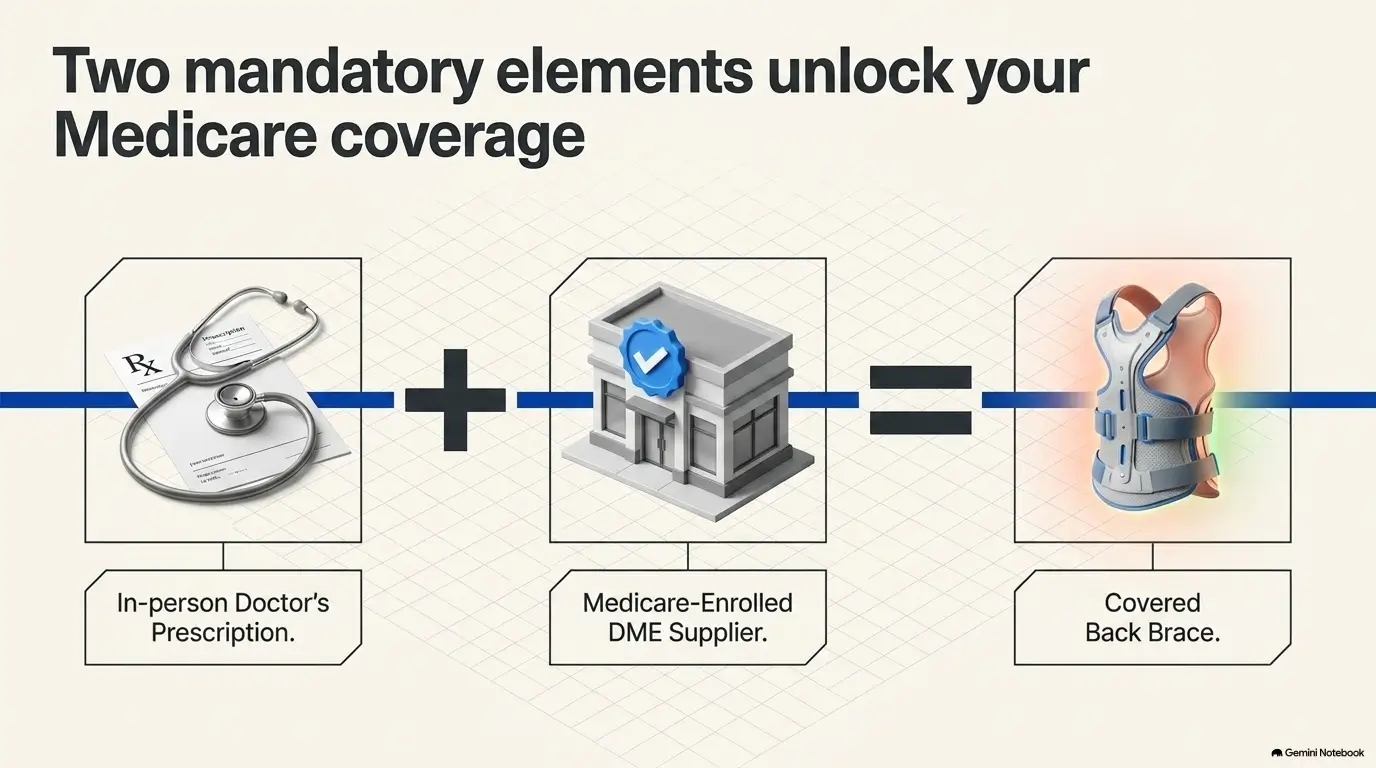
The safest route is to use a Medicare-enrolled supplier and confirm assignment before accepting the brace. A doctor’s prescription alone does not make an otherwise problematic supplier arrangement safe.
A participating Medicare supplier must accept assignment. That means it agrees to the Medicare-approved amount as the basis for payment and can generally collect the applicable deductible and coinsurance rather than simply setting its own price for the covered claim.
A non-participating supplier may still accept assignment for a particular claim, but you should ask rather than assume. Medicare provides an official medical equipment supplier directory that can help you locate suppliers that work with Medicare.
Before the brace is delivered, ask the supplier:
- Are you enrolled in Medicare?
- Do you accept Medicare assignment for this brace?
- What HCPCS billing code will you use?
- Has my doctor’s order been received?
- Does this particular code require prior authorization?
- What is my estimated out-of-pocket amount?
That six-question conversation is usually more useful than asking, “Does Medicare take you?” A supplier can work with Medicare while the details of a particular claim still determine what you owe.
Read a noncoverage notice before accepting financial responsibility. With Original Medicare, an Advance Beneficiary Notice of Non-coverage (ABN) explains why payment may be denied and estimates the cost. It is not Medicare’s final denial. Ask which item and reason apply, read the options, and keep a copy. Choosing to receive the item with a claim submitted preserves the ability to appeal a later Medicare denial; choosing to receive it without a claim means there is no Medicare appeal of that purchase. A signature is not proof of coverage. Medicare Advantage uses its own coverage-decision process.
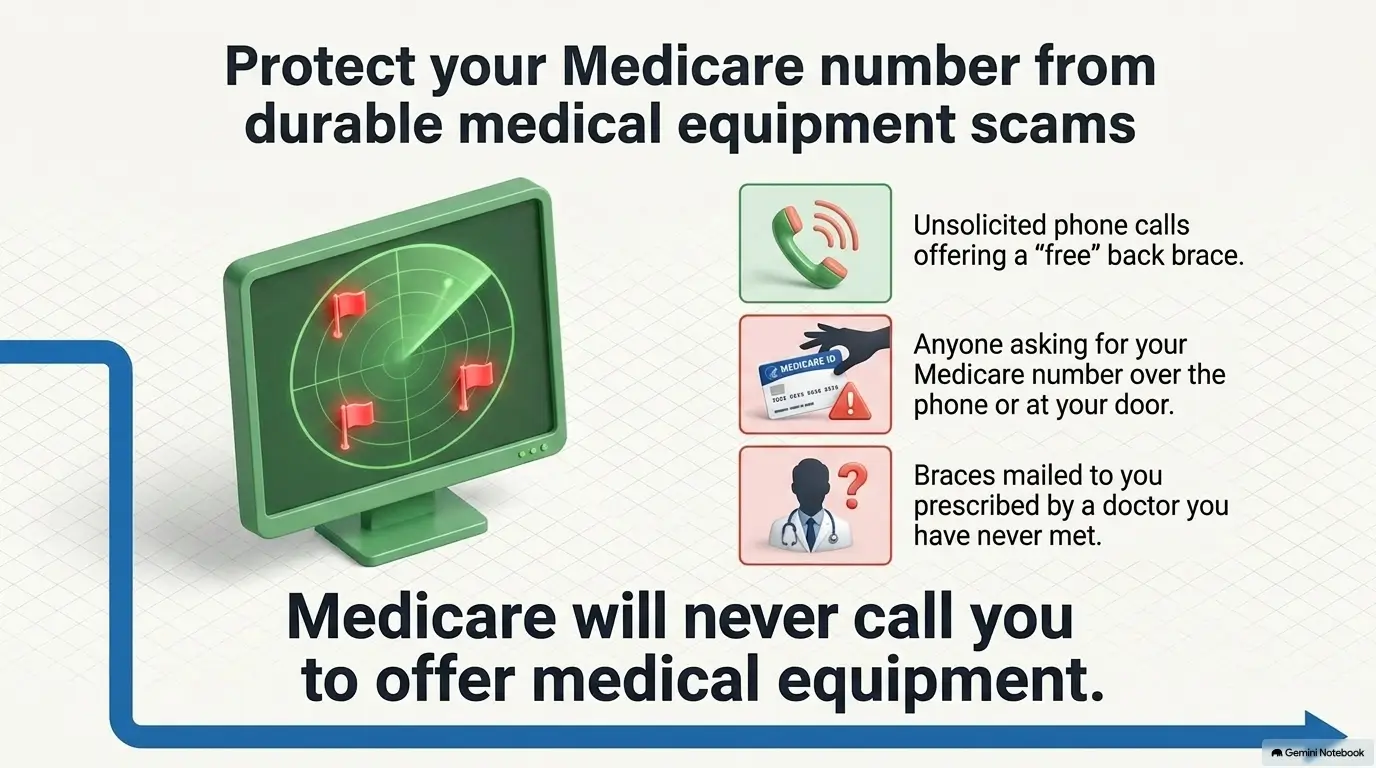
Be cautious about unsolicited “free brace” offers. The FTC’s back-brace scam warning advises against giving Medicare details to callers offering equipment. Contact your treating clinician and a supplier you independently verify. If an unfamiliar brace claim appears, check your Medicare Summary Notice and report suspected misuse through Medicare’s official channels.
Some Back Braces May Require Prior Authorization
Do not assume Original Medicare means prior authorization can never apply. CMS has placed certain spinal orthosis billing codes on its DMEPOS Required Prior Authorization List.
This is one reason the HCPCS code matters. Two products that both look like “back braces” to a shopper can enter Medicare under different billing classifications.
Ask the supplier whether the exact code being billed requires authorization and whether approval has been obtained before delivery. For a broader preparation sequence, the orthopedic prior authorization checklist can help you organize the questions and paperwork before an item or procedure is scheduled.
A request for authorization does not itself prove that Medicare will pay. It is a coverage checkpoint, and the submitted documentation still has to support the item.
What Your Medical Record Needs to Make Clear
The record should explain why the brace is medically needed, not merely state that you want additional support.
Depending on the clinical situation, useful documentation may describe the condition being treated, relevant symptoms, functional problems, recent injury or surgery, weakness or deformity, and why restricting or supporting spinal movement is medically appropriate.
This does not mean you should manufacture insurance-friendly language. Describe what is actually happening. If back problems interfere with walking, standing, transferring, dressing, sleeping, working, or other daily activities, recording those limitations accurately can make the clinical picture clearer. The guide to documenting functional limitations explains how to prepare concrete examples for a medical appointment without exaggerating them.
If the brace is being considered at a spine visit, bringing medication information, imaging history, prior treatment details, and a short symptom timeline can also reduce loose ends. This spine doctor visit checklist can help with that preparation.
Original Medicare and Medicare Advantage Do Not Handle the Purchase the Same Way
Medicare Advantage plans must cover medically necessary services and items that Original Medicare covers, but they can use different networks, authorization procedures, and cost-sharing rules.
| Question | Original Medicare | Medicare Advantage |
|---|---|---|
| Can a medically necessary back brace be covered? | Yes, when Medicare criteria are satisfied | Yes, subject to the plan’s coverage administration |
| Supplier choice | Use a Medicare-enrolled supplier; assignment affects costs | Plan network rules may apply |
| Prior authorization | Applies to certain items or codes | May be required under plan rules |
| Patient cost | Usually Part B deductible plus 20% of the approved amount under standard Original Medicare rules | Copays, coinsurance, and deductibles vary by plan |
If you have Medicare Advantage, call the number on your member card before the brace is supplied. Medicare’s comparison of Original Medicare and Medicare Advantage confirms that Advantage plans may use provider networks and prior authorization even though they must cover Medicare-covered medically necessary benefits.
Ask your plan to verify the exact brace or HCPCS code, the supplier’s network status, prior authorization requirements, and your expected cost-sharing. “Back braces are covered” is not sufficiently specific for a purchase decision.
When Buying a Cheaper Brace Yourself May Make Sense
Paying cash can be reasonable when you are deliberately buying a low-cost support for comfort and do not need the device to qualify for Medicare reimbursement. But that is a different decision from obtaining a medically necessary spinal orthosis.
A cheap retail support may be enough when your clinician agrees that you do not need substantial immobilization, specialized fitting, or a specific medical brace. In that situation, spending several hours pursuing Medicare reimbursement for an inexpensive non-covered support may offer little value.
Paying more becomes more rational when the medical need requires rigid support, an appropriate fit, post-surgical protection, movement restriction, or a device selected for a specific spinal condition. The extra spending should buy a clinically relevant function, not merely a premium-looking box.
Do not substitute a retail brace for a prescribed post-operative or injury-specific orthosis without discussing the substitution with the treating clinician. Similar appearance does not establish equivalent function.
Four Mistakes That Can Turn a Covered Brace Into an Unnecessary Bill
Most preventable problems happen before the brace reaches your hands.
- Buying first and checking Medicare later. A retail purchase may not satisfy Medicare’s ordering, supplier, coding, or authorization requirements.
- Assuming every elastic lumbar support is a Medicare brace. A product may be useful but still fall outside Medicare’s statutory brace benefit.
- Ignoring the supplier’s Medicare status. Enrollment, participation, and assignment can materially affect payment and your financial exposure.
- Letting the discussion stop at “medically necessary.” The medical record and billing classification must support why the particular orthosis is being supplied.
The safest moment to resolve these issues is before delivery, while the order and claim details can still be corrected before an avoidable billing dispute develops.
Your 10-Minute Back Brace Coverage Check
Before paying for a brace, collect three pieces of information: the medical reason for the brace, the exact product or HCPCS code, and the supplier’s Medicare status.
- Ask the prescriber: “What medical problem is this brace treating, and why do I need this type rather than a simple elastic support?”
- Ask the supplier: “What HCPCS code are you billing to Medicare?”
- Ask about paperwork: “Do you have the required written order and supporting documentation?”
- Ask about authorization: “Does this code require prior authorization, and has that process been completed?”
- Ask about assignment: “Do you accept Medicare assignment for this claim?”
- Ask about money: “What Medicare-approved amount or estimated patient responsibility applies before I accept the brace?”
- If you have Medicare Advantage: confirm the supplier is permitted under your plan and ask the plan for your exact copay or coinsurance.
If the supplier cannot tell you what it intends to bill Medicare, pause before signing a delivery form or paying a large amount. You should understand what item you are receiving and how it will be submitted.
Frequently Asked Questions About Medicare and Back Braces
Does Medicare cover a back brace bought at a pharmacy or online?
Not simply because the product is labeled a back brace. Medicare coverage depends on whether the particular device qualifies under the braces benefit, is medically necessary, is properly ordered, and is furnished through a supplier that can bill Medicare under the applicable requirements. A primarily elastic support may not qualify as a covered brace at all.
Can Medicare cover a custom back brace?
Yes, custom-fitted or custom-fabricated spinal orthoses can potentially be covered when Medicare’s requirements are met. Customization itself does not guarantee payment. The billed classification and medical documentation must support the device supplied and, where applicable, why that degree of customization is required.
Can Medicare cover a brace after spine surgery?
Potentially. Facilitating healing following surgery involving the spine or related soft tissue is one of the recognized coverage indications for spinal orthoses. The treating provider still determines whether a brace is clinically appropriate for the individual patient, and Medicare or the Medicare Advantage plan determines coverage under its applicable rules.
What should I do if Medicare denies the back brace?
Start with the denial reason rather than immediately paying the bill. Compare the claim with the doctor’s order, the HCPCS code, supplier information, medical documentation, and any required authorization. A missing document, coverage failure, incorrect coding issue, or medical-necessity denial may require different next steps. If you disagree with a Medicare coverage decision, follow the appeal instructions on the Medicare Summary Notice or, for Medicare Advantage, the notice issued by your plan.
What to Check Before You Accept the Brace
Do one thing before the brace is handed over: ask the supplier for the HCPCS code and your estimated Medicare patient responsibility. Then confirm that the order is on file, the supplier accepts the coverage arrangement you expect, and any required authorization has been completed.
That short check separates two very different purchases: a medically necessary brace moving through the Medicare system and a retail back support you may be paying for yourself. Confirming the item and payment arrangement helps you avoid an unexpected bill.
Last reviewed: 2026-10
Targeted review: October 17, 2026. Added Original Medicare noncoverage-notice choices and official advice on unsolicited brace offers. Other sections retain their stated review scope.
Targeted editorial update: October 21, 2026. Added a topic-specific follow-up record and recheck triggers, revised the title and search description, and removed unverified first-person claims or clarified selected wording where found. The existing body was retained. This update is not a complete legal, coverage or clinical review; confirm current rules and individual decisions with the relevant official source or service.