

Home care equipment comparison starts with the person’s current needs and actual instructions, then checks what each real candidate can and cannot provide. A familiar device name, a reassuring photograph or a lower advertised price does not establish that an item fits the person, the home or the assistance available. This guide helps you prepare questions and retain actual answers before choosing equipment.
Use the candidate-and-condition comparison table, follow seven essential checks, read two fictional examples, or download the free offline questions-and-answers record. Begin with one concern. No score, shopping order, movement demonstration or complete home audit is needed.
This page covers pre-purchase comparison: the intended role, specific model, documented conditions, real professional and supplier answers, and comparable service terms. For equipment already delivered, the separate delivery, fit, education and handover guide records what actually arrived and was completed. A pre-purchase offer is not a completed handover.
Written for people and family supporters discussing equipment with relevant professionals. The site operator writes from a family-caregiver perspective and is not a medical professional. This is document-based editorial education; no independent clinical review, direct product test or clinical validation of the worksheet is claimed.
Table of Contents
Urgent care and current assistance come before shopping
Breathing difficulty, chest pain, inability to wake normally, new confusion, sudden severe pain or other serious acute symptoms require immediate medical help. Use local emergency services—911 for a U.S. emergency. Do not finish this comparison, wait for a supplier reply or buy a device instead of seeking needed care. MedlinePlus emergency guidance supports these selected examples, not a complete triage checklist.
After a fall, seek emergency help if the person cannot get up or may have injured the head, neck, back or hip. Do not improvise a lift or repeat a difficult movement to show the equipment problem. See NHS falls guidance. This page supplies no self-rescue or transfer sequence.
If current instructions are unclear, pain or movement has changed, equipment seems unsuitable, or needed help is unavailable, contact the relevant clinical or care team for individual guidance. Keep conflicting advice and its sources visible; this worksheet cannot decide which instruction applies. No device substitutes automatically for required human assistance, assessment or education.
Compare actual candidates under the same conditions
First ask whether the candidates address the same assessed need. A seat, a hand support and an aid for walking may have different roles; the presence of all three in one room does not make them interchangeable. Keep an unknown condition marked unknown rather than assigning points or inferring permission from a product category.
| Condition to compare | Candidate A: record the actual answer | Candidate B: record the actual answer |
|---|---|---|
| Person’s priority and current instruction | Need, relevant instruction, source and required help as known. | Same need, or a different role? Keep the distinction. |
| Exact candidate and documents | Manufacturer, model, version and matching manual if available. | Manufacturer, model, version and matching manual if available. |
| Intended role and limits | What task is the item intended for? What does it not provide? | Compare the same task; do not assume a different type replaces it. |
| Environment and compatibility | Documented dimensions, installation requirements and actual assessment reply. | Same relevant conditions, including unresolved measurements or compatibility. |
| Use, fitting, education and assistance | Actual clinical answer and supplier scope; who must fit or teach, and what help is required? | Separate individual advice from a general specification or sales statement. |
| Quote and service conditions | Actual included/excluded delivery, installation, fitting, education and other charges. | Compare equivalent scope rather than headline price alone. |
| Purchase or rental terms | Actual return, exchange, trial and service conditions in writing where available. | Check limitations and who answers a problem; no assumed entitlement. |
| What remains unanswered | Question, appropriate recipient, actual response status and next owner. | Unconfirmed is not a failed score or a recommendation to buy A. |
The table contains no tested product ranking. Add your actual candidates and attributed replies; if only one candidate exists, use the other column for an unanswered alternative question. Do not invent a second product just to complete the form. A model name alone does not establish an assessment, compatibility or a service commitment.
Use measurements already documented or obtained through an appropriate assessment or supplier process. Ask who should verify any missing information and how that will be done. Do not climb, move heavy furniture, repeat a painful transfer or walk until fatigue appears to collect data for this page.
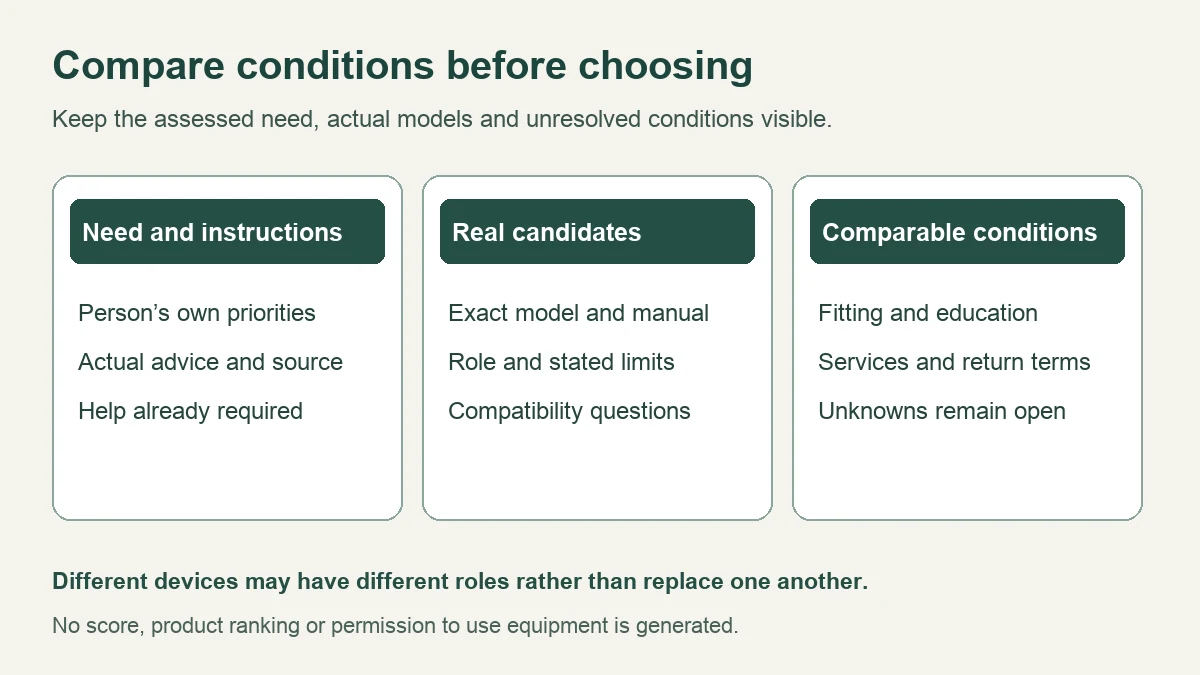
Home care equipment: seven essential comparison checks
Start with the person’s priorities and existing information
Keep pain, sleep, daily tasks, preferences, current restrictions and assistance needs together. A frequently repeated task does not automatically outrank a less frequent serious concern. No function-first rule, pain-per-dollar ratio or room-first buying order applies. Existing experiences are enough to raise a question; a family member need not witness failure.
Keep clinical needs separate from a product claim
A claim such as comfort, stability or independence describes a sales proposition, not individual suitability. Ask what the proposed device is intended to do in this person’s circumstances and what remains outside its role. A familiar design or positive review does not answer weight-bearing, cognition, support or procedure-specific questions.
Identify the exact candidate and matching instructions
Retain the actual model and document source. Different versions can have different conditions. Ask the supplier for the relevant instructions and stated limits rather than copying a generic demonstration from another device. This guide provides no universal handle height, clearance, weight limit or adjustment method.
Confirm the person–environment–help conditions
Ask the relevant professional about the person’s needs, the actual setting and required help. Ask the supplier which documented product and installation requirements apply. A device fitting through a doorway does not alone confirm it is usable there. A family label such as low risk is not an assessment.
Ask who will fit, install and teach
Before choosing, clarify responsibility and service scope: what is offered, by whom and under what conditions. Planned training is not training received. If a supervised trial or assessment is proposed, follow its actual professional arrangements and product instructions; this page does not prescribe an unsupervised home trial.
Compare written offers on equivalent scope
Keep the item and services distinct. Delivery, setup, individual fitting, clinical assessment, education, repairs and return collection may be different services; confirm the actual offer. Record exclusions and conditions. No list price, expected saving, coverage approval or universal rental-versus-purchase winner is generated.
Preserve unresolved questions before a decision
Retain who answered, what was actually said and what remains unknown. A booking is not assessment, a receipt is not fitting and a supplier’s statement is not clinical clearance. Ask the appropriate role for a plan when current needs remain unmet; do not invent a waiting period or substitute method while comparing.
Equipment roles and limits need different questions
| Candidate category | Role question | Boundary to verify |
|---|---|---|
| Walking aid: cane, walker or rollator | Which actual aid and use instructions address the assessed need? | Do not substitute a different aid from a blog comparison. Confirm individual instructions and exact-model limits. |
| Bathroom seating or hand support | Does the concern involve sitting, access, support or assistance, and what assessment is needed? | Different roles may be complementary. A seat does not itself confirm a transfer or installation plan. |
| Portable adult bed rail | Is a rail appropriate at all, and what alternatives should be considered? | Entrapment and falls are material risks; compatibility and assessment matter. It is not a default safety purchase. |
| Reaching or dressing aid | What specific task and current instruction would it support? | Small size or low price does not establish appropriateness or remove assistance needs. |
| Environmental change or care support | Is the unmet need about the setting, equipment, teaching or actual assistance? | A device cannot automatically replace a person, service or change in the care plan. |
The AAOS guide to crutches, canes and walkers provides general walking-aid education. It is not a model-by-model rollator evaluation or an instruction to change an aid. Seat use, brake operation, transport claims and other features need the matching manufacturer instructions and appropriate individual advice; no general photograph establishes those permissions.
For adult portable bed rails, FDA guidance identifies entrapment and fall risks, particularly with factors such as confusion, restlessness or impaired muscle control. It also warns that rails, mattresses and frames are not universally interchangeable. Ask about appropriateness, alternatives and compatibility; rails do not replace monitoring. This article gives no installation or gap-measurement tutorial.
The MedlinePlus home-preparation page concerns knee or hip surgery and advises discussing preparations with the treating team. Its equipment examples are not a universal buying list for all orthopedic pain. The NHS handling guide supports seeking advice before purchasing moving or lifting equipment. Its UK service arrangements do not establish U.S. funding or service access.
Separate real answers from promises and offers
In a useful home care equipment comparison, answers remain attributed. A professional may need to assess the person and setting; a supplier may explain a specific manual and commercial terms. An insurer or benefit administrator may explain its actual requirements. None of those answers automatically settles questions belonging to the other roles.
Ask a clinical question plainly: “Given the actual need and current instructions, what should be assessed, what help is required, and which questions remain before considering this candidate?” Ask the supplier: “For this exact model and setting, what conditions apply, and who provides installation, fitting and education?” Record a response only after it is actually received.
For money questions, request the actual quote, the included services and any exclusions or return conditions. If payment support matters, ask the relevant plan or administrator about the specific item and circumstances. No coverage guarantee, tax conclusion or estimated out-of-pocket amount follows from this guide. Do not delay necessary care while seeking a price comparison.
A proposed next step may be assessment, a document request, a different candidate discussion or clarification of needed support. This page does not prescribe an approval sequence. If instructions conflict, retain the actual sources and seek clarification from the responsible team rather than selecting the answer that makes purchasing easiest.
Once equipment arrives, use the separate delivery, fitting, education and handover record to distinguish an offer from work really completed. This page deliberately stops at pre-purchase questions and confirmed conditions. It does not certify the delivered item or close an unresolved care need.
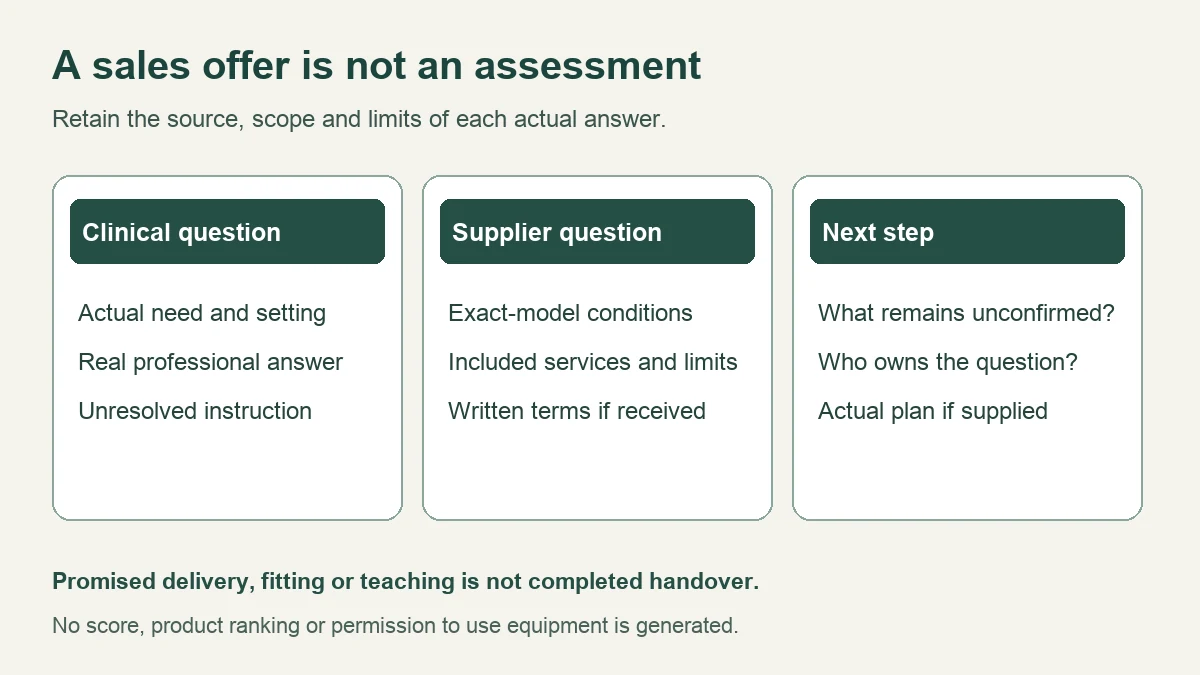
Two fictional candidate-comparison writing examples
These are invented records, not real families, product tests, professional recommendations or successful outcomes. No model, price, permission or clinical answer is fabricated. They illustrate how to retain uncertainty without a score or preferred purchase.
Example A: bathroom candidates have different roles
| Record | Fictional entry |
|---|---|
| Existing concern | The person wants to discuss an already experienced bathroom-task difficulty. No demonstration is requested. |
| Candidates | A shower seat and a grab support have been mentioned. Exact models and instructions are not supplied. |
| Comparison issue | They may address different needs rather than replace one another. Suitability, assistance and installation are unconfirmed. |
| Question prepared | What need should be assessed, which roles are relevant, and what help or installation conditions would apply? |
| Actual answer / next step | No professional or model-specific supplier reply supplied. No interim technique, purchase choice or safety outcome invented. |
A question could read: “These options appear to have different roles. Could you clarify the actual need, required assistance and conditions to assess before we consider either?” It does not conclude that buying both resolves the problem.
Example B: two offers include different services
| Record | Fictional entry |
|---|---|
| Proposed role | Two offers are being discussed for the same proposed equipment role; exact models are not supplied. |
| Offer A | Delivery is described. Individual fitting and education are not confirmed. |
| Offer B | Delivery, fitting and education are described as included, but actual conditions remain unconfirmed. |
| Remaining questions | Do the models and services match? What is excluded, who provides fitting and education, and what return conditions apply? |
| Actual answer / decision | No new supplier or clinical reply supplied. No price, savings estimate, winner, completed teaching or purchase claimed. |
A question could read: “Please confirm the exact model and an itemized scope for each offer. Are assessment, fitting, installation and education included, and what limits apply?” A fuller offer is not automatically the appropriate one; clinical suitability and real terms remain separate questions.
Private pre-purchase questions and actual-answer record
Download the offline tool before entering actual health or care details. Use fictional entries on this webpage because surrounding ads and analytics may be present. The tool itself makes no network requests, uses no browser storage and does not save automatically. The offline export contains no external assets or automatic network requests.
You may leave fields blank. The record repeats your entries and adds optional clarification questions for blanks; it cannot decide suitability or recommend a purchase. Omit names, addresses, private contacts, identifiers, photographs of labels and full reports. Share relevant details only through an agreed private channel. A paper record with the same headings works.
Pre-purchase questions, candidate conditions and actual answers
Begin with one concern and one or two actual candidates. Unknown fields are welcome.
Download the offline tool before entering actual health or care details. Use fictional entries here; surrounding ads and analytics may be present.
Offline copy. No ads, analytics, external assets or automatic network requests.
The tool makes no network requests, uses no browser storage and does not automatically save. Refreshing may lose entries. Omit names, addresses, private contacts, identifiers and full reports. A comparison cannot replace needed assessment or assistance.
Start with the fictional example or download a blank offline copy.
Paper alternative: priorities; current instructions; candidates A and B; documented conditions; clinical answer; supplier answer; actual quote scope; remaining question; actual next step.
My equipment comparison questions and answers
Unverified personal record for discussion. Entries verify no diagnosis, advice, completed change or treatment outcome.
Guide: living.kioptrix.com/orthopedic-home-care-equipment-2/
Build the record, then copy, download text or print/save PDF. Editing hides the old result until rebuilt. The example buttons replace entries and mark the output fictional. Offline downloads include current entries; keep completed copies private. Refreshing or closing may lose unsaved work. Nothing is sent, booked, assessed or approved by this tool.
Common pre-purchase comparison questions
Can the worksheet select the safest product?
No. It organizes known conditions and questions. It is not a validated safety, eligibility or purchasing instrument.
Should frequent tasks get a higher score?
No score is assigned. Frequency can describe ordinary life, but it does not determine the importance of a serious concern or override individual instructions.
Must we repeat the difficult movement?
No. Use existing experiences and records. A new movement demonstration or endurance trial is not required to prepare a question.
Does a supplier fitting offer establish clinical suitability?
No automatic conclusion follows. Retain the actual supplier scope and relevant professional assessment separately.
Is rental always better for short-term use?
No universal answer is supplied. Compare actual terms, model, service scope and circumstances without inventing a recovery period or expected saving.
Is this the same as checking delivered equipment?
No. This is for questions before choosing. Delivery, setup, fitting, education and correction actually completed belong in the separate handover record.
Sources, editorial corrections and limits
Editorial revision and source check: October 30, 2026. This revision removes task scores, purchase hierarchies, timed walkthroughs, repeated caregiver tests, eligibility shortcuts and unverified first-person stories. The static “calculator” and promotional duplicated artwork are replaced. Earlier update notes are not represented as independent medical review.
- NHS: Moving, lifting and handling someone else — general handling assessment, education and pre-purchase advice, not procedure-specific permission or U.S. service entitlement.
- AAOS: How to use crutches, canes and walkers — general walking-aid education; not a rollator model comparison or authorization to substitute devices.
- FDA: Consumer and caregiver recommendations about adult portable bed rails — selected risk, monitoring and compatibility considerations; not a blanket recommendation or installation tutorial.
- MedlinePlus: Getting your home ready—knee or hip surgery — surgery-specific preparation, not a universal equipment list.
- MedlinePlus: Recognizing medical emergencies and NHS: Falls — selected warning examples; not a complete triage tool.
The seven checks, comparison tables and record are editorial communication aids. No product performance testing, actual quotes, model-specific manufacturer verification, clinical validation or independent usability study is claimed. These limits matter: documented questions are useful, but they do not establish that a product is suitable or that a care need has been met.
The representative image is an AI-generated fictional consultation, not a real patient assessment or product endorsement. Two editorial diagrams illustrate candidate conditions and attributed answers. No promotional promise of pain relief, independence or safer daily living is implied.