
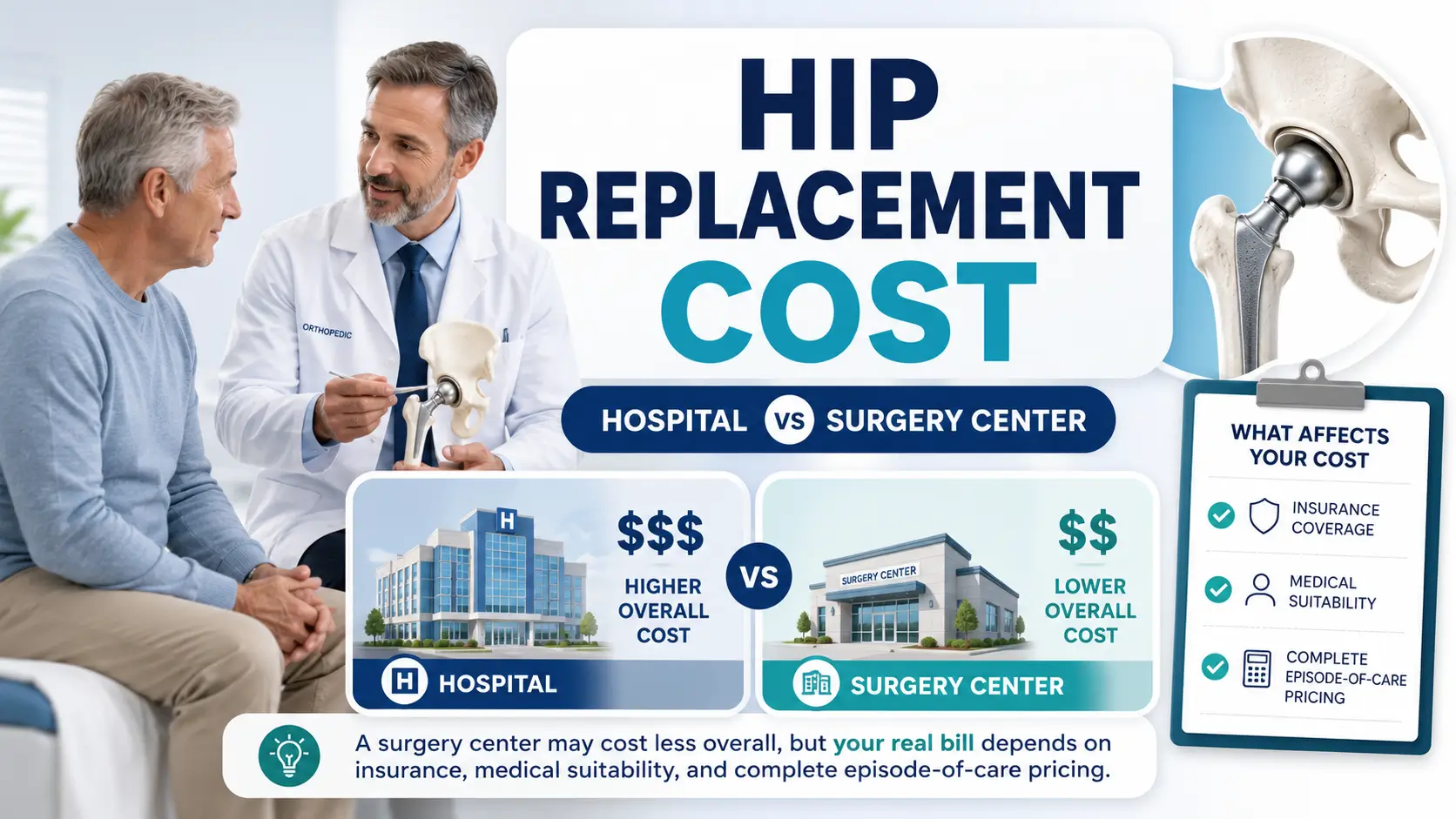
Hip Replacement Cost: Hospital vs Surgery Center
A freestanding ambulatory surgery center can cost the health-care system less for an outpatient hip replacement than a hospital outpatient department. That does not automatically mean your own bill will be lower.
Your real cost depends on the facility, surgeon, anesthesia, implant-related charges, insurance network, deductible, coinsurance, prior authorization, and whether you are medically suitable for same-day outpatient surgery.
This guide focuses on U.S. total hip replacement and shows how to compare hospital and surgery-center estimates without choosing a surgical setting on price alone.
This article is for U.S. patients comparing a hospital outpatient department with a freestanding ambulatory surgery center for primary total hip replacement. The biggest variables are medical suitability and your specific insurance contract. By the end, you should know which prices to compare, which questions to ask, and when a lower-cost surgical setting may or may not make sense.
Cost should not determine surgical setting by itself. Your surgeon and anesthesia team should consider your health conditions, expected monitoring needs, home support, mobility, and ability to recover safely after discharge. Insurance rules also vary by plan. Confirm both medical suitability and coverage before scheduling.
Table of Contents
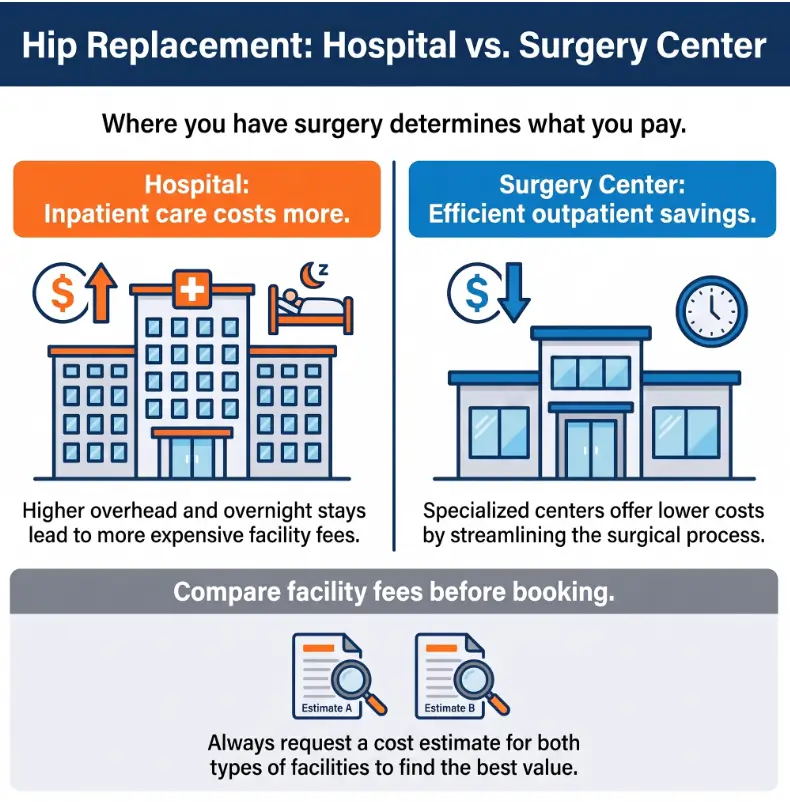
Hospital vs Surgery Center: Which Usually Costs Less?
A freestanding ambulatory surgery center, or ASC, will often have a lower total allowed payment for an eligible outpatient procedure than a hospital outpatient department. But your personal out-of-pocket cost can follow different rules, so comparing facility prices alone can produce the wrong answer.
Medicare itself provides a procedure-price comparison tool specifically for procedures that may be performed in both ambulatory surgery centers and hospital outpatient departments.
Lower total cost means the combined amount paid to providers may be lower. Lower patient cost means your deductible, copay, and coinsurance result in a smaller personal bill. Those are related, but they are not the same thing.
An ASC is a facility designed around outpatient procedures. A hospital outpatient department can also perform same-day hip replacement, but it operates within a hospital system with broader diagnostic, inpatient, emergency, and monitoring capabilities.
Total hip replacement has been on Medicare’s ASC covered-procedure list since 2021, but coverage eligibility does not mean every patient should have the operation there. CMS and orthopedic organizations continue to emphasize appropriate patient selection.
| Setting | Often fits | Main financial advantage | Main limitation |
|---|---|---|---|
| Freestanding ASC | Appropriately selected outpatient patients | Lower facility-level spending may be possible | Less appropriate when additional hospital resources or observation may be needed |
| Hospital outpatient department | Patients suitable for outpatient surgery who may benefit from hospital infrastructure | Insurance cost sharing may sometimes be favorable despite a higher allowed facility amount | Facility charges can be higher |
| Hospital inpatient stay | Patients whose clinical needs justify inpatient admission | Provides inpatient monitoring and services when medically necessary | Different benefit rules and potentially greater total spending |
The word hospital also needs clarification. A hip replacement performed at a hospital may be billed as outpatient care or as an inpatient admission. Those statuses can trigger very different insurance rules.
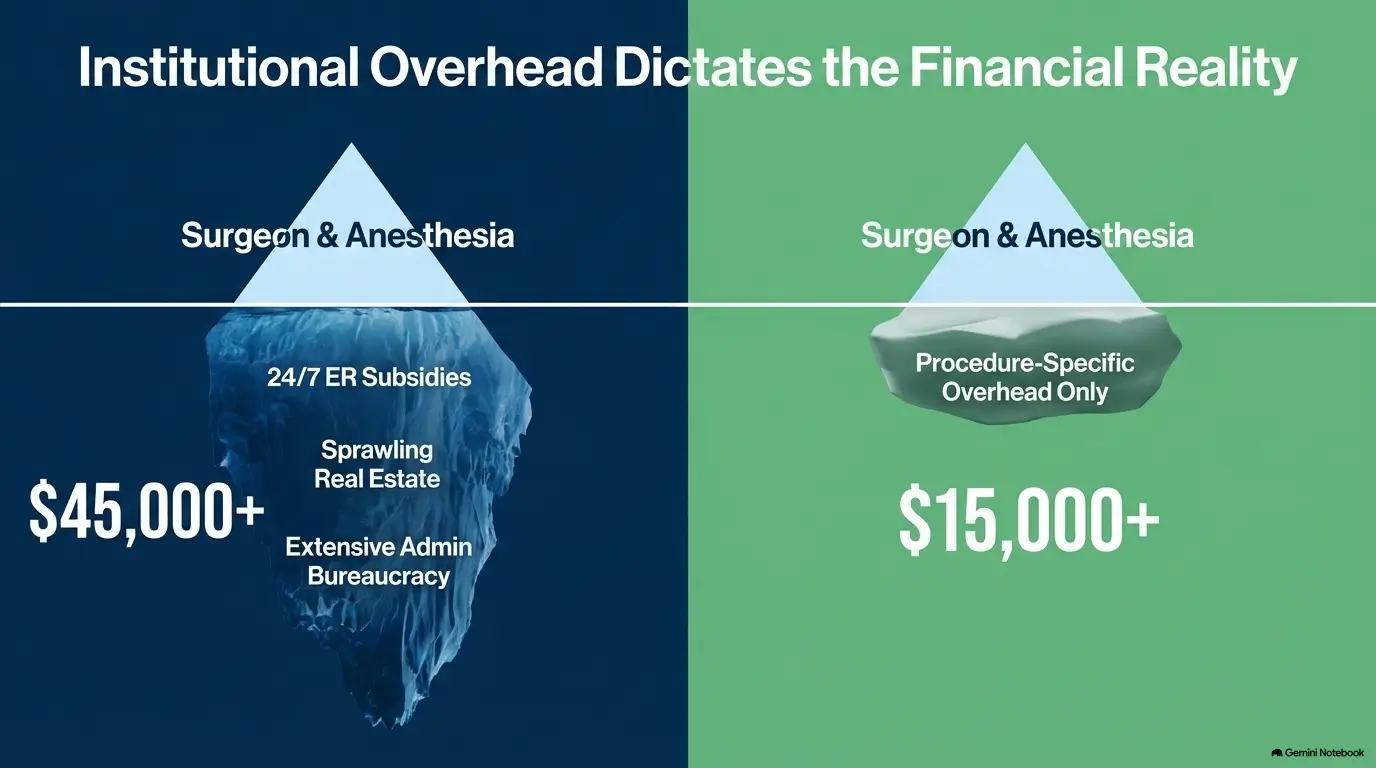
What Changes the Cost of Hip Replacement?
Hip replacement does not arrive as one universal price. The final amount is assembled from multiple clinical and financial components, some of which may come from separate organizations.
1. Facility charges
The facility component can cover the operating room, recovery area, nursing, routine supplies, and other services associated with using the surgical facility. This is often where the largest difference between a hospital outpatient department and freestanding ASC appears.
If the estimate contains an unfamiliar line called a facility fee, this guide to facility fees in orthopedic care explains why the location of care can change the bill even when the surgeon is the same.
2. Surgeon and professional fees
The surgeon’s professional service can be billed separately from the facility. Do not assume a facility quote automatically includes the surgeon’s bill.
3. Anesthesia
Anesthesia services may involve a separate physician or anesthesia group. A facility can be in network while the anesthesia arrangement follows a different billing pathway, so ask explicitly how anesthesia will be billed.
If you are trying to make sense of this particular piece, see why a separate anesthesia bill can appear after surgery.
4. Implant and supply accounting
Do not compare two estimates until you know whether implant-related costs and major supplies are incorporated into the quoted facility amount or handled elsewhere. The important question is not simply, “What does the implant cost?” It is, “Is everything required for my planned procedure represented in this estimate?”
5. Preoperative and postoperative care
Imaging, laboratory testing, medical clearance, physical therapy, medications, equipment, home assistance, follow-up visits, and unexpected additional care may sit outside the procedure quote.
2026 Medicare Example: The Counterintuitive Cost Difference
Original Medicare provides one of the clearest examples of why “lower facility cost” and “lower patient cost” should be separated.
For CPT 27130, primary total hip replacement, 2026 national-average Medicare figures place the combined ASC amount at roughly $10,778, versus about $14,278 in a hospital outpatient department. Yet the listed beneficiary share is approximately $2,154 at the ASC and $1,968 at the hospital outpatient department. These are Medicare national averages, not a personalized quote. Location, deductible status, supplemental coverage, and other circumstances can change what a beneficiary ultimately pays.
| 2026 Medicare national-average example | ASC | Hospital outpatient |
|---|---|---|
| Approx. combined allowed amount | $10,778 | $14,278 |
| Approx. listed patient share | $2,154 | $1,968 |
| What this illustrates | Lower overall allowed amount | Lower listed beneficiary share in this example |
Why can that happen? Medicare generally applies 20% cost sharing to covered ASC services under Part B, while hospital outpatient copay rules include statutory limits that can affect high-cost services. The 2026 Part B deductible is $283, and the 2026 inpatient Part A deductible used in relevant outpatient copay limitations is $1,736.
Technical depth: Why the Medicare percentages do not look symmetrical
The ASC example behaves roughly like ordinary Part B coinsurance: the beneficiary share is tied to a percentage of Medicare-approved facility and physician amounts.
Hospital outpatient cost sharing works differently for high-cost services because Medicare limits the copayment that can apply to an individual hospital outpatient service. That can make a hospital outpatient department’s beneficiary copayment lower than a straight percentage of the hospital’s much larger total allowed amount.
This is why multiplying a posted facility price by 20% is not a reliable substitute for checking the Medicare Procedure Price Lookup or your insurer’s own personalized estimate.
Medicare’s 2026 handbook also states that covered ASC procedures generally involve 20% beneficiary cost sharing for both the ASC and treating doctor after the applicable Part B deductible, while hospital outpatient services use their own copayment rules.
For an Original Medicare beneficiary, the hospital outpatient option can sometimes produce lower listed patient cost sharing for a high-cost procedure. Check your own coverage before deciding.
Check Medicare’s Hip Replacement Price Lookup
Are You a Good Candidate for a Surgery Center?
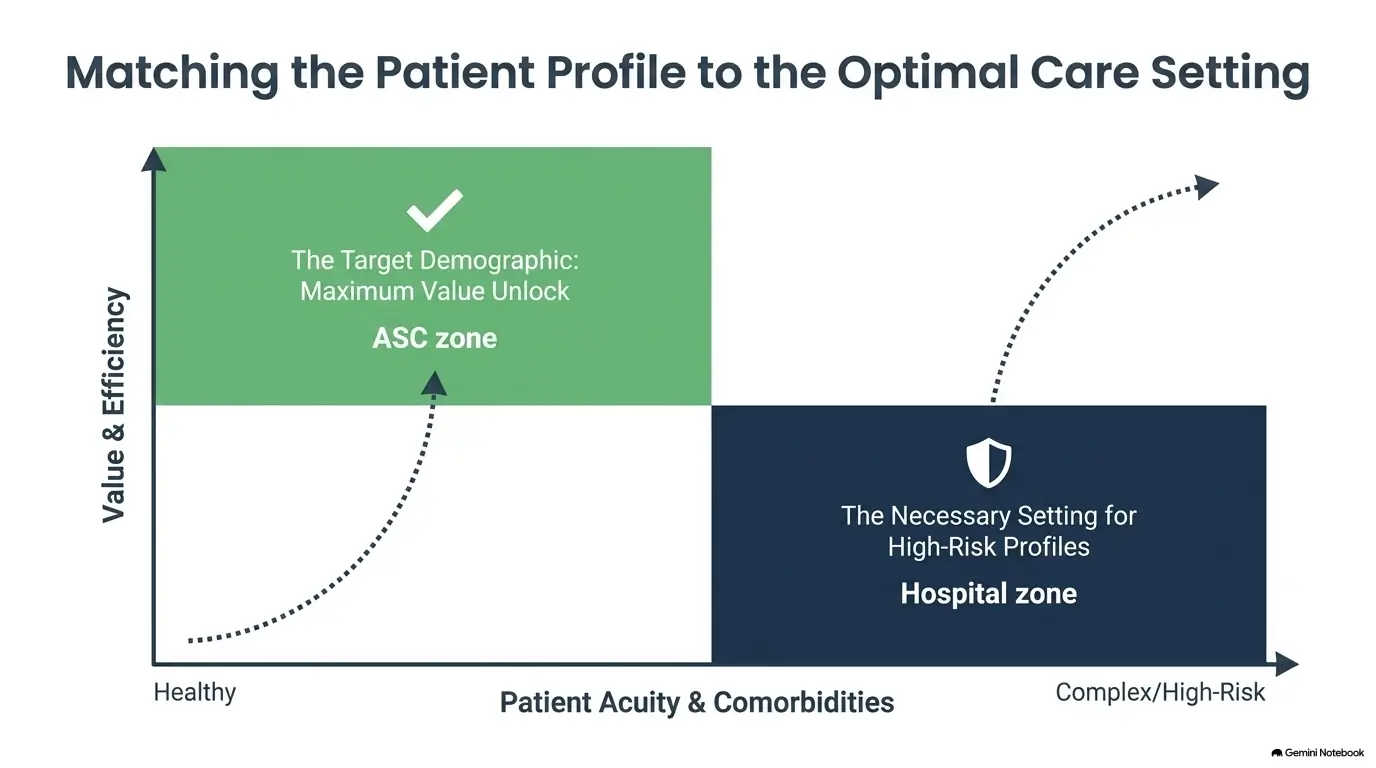
The right candidate for ASC hip replacement is not defined by insurance eligibility alone. Patient selection is a major part of safe outpatient joint replacement planning.
The American Academy of Orthopaedic Surgeons notes that patient selection is especially important for outpatient joint replacement, and the American Association of Hip and Knee Surgeons says outpatient programs require individualized selection, perioperative planning, pain management, education, and postoperative coordination.
A surgeon may consider factors such as your overall medical stability, existing conditions, anesthesia risk, mobility, expected blood loss or complication risk, ability to manage pain and medications at home, available caregiver support, and distance from appropriate follow-up or emergency care.
The budget-conscious patient
If you are medically appropriate for same-day outpatient replacement, have reliable support at home, and both facilities are in network, comparing an ASC with a hospital outpatient department is reasonable. A lower-cost ASC may be entirely sufficient.
The higher-support patient
If your surgical team expects that you may need prolonged monitoring, additional medical management, or a greater chance of admission, a hospital setting may offer resources that matter more than the difference between two facility estimates.
AAOS explains that some total hip replacements are performed as same-day outpatient procedures while others involve admission, and that the plan should be discussed with the surgeon before surgery.
“Based on my specific medical history, what is the clinical reason you recommend an ASC, a hospital outpatient department, or inpatient admission, and what would make you change that plan?”
You can review AAOS guidance on outpatient joint replacement and patient selection for additional context.
What Should a Hip Replacement Estimate Include?
A useful estimate should let you identify the organizations likely to bill you. A one-line “hip replacement price” is not enough if it quietly excludes major professional services.
Before comparing facilities, ask for estimates that address the same scope. Your working checklist should include:
- facility fee;
- surgeon’s professional fee;
- assistant surgeon, if expected;
- anesthesia professional charge;
- implant and routine surgical supplies;
- preoperative laboratory or imaging services;
- medical clearance or specialist consultations;
- post-anesthesia recovery;
- planned physical therapy;
- walker or other durable medical equipment;
- routine postoperative visits;
- medications obtained separately;
- what happens financially if outpatient discharge changes to hospital admission.
If you want a reusable way to organize those components, the orthopedic surgery estimate checklist provides a useful companion framework.
Cash-pay and self-pay patients have an additional protection
If you are uninsured or choose not to use insurance, federal rules generally give you the right to receive a good faith estimate for scheduled care. CMS states that a self-pay patient may be eligible for the patient-provider dispute process if a final bill from a provider or facility is at least $400 above its good faith estimate.
If your surgeon considers you an appropriate ASC candidate, the ASC is in network, the complete estimate is lower for you, and its discharge and follow-up plan meets your needs, there is no financial virtue in paying more merely to have the procedure inside a hospital building.
Insurance, Network Status, and Prior Authorization
With commercial insurance or Medicare Advantage, your plan’s own cost-sharing estimate is usually more useful than a generic national price. The relevant questions are whether the facility and clinicians participate in your exact network, what deductible remains, how coinsurance applies, and whether authorization or other plan requirements have been met.
Federal Transparency in Coverage rules require most applicable group health plans and insurers to provide members with personalized cost-sharing information through online price-comparison tools, covering all items and services under the phased requirements in effect since 2024.
Hospitals also must publish pricing information, including machine-readable data and consumer-facing information for shoppable services. CMS began enforcing updated 2026 hospital price-transparency requirements on April 1, 2026.
Review CMS Hospital Price Transparency Resources
Use this insurance verification script
Call the number on your insurance card with the facility names and surgeon information in front of you. Ask:
- Is total hip replacement covered under my current plan when medically necessary?
- Does my plan require prior authorization?
- Is this specific surgery center in my network?
- Is this specific hospital outpatient department in my network?
- Is my surgeon in network at both locations?
- How will anesthesia be handled for network purposes?
- What deductible remains today?
- What copay or coinsurance applies to each facility?
- Can you give me a personalized cost estimate for CPT 27130 at both locations?
- Would an unexpected hospital admission change my cost-sharing category?
- Can you provide a reference number for this call?
If authorization is part of your plan, use the orthopedic prior authorization checklist before assuming the surgeon’s scheduling office has resolved every payer requirement.
Do not ask only, “Is my surgeon in network?” A surgeon may operate at several locations. Your cost can change substantially depending on which facility is scheduled, even when the operation and surgeon are unchanged.
When a Hospital May Be Worth the Higher Facility Cost
Paying more for a hospital setting can be reasonable when the extra clinical infrastructure materially matters to your case. The value is not the hospital logo. It is access to services your surgical team believes you may need.
A hospital may be preferred when medical conditions require more monitoring, when same-day discharge is uncertain, when the surgeon expects a higher chance of inpatient care, or when postoperative support at home is inadequate.
| Decision path | Best fit | Cost logic | Verify |
|---|---|---|---|
| Good: ASC | Low-risk patient judged appropriate for same-day outpatient care | Lower facility spending may be sufficient | Your out-of-pocket estimate and contingency plan |
| Better fit: Hospital outpatient | Outpatient candidate who benefits from hospital-based resources | Higher facility amount can be justified by clinical needs or insurance cost sharing | Whether observation or admission is anticipated |
| Higher-support: Inpatient hospital | Patient whose condition supports inpatient admission | Cost is secondary to medically necessary hospital-level care | Admission status and insurance coverage |
“Best” therefore does not mean most expensive. It means the setting that matches your medical needs without buying unnecessary capacity.
Short Story: A cheaper facility that is not automatically the cheaper choice
This is an illustrative scenario.
A patient is offered the same primary hip replacement by the same surgeon at a freestanding ASC and a hospital outpatient department. The ASC’s total negotiated facility amount is lower.
The patient’s insurance portal, however, shows that the hospital outpatient option would leave a smaller personal balance because the two facilities sit under different cost-sharing rules. Meanwhile, the surgeon says the patient is clinically suitable for either setting.
The patient therefore has two separate comparisons: health-system price and personal price. Only the second determines the immediate household expense.
If the surgeon instead believed hospital monitoring was important, the cost comparison would move down the priority list. The spreadsheet cannot overrule the clinical plan.
Costly Mistakes When Comparing Hip Replacement Prices
The most expensive errors usually begin with an incomplete comparison rather than an obviously bad price.
| Mistake | Why it costs money | Safer move |
|---|---|---|
| Comparing sticker prices | They may not reflect your insurer’s negotiated amount | Compare personalized allowed and out-of-pocket estimates |
| Checking only the surgeon’s network status | The facility and anesthesia group may follow different contracts | Verify every major billing entity |
| Assuming ASC means lower patient cost | Cost-sharing rules can reverse the apparent advantage | Get estimates for both settings |
| Ignoring prior authorization | A coverage problem can dwarf modest facility savings | Confirm authorization before surgery |
| Comparing incomplete estimates | One quote may omit anesthesia, therapy, or other charges | Normalize both estimates to the same scope |
| Choosing by price despite greater medical needs | An unsuitable setting can create avoidable clinical and financial complications | Let clinical suitability define the eligible options first |
A simple comparison worksheet
Create two columns, one for the hospital and one for the ASC, then fill in these six lines:
- facility expected patient cost;
- surgeon expected patient cost;
- anesthesia expected patient cost;
- known preoperative costs;
- known recovery and therapy costs;
- maximum expected exposure if the discharge plan changes.
Then add a final nonfinancial line: “Does my surgeon consider both settings equally appropriate for me?”
If bills later arrive from several organizations, the guide to orthopedic bills from multiple providers can help you map each charge back to the episode of care.
FAQ
Is hip replacement cheaper at a surgery center than a hospital?
The total allowed amount can be lower at an ambulatory surgery center, but your personal cost is determined by your insurance benefits and may not follow the same pattern. Original Medicare’s 2026 national-average example for total hip replacement illustrates this clearly.
Does Medicare cover hip replacement at an ambulatory surgery center?
Medicare includes primary total hip arthroplasty among procedures that can be covered in an ASC when applicable Medicare requirements are met. The fact that a procedure is ASC-covered does not establish that an individual patient is medically suited to have it there.
Why can Medicare patient cost be higher at an ASC?
ASC and hospital outpatient cost sharing are governed by different payment mechanics. For high-cost hospital outpatient services, Medicare’s copayment limits can produce a lower beneficiary share even when the hospital’s overall allowed amount is higher.
Should I choose a surgery center to save money?
Only after your surgeon determines that the ASC is an appropriate setting for you. If both settings are clinically reasonable, then comparing your personalized cost, network status, discharge plan, and billing scope becomes useful.
Can a hospital and surgery center quote the same surgeon?
Yes. Surgeons may operate at more than one facility. This makes facility-specific insurance verification especially important because the surgeon’s network status alone does not establish the cost of the entire episode.
What if I have Medicare Advantage instead of Original Medicare?
Use your plan’s specific network and cost-sharing information rather than applying Original Medicare’s national-average patient amounts. Ask whether authorization is required and request estimates for each proposed facility.
What if I am paying cash for hip replacement?
Ask for a written good faith estimate and confirm which providers and services it covers. CMS states that uninsured or self-pay patients generally have federal good-faith-estimate protections for scheduled services.
Your 15-Minute Hip Replacement Cost Check
You do not need to solve the entire billing system today. You need two comparable estimates and one clear clinical answer.
- Write down the exact hospital outpatient department and ASC being considered.
- Ask your surgeon whether both settings are medically appropriate for you.
- Find CPT 27130 in your insurer’s estimator or Medicare’s Procedure Price Lookup.
- Record your expected out-of-pocket amount for each facility.
- Confirm the surgeon, facility, and anesthesia network status.
- Check whether prior authorization has been approved.
- Ask what is excluded from each estimate.
- Ask what happens to your bill if same-day discharge becomes hospital admission.
First identify the settings that are medically appropriate. Then compare what you are expected to pay for the same complete episode of care, not merely which building has the lower facility price.
Last reviewed: August 12, 2026