
This site is written from a family-caregiver perspective. The operator is not a medical professional or an insurance, legal or financial adviser. Use this guide to organize questions for the relevant service.
Work from the actual denial notice
Use this follow-up record alongside the guide below. It does not determine medical suitability, insurance eligibility or legal rights, and it does not guarantee a price.
- Keep together
- Denial document, exact reason, relevant order and records, stated procedure and deadline information.
- Unanswered question
- Which process applies to this denial and who can supply the missing information?
- Next contact and owner
- Confirm the process with the plan or contractor and clinician; retain submission and receipt evidence.
- Recheck when
- A new decision, requested record or deadline notice arrives.
For each response, record its date, source, reference number and what remains uncertain. Agree the next follow-up date instead of treating silence as confirmation. Use official contact channels and keep identifying health, account and policy information out of public comments.

Insurance Appeal Guide
How to Appeal a Denied Brace or Support for Joint Pain
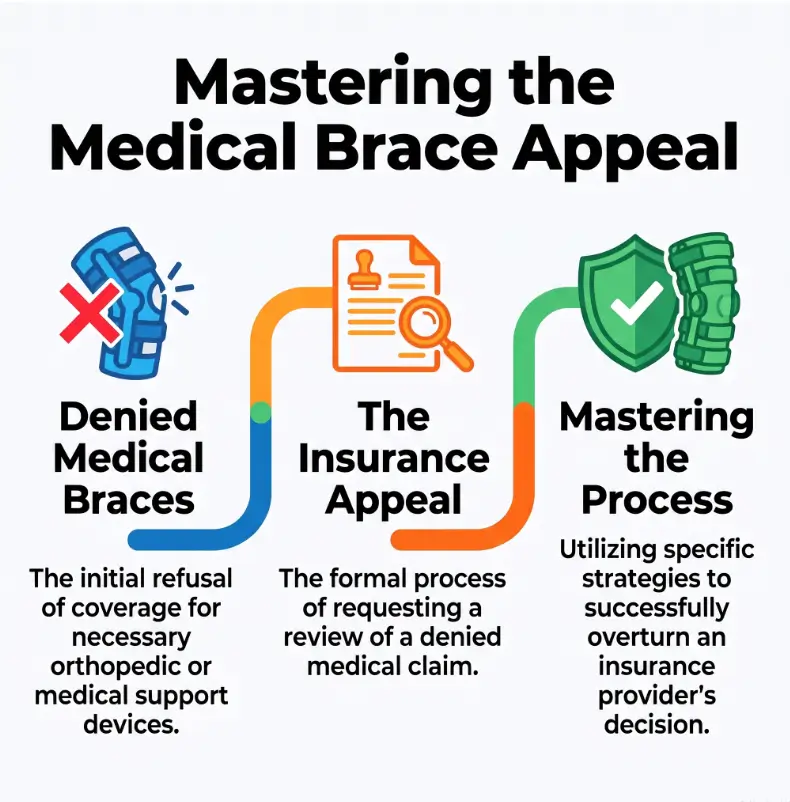
A brace denial can feel strangely personal. Your knee buckles, your wrist will not settle, or your back needs support, yet the insurer replies with a cold sentence about medical necessity, coding, authorization, or coverage rules.
The useful question is not simply, “Why did they say no?” It is, “What exact fact, document, code, or procedure would have produced a different review?” Once you identify that missing link, the appeal becomes less of a paper storm and more of a repair job.
This guide shows you how to read the denial, build a focused evidence packet, coordinate the clinician and supplier, choose the correct appeal route, and protect your health while the paperwork moves through the system.
The denial letter is not the end of the road. It is the map legend. 🧭
This guide is for U.S. patients and caregivers appealing a denied prescription brace, orthosis, splint, or joint support. You will learn how to identify the denial type, gather the right records, compare appeal routes, avoid wasted spending, and create a one-page action map you can use today.
Table of Contents
This article provides general educational information, not medical, legal, or insurance advice. Coverage depends on your plan, diagnosis, device classification, coding, supplier, documentation, and applicable rules. Confirm deadlines and procedures with the plan. Do not delay urgent medical care or use an unsuitable replacement brace while waiting for an appeal decision.
Read the Denial Before Writing the Appeal
The fastest way to weaken a brace appeal is to answer the wrong question beautifully. A six-page letter about pain will not correct an invalid supplier number. A new billing code will not cure a genuine medical-necessity denial.
Begin with the adverse-benefit notice, explanation of benefits, prior-authorization decision, Medicare Summary Notice, or plan letter. Read it with a pen nearby. The sentence that identifies the reason for denial determines what you must fix.
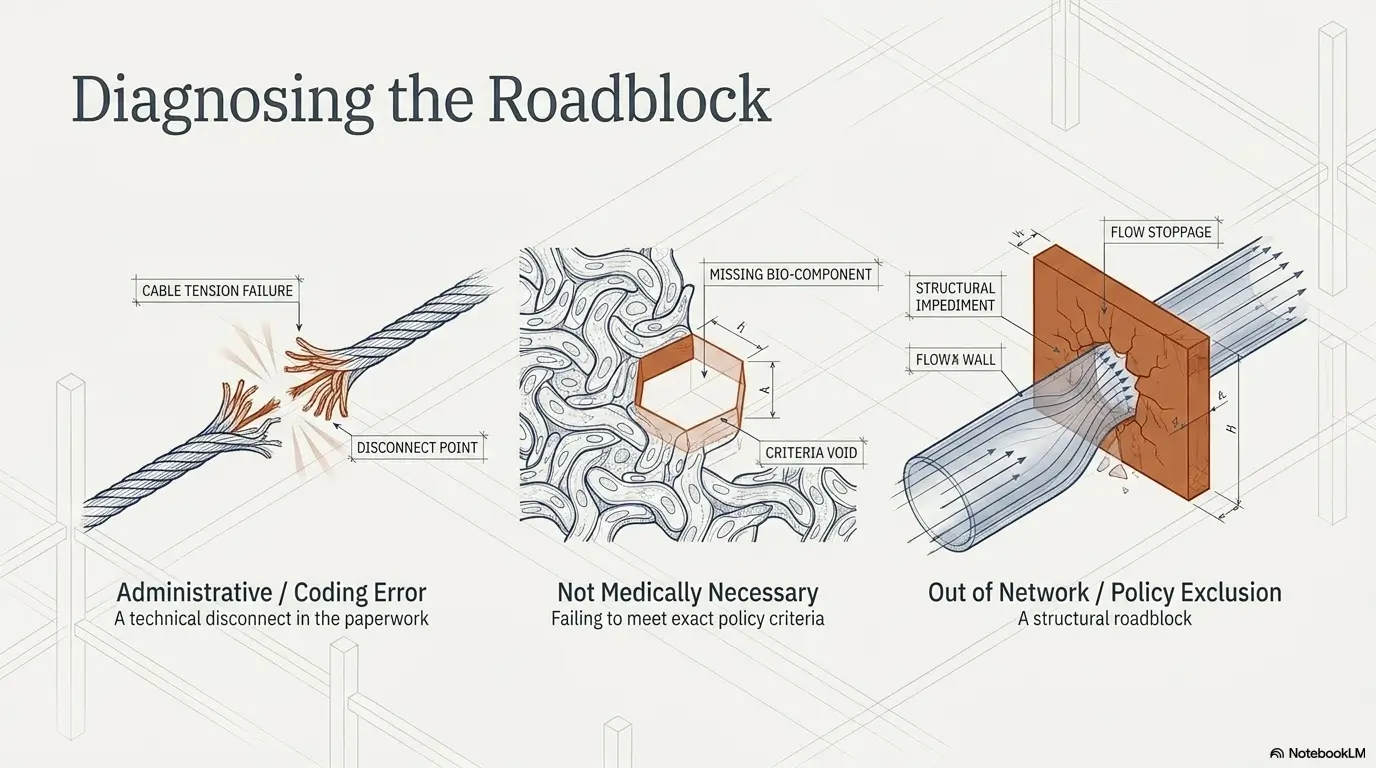
Identify the exact denial category
- Medical necessity: The records did not show why the device was clinically required.
- Benefit exclusion: The plan treats the item as non-covered, convenience equipment, or outside the benefit definition.
- Prior authorization: Approval was not obtained before ordering, fitting, or delivery.
- Coding error: The claim used the wrong HCPCS code, diagnosis code, modifier, or date.
- Supplier problem: The supplier was out of network, not enrolled, not qualified, or not permitted to bill for the item.
- Missing documentation: The claim lacked a signed order, qualifying encounter, clinical note, proof of delivery, or requested form.
- Same or similar equipment: The plan believes a comparable device was supplied previously.
If the codes look like alphabet soup wearing tiny neckties, review this plain-English guide to common orthopedic billing terms before calling the insurer.
Circle four details before making any calls
- The exact appeal deadline.
- The mailing address, fax number, portal, or form required.
- The claim, authorization, and member identification numbers.
- The policy, guideline, exclusion, or documentation rule cited.
Record the notice date and when it was received, then confirm the rule for that plan and appeal level. Deadlines may run from the date on the notice or from receipt, sometimes using presumed receipt rules. The day you opened the envelope is not a reliable substitute. If time is short, ask about a timely appeal with later supplementation; do not assume a phone call extends the deadline.
“Denied” is not a complete diagnosis of the claim. The reason code tells you whether to strengthen the medical record, correct the paperwork, change the supplier, request an exception, or follow a formal appeal route.
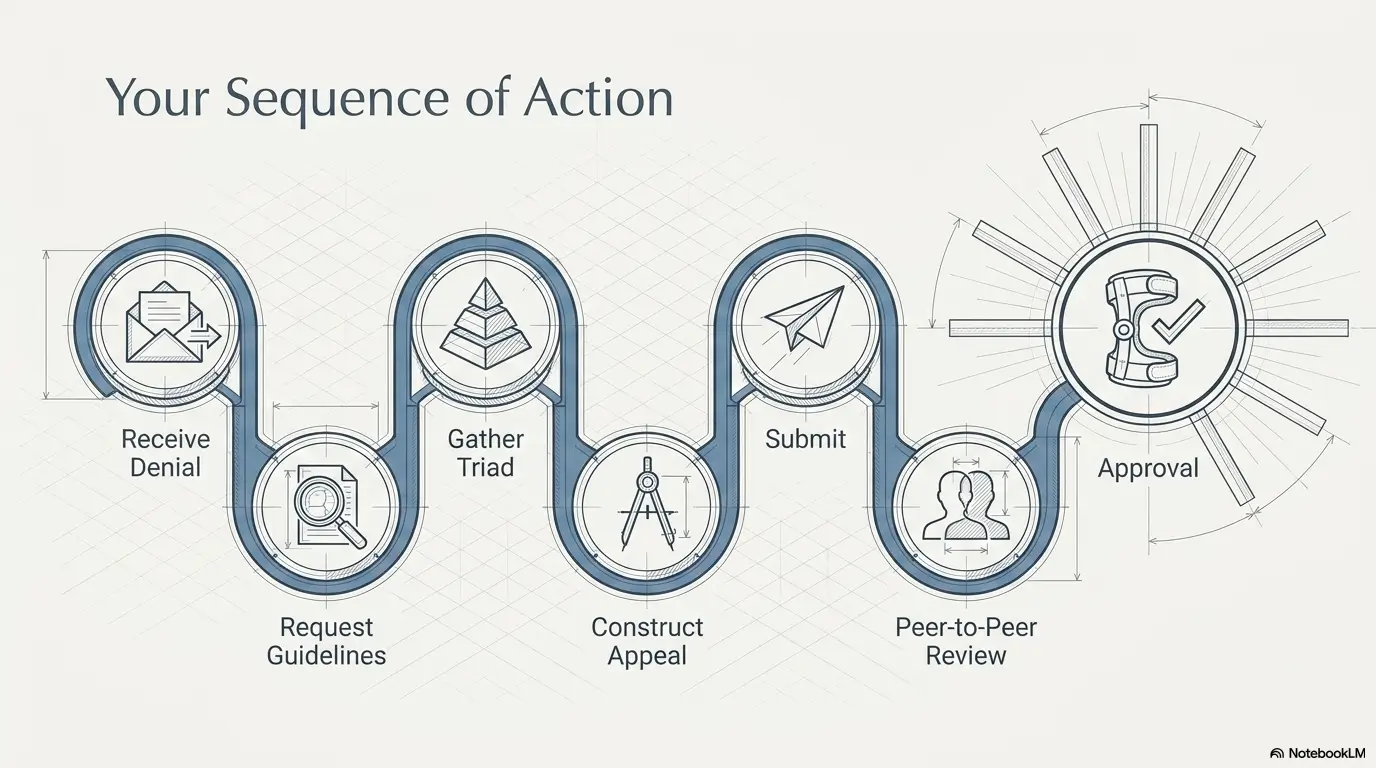
Use the five-step denial repair map
Request the policy criteria and reviewed documents
Ask member services to identify the exact criterion that was not met and the records considered during the decision. Request the applicable medical policy, durable medical equipment policy, orthosis guideline, benefit exclusion, or plan-document section.
Do not settle for “the system says it was denied.” Ask a narrower question: “Which clinical or administrative requirement was missing from the file reviewed on the decision date?”
Show me the nerdy details
An orthosis claim is often tested on several separate levels. The item may need to fit a covered benefit category, meet the plan’s definition of reasonable and necessary care, satisfy device-specific criteria, use the correct billing code, and comply with order, encounter, supplier, and delivery rules.
That is why a prescription alone may not be enough. The insurer may agree that support would help while still disputing the design, rigidity, custom feature, supplier, replacement timing, or documentation supporting the billed code.
Build the Evidence Packet Reviewers Actually Need
A strong appeal packet is not the thickest packet. It is the one in which every page answers a recognizable coverage question.
Think of the packet as a small case file with a table of contents. Place the denial first, followed by a one-page appeal summary, the medical evidence, the order, supplier information, and proof of timely submission.
Create the core appeal file
| Document | What it should prove | Common problem to check |
|---|---|---|
| Denial notice | The reason, deadline, and appeal level | Missing pages or an older decision notice |
| Prescription or written order | The exact item requested by the treating practitioner | Vague item description, missing date, or missing signature |
| Office or therapy notes | Diagnosis, examination findings, function, and treatment plan | Notes mention pain but not instability or functional loss |
| Imaging or operative report | Objective support when relevant | Report included without explaining how it relates to the brace |
| Medical-necessity letter | Why this device, for this condition, at this time | Generic language copied from a template |
| Claim and supplier records | Code, modifier, network status, authorization, and delivery details | Incorrect code or missing attachment |
| Plan policy | The criterion the appeal must answer | Using an outdated or unrelated policy |
| Delivery confirmation | Proof the appeal arrived before the deadline | No fax confirmation, portal receipt, or tracking record |
Prioritize records that describe function
“Knee pain, 8 out of 10” provides context, but it does not show why a hinged knee orthosis is required. A more useful note might document recurrent buckling, medial-lateral instability on examination, reduced walking tolerance, and the need for stabilization during rehabilitation.
- How far the patient can walk before symptoms or instability force a stop
- Whether stairs, standing, lifting, gripping, driving, or work duties are limited
- How often the joint gives way, locks, or causes a near-fall
- Whether assistance is needed for dressing, bathing, transfers, or meal preparation
- Whether the patient is postoperative and under movement restrictions
- What changed between the prior examination and the current request
Patients who struggle to describe daily limitations may find this functional pain assessment guide useful when preparing for a follow-up visit.
Document treatment already attempted
Many coverage policies ask whether lower-cost or less restrictive options were tried, considered, or ruled out. Gather records of physical therapy, occupational therapy, home exercise, medication, injections, activity changes, taping, temporary supports, previous braces, surgery, or postoperative rehabilitation.
“Failed conservative treatment” should not be a decorative phrase. Include dates, duration, adherence, the response, and the reason the approach was insufficient or inappropriate.
Check the written order line by line
A valid order generally needs to identify the patient, describe the item, show the order date, identify the treating practitioner, and include the required signature. Depending on the device and coverage, additional encounter, prior-authorization, or pre-delivery requirements may apply.
- Does the item description match the device actually billed?
- Is the laterality clear, such as left, right, or bilateral?
- Is the order dated before delivery when required?
- Does the practitioner’s name match the submitted claim?
- Are electronic or handwritten signatures complete and attributable?
- Does the chart note support the order rather than merely repeating it?
Reviewers do not need a mountain of paper. They need a visible bridge from the covered condition to the exact brace, supported by a complete order and records that describe measurable functional need.
Translate Pain into Function and Device-Specific Need
Pain matters, but pain alone often leaves an unanswered question: Why is this particular brace medically appropriate?
The appeal should connect five points without forcing the reviewer to assemble the chain alone.
Diagnosis → Objective finding → Functional limitation → Brace feature → Expected clinical role
Name the objective findings
- Joint instability, laxity, or recurrent buckling
- Weakness, deformity, or abnormal alignment
- Restricted or painful range of motion
- Swelling, tenderness, or abnormal gait
- Postoperative movement restrictions
- Imaging or examination findings relevant to the request
- Documented falls, near-falls, or loss of safe function
A patient statement may explain what life feels like. The clinician’s record should explain what the examination showed and how the device fits the treatment plan.
Match the brace feature to the clinical job
An elastic sleeve, rigid brace, immobilizer, custom-fabricated orthosis, custom-fitted device, and off-the-shelf support do not perform identical jobs. The appeal should explain why the prescribed level of support is appropriate.
| Question | Weak explanation | More useful explanation |
|---|---|---|
| Why this brace? | “It helps the knee.” | “The hinged design limits side-to-side instability documented during walking.” |
| Why not a sleeve? | “The sleeve did not work.” | “Compression reduced swelling but did not prevent recurrent buckling.” |
| Why custom features? | “The doctor ordered custom.” | “Documented deformity and fit failure prevented safe use of standard sizing.” |
| What is the goal? | “Reduce pain.” | “Support safer ambulation during therapy while protecting the healing structure.” |
When the disagreement involves an ankle device, this comparison of an ankle brace versus a walking boot may help clarify why device classification and movement control matter.
Quantify limitations without exaggerating
Specific information is easier to evaluate than sweeping language. Replace “I cannot walk” with a precise account when that is accurate: “I can walk approximately one block before instability forces me to stop, and the knee has buckled four times in the past two weeks.”
- Walking or standing tolerance
- Frequency of falls, near-falls, locking, or buckling
- Weight or duration limits at work
- Assistance required for daily activities
- Sleep interruption caused by positioning or instability
- Change in function after surgery, injury, or a treatment trial
Before a follow-up appointment, use this guide on how to describe pain to an orthopedist to turn a foggy symptom history into usable clinical detail.
Real-world example: The appeal that needed one missing sentence
A patient with knee osteoarthritis received a denial stating that the submitted records did not establish the need for a stabilizing orthosis. The original note documented pain, medication use, and an X-ray, but it did not describe instability.
At the next visit, the clinician documented recurrent buckling, laxity during examination, reduced walking tolerance, and two near-falls on stairs. The supplier confirmed that the prescribed device included hinges intended to control the unstable movement.
The appeal did not argue that the pain was more deserving than the insurer realized. It repaired the missing chain: diagnosis, examination finding, safety limitation, brace feature, and treatment goal.
The practical lesson is quiet but important. Sometimes the most valuable page is not a dramatic letter. It is a complete clinic note.
The appeal becomes stronger when the reviewer can see why a cheaper, softer, older, or more generic support cannot perform the clinical job assigned to the prescribed device.
Audit the Claim Before the Doctor and Supplier Trade Blame
Brace denials often sit at the seam between clinical care and medical billing. The clinician may believe the supplier handled the paperwork. The supplier may say the chart was incomplete. Meanwhile, the patient becomes the unwilling project manager.
You do not need to master billing. You do need a written inventory of what was submitted.
Ask the supplier what was actually submitted
- The exact HCPCS code and item description
- The diagnosis code or codes
- Any modifiers used
- The ordering practitioner listed
- The supplier’s network and enrollment status
- The prior-authorization number, if any
- The service or delivery date
- The clinical documents attached
- Proof of delivery or fitting
- Whether the claim was rejected, denied, or returned for correction
When several providers appear on an orthopedic bill, this explanation of why orthopedic care can generate multiple provider charges can help you separate the clinician, facility, and supplier roles.
Ask the clinician what the chart proves
A new medical-necessity letter may help, but it cannot always erase a thin original record. Ask whether the chart documents the finding the policy requires, such as instability, weakness, deformity, postoperative restriction, or failure of a simpler support.
The best question is not, “Can you write a stronger letter?” Ask, “Can you review the denial criterion and identify whether the existing examination supports it?”
Decide whether you need a corrected claim or a formal appeal
| Problem found | Likely first action to ask about | Why |
|---|---|---|
| Transposed code or wrong modifier | Corrected claim or resubmission | The underlying medical request may not be disputed |
| Missing office note | Supplemental documentation or reconsideration | The claim file may simply be incomplete |
| No prior authorization | Retrospective authorization, exception, or administrative appeal | The plan may have a separate process for authorization failures |
| Medical-necessity denial | Clinical appeal with targeted evidence | The plan is disputing whether the criterion was met |
| Explicit benefit exclusion | Review plan language and exception rights | More clinical records may not overcome a contractual exclusion |
Do not spend a week drafting a medical argument when the claim only needs a corrected code, a missing attachment, or a qualified supplier. Ask which repair route preserves your appeal rights and deadline.
Investigate “same or similar” equipment denials
A plan may believe the requested brace duplicates equipment supplied earlier. Ask for the item description, code, supplier, and date associated with the prior device.
The response may need to explain that the earlier item was returned, reached the end of its expected useful period, no longer fits because of a material change, addressed a different condition, or lacks the features required now. Do not assume that “different brand” means “different covered function.”
Choose the Correct Appeal Lane
Private insurance, employer health plans, Original Medicare, and Medicare Advantage do not use one universal appeal procedure. The denial notice controls the next step, even when a clinician or supplier recommends another route.
Private and Marketplace insurance
Start with the internal appeal instructions in the notice. Many plans subject to federal protections allow at least 180 days to request an internal appeal, but you should rely on the exact deadline and procedure printed in your documents.
If the internal appeal remains denied, the notice may describe eligibility for independent external review. External review is not available for every type of dispute, particularly when the issue is a clear contractual exclusion rather than medical judgment.
Employer-sponsored health plans
Ask the benefits administrator whether the plan is fully insured or self-funded. That distinction can affect which regulator, external-review process, and consumer-assistance options apply.
A self-funded plan may be governed primarily by federal employee-benefit rules rather than ordinary state insurance law. Keep the summary plan description, claims procedure, denial notice, and final internal decision together.
Original Medicare
Follow the appeal instructions and deadline on the Medicare Summary Notice. Original Medicare uses multiple appeal levels, beginning with redetermination. Supporting information from the practitioner and supplier can be submitted with the request.
Remember that an Advance Beneficiary Notice warns that Medicare may not pay. It is not the final claim decision itself. In many situations, the claim must be submitted before an appealable payment determination exists.
Medicare Advantage
Medicare Advantage members generally begin by requesting reconsideration from the plan. If the plan continues to deny the item, the case may move to an independent review entity under the Medicare appeal process.
This guide to Medicare Advantage orthopedic care explains why plan networks, referrals, authorization, and coverage management can affect the patient’s route.
Ask about expedited review when health or function is at risk
An expedited appeal may be available when waiting under the standard timeline could seriously jeopardize health, recovery, or the ability to regain maximum function. Financial pressure, scheduling inconvenience, or understandable frustration may not satisfy the medical standard.
Ask the treating clinician whether the medical facts support an urgent request and whether the clinician must initiate or certify it.
Compare DIY, Clinician, Advocate, and Legal Help
Many brace denials can be handled without hiring anyone. Others become expensive in time, missed work, or medical delay long before a professional fee enters the picture.
The best level of help depends on the reason for denial, value of the device, medical urgency, complexity of the plan, and your ability to gather records before the deadline.
Good, Better, and Best-fit appeal support
| Approach | What it includes | Cost pattern | Best suited to |
|---|---|---|---|
| Good: Self-organized appeal | You obtain the policy, collect records, write a concise cover letter, and track deadlines. | Usually low direct cost, but requires time and organization. | Clear missing-document, simple coding, or straightforward first-level appeals. |
| Better: Coordinated clinician and supplier response | The clinician addresses medical necessity while the supplier audits codes, authorization, and documentation. | Often included in existing care or supplier service, though administrative fees may apply. | Denials involving both clinical records and claim mechanics. |
| Best fit for complex cases: Advocate or attorney review | A qualified professional reviews plan language, procedural rights, evidence gaps, and escalation options. | May involve an hourly fee, flat fee, contingency arrangement, or nonprofit assistance. | High-cost devices, repeated denials, serious delay, employer-plan disputes, or unclear legal rights. |
“Best” does not automatically mean “most expensive.” Paying for professional help to correct an obvious missing fax may waste money. Refusing help in a complex self-funded plan dispute can waste something scarcer: the filing window.
Use free assistance before paying when appropriate
- The health plan’s member-services and appeals unit
- The employer’s benefits administrator
- A state insurance department or consumer-assistance program
- A State Health Insurance Assistance Program for Medicare questions
- The Department of Labor’s Employee Benefits Security Administration for covered employer-plan issues
- A hospital, clinic, or medical-group patient advocate
Free help is most useful when you arrive with the denial letter, deadline, policy citation, claim number, and a short timeline. “My brace was denied” starts a conversation. “The plan denied code X for missing criterion Y, and the deadline is August 14” starts problem-solving.
Ask these questions before paying an advocate or attorney
- Have you handled disputes involving this type of plan and orthosis?
- Will you review the denial and plan document before recommending a full engagement?
- What work is included in the fee?
- Will you communicate with the clinician, supplier, employer, or insurer?
- Who owns the deadline calendar?
- Are there additional filing, record, expert, or administrative costs?
- What result can you responsibly promise? The correct answer should not be guaranteed approval.
For another example of a coverage dispute that may require escalation, see this guide to a denied second opinion for orthopedic pain.
Pause before buying the brace yourself
Self-paying may be reasonable when the device is affordable, medically appropriate, returnable, and needed promptly. It can also complicate reimbursement, proof of medical necessity, supplier participation, warranty rights, and the amount remaining in dispute.
- Ask whether purchasing now affects the pending authorization or appeal.
- Confirm whether reimbursement is possible and what documents would be required.
- Verify the return and fitting policy before opening or altering the device.
- Ask the clinician whether a retail substitute is medically acceptable.
- Keep the prescription, itemized receipt, product description, and proof of payment.
Protect Your Health While the Appeal Is Pending
Insurance moves on administrative time. Injuries, postoperative restrictions, nerve symptoms, and circulation problems do not read the calendar.
Ask the treating clinician what to do while the appeal is pending. Do not improvise immobilization, tighten a brace aggressively, or substitute a different device solely because it is available online.
Contact the clinician promptly when symptoms or fit change
- The joint repeatedly gives way or causes falls
- Pain or swelling is rapidly worsening
- Required postoperative immobilization cannot be maintained
- The current support causes new numbness, pressure, blistering, or skin injury
- The brace slips, twists, or changes movement in a concerning way
- You are unsure whether a retail alternative is safe
Seek urgent medical assessment for red flags
- A visibly deformed limb or suspected fracture
- Sudden inability to bear weight or move the limb
- New significant weakness or loss of sensation
- A cold, pale, blue, or markedly discolored hand or foot
- Severe neck or back pain with spreading weakness or numbness
- New bladder or bowel dysfunction
- Fever, drainage, spreading redness, or other signs of infection
A cold, pale or blue limb with severe pain, major weakness, or loss of sensation needs immediate emergency assessment. New bladder or bowel dysfunction, urinary retention, or saddle numbness with back or leg symptoms also needs immediate assessment, without waiting for several signs together. Other listed injuries or infection concerns need prompt care under the clinical plan; paperwork must not delay it.
An appeal can protect access to coverage, but it cannot diagnose a new complication. Treat sudden weakness, circulation changes, severe neurological symptoms, infection signs, and suspected fractures as medical issues first.
Avoid the Mistakes That Quietly Sink Appeals
Most appeal mistakes are not dramatic. They are small procedural leaks: a deadline entered incorrectly, a letter sent to the claim address instead of the appeal address, or a thick packet that never answers the cited criterion.
Do not submit the same records unchanged
An appeal should repair the gap identified in the denial. Reprinting the same office note and adding a cover page may simply reproduce the original decision.
Do not let a template replace the evidence
A template can organize the appeal, but generic language about pain, dignity, and quality of life does not prove why a specific device meets a specific coverage rule.
Do not lose the case to the calendar
- Use the deadline in the official notice.
- Confirm whether the date refers to sending, receipt, or online submission.
- Use the required appeal form when one is specified.
- Save portal receipts, fax confirmations, tracking records, and copies.
- Record the name, department, reference number, date, and substance of each call.
Use this mistake-to-repair checklist
| Common mistake | Safer alternative |
|---|---|
| Arguing only that the doctor prescribed it | Show how the request meets the plan’s device-specific criterion |
| Describing only pain severity | Document objective findings, function, and safety limitations |
| Ignoring the supplier | Audit codes, modifiers, network status, authorization, and attachments |
| Waiting for perfect records | Ask about a timely protective appeal and supplementation rights |
| Treating an ABN as the final Medicare denial | Confirm whether an appealable claim decision has been issued |
| Buying a replacement immediately | Check reimbursement, return, fitting, and appeal consequences first |
| Sending an angry accusation | Use calm, criterion-centered language and a numbered evidence index |
Calm writing is not surrender. It is an engineering choice. Make the file easy to understand, easy to route, and easy to approve when the evidence supports approval.
Frequently Asked Questions
Can insurance deny a brace prescribed by my doctor?
Yes. A prescription supports the request, but the plan may separately review benefit eligibility, medical necessity, prior authorization, coding, supplier requirements, replacement rules, and documentation.
What does “not medically necessary” mean for a brace?
It usually means the information reviewed did not satisfy the plan’s clinical criteria for that device, diagnosis, design, or level of support. It does not always mean the plan believes you have no pain or impairment.
Can my doctor appeal the denial for me?
The clinician may submit records, write a medical-necessity letter, join a peer-to-peer discussion, or act as an authorized representative when permitted. The patient should still monitor the filing deadline and confirm who is submitting what.
What should a medical-necessity letter include?
It should identify the patient, diagnosis, device, code when known, denial, objective findings, functional limitations, prior treatment, reason for the prescribed design, inadequacy of simpler alternatives, treatment goal, and the coverage criterion being addressed.
Can I appeal if prior authorization was never requested?
Possibly. Ask whether the plan permits retrospective authorization, an administrative appeal, a claim correction, or an exception request. Do not assume a clinical appeal is the only route.
Should I include photographs or a pain diary?
They may supplement the file when relevant, particularly when they document fit problems, swelling, skin injury, or changes over time. They should not replace a valid order, examination findings, treatment notes, or plan-specific medical evidence.
Can I appeal an off-the-shelf brace denial?
Yes, when the decision carries appeal rights. The central questions are whether the item is a covered medical benefit and whether the records support that particular device rather than a general retail support.
What happens if the internal appeal is denied?
The next step may be external review, another Medicare appeal level, review by an independent entity, a regulator complaint, assistance from an employee-benefits agency, or professional legal advice. Follow the rights and deadline printed in the final decision.
Make Your One-Page Denial Map in 15 Minutes
The appeal becomes manageable when the loose papers are reduced to nine fields. Open the denial notice and complete the table below before calling the insurer, clinician, or supplier.
| Field | Information to collect |
|---|---|
| Denied item | Exact brace, orthosis, splint, or support name |
| Device code | HCPCS or claim code, if listed |
| Denial reason | Quote the notice exactly |
| Policy cited | Guideline, exclusion, documentation rule, or benefit section |
| Filing deadline | Exact calendar date |
| Missing evidence | Clinical note, order, authorization, code, supplier record, or delivery proof |
| Responsible person | Patient, clinician, supplier, employer benefits office, or representative |
| Submission method | Portal, fax, tracked mail, or required form |
| Next review level | Internal appeal, external review, Medicare level, or employer-plan review |
Use one precise call script
“Please identify the exact coverage criterion that was not met, the documents reviewed, the appeal deadline, and whether a corrected claim, internal appeal, peer-to-peer review, exception request, or expedited review is the appropriate next step.”
Write down the representative’s name, department, call reference number, and response. Then send one message to the clinician or supplier that names the missing item and the deadline.
That is your next fifteen minutes: not writing the entire appeal, not solving every coverage rule, and not buying a substitute in frustration. Simply identify the lane, the missing proof, and the person responsible for the next document.
A denied brace claim may begin as a blunt “no.” Your task is to turn it into a specific, answerable question. Once the question is visible, the paperwork stops being a maze and becomes a sequence.
Last updated: October 14, 2026
Targeted editorial update: October 21, 2026. Added a topic-specific follow-up record and recheck triggers, revised the title and search description, and removed unverified first-person claims or clarified selected wording where found. The existing body was retained. This update is not a complete legal, coverage or clinical review; confirm current rules and individual decisions with the relevant official source or service.