

A second opinion denial needs a precise record of who declined what, the actual notice and the clinical question you still want answered. A clinic intake problem is not automatically an insurance denial. A coverage decision does not decide whether waiting is safe or which care you need now. This guide connects the request, actual replies and handoff to the existing care team without selecting an appeal or payment strategy.
Use the six essential follow-up checks, compare issuer, request, reason and procedure, read two fictional writing examples, or build the request, notice, actual-answer and care-handoff record. This page focuses on an additional clinical opinion and what happens to that opinion afterward. Our separate MRI denial appeal guide addresses an imaging request; neither record establishes a right to coverage or permission to postpone care.
Needed assessment must not wait for an appeal, records or a cost answer. With back pain, new bladder/bowel changes, loss of feeling around the genitals or anus, symptoms in both legs such as weakness or numbness, chest pain or pain after a serious accident needs emergency assessment. Sudden severe joint pain, swelling, heat or difficulty moving needs urgent assessment; fever may be absent. Use appropriate local urgent/emergency services, including 911 for U.S. emergencies. These selected examples are not a complete triage list. NHS back-pain guidance; NHS joint-infection guidance.
This is U.S.-focused caregiver-written education, not individual medical, insurance, legal or financial advice. The operator is not a professional adviser. Actual coverage, notices and procedures vary; the relevant treating team assesses clinical needs. A permitted helper can organize questions without choosing between clinical opinions or assuming authority to file on someone’s behalf. You can ask for help with an incomplete record.
Table of Contents
Second opinion denial: six essential follow-up checks
| Check | Actual fact to preserve | Question to clarify |
|---|---|---|
| 1. Consultation purpose | Your unresolved question and any actual clinician explanation. | What decision or uncertainty is the additional opinion meant to address? |
| 2. Current care | Actual plan, timing advice, access barriers and existing changes. | What does the treating team advise now, separately from the coverage issue? |
| 3. Who declined what | Issuer, exact service/request and event scope. | Is this a booking/intake issue, an actual plan decision or still unclear? |
| 4. Notice and applicable process | Real notice, reason, procedure and stated deadline wording. | Which correction or review route applies to this actual event? |
| 5. Request and actual reply | Prepared, sent, receipt confirmed and real answer/decision. | What has happened, what remains pending and who can verify it? |
| 6. Consultation and handoff | Booking, opinion actually received, delivery to the existing team and actual explanation. | Who will explain any differences and agree the next clinical step? |
These are record checks, not six mandatory steps or ranked coverage levels. Clinical care and administrative clarification may happen in parallel. A stable symptom description does not create permission to wait; an unanswered plan question does not select self-pay care. The organizer generates no urgency, approval or appeal-success score.
Who declined what? Compare the event before naming a procedure
| Actual issuer or event | What may need clarification | Procedure question, not an automatic instruction |
|---|---|---|
| Clinic cannot book or reports missing material | Acceptance, appointment availability, referral or records actually received. | Which intake requirement is missing, and is there a formal plan decision at all? |
| Plan notice concerns referral or authorization | Exact service, applicable requirement and the notice’s real wording. | Does a correction, resubmission, appeal or another process apply, and what source confirms it? |
| Plan notice concerns network access | Specific clinician/site, request scope and stated plan reason. | Which applicable network or exception process can the relevant contact explain? |
| Plan notice disputes medical necessity | Actual clinical criteria, stated reasoning, missing material if any and clinical disagreement. | What issue is disputed, and which review route applies? More paperwork is not automatically the answer. |
| Plan notice cites a benefit exclusion or limit | Exact plan language, service and decision scope. | What explanation or review is available for this notice? Do not assume external review applies. |
| Only a verbal message or unclear status exists | Who said what, date if known and whether a notice or decision is available. | What was actually decided, and how can its scope and applicable next step be clarified? |
Keep several reasons together when the real notice lists more than one. Do not rewrite a decision into a single convenient category or infer that the original request was properly received. A clinical recommendation, clinic acceptance, coverage decision and appointment confirmation answer different questions.
If a clinic says “insurance denied it,” ask what document or plan answer that statement refers to. Preserve the real information and the remaining uncertainty. Equally, do not treat a scheduling problem as proof that no plan process matters. The purpose is to identify the actual event, not to decide legal rights from a label.
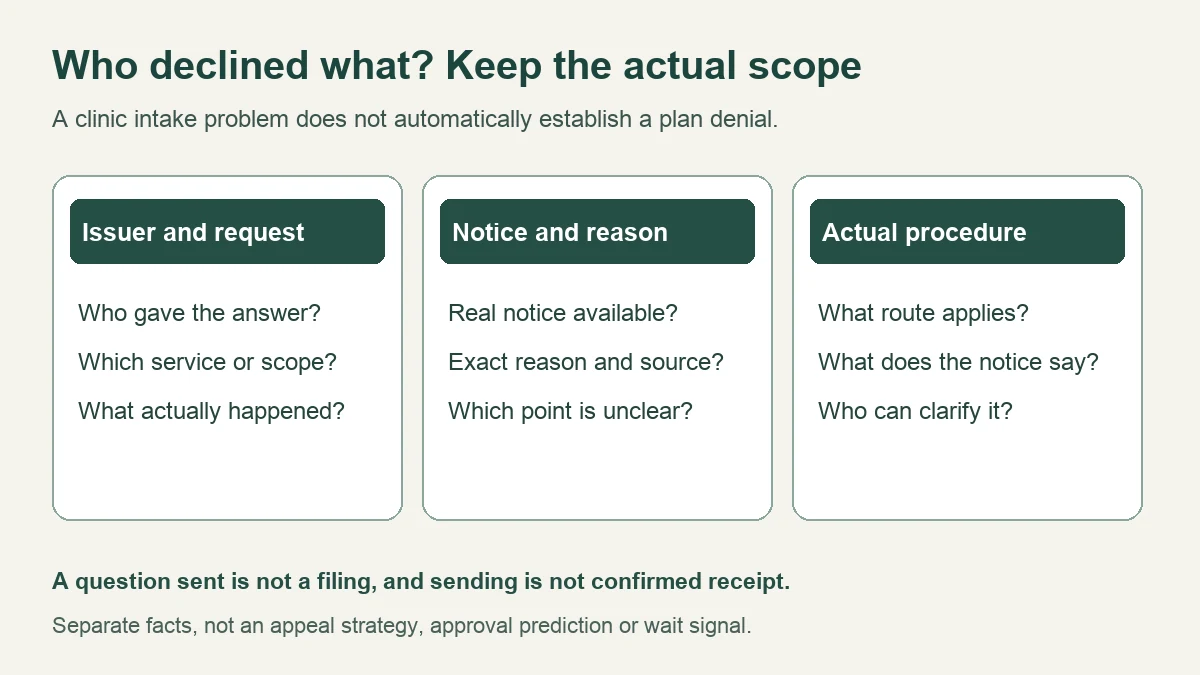
Define the second opinion question and its actual scope
Write the question in your own words: what remains uncertain, and what do you want explained? Keep that separate from the treating clinician’s actual reasoning. Possible questions may concern how recommendations differ or what options have been discussed, but this article supplies no diagnosis, surgery decision, scan requirement or instruction to change therapy.
Ask the receiving service what the consultation includes: records review, an examination, a written opinion, a discussion or another defined service. Record the actual answer rather than assuming every “second opinion” is identical. Ask what existing reports or images it needs, its accepted transfer method and whether receipt has been confirmed. A report available to you does not establish image access by the consultant.
Keep the proposed clinician/service, actual referral, records status and booking distinguishable. A consultation proposed by one team is not a confirmed appointment. Approval of a visit, if actually received, does not establish that later tests or procedures are covered or clinically indicated. Preserve the scope of each real answer.
For financial questions, keep the exact service and quote conditions with the relevant contact. This page does not rank appeal-first and cash-first paths, compare speculative productivity loss with consultation cost or promise later reimbursement. If affordability or access is preventing recommended care, tell the relevant clinical/support team. Our care access and support inquiry guide organizes those barriers without choosing treatment.
Keep current care and factual history separate from persuasion
Record the actual current plan and any timing or reassessment instructions you have received. Ask the treating team about an unresolved care question or an access gap; do not assume a second opinion denial means all care is denied or the existing plan is necessarily sufficient. This record cannot decide whether a few days of delay is safe.
Describe what actually happened: care received or not received, benefit, no change, worsening, unwanted effects, barriers and uncertainty. Do not undertake unnecessary treatment, extend a trial, repeat painful movements or invent functional losses to create a stronger appeal. A partial response and an inaccessible treatment are different facts. There is no required number of failed treatments or limitations from this article.
Keep pain, sleep and ordinary-function observations alongside each other. Difficulty describing a pattern does not make pain less credible. If a clinician’s explanation is needed, request the actual explanation rather than writing it yourself. A second opinion should help address a real uncertainty, not serve as a reward for sufficiently persuasive suffering.
When symptoms change or advice conflicts, contact the relevant clinical team through the appropriate route. Needed assessment should not wait for a complete timeline, a callback from the plan or a finished review. The tool creates no home-care bridge, medicine change, exercise program, work clearance or instruction to cancel another appointment.
Use real notices, actual deadlines and the applicable review route
HealthCare.gov’s internal appeal guidance describes a 180-day filing period after receipt of a denial under the process it explains. Treat that as a source-specific example, not a universal deadline. Medicare, Medicaid and other coverage can use different procedures. Preserve the actual notice, relevant plan information, receipt date if known and stated submission requirements; obtain appropriate clarification if they are unclear.
A question about a decision is not necessarily an appeal filing. A request drafted is not sent, and sending is not confirmed receipt. Keep the actual form or submission record privately, together with any receiving confirmation and further request for information. Do not infer that a call, record request, missing document or this worksheet extends a real deadline. Do not wait for a perfect file before addressing actual notice requirements.
HealthCare.gov’s external review guidance describes eligible denial types, including medical-judgment disputes, and different applicable review arrangements. External review is not an automatic next step for every second opinion denial. Use the real notice and appropriate plan or consumer-assistance source to clarify the route. CMS’s external appeals information provides additional process context, not an individual eligibility decision.
If standard review could seriously jeopardize life or the ability to regain maximum function, ask the treating clinician and plan about expedited review under the applicable process. HealthCare.gov describes concurrent internal/external requests in eligible urgent situations. The actual rules and case matter; this article does not determine eligibility or promise reversal. Emergency care must not wait for an insurance decision.
When another person helps with a submission, ask about the actual representation/permission requirements. A family relationship or copied worksheet does not itself establish filing authority. Keep identifying notices, member numbers and medical records out of public tools and comments. Use designated private channels for information actually required.
Follow the actual request, reply and decision without filling gaps
| Status actually known | Useful record | Conclusion to avoid |
|---|---|---|
| Question or request prepared | Scope, intended role and unresolved point. | The plan or clinic has received it. |
| Inquiry sent | Actual contact, source/date and what was asked. | An appeal was formally filed. |
| Review request submitted | Real submission record and route. | Receipt or completeness is confirmed. |
| Receipt confirmed | Receiving role, date and exact material/request confirmed. | The requested service is approved. |
| Answer or decision received | Actual wording, issuer, date, scope and conditions. | Other services, dates or future care share the same decision. |
| Reply pending or partial answer | What was answered and what remains uncertain. | Silence is approval, denial or permission to wait. |
Attach each answer to the matching question. An office may clarify appointment acceptance while a plan contact explains a coverage decision. A clinician explains clinical reasoning. If replies conflict, retain both sources and ask for clarification within their roles rather than selecting the one that sounds most favorable.
After an actual reply, record the next action, responsible role and follow-up arrangement if agreed. Do not invent a standard callback date, a review outcome or a universal correction sequence. If the remaining uncertainty affects needed care or a real notice response, seek appropriate help instead of treating the worksheet as the process itself.
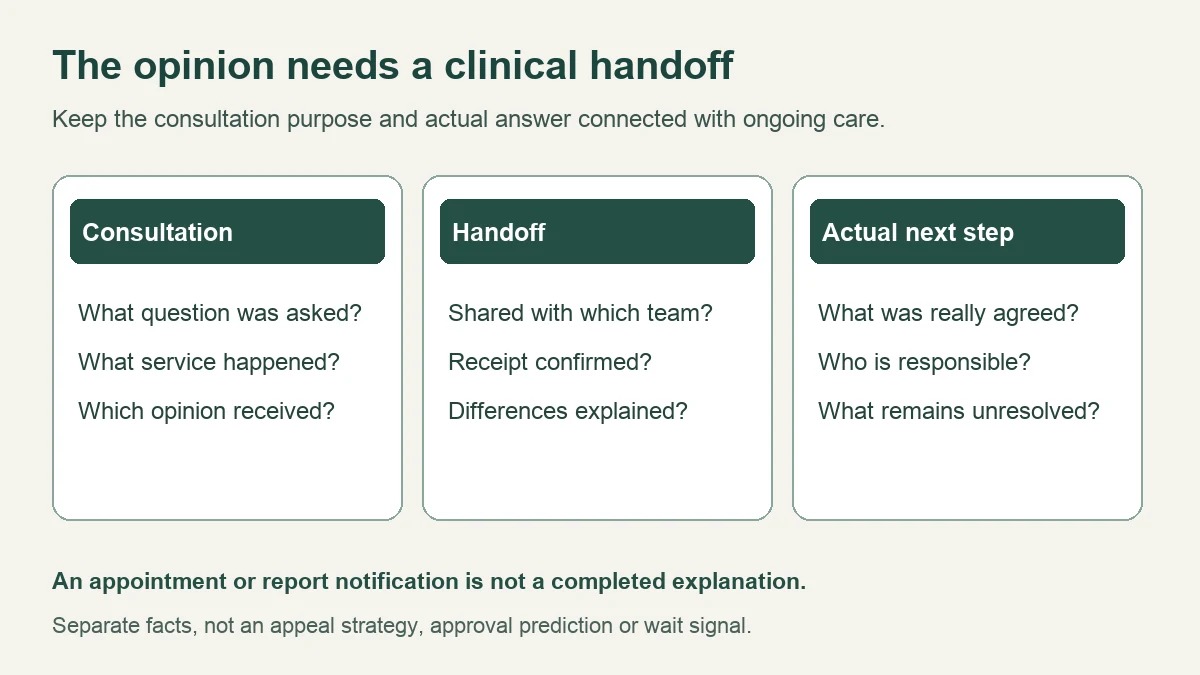
After the consultation: connect the opinion with the existing care team
A second opinion appointment and a clinical opinion actually received are separate facts. Record what service happened, what questions it addressed and which questions remained outside its scope. Do not treat a scheduled slot, a payment or a report notification as proof that the consultation question has been resolved.
| Handoff fact | What to preserve | Question if incomplete |
|---|---|---|
| Opinion available | Actual document or explanation and its source/date. | What has really been received, and what remains unanswered? |
| Shared with existing team | Permitted transfer, sending and confirmed receipt. | Has the team responsible for current care received the relevant material? |
| Differences explained | Actual discussion of how the opinions relate and remaining disagreement. | Who will explain the differences in the context of my situation? |
| Next clinical action agreed | Real instruction, responsible role and follow-up, or unconfirmed. | What is the actual plan, and whom do I contact about uncertainty or change? |
Do not choose the more expensive, more confident or more reassuring opinion as the correct one from a blog rule. Ask the relevant professionals to explain disagreements. Keep actual instructions and their dates together; this article does not tell you to stop medicines, abandon therapy, change a brace or proceed with a procedure because another opinion exists.
This handoff is the distinct purpose of this second opinion guide. A denial record helps clarify access and process, but the consultation still needs a question, an actual answer and a link to ongoing care. For an imaging-specific dispute, use the MRI care-and-appeal record rather than assuming a specialist-consultation answer approves a scan.
Two fictional writing examples
These examples demonstrate documentation only. They are not real cases, notices, filings, clinical instructions or insurance decisions. No deadline, appeal route, self-pay choice or waiting period is selected. The tool’s example buttons replace entries and label the generated record fictional.
Example A: clinic intake issue, no plan notice supplied
| Record area | Fictional entry |
|---|---|
| Request / event | Clinic reports missing referral material in this fictional example. Actual sending and receipt need checking. |
| Notice / procedure | No formal plan denial notice supplied. Do not infer one from a booking message or choose an appeal route. |
| Question / actual reply | Question about required material and receipt prepared; not sent. No actual clinic or plan answer supplied. |
| Consultation / next owner | No confirmed appointment or second opinion received. Record actual clarification and the next owner; no care substitution or waiting decision made. |
This example improves the precision of the question. It does not establish that the plan approved the service, that no requirement applies or that clinical assessment can wait while records are located.
Example B: plan notice, criteria and actual reply still unresolved
| Record area | Fictional entry |
|---|---|
| Purpose / event | Additional specialist opinion sought for an unresolved care question. A fictional plan notice states that the consultation is not medically necessary. |
| Notice / procedure | Preserve the real document, service scope and dates privately. No actual deadline or review route is supplied by this example. |
| Request / actual answer | Question about the stated reason, criteria and applicable process sent in the fictional example; receipt unconfirmed. No appeal filing or decision claimed. |
| Consultation / handoff | No new opinion supplied or explained by the existing team. Record real replies and actual agreements without selecting a wait or payment strategy. |
A documentation gap and a disagreement about medical judgment are not assumed to be the same. The clinical team can explain the actual purpose of the consultation while the appropriate contact clarifies the procedure. Neither task requires inventing treatment failure or postponing needed assessment.
Private request, notice, actual-answer and care-handoff record
Download the offline tool before entering actual health, notice or personal details. Use fictional entries here because the surrounding page may contain ads and analytics. The tool sends nothing, uses no browser storage and does not automatically save. Its offline copy contains no external assets or automatic network requests. Keep completed copies and exports private.
Use one second opinion request per record, with matching labels if several services or notices are involved. Unknown, not asked, reply pending and not applicable according to an actual answer are useful entries. A paper note with the same headings works. Nothing about completing the fields verifies a notice, deadline, legal right or clinical plan.
Second opinion request, denial notice, actual-answer and care-handoff record
Keep the consultation question, actual event, real notice, applicable procedure, actual reply and clinical handoff separate. This organizer decides no care urgency, appeal eligibility, payment route or clinical plan.
Download the offline tool before entering actual health, notice or personal details. Use fictional entries here; the surrounding site may contain ads and analytics.
Offline copy. This file has no ads, analytics, external assets or automatic network requests.
The tool uses no network requests, browser storage or automatic saving. Refreshing or closing may lose entries. Keep exports private; omit names, account/claim numbers and full notices or medical records. Do not delay needed assessment or a real notice response for this record or a routine reply.
Start with the fictional example or download a blank offline copy.
Paper alternative: consultation question; current care; exact request; who declined what; real notice; applicable process; actual deadline wording; sending/receipt; real answer; consultation status; clinical handoff; next owner. Unknown and pending are valid.
My second opinion request, notice, actual-answer and care-handoff record
Unverified personal record for discussion. Entries verify no clinical need, legal right, deadline, filing, coverage decision or care handoff.
Guide: living.kioptrix.com/denied-second-opinion-for-orthopedic-pain/
Rebuild after edits, then copy, download text or print. An offline download includes current entries; keep the file private. Exporting does not submit an appeal, contact a professional, extend a deadline, transfer records or book care. Blank items add optional questions, not a missing-approval score.
Common second opinion denial questions
Does a clinic refusing an appointment mean my plan denied coverage?
Not automatically. Preserve who said what and ask which actual intake issue, requirement or plan decision is involved. This guide does not infer an insurance decision from a booking problem.
Does a second opinion denial mean I should wait with conservative care?
No waiting permission follows from a coverage decision or stable-symptom label. Ask the treating team about actual care and timing. Seek appropriate assessment for concerning changes without waiting for an appeal.
Should I appeal first or pay cash first?
This guide does not choose that strategy. Clinical care, applicable review procedures and service/cost conditions are separate questions. A speculative lost-work estimate cannot determine medical urgency.
Is 180 days always my deadline?
No universal deadline is provided here. Keep the actual notice and applicable procedure, and obtain appropriate help if unclear. An inquiry or record request is not assumed to extend time.
Will more PT notes reverse a medical-necessity denial?
No outcome is promised. Preserve truthful records and ask what issue or criterion is disputed. Missing information, benefit limits and clinical disagreement may call for different clarification.
What should happen after I receive another opinion?
Record the actual opinion and scope, permitted delivery to the existing team, receipt, real explanation of any differences and next action actually agreed. Do not change clinical instructions from the worksheet.
Sources, corrections and review limits
- HealthCare.gov: Internal appeals — source-specific process, records and urgent-review context; not every coverage program.
- HealthCare.gov: External review — eligible denial types and applicable review arrangements; not automatic eligibility.
- CMS: External appeals — official process resources, not an individual coverage ruling.
- NHS: Back pain; NHS: Septic arthritis — selected clinical warning symptoms, not U.S. insurance rules.
Source check and editorial update: October 29, 2026. Removed stable-symptom waiting advice, bridge eligibility, appeal-first/cash-first rules, speculative productivity comparisons and persuasive-history framing. Replaced generic pain/MRI material with actual issuer, request scope, notice, submission/receipt, real reply and clinical handoff distinctions. The existing URL, original publication date, author and classification are retained.
This caregiver-created organizer is not a validated clinical or legal instrument. No independent clinical/legal review, real-reader study, filing success, savings or improved clinical outcome is claimed. The featured image is AI-generated fictional artwork; diagrams show distinct facts rather than a strategy or approval pathway. Our background and editorial approach.