

How to Use a Shopping Cart as Support Safely
Without Mistaking It for a Walker
A shopping cart can feel reassuring when a long grocery aisle turns your legs uncertain or fatigue arrives sooner than expected. The handle is wide, the frame looks solid, and almost everyone around you is pushing one. Yet the feature that makes a cart useful for groceries, its willingness to roll, is precisely what makes it unreliable as a mobility aid.
This does not mean that every light touch on a cart is dangerous. Someone who walks independently may use gentle hand contact for temporary orientation or steadiness. The important boundary is whether you are guiding the cart or depending on it to keep your body upright. Once your weight begins to follow the wheels, a harmless-looking wobble can become a fast, awkward chase.
This guide shows you how to test a cart, position your body, handle turns and reaching, manage checkout and parking-lot transitions, and recognize when cart dependence deserves a conversation with a healthcare professional. The goal is not to make shopping frightening. It is to make the risk visible while you still have time to choose the safer route.
Test first
Spot pulling, sticking, and wheel trouble before groceries add weight.
Move deliberately
Use upright posture, two hands, short steps, and complete stops before reaching.
Know the boundary
If the cart must hold you up, it is time for assistance or a fitted mobility aid.
The central rule: You should control the cart. The cart should never be responsible for controlling your body. 🛒
Snapshot
This article is for independent shoppers who want light, temporary steadiness, as well as caregivers planning a safer store visit. You will learn how to test a cart, avoid common fall-risk traps, compare support options, and decide when a mobility assessment may be the more independent choice.
Table of Contents
The Safety Boundary: Light Contact Is Not Weight-Bearing Support
A shopping cart is designed to transport merchandise. It is not fitted to your height, selected for your walking pattern, or built to provide a dependable amount of body-weight support.
That difference matters because a cart can swivel, drift, stop, accelerate on a slope, or respond unevenly to pressure. A properly selected cane, walker, or rollator is intended to improve support when used correctly. A cart simply happens to have a handle.
Before you act
This article provides general physical-safety education. It cannot determine whether a shopping cart, cane, walker, rollator, or motorized cart is appropriate for you. New balance trouble, repeated near-falls, sudden dizziness, weakness, or a change after surgery or medication should be discussed with a qualified healthcare professional. Follow any weight-bearing or mobility instructions already provided by your physician or rehabilitation team.
Who May Use Light Contact for Temporary Steadiness
Light contact may be reasonable when you can already walk independently, remain upright without pushing down, and recover your balance if the cart moves several inches.
- You can stand without holding the cart.
- Your arms remain relaxed rather than locked.
- You are using the cart on smooth, level indoor flooring.
- You can stop, turn, and look around without pulling on the handle.
- You have a backup plan if fatigue, pain, or dizziness increases.
Who Should Not Depend on a Cart for Support
Do not use a cart as a substitute for prescribed equipment. A person recovering from surgery may have specific restrictions on weight-bearing, turning, or walking distance. Those instructions do not disappear when the setting changes from home to a supermarket.
- You must lean forward or press down to stay standing.
- You cannot recover if the cart rolls unexpectedly.
- You feel faint, newly confused, unusually weak, or suddenly uncoordinated.
- You have been told to use crutches, a cane, a walker, or another device.
- You plan to cross stairs, curbs, ice, rough pavement, or a steep slope.
The Revealing Self-Check
Before moving, stand in a stable position and ask, “Could I stay upright if this cart moved away from me?”
This is not a medical balance test. It is a practical boundary. An uncertain answer means you should use your prescribed aid, shop with a companion, request a motorized cart, or ask an employee for help.
Key takeaway
Gentle hand contact and weight-bearing support are not the same activity. If releasing the handle would make you fall, the cart is already doing a job it was not designed to do.
The First Five Feet Reveal the Cart’s Real Behavior
A cart that looks ordinary while parked may behave like a stubborn office chair once it moves. Test it before entering a busy aisle and before adding a single item.
Run the 10-Second Cart Test
- Push the cart forward several inches.
- Pull it back gently.
- Turn left at a slow walking pace.
- Turn right at the same pace.
- Stop without bracing your body against the handle.
Replace the cart if a wheel chatters, drags, sticks, shakes, pulls sideways, or requires repeated corrections. A problem that feels minor at the entrance can become more demanding after the basket is loaded.
Scan the Floor Before the Shelves
Produce mist, freezer condensation, folded mats, door tracks, boxes, pallet corners, and low displays can alter either your footing or the cart’s path. Your eyes should check the next several feet before they wander to labels and sale signs.
- Pause at aisle intersections where another cart may appear suddenly.
- Give stocking equipment more clearance than you think you need.
- Cross floor transitions straight rather than at a sharp angle.
- Report spills instead of trying to steer tightly around them.
- Choose a wider aisle when displays reduce turning space.
What a Pulling Wheel Is Trying to Tell You
A drifting cart requires repeated sideways force. Those corrections occupy your arms and rotate your torso, leaving less capacity to respond to a stumble or obstacle.
Do not compensate for ten aisles because replacing the cart feels inconvenient. The safest cart is not the nearest cart. It is the one that moves predictably under light control.
Short Story: The Cart That Worked Until the Freezer Aisle
Ruth felt comfortable during the first half of her grocery trip. The cart rolled smoothly, and resting her hands on the handle made the bright, crowded store feel easier to navigate.
Near the freezer section, one front wheel began to resist. Ruth pushed harder, leaned forward, and tried to steer around a floor display without stopping. The cart suddenly cleared the sticky spot and moved faster than she expected.
She caught herself against a freezer door and was not injured, but the moment changed the trip. Her daughter replaced the cart, asked an employee to retrieve the remaining items, and arranged carryout help.
The lesson was not that Ruth should never shop. It was that a cart problem and a body-position problem had quietly joined forces. Either one alone might have been manageable. Together, they removed her margin for recovery.
Posture, Hands, and Steering: Stay in Charge of the Wheels
Safe cart use depends less on squeezing the handle and more on how your entire body is arranged. Your stance, elbow position, distance from the cart, and visual attention all influence whether you are directing the cart or following it.
Use Two Hands Without Death-Gripping the Handle
Place both hands on the main horizontal handle. Keep your elbows slightly bent and your shoulders relaxed. Straight, locked arms encourage forward leaning and make it harder to absorb a small change in the cart’s movement.
Keep phones, drinks, coupons, and shopping lists out of your hands while moving. A phone can wait in a pocket or secure bag until the cart has stopped.
Walk Close Without Chasing the Cart
- Keep your torso upright rather than folded over the handle.
- Use short, controlled steps.
- Maintain enough space for your feet to move freely.
- Push from close range instead of reaching with straight arms.
- Slow down before turning rather than during the turn.
If the cart repeatedly gets farther ahead of your feet, reduce your pace. A cart should not become a moving finish line.
Stop Before Looking Sideways or Reaching
Looking toward a shelf removes visual information about the path ahead. Reaching changes your center of balance. Doing both while walking creates a three-part task: steer, scan, and stabilize.
Instead, bring the cart to a full stop. Place both feet securely, look toward the item, and then reach. For high, low, heavy, or distant merchandise, ask for assistance rather than using the cart as an anchor.
The CART control loop
1. Check
Test wheels, turns, stopping, and the floor ahead.
2. Align
Stand upright, stay close, and keep both hands available.
3. Rest
Stop before turning your head, reaching, or lifting.
4. Test again
Reassess after loading, fatigue, pain, or surface changes.
Key takeaway
Stop the cart before your attention leaves the path. Reading a label, checking a list, or reaching for cereal is safer as a separate task, not a moving performance.
Load, Reach, and Fatigue Change the Risk Mid-Trip
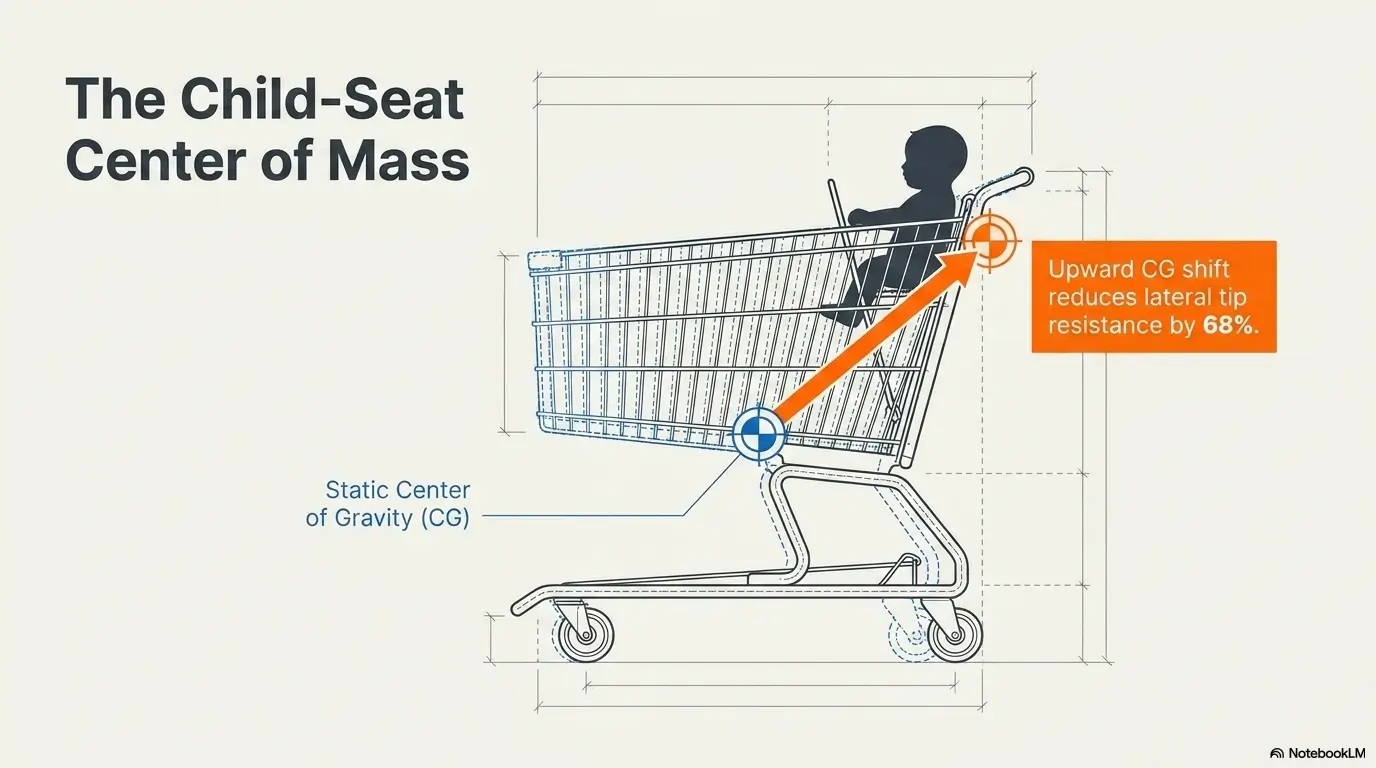
The cart you tested at the entrance will not feel exactly the same after adding beverages, canned goods, pet food, or bulky household items. Weight changes how quickly it starts, how firmly it stops, and how much effort a turn requires.
Retest Steering as the Basket Fills
An empty cart may feel lively and quick to roll. A heavily loaded cart may resist starting, build momentum on a slope, and require more room to stop. Neither state is automatically safer.
After adding several heavy items, pause in a clear area. Make one gentle turn and one controlled stop. If handling now demands substantial arm force, ask for help or shorten the trip.
Keep Weight Low, Centered, and Off the Handle
- Place heavy items inside the basket or approved lower rack.
- Do not balance bulky merchandise near the handle.
- Avoid hanging heavy bags, purses, or equipment from the handle.
- Keep the hand area clear along its full useful width.
- Ask for help with cases of water, large pet-food bags, and awkward boxes.
Handle-hung bags can crowd your grip and change the cart’s feel during turns. They can also swing into your legs when the cart stops.
The Reach May Be Riskier Than the Push
Sideways stretching, deep bending, and overhead reaching shift your body away from its strongest base. The danger increases when one hand is pulling against a rolling handle while the other reaches.
Move the cart out of traffic, stop fully, and place your feet before reaching. An employee’s help with one high shelf is far less disruptive than recovering from a preventable fall.
Fatigue Is a Stop Signal, Not a Leaning Signal
People often begin a trip upright and gradually pour more weight into the handle as pain or fatigue increases. That change can happen so slowly that it feels normal.
Use a simple rule: when your posture changes, your plan changes. Sit, ask for help, check out early, switch to pickup, or let a companion finish the list.
Show me the nerdy details
Four moving variables determine how forgiving a cart feels: wheel alignment, rolling resistance, load distribution, and the direction of your body pressure.
Forward pressure can make a cart move away from you. Sideways pressure can rotate the cart while also rotating your torso. A heavy load may reduce quick rolling on level flooring but create greater momentum on a decline. A sticky wheel can resist movement and then release suddenly after extra force is applied.
This is why no universal amount of “safe body weight” can be assigned to a standard shopping cart. The cart, surface, load, wheel condition, and shopper all vary from one trip to the next.
Thresholds, Checkout, and Parking Lots Are Different Environments
A smooth aisle can create false confidence. The trip changes at door tracks, curb ramps, checkout stations, sloped exits, and outdoor pavement. Treat every transition as a fresh mobility problem.
Do Not Use the Cart to Step Off a Curb
The cart’s front wheels can drop before your feet are prepared, pulling the handle down and forward. Use a curb cut, wait for assistance, or allow someone else to move the cart while you use an appropriate walking route.
On a gentle ramp, approach straight, reduce speed before the incline changes, and avoid diagonal steering. If a loaded cart begins pulling downhill, do not use your body as its brake.
Expect the Exit to Change Things
Door tracks, security gates, floor mats, crowds, and automatic doors narrow your working space. Some stores also use perimeter wheel-control systems, so a cart may resist movement or stop near an exit boundary.
Never depend on a store cart for essential balance while crossing the exit. Pause, look ahead, and ask for assistance before entering a surface or area where the cart may behave differently.
Checkout Is a Stability Transition
Checkout combines twisting, lifting, stepping sideways, reaching for payment, and releasing the handle. Break those actions apart.
- Stop and establish a stable stance.
- Move one item at a time when needed.
- Avoid twisting while your feet remain planted.
- Place filled bags inside the basket, not beside your feet.
- Ask the cashier or attendant to slow the process when necessary.
A staffed lane may be easier than self-checkout if the latter requires repeated turning between the cart, scanner, scale, payment terminal, and bagging area.
The Parking Lot Deserves Its Own Plan
Traffic, drainage channels, speed bumps, cracked pavement, wind, slopes, and distracted drivers add risks that do not exist in a quiet aisle. Review this related guide to parking-lot safety with a walker when you use a prescribed walking aid outdoors.
Store pickup, carryout assistance, a companion, or parking near an accessible entrance may reduce the hardest part of the trip without taking away your role in choosing and buying your groceries.
Key takeaway
Indoor cart control does not guarantee outdoor control. Reassess at every door, track, ramp, curb cut, checkout station, and pavement change.
Seven Quiet Mistakes That Raise Fall Risk
The most dangerous shopping habits often feel efficient. They save a few seconds, avoid asking for help, or let you keep moving when your body is requesting a pause.
| Mistake | Why it raises risk | Safer alternative |
|---|---|---|
| Treating the cart like a walker | The cart can roll or swivel under body weight. | Use only light contact or bring the prescribed mobility aid. |
| Keeping a cart with one bad wheel | Repeated corrections pull the body sideways. | Replace it before adding groceries. |
| Leaning more as fatigue grows | Your balance becomes tied to a moving object. | Stop, sit, shorten the trip, or request help. |
| Moving while reaching | Steering and body position change simultaneously. | Stop, set your feet, and then reach. |
| Steering one-handed while using a phone | Attention and directional control are reduced. | Park the cart before checking the phone. |
| Assuming all surfaces behave alike | Tracks, mats, slopes, and cracks change wheel movement. | Slow down and retest after transitions. |
| Leaving a proper aid at home | Embarrassment replaces suitable support with improvised support. | Use the device that lets you move safely and independently. |
The Embarrassment Trap
Some people use a cart because bringing a walker or cane feels conspicuous. Yet the cart may require more leaning, more concentration, and more environmental luck than a correctly fitted device.
Independence is not measured by how invisible your support looks. It is measured by whether you can complete the activity with control, choice, and enough energy left to get home safely.
The “Just One More Aisle” Trap
Pain, fatigue, and balance rarely announce a precise finish line. They usually arrive as smaller changes: shorter steps, heavier arms, slower turns, more leaning, or a growing need to stop near displays.
Use the first posture change as your cue. Checking out five minutes early is a small compromise. Continuing until your legs are trembling is an expensive wager with no useful prize.
The Helper Who Moves Too Fast
A companion can improve safety, but only when the shopper controls the pace. Do not have another person pull the cart while you hold the opposite side. The resulting movement may be difficult to predict.
Agree on simple roles: the shopper walks, the companion retrieves high or heavy items, and either person may call a pause without debate.
When Cart Dependence Is a Clue, Not Just a Shopping Habit
Large stores demand more than ordinary household walking. They involve longer distances, bright visual stimulation, repeated turns, standing in line, reaching, decision-making, and navigating other people.
Difficulty may appear in a store before it becomes obvious during short walks at home. That makes the shopping cart useful information, even when it is not a suitable mobility aid.
Notice Patterns, Not One Bad Day
- You choose a cart even when buying only one or two items.
- You search for the cart before deciding whether you can enter the store.
- You increasingly hold walls, furniture, counters, or another person.
- You avoid stores without carts.
- You feel unsafe while standing in checkout lines.
- You have experienced falls or repeated near-falls.
- You cannot complete the trip without leaning more heavily over time.
Falls are not simply an inevitable part of getting older, and fall risk can involve multiple factors that deserve review. CDC and National Institute on Aging resources encourage older adults to discuss falls, balance concerns, medications, vision, footwear, and other contributing issues with healthcare professionals.
A Cane Is Not Automatically the Answer
A cane usually provides less stability than a walker and requires sufficient balance, hand function, coordination, and strength. A rollator may help some people travel farther but adds brakes, a seat, and different turning behavior that must be understood.
Device type and fit should match the user rather than the store aisle. Clinical guidance emphasizes selecting and sizing walking aids for the individual, often with help from a physician or physical therapist.
Ask for an Assessment, Not Merely a Product
A useful mobility conversation may review balance, gait, pain, endurance, vision, sensation, medication effects, footwear, turning, transfers, and the environments where difficulty appears.
Bring specific examples. “I am fine in my kitchen but lean heavily on a cart after ten minutes in a large store” gives a clinician more usable information than “I feel a little unsteady sometimes.”
Use this walker appointment checklist to prepare questions about device choice, fitting, training, and community use.
Separate Habit From Function
Some shoppers push a cart simply because they are shopping. Others select it because they do not trust their legs without two-handed support. The behavior looks identical from across the aisle, but the functional meaning is entirely different.
You may also find it helpful to read about furniture walking and fall risk, especially when the same pattern appears at home.
Safer Shopping Support Options: Good, Better, and Best
The best option is not always the most expensive or elaborate one. It is the option that matches your current ability, the store environment, and the amount of support you actually need.
| Level | Best fit | What it may include | What to verify |
|---|---|---|---|
| Good | Independent shopper needing only light temporary steadiness | 10-second cart test, low-traffic time, short list, stable shoes, planned rest | You can remain upright without leaning on the cart. |
| Better | Shopper with variable fatigue, pain, or mild balance concerns | Companion, staffed checkout, store pickup, carryout help, planned seating | The companion understands your pace and the store offers the service. |
| Best | Shopper who depends on two-handed or weight-bearing support | Professionally selected mobility aid, motorized cart when appropriate, mobility assessment | Fit, training, transfers, brakes, weight-bearing instructions, and outdoor route. |
Try Free and Low-Cost Options First
- Shop during a quiet hour.
- Use a shorter list organized by aisle.
- Choose pickup for heavy staples and shop only for fresh items.
- Ask whether seating is available near the entrance or pharmacy.
- Request carryout assistance before checkout begins.
- Let a companion retrieve high, low, or bulky items.
These options may be enough when the main problem is trip length rather than basic balance. They can also preserve energy for cooking, bathing, and getting safely through the rest of the day.
When Paid Equipment or Professional Help May Be Worth Considering
A mobility evaluation may be worthwhile when you repeatedly rely on carts, avoid stores without them, have fallen, or cannot manage the parking-lot route safely. The value is not merely receiving a product recommendation. It is learning whether the device fits, when to use it, and how to turn, stop, transfer, and navigate community surfaces.
Before buying a cane, walker, or rollator, compare adjustability, handle comfort, device width, brakes where applicable, folding method, storage, vehicle loading, indoor turning space, and the amount of support the device is intended to provide.
What to Ask Before Buying Mobility Equipment
- Which device type matches my balance and weight-bearing needs?
- Who will adjust the handle height and check my posture?
- Can I test turning, thresholds, ramps, and stopping?
- Will the device fit through my home and preferred stores?
- Can I safely fold, lift, and place it in a vehicle?
- What maintenance do the tips, wheels, or brakes require?
- Does my recovery plan limit how much weight I may place through my arms or legs?
Key takeaway
Do not buy the device that appears most supportive. Choose the support that matches your body, environment, and ability to use it correctly.
When to Get Medical or Emergency Help
A change in shopping ability may reflect pain or ordinary fatigue, but it can also expose medication effects, vision problems, weakness, blood-pressure changes, balance disorders, or other concerns that deserve attention.
Contact a Healthcare Professional Soon When
- You have fallen or experienced repeated near-falls.
- You increasingly rely on walls, furniture, counters, or carts.
- Your balance problem is new, recurring, or worsening.
- Dizziness appears while standing or walking.
- A medication change coincided with instability.
- Pain, numbness, weakness, or vision changes affect walking.
- Fear of falling is causing you to avoid ordinary activities.
Keep a brief record of when symptoms occur, how long you can walk before leaning, whether the problem changes after eating or taking medication, and whether one side feels different from the other. A simple pattern log can turn a vague concern into a more useful clinical conversation.
For a broader self-review, see this guide to fall risk in older adults.
Call 911 for Sudden Stroke Warning Signs
Sudden trouble walking, loss of balance or coordination, one-sided weakness or numbness, facial drooping, speech difficulty, confusion, vision trouble, or a severe unexplained headache may be stroke warning signs. Call 911 immediately rather than driving yourself or waiting to see whether the symptoms improve.
Get Urgent Help After a Head Impact
A fall that involves a blow or jolt to the head can cause a traumatic brain injury even when there is no dramatic external wound. Seek immediate medical help for worsening headache, repeated vomiting, slurred speech, seizures, increasing confusion, unusual drowsiness, weakness, numbness, loss of consciousness, or difficulty waking.
People taking blood-thinning medication or those with significant medical conditions should follow their clinician’s instructions about evaluation after a fall or head impact.

Shopping-Cart Support FAQ
Is It Safe for an Older Adult to Use a Shopping Cart Like a Walker?
No shopping cart should be treated as a walker. Someone who already walks independently may use light hand contact for temporary steadiness, but depending on the cart for weight-bearing support is different. The wheels can turn, roll, stick, or stop without providing the controlled support of a fitted mobility device.
How Much Body Weight Can I Safely Put on a Shopping Cart?
There is no dependable personal weight-bearing allowance. Standard carts vary in wheel condition, frame design, load, maintenance, and surface response. Use only light guiding contact. If you need downward pressure to stay upright, choose assistance or an appropriate mobility aid.
Is an Empty Cart or a Full Cart Easier to Control?
Each presents different problems. An empty cart may roll and turn quickly. A loaded cart may be harder to start, stop, or control on a slope. Test the cart while empty and reassess after adding heavy items.
What Should I Do If the Cart Pulls to One Side?
Stop and replace it. Do not spend the trip applying continuous sideways force. The repeated corrections can fatigue your arms, rotate your body, and reduce your ability to respond to a stumble.
Can I Use a Shopping Cart on a Parking-Lot Slope?
A mild slope may still increase cart momentum, especially when the basket is loaded. If controlling the cart requires leaning, pulling hard, or using your body as a brake, stop and request carryout assistance. Traffic and uneven pavement make outdoor improvisation particularly unforgiving.
Is a Warehouse Flatbed Cart Safe for Balance Support?
No flatbed or platform cart should be assumed to provide mobility support. Handle height, steering, braking, visibility, load movement, and wheel behavior may be unsuitable. Use the cart for merchandise, not as a walking aid.
Would a Motorized Shopping Cart Be Safer?
A motorized cart may reduce walking and standing demands, but safe use still requires getting on and off, steering, judging clearance, following store instructions, and managing bags. Ask for orientation when unfamiliar with the controls and request caregiver or employee help with transfers when needed.
When Should I Consider a Cane, Walker, or Rollator?
Consider a professional assessment when you repeatedly depend on carts, experience falls or near-falls, avoid stores without support, lean more as the trip continues, or struggle with outdoor routes. Do not assume a cane is the necessary next step. The suitable device depends on your balance, strength, pain, walking pattern, environment, and ability to use it correctly.
Your 15-Minute Store Plan
You do not need to redesign your entire routine today. Use fifteen minutes to prepare one safer shopping trip and one clear fallback.
Five Minutes Before Leaving Home
- Shorten and organize the shopping list.
- Wear stable, well-fitting footwear.
- Bring your prescribed mobility device when applicable.
- Choose a quieter shopping time.
- Decide who you will call or what service you will use if the trip becomes difficult.
Five Minutes to Check Store Support
- Confirm whether motorized carts are available.
- Ask about carryout assistance.
- Locate seating, the customer-service desk, and the safest exit.
- Choose a staffed checkout lane when repeated reaching is difficult.
- Use pickup or delivery for the heaviest items.
Five Minutes at the Entrance
- Push the empty cart forward.
- Pull it back gently.
- Turn left and right.
- Check the wheels and the first stretch of flooring.
- Replace the cart if it pulls, sticks, shakes, or stops unpredictably.
Then make one agreement with yourself: if you begin leaning, shuffling, feeling dizzy, or losing control of the cart, you will stop rather than negotiate for one more aisle.
One concrete next step
On your next trip, complete the 10-second cart test before adding an item and decide in advance what you will do if the cart fails or your balance changes. A fallback chosen calmly at home is easier to use than one invented under fluorescent lights with melting groceries.
Last reviewed: 2026-08