
This site is written from a family-caregiver perspective. The operator is not a medical professional or an insurance, legal or financial adviser. Use this guide to organize questions for the relevant service.
List unresolved items instead of filling them with zero
Use this follow-up record alongside the guide below. It does not determine medical suitability, insurance eligibility or legal rights, and it does not guarantee a price.
- Keep together
- The written quote, included billers, exclusions, provisional services and the contact who issued it.
- Unanswered question
- Which parts can be clarified now, and who can estimate each excluded component?
- Next contact and owner
- Assign a contact and follow-up date to every unpriced component.
- Recheck when
- The clinical plan, location or list of billers changes.
For each response, record its date, source, reference number and what remains uncertain. Agree the next follow-up date instead of treating silence as confirmation. Use official contact channels and keep identifying health, account and policy information out of public comments.

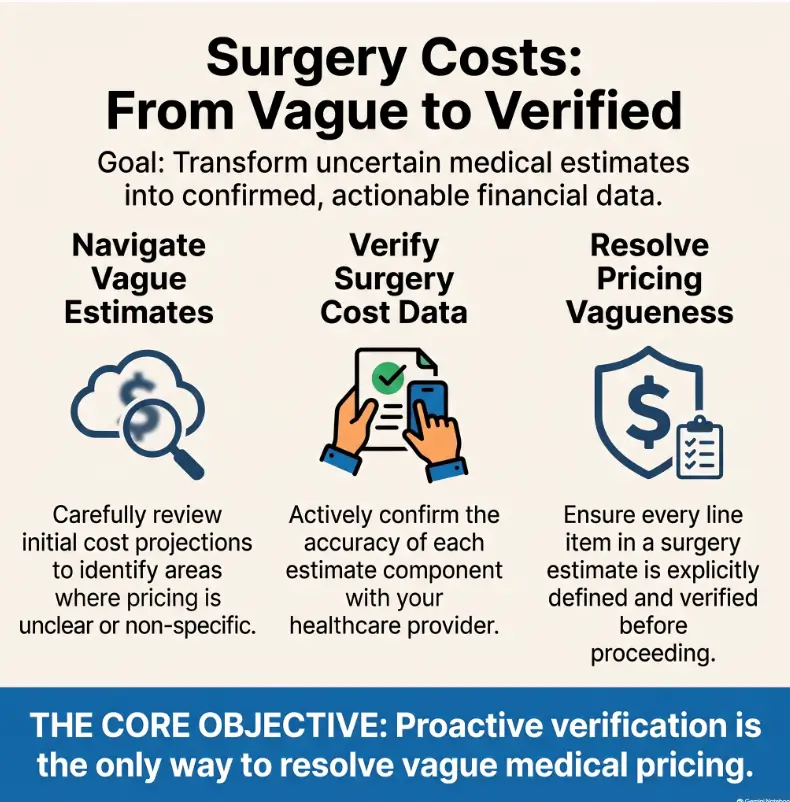
If your surgery estimate says little more than “estimated patient responsibility,” gives a wide range, or leaves major charges unexplained, do not assume the number represents your full cost. For planned surgery in the United States, the most important question is what the estimate includes and what it leaves outside the frame.
Your first move is simple: ask for the procedure and billing codes, the facility charge, separate professional fees, expected anesthesia charges, implant or device costs when applicable, and the network status of everyone expected to bill you. If you are insured, compare that information with your health plan’s own cost estimate. If you are uninsured or deliberately paying without insurance, federal Good Faith Estimate rules may give you additional protections.
A vague estimate is not automatically wrong. Surgery contains genuine clinical uncertainty. But uncertainty about what the surgeon might find is different from an estimate that simply fails to identify known billing components.
Table of Contents
First, Find Out Whether the Estimate Is Incomplete or Simply Variable
A useful surgery estimate can still contain a range. The problem is not necessarily the range itself. The problem is a range with no map showing what could move the number.
Separate two kinds of uncertainty:
- Clinical uncertainty: the surgeon may not know whether an additional procedure, implant, pathology service, extra imaging, or longer stay will become medically necessary.
- Billing uncertainty: the estimate does not say whether anesthesia, the surgeon, assistant surgeon, facility, laboratory, imaging, device, or other professional charges are included.
The first kind may be impossible to eliminate completely before surgery. The second kind can often be clarified before you consent to the financial side of the procedure.
If you are still trying to understand how surgical quotes are assembled, see this guide to reading an orthopedic surgery estimate.
Ask What the Number Actually Includes
Do not ask only, “Is this my total?” That question invites an equally vague answer. Ask the billing office to identify the components behind the estimate.
For a scheduled operation, useful questions include:
- What procedure code or codes were used to create this estimate?
- Is this the surgeon’s charge, the facility’s charge, or an estimate combining both?
- Is anesthesia included?
- Are assistant-surgeon or other professional fees expected?
- Are implants, hardware, supplies, or medical devices included?
- Are imaging, laboratory, and pathology services included if they are routinely expected?
- Does the estimate assume outpatient surgery, observation, or an inpatient stay?
- Which charges could change if the procedure becomes more complex?
One particularly important phrase is “facility fee.” It can represent a substantial portion of the financial structure surrounding a procedure and is distinct from the physician’s professional fee. If that term appears without explanation, this guide to facility fees in orthopedic care explains what to check.
Treat Separate Anesthesia Billing as a Question, Not a Surprise
Anesthesia is one of the easiest costs to mentally fold into “surgery” even when the paperwork does not. The anesthesia clinician or group may bill separately from both the surgeon and the facility.
Before surgery, ask whether the estimate contains an anesthesia component and whether the expected anesthesia group participates in your insurance network. Also ask whether the amount shown is a facility estimate only.
If anesthesia is being handled separately, the distinctions in why anesthesia may produce a separate bill can help you understand what the estimate is missing.
For people using most private health insurance, the federal No Surprises Act also provides balance-billing protections in certain situations involving out-of-network clinicians providing services connected with care at an in-network facility. Anesthesiology is among the services receiving important protections. CMS explains the current rules in its guidance on medical bill rights when using insurance.
Those protections do not make every provider, facility, health plan, or surgical circumstance equivalent. Network status is still worth verifying before a planned procedure.
If You Have Insurance, Get a Second Estimate From the Health Plan
The hospital’s estimate and your insurer’s estimate answer different questions. The provider knows what it expects to perform and charge. The health plan is better positioned to estimate how its negotiated rates, deductible, copayments, coinsurance, and current benefit accumulation may affect your share.
For plan years beginning on or after January 1, 2024, most plans and issuers subject to federal Transparency in Coverage requirements must make price-comparison information available for covered items and services. CMS describes the consumer tools and paper-request option in its health plan price transparency guidance.
When contacting your insurer, provide as much of the following as the surgical office can give you:
- procedure code or codes,
- diagnosis code if available,
- surgeon’s name and National Provider Identifier if available,
- facility name,
- planned place of service,
- expected anesthesia provider or group if known,
- implant or device information when relevant.
Then ask for your estimated responsibility using your current deductible and out-of-pocket accumulations, not merely the generic benefit design printed on the insurance card.

Do Not Confuse Prior Authorization With a Complete Price Quote
Prior authorization and cost estimation solve different problems. Authorization concerns whether the plan has approved a service under its coverage and medical-management rules. It does not, by itself, tell you the exact amount you will owe after every claim is processed.
If the office says, “Insurance approved it,” ask a second question: “What does my plan currently estimate my patient responsibility will be?”
If authorization is still pending or you are not sure what has actually been approved, use the orthopedic prior authorization checklist before treating an approval conversation as financial certainty.
Use This Five-Minute Vague Estimate Test
Take the estimate you received and check whether you can answer each question below without making an assumption. Every unanswered question is a reason to ask for clarification before comparing prices or paying a large deposit.
| Check | What You Need to Know | Why It Matters |
|---|---|---|
| Procedure | Exact procedure or billing codes used | A different code can change the allowed amount and coverage calculation |
| Facility | Hospital, hospital outpatient department, or ambulatory surgical center | Place of service can materially change charges and patient cost |
| Professional fees | Whether surgeon and other clinician fees are included | The facility estimate may not represent the physician bill |
| Anesthesia | Included, separate, or unknown | A separate anesthesia claim may be submitted |
| Network | Status of the facility and expected clinicians | Network status can affect cost sharing and billing protections |
| Insurance assumptions | Deductible, coinsurance, copay, and benefit status used | An old deductible balance can make the estimate stale |
| Exclusions | Services explicitly omitted from the estimate | This is where many apparent “totals” stop being totals |
A good response does not require the provider to predict every clinical turn. It should allow you to distinguish a known estimated cost from an unknown one.
How to Read “Estimated Patient Responsibility”
“Estimated patient responsibility” usually means exactly that: an estimate based on information available at that time. It should not automatically be read as a guaranteed maximum bill.
The figure may change because of:
- a different final procedure or billing code,
- additional medically necessary services,
- a change in inpatient or outpatient status,
- claims from separate providers,
- updated deductible or out-of-pocket spending before surgery,
- coverage rules applied when claims are adjudicated.
That does not mean the estimate is useless. It means you need to know its assumptions before using it to make a financial decision.
A Simple Way to Sanity-Check an Insured Estimate
For insured care, your own cost is usually more meaningfully compared with the plan’s allowed amount and benefit rules than with the hospital’s full sticker charge. The exact calculation depends on your plan.
Illustrative example: suppose your plan’s estimated allowed amount for the covered services is $11,000, you have $1,000 of deductible remaining, and your plan then requires 20% coinsurance. Ignoring copays, separate claims, out-of-network issues, and the plan’s out-of-pocket maximum for this illustration, the rough calculation would be:
- $1,000 applied to the remaining deductible.
- $10,000 remains.
- 20% of $10,000 equals $2,000.
- Illustrative patient responsibility: $3,000.
Do not use that formula blindly. Real claims can involve different cost-sharing rules, multiple providers, services treated differently under the plan, or an out-of-pocket maximum that changes what you owe. The point of the calculation is to test whether the estimate’s logic is visible.
If the billing office cannot tell you what deductible balance, coinsurance, or allowed amount produced its number, ask your insurer to recreate the estimate independently.
If You Are Uninsured or Paying Without Insurance, Ask for a Good Faith Estimate
Federal rules create a more specific process when you do not have insurance or choose not to use insurance for the care. In many planned-care situations, an uninsured or self-pay patient is entitled to a written Good Faith Estimate of expected charges.
According to current CMS guidance, if care is scheduled at least 10 business days ahead, the estimate generally must be provided within 3 business days after scheduling. If it is scheduled 3 to 9 business days ahead, the estimate generally must be provided within 1 business day. You can also request an estimate before scheduling, in which case CMS says it generally must be provided within 3 business days. The federal timing entitlement does not apply in the same way when care is scheduled only 0 to 2 business days ahead.
CMS explains these requirements and the current timing rules in its official guide to Good Faith Estimates for uninsured and self-pay patients.
If you are using this route for orthopedic care, you may also want the more focused explanation of an orthopedic Good Faith Estimate.
A Good Faith Estimate Can Matter After the Bill Arrives
For uninsured or self-pay patients, keeping the written estimate is particularly important. Under the federal patient-provider dispute process, you may be able to dispute a bill from a provider when it is at least $400 higher than that provider’s expected charge on the Good Faith Estimate, assuming the other requirements for the process are met.
This is one reason a verbal “probably around $5,000” is much weaker than a formal written estimate identifying the expected services and charges.
Protect the dispute deadline while asking for clarification. CMS’s patient-provider dispute guidance uses 120 calendar days from the date on the initial bill. Keep that date alongside the written estimate and provider contact details; do not plan around a later reminder statement. Asking the billing office for an explanation is a useful first step, but keep the formal filing deadline in view while doing so.
Hypothetical comparison: if one provider’s written GFE is $5,000 and that same provider bills $5,500 for the relevant care, the difference is $500. That clears the dollar threshold discussed above, but it does not by itself establish eligibility or guarantee a reduction. Match the issuing provider, services and documents before choosing a dispute route. A routine insurance cost estimate is not interchangeable with the uninsured/self-pay GFE process.
Use Hospital Price Transparency as a Cross-Check, Not as Your Final Bill
Hospitals in the United States are subject to federal price-transparency requirements that make standard charge information available publicly, including consumer-facing information for shoppable services. CMS maintains the current requirements and tools on its Hospital Price Transparency page.
This can be useful when an estimate seems strangely opaque. Look for the same procedure, facility, payer, or cash-pay context where possible.
But do not take one hospital price field and treat it as your guaranteed personal cost. A hospital’s published charge information and your eventual patient responsibility are different things, particularly when insurance cost sharing and multiple professional claims are involved.
When a Vague Estimate Is Still Good Enough to Proceed
You probably do not need to postpone a planned procedure merely because nobody will guarantee the final bill to the penny. Some uncertainty is intrinsic to medical care.
A range may be reasonably useful when you know:
- which scheduled procedure it covers,
- which providers and facility charges are included,
- what is explicitly excluded,
- whether the main participants are in network,
- what insurance assumptions were used,
- which plausible clinical events could increase the cost.
A $2,000-wide range with documented assumptions may be more useful than a suspiciously precise number that quietly excludes anesthesia and professional fees.
When the Estimate Deserves More Pushback
Ask for a revised or more detailed estimate before making a large prepayment when the office cannot tell you what the quoted number represents.
Particularly useful warning signs include:
- “total cost” is used but professional fees are excluded,
- no procedure code can be provided for a scheduled procedure,
- facility and surgeon network status remain unverified,
- the estimate uses an old deductible balance,
- a large prepayment is requested without explaining how overpayments are reconciled,
- staff cannot explain whether anesthesia or other likely separate claims are included.
You do not necessarily need a paid advocate or attorney simply because an estimate is poorly written. Start with the provider’s billing office and your health plan. Paying for outside help becomes more rational when a large amount is at stake, several providers are disputing responsibility, billing protections may have been violated, or you cannot reconcile the post-service claims after reasonable attempts.
What to Keep Before Surgery
Save the paperwork you used to make the decision. Written records are easier to reconcile later than an undocumented phone conversation.
- the original estimate and every revised version,
- procedure and diagnosis codes provided before surgery,
- screenshots or PDFs of insurer cost estimates,
- network-status confirmations,
- prior authorization reference numbers,
- receipts for deposits or prepayments,
- names and dates from important billing calls.
After care, compare that record with your insurer’s Explanation of Benefits and the provider’s bill before assuming every amount is correct. If the final charges become difficult to reconcile, use an itemized orthopedic bill to separate the components instead of arguing about one unexplained total.

FAQ About Vague Surgery Estimates
Should I ask the hospital or the surgeon for the estimate?
Ask both when they bill separately. A hospital or surgical center may estimate the facility portion while the surgeon’s practice estimates professional charges. Anesthesia and other clinicians may add separate claims as well.
Can I ask for the CPT code before surgery?
Yes, asking which procedure or billing code the office expects to use is a practical way to improve an estimate and give your insurer something specific to price. The final code can still change if the actual services differ from what was anticipated.
Should I pay the requested surgical deposit if the estimate is unclear?
Before making a substantial prepayment, ask what the payment is based on, whether it is a deposit or estimated patient responsibility, how insurance adjustments will be handled, and how any overpayment will be refunded or credited. Payment policies vary by provider and applicable law.
What if my insurer’s estimate and hospital estimate are very different?
Ask each party what amount it is estimating. The hospital may be showing expected charges or a facility component, while the insurer may be estimating your personal cost sharing using negotiated rates and benefit information. Differences often become understandable once the estimates are compared line by line rather than dollar against dollar.
Can the final surgery bill legally be higher than the estimate?
Sometimes. The answer depends on your insurance status, the type of estimate, what services were actually provided, applicable federal or state billing protections, and the providers involved. Uninsured and self-pay patients with a qualifying Good Faith Estimate have a specific federal dispute process when a provider’s bill exceeds that provider’s estimated charge by at least $400.
Your Next 10 Minutes
Put the estimate in front of you and circle four things: procedure, facility, anesthesia, and exclusions. If any one is unclear, contact the billing office and ask, “Can you tell me exactly which expected charges this estimate includes and which providers may bill separately?”
Then, if you are insured, run the same procedure and facility through your health plan’s price-comparison tool or request a cost estimate from the plan. You are not trying to force medicine into an exact checkout-screen price. You are trying to make sure the known costs have names before they become bills.
Last reviewed: 2026-10
Targeted update: 17 October 2026. Added the federal self-pay dispute deadline and a provider-specific comparison example. Other sections retain their existing review scope.
Targeted editorial update: October 21, 2026. Added a topic-specific follow-up record and recheck triggers, revised the title and search description, and removed unverified first-person claims or clarified selected wording where found. The existing body was retained. This update is not a complete legal, coverage or clinical review; confirm current rules and individual decisions with the relevant official source or service.