
This site is written from a family-caregiver perspective. The operator is not a medical professional or an insurance, legal or financial adviser. Use this guide to organize questions for the relevant service.
A completed checklist still needs confirmed answers
Use this follow-up record alongside the guide below. It does not determine medical suitability, insurance eligibility or legal rights, and it does not guarantee a price.
- Keep together
- Current quote, service and facility details, benefits, authorization information and unresolved exclusions.
- Unanswered question
- Which assumptions are confirmed and which still require a response from another office?
- Next contact and owner
- Name a responsible contact and follow-up date for every open question.
- Recheck when
- Scheduling, benefits, service scope or billers change.
For each response, record its date, source, reference number and what remains uncertain. Agree the next follow-up date instead of treating silence as confirmation. Use official contact channels and keep identifying health, account and policy information out of public comments.

Orthopedic Surgery Estimate Checklist: What to Verify Before You Schedule
An orthopedic surgery estimate is useful only if it captures the people, facility, services, and insurance rules that can actually generate charges. A single number from the surgeon’s office may be only one piece of the financial picture.
Before scheduling, identify who will bill you, where the procedure will occur, whether every major participant is in network, what your insurer has authorized, and which services sit outside the estimate. That distinction can matter more than the headline price.
This checklist helps you turn an estimate from a vague promise into a usable planning document, without pretending that any pre-surgery quote can predict every clinical change or final claim adjustment.
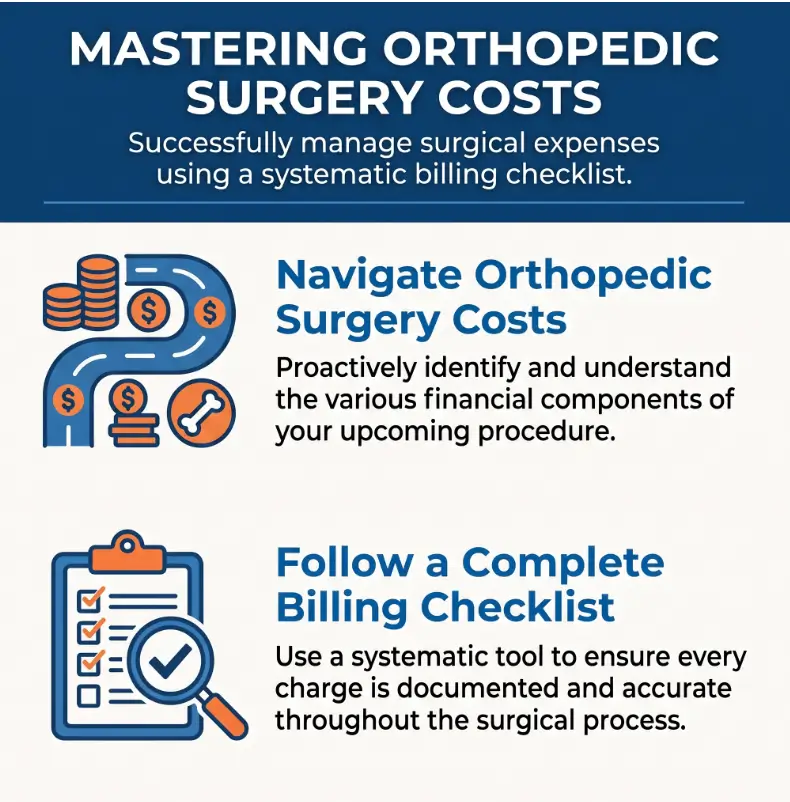
What Should an Orthopedic Surgery Estimate Include?
A useful orthopedic surgery estimate should help you identify the expected procedure, the location of care, the organizations and clinicians likely to bill, and the services that are included or excluded. If it gives you only one total without explaining those pieces, ask for more detail.
The central problem is that surgery is often a small financial ecosystem rather than a single transaction. The orthopedic surgeon can quote a professional fee while the hospital or ambulatory surgery center, anesthesia group, laboratory, radiology provider, implant supplier, physical therapist, and other participants operate under different billing arrangements.
Use this orthopedic surgery estimate checklist
- Exact planned procedure and body site
- Surgeon’s professional fee or estimated allowed charge
- Hospital or ambulatory surgery center facility charge
- Anesthesia services
- Assistant surgeon or other surgical professional, if expected
- Implants, hardware, prosthetic components, or surgical supplies when relevant
- Preoperative laboratory work or imaging
- Pathology or other diagnostic services when applicable
- Post-anesthesia recovery services
- Expected inpatient room charges if admission is planned
- Postoperative imaging, braces, crutches, walkers, or other equipment if ordered
- Physical or occupational therapy expected after surgery
- Follow-up visits and whether they are included in the surgical billing arrangement
- Prescription medications that will be obtained separately
- Any service specifically excluded from the quote
If your first quote contains only the surgeon’s fee, start with the broader orthopedic surgery estimate guide and then build outward to the other billing entities.
What Changes the Final Cost?
The procedure name alone does not determine what you will owe. The final amount can change because of where surgery is performed, who participates, how the claim is coded, what equipment is used, what your insurance contract allows, and whether the clinical plan changes.
The surgery setting can change the billing structure
A hospital outpatient department and an ambulatory surgery center can attach different facility charges and insurance arrangements to a similar procedure. Inpatient surgery introduces still more variables, including hospital services and the length and complexity of the stay.
Do not assume that the location with the lower published price automatically produces the lower personal cost. Your network contract, deductible status, coinsurance, benefit design, and whether a particular facility is covered can reverse the apparent advantage.
If the facility fee itself is unclear, see the separate guide to facility fees in orthopedic care.
Implants and surgical hardware can be separate cost drivers
Joint replacement, fracture fixation, fusion procedures, and some reconstructive surgeries may involve implants or specialized hardware. Ask whether those expected items are already represented in the facility estimate and what would happen financially if the surgeon needs a different component during the operation.
The estimate can change when the clinical plan changes
An estimate is based on the anticipated course of care. An unexpected admission, additional imaging, laboratory testing, a longer procedure, treatment of a complication, or another medically necessary service can create charges that were not predictable from the original quote.

One Procedure, Several Bills: Build a Complete Estimate
The safest way to evaluate an orthopedic surgery estimate is to stop thinking in terms of “the surgery bill” and start thinking in terms of billing entities. One episode of care can produce claims from organizations that never appear on the surgeon’s estimate.
| Possible biller | What it may cover | What to verify | Cost concern |
|---|---|---|---|
| Orthopedic surgeon | Professional surgical services | Network status and procedure estimate | May be separate from facility charges |
| Hospital or surgery center | Operating room, recovery, supplies, facility services | Network status and facility estimate | Can represent a large separate charge |
| Anesthesia group | Anesthesia professional services | Participation and expected billing arrangement | May not appear on surgeon’s quote |
| Other clinicians | Assistant surgeon, radiology, pathology, consultations | Whether participation is expected | May generate separate claims |
| Recovery services | Therapy, equipment, medications, follow-up care | What is ordered and how benefits apply | Often occurs after the surgical episode |
This is also why a later bill can arrive from a provider whose name you do not immediately recognize. The guide to orthopedic bills from multiple providers explains how to sort those charges after care, while the guide to a separate anesthesia bill addresses one of the more common sources of confusion.
Technical detail: Why one estimate may not cover every provider
For patients who are uninsured or choosing not to use insurance, federal Good Faith Estimate rules are especially relevant. CMS currently explains that these estimates generally apply when qualifying self-pay care is scheduled in advance or when an estimate is requested, and that current estimates may cover a single provider or facility rather than automatically consolidating every participant in the episode.
That makes separate requests important. The site’s orthopedic Good Faith Estimate guide walks through that issue in more detail.
How Insurance Changes the Estimate
If you plan to use insurance, the provider’s estimate is not the same thing as your insurer’s determination of benefits. You need both sides of the equation: what providers expect to charge and how your plan expects to process those charges.
Verify the network at the provider level, not just the building level
An in-network hospital does not automatically answer every network question surrounding the episode. Ask about the surgeon, facility, anesthesia arrangement, and any other known professional group that may participate.
Federal surprise-billing protections can apply to certain out-of-network services connected with non-emergency care at an in-network hospital, hospital outpatient department, or ambulatory surgical center. Those protections are important, but they do not make every conceivable out-of-network situation harmless or eliminate the need to verify coverage before elective care.
Ask about prior authorization before treating approval as settled
Authorization and coverage are related but different questions. A surgeon’s recommendation does not by itself establish that an insurer has authorized the procedure, and an authorization does not necessarily guarantee a particular final payment amount.
Before the surgery date, confirm whether authorization is required, whether it has actually been submitted, whether it has been approved, which procedure and facility the approval covers, and whether anything could cause the authorization to expire or require revision. A step-by-step version is available in the orthopedic prior authorization checklist.
Use this insurer call script
- “Is this planned orthopedic procedure covered under my current benefits?”
- “Is prior authorization required, and what is its current status?”
- “Is the surgeon in network for my specific plan?”
- “Is the hospital or ambulatory surgery center in network?”
- “What should I verify about anesthesia and other professional services?”
- “How much of my deductible has been met?”
- “What coinsurance or copayment rules apply to the surgeon and facility?”
- “What is my remaining in-network out-of-pocket maximum?”
- “Are postoperative physical therapy, durable medical equipment, imaging, or home services subject to separate cost sharing or visit limits?”
- “Can you provide a reference number or written record for this benefits inquiry?”
Deductibles, coinsurance, copayments, network rules, and out-of-pocket limits affect patient responsibility in different ways. HealthCare.gov provides current federal explanations of these cost-sharing concepts, but your plan documents and insurer remain the better sources for your specific benefits.
Self-Pay and High-Deductible Patients: How to Compare Quotes
Self-pay patients and insured patients with substantial remaining deductibles often have a stronger reason to compare settings and request detailed estimates. But the comparison should be based on the same scope of care, not merely the smallest number printed at the bottom of a quote.
| Approach | Best for | Main advantage | Main limitation | What to verify |
|---|---|---|---|---|
| Basic quote | Early planning | Fast starting point | May omit separate billers | Exactly what is included |
| Itemized provider + facility comparison | Self-pay or deductible-sensitive patients | Better side-by-side comparison | Still may not predict clinical changes | Same procedure and included services |
| Full estimate + insurer verification | Insured patients facing meaningful cost exposure | Highest control before scheduling | Requires several calls | Network, authorization, cost sharing, exclusions |
For self-pay patients
Ask each relevant provider or facility for its written estimate rather than relying on a verbal package price. Confirm whether the quote includes professional services, facility charges, implants, anesthesia, imaging, laboratory work, and postoperative care.
CMS states that uninsured or self-pay patients can generally receive a Good Faith Estimate for scheduled care that meets the federal requirements, or request one before scheduling. Save each estimate so you can compare it with later bills.
For high-deductible insured patients
Do not compare a self-pay cash quote with an insurance estimate as though they were interchangeable. Ask what happens if you choose self-pay, whether the provider will submit a claim, whether the payment will count toward your deductible or out-of-pocket limit, and whether the choice affects any plan protections.
When the cheapest quote is enough
You do not need a paid financial advocate merely to collect routine estimates when the surgery is straightforward, the providers are easy to identify, your insurer answers clearly, and the written numbers reconcile reasonably well. A spreadsheet, a folder, and several focused phone calls may be enough.
When paying for help can make sense
Additional billing or benefits assistance may be reasonable when the procedure involves several facilities, complicated out-of-network questions, prior denials, multiple competing estimates, substantial self-pay exposure, or bills that cannot be reconciled with the written estimates and insurer records.
If the cost is manageable but payment timing is difficult, compare financing carefully rather than assuming a payment plan is free. The separate guide to orthopedic payment plans explains what to check before agreeing to one.
Before You Pay: Questions for the Surgeon, Facility, and Anesthesia Team
Before paying a deposit or locking in a surgery date, turn your estimate into a short interview. Each billing party should be able to tell you what its number represents and what could reasonably fall outside it.
Questions for the surgeon’s office
- What exact procedure is currently planned?
- What professional services are included in this estimate?
- Are routine postoperative visits included or billed separately?
- Is an assistant surgeon or another clinician expected?
- Are implants or special surgical materials involved?
- Could the procedure change after surgery begins, and how would that affect billing?
- Has prior authorization been completed if my plan requires it?
- Who should I contact if the insurer authorizes a different site or service?
Questions for the facility
- Does the quote include the operating room and recovery area?
- Are common supplies included?
- Are expected implants or prosthetic components included?
- Is anesthesia included or billed by a separate group?
- Could laboratory, pathology, or radiology charges be separate?
- Is an overnight stay expected, and if so, is it represented in the quote?
- What deposit is required?
- What is the refund or reconciliation process if the final patient responsibility is lower?
Questions about anesthesia
- Which anesthesia group is expected to provide care?
- Will it submit a separate claim?
- Can I obtain an estimate or expected billing information in advance?
- What should I confirm with my insurer about network treatment?
- Could the type or duration of anesthesia alter the final charge?
If terminology starts to blur together, the orthopedic billing terms guide can help you distinguish charges, allowed amounts, cost sharing, and other billing language before making the calls.
Use hospital price tools as a cross-check, not as a promise
U.S. hospitals are subject to federal hospital price transparency requirements and make pricing information available online in specified formats. These resources can help you investigate prices and ask sharper questions, but published hospital pricing does not by itself establish your final insured out-of-pocket amount.
Costly Estimate Mistakes and Safer Moves
The most expensive estimate mistake is often not choosing the “wrong” hospital. It is making a decision with an incomplete set of numbers and discovering later that different parts of the episode were never included.
| Mistake | Why it costs money | Safer move |
|---|---|---|
| Treating the surgeon’s quote as the total | Facility and other professional bills may be separate | Create a billing-entity list before comparing totals |
| Checking only the hospital’s network status | Other participants may have different arrangements | Verify known major participants individually |
| Assuming prior authorization means a guaranteed price | Authorization does not determine every claim adjustment | Verify benefits and expected cost sharing separately |
| Comparing two quotes with different inclusions | The lower number may simply omit more services | Compare line items and exclusions |
| Ignoring post-surgery care | Therapy, equipment, imaging, and medications can add costs | Build a recovery-cost list alongside the surgery estimate |
| Throwing away estimates after surgery | You lose a useful reference when bills arrive | Save written estimates, insurer references, EOBs, and bills together |
When a Lower-Cost Setting Is Enough, and When It Isn’t
Spending more does not automatically buy a better orthopedic outcome, and spending less is not automatically reckless. The appropriate setting is first a clinical and safety question, then a coverage and cost question.
A lower-cost option may be reasonable when
- Your surgeon considers the setting clinically appropriate for the planned procedure.
- Your health conditions and anticipated recovery do not require resources available only in a higher-acuity setting.
- The facility and major participants work favorably with your insurance.
- The estimate clearly includes the services you are comparing.
- You have a safe discharge and postoperative care plan.
Paying more may be reasonable when
- Your surgeon recommends a setting with additional clinical resources because of your medical situation.
- A cheaper facility is out of network or creates materially worse coverage.
- The lower quote excludes important services included elsewhere.
- Complex surgery, medical conditions, or recovery needs make additional resources relevant.
- The apparently cheaper option creates logistical costs or care gaps that matter to you.
Do not choose a surgical facility solely from a price table. Ask the surgeon why that setting is appropriate, then compare the financial implications among clinically reasonable options.

Orthopedic Surgery Estimate FAQ
Is an orthopedic surgery estimate the same as the final bill?
No. An estimate describes expected charges or patient responsibility based on information available before care. The actual services performed, insurer claim processing, contractual adjustments, and unexpected clinical needs can change the final amount.
Why did the surgeon give me an estimate but the hospital gave me another one?
They may represent different billing entities. The surgeon can bill professional services while the facility bills for the operating room, supplies, recovery services, and other facility resources.
Can anesthesia be billed separately?
Yes, anesthesia professional services may be billed separately from the surgeon and facility. Ask who is expected to provide anesthesia and what estimate or insurance information is available before the procedure.
Does prior authorization guarantee that insurance will pay the estimated amount?
No. Authorization addresses whether the plan has approved a requested service under its rules, but final payment can still depend on eligibility, network status, coding, covered services, cost sharing, and the care actually provided.
Should I ask for a Good Faith Estimate if I am self-pay?
Yes, it can be an important planning document when the federal Good Faith Estimate rules apply. CMS currently states that qualifying uninsured or self-pay patients can receive an estimate for care scheduled sufficiently in advance or request one directly. Current federal guidance should be checked if you plan to rely on the associated dispute process.
What if the final self-pay bill is much higher than my Good Faith Estimate?
Keep the written estimate and compare the billed charges provider by provider. Federal rules currently provide a patient-provider dispute process in qualifying cases when billed charges from a provider or facility exceed its Good Faith Estimate by the specified federal threshold. Because eligibility requirements and deadlines matter, use the current CMS Medical Bill Rights guidance rather than relying on memory.
Is an ambulatory surgery center always cheaper than a hospital?
No universal rule guarantees that it will cost you less. Facility prices may differ, but your personal cost also depends on the procedure, insurance contract, network participation, deductible, coinsurance, and services included in each estimate.
Should I pay a surgery deposit before insurance finishes reviewing authorization?
Ask first what the deposit represents, whether authorization is complete, how the amount was calculated, and what happens if coverage, scheduling, or the procedure changes. Get the payment and refund terms in writing before paying a substantial deposit.
Your 15-Minute Orthopedic Surgery Estimate Check
You do not need to solve the entire medical billing system this afternoon. In 15 minutes, you can find out whether your current estimate is complete enough to trust for planning.
- Write the exact procedure and facility name. Do not work from “knee surgery” or “shoulder repair” if a more specific planned procedure is available.
- List the expected billers. Start with surgeon, facility, and anesthesia, then add known imaging, laboratory, implant, equipment, and therapy providers.
- Put a check beside every written estimate you already have. Blank spaces reveal your next calls.
- Circle every provider whose network status you have not verified.
- Write down the prior authorization status. Use “not required,” “pending,” or “approved” only when you have actually confirmed it.
- Write your remaining deductible and out-of-pocket information from the insurer. Do not rely on an old statement if more claims have been processed.
- Highlight exclusions. Look for anesthesia, implants, laboratory work, radiology, therapy, equipment, and postoperative care.
- Create one folder. Keep estimates, authorization information, insurer reference numbers, later EOBs, and actual bills together.
Once those eight items are on one page, the financial picture usually becomes less foggy. You may still have unknowns, but they are named unknowns, which is much easier to work with than a reassuring number whose boundaries you cannot see.
The next useful move is simple: call the organization responsible for the biggest blank space on your page. One good question now can prevent several baffling envelopes later.
Targeted editorial update: October 21, 2026. Added a topic-specific follow-up record and recheck triggers, revised the title and search description, and removed unverified first-person claims or clarified selected wording where found. The existing body was retained. This update is not a complete legal, coverage or clinical review; confirm current rules and individual decisions with the relevant official source or service.