
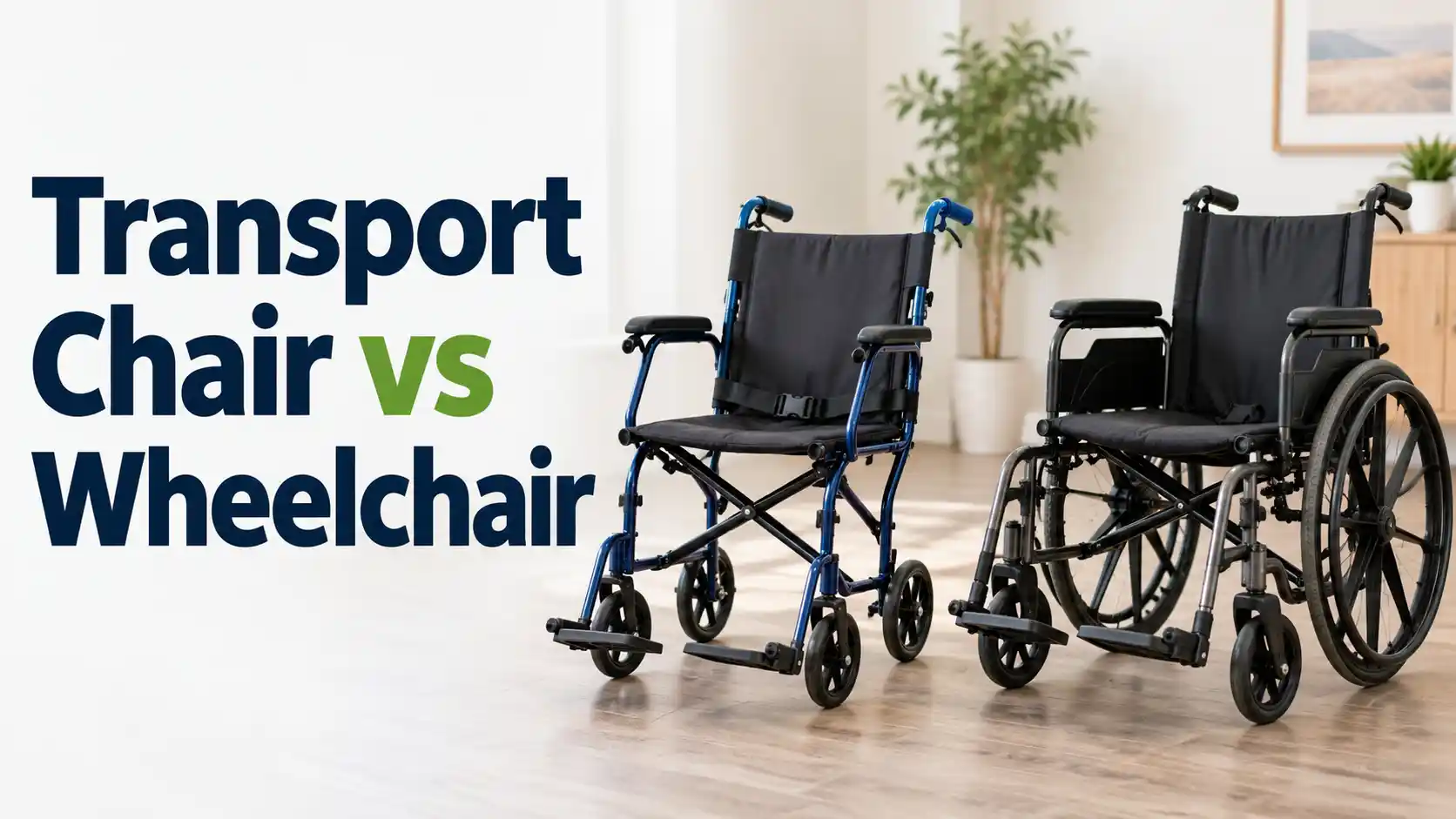
A transport chair and a standard wheelchair may look similar, but they solve different mobility problems. The biggest distinction is who provides the movement: a standard manual wheelchair typically has large rear wheels that let the user self-propel, while a transport chair has smaller wheels and is designed to be pushed by another person.
That difference affects portability, independence, price, and Medicare coverage. For someone comparing equipment after surgery, during rehabilitation, or because walking has become difficult, the cheapest chair is not automatically the right chair. The better question is whether the person needs independent mobility or reliable caregiver-assisted transport.
For Original Medicare beneficiaries, both types may fall within the durable medical equipment framework when the applicable medical-necessity rules are satisfied. In 2026, the Part B deductible is $283, and after the deductible Medicare generally leaves the beneficiary responsible for 20% of the Medicare-approved amount when the supplier accepts assignment.
Table of Contents
Transport Chair vs Wheelchair at a Glance
| Question | Transport chair | Standard manual wheelchair |
|---|---|---|
| Who moves the chair? | A caregiver or companion normally pushes it | The user may self-propel with the large rear wheels, or another person may push |
| Rear wheels | Usually smaller | Usually large enough for hand propulsion |
| Portability | Often lighter and easier to load into a vehicle | Usually heavier and bulkier |
| Best fit | Shorter trips or situations where a reliable helper is available | Greater independence or regular in-home mobility |
| Medicare coding | E1037, E1038, or E1039 | K0001 for a standard manual wheelchair |
| Medicare coverage possible? | Yes, when applicable criteria are met | Yes, when applicable criteria are met |
Medline’s explanation of wheelchairs versus transport chairs describes the practical distinction clearly: wheelchairs have larger rear wheels that permit self-propulsion, while transport chairs use a lighter frame and smaller wheels intended for caregiver-assisted movement.
A Transport Chair Gives Up Independence for Portability
A transport chair can be appealing when the person rarely needs to move independently while seated. It may be useful for medical appointments, moving between a car and a building, or covering distances that have become too tiring to walk when a caregiver is available.
The trade-off is significant. The seated person generally cannot simply grab the rear wheels and travel across the room independently. If the caregiver walks away, the person may effectively be parked until help returns.
That makes caregiver availability a functional requirement, not merely a convenience. Before choosing a transport chair, ask who will push it during bathroom trips, transfers, meals, appointments, and the less predictable parts of the day.
This becomes particularly important after an operation. Someone who appears mobile during a short therapy session may have very different needs later when pain, stiffness, medication, or fatigue increases. If this decision is part of joint-surgery planning, the guide on when living alone becomes unsafe after joint surgery can help separate equipment needs from the need for actual hands-on assistance.

A Standard Wheelchair Can Provide More Independent Mobility
A standard manual wheelchair usually has large rear wheels with hand rims. A person with sufficient upper-body ability may therefore move without waiting for someone else to push.
That independence comes with compromises. Standard wheelchairs are commonly heavier and more cumbersome to load into a car. They also require enough space to turn and maneuver inside the home. Seat width, overall width, arm configuration, footrests, weight capacity, and the user’s ability to propel safely all matter.
Do not assume that difficulty walking automatically means a wheelchair is medically necessary. Medicare’s coverage standards look at what the mobility limitation prevents the beneficiary from doing inside the home and whether a cane, crutch, or walker can adequately resolve the problem.
When mobility problems are difficult to describe during a short appointment, it can help to record specific limitations rather than writing only “I cannot walk well.” The site’s guide to documenting walking, stairs, sitting, and other functional limitations shows how to record distance, assistance, symptoms, and task failures more clearly.
Does Medicare Cover a Transport Chair?
Potentially, yes. CMS’s current Manual Wheelchair Bases coverage policy specifically identifies transport chairs under HCPCS codes E1037, E1038, and E1039. The policy states that a transport chair can be covered as an alternative to a standard manual wheelchair when the applicable general requirements and caregiver-assistance requirement are met.
This is important because a transport chair should not be treated as automatically non-covered simply because it is lightweight or companion-propelled. The medical and functional circumstances still determine whether Medicare’s requirements are satisfied.
Among the central questions are whether the beneficiary has a mobility limitation that significantly interferes with mobility-related activities of daily living in the home, whether other mobility aids adequately resolve the limitation, whether the home can accommodate the chair, and whether the necessary assistance is available.
For a transport chair in particular, CMS includes a criterion requiring a caregiver who is available, willing, and able to provide assistance with the wheelchair.
Does Medicare Cover a Standard Manual Wheelchair?
Original Medicare Part B can cover a medically necessary manual wheelchair as durable medical equipment. Medicare’s wheelchair and scooter coverage guidance explains that wheelchairs are covered through the Part B DME benefit when eligibility and provider requirements are satisfied.
CMS’s manual-wheelchair policy goes further by defining the functional criteria used for particular wheelchair categories. A standard manual wheelchair uses HCPCS code K0001. Lightweight, high-strength, heavy-duty, and other wheelchair categories have additional requirements rather than being interchangeable upgrades that Medicare automatically pays for.
In practical terms, the prescription should match the functional problem. A more expensive wheelchair is not automatically more coverable, and buying a particular model first does not force Medicare to reimburse it later.
The “Used in the Home” Rule Is Easy to Miss
One of the most important Medicare distinctions is that the DME benefit focuses on medically necessary equipment for use in the home. Medicare’s durable medical equipment guidance defines covered DME partly around home use.
That means wanting a transport chair for shopping malls, airports, vacations, long outdoor walks, or occasional community events does not by itself establish Medicare coverage. Those may be perfectly reasonable reasons to buy a chair privately, but they are different from demonstrating a qualifying in-home mobility limitation.
CMS’s manual-wheelchair policy also distinguishes equipment used for in-home mobility from a wheelchair intended only for mobility outside the home.
How Much Do Transport Chairs and Wheelchairs Cost?
There are two different prices to think about: the retail cash price and the amount on which insurance payment is calculated. They should not be treated as the same number.
Retail prices vary with frame material, chair weight, seat dimensions, wheel size, braking systems, weight capacity, and included accessories. Compare equivalent configurations rather than assuming every transport chair costs less than every standard wheelchair.
Compare dated quotes for the exact models you are considering, including delivery, fitting, accessories, returns, and any rental charges. Retail listings and promotions can change, so an undated price range should not be treated as a current quote or a national average. A retail quote is also separate from the Medicare-approved amount and your actual patient responsibility.
A standard wheelchair can also range from a relatively inexpensive basic chair to a much more costly lightweight, ultralight, positioning, bariatric, or customized model. Accessories can further change the total.
If you are choosing equipment during knee-replacement recovery, avoid building the budget around a wheelchair before the clinical team says one is needed. The site’s knee-replacement recovery equipment cost guide compares common recovery items and explains why purchasing large mobility equipment “just in case” can waste money.

What Would You Pay With Original Medicare in 2026?
For 2026, the Original Medicare Part B deductible is $283. Once the deductible is satisfied, beneficiaries generally pay 20% of the Medicare-approved amount for covered DME when the supplier accepts assignment. Medicare publishes the current deductible on its 2026 Medicare costs page.
Do not calculate your expected bill simply by taking 20% of a store’s sticker price. Medicare payment is based on the Medicare-approved amount and applicable payment rules, not necessarily the price displayed by an online retailer.
Supplier status matters too. Medicare advises beneficiaries to make sure the DME supplier is enrolled in Medicare and to determine whether the supplier accepts assignment. A supplier that accepts assignment agrees to accept the Medicare-approved amount under Medicare’s payment rules.
Medicare Advantage Can Produce a Different Out-of-Pocket Cost
Medicare Advantage plans must provide Medicare-covered benefits, but the practical route to obtaining equipment can differ. Network suppliers, plan authorization rules, copayments, coinsurance, and plan procedures may affect what you pay and where you can obtain the chair.
Before accepting delivery, ask the plan and supplier four specific questions:
- Is this exact type of transport chair or wheelchair covered for my documented need?
- Which DME suppliers may I use?
- Is prior authorization or other approval required?
- What is my estimated out-of-pocket amount under my plan?
If authorization paperwork is becoming the real obstacle, the orthopedic prior authorization checklist provides a useful framework for tracking approvals, documentation, provider information, and coverage questions instead of relying on a vague “it should be covered.”
Renting vs Buying Can Change the Calculation
Medicare does not handle every DME item through one universal purchase method. Depending on the equipment and payment category, Medicare may require rental, purchase, or allow different arrangements. Medicare specifically advises beneficiaries to check how the particular DME item will be supplied.
This matters especially when the chair may be needed for only part of a recovery. A six-week mobility problem and a long-term inability to walk independently are not the same purchasing decision.
Before buying privately, ask the DME supplier whether Medicare treats the prescribed item as rental or purchase equipment and what happens if your functional needs change during rehabilitation.
When a Transport Chair May Be the Better Choice
- The user consistently has a caregiver available to push the chair.
- Portability and loading the chair into a vehicle are major concerns.
- The chair is primarily needed for assisted movement rather than independent mobility.
- A clinician or therapist determines that caregiver-propelled mobility is appropriate.
- The home layout and required routes work safely with the chosen chair.
A transport chair can be elegantly simple when those conditions are true. It becomes a frustrating little island on wheels when the user routinely needs to move while nobody is available to push.
When a Standard Wheelchair May Make More Sense
- The user needs greater independent mobility.
- The person has the upper-body function needed to self-propel safely.
- The chair will be used regularly inside the home.
- The home has sufficient doorway and turning clearance.
- The treating clinician and DME evaluation support a standard manual wheelchair rather than another mobility aid.
More independence is not automatically safer, however. Someone may technically be capable of pushing a wheelchair yet struggle with transfers, braking, thresholds, fatigue, or positioning. The complete task matters more than the label on the equipment.
Do Not Choose the Chair Before Checking the Home
Measure the narrowest doorway and the actual route between the bed, bathroom, kitchen, and primary sitting area. Include turns, furniture, rugs, thresholds, and footrests in the assessment.
Also consider transfers. Can the user safely move between the chair and bed, toilet, car seat, or recovery chair? Can the caregiver manage the transport chair without lifting or twisting unsafely?
A broader surgery recovery checklist can help organize mobility devices, transfer supplies, home setup, and other practical needs when the chair is being selected for postoperative recovery rather than permanent use.
Five Questions to Ask Before Ordering Either Chair
- Does the person need to propel independently? If yes, a conventional transport chair may be a poor fit.
- Is the chair needed inside the home? This is particularly important when Medicare coverage is being considered.
- What mobility task cannot be completed safely with a cane, crutch, or walker? Describe the task rather than simply saying walking is difficult.
- Who will provide assistance? For a transport chair, caregiver availability can be central to both practicality and Medicare coverage criteria.
- What will the beneficiary actually owe? Confirm the supplier, assignment status, rental or purchase arrangement, deductible, coinsurance, and Medicare Advantage rules before delivery.
The Bottom Line
A transport chair is usually the more portable, caregiver-dependent option. A standard wheelchair is generally heavier but can provide much more independent mobility because the user can propel the large rear wheels.
Under Original Medicare, the distinction does not reduce to “wheelchairs are covered and transport chairs are not.” CMS specifically recognizes transport chairs as an alternative manual-wheelchair category when the required medical and caregiver criteria are satisfied.
For 2026, the Part B deductible is $283, followed by the usual 20% beneficiary share of the Medicare-approved amount for covered DME when the supplier accepts assignment. Your actual cost may differ because of other insurance, supplier status, equipment category, rental rules, Medicare Advantage plan terms, and whether the item meets Medicare’s medical-necessity requirements.
Before paying cash, ask the treating clinician and Medicare-enrolled DME supplier which chair addresses the actual in-home mobility problem. A chair that costs less but leaves the user stranded without a caregiver is not a bargain, while a heavier wheelchair that provides independence may be worth the extra complexity when it matches the person’s functional needs.
Last updated: October 15, 2026