
This site is written from a family-caregiver perspective. The operator is not a medical professional or an insurance, legal or financial adviser. Use this guide to organize questions for the relevant service.
Keep each estimate tied to its issuer
Use this follow-up record alongside the guide below. It does not determine medical suitability, insurance eligibility or legal rights, and it does not guarantee a price.
- Keep together
- Each estimate, issuing provider, planned services, date and the intended payment arrangement.
- Unanswered question
- Does this document cover this provider’s expected services and identify what it excludes?
- Next contact and owner
- Request missing documents or corrections from their issuers and keep current official guidance available.
- Recheck when
- Service, provider, timing or payment arrangement changes.
For each response, record its date, source, reference number and what remains uncertain. Agree the next follow-up date instead of treating silence as confirmation. Use official contact channels and keep identifying health, account and policy information out of public comments.

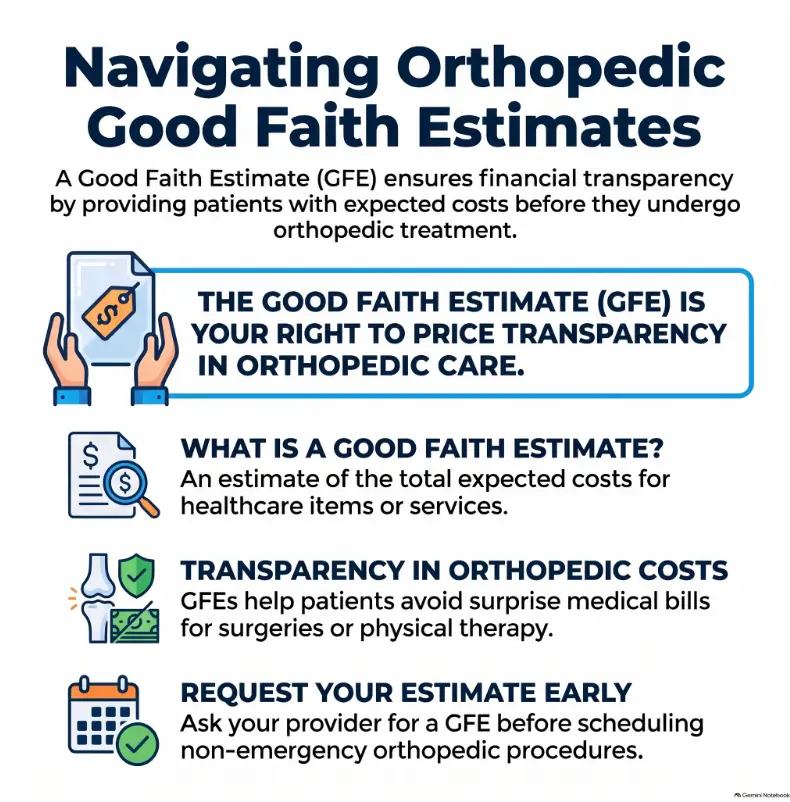
A good faith estimate, or GFE, is a written estimate of the charges a health care provider or facility expects for scheduled care. For orthopedic patients, it can help clarify the expected price of a consultation, imaging, injection, brace, surgery, or other planned service before treatment begins.
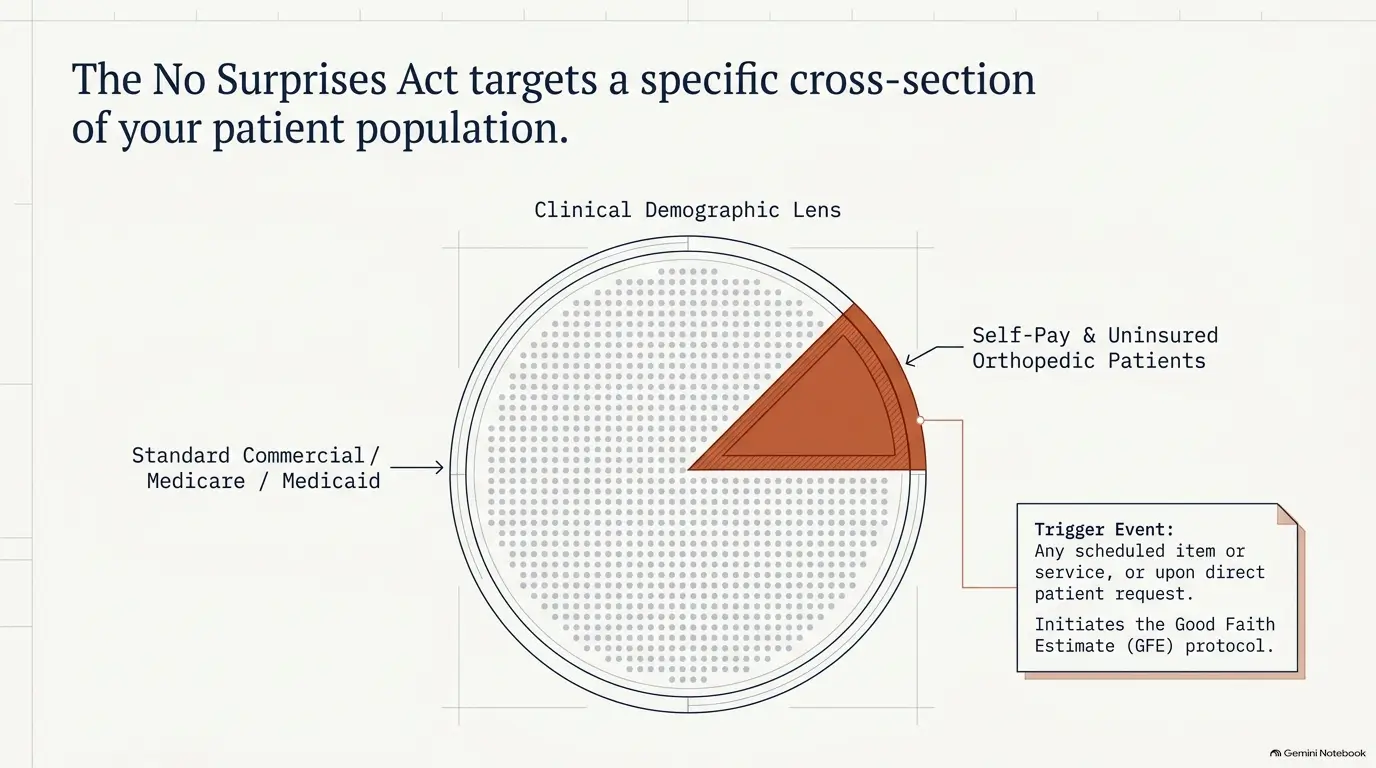
The most important distinction is whether you are using health insurance. Federal Good Faith Estimate protections generally apply when you are uninsured or when you have insurance but choose not to use it for the care. If you are using insurance, your more useful questions are usually about network status, prior authorization, the insurer’s allowed amount, and your expected deductible, copay, or coinsurance. Current federal guidance is available through CMS’s explanation of Good Faith Estimates.
For orthopedic care, the best first move is simple: ask for the estimate in writing, then check which provider and which parts of your treatment it actually covers. A single estimate may not capture the surgeon, hospital or surgery center, anesthesia, imaging, medical equipment, and rehabilitation bills that can surround one orthopedic episode.
Table of Contents
Who Can Get a Federal Good Faith Estimate?
The federal Good Faith Estimate rules described here generally apply to people without insurance or people with commercial coverage who choose not to submit the claim to that plan. People enrolled in Medicare, Medicaid, TRICARE, VA health care, or another federal health program should check that program’s rules; these uninsured/self-pay protections should not be assumed to apply in the same way.
| Situation | What to Request | Main Question |
|---|---|---|
| No health insurance | Good Faith Estimate | What will each provider or facility charge me? |
| Insured but paying entirely without using the plan | Good Faith Estimate | Is the self-pay price better than using my coverage? |
| Using health insurance | Provider estimate plus insurer cost estimate | What is my actual expected out-of-pocket cost? |
| Emergency orthopedic care | Different billing protections may apply | What protections apply to this emergency bill? |
This distinction matters because an orthopedic clinic’s cash price and your insurance cost-sharing amount answer different questions. A $3,000 self-pay quote does not mean an insured patient will owe $3,000, and a low copay for the surgeon does not tell you what the facility, imaging, or other services will cost.
If you plan to use insurance, also verify whether the planned service requires authorization. The orthopedic prior authorization checklist can help you separate approval questions from price-estimate questions.
What Should an Orthopedic Good Faith Estimate Include?
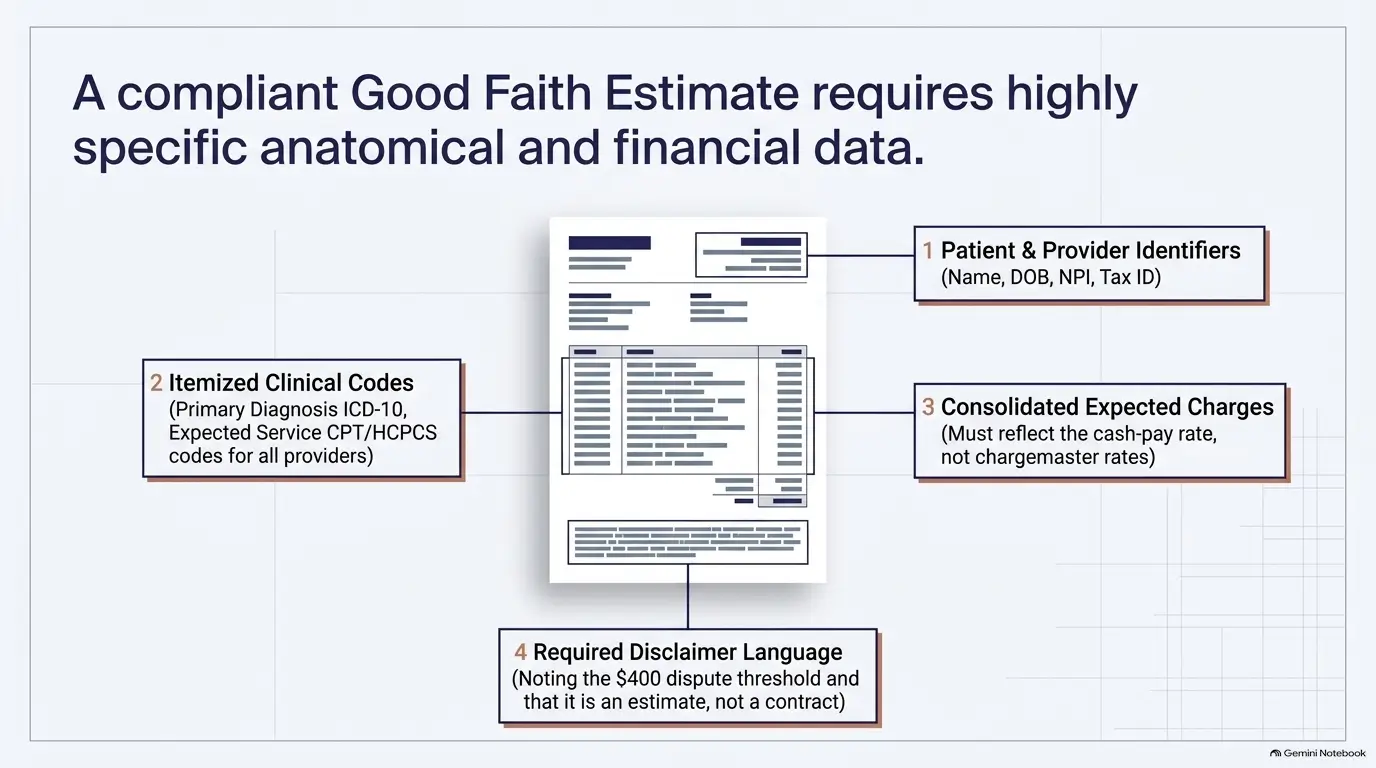
A useful GFE should be specific enough that you can later compare the expected services with the bill. Federal guidance calls for an itemized list of expected charges and details about the items or services that the provider or facility reasonably expects to furnish.
- The provider or facility issuing the estimate
- The scheduled item or service
- Service or procedure codes used for the estimated care
- Expected charges for the listed items and services
- The location where the services are expected to be provided
- Relevant diagnosis information when required for calculating the estimate
For a simple orthopedic office visit, one estimate may be relatively straightforward. For surgery, however, the financial anatomy can have more joints than the procedure itself.
For surgery, check each potential billing source
Ask whether your estimate covers each of the following, or whether you need a separate estimate:
- Orthopedic surgeon’s professional fee
- Hospital or ambulatory surgery center charges
- Anesthesia services
- Preoperative imaging or laboratory testing
- Implants, surgical supplies, or medical devices when applicable
- Braces or other durable medical equipment supplied separately
- Postoperative services that have already been scheduled
- Physical therapy or rehabilitation arranged separately
CMS currently advises patients that Good Faith Estimates may cover only the charges from a single provider or facility. For surgery, that can mean requesting estimates separately from the surgeon and the facility, and potentially from other independently billing providers.
Facility charges are particularly easy to overlook. If your quote mentions a professional fee but says little about where the procedure will occur, review how an orthopedic facility fee can affect the total bill.
When Should You Receive the Estimate?
The timing depends on how far ahead the care is scheduled. Under current federal guidance for uninsured and self-pay patients, the key deadlines are based on business days.
| When Care Is Scheduled | Federal GFE Timing |
|---|---|
| 3 to 9 business days before care | Generally within 1 business day after scheduling |
| 10 or more business days before care | Generally within 3 business days after scheduling |
| You request an estimate before scheduling | Generally within 3 business days of the request |
| 0 to 2 business days before scheduled care | The federal GFE entitlement generally does not apply |
Emergency care is different. The federal rule does not require a Good Faith Estimate before emergency treatment. Other No Surprises Act protections may still be relevant depending on the bill and circumstances. CMS maintains a broader explanation of medical billing rights when you are not using insurance.
Why One Orthopedic Estimate May Not Be the Whole Price
The most common mistake is treating one estimate as the price of the entire episode of care. Orthopedic treatment often involves multiple organizations that bill independently.
Suppose the surgeon gives you a written estimate for the operation. That document may accurately describe the surgeon’s expected charge while saying nothing about the surgery center. Likewise, a facility estimate may not represent the anesthesiologist’s separate charge.
Anesthesia deserves its own question before many procedures because it can arrive as a separate bill. If surgery is planned, reviewing how a separate anesthesia bill works can help you identify another estimate you may need.
Ask this before scheduling: “Which organizations or clinicians may bill me separately for this procedure, and whom should I contact for a written estimate from each one?”
That question is often more useful than simply asking, “How much is the surgery?” It turns one vague number into a map of the actual billers.
Use This Five-Minute Estimate Check Before You Agree to Care
Before treating an estimate as your expected total, run through these five checks.
- Confirm your payment status. Are you uninsured, deliberately self-paying, or submitting the claim to insurance?
- Identify the exact service. Confirm what procedure, imaging study, injection, device, or visit is being estimated.
- Identify every expected biller. Ask whether the surgeon, facility, anesthesia provider, imaging group, or equipment supplier will bill separately.
- Check exclusions. Ask what commonly associated services are not included in the written estimate.
- Save the estimate. Keep the paper or electronic copy so you can compare it with the final bill.
If you are considering a procedure rather than a routine visit, the orthopedic surgery estimate checklist can help you examine the quote at a more detailed level.
How to Compare the Estimate With the Final Bill
Do not compare only the grand totals. Match each provider’s estimate against that provider’s bill. This matters because the federal dispute threshold is generally applied to the charges from an individual provider or facility rather than by simply combining unrelated bills.
Illustrative example: assume you receive separate written estimates of $2,400 from the surgeon, $5,200 from the surgical facility, $900 from anesthesia, and $350 from an equipment supplier. The combined expected amount is $8,850, but those figures remain separate estimates from separate billers.
If the facility later bills $5,650, the difference between its $5,200 estimate and its bill is $450. If the federal eligibility requirements are otherwise satisfied, that individual difference may be relevant to the patient-provider dispute process. A $200 increase from one provider plus a $250 increase from another should not automatically be treated as one $450 discrepancy.
When the bill arrives, an itemized statement makes this comparison much easier. Use the itemized orthopedic bill guide to check service descriptions, separate charges, and potential mismatches.
What If the Bill Is Much Higher Than the Good Faith Estimate?
For qualifying uninsured or self-pay patients, a federal dispute process may be available when a provider or facility bills at least $400 more than the expected charges shown on that provider’s or facility’s Good Faith Estimate.
The dispute generally must be started within 120 calendar days of the date printed on the initial bill. An independent dispute resolution entity reviews the estimate, the bill, and relevant information. CMS explains eligibility and the current process on its patient-provider medical bill dispute page.
Prepare the filing documents and fee. The current CMS dispute instructions list a $25 non-refundable administrative fee, a copy of the GFE, the bill, and provider contact information. CMS states that the process does not start until the fee is paid; if the decision favors you, that fee is deducted from the amount you owe the provider. Check eligibility before paying and keep your submission confirmation.
Keep the routes separate: use the initial bill and the issuing provider’s GFE to organize this self-pay dispute. If you used insurance and disagree with the plan’s processing, ask the plan which review or appeal process applies instead. Do not assume the same $400 threshold or 120-day clock governs an insurance appeal.
A higher bill is not automatically an error. Treatment can change, complications may require services that could not reasonably have been anticipated, or additional care may have been added. Start by asking the billing office to explain the difference line by line.
If you formally enter the federal patient-provider dispute process, federal rules also provide protections relating to collections and late fees while the dispute is being handled. Do not simply ignore the bill. Preserve the estimate, initial bill, correspondence, and any revised statements.
A Good Faith Estimate Is Not the Same as Insurance Approval
A GFE answers a price question. Prior authorization answers a coverage-administration question. Network status affects contractual pricing. Medical necessity can affect whether an insurer pays. These pieces may overlap, but none substitutes for the others.
| Document or Check | What It Tells You | What It Does Not Guarantee |
|---|---|---|
| Good Faith Estimate | Expected self-pay charges from the issuing provider or facility | Your final bill will equal the estimate exactly |
| Prior authorization | A payer has reviewed a requested service under its rules | Zero out-of-pocket cost |
| Insurance cost estimate | Expected member cost based on plan information | The claim will process exactly as estimated |
| Provider network confirmation | Whether a provider participates with the plan | Every other clinician involved is also in-network |
If you have insurance but the cash price looks attractive, compare both routes before choosing self-pay. Ask the insurer what your expected responsibility would be if the claim were submitted, then ask the provider whether paying cash means the service will not be billed to the plan. Also consider whether a self-pay payment will count toward your deductible or out-of-pocket limit, because that depends on the plan and how the claim is handled.
When a Cheaper Orthopedic Quote Is Enough, and When It Is Not
You probably do not need to pay more simply because one facility has a more expensive estimate. Price becomes meaningful only after confirming that you are comparing the same service, setting, providers, equipment, and expected follow-up.
A lower self-pay price can be perfectly reasonable for straightforward scheduled care when the scope is clear and the providers are appropriately qualified. Paying more may become rational when the clinical situation requires a different facility, specialized surgeon, particular implant or equipment, higher level of monitoring, or other medically relevant resources.
The estimate should help expose those differences. It should not decide your treatment. Clinical suitability remains a medical decision between you and the treating professionals.
Frequently Asked Questions About Orthopedic Good Faith Estimates
Can I ask for a Good Faith Estimate before choosing an orthopedic surgeon?
If you are uninsured or planning to self-pay, you can generally request a GFE before scheduling care. Current CMS guidance says a requested estimate should generally be provided within three business days.
Does the estimate lock the provider into that exact price?
No. A GFE is an estimate rather than a guaranteed fixed-price contract. Unexpected or previously unanticipated care can change the final charges. However, qualifying self-pay patients may have federal dispute rights when an individual provider’s or facility’s bill is at least $400 above its estimate.
Should physical therapy after orthopedic surgery appear on the estimate?
Not necessarily. Services scheduled separately or provided by another organization may not appear on the estimate you receive for the surgery. Ask whether rehabilitation is included, separately scheduled, or billed by another provider.
What if the orthopedic office only gives me a price over the phone?
If the federal GFE requirements apply to you, ask for the estimate in paper or electronic form. A verbal conversation may be helpful, but retaining the written estimate matters if you later need to compare it with the bill or pursue a dispute.
What to Ask Before You Schedule
Take the written estimate and make one short call to the orthopedic office. Ask: “Is this the complete estimate from your organization, what is excluded, and which other providers or facilities may bill me separately?”
Write down the names of every separate biller they identify. Request the appropriate estimate from each one, save all documents in the same folder, and compare them with the bills after care. That small paper trail can turn an orthopedic price from a foggy promise into something you can actually verify.
Last updated: October 15, 2026
Targeted update: 17 October 2026. Added CMS filing-document and fee instructions, and distinguished the self-pay dispute from an insurance appeal. Other sections retain their existing review scope.
Targeted editorial update: October 21, 2026. Added a topic-specific follow-up record and recheck triggers, revised the title and search description, and removed unverified first-person claims or clarified selected wording where found. The existing body was retained. This update is not a complete legal, coverage or clinical review; confirm current rules and individual decisions with the relevant official source or service.