

Outpatient Surgery Recovery Guide
Getting Through Pharmacy Pickup After Surgery
Without the Scramble
The pharmacy stop after outpatient surgery looks simple on paper. A prescription is sent, a caregiver drives over, and everyone heads home. In real life, that short errand can become a maze of closing times, out-of-stock medication, insurance rejections, missing identification, and discharge instructions remembered through a fog of anesthesia.
The safest plan begins before the procedure. You need the exact pharmacy branch, a designated pickup person, confirmation that the prescriptions were received, and a clear way to compare every bottle with the discharge medication list. That small bit of preparation protects the first dose, the first night, and the patient who should not be driving anywhere.
This guide walks patients and caregivers through the whole handoff, from choosing a pharmacy to handling an unavailable opioid prescription. It also explains when a simple phone call is enough, when the surgeon must intervene, and when the problem is no longer a pharmacy problem at all.
The goal is not a perfect pharmacy trip. It is a safe first night at home. 🧾
Snapshot
This guide is for U.S. outpatient-surgery patients and the caregivers helping them get home safely. It solves the most common pharmacy-pickup problems, including missing prescriptions, controlled-medication rules, stock shortages, insurance rejections, and first-dose confusion. By the end, you will have a practical pickup checklist and a clear escalation plan.
Table of Contents

Before You Act: What This Guide Can and Cannot Do
This article offers general planning and medication-safety information. It cannot tell you which medicine is right for you, when you personally should take a dose, whether an over-the-counter drug is safe after your procedure, or whether a controlled prescription can be transferred under your state’s rules.
Your surgeon’s discharge instructions and the dispensing pharmacist’s label should guide the medication plan. When those instructions conflict, appear incomplete, or do not match the medication in the bag, pause and ask for clarification before taking another dose.
Key takeaway
A pharmacy delay is inconvenient. A medication mismatch is a safety issue. Treat those as two different problems, and never solve the second one by guessing.
Patients with severe medication allergies, sleep apnea, kidney or liver disease, pregnancy, anticoagulant use, complicated medication lists, prior opioid problems, or a history of dangerous drug reactions should obtain individualized instructions before surgery day.
The recovering patient should not be the errand runner
Sedation and anesthesia can affect attention, coordination, memory, judgment, and reaction time. Even a patient who feels surprisingly alert may still be under driving restrictions.
Follow the discharge instructions exactly. For many procedures involving sedation, that means arranging an adult driver and avoiding driving, alcohol, important decisions, and machinery for a specified period after the procedure.
A smoother ride home also begins before anyone reaches the pharmacy. The caregiver can use a practical post-surgery car-seat setup so the patient is not waiting uncomfortably in a parking lot while a prescription problem is sorted out.

Plan the Pharmacy Pickup Before Surgery Day
The best time to fix a pharmacy problem is while the patient is still fully awake, holding a calendar, and capable of remembering a phone conversation. A ten-minute check before surgery can prevent a two-hour chase after discharge.
Confirm the exact branch, not merely the pharmacy chain
Electronic medical records often contain an old preferred pharmacy. A prescription intended for the branch near home may land at a branch near a former workplace, a hospital outpatient pharmacy, or a mail-order service.
Record the full branch address, direct telephone number, closing time on the surgery date, weekend hours, drive-through availability, insurance-network status, and whether the branch regularly stocks the medication being discussed.
- Ask the surgical office to read back the pharmacy address.
- Check whether the branch closes for lunch.
- Confirm whether the drive-through handles controlled prescriptions.
- Ask whether a caregiver may pay with the patient’s card or a different card.
- Save the pharmacy number in both the patient’s and caregiver’s phones.
Ask when the prescriptions will actually be sent
Some surgical teams transmit prescriptions days before the procedure. Others send them during recovery, after the surgeon confirms what was done, or only after the discharge order is completed.
That timing changes the whole pickup plan. When prescriptions are sent in advance, the patient may be able to resolve insurance or stock issues before surgery. When they are sent after discharge, the caregiver needs a reliable confirmation method and the surgical office’s after-hours number.
Ask which medications may be filled before the procedure
Do not assume every postoperative prescription must wait until the operation is complete. The surgeon may be willing to send certain non-controlled medicines, such as an anti-nausea medication or another routinely planned prescription, in advance.
Other medications may depend on the final procedure, the anesthesia plan, the patient’s condition, or legal dispensing limits. The useful question is not, “Can I fill everything early?” It is, “Which prescriptions can safely and legally be ready before surgery?”
The pharmacy handoff in four checks
Short Story: The phone call that saved the first night
Claire was scheduled for shoulder surgery on a Friday morning. Her sister planned to collect the prescriptions on the way home, and the pharmacy was only six minutes from the surgical center.
The day before surgery, Claire called to confirm the branch. The office had an older location in her chart, one that closed at 5 p.m. and did not stock the prescribed pain medicine.
The nurse updated the record, sent the non-controlled prescriptions early, and noted a backup branch. After surgery, Claire’s sister received a ready message before leaving the recovery area. She picked up the medications while another relative stayed with Claire in the car.
Nothing dramatic happened, which was exactly the victory. The lesson was not that every pharmacy problem can be predicted. It was that one ordinary phone call moved the problem into daylight, before anesthesia, closing time, and pain joined the conversation.
Patients recovering with limited help may also benefit from planning beyond the pharmacy. The shoulder surgery recovery alone guide explains how to arrange household support before the day of surgery.
Who Can Pick Up Prescriptions After Surgery?
A spouse, relative, friend, neighbor, or caregiver can generally collect a patient’s filled prescription. HIPAA does not ordinarily require the patient to formally name that person in advance when the pharmacist reasonably believes the pickup is in the patient’s best interest.
That does not mean every pharmacy follows the same counter procedure. Identification requirements, controlled-substance policies, payment rules, and state laws can still vary.
What the caregiver should bring
A caregiver should arrive with enough information to identify the patient and enough paperwork to spot an incomplete order. The goal is not to carry a briefcase. It is to avoid the parking-lot call that begins, “What is your insurance group number?”
- The caregiver’s government-issued photo identification
- The patient’s full legal name and date of birth
- The patient’s address and telephone number
- The prescription-insurance card or a clear photograph of both sides
- A payment method
- The discharge medication list
- The surgical center and surgeon’s telephone numbers
- The patient’s known medication allergies
Controlled medication? Call before the caregiver leaves
When an opioid or another controlled medication is involved, ask the pharmacy what the pickup person must bring. The answer may depend on the pharmacy, state, medication, quantity, and local procedure.
Useful questions include:
- Does the caregiver need their own photo ID?
- Does the pharmacy need the patient’s ID or a copy?
- Can the prescription be paid for by a person other than the patient?
- Is the full quantity available today?
- Will the drive-through handle this pickup?
- Is there any unresolved prescriber or insurance issue?
Use one caregiver communication channel
When several relatives are helping, duplicate calls and duplicate doses become surprisingly easy. Choose one primary caregiver to communicate with the pharmacy and surgical team, then share updates in one place.
A simple caregiver group chat after surgery can record who collected the medication, when the first dose was given, and which problem still needs a call.
Key takeaway
HIPAA usually allows caregiver pickup, but it does not erase pharmacy procedures. One call ahead is cheaper than one unnecessary round trip.
When the Prescription Is Missing, Rejected, or Out of Stock
“The pharmacy does not have it” can describe several entirely different problems. Before anyone calls the surgeon in a panic, ask the pharmacist to identify the exact status.
Ask the pharmacy to name the problem precisely
| What the pharmacy says | What it may mean | Likely next action |
|---|---|---|
| “We did not receive it” | Wrong branch, transmission failure, or prescription not yet sent | Confirm the exact pharmacy and contact the surgical team |
| “It is not ready” | Still processing, pharmacist review, or clarification needed | Ask for the estimated completion time and unresolved issue |
| “Insurance rejected it” | Coverage limit, early refill, prior authorization, or wrong information | Ask for the rejection code and who must act |
| “We do not have it” | Out of stock, insufficient quantity, or not routinely carried | Ask when stock is expected and whether another branch has confirmed supply |
| “The prescriber must call” | Directions, quantity, authorization, or legal issue | Send the surgical team the pharmacy’s exact message |
Check where the prescription may be hiding
Electronic prescriptions sometimes go to the wrong place without being truly lost. Check the patient portal, discharge paperwork, text messages, and pharmacy app.
- Another branch of the same chain
- An old preferred pharmacy in the medical record
- The hospital’s outpatient pharmacy
- A pharmacy near the surgeon’s office
- A mail-order pharmacy
- A specialty pharmacy used for a procedure-specific medication
Give the surgical team one complete message
“The pharmacy says there is a problem” forces the surgical office to start from zero. A complete message gives the staff a chance to act before the pharmacy closes.
Copy-and-use call script
“The prescription for [medication name] was sent to [pharmacy name and branch]. The pharmacist says [exact rejection or stock message]. The pharmacy closes at [time]. Their telephone number is [number]. A nearby branch at [location] has confirmed that it has the medication. Please tell us what action is appropriate.”
Controlled prescriptions have tighter transfer rules
Federal rules permit a patient to request a one-time transfer of an electronic Schedule II through V prescription between DEA-registered retail pharmacies when state law allows it. The prescription must remain electronic, and the transfer is handled directly between licensed pharmacists.
That does not guarantee that every pharmacy can or will complete the transfer. Pharmacy systems, company policies, state rules, stock, and pharmacist availability can affect what happens next.
Show me the nerdy details
A prescription may be “transferable” under one rule yet still unusable at the destination pharmacy. The receiving pharmacy must be properly registered, the medication must be in stock, state law must permit the transfer, and the prescription must meet electronic-transfer requirements.
The pharmacist may also need time to communicate directly with the other pharmacy, verify the prescription record, and document the transfer. A caregiver cannot complete those professional steps by carrying a screenshot or printed medication list to another counter.
For that reason, the most efficient question is: “Can your pharmacists complete the transfer under current federal and state rules, and do you have the full quantity available?”
Make the First Dose Safer Once You Get Home
The pharmacy bag is not the medication plan. It is one part of the medication plan.
Before opening bottles, place the discharge medication list beside the pharmacy receipt and compare the order line by line. This is especially important when several prescriptions were sent, an old medication is being paused, or a caregiver was not present for the discharge conversation.
Match every bottle to the written instructions
- Medication name
- Strength
- Number of tablets, capsules, or measured doses
- How often it may be taken
- Whether it is scheduled or taken only as needed
- Its purpose
- The maximum daily amount
- When it should be stopped
- Whether food, alcohol, driving, or another medicine must be avoided
If the label and discharge sheet appear inconsistent, call the pharmacy or surgical team. Do not average the instructions, choose the more convenient version, or let the internet cast the deciding vote.
Patients with several bottles may find it useful to create larger, clearer pill bottle labels after surgery, provided the original pharmacy label remains intact and readable.
Watch for overlapping active ingredients
Some prescription pain medicines contain acetaminophen in combination with an opioid. A patient who then adds an over-the-counter cold remedy, sleep aid, or separate acetaminophen product may unintentionally take more of the same active ingredient.
Compare active ingredients, not just brand names. Ask the pharmacist to identify duplicate ingredients and confirm the care team’s maximum-dose instructions.
Do not add an NSAID merely because it is over the counter
Ibuprofen, naproxen, aspirin, and other nonsteroidal anti-inflammatory drugs are not appropriate after every procedure. Depending on the patient and operation, they may affect bleeding, the stomach, kidneys, blood pressure, or another part of the treatment plan.
Follow the surgeon’s specific instructions. Readers who want a broader explanation can review this guide to NSAIDs for joint pain, then confirm what applies to the current procedure.
Write down the first dose immediately
Record the medication, dose, and time as soon as it is given. A paper log on the kitchen counter works. So does a shared phone note.
The system does not need pastel tabs, an app subscription, or the organizational energy of an air-traffic controller. It needs one reliable record that every caregiver can see.
Key takeaway
The safest first-dose tool is a written timestamp. Memory after anesthesia is a foggy witness, and several helpful caregivers can accidentally become one duplicate dose.
If a patient becomes unusually confused about which medicine was taken, use the steps in this guide to monitor medication confusion after surgery and contact the care team promptly.
Opioid Pickup Requires an Extra Safety Check
Not every postoperative pain prescription is an opioid. When one is prescribed, however, the caregiver should know exactly which bottle it is, how it should be used, and what warning signs require immediate help.
Ask the pharmacist to identify the opioid clearly
Postoperative opioids may include medicines such as oxycodone, hydrocodone, morphine, or tramadol. Some are combined with another pain reliever, which makes the active-ingredient check especially important.
Ask the pharmacist:
- Is this medication an opioid?
- Does it contain acetaminophen or another active ingredient?
- Is it intended for scheduled use or only as needed?
- What side effects should prompt a call?
- Which medicines, supplements, or substances should be avoided?
Confirm what must not be combined with it
Opioids can cause sleepiness, slowed thinking, constipation, nausea, and dangerous breathing problems. Alcohol, benzodiazepines, sleep medicines, sedating antihistamines, and other central nervous system depressants can increase risk.
The patient should not add or resume a sedating product without checking the discharge plan, pharmacist, or prescriber. This matters even when the other medication was prescribed by a different clinician months earlier.
Ask whether naloxone should be part of the plan
The FDA recommends discussing naloxone when opioids are prescribed. It may be particularly important when the patient has increased overdose risk, uses other sedating medicines, has respiratory vulnerability, or lives with someone who could accidentally access the opioid.
Ask who should keep naloxone, where it will be stored, and how household members can recognize an overdose. Naloxone is emergency first aid, not a replacement for emergency medical care.
Plan storage and disposal before pills accumulate
Store opioid medication securely, away from children, visitors, household workers, and anyone for whom it was not prescribed. Do not leave it in a purse, open bathroom cabinet, or visible kitchen basket.
When the medication is no longer needed, use an authorized take-back location, mail-back option, or another disposal method recommended by the FDA. Do not save leftover opioid pills for a future injury or share them with another person.
Key takeaway
An opioid prescription adds four tasks to pickup: identify it, check interactions, discuss naloxone, and secure the leftovers.
Good, Better, and Best Pharmacy Pickup Setups
The best setup is not necessarily the most expensive one. It is the lowest-friction arrangement that fits the patient’s mobility, medication risk, caregiver availability, pharmacy hours, and recovery plan.
| Setup | What it includes | Best for | Cost considerations |
|---|---|---|---|
| Good | One caregiver, one confirmed pharmacy, ready-for-pickup notification, printed medication list | Routine outpatient procedures with reliable transportation | Usually no added service cost beyond medication and travel |
| Better | Advance filling where allowed, backup pharmacy, shared dose log, drive-through or curbside pickup | Evening discharge, limited mobility, multiple prescriptions, or longer travel | Possible cash-price differences, delivery fees, or out-of-network costs |
| Best for complex needs | Medication reconciliation before surgery, designated lead caregiver, pharmacy consultation, naloxone discussion, after-hours escalation plan | Complicated medication lists, opioid risk, sleep apnea, allergies, or limited household support | May involve professional caregiver time, consultation costs, or a more expensive pharmacy option |
Delivery versus caregiver pickup
Delivery can be helpful when the caregiver must stay with the patient, parking is difficult, or the pharmacy is far from home. Before paying a delivery fee, confirm that every prescribed medication is eligible for delivery and that the timing fits the first planned dose.
A same-day delivery estimate is not useful when the pharmacy cannot guarantee arrival before bedtime. Controlled medications may also have different delivery restrictions or identification procedures.
Cash price versus insurance processing
When insurance rejects a prescription, ask whether the patient may pay the cash price while the coverage issue is reviewed. Then ask whether doing so could affect reimbursement, future refill timing, or the ability to reverse the claim later.
Do not assume cash is automatically cheaper, faster, or financially sensible. Compare the actual price, the importance of the medication, the expected delay, and the prescriber’s alternatives.
When paid caregiver help may be worth considering
A professional caregiver may be useful when the patient lives alone, has mobility restrictions, cannot safely manage several medications, or lacks a reliable adult who can stay through the first recovery period.
Before hiring help, ask whether medication pickup is included, whether the caregiver may transport controlled prescriptions, how medication administration is documented, and what happens if the pharmacy or surgeon must be contacted.
Compare those hours with equipment and household support using this guide to home equipment versus caregiver hours. A delivery service solves transportation. It does not necessarily solve medication supervision.
When to Call the Surgeon, Pharmacist, or Emergency Services
Some problems belong at the pharmacy counter. Others need the surgical team. A few require immediate emergency action.
Call the pharmacist for medication-specific clarification
- The label is hard to understand.
- You suspect duplicate active ingredients.
- You need to confirm whether a pill may be split or crushed.
- You need storage instructions.
- The bottle looks different from a medication taken previously.
- You need the exact insurance rejection reason.
- You want to know whether another branch has confirmed stock.
Call the surgical team when the treatment plan must change
- The prescription was never sent.
- The pharmacist needs corrected directions or a new prescription.
- The prescribed medicine is unavailable and an alternative is being considered.
- Pain remains uncontrolled despite taking medication exactly as directed.
- The patient is vomiting and cannot keep medication down.
- The written instructions conflict with the pharmacy label.
- A medication error or duplicate dose may have occurred.
Do not take an extra dose, shorten the dosing interval, or substitute leftover medication while waiting for a response.
Call emergency services for possible overdose or severe reaction
Extreme sleepiness, inability to wake the patient, slow or shallow breathing, long pauses between breaths, blue or gray lips, severe confusion, collapse, or another sign of possible opioid overdose requires urgent action.
Administer naloxone when available and according to instructions, but do not delay emergency help. Stay with the patient and follow the dispatcher’s directions.
Emergency help may also be needed for severe allergic symptoms such as trouble breathing, facial or throat swelling, fainting, or rapidly worsening symptoms.
Follow the procedure-specific red flags
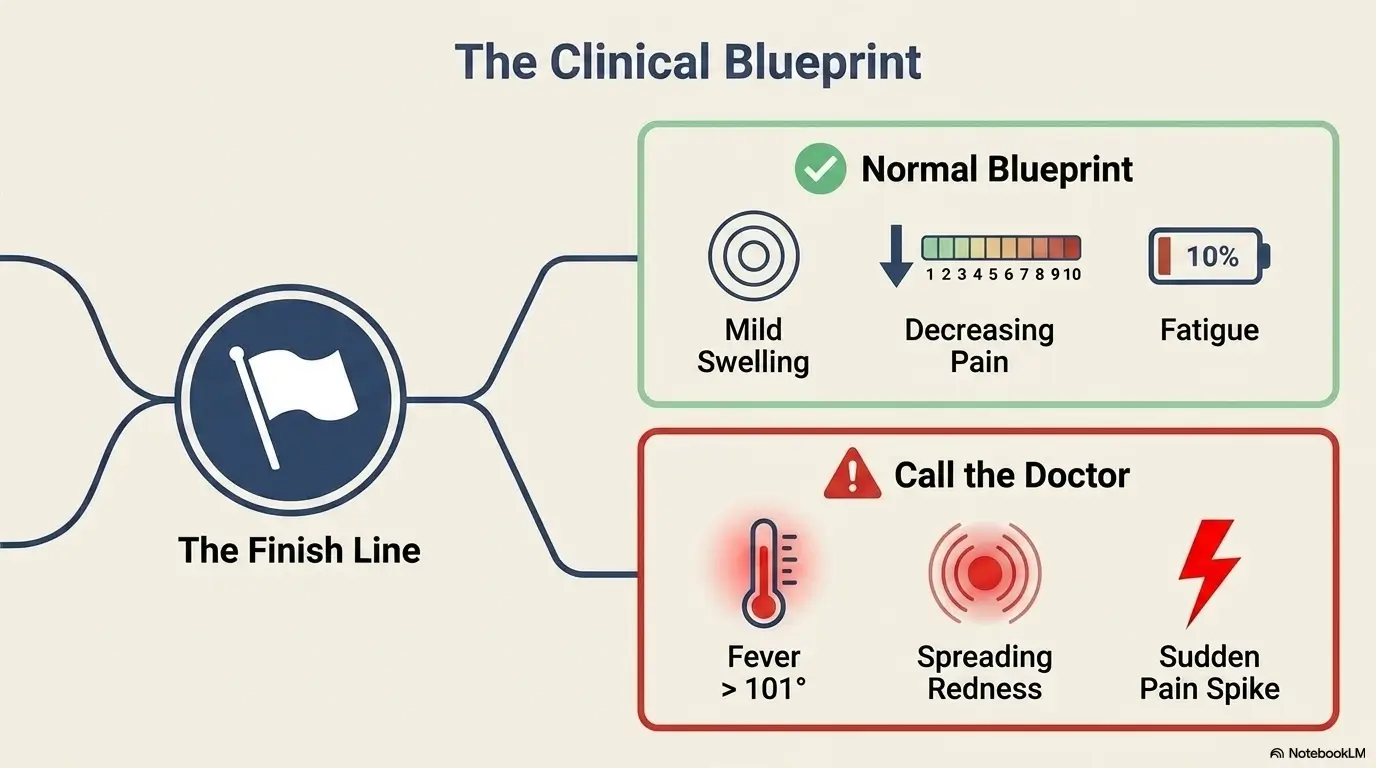
Significant bleeding, worsening wound changes, severe vomiting, chest pain, sudden breathing problems, new weakness, uncontrolled swelling, or another symptom named in the discharge instructions should be handled through the surgeon’s urgent pathway or emergency care as directed.
Key takeaway
When the question is “What does this label mean?” call the pharmacist. When the prescription or treatment must change, call the surgical team. When breathing or consciousness changes, call emergency services.
FAQ: Pharmacy Pickup After Surgery
Can my spouse or friend pick up my postoperative prescription?
Usually, yes. HIPAA generally permits a pharmacist to give a filled prescription to a family member, friend, or another person acting for the patient. The pharmacy may still require identification, patient details, payment information, or additional steps for a controlled medication.
Does the caregiver need the patient’s photo ID?
Requirements can vary by state, pharmacy, and medication. The caregiver should carry their own photo ID and ask the pharmacy whether a copy of the patient’s ID is needed.
Can postoperative prescriptions be filled before surgery?
Sometimes. Ask the surgeon which prescriptions can be sent early and which depend on the final procedure, discharge assessment, or controlled-substance rules. Do not request early filling without the prescriber’s approval.
What should I do when the pain medicine is out of stock?
Ask whether the pharmacy expects stock soon, whether another branch has confirmed availability, and whether the prescription is eligible for transfer. Controlled-prescription transfers may require direct pharmacist communication and must comply with state and federal rules. The prescriber may need to issue or change the prescription.
Can the pharmacy change the medication to something similar?
A pharmacist generally cannot switch to an entirely different prescription medication solely because the original drug is unavailable. The prescriber may need to authorize an alternative, dose, quantity, or set of directions.
What happens when insurance refuses the prescription?
Ask for the exact rejection reason. It may involve an early refill, quantity limit, formulary rule, prior authorization, incorrect insurance information, or another coverage issue. Ask whether cash payment is possible, what it costs, whether the claim can later be reversed, and whether the prescriber should consider a covered alternative.
Should the first pain dose be taken before a nerve block wears off?
Follow the timing instructions provided by the surgeon or anesthesia team. There is no universal schedule that is appropriate for every nerve block, procedure, patient, or medication.
Can I use leftover pain medicine from an earlier procedure?
Do not use an old prescription unless the current prescriber specifically reviews and approves it. The medicine may be expired, inappropriate for the new procedure, unsafe with the new medication list, or prescribed only for the original patient and condition.
Build Your Three-Minute Pharmacy Plan
You do not need a binder thick enough to stop a door. You need one note that survives surgery-day fatigue.
Within the next 15 minutes, create a pharmacy note in the patient’s phone and share it with the designated caregiver.
- Write the exact pharmacy name, branch address, and direct telephone number.
- Add the closing time for the day of surgery.
- Name the person responsible for pickup.
- List the identification, insurance information, and payment method they will carry.
- Add the surgeon’s daytime and after-hours numbers.
- Record one backup pharmacy only after confirming stock by phone.
- Place the discharge medication list beside the note when the patient gets home.
Use this confirmation sentence
“Please confirm that all of my postoperative prescriptions have been received, are fillable today, and will be ready before the pharmacy closes.”
That sentence does more work than “Did you get my prescription?” It checks receipt, legal and insurance readiness, stock, timing, and the closing-time problem in one breath.
Once the medications arrive home, compare the bottles, record the first dose, and keep the after-hours number visible. The successful pharmacy trip is the one nobody remembers because the patient rested, the caregiver knew what to do, and the first night remained quiet.
Last reviewed: 2026-08