
This site is written from a family-caregiver perspective. The operator is not a medical professional or an insurance, legal or financial adviser. Use this guide to organize questions for the relevant service.
Keep the hospital comparison consistent
Use this follow-up record alongside the guide below. It does not determine medical suitability, insurance eligibility or legal rights, and it does not guarantee a price.
- Keep together
- Proposed operation, facility, included professionals, expected care setting and recovery items quoted.
- Unanswered question
- Which charges and follow-up services are excluded at each location?
- Next contact and owner
- Ask each service for equivalent scope and have the plan confirm the relevant cost assumptions.
- Recheck when
- Hospital, operation, discharge plan or billers change.
For each response, record its date, source, reference number and what remains uncertain. Agree the next follow-up date instead of treating silence as confirmation. Use official contact channels and keep identifying health, account and policy information out of public comments.

How to Compare Hospital Prices for Hip Replacement
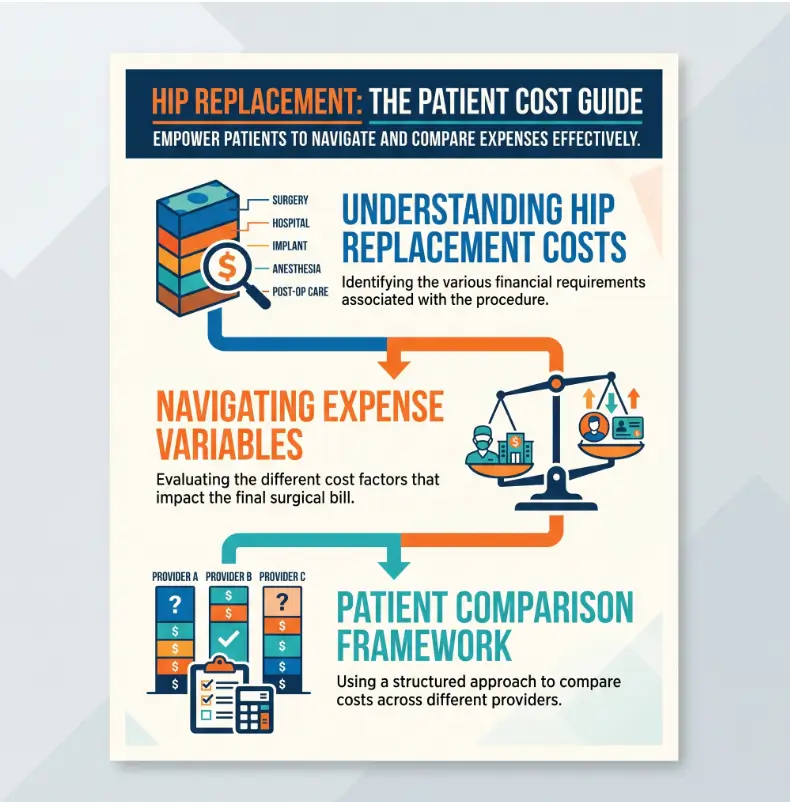
A hip replacement price is rarely one neat number. The hospital, surgeon, anesthesia team, implant, insurance contract, care setting, and follow-up services can all affect what appears on the final bill.
That means the useful question is not simply, “Which hospital posts the lowest price?” It is, “Which hospital gives me the lowest reliable total cost for comparable care under my actual coverage?”
This guide shows U.S. patients how to compare hospital price estimators, insurer estimates, cash prices, facility charges, professional bills, and quality information without mistaking a bargain-looking number for a complete quote.
Table of Contents
The Fastest Way to Compare Hip Replacement Prices
The fastest reliable method is to collect three comparable estimates from hospitals or surgical facilities and then check those numbers against your health plan’s personalized cost tool.
Do not begin with a hospital’s gross charge. For most insured patients, that number has little resemblance to the negotiated amount used to calculate patient responsibility. CMS requires U.S. hospitals to make standard charge information public through a machine-readable file and a consumer-friendly display of shoppable services or qualifying estimator tool.
Your first pass can therefore be simple:
- Choose three realistic hospitals or surgical facilities.
- Search each facility’s price estimator for total hip replacement or total hip arthroplasty.
- Enter your insurance information when the estimator permits it.
- Repeat the search in your health plan’s own price-comparison tool.
- Call the hospital and insurer to identify anything the online estimate excludes.
Most non-grandfathered group and individual health plans subject to the federal Transparency in Coverage rules have been required to make price-comparison information available through an online self-service tool for covered items and services since plan years beginning on or after January 1, 2024.
Exact procedure and setting
Hospital estimates
Insurer out-of-pocket estimates
Included and excluded bills
Price plus quality
If the hospital estimate feels cryptic, it helps to understand how an orthopedic surgery estimate is assembled before you compare the totals.

What Changes a Hip Replacement Price?
Two patients can have the same operation at the same hospital and still face different financial responsibility. The procedure may be similar, but the payment pathway is not.
Your insurance contract
An insured patient generally cares more about the plan’s negotiated rate and cost-sharing rules than the hospital’s gross charge. Your deductible status, coinsurance, copay structure, out-of-pocket maximum, network tier, and employer or plan design can all change the result.
Inpatient vs outpatient surgery
Total hip replacement may be performed in different settings when clinically appropriate. Setting matters because facility payment rules, insurance benefits, professional billing, and the services bundled into the encounter can differ.
A lower facility price is useful only if that setting is appropriate for you. Someone with significant medical complexity may have a very different clinical decision from a relatively healthy patient whose surgeon considers outpatient surgery reasonable.
The surgeon and anesthesia team
The hospital can be in network while an individual professional involved in your care has a different contractual relationship. Federal surprise-billing protections address many situations involving out-of-network clinicians at in-network facilities, but they do not make every elective billing situation identical. Verify the expected billing arrangement rather than assuming every name under the hospital roof shares one network status.
Implant and ancillary services
The implant, laboratory work, imaging, medications, pathology when applicable, rehabilitation planning, medical consultations, and other ancillary services may affect the financial picture. The important question is not whether a hospital advertises a “hip replacement price,” but what that price actually contains.
If the phrase facility fee keeps appearing in your estimate, this explanation of facility fees in orthopedic care can help separate the building’s bill from professional charges.
Cash Price vs Insurance Estimate: Which Number Matters?
The right number depends on how you intend to pay. A self-pay patient and a patient with comprehensive insurance should not rank hospitals using the same column.
| Comparison method | Best for | Main advantage | Main limitation | What to verify |
|---|---|---|---|---|
| Hospital discounted cash price | Self-pay patients or patients considering not submitting a claim | Direct starting point for cash comparison | May not include every professional or follow-up service | What is included and whether payment affects insurance credit |
| Hospital insurance estimator | Insured patients doing an initial comparison | Convenient and specific to the hospital | Estimate may rely on incomplete benefit or service assumptions | Network, deductible data, professional fees, authorization |
| Insurer price-comparison tool | Most commercially insured patients | Uses plan-specific cost-sharing information | Still an estimate rather than a final claim adjudication | Facility, surgeon, anesthesia, and procedure setting |
| Written pre-service estimate plus phone verification | Higher-cost or complicated cases | Creates the clearest comparison trail | Requires more work and may involve several providers | Separate bills, exclusions, expiration date, authorization |
For insured patients
Start with the insurer’s personalized estimate, not the hospital’s chargemaster or gross charge. Then compare the insurer’s number with the hospital estimate and investigate any large mismatch.
If Hospital A says you will owe $3,000 and your insurer estimates $5,000, that is not a cue to average the numbers. It is a cue to ask what assumptions differ.
For self-pay patients
Ask specifically for the discounted cash price and whether it is a bundled amount. Federal hospital price-transparency rules require covered hospitals to publish discounted cash prices as part of their standard charge information.
Then ask whether the quoted cash amount includes the surgeon, assistant surgeon if one is expected, anesthesia, implant, facility, routine imaging, laboratory services, and immediate postoperative care. A low cash price that covers only the facility can lose its shine rather quickly.
How to Build an Apples-to-Apples Hip Replacement Quote
Before comparing totals, make each hospital answer the same set of questions. Otherwise you may compare a bundled estimate at one hospital with a facility-only estimate at another.
Use this mini worksheet for each candidate facility.
- Procedure: total hip replacement / total hip arthroplasty
- Side: right or left, if requested by the estimator
- Setting: inpatient hospital, hospital outpatient department, or ambulatory surgical center when clinically appropriate
- Surgeon: name and network status
- Facility: legal facility name and network status
- Anesthesia: included or separately billed
- Implant: included in the estimate or separately priced
- Assistant surgeon: expected, possible, or not anticipated
- Preoperative services: testing, imaging, clearance visits
- Postoperative services: follow-up, physical therapy, home health, equipment
- Authorization: required, submitted, pending, or approved
- Patient estimate: total expected out-of-pocket amount
It is especially useful to ask whether the estimate represents the entire episode or only charges from one entity. If your previous orthopedic bills have arrived from several organizations, this guide to why orthopedic care generates multiple provider bills shows why that distinction matters.
Technical detail: the codes and price files behind the quote
Total hip arthroplasty is commonly identified by CPT/HCPCS 27130 for physician and outpatient procedure searches. Facility billing can use different payment classifications depending on the setting, payer, complications, and contract, so one code should not be treated as the entire financial episode.
Hospital machine-readable files contain gross charges, discounted cash prices, payer-specific negotiated charges, and de-identified negotiated information. Effective January 1, 2026, CMS also revised how certain percentage- or algorithm-based negotiated arrangements are represented, including allowed-amount distribution fields when required. Enforcement of the updated 2026 hospital price-transparency requirements began April 1, 2026.
For most patients, the consumer estimator and insurer cost tool are easier to use than the raw machine-readable file. The raw data becomes useful when you are auditing a quote, building a detailed comparison, or trying to understand why a hospital’s published rate does not match a simple estimator result.
If prior authorization is part of your plan, complete that step before treating an estimate as dependable. A useful companion is this orthopedic prior authorization checklist.
How Medicare Patients Should Compare Hip Replacement Costs
Medicare patients should separate two questions: what Medicare’s payment structure looks like for the procedure and what this particular patient will owe at this particular facility.
Medicare’s official Procedure Price Lookup includes total hip arthroplasty under procedure code 27130 and allows users to compare national-average Medicare costs for eligible outpatient settings. The tool also warns that additional physicians and costs may apply, which is exactly why a single facility figure should not be treated as the complete episode price.
Do not assume the national average is your final obligation. Original Medicare, Medicare Advantage, supplemental coverage, inpatient versus outpatient status, additional professional services, and individual eligibility can change what you actually pay.
Medicare Advantage members should generally use their plan’s network and cost-estimator resources because plan-specific cost sharing and authorization rules matter. If that is your situation, the site’s guide to Medicare Advantage orthopedic care can help organize those questions.
How to Compare Quality Without Ignoring Price
A hip replacement comparison should not become a spreadsheet contest in which the smallest dollar figure automatically wins. Price is one dimension of value. Outcomes, complication information, clinical suitability, surgeon experience, discharge planning, and access to follow-up care matter too.
CMS publicly reports hospital quality information, including measures related to hip and knee replacement complications and patient-reported outcomes where data are available.
Compare cost and quality on one shortlist
First eliminate options that are clinically unsuitable or outside the surgeon and care team’s reasonable recommendations. Then compare the remaining facilities on both financial and quality factors.
| Check | Hospital A | Hospital B | Hospital C |
|---|---|---|---|
| Estimated patient responsibility | _____ | _____ | _____ |
| Facility in network? | Yes / No | Yes / No | Yes / No |
| Surgeon in network? | Yes / No | Yes / No | Yes / No |
| Anesthesia addressed? | Yes / No | Yes / No | Yes / No |
| Major exclusions identified? | _____ | _____ | _____ |
| Quality concerns? | _____ | _____ | _____ |
Read the measure behind a quality score. Beside each quality result, record the measure name, reporting period, patient group, and any explanation for missing data. Check whether it describes hip replacement, a combined hip-and-knee population, patient experience, or the hospital more broadly. Do not treat those as interchangeable scores for your own surgeon or your individual risk.
Medicare’s explanation of overall hospital star ratings notes that some new or small hospitals do not report enough measures to receive a rating. A missing rating is therefore not the same as a zero score or proof of poor care. If a relevant result is unavailable, ask the surgical team what evidence and experience apply to your planned operation. Use that discussion alongside the price and follow-up plan, rather than converting a general rating into a personal outcome promise.
When paying more may make sense
A higher-cost option may be reasonable when the difference reflects a clinically appropriate setting, stronger continuity of care, a surgeon-facility combination your medical team considers important, or better support for a complex health situation.
That does not mean expensive automatically means better. It means a price difference deserves explanation before it deserves either suspicion or admiration.
Hip Replacement Price-Comparison Mistakes That Cost Money
The most expensive mistakes usually happen when a patient compares numbers that describe different things.
| Mistake | Why it costs money | Safer move |
|---|---|---|
| Comparing gross charges | Sticker prices may not reflect your negotiated insurance rate or cash discount | Compare personalized patient responsibility or discounted cash prices |
| Checking only the hospital network | Professional services may be billed separately | Verify surgeon, facility, and anticipated professional billing |
| Assuming the quote includes anesthesia | Anesthesia may produce a separate bill | Ask who bills anesthesia and whether it is included |
| Ignoring prior authorization | A technically attractive estimate may not reflect coverage requirements | Confirm authorization before scheduling |
| Choosing only by price | The cheapest setting may not be clinically appropriate | Compare price only among medically reasonable options |
| Forgetting post-surgery care | Therapy, equipment, prescriptions, and home support may sit outside the surgical quote | Build a separate recovery-cost list |
Anesthesia deserves particular attention because it is a classic example of a charge patients may mentally fold into “the surgery” even when billing is separate. See why a separate anesthesia bill may appear before assuming one estimate covers everything.
Questions to Ask Before Scheduling Hip Replacement
A short, disciplined phone call can be more useful than another hour of browsing price pages. Have the hospital estimate and insurer estimate open at the same time.
Call the hospital billing or financial-estimate team
- “Is this estimate for total hip replacement at the exact facility where my surgeon plans to operate?”
- “Does this number represent my estimated out-of-pocket responsibility or only the hospital’s charge?”
- “Does it include the implant and routine facility services?”
- “Are surgeon, anesthesia, assistant surgeon, imaging, laboratory, or pathology charges excluded?”
- “Is this estimate based on my current insurance benefits and deductible status?”
- “How long is this estimate valid?”
- “What could cause the final amount to be materially higher?”
Then call the insurer
- “Is the hospital in network for my exact plan?”
- “Is my surgeon in network at that facility?”
- “Is prior authorization required for total hip replacement?”
- “What deductible remains before the planned surgery date?”
- “What coinsurance or copay applies to the facility and surgeon?”
- “Can you give me a personalized estimated member responsibility for this facility?”
- “Are there network or site-of-service rules that could change what I pay?”
- “Can I have a reference number for this call?”
Write down the representative’s name, date, reference number, and the exact facility discussed. Save the written response or reference number with the estimate so you can follow up on the same assumptions.
If you are self-pay
Ask for a written good faith estimate. Federal rules generally require providers or facilities to give uninsured or self-pay individuals a good faith estimate when qualifying scheduled care is arranged at least three business days in advance or when the individual requests one before scheduling. CMS also explains that a surgical patient may need separate estimates from the surgeon and hospital because one provider’s estimate does not automatically encompass every other provider.
If the remaining balance is manageable but difficult to pay at once, financing should come after price verification, not before it. Compare the hospital’s terms, interest, fees, and financial-assistance options before using outside credit. This guide to orthopedic payment plans can help frame that decision.

FAQ
Why can hip replacement prices differ so much between hospitals?
Hospitals negotiate different rates with insurers and may have different cash prices, facility structures, contracting arrangements, and service bundles. Your own deductible, coinsurance, network status, and surgical setting can further change what you owe.
Should I compare the hospital’s listed price or my estimated out-of-pocket cost?
If you are insured, your estimated out-of-pocket responsibility is usually the more decision-relevant number. Still check what services the estimate includes and compare it with your insurer’s estimate. Self-pay patients should focus more heavily on the hospital’s discounted cash price and written good faith estimates.
Does a hip replacement estimate normally include the surgeon?
Not necessarily. Hospitals and physicians can bill separately. Ask explicitly whether the quoted amount includes facility services, surgeon fees, anesthesia, assistant surgeon charges, and other professional services.
Can the final bill be higher than the hospital estimate?
Yes. Estimates depend on assumptions about the planned service, benefits, and anticipated care. Additional services, changes in clinical circumstances, benefit updates, separate providers, or differences between estimated and adjudicated claims can change the final amount. Ask the hospital what is excluded and what circumstances could materially change the price.
Is the cheapest hospital always the best place for hip replacement?
No. Compare prices only among options that are clinically appropriate for you. Quality information, complication measures, surgeon-facility fit, follow-up care, and your medical needs belong in the decision alongside cost.
Can I ask for a cash price even if I have insurance?
You can ask what the hospital’s discounted cash price is, but paying cash instead of using insurance has consequences. Among other things, the payment may not be processed under your plan in the same way as an insurance claim. Before choosing cash because it looks cheaper, ask your insurer how the decision affects your deductible, out-of-pocket accumulation, and coverage.
Do I need the exact billing code before comparing hospitals?
It helps. Total hip arthroplasty commonly appears under CPT/HCPCS 27130 in procedure searches, but the complete episode can involve other facility and professional billing. Confirm the procedure, setting, and scope of each estimate rather than assuming one code captures the whole bill.
Compare Three Hip Replacement Options in 15 Minutes
You do not need a thirty-tab browser session to make meaningful progress. Use the next 15 minutes to create a clean first comparison.
- Minutes 1–3: Write down your exact procedure, surgeon, insurer, and planned surgical setting.
- Minutes 4–7: Open the price estimators for three realistic facilities and record each estimated patient responsibility or cash price.
- Minutes 8–10: Open your insurer’s price tool and check the same three facilities.
- Minutes 11–13: Mark each estimate as “facility only,” “partially bundled,” or “scope confirmed.”
- Minutes 14–15: Circle any price difference large enough to affect your decision and write one question explaining what you need to verify.
After that, you have something far more useful than three numbers. You have three numbers with context.
That is the point of comparing hospital prices for hip replacement. The winner is not automatically the hospital with the smallest figure on its website. It is the medically appropriate option whose total expected cost, insurance treatment, exclusions, and quality you understand well enough to make a deliberate decision.
Last reviewed: 2026-09
Targeted review: October 17, 2026. Added a checklist for interpreting hospital quality measures and missing ratings. Restored 10 table-of-contents links to their heading targets. Other sections retain their stated review scope.
Targeted editorial update: October 21, 2026. Added a topic-specific follow-up record and recheck triggers, revised the title and search description, and removed unverified first-person claims or clarified selected wording where found. The existing body was retained. This update is not a complete legal, coverage or clinical review; confirm current rules and individual decisions with the relevant official source or service.