
This site is written from a family-caregiver perspective. The operator is not a medical professional or an insurance, legal or financial adviser. Use this guide to organize questions for the relevant service.
Match the protocol before comparing prices
Use this follow-up record alongside the guide below. It does not determine medical suitability, insurance eligibility or legal rights, and it does not guarantee a price.
- Keep together
- Order, body area, side, protocol or contrast instructions, facility and technical or reading charges.
- Unanswered question
- Does the quote cover the exact ordered study and all expected billers, and will the treating team accept it?
- Next contact and owner
- Ask the ordering and imaging teams to resolve protocol questions; discuss authorization and cost separately.
- Recheck when
- Order, contrast plan, facility or interpretation arrangements change.
For each response, record its date, source, reference number and what remains uncertain. Agree the next follow-up date instead of treating silence as confirmation. Use official contact channels and keep identifying health, account and policy information out of public comments.

An X-ray, MRI, or CT scan ordered before orthopedic surgery can look like a simple line item. Financially, it often isn’t. The amount you owe may depend on the exact study, the imaging location, your insurance network, your remaining deductible, whether contrast is used, and whether separate professional or facility charges apply.
The useful question is therefore not simply, “How much does an MRI cost?” It is, “What imaging does my surgeon actually need, where can it be performed appropriately, and what will I personally owe at that location?” Answer them before comparing quotes or paying a deposit.
This guide is U.S.-focused. It will help you separate medically necessary imaging from administrative requirements, compare payment paths, check authorization and network status, and obtain a more meaningful estimate before you schedule the scan.
Compare the right priceEstimate your cost at the actual imaging location.
Avoid duplicate imagingAsk whether recent images can still answer the surgeon’s question.
Verify before payingCheck authorization, network status, and separate fees.
The practical goal: know what study is being ordered, why it is needed, where it will be done, and what your estimated out-of-pocket cost is before the appointment.
Snapshot
This guide is for U.S. patients preparing for orthopedic surgery who have been asked to obtain X-rays, MRI, CT, or other imaging. Your actual cost depends heavily on the study, facility, insurer, network, deductible, and billing structure. By the end, you should be able to request a useful estimate and spot the questions that need answers before the scan.
Before you act
Do not cancel or substitute medically recommended imaging solely to reduce cost. Different orthopedic problems require different views and imaging methods, and a cheaper study is not automatically an equivalent study.
Ask the ordering clinician what clinical or surgical-planning question the study is meant to answer. Then verify coverage, authorization, network status, and estimated patient responsibility with the insurer and imaging provider. Urgent or emergency care follows different practical rules.
Table of Contents
What Imaging Might You Need Before Orthopedic Surgery?
The imaging required before orthopedic surgery depends on what your surgeon needs to see. A knee replacement, rotator cuff repair, spinal procedure, fracture fixation, and hip surgery can require very different information.
That distinction matters because an MRI is not simply a “better X-ray,” and a CT scan is not automatically an upgrade from MRI. Each modality answers different questions.
X-rays
Radiographs are commonly used to evaluate bones, alignment, joint-space changes, fractures, arthritis, hardware, and other structural findings. Orthopedic surgeons may request particular positions or weight-bearing views rather than simply accepting any prior X-ray of the same body part.
MRI
MRI can provide detailed information about soft tissues such as cartilage, tendons, ligaments, muscles, discs, nerves, and bone marrow. It may be particularly useful when the surgical decision depends on structures that are poorly characterized on standard radiographs.
But MRI is not universally required before orthopedic surgery. The appropriate study depends on the diagnosis and clinical question. The American College of Radiology publishes evidence-based Appropriateness Criteria for diagnostic imaging that illustrate how imaging choices change by condition and scenario.
CT
CT is particularly useful when detailed bone anatomy matters. In some orthopedic procedures, specialized CT protocols may also be used for surgical planning, implant positioning, or evaluation of complex anatomy.
A planning CT may have specific technical requirements. That means the lowest-priced generic CT at another facility may not necessarily satisfy the surgeon’s protocol.
Ultrasound and other imaging
Ultrasound can be useful for selected tendon, muscle, fluid, and soft-tissue questions. Nuclear medicine studies and other specialized examinations are sometimes used in more complex cases, particularly when infection, implant problems, bone activity, or another specific issue is being evaluated.
Key takeaway
Do not price-shop by modality alone. First obtain the exact study description, body part, laterality, contrast requirement, and any surgical-planning protocol. Otherwise you may compare two scans that are not clinically interchangeable.
If you’re still earlier in the diagnostic process rather than already committed to surgery, the separate guide to MRI referrals for orthopedic pain may help clarify why MRI is sometimes ordered and sometimes deferred.
What Changes the Cost of Pre-Surgery Imaging?
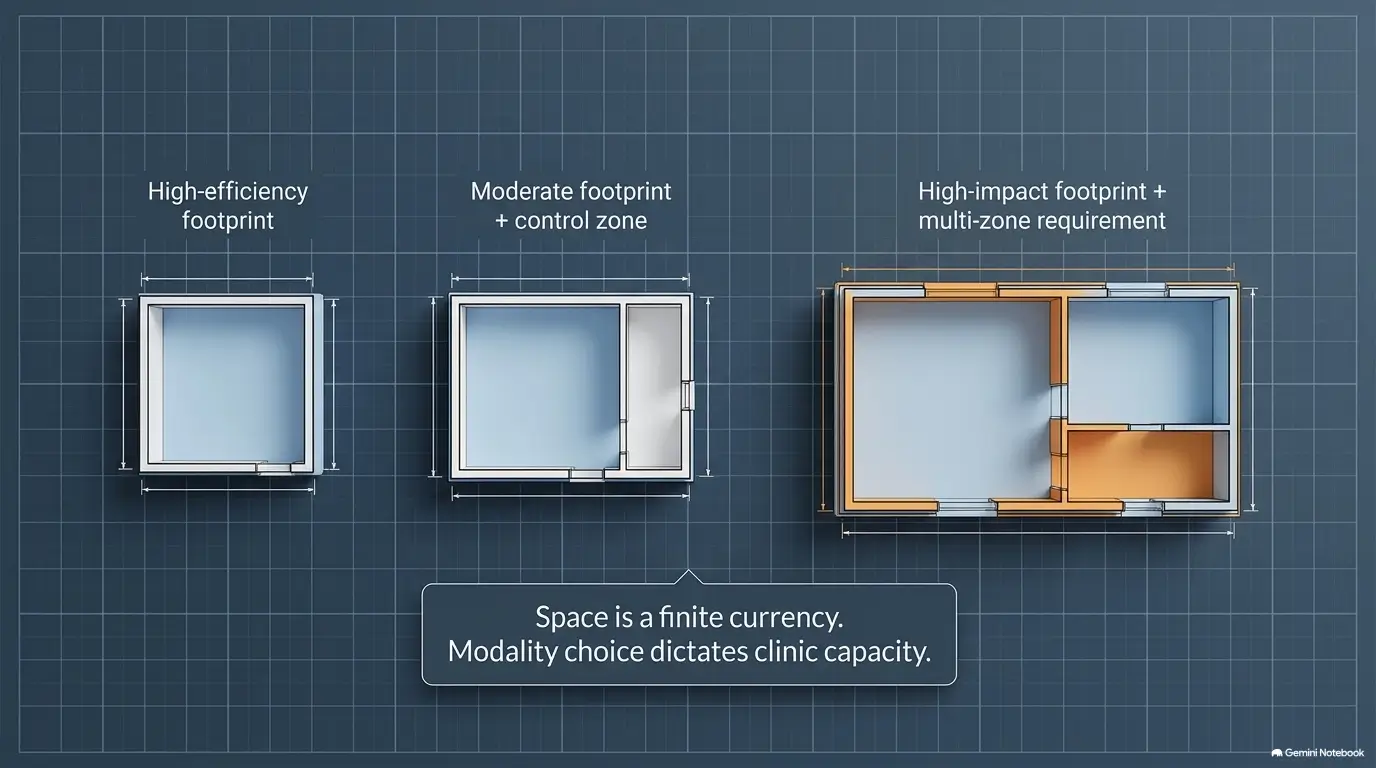
Your cost is shaped by more than the scanner itself. The most important variables are usually the type of study, the place of service, insurance terms, and the way the service is billed.
- Imaging modality: X-ray, MRI, CT, ultrasound, and nuclear medicine involve different equipment and professional work.
- Body part and protocol: a simple examination and a specialized surgical-planning protocol may be billed differently.
- Contrast: some MRI and CT examinations require contrast material, while others do not.
- Facility: a hospital outpatient department and an independent imaging center may have different contracted prices and patient cost sharing.
- Network status: the difference between in-network and out-of-network care can outweigh the advertised scan price.
- Deductible: someone who has not met a deductible may face a very different bill from someone whose cost-sharing position is different later in the plan year.
- Professional interpretation: confirm whether the radiologist’s interpretation is included in the quote or separately billed.
- Authorization: some plans require prior authorization for advanced imaging.
- Additional views or repeat studies: imaging may need to be repeated if the existing study does not meet the surgeon’s needs.
Location deserves particular attention. CMS notes that the setting where diagnostic imaging is performed can affect Medicare patient costs, and hospital outpatient imaging may involve additional hospital cost sharing.
The same principle is useful even if you have commercial insurance: compare your estimated responsibility at the specific facilities your surgeon considers acceptable rather than assuming the hospital and a freestanding center will produce the same financial result.
The pre-surgery imaging cost path
1. Identify
Get the exact imaging order and protocol.
2. Verify
Check network and authorization requirements.
3. Compare
Compare patient estimates at acceptable locations.
4. Confirm
Ask what the quote includes before booking.
Insurance, Cash, or Hospital Pricing: Which Path Should You Compare?
For a scheduled scan, you may have more than one price worth checking. The financially sensible option is not automatically the one with the smallest sticker price.
| Path | Best for | Main advantage | Main limitation | Verify before choosing |
|---|---|---|---|---|
| Insurance price | Patients who want the claim processed through their plan | May count toward applicable deductible and out-of-pocket rules | Your cost depends on plan terms | Network, authorization, estimate, deductible |
| Cash or self-pay price | Uninsured patients or people considering not using insurance | Can be simpler to understand | May not count toward insurance cost sharing | Full bundled price and whether professional fees are included |
| Hospital price tool | Patients comparing hospital-based imaging | Provides access to published pricing information | Displayed price may not equal your final responsibility | Exact service, payer, location, ancillary charges |
U.S. hospitals are required to make specified pricing information available online, including consumer-friendly information for shoppable services. Imaging is among the types of services CMS identifies as potentially shoppable.
Most covered individuals in applicable group and individual health plans also have access to plan price-comparison information for covered services. CMS says these tools are intended to provide personalized estimates of cost-sharing responsibility for specific services and providers.
Check CMS Hospital Price Transparency Guidance
When cash pricing deserves a look
If you are uninsured, intentionally self-paying, facing substantial cost sharing, or simply trying to understand the market price, asking for the cash price can be useful.
But compare the whole transaction. A low quoted scan price becomes less useful if the radiologist’s interpretation, contrast, or another required service is billed separately.
The cheapest option may be enough when…
The surgeon confirms the facility and protocol are acceptable, the study meets the clinical need, the quote includes the necessary services, and using a more expensive location offers no meaningful medical or insurance advantage.
How to Estimate Your Real Out-of-Pocket Cost
The number that matters is not the provider’s gross charge. It is your expected financial responsibility under the payment path you actually intend to use.
For commercially insured patients
Start with your insurer’s cost-estimator tool or member services. Give the representative enough information to identify the exact service rather than asking, “How much is an MRI?”
- Ask the ordering office for the exact study description.
- Confirm whether contrast is ordered.
- Ask for the imaging facility’s legal name and location.
- Confirm that the facility is in network for your specific plan.
- Ask whether the interpreting radiologist is included in the estimate.
- Check whether prior authorization is required.
- Ask what deductible, copay, or coinsurance would apply if the study occurred now.
If you’re also trying to understand the total operation rather than imaging alone, use the orthopedic surgery estimate checklist to separate imaging from surgeon, facility, anesthesia, and other charges.
For uninsured or self-pay patients
Federal rules generally give people who are uninsured or not using insurance the right to receive a good faith estimate for scheduled care in applicable circumstances. CMS also describes a federal patient-provider dispute process when a provider’s bill is at least $400 higher than that provider’s good faith estimate.
Keep the estimate rather than treating it as disposable paperwork. If the final bill later differs materially, the document gives you something concrete to compare.
For a deeper walkthrough, see how to request an orthopedic good faith estimate.
Review CMS Self-Pay Estimate Rights Technical depth: why a quoted imaging price and your bill can differ
A medical imaging transaction can contain several financial layers: the provider’s published charge, a payer-negotiated or allowed amount, facility charges, professional interpretation, your deductible position, and your required copay or coinsurance.
The amount displayed on a hospital transparency page may therefore answer a different question from the one you actually care about. A hospital’s published standard charge is not automatically your personal out-of-pocket responsibility.
The safest comparison uses the same exact service, the same insurance plan, the same facility, and the same expected date of service whenever possible.
Apply the remaining deductible across the related bills once. Separate bills do not mean you should restart the same remaining deductible for each one. HealthCare.gov’s deductible explanation distinguishes the amount paid before plan benefits change from the copay or coinsurance that can follow.
Hypothetical commercial-plan calculation: assume the technical scan has an $800 allowed amount, interpretation has a $200 allowed amount, and both are covered in network under the same deductible. With $300 of deductible remaining and 20% coinsurance afterward, the combined patient amount is $300 + 20% × ($1,000 − $300) = $440. This assumes no copays, separate deductibles, other claims, exclusions, or out-of-pocket-limit adjustment. Actual claim allocation can depend on processing order, so ask the insurer to estimate the components together and confirm the current accumulator. Do not apply another full $300 deductible independently to each bill.
Prior Authorization and Network Status Can Matter More Than the Scan Price
A competitive imaging quote can become irrelevant if the insurer will not process the service as expected. Before scheduling advanced imaging, verify both authorization and network status.
Do not assume that an in-network orthopedic surgeon automatically means every imaging location they use is in network for your plan. Networks can be service-specific and plan-specific.
What to ask your insurer
- Is this exact imaging study covered under my plan?
- Is prior authorization or another approval required?
- Has authorization already been approved, or merely submitted?
- Is this exact imaging facility in network for my plan?
- Is the radiologist’s interpretation covered at in-network terms?
- What deductible, copay, or coinsurance applies?
- Does the authorization apply only to a specific facility?
- Is there an expiration date or service window on the authorization?
If authorization is still unresolved, the orthopedic prior authorization checklist can help you organize the call before the imaging appointment.
A useful insurer script
“My orthopedic surgeon ordered this study before surgery. Please confirm whether the exact facility is in network, whether prior authorization is required and approved, and what my estimated out-of-pocket responsibility would be if I have the scan there.”
What Medicare patients should know
Original Medicare Part B covers covered diagnostic non-laboratory tests such as CT scans, MRI, and X-rays when ordered to diagnose or treat a medical problem. Medicare explains that patient costs can vary with the type of facility and other circumstances, and hospital outpatient imaging can involve hospital cost sharing in addition to the applicable Part B rules.
Medicare Advantage plans can have different network and utilization-management procedures, so members should verify the plan’s current requirements rather than applying Original Medicare rules mechanically.
See the official Medicare diagnostic imaging coverage page for current federal information.
When the Cheaper Imaging Option May Be Enough
Spending more is not inherently safer or more medically appropriate. A lower-cost imaging center can be a sensible choice when it can perform the exact study the surgeon needs and your insurance treats the location favorably.
| Choice | May fit when | Main caution | What to verify |
|---|---|---|---|
| Lower-cost in-network imaging center | Routine study with a standard protocol | Protocol may differ from surgeon preference | Exact order, accreditation where relevant, image transfer |
| Hospital outpatient imaging | Surgery team prefers integrated imaging or complex services are needed | Cost sharing may differ | Personal estimate and included charges |
| Specialized orthopedic imaging site | Surgeon requires a specific planning protocol | Convenience or specialization does not guarantee lower cost | Why specialization is required and insurance treatment |
If two facilities can produce clinically equivalent images that your surgeon will accept, the lower-cost in-network option may be perfectly adequate. Paying more merely for a more prestigious address may add no useful clinical information.
When paying more may make sense
A higher-cost option may be reasonable when the surgeon requires a specialized protocol, previous imaging was technically inadequate, complex hardware affects imaging quality, the case requires subspecialty interpretation, or the lower-priced provider cannot reliably deliver the images in the format and timing required for surgery.
The reason for paying more should be concrete. “Our surgeon needs this exact protocol” is a meaningful reason. “This is where we send everyone” deserves a follow-up question.
Imaging Mistakes That Can Cost You Money
Most avoidable imaging expenses are not caused by choosing the wrong coupon. They come from missing one administrative or clinical detail before the appointment.
| Mistake | Why it costs money | Safer move |
|---|---|---|
| Booking before authorization is resolved | Coverage may not process as expected | Confirm approval status before the appointment |
| Assuming every location is in network | Plan cost sharing can change substantially | Verify the exact facility with the insurer |
| Comparing only the headline price | Interpretation or ancillary charges may be separate | Ask what the quote includes |
| Repeating usable imaging automatically | You may pay for another study without gaining useful information | Ask whether existing images are recent and adequate |
| Choosing a cheaper but incompatible protocol | The surgeon may still need another study | Have the surgical team approve the alternative facility first |
| Ignoring image-transfer logistics | Surgery planning can be delayed or imaging repeated | Confirm electronic transfer or obtain the images promptly |
The duplicate-imaging question is worth asking
If you already had imaging elsewhere, ask the surgeon whether the existing images themselves can be reviewed, not merely the written radiology report. A report may summarize findings, while the surgeon may need to inspect the actual images for planning.
Sometimes new imaging is appropriate because the previous study is too old, uses different views, has insufficient quality, or does not capture what the surgeon now needs. The point is not to resist repeat imaging. It is to understand why it is being repeated.
If you received a normal X-ray earlier but symptoms persisted, what a normal X-ray can and cannot explain provides useful context for why additional imaging may sometimes be considered.
Questions to Ask Before Booking the Scan
You can usually uncover the most important cost traps with two short calls: one to the ordering office or imaging center, and one to your insurer.
Ask the orthopedic office
- What exact imaging study has been ordered?
- Does it require contrast?
- Is there a specific surgical-planning protocol?
- Can I use another in-network imaging facility?
- If I already have imaging, can you review it before ordering another study?
- How recent do the images need to be for surgical planning?
- Does your office obtain authorization, or do I need to coordinate it?
- How should the images be delivered to the surgeon?
Ask the imaging provider
- What is my estimated patient responsibility?
- Does the estimate include the technical and professional components?
- Could contrast or another service create an additional charge?
- Is this facility in network for my exact insurance plan?
- Has the required authorization been received?
- Can you provide the estimate in writing?
- How will the images and report reach my surgeon?
If the imaging occurs in a hospital setting, the distinction between the scan charge and facility-related charges is worth understanding. The guide to facility fees in orthopedic care explains why location can change the billing picture.
Before you pay a deposit
Write down the study, facility, estimated amount, authorization status, and what the quote includes. If a large payment is requested in advance, ask whether the amount is an estimate, a required deposit, or the final negotiated patient responsibility.
FAQ
Is an MRI always required before orthopedic surgery?
No. Imaging requirements depend on the diagnosis, operation, anatomy, existing studies, and the information the surgeon needs. Some cases rely primarily on radiographs, while others benefit from MRI, CT, or specialized imaging.
Can I choose a cheaper imaging center?
Often you can ask about alternatives, but confirm that the center can perform the exact ordered study and that your surgeon will accept its protocol and images. Also verify network status and authorization before switching locations.
Why can hospital imaging cost me more than a freestanding center?
The billing structure and insurance cost sharing can differ by place of service. Hospital outpatient care may involve facility-related charges or different negotiated amounts, which is why your personal estimate matters more than a generic national price.
Should I compare cash price with my insurance price?
It can be useful, especially if you have substantial cost sharing. But check whether paying cash means the expense will not be credited toward your insurance deductible or other plan limits, and make sure the cash quote includes all expected imaging charges.
Can my surgeon use an MRI I already had?
Possibly. The surgeon may consider its age, image quality, protocol, anatomy covered, and whether your condition has changed. Ask before repeating the study, but do not assume older imaging is adequate for current surgical planning.
Does insurance approval mean the scan will be free?
No. Authorization and payment are different questions. An approved service can still be subject to your deductible, copay, coinsurance, network rules, or other plan terms.
Can imaging produce more than one bill?
It can. Depending on the setting and billing arrangements, the technical imaging service and professional interpretation may appear separately. Ask what your estimate includes. If orthopedic care is producing several separate statements, the guide to orthopedic bills from multiple providers can help you sort them.
Your 15-Minute Pre-Imaging Cost Check
You do not need to become a medical-billing expert before surgery. You need a small set of facts that turn a vague “scan cost” into a decision you can actually inspect.
- Write down the exact study. Include body part, side, contrast, and any special planning protocol.
- Write down the facility. Use the precise legal or billing name if possible.
- Check network status. Confirm it with your insurer rather than relying solely on a provider directory entry.
- Check authorization. Ask whether it is required, submitted, and approved.
- Request your estimate. Ask what you are expected to owe based on your current plan position.
- Ask what is included. Specifically ask about radiologist interpretation, contrast, and facility-related charges.
- Check your old images. If you already have imaging, ask whether it can answer the surgeon’s current question.
If those seven items are clear, you have done most of the useful financial work available before the scan. The goal is not to chase the smallest number at any cost. It is to pay for the right imaging, at an appropriate location, with fewer surprises waiting on the other side of the scanner.
Last reviewed: 2026-09
Targeted review: October 17, 2026. Added a two-component imaging example and clarified how one remaining deductible is allocated. Other sections retain their stated review scope.
Targeted editorial update: October 21, 2026. Added a topic-specific follow-up record and recheck triggers, revised the title and search description, and removed unverified first-person claims or clarified selected wording where found. The existing body was retained. This update is not a complete legal, coverage or clinical review; confirm current rules and individual decisions with the relevant official source or service.