
Medicare usually needs more than a simple note saying you need a back brace. For Original Medicare, the claim generally needs a valid written order from your treating practitioner, medical records that support why the brace is medically necessary, correct billing information from a Medicare-enrolled supplier, and proof that the brace was delivered. Certain lumbar-sacral orthoses have extra requirements, including a recent face-to-face encounter, a written order before delivery, and in some cases prior authorization.
The important distinction is that you, as the patient, normally do not have to assemble every Medicare document yourself. Much of the paperwork moves between the treating practitioner and the brace supplier. Your job is to make sure the process is actually happening before you accept an expensive brace.
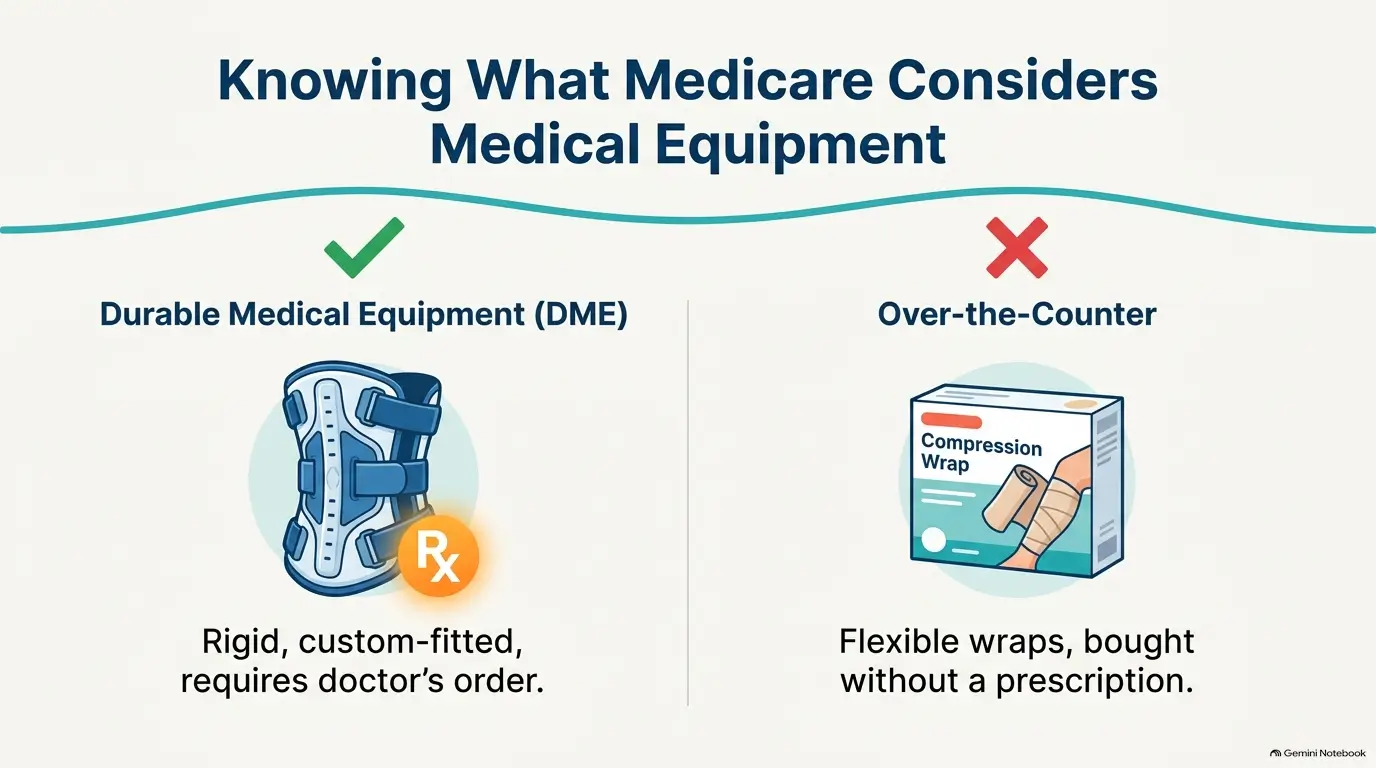
Medicare Part B covers medically necessary arm, leg, back, and neck braces when ordered by a doctor or other eligible health care provider. Medicare describes these braces as rigid or semi-rigid devices used to support a weak or deformed body part or restrict movement of an injured body part. You can review the federal baseline on the official Medicare brace coverage page.
Table of Contents
The Short Answer: What Documents May Be Needed?
For a typical back-brace claim under Original Medicare, think of the paperwork as several layers rather than one magic form.
| Document or requirement | When it matters | Who usually handles it |
|---|---|---|
| Standard Written Order | Required for Medicare DMEPOS claims | Treating practitioner and supplier |
| Supporting medical record | Shows why the spinal orthosis is medically necessary | Treating practitioner |
| Face-to-face encounter documentation | Required for selected back-brace HCPCS codes | Treating practitioner |
| Written Order Prior to Delivery | Required for selected codes before the brace is delivered | Practitioner and supplier |
| Prior authorization | Required for certain spinal orthosis codes | Usually supplier, with clinical records from practitioner |
| Fitting or customization records | Important for custom-fitted or custom-fabricated braces | Supplier, orthotist, and practitioner |
| Proof of delivery | Supports the final Medicare claim | Supplier |
Not every back brace triggers every line in that table. The exact requirements can depend on the brace’s HCPCS billing code, how it is fitted, whether it is prefabricated or custom fabricated, and whether Medicare has placed that code on a special documentation or prior-authorization list.
1. Medicare Needs a Valid Written Order for the Back Brace
The starting document is usually the Standard Written Order, or SWO. CMS uses standardized order elements for durable medical equipment, prosthetics, orthotics, and supplies, collectively called DMEPOS.
Under current CMS DMEPOS order requirements, a standard written order generally includes:
- The Medicare beneficiary’s name or Medicare Beneficiary Identifier
- A description of the ordered item
- The quantity, when applicable
- The treating practitioner’s name or National Provider Identifier
- The date of the order
- The treating practitioner’s signature
For DMEPOS items that are not subject to the special Written Order Prior to Delivery rule, the complete order generally must reach the supplier before the supplier submits the Medicare claim. For an item that is subject to Written Order Prior to Delivery, the timing is stricter: the required order must be completed before the brace is delivered.
That difference matters. A prescription created after someone has already walked out of the office wearing the brace does not necessarily repair a missing pre-delivery requirement.
2. The Medical Record Must Explain Why You Need the Brace
A written order identifies the brace being requested. It does not, by itself, prove that Medicare’s coverage criteria are met.
CMS’s current Local Coverage Determination for spinal orthoses says covered thoracic-lumbar-sacral and lumbar-sacral orthoses may be ordered for purposes such as reducing pain by restricting trunk movement, helping healing after a spinal or related soft-tissue injury, helping healing after spinal surgery, or supporting weak spinal muscles or a deformed spine.
The medical record therefore needs to tell a clinical story that supports the brace being billed. Depending on the situation, useful documentation may include:
- The diagnosis or condition being treated
- The patient’s symptoms and relevant history
- Physical examination findings
- Weakness, deformity, instability, restricted movement, or other relevant findings
- How the condition limits function
- The intended therapeutic purpose of the brace
- Relevant imaging, diagnostic testing, operative information, or treatment history when applicable
- Why the particular type of spinal orthosis is appropriate
CMS explains that supporting records for DMEPOS may include history, examination findings, diagnostic tests, progress notes, treatment plans, and other patient-specific clinical information. A generic statement such as “back pain, needs brace” may leave far more unanswered than a note explaining the condition, findings, functional limitation, and reason the prescribed orthosis is being used.
If you are still at the shopping or fitting stage, the site’s guide on how to check whether a brace is covered before buying it explains why the prescription, billing code, supplier, and insurer’s coverage rules should be matched before money changes hands.
3. Some Back Braces Require a Face-to-Face Visit Within Six Months
This is where back-brace paperwork becomes code-specific.
CMS requires a qualifying face-to-face encounter for certain DMEPOS items before they are ordered. For items subject to this requirement, the encounter generally must occur within the six months before the order and must collect information relevant to diagnosing, treating, or managing the condition for which the equipment is being prescribed.
CMS currently identifies several lumbar-sacral orthosis codes as subject to the face-to-face encounter and Written Order Prior to Delivery requirements, including L0631, L0635 through L0640, L0648, L0650, and L0651. The CMS spinal orthoses compliance guidance is a useful place to verify these requirements.
A qualifying encounter may be conducted through telehealth when the applicable Medicare telehealth requirements are met. The key point is not simply that a visit occurred. The record needs to contain patient-specific information related to the medical condition for which the brace is ordered.
4. Some Back Braces Need the Written Order Before You Receive Them
A Written Order Prior to Delivery, or WOPD, sounds almost identical to the standard written order because the underlying order contains the same standardized elements. The important difference is timing.
If your particular spinal orthosis is on Medicare’s Required Face-to-Face Encounter and Written Order Prior to Delivery List, the supplier must have the required complete order before delivering the brace.
For other DMEPOS items, Medicare’s general rule requires the completed written order before the claim is submitted rather than necessarily before delivery.
That is why asking only, “Did my doctor prescribe it?” can miss the most important billing question. Ask the supplier:
“What HCPCS code will you bill for this brace, and does Medicare require the written order or face-to-face documentation before you deliver it?”
The HCPCS code is the small hinge on which a surprisingly large paperwork door can swing.
5. Certain Medicare Back Braces Also Require Prior Authorization
A prescription and prior authorization are not the same thing.
The prescription comes from the treating practitioner. Prior authorization is a Medicare review process used for selected DMEPOS codes before Medicare payment is made under the applicable rules.
As of September 26, 2026, Medicare’s required prior-authorization rules include several spinal orthosis codes, including L0631, L0637, L0639, L0648, L0650, and L0651. CMS states that L0651 joined the nationwide required prior-authorization list effective April 13, 2026.
You can check the current program and upcoming implementation changes on the CMS DMEPOS prior authorization page.
For an orthosis subject to prior authorization, the review package may need the written order, required face-to-face documentation, and medical records supporting medical necessity. The supplier is generally the party coordinating the prior-authorization submission, but it depends on receiving usable clinical documentation from the treating practitioner.
Do not assume that “the doctor’s office ordered it” means the applicable Medicare review is complete. Ask whether prior authorization applies to the exact HCPCS code and supplier. Some qualifying suppliers have a CMS prior-authorization exemption effective June 1, 2026; an exemption does not remove the underlying order, encounter, medical-necessity, or delivery documentation requirements. Where authorization is required, ask whether an affirmative decision has been received before delivery.
Check the Service Date: Medicare’s Lists Are Changing
Medicare periodically changes its documentation and prior-authorization requirements. CMS’s announced October 28, 2026 expansion includes spinal orthosis codes L0456, L0457, and L0486 on the nationwide required prior-authorization list. A separate probationary prior-authorization process begins October 15, 2026 for certain newly enrolled DMEPOS suppliers or ownership changes. Ask the supplier to confirm both the item-specific rules and any supplier-specific review that applies to your delivery date.
That makes the date of delivery important. If you are reading this article after October 28, 2026, do not rely solely on a list of codes copied from an older article, office handout, or forum post. Ask the supplier to check the current CMS list for the code actually being billed.
This article was reviewed against federal Medicare materials on October 15, 2026. Requirements announced for later service dates are described by their effective dates; verify the current CMS list and your supplier’s status before delivery.
6. Custom-Fitted and Custom-Fabricated Braces May Need More Documentation
“Custom” is not merely a marketing adjective in Medicare orthotics billing. The way a brace is manufactured and fitted can affect its HCPCS code and the records needed to support that code.
CMS distinguishes among off-the-shelf, custom-fitted, and custom-fabricated spinal orthoses.
For a custom-fitted prefabricated orthosis, documentation may need to describe the modifications performed by an appropriately trained individual at the time of fitting. For a custom-fabricated orthosis, the medical record must support why the patient needs a custom-fabricated device rather than a prefabricated alternative.
This matters because two braces that look similar to a patient may be billed differently depending on how much professional fitting or fabrication was actually required.
7. The Supplier Needs Proof of Delivery
The paperwork does not end when the medical-necessity review is satisfied.
Medicare’s DMEPOS documentation rules also require proof of delivery. CMS has specifically highlighted spinal-orthosis claims in which a proper order and supporting clinical record existed but payment was still considered unsupported because adequate proof of delivery was missing.
This is primarily a supplier documentation responsibility rather than something a beneficiary normally sends to Medicare independently. Still, keep your own copy of anything you sign when receiving the brace, along with the receipt, item description, supplier name, and any paperwork showing the billed code.
What Should You Bring to the Doctor?
You generally do not need to arrive carrying a miniature Medicare filing cabinet. A small amount of organized information is more useful.
- Your Medicare card and any secondary insurance information
- Your current medication list when relevant to the visit
- Recent imaging or specialist records if the treating practitioner does not already have access to them
- A clear description of where the problem occurs and what movements are difficult
- Information about previous braces or similar equipment Medicare has paid for
- The brace supplier’s information, if you have already chosen one
Be concrete about function. “My back hurts” is clinically important, but “I cannot remain upright long enough to prepare a meal without increasing pain” gives the practitioner additional functional context. Do not exaggerate symptoms for coverage purposes. The record should reflect your actual condition and the practitioner’s clinical findings.
What Should You Ask the Brace Supplier Before Delivery?
A five-minute paperwork check before delivery can be much easier than untangling a denial afterward.
- What exact HCPCS code will you bill?
- Are you enrolled in Medicare?
- Do you accept Medicare assignment for this item?
- Do you already have my doctor’s Standard Written Order?
- Does this code require a face-to-face encounter?
- Does Medicare require the written order before delivery?
- Does this code require prior authorization?
- If prior authorization applies, has Medicare issued a decision?
- Do you have the medical records needed to support medical necessity?
- Is this brace being billed as off-the-shelf, custom fitted, or custom fabricated?
- What will I be asked to sign when the brace is delivered?
- What amount should I expect to pay if Medicare approves the claim?
Original Medicare generally covers medically necessary back braces under Part B when the coverage conditions are satisfied. After the Part B deductible, beneficiaries generally pay 20% of the Medicare-approved amount for covered braces. What you actually owe can also depend on whether the supplier accepts assignment and whether you have Medigap, Medicaid, employer coverage, or another payer.
Medicare provides an online medical equipment Supplier Directory that can help you check Medicare-enrolled suppliers.
Do Not Confuse “Medicare-Enrolled” With “Accepts Assignment”
These phrases answer different questions.
A Medicare-enrolled supplier is eligible to submit Medicare claims. A supplier that accepts assignment agrees to accept the Medicare-approved amount as payment in full for the covered item, leaving the beneficiary responsible for the applicable deductible and coinsurance rather than an unrestricted supplier charge.
Before accepting delivery, ask both questions rather than simply asking, “Do you take Medicare?”
What If Medicare Says the Back Brace Is Not Covered?
First identify the reason. A denial related to missing documentation requires a different response from a denial based on medical necessity, incorrect coding, duplicate or replacement equipment, an ineligible supplier, or missing prior authorization.
Gather the Medicare Summary Notice or other claim decision, the written order, relevant medical records, the HCPCS code, supplier information, authorization records, and delivery paperwork. Then determine whether the problem requires a corrected claim, additional documentation, or a formal Medicare appeal.
If you have already received a denial, the site’s step-by-step guide to appealing a denied brace or orthopedic support claim explains how to separate medical-necessity problems from coding, supplier, authorization, and documentation issues before preparing the appeal.
What Changes If You Have Medicare Advantage?
If you have a Medicare Advantage plan rather than Original Medicare, do not assume the administrative process above works exactly the same way.
Medicare Advantage plans must cover medically necessary services that Original Medicare covers, but the plan may apply its own network, authorization, referral, supplier, and cost-sharing rules. Medicare’s comparison of Original Medicare and Medicare Advantage specifically notes that Medicare Advantage members may need plan approval before certain services or supplies are covered.
Before getting the brace, call the number on your Medicare Advantage member card and ask about the exact item and supplier. The site’s Medicare Advantage orthopedic care guide covers the additional network, referral, authorization, equipment, and cost questions worth checking.
A Simple Example
Imagine a beneficiary named Robert whose clinician recommends a lumbar-sacral orthosis after evaluating a spinal condition.
The supplier determines that the brace will be billed under a HCPCS code subject to Medicare’s special face-to-face, Written Order Prior to Delivery, and prior-authorization requirements.
- Robert has a qualifying clinical encounter and the practitioner documents the relevant condition and findings.
- The practitioner completes the required written order.
- The supplier receives the order and supporting medical records.
- The supplier submits the required prior-authorization request.
- The applicable Medicare review is completed.
- The supplier delivers and fits the brace in accordance with the approved and billed item.
- The supplier maintains proof of delivery and submits the claim with the correct coding.
Now change one fact: Robert receives a different back brace whose HCPCS code is not subject to the special face-to-face or WOPD list. The paperwork pathway may be simpler even though Medicare still needs a valid order, medical-necessity support, correct coding, and delivery documentation.
That is why there is no single accurate answer to “What form does Medicare need for a back brace?” without identifying the brace being billed.

Frequently Asked Questions
Does Medicare require a prescription for a back brace?
Medicare Part B covers medically necessary back braces when ordered by a doctor or other eligible health care provider. Medicare DMEPOS claims require a compliant written order. Additional encounter, pre-delivery, or authorization requirements may apply to particular HCPCS codes.
Do I personally have to send my medical records to Medicare?
Usually, the treating practitioner and DMEPOS supplier coordinate the documentation needed for the claim or prior-authorization process. However, patients should verify that the supplier actually has the required order and records rather than assuming the transfer occurred.
Is a doctor’s prescription enough for Medicare to pay?
Not necessarily. The medical record must support the coverage criteria, the supplier and coding requirements must be satisfied, and selected spinal orthosis codes can require a face-to-face encounter, Written Order Prior to Delivery, and prior authorization.
Does every Medicare back brace need prior authorization?
No. Prior authorization applies to selected HCPCS codes rather than every back brace. Ask the supplier for the code it intends to bill and verify that code against the current CMS requirements.
Can Medicare cover an over-the-counter back support I buy myself?
Do not assume that a retail back support qualifies simply because it resembles a Medicare-covered brace. Medicare coverage depends on the device meeting an applicable orthosis definition and coverage requirements, a valid order, medical necessity, correct coding, and supplier requirements. Buying first and trying to obtain reimbursement later can leave you responsible for the cost.
The Best Paperwork Check Takes About Five Minutes
Before accepting a Medicare back brace, ask the supplier for the HCPCS code. Then ask whether that specific code requires a face-to-face encounter, Written Order Prior to Delivery, or prior authorization.
Next, confirm that the supplier has the completed written order and the clinical documentation it needs, and ask whether the supplier is Medicare-enrolled and accepts assignment.
The paperwork is not really one document. It is a chain: clinical evaluation → medical record → written order → any required authorization → correct brace and fitting → proof of delivery → Medicare claim.
When those pieces describe the same patient, condition, brace, and date of service, the claim has a much sturdier foundation. When they do not, even a perfectly real back problem can become a paperwork problem.
This article provides general educational information about Medicare coverage and documentation, not medical, legal, or individualized insurance advice. Medicare requirements can change, and Medicare Advantage plans may apply additional plan-specific rules. Verify the current requirements for the actual HCPCS code and coverage in effect on the date the brace is supplied.
Last updated: October 15, 2026