

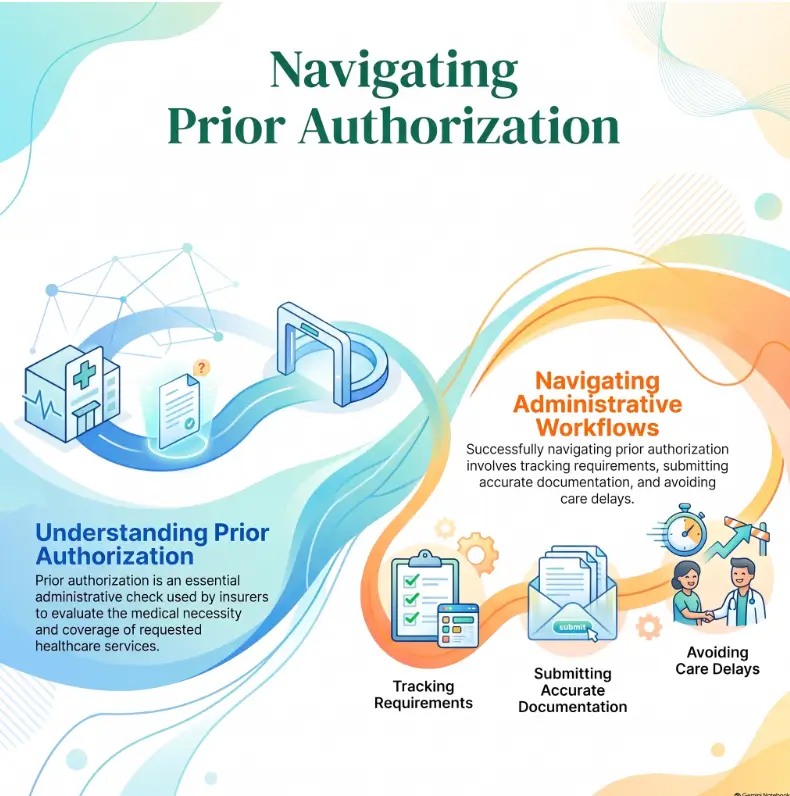
Prior authorization means your health plan wants to review certain care before it agrees to cover it under the plan’s rules. The requirement may apply to a procedure, medical test, prescription drug, specialist treatment, durable medical equipment, or another service. Your doctor may recommend the care, but the insurer can still require additional information before deciding whether its coverage criteria are met.
For a patient, the practical message is simple: if prior authorization is required, make sure the request has actually been submitted and approved before non-emergency care is provided. Do not assume that a scheduled appointment, a doctor’s order, or the words “we sent it to insurance” mean the authorization is complete.
There is one especially important catch. HealthCare.gov defines preauthorization, also called prior authorization, prior approval, or precertification, as an insurer’s advance decision about medical necessity, but explicitly notes that preauthorization is not a promise that the health plan will ultimately pay the entire cost.
Table of Contents
What Prior Authorization Actually Does
Think of prior authorization as an advance coverage checkpoint. Before certain planned care moves forward, the insurer reviews information about what is being requested and why.
The request may include the diagnosis, proposed treatment, medical records, previous therapies, imaging results, medication history, procedure codes, the treatment setting, or other documentation required by the plan.
The insurer may then approve the request, deny it, ask for more information, or approve something narrower than what was originally requested.
For example, your doctor might order an MRI because of persistent neurological symptoms. Your health plan might require documentation showing how long the symptoms have lasted, what the examination found, and whether other treatment has already been tried. The authorization process does not decide whether your doctor is allowed to recommend the MRI. It determines whether the insurer will approve coverage under the applicable plan rules.
Prior Authorization Is Not the Same as a Referral
Patients often hear several insurance terms at once, and they are easy to blend together. They answer different questions.
| Term | What it generally means | Main question |
|---|---|---|
| Prior authorization | The insurer reviews a service, drug, or item before coverage is approved | Has the plan approved this request? |
| Referral | A primary care clinician or another provider directs you to a specialist | Do I need permission or a referral to see this specialist? |
| Network verification | You confirm whether a provider or facility participates in your specific plan | Is this provider in network? |
| Benefits check | You confirm whether a category of care is included in the plan | Does my policy include this benefit? |
| Cost estimate | You estimate deductibles, copays, coinsurance, and other charges | What might I have to pay? |
You may need several of these at the same time. A specialist could be in network, for example, while the procedure they want to perform still requires prior authorization.
This distinction becomes particularly important before surgery. If you are coordinating orthopedic care, the site’s orthopedic prior authorization checklist provides a more detailed way to confirm the procedure, facility, codes, approval status, and authorization window before a planned operation.
Who Usually Requests Prior Authorization?
In many cases, the doctor’s office, hospital, pharmacy team, medical equipment supplier, or other treating provider submits the request. The patient may not personally complete the authorization form.
That does not mean the patient should disappear from the process.
A common source of trouble is the gap between “the office is handling it” and “the insurer has received a complete request and approved it.” When expensive or time-sensitive care is approaching, it is reasonable to confirm the status with both the provider and the health plan.
You can ask the provider:
- Was prior authorization required?
- When was the request submitted?
- What service or procedure was submitted?
- Did the insurer request more documentation?
- Has a final decision been received?
- What authorization number and approved date range are on file?
You can then ask the insurer to confirm what it sees in its own system. Matching those two versions can catch paperwork gaps before they collide with the appointment date.
What Does an Approved Prior Authorization Mean?
An approval generally means the insurer has reviewed the submitted request and determined that it satisfies the applicable authorization requirements based on the information presented.
That is useful, but the word approved should not be stretched into meanings it does not have.
An authorization may be limited by details such as:
- The specific procedure or service
- The number of treatments or visits
- The approved medication or dose
- The provider or facility
- The site of service
- The authorization start and expiration dates
- A particular diagnosis or clinical indication
If the treatment plan changes, the original authorization may no longer match what is being performed. A surgery moved to a different facility, a different procedure code, additional therapy sessions, or an expired authorization window can create a new coverage question.
Does Prior Authorization Guarantee Insurance Payment?
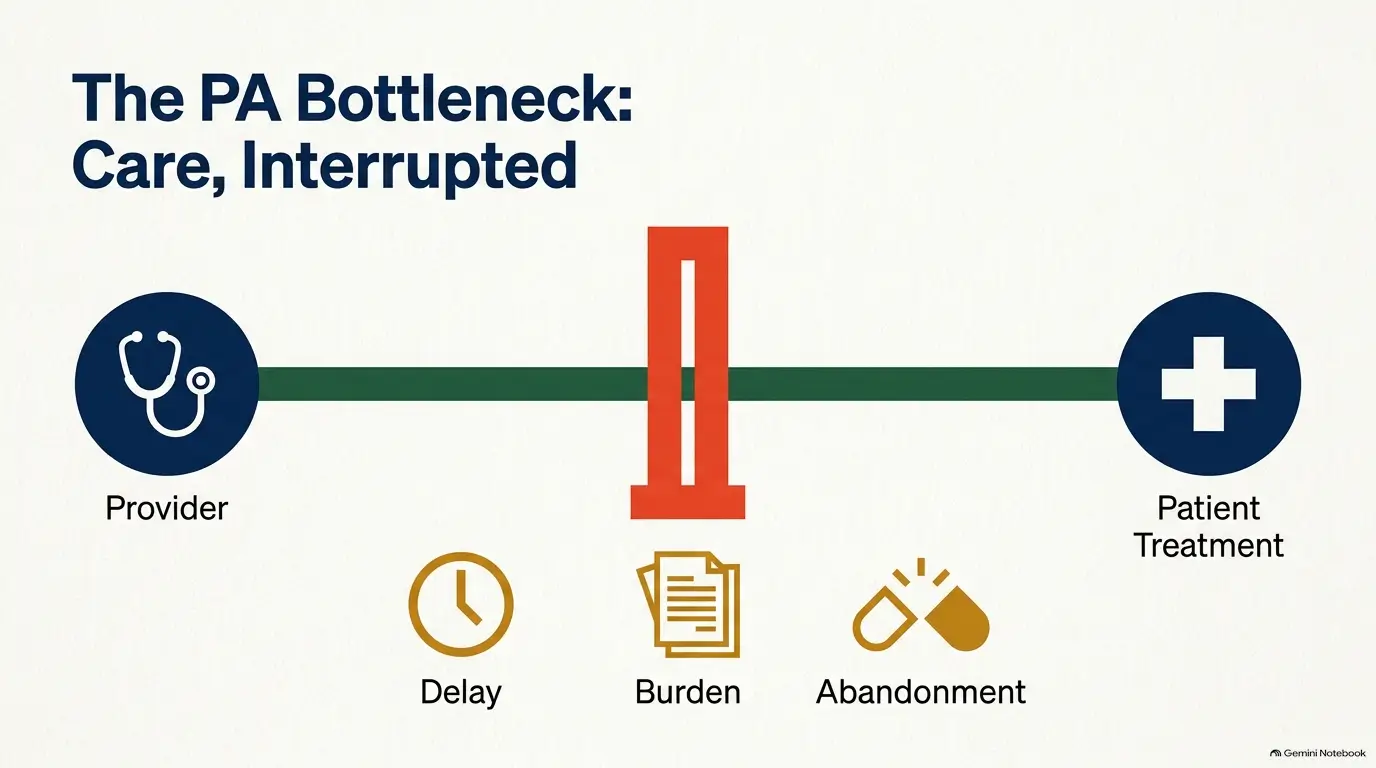
No. Prior authorization is not the same as a guarantee of payment or a guarantee that you will owe nothing.
The final claim can still be affected by your eligibility on the date of service, network status, deductible, copayment, coinsurance, benefit exclusions, billing codes, the services actually performed, and other provisions of your health plan.
This is why two separate questions should be asked before major planned care:
- Has the service been authorized?
- What does my plan say I may owe if the authorized service is performed as planned?
The first question concerns permission under the insurer’s coverage process. The second concerns money. They overlap, but they are not interchangeable.
What Does “Prior Authorization Pending” Mean?
Pending usually means there is not yet a final approval or denial.
The insurer may still be conducting its review, or it may be waiting for clinical notes, test results, treatment history, a corrected code, or another piece of information.
If a planned procedure is getting close, ask exactly what is holding the request up. “Still pending” is a status, not an explanation.
Useful questions include:
- Has the insurer received the complete request?
- Is any information missing?
- Who needs to provide it?
- Is there a reference or authorization-request number?
- When did the insurer receive the request?
- What decision timeframe applies to my type of plan?
- Is an expedited review available if the clinical situation is genuinely urgent?
Decision deadlines are not identical across every form of U.S. coverage. For certain Medicare Advantage, Medicaid, and CHIP payers, for example, CMS prior authorization requirements effective in 2026 generally require decisions on non-drug medical items and services within seven calendar days for standard requests and 72 hours for expedited requests. Those particular federal requirements do not create one universal deadline for every commercial plan, Marketplace plan, or prescription drug authorization.
What Happens If Prior Authorization Is Denied?
A denial means the insurer did not approve the request as submitted. It does not automatically mean that the treatment is medically wrong, that your clinician must abandon the plan, or that no further review is possible.
The reason matters.
A request might be denied because the records did not demonstrate a required medical-necessity criterion, the insurer wants a different treatment tried first, information is missing, the requested drug is subject to a formulary rule, the site of service does not meet the plan’s requirements, or another coverage provision applies.
Begin by obtaining the actual denial reason rather than relying on a shorthand message from the provider’s scheduling desk.
Under the CMS rules that apply to certain federally regulated payers, specific denial reasons are required for affected non-drug prior authorization decisions beginning in 2026. Other plans have their own notice and appeal requirements.
A Denial Can Sometimes Be Corrected Without Starting From Zero
Once you know the reason, ask the provider and insurer what procedural route fits the problem.
| What went wrong? | What may need to happen next? |
|---|---|
| Missing records | Provider submits the requested documentation |
| Incorrect or incomplete information | Correct or resubmit the request |
| Medical-necessity disagreement | Clinical reconsideration, appeal, or other plan review |
| Step-therapy requirement | Document prior treatment or request an exception when allowed |
| Wrong facility or network issue | Confirm whether another covered setting is available or whether an exception applies |
| Authorization expired | Ask whether a new or extended authorization is required |
The right response is therefore not simply “appeal everything.” A missing attachment and a substantive medical-necessity denial are different paperwork problems.
For a concrete example of how denial reasons can change the next step, see the site’s guide to a denied brace insurance appeal, which separates authorization failures, documentation gaps, coding problems, supplier issues, and clinical denials.
Can a Patient Appeal a Prior Authorization Denial?
Often, yes, although the exact appeal route depends on the type of coverage and the decision involved.
For health plans subject to the federal Affordable Care Act appeal protections, HealthCare.gov explains the internal appeal process and notes that supporting information from a doctor can be submitted. Urgent cases can have faster procedures when waiting through the ordinary process could seriously jeopardize the patient’s life or ability to regain maximum function.
Read the denial notice carefully because it should identify the deadline and the process that applies to that decision. Medicare, Medicare Advantage, Medicaid, employer plans, Marketplace coverage, and other commercial insurance arrangements do not all use exactly the same appeal system.
If the medical situation is deteriorating while paperwork is pending, contact the treating clinician. An insurance appeal should not become a substitute for medical reassessment.
Prior Authorization and Prescription Drugs
Prescription drugs can have their own authorization rules.
A drug plan might require the prescriber to demonstrate that a medication is medically necessary for a particular condition or that specific criteria have been met before the plan covers it.
Do not confuse prior authorization with two other common pharmacy restrictions. Medicare’s explanation of Part D plan rules, for example, distinguishes prior authorization from step therapy and quantity limits.
- Prior authorization: the plan requires advance approval under specified criteria.
- Step therapy: the plan generally requires another drug to be tried first unless an exception is granted.
- Quantity limit: the plan limits the amount covered over a particular period.
If a medication is involved, ask the pharmacy or prescriber which rule is blocking the prescription. “Insurance rejected it” does not tell you whether the problem is authorization, formulary status, quantity, timing, or something else.
How Prior Authorization Works With Medicare
Medicare is another place where the exact type of coverage matters.
Medicare’s comparison of Original Medicare and Medicare Advantage states that Original Medicare generally does not require prior authorization for most services and supplies, although there are specific exceptions and prior authorization programs. Medicare Advantage plans, by contrast, may require plan approval before certain services or supplies are covered.
If you have Medicare Advantage, do not rely solely on what someone remembers about Original Medicare. Check the rules of your actual plan. The site’s Medicare Advantage orthopedic care guide discusses how authorization, network rules, referrals, and patient costs can interact when orthopedic treatment is involved.
What About Prior Authorization in the UK?
The process described above is primarily the U.S. health-insurance use of prior authorization.
UK private medical insurance can use a similar concept, commonly described as pre-authorisation. The Association of British Insurers advises private medical insurance customers to contact their insurer before arranging private treatment to confirm that the treatment is covered and to stay in contact as treatment progresses.
The details depend on the individual policy, so a U.S. explanation of prior authorization deadlines, appeals, Medicare, or network rules should not be copied directly onto a UK private insurance claim.
What Should You Do When a Doctor Says “We Need Prior Authorization”?
You do not need to become an insurance specialist. You need a small number of precise facts.
- Confirm that authorization is actually required. Ask whether the requirement applies to the exact service, drug, device, or procedure being ordered.
- Find out who is submitting it. Usually this is the provider or prescriber, but do not assume responsibility has been assigned.
- Record when it was submitted. The submission date becomes important if the request stalls.
- Ask whether anything is missing. A request can sit in limbo because a clinical note, treatment history, code, or form never arrived.
- Get the decision in a durable form. Save the portal message, letter, authorization number, dates, and any limitations.
- Confirm the financial side separately. Ask about network status, deductible, copay, coinsurance, and any services that may be billed separately.
- If denied, obtain the precise reason and deadline. Then ask whether the appropriate next step is additional documentation, resubmission, an exception, an appeal, or another form of review.
A Simple Example
Suppose your doctor recommends a knee procedure and the scheduler says, “We’re waiting on authorization.”
You call three days later and learn that the insurer has not denied the procedure. It requested the physical therapy notes showing what conservative treatment you already completed. The doctor’s office sends those records, and the request is later approved for a particular facility during a specified date range.
At that point, you know considerably more than “insurance approved it.” You know what was approved, where it was approved, and when the authorization is valid.
You still need to check your expected deductible and coinsurance. If the operation is rescheduled beyond the authorization period or moved to another facility, you should ask whether the existing authorization remains valid.
That is prior authorization from the patient’s perspective: not a mysterious stamp of medical permission, but a coverage process with specific inputs, a status, a decision, and sometimes conditions attached.

Do Not Wait for Prior Authorization in a Medical Emergency
Prior authorization is primarily a concern for planned care. HealthCare.gov specifically distinguishes emergency care from services that may require preauthorization.
If you believe you are experiencing a medical emergency, seek appropriate emergency care rather than delaying treatment while trying to obtain an authorization number. Questions about insurance coverage and billing can be addressed once immediate safety has been dealt with.
The Bottom Line
Prior authorization means the insurer wants to approve certain care under its coverage rules before that care is provided. Your healthcare professional may initiate the request, but patients benefit from checking that the request was received, whether anything is missing, what exactly was approved, and how long that approval remains valid.
Most importantly, keep four ideas separate: a clinician’s recommendation, the insurer’s authorization, the provider’s network status, and your final financial responsibility. They are connected pieces of the same healthcare journey, but none automatically proves the others.
If the request is denied, focus on the stated reason rather than treating the word “denied” as the end of the process. Missing documentation, medical-necessity disagreements, drug restrictions, network problems, and expired authorizations require different responses. The denial notice and your actual health-plan documents are the place to identify which door opens next.