
This site is written from a family-caregiver perspective. The operator is not a medical professional or an insurance, legal or financial adviser. Use this guide to organize questions for the relevant service.
Use the current plan response
Use this follow-up record alongside the guide below. It does not determine medical suitability, insurance eligibility or legal rights, and it does not guarantee a price.
- Keep together
- Matched covered services, network, allowed amounts, benefit terms and accumulated spending information.
- Unanswered question
- Which services and claim assumptions does this patient estimate include, and what could change it?
- Next contact and owner
- Ask the plan and provider to explain gaps rather than treating a simple formula as a final bill.
- Recheck when
- Benefits, accumulated spending, claim scope or timing changes.
For each response, record its date, source, reference number and what remains uncertain. Agree the next follow-up date instead of treating silence as confirmation. Use official contact channels and keep identifying health, account and policy information out of public comments.

How to Estimate Your Out-of-Pocket Cost Before Knee Surgery
The price attached to knee surgery is not the same thing as the amount you will actually pay. Your real out-of-pocket cost is shaped by your insurer’s negotiated rate, how much of your deductible remains, coinsurance, your out-of-pocket maximum, network status, and which professionals send separate bills.
That makes a hospital’s headline price only one piece of the puzzle. A useful estimate combines your health plan’s cost-sharing rules with an itemized picture of the surgery: surgeon, facility, anesthesia, implants or supplies, testing, and follow-up services.
This guide shows you how to build that estimate before you schedule, which numbers matter, where surprise charges can hide, and when a cheaper surgical setting may be worth asking about without allowing price to overrule clinical appropriateness.
Table of Contents
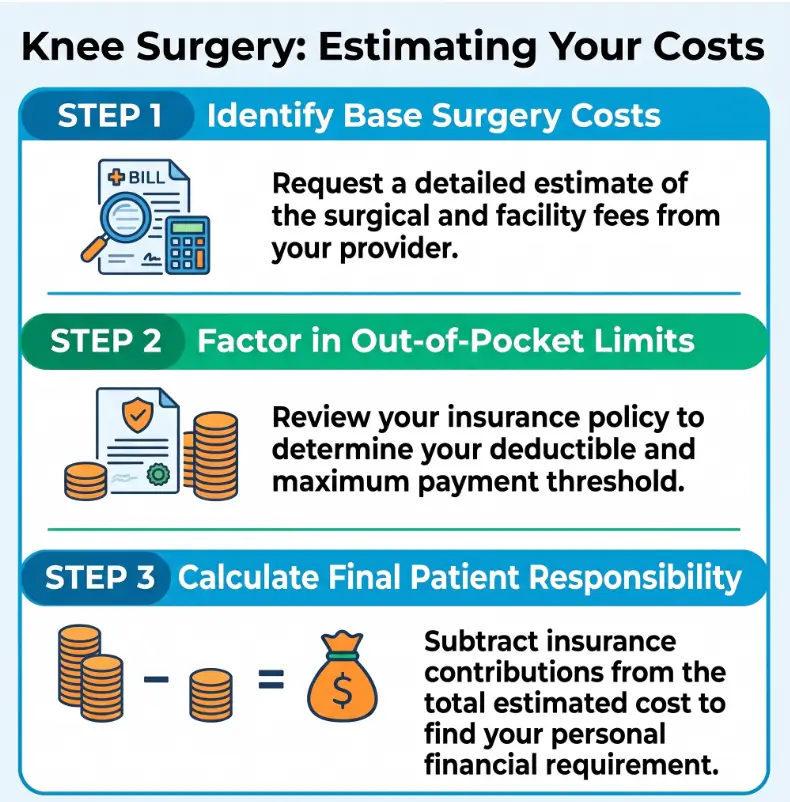
How Do You Estimate Knee Surgery Out-of-Pocket Cost?
Start with your health plan, not the surgeon’s billed charge. For insured patients, the useful number is generally the amount your plan recognizes for covered care, combined with the deductible, copayment or coinsurance rules that apply to you.
CMS says health plans subject to federal Transparency in Coverage requirements must make price-comparison information available for covered items and services through an online self-service tool, with paper information available on request. That makes your insurer’s estimator one of the best places to begin a pre-surgery calculation.
A practical estimate uses five numbers or facts:
- Your remaining deductible.
- Your coinsurance or applicable surgical copayment.
- Your remaining in-network out-of-pocket maximum.
- The insurer’s estimated allowed cost for the procedure and related services.
- Whether every relevant provider and facility is treated as in network.
Those five items turn a vague question such as “How much is knee surgery?” into the much more useful question: “How much of this particular episode of care is my plan likely to assign to me?”
If you want to understand the terminology on an estimate before calculating anything, this guide to orthopedic billing terms can help separate allowed amounts, billed charges, deductibles, copays, and coinsurance.

What Changes Your Knee Surgery Cost the Most?
The answer can change dramatically even when two patients are scheduled for procedures that sound similar. Insurance design, surgical setting, procedure complexity, and network status can matter more to your personal cost than the surgeon’s headline charge.
1. How much of your deductible is still unpaid?
If your plan applies the deductible to surgery, an operation early in your plan year can feel financially different from the same covered operation after substantial medical spending has already accumulated.
Do not assume the deductible shown on your insurance card is still fully outstanding. Log in to your insurer’s portal and look for the amount already satisfied for the current plan year.
2. What happens after the deductible?
Many plans shift from deductible spending to coinsurance or another form of cost sharing. HealthCare.gov describes coinsurance as a percentage of covered costs that the patient pays after the relevant deductible rules are satisfied.
3. How close are you to your out-of-pocket maximum?
This can be the forgotten number in surgery planning. For Marketplace coverage, the out-of-pocket maximum generally caps what you pay for covered in-network benefits during the plan year, but premiums, uncovered services, out-of-network care, and certain amounts above an allowed charge do not necessarily count toward that limit.
That distinction matters because a calculation based only on deductible plus coinsurance can overstate what you owe if you are already close to your applicable in-network maximum.
4. Is the surgery inpatient, hospital outpatient, or at an ambulatory surgery center?
The facility is not merely an address. It can determine which facility fee, benefit category, cost-sharing rules, and network contracts apply.
5. Is the operation the only expensive part of the episode?
Usually not. Preoperative testing, anesthesia, medical equipment, rehabilitation, medications, imaging, or an unexpected additional service may sit outside the number you first receive from the surgeon.
Get the exact planned service and codes.
Check surgeon, facility, and related providers.
Collect plan and provider estimates.
Apply deductible and coinsurance.
Compare with your remaining OOP maximum.
Build the Complete Surgery Bill Before Doing the Math
The most common estimation error is calculating the right percentage against the wrong bundle of services. Before you reach for a calculator, identify who may bill you.
| Potential charge | What to ask | Why it matters |
|---|---|---|
| Surgeon | What exact procedure is planned, and what billing code should I give my insurer? | The surgeon’s professional fee may be separate from the facility. |
| Hospital or ASC | What facility will be used, and what is the estimated facility charge under my plan? | The site of care can materially change the financial calculation. |
| Anesthesia | Who provides anesthesia, and how will my plan treat that service? | Anesthesia may generate a separate claim. |
| Implants and supplies | Are expected implants or major surgical supplies included in the estimate? | Do not assume every component is represented in one quote. |
| Pre-op services | Are labs, imaging, medical clearance, or other tests billed separately? | They may occur on different dates or under different benefits. |
| Post-op care | What follow-up visits, therapy, equipment, or medications should I budget for? | The operation is only the beginning of the recovery spending period. |
Separate anesthesia billing is easy to overlook. If you want to map that piece independently, see why anesthesia can arrive as a separate bill.
CMS hospital price-transparency rules require U.S. hospitals to publish pricing information, including a consumer-friendly display of shoppable services or qualifying price-estimator functionality. Hospital pricing can help you compare facilities, but your own insurer’s estimate remains important because your actual cost depends on your benefit design.
If the facility charge itself is confusing, the site’s guide to the facility fee in orthopedic care explains why that line item deserves separate attention.
How to Calculate Your Cost With Health Insurance
A useful simplified formula is: apply any remaining deductible to the covered allowed amount, apply the relevant coinsurance or copayment to the portion subject to cost sharing after that, then check whether the result would push you past your remaining in-network out-of-pocket maximum.
Illustrative scenario: a simplified insured surgery calculation
This is an illustrative example only. The numbers are chosen to demonstrate the calculation and are not presented as typical knee-surgery prices.
Suppose your insurer estimates an in-network allowed amount of $12,000 for the services included in its estimate. You have $1,500 left on the applicable deductible and then owe 20% coinsurance.
In a simplified calculation, you would first assign $1,500 to the deductible. That leaves $10,500. Twenty percent of $10,500 is $2,100, producing a preliminary patient share of $3,600.
In this example, the capped estimate is $2,700—not $3,600. If $2,700 remains to the applicable in-network out-of-pocket maximum, the simplified calculation is the lower of $3,600 and $2,700. This assumes all the estimated services are covered, in network, in the same plan year, and count toward that same maximum. The deductible is part of the capped cost sharing; do not add it again on top of $2,700. HealthCare.gov explains which costs the out-of-pocket maximum limits.
A separate bill for covered in-network therapy or equipment in that same plan year does not, by itself, remove that protection. Total recovery spending can still exceed this estimate when it includes non-covered services, costs outside the applicable network protection, services under a different benefit or accumulator, or care in a later plan year. Ask the insurer which limit applies to each excluded item. This is a simplified private-plan example, not an Original Medicare calculation.
Technical note: why “20% coinsurance” does not mean “20% of the hospital bill”
For covered in-network services, cost sharing is generally tied to the plan’s rules and recognized or allowed amount, not automatically to whatever amount appears as a provider’s gross billed charge.
Also check whether your plan uses different deductibles or out-of-pocket limits for different benefits, whether copays apply, whether a service is excluded, and whether an out-of-network benefit exists. A single percentage copied from the insurance card is therefore not enough to reconstruct a complex surgical claim.
The safest calculation starts with the insurer’s patient-specific estimate for the exact provider, facility, and service, then reconciles it with your current deductible and out-of-pocket accumulators.
Hospital vs Ambulatory Surgery Center: Can the Setting Change Your Cost?
Yes, the surgical setting can change your expected cost, but only if more than one setting is medically appropriate for your particular procedure and health status. Price should be a comparison factor after clinical suitability, not a substitute for it.
The financial comparison should use patient-specific estimates for the same planned procedure under your own insurance plan. CMS hospital price-transparency requirements and insurer price-comparison tools can provide useful starting points for comparing facilities.
| Path | Best for | Main advantage | Main limitation | What to verify |
|---|---|---|---|---|
| Good: Stay with planned facility | A straightforward case where the facility is appropriate and the estimate is affordable | Least administrative friction | You may miss a lower-cost clinically appropriate setting | Network status and full patient estimate |
| Better: Compare approved settings | Patients whose surgeon says hospital outpatient and ASC care are both reasonable options | Lets you compare facility-related cost without changing the treatment goal | Not every operation or patient is suitable for every setting | Same procedure, same surgeon if applicable, same benefit assumptions |
| Best-controlled: Written comparison | High-deductible or high-cost cases where several thousand dollars of exposure may remain | Creates a documented comparison across insurer and facility estimates | Requires more phone calls and paperwork | What is included, excluded, authorized, and separately billed |
The “best-controlled” option is not necessarily the most expensive medical option. It simply means you have reduced uncertainty before making the financial commitment.
If you are specifically comparing facility types, the site’s hospital outpatient vs ASC facility-fee guide is the natural next comparison.
How to Verify the Estimate With Your Insurer and Providers
The strongest pre-surgery estimate is assembled from more than one source. Ask the insurer what your plan expects you to pay, then ask the surgical providers exactly what their estimates include.
Call your insurer with a procedure-specific script
Have the surgeon’s name, facility, planned procedure description, and available billing codes in front of you. Then ask:
- Is this procedure covered under my current plan when medically necessary?
- Is prior authorization or another pre-service approval required?
- Are the surgeon and facility in network for my exact plan?
- What is my current remaining deductible?
- What copayment or coinsurance applies to the surgeon and facility?
- How much remains before I reach my applicable in-network out-of-pocket maximum?
- Can you provide a patient-specific cost estimate for this procedure at this facility?
- Does the estimate include anesthesia and other commonly associated services?
- If those services are not included, can you estimate them separately?
- Can you send the estimate or call reference information in writing?
Prior authorization deserves its own check because authorization and cost estimation solve different problems. An authorized service can still carry significant patient cost-sharing. Use the orthopedic prior authorization checklist if that approval is still outstanding.
Then call the surgeon’s office or financial counselor
Ask them to confirm the planned procedure, surgical location, whether an assistant surgeon is expected, whether implants or special supplies are anticipated, and which services their quote does and does not include.
A useful question is: “If I paid every bill related to this operation, which organizations could send me one?” It is delightfully unglamorous, but it often uncovers the missing pieces.
Do not treat “the hospital is in network” as the end of the network check
For most private health insurance, the federal No Surprises Act provides protections against certain unexpected out-of-network bills when non-emergency care is received in an in-network hospital, hospital outpatient department, or ambulatory surgical center. Those protections have boundaries, however, and they do not make every possible service or setting automatically in network.
CMS specifically notes that notice-and-consent rules can matter for some scheduled out-of-network care, while certain ancillary specialties, including anesthesiology in protected situations, cannot use notice and consent to waive those federal protections.
Check CMS Health Plan Price Transparency Guidance
Knee Surgery Cost Mistakes That Can Produce Expensive Bills
Most estimating mistakes are not arithmetic mistakes. They are scope mistakes. One missing provider, one network assumption, or one service excluded from the estimate can make a beautifully calculated number useless.
| Mistake | Why it can cost money | Safer move |
|---|---|---|
| Using the hospital’s sticker price | It may not represent your plan’s negotiated amount or personal cost sharing | Start with the insurer’s patient-specific estimate |
| Checking only the surgeon’s network status | The facility or another provider may be treated differently | Verify each major billing entity |
| Ignoring the out-of-pocket maximum | You may overestimate your remaining liability for covered in-network care | Check the current plan-year accumulator |
| Assuming one quote includes everything | Anesthesia, testing, therapy, equipment, or other services may be separate | Ask for an explicit included/excluded list |
| Confusing authorization with coverage certainty | Approval does not necessarily eliminate deductible or coinsurance | Ask separately about approval and patient cost |
| Paying a large pre-surgery amount without reconciliation rules | The final claim may differ from the estimate | Ask how overpayments, credits, and refunds are handled |
Be careful with large prepayments
A provider may request your estimated share before surgery. Before paying a large amount, ask whether it is an estimate or final responsibility, how the provider reconciles the payment after the insurer processes the claim, and how any credit balance is returned.
You may also want a receipt showing which account, facility, and date of service the payment applies to. A five-minute documentation habit can save a surprisingly dreary billing scavenger hunt later.
When paying more for help can make sense
Professional billing assistance or patient advocacy may be reasonable when you have a denied high-cost claim, conflicting network information, a disputed balance bill, multiple insurers, coordination-of-benefits problems, or bills that cannot be reconciled against the explanation of benefits.
For an ordinary scheduled procedure with clear in-network coverage, you may not need paid assistance at all. Start with the insurer, provider billing office, and plan documents.
Medicare and Self-Pay Patients Need a Different Calculation
Do not apply a commercial insurance deductible-and-coinsurance worksheet blindly to Medicare or self-pay care. The underlying question is the same, “What am I likely to owe?”, but the rules and best tools differ.
If you have Original Medicare
Medicare covers many medically necessary inpatient and outpatient surgical procedures, but the beneficiary cost depends on factors such as the setting, applicable Medicare benefit, other coverage, and the specific services furnished. Medicare maintains an official Procedure Price Lookup for outpatient procedures that can compare national average Medicare payments and beneficiary copay information across hospital outpatient departments and ambulatory surgical centers for eligible procedures.
Total knee replacement is specifically included in Medicare’s discussion of certain comprehensive outpatient surgical services, but your actual responsibility can still be affected by supplemental insurance and the circumstances of your care.
Use Medicare’s Procedure Price Lookup
If you have Medicare Advantage
Use the plan’s own benefit and network rules rather than assuming Original Medicare cost-sharing applies. Ask about authorization, network status, the surgical facility, and your plan-specific maximum out-of-pocket exposure.
If you are uninsured or choosing self-pay
The federal Good Faith Estimate rules become especially useful. CMS states that when you are not using insurance to pay, providers generally must give you a Good Faith Estimate of expected charges when you request one or when qualifying scheduled care is arranged sufficiently in advance.
One subtle but important limitation is that a Good Faith Estimate may cover only a single provider or facility. CMS even uses scheduled surgery as an example in which a patient may need separate estimates from the surgeon and hospital. Services scheduled independently, such as later physical therapy, may also fall outside that estimate.
The site’s orthopedic Good Faith Estimate guide can help you work through that request in more detail.
If the estimate is manageable but the timing is not, you can separately review questions to ask about an orthopedic payment plan.

Frequently Asked Questions
Can my surgeon tell me exactly what knee surgery will cost?
Usually not by themselves. The surgeon may estimate the professional component, but your full out-of-pocket cost can depend on the facility, anesthesia, insurance-negotiated rates, deductible, coinsurance, out-of-pocket status, and services ultimately performed.
Should I use the hospital price estimator or my insurance estimator?
Use both when available, but give special weight to the insurer’s patient-specific estimate for your exact plan. Hospital tools can be useful for facility comparisons, while your insurer knows your benefit design and current cost-sharing accumulators.
Does meeting my deductible mean knee surgery is free?
No. Depending on the plan, coinsurance or copayments may continue after the deductible until applicable cost-sharing rules or the out-of-pocket maximum are reached. Verify your plan rather than assuming the deductible is the finish line.
If I reach my out-of-pocket maximum, will every surgery-related bill be covered?
Not necessarily. Out-of-pocket maximum rules generally apply to covered benefits subject to the plan’s rules. Premiums, uncovered services, and some out-of-network costs may fall outside the protection. Confirm which services count toward your specific maximum.
Can anesthesia still create a surprise bill?
Federal surprise-billing protections apply in many situations involving non-emergency care at an in-network hospital, hospital outpatient department, or ambulatory surgical center, including important protections involving ancillary services. Coverage details and exceptions still matter, so verify the planned facility and ask your insurer how anesthesia will be treated.
Is an ambulatory surgery center always cheaper than a hospital?
No universal rule can answer that for your plan. Compare patient-specific estimates only when your surgeon considers both settings clinically appropriate. Network contracts, facility benefits, the procedure itself, and your remaining cost sharing can change the result.
Should I pay the estimated amount before surgery?
If prepayment is requested, first ask whether the amount is an estimate, how it will be reconciled after insurance processes the claim, and how an overpayment would be refunded. Keep the written estimate and payment receipt.
What if my insurer and hospital give me different estimates?
Ask both parties what is included in their number. Check whether they are using the same procedure, facility, network assumptions, and associated services. A difference often becomes understandable once the scope of each estimate is placed side by side.
Your 15-Minute Knee Surgery Cost Check
You do not need to solve the entire medical billing system today. Spend 15 minutes gathering the five numbers that determine whether you already have a usable estimate or merely a quote-shaped fog bank.
- Open your insurer portal and write down your remaining deductible.
- Write down your current in-network out-of-pocket spending and remaining maximum, if displayed.
- Find the surgical coinsurance or copayment that appears to apply.
- Write the exact surgeon and facility names beside the planned procedure.
- Run the insurer’s price estimator or prepare one call asking for a patient-specific estimate.
- Mark whether anesthesia, implants, testing, and rehabilitation are included or still unknown.
- Confirm whether prior authorization has been obtained or is still pending.
If those seven lines are filled in, you have moved from “knee surgery could cost anything” to a concrete list of known costs and missing information. That is enough to make the next phone call useful.
For the next step, you can use the site’s orthopedic surgery estimate guide to organize the provider quote itself before comparing it with your insurance calculation.
Last reviewed: 2026-09
Targeted review: October 17, 2026. The insured example and out-of-pocket-limit explanation were checked and clarified. Other sections retain their stated review scope.
Targeted editorial update: October 21, 2026. Added a topic-specific follow-up record and recheck triggers, revised the title and search description, and removed unverified first-person claims or clarified selected wording where found. The existing body was retained. This update is not a complete legal, coverage or clinical review; confirm current rules and individual decisions with the relevant official source or service.