
This site is written from a family-caregiver perspective. The operator is not a medical professional or an insurance, legal or financial adviser. Use this guide to organize questions for the relevant service.
Clinical suitability comes before price matching
Use this follow-up record alongside the guide below. It does not determine medical suitability, insurance eligibility or legal rights, and it does not guarantee a price.
- Keep together
- The settings the surgeon considers appropriate, proposed services, expected billers and plan information.
- Unanswered question
- Are both settings appropriate for this person, and are the financial quotes for equivalent services?
- Next contact and owner
- Discuss suitability with the clinical team, then reconcile scope and benefits with the billing contacts.
- Recheck when
- Medical plan, setting, billers or discharge needs change.
For each response, record its date, source, reference number and what remains uncertain. Agree the next follow-up date instead of treating silence as confirmation. Use official contact channels and keep identifying health, account and policy information out of public comments.

Orthopedic surgery decision guide
Ambulatory Surgery Center vs Hospital for Orthopedic Surgery
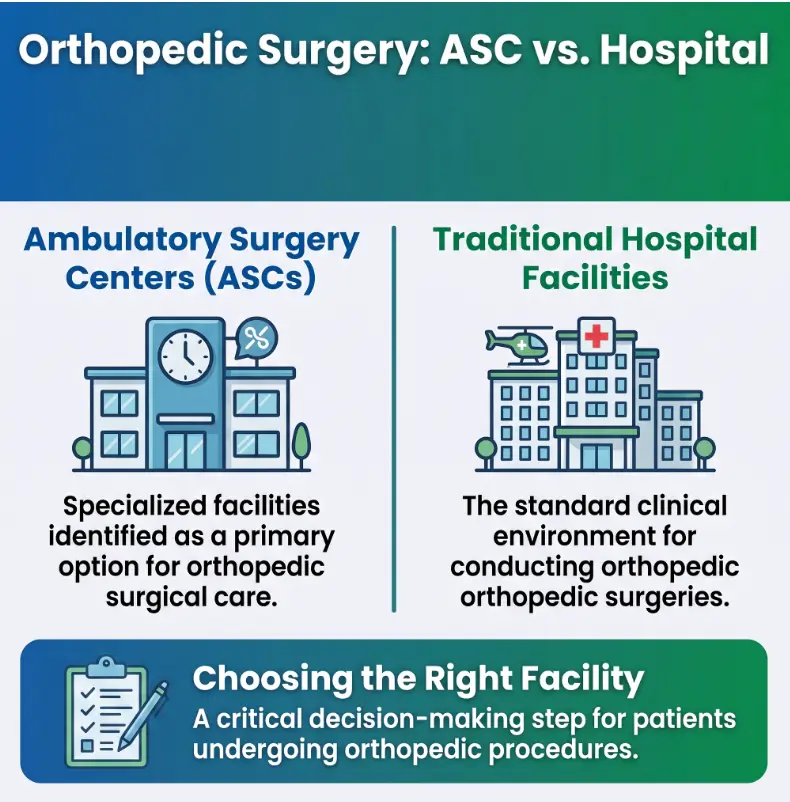
An ambulatory surgery center can be an excellent setting for many planned orthopedic procedures, particularly when the patient is medically stable and the operation has a well-established same-day pathway. A hospital may be the better choice when medical complexity, surgical complexity, or the possibility of needing more intensive postoperative care changes the risk equation.
The important comparison is not simply “small facility versus big hospital.” The surgeon, anesthesia plan, patient selection, emergency-transfer process, insurance network, expected recovery, and total bill all matter. Two facilities with different signs over the door can produce very different experiences and costs.
This guide helps you decide which setting deserves the stronger look, what could make an ASC inappropriate, where a hospital may add useful backup, and what to verify before you commit to a surgery date.
The right facility is the least intensive setting that can safely handle your operation, your health risks, and a realistic complication plan.
This U.S.-focused guide is for adults comparing a freestanding ambulatory surgery center with hospital-based orthopedic surgery. For appropriately selected patients, an ASC may offer a streamlined same-day experience and sometimes lower facility costs. A hospital may be more appropriate when medical conditions, a complex operation, difficult recovery logistics, or the possibility of needing hospital-level services raises the stakes. By the end, you should know which questions can settle the choice before you pay or schedule.
Facility choice is a medical decision as well as a financial one. Your surgeon and anesthesia team should consider the procedure, your health conditions, previous anesthesia problems, medications, mobility, expected blood loss, postoperative monitoring needs, and the support available after discharge.
Do not move an operation to an ASC solely because a quoted price is lower. Likewise, do not assume a hospital is automatically safer for every healthy patient having a routine outpatient procedure. Ask what makes your case appropriate for the proposed setting and what happens if recovery does not go according to plan.
Table of Contents
Should You Choose an ASC or Hospital for Orthopedic Surgery?
For a medically stable patient having an orthopedic procedure designed for same-day discharge, an ambulatory surgery center can be a reasonable choice. A hospital becomes more attractive when the patient, procedure, anesthesia, or recovery plan creates a meaningful chance that hospital-level monitoring or treatment will be needed.
An ASC is not simply a doctor’s office with an operating room. Medicare-certified ambulatory surgical centers operate under federal conditions for coverage, and the setting is specifically designed for surgical patients who are not expected to require hospitalization.
That still leaves plenty of room for judgment. Shoulder arthroscopy in an otherwise healthy adult is a different decision from revision joint replacement in someone with significant heart or lung disease. Even two people scheduled for the same knee procedure may belong in different settings.
Do not ask, “Is an ASC safer than a hospital?” Ask, “Am I an appropriate candidate for this specific procedure at this specific ASC, and what backup exists if I am not ready to go home?”
Orthopedic procedures performed in outpatient settings can include arthroscopic operations, hand and foot surgery, some fracture-related procedures, and selected hip or knee replacements. Medicare maintains a specific list of procedures payable in ASCs, while commercial insurance policies may use their own rules.
Observational orthopedic research has found that appropriately selected patients can undergo outpatient joint replacement with favorable outcomes, but that evidence comes with an important footnote: ASC patients are often intentionally selected because they are lower-risk. The facility label by itself does not create the outcome. Patient selection does much of the quiet work.
That is why a recommendation to use an ASC should be accompanied by an explanation of why you qualify, not merely a comment that the surgeon performs cases there every Tuesday.
What Changes the Answer?
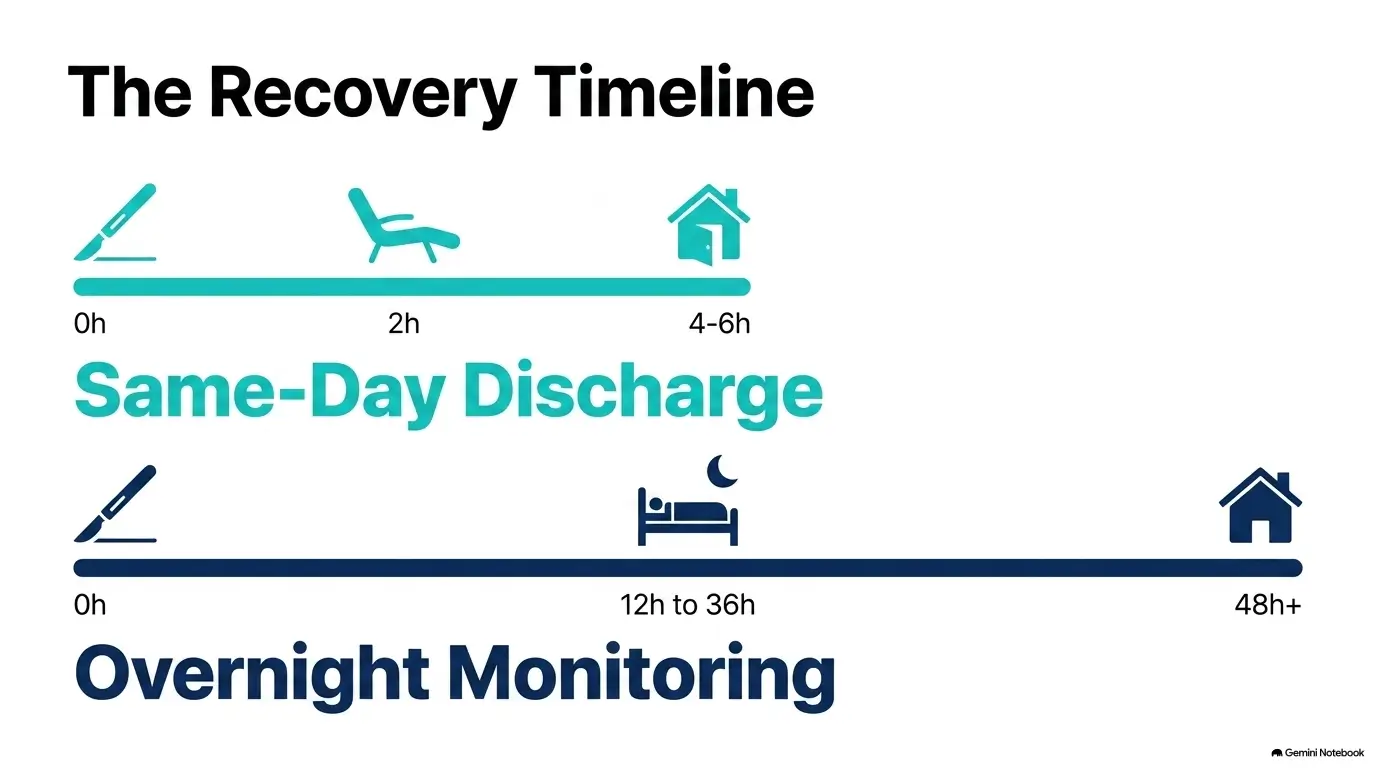
The better setting depends on four interacting questions: how medically resilient you are, how complicated the surgery is, how predictable the recovery is, and how quickly higher-level care can be reached if something changes.
1. Your medical risk
A surgeon and anesthesia professional may look differently at ASC surgery if you have unstable heart or lung disease, significant sleep-related breathing problems, difficult-to-control diabetes, a history of anesthesia complications, bleeding concerns, severe frailty, or another condition that could require extended monitoring.
This does not mean one diagnosis automatically rules out an ASC. It means the medical question becomes more important than the convenience question.
2. The operation itself
Duration, expected blood loss, revision surgery, implant complexity, the likelihood of postoperative imaging or laboratory testing, and the chance of an unplanned change in the operative plan can all affect the appropriate site of care.
A straightforward primary procedure with a mature outpatient pathway is not equivalent to an unusually long or technically complex case.
3. Your ability to go home safely
Outpatient success does not end when the dressing goes on. You may need to walk safely, control pain and nausea, urinate when clinically appropriate, tolerate fluids or food, understand medications, and have a responsible adult available for transportation and early recovery.
If home support is uncertain, tell the surgical team before scheduling. The cheapest facility becomes expensive very quickly if the discharge plan was unrealistic from the beginning.
4. Your surgeon’s pathway and the facility’s capabilities
A high-functioning outpatient program is a system, not just a building. It includes patient screening, anesthesia planning, nursing protocols, pain control, physical therapy or mobility assessment when appropriate, postoperative phone access, and clear escalation instructions.
Are your medical conditions stable enough for planned same-day care?
Is the operation routinely performed there with a predictable recovery pathway?
If recovery changes, is monitoring, transfer, and follow-up clearly organized?
If all three are convincing, an ASC may be a strong option. If one is shaky, the hospital question deserves another look.
ASC vs Hospital: Where Each Setting Is Stronger
ASCs and hospitals overlap more than many patients expect, but they are built for different levels of complexity. The most useful comparison is functional rather than emotional.
| Setting | Often fits best | Main advantage | Main limitation | Cost question |
|---|---|---|---|---|
| Ambulatory surgery center | Selected patients having planned outpatient procedures | Focused surgical workflow and same-day discharge model | Not designed to provide full hospital-level care if needs escalate | Is the facility, surgeon, anesthesia team, and implant arrangement all in network? |
| Hospital outpatient department | Patients suitable for outpatient surgery who may benefit from broader hospital resources | Access to hospital resources varies by the actual outpatient location; confirm what is on site | Facility costs and billing structure may differ substantially | What hospital outpatient facility fee and professional fees apply? |
| Hospital inpatient care | Patients or procedures expected to require admission or more intensive monitoring | Hospital-level observation and treatment are already available | Greater resource use and potentially higher patient cost | Does your plan authorize inpatient status and what cost-sharing applies? |
The table does not create a Good / Better / Best ranking because no such ranking is honest here. A carefully selected patient may gain little from paying for hospital resources unlikely to be used. A medically complex patient may gain quite a lot from having the needed resources available on site.
For a budget-conscious, low-risk patient, a well-run in-network ASC may deserve serious consideration. For a patient with substantial medical risk, difficult mobility, uncertain discharge support, or a procedure likely to require more monitoring, the hospital’s broader capabilities may justify the different cost structure.
If you are an appropriate outpatient candidate, your procedure is routinely performed at the ASC, the anesthesia plan is straightforward, your coverage is favorable, and you have reliable support at home, choosing a hospital only because it feels “bigger” may add cost without adding a meaningful benefit.
Check the actual address, not just the hospital name. A hospital outpatient department can be on the hospital’s main campus or at an off-campus site. CMS distinguishes both settings in its place-of-service definitions. A hospital name on the estimate does not establish that an emergency department, ICU, or inpatient bed is in the same building as your operating room.
For either option, ask: “At this exact surgical address, which services are available on site, and which would require transfer?” Confirm who handles escalation, where a transfer would go, and what happens if you cannot be discharged as planned. Use those answers with the surgical and anesthesia teams when comparing suitability. Hospital ownership or a billing category is not, by itself, a description of every resource physically present.
Safety and Backup: What Outpatient Surgery Really Means
Choosing an ASC does not mean choosing surgery without emergency planning. Medicare-certified ASCs must meet conditions for coverage, and federal regulations require an effective process for transferring a patient to a hospital when emergency care exceeds the ASC’s capabilities.
That distinction matters because a transfer plan is not the same thing as having an intensive care unit, emergency department, blood bank, or inpatient bed immediately available within the same building.
The most revealing question is therefore not “Can you transfer me?” Any compliant program should have a process. Ask what circumstances trigger transfer, which hospital usually receives patients, who arranges transportation, and how your surgeon remains involved.
Patient selection is part of the safety system
Studies of outpatient joint replacement frequently emphasize selection because lower-risk patients are disproportionately sent to ASCs. This makes simplistic comparisons misleading. If an ASC has fewer complications than a hospital in a dataset, part of the reason may be that the hospital is caring for older, sicker, or more complex patients.
A 2025 orthopedic study examining a health system after it opened an ASC found that the hospital subsequently cared for a more medically complex joint-replacement population. That is a useful reminder that site-of-care statistics need context.
You can review the study through the National Library of Medicine.
Technical depth: Why “same-day surgery” and “ASC surgery” are not interchangeable
A patient can have outpatient surgery in a hospital outpatient department or in a freestanding ambulatory surgery center. The words describe different things: outpatient describes the admission status or care pathway, while ASC describes a type of facility.
A hospital can therefore perform a procedure without formally admitting the patient as an inpatient. Conversely, an ASC is specifically organized around surgical care for patients who are not expected to require hospitalization.
This matters for cost comparisons. Ask whether the proposed alternative is an ASC, a hospital outpatient department, or inpatient hospital care. Otherwise, you may compare three very different payment structures while thinking you are comparing only two.
CMS also publishes facility-level quality information for participating hospitals and ASCs. Public data cannot predict your individual result, but it gives you something more useful than glossy waiting-room photography. You can start with Medicare Care Compare.
How the Surgery Setting Can Change Your Cost
The same orthopedic procedure can produce a different total bill depending on where it is performed because facility payment systems, negotiated insurer rates, professional fees, implants, anesthesia, and patient cost-sharing can all differ.
Do not compare only the surgeon’s number. The facility is often its own financial event.
If the phrase “facility fee” is new to you, review how facility fees work in orthopedic care before comparing two surgery quotes.
Money moment 1: ASC facility charge vs hospital outpatient charge
Medicare uses separate payment systems for ambulatory surgical centers and hospital outpatient departments. Its public Procedure Price Lookup tool allows beneficiaries to compare national-average Medicare costs for qualifying outpatient procedures in the two settings.
You can check a covered procedure using Medicare Procedure Price Lookup.
Private insurance is less tidy. Your insurer’s negotiated ASC rate could be lower, similar, or occasionally less favorable than a hospital alternative. A high-deductible plan can make that negotiated amount especially important because you may be paying a large share yourself.
Money moment 2: The “facility quote” is not the total surgery quote
A surgical episode can generate charges from multiple entities. Depending on the case, that may include the surgeon, facility, anesthesiology group, pathology or imaging services, implant-related charges, postoperative equipment, and rehabilitation.
Use the orthopedic surgery estimate checklist to identify the moving parts before treating one number as the final price.
If anesthesia appears separately, that is not automatically a billing error. This guide to a separate anesthesia bill after orthopedic surgery explains why professional billing can arrive apart from the facility charge.
Money moment 3: Cash price vs insurance price
Do not assume the cash price is automatically better because the headline figure is lower. Using insurance may move spending toward your deductible or out-of-pocket limit and may protect you through contracted rates. Self-pay can still be attractive in some circumstances, but compare the complete episode rather than one isolated charge.
Uninsured or self-pay patients can generally request a good faith estimate for scheduled care. CMS explains that an estimate may not automatically capture every separately scheduled provider or service, which is particularly important in surgery.
For a practical preparation sequence, use the orthopedic good faith estimate checklist. You can also review the official CMS Good Faith Estimate guide.
Make both quotes describe the same surgery, surgeon, anesthesia plan, implant assumptions, expected discharge status, and covered postoperative services. Otherwise, you may be comparing a nearly complete package with a single facility line item.
Insurance, Medicare, and the Bills You Still Need to Check
Insurance approval for the operation does not automatically mean every participant in the surgical episode is covered on favorable terms. Verify the procedure, facility, surgeon, anesthesia arrangement, and authorization requirements separately when your plan distinguishes them.
For Medicare, ASC coverage is procedure-specific. Medicare maintains an approved procedure list and pays ASC facility services under its ASC payment system. Medicare Advantage plans can add network and authorization rules, so beneficiaries should check the plan rather than assuming Original Medicare’s administrative pathway applies unchanged.
If you have Medicare Advantage, see the separate guide to Medicare Advantage orthopedic care.
Use this insurer call script
Call the number on your insurance card with the surgeon’s name, facility name, procedure description, and any procedure code supplied by the office.
- Is the proposed orthopedic procedure covered at this facility?
- Is the facility in network under my specific plan?
- Is the surgeon in network at this location?
- Is prior authorization required for the procedure or site of service?
- Does the authorization specify ASC, hospital outpatient, or inpatient care?
- What deductible, copay, or coinsurance applies to the facility?
- How is professional anesthesia billed, and what network protections apply?
- Are implants, postoperative equipment, imaging, or therapy billed separately?
- Can you provide a reference number for this benefit verification call?
If authorization has not been confirmed, use the orthopedic prior authorization checklist before assuming the surgery date and the insurance approval are the same thing.
What about surprise anesthesia bills?
Federal No Surprises Act protections apply in many situations involving non-emergency services from out-of-network clinicians at an in-network hospital, hospital outpatient department, or ambulatory surgical center. Anesthesiology is one of the areas patients commonly worry about.
Those protections are valuable, but they should not replace pre-surgery verification. Different insurance products and circumstances can change how a claim is handled, and a service that is not covered at all is a different problem from an unexpected out-of-network bill.
Authorization addresses whether the plan has approved the requested service under its rules. It does not, by itself, tell you the final contracted charge, remaining deductible, coinsurance, or every separate professional bill.
How to Compare the Actual Facilities
Once both settings are medically reasonable, compare the specific facilities rather than arguing about ASC versus hospital in the abstract. A strong facility should be able to answer practical questions without turning the conversation into fog.
Your facility scorecard
| Question | What you want to understand | Why it matters |
|---|---|---|
| How often is this procedure performed here? | Whether the team has a routine pathway | Repetition can improve coordination |
| Who provides anesthesia? | Credentials, plan, and billing arrangement | Anesthesia affects both safety and cost |
| What makes me eligible for this setting? | The actual screening logic | A personalized answer is more useful than “we do these all the time” |
| What happens if I cannot go home? | Observation or transfer pathway | Same-day recovery is not guaranteed |
| Which hospital receives transfers? | Emergency escalation plan | Clarifies what backup really looks like |
| Who do I call overnight? | Postoperative access | Recovery continues after the facility closes |
| Which bills should I expect? | Facility and professional billing structure | Prevents one quote from masquerading as the whole cost |
Quality data can add another layer, particularly for Medicare-participating facilities. CMS publicly reports selected quality measures for both ambulatory surgical centers and hospital outpatient settings.
Do not reduce the decision to a single star rating. Look for patterns, ask the surgeon how the facility handles your particular operation, and make sure the surgeon’s preferred site is also sensible for your medical profile and insurance plan.
Ask the surgeon one unusually useful question
Instead of asking only, “Which place do you prefer?” ask:
“What would have to be different about my health or my operation for you to move this case from the ASC to the hospital?”
The answer often reveals the surgeon’s actual threshold for risk. It also turns a vague reassurance into a concrete discussion of your case.
Costly Mistakes When Choosing a Surgery Setting
The expensive mistakes are usually not dramatic. They happen in paperwork gaps, mismatched assumptions, and phrases such as “I thought that was included.”
| Mistake | Why it costs money | Safer move |
|---|---|---|
| Choosing the facility from the surgeon’s preference alone | The preferred facility may not have your best insurance terms | Verify both medical appropriateness and network status |
| Comparing only facility quotes | Surgeon, anesthesia, implants, or rehabilitation may be outside the number | Build an episode-of-care estimate |
| Assuming an ASC is automatically cheaper | Commercial negotiated rates differ by contract | Ask your insurer for your estimated responsibility at both settings |
| Assuming a hospital is automatically safer | You may pay for resources that add little value in a low-risk routine case | Ask which hospital capability would actually change your care |
| Ignoring the discharge plan | A failed home plan can trigger unexpected care and logistical costs | Confirm transportation, medication help, mobility, and overnight support |
| Failing to document benefit calls | Disputes are harder when nobody remembers what was discussed | Record date, representative, reference number, and quoted benefits |
Multiple bills after orthopedic surgery are common enough that it helps to know what can legitimately come from different providers. The guide to orthopedic bills from multiple providers can help you map them before assuming duplication.
you are medically low-risk, the operation has a mature outpatient pathway, the ASC has appropriate emergency procedures, your home recovery plan is solid, and the total in-network cost is favorable. Paying more for a hospital should have a reason beyond the architecture.
When a Hospital May Make More Sense
A hospital deserves stronger consideration when there is a meaningful possibility that you will need resources beyond a focused same-day surgical program.
That may include a patient with significant or unstable medical conditions, a complex revision procedure, a history that makes anesthesia management more demanding, uncertain postoperative mobility, or an operation for which the surgical team expects a greater chance of extended monitoring.
It can also be the better practical choice when the hospital is clearly more favorable under your insurance plan. Medical intensity and financial intensity do not always travel in the same direction.
When paying more may be reasonable
A higher-cost hospital setting may be justified when the additional resources materially improve the plan for your particular risks. The point is not that “premium” care is better. The point is that access to broader monitoring, inpatient services, or specialist support can have real value when there is a credible chance you will need them.
If your surgeon recommends an ASC but you remain uncertain, a second opinion can be reasonable for a major elective operation, especially when the disagreement is about medical suitability rather than convenience.
Conversely, if a hospital is recommended for an apparently routine case, it is fair to ask what specific patient or procedural factor makes hospital care preferable. Good decisions survive polite questions.

Frequently Asked Questions
Is an ambulatory surgery center cheaper than a hospital for orthopedic surgery?
It can be, particularly because facility payment structures differ, but do not assume it. Private insurer contracts, deductibles, coinsurance, surgeon fees, anesthesia, implants, and other services can change your actual out-of-pocket cost. Compare complete estimates for the same operation.
Are ambulatory surgery centers safe for joint replacement?
Selected patients can undergo outpatient hip or knee replacement in ASCs, and published studies have reported favorable outcomes in appropriately chosen populations. The important phrase is “selected patients.” Your medical risk, procedure, support at home, anesthesia plan, and the facility’s program all matter.
What happens if something goes wrong at an ASC?
Medicare-certified ASCs must have procedures for transferring patients to a hospital when emergency care exceeds the ASC’s capabilities. Ask where transfers normally go and how the process works before surgery rather than discovering the answer during a complication.
Can Medicare pay for orthopedic surgery at an ASC?
Yes, Medicare covers facility services for procedures that are included on its ASC covered-procedure list when applicable requirements are met. Coverage is procedure-specific, and your personal cost can depend on Medicare rules, supplemental coverage, and other insurance you have.
Does insurance prior authorization mean the ASC is in network?
Do not assume so. Authorization and network participation answer different questions. Confirm the facility’s network status under your exact plan even after authorization is approved.
Can I ask my surgeon to move the operation to a different facility?
You can ask. Whether the alternative is medically appropriate and available depends on the surgeon’s privileges, the procedure, scheduling, equipment, implants, anesthesia resources, insurance contracts, and your health profile.
Should an older adult automatically have orthopedic surgery in a hospital?
No single age automatically settles the question. Overall medical risk, frailty, cognition, mobility, anesthesia considerations, procedure complexity, medications, and home support may matter more than a birthday alone. Older adults with additional risk factors may reasonably require a more conservative facility plan.
Your 15-Minute Facility Check
You do not need to solve the entire surgery decision today. You can, however, expose most of the hidden variables in about 15 minutes.
- Write down the exact procedure and proposed facility.
- Ask the surgeon’s office why you are considered appropriate for that setting.
- Ask what happens if you cannot be discharged as planned.
- Call your insurer and verify the facility, surgeon, authorization, and expected cost-sharing.
- Ask whether anesthesia and other professional services may bill separately.
- Request the most complete written estimate available.
- Write the hospital alternative beside the ASC and compare the same categories, not just the headline price.
If the ASC remains medically appropriate and financially favorable after that exercise, you have a much stronger reason to choose it than “it is cheaper.” If the hospital remains preferable, you will know which risk, service, or insurance factor is buying the difference.
And once the facility decision is settled, turn to the next practical problem: recovery. For knee surgery, even something as ordinary as seating can become surprisingly important. The guide to choosing the best chair setup after knee surgery can help you prepare the home before surgery day rather than improvising afterward.
The useful finish line is not “ASC wins” or “hospital wins.” It is knowing why the proposed facility fits your health, your operation, your recovery plan, and your coverage. Once those four pieces agree, the decision becomes far less mysterious.
Last reviewed: 2026-09
Targeted review: October 17, 2026. The addition checks on-campus versus off-campus location and avoids assuming that every hospital outpatient site has the same on-site backup. Other sections retain their stated review scope.
Targeted editorial update: October 21, 2026. Added a topic-specific follow-up record and recheck triggers, revised the title and search description, and removed unverified first-person claims or clarified selected wording where found. The existing body was retained. This update is not a complete legal, coverage or clinical review; confirm current rules and individual decisions with the relevant official source or service.