

An orthopedic appointment checklist should help your information reach the right team and keep the actual answers usable afterward. Bring information you already have, confirm what the office requests, and leave room for unanswered questions. No two-week diary, minimum number of treatment entries or fixed advance-call deadline is required by this guide. Do not postpone needed care to finish preparation.
Use the short preparation list, compare preparation with actual receipt and review, follow seven essential checks, read two fictional examples, or download the free offline appointment checklist tool. Start with one concern or one missing item; filling every field does not prove readiness.
This page focuses on information transfer, actual answers and follow-through across the visit. It does not select a specialist, decide whether MRI is needed or build a case for a particular treatment. The pain and dressing discussion guide addresses separating reports, observations and clinical explanations. Here the question is whether relevant information was requested, delivered, understood and acted on.
Family-caregiver-written general education, not individual medical advice or an independently medically reviewed checklist. Administrative examples use U.S. terms; office, insurer and local arrangements vary. No real patient outcome or successful record transfer is claimed.
Table of Contents
Warning symptoms come before appointment preparation
Use local emergency services for severe breathing difficulty or possible stroke symptoms. Gasping or being unable to get words out, or sudden face weakness, arm weakness and speech changes need immediate help. In the U.S., call 911. Do not wait for the appointment, an office callback or a finished checklist. NHS breathlessness guidance and NHS stroke guidance support these specific warning contexts.
With back or leg symptoms, new difficulty starting urination, inability to urinate, loss of bladder/bowel control, numbness around the genitals or anus, or severe/worsening weakness or numbness in both legs needs emergency assessment. NHS sciatica guidance supports this back/leg context; it does not cover every joint complaint. These are selected examples, not complete triage. Seek appropriate care for other new or concerning changes and follow actual individual contact instructions. No safe waiting period is calculated here.
What to bring: a short appointment checklist
- Your concerns and questions in your own words, including existing changes and what you want explained.
- Medication information: actual use, known doses and frequency, over-the-counter products, supplements and reactions; mark uncertainty.
- Relevant history and records the office requests, including imaging and reports when requested; confirm its format and transfer method.
- The practical details the office asks for, such as identification, insurance information or referral details, using its designated route.
- Communication, access or companion support you want to arrange; a helper’s role should reflect your permission.
AAOS visit preparation guidance supports bringing relevant records, medication information and concerns, asking questions and reviewing instructions afterward. The status table and tool below are our editorial aids, not an AAOS-validated assessment. A missing item should stay visible as a gap rather than becoming a reason to conceal a concern or invent information.
Ask the office which material matters for your visit. Do not send every old report by default, share portal passwords, or assume another organization can access your records. A one-page summary can be convenient, but it is not a limit on what concerns are legitimate or what information a clinician may need.
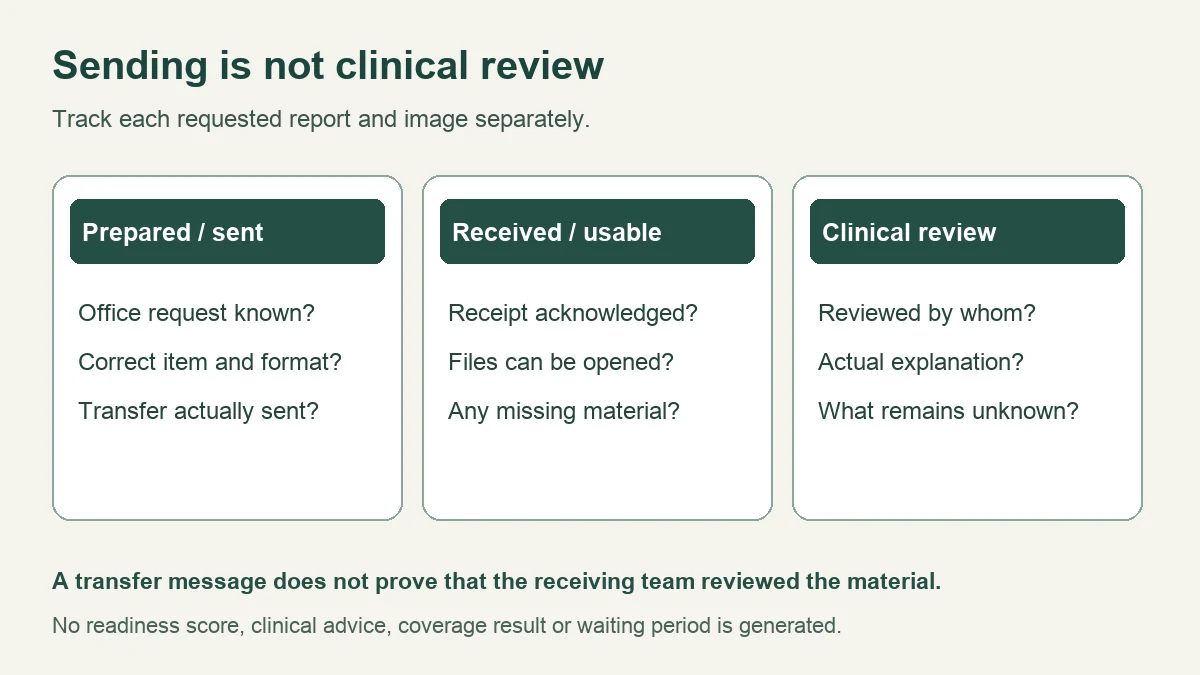
Prepared, sent, received and reviewed are different states
| Item | Preparation / office request | Actual status to retain | Unanswered question |
|---|---|---|---|
| Prior imaging and report | Relevant examination, source and format requested. | Report and images tracked separately: held, sent, received, readable and clinically reviewed. | Can the receiving team use the requested material, and what is the actual plan if it is missing? |
| Medication information | Existing written instructions and actual use kept distinct; known reactions described. | List prepared, discrepancy raised, actual clarification supplied, corrected list received. | What difference remains, and which clinical team member can clarify it? |
| Referral or office paperwork | What this office and plan actually require. | Requested, sent and received; any decision or missing information as actually communicated. | Does an administrative issue remain? Who is addressing it? |
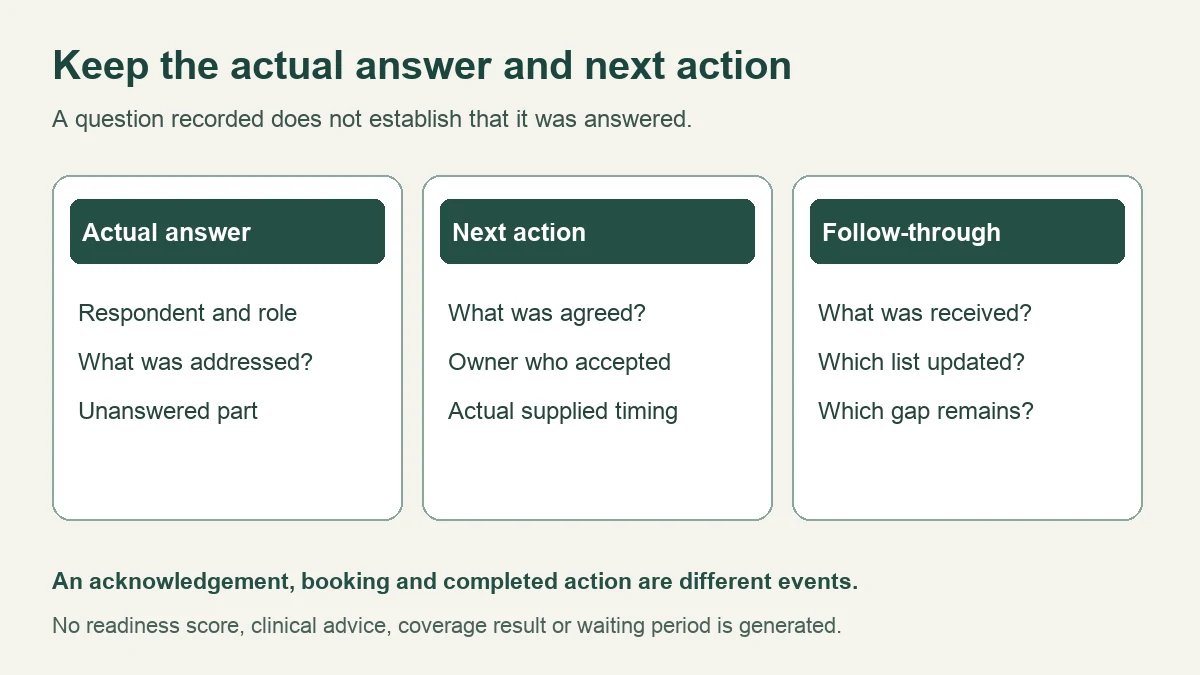
| Questions and instructions | The person’s concerns and questions. | Asked, partly answered or unanswered; actual advice and its source. | What needs clarification, and what next action was agreed? |
| Practical or communication support | Support requested, permitted and accepted. | What was actually available during the visit, not merely requested. | Which unmet need affected the conversation or next step? |
An upload confirmation does not prove that the file is readable or that a clinician reviewed it. A receptionist acknowledging a referral does not supply a clinical assessment or guarantee coverage. If a status is unknown, write “unconfirmed.” Ask the relevant team how to handle the gap; this page does not tell you to cancel, postpone, pay privately or repeat imaging.
Seven essential checks for your orthopedic visit
Keep your own agenda
Write the concern you want addressed. Pain, sleep, sensation, daily activity, emotional concerns and treatment problems can all matter; none must be replaced by a more persuasive function story. A short note is optional help, not proof that you deserve assessment.
Use existing information without a home test
Describe a change you already noticed. Approximate timing is acceptable if that is all you know. There is no required two-week record, three-row treatment history, timed task or painful demonstration. A clinician-requested diary has its own purpose and instructions.
Confirm the office’s actual request
Ask what relevant records, forms or imaging format are needed and the designated delivery channel. Follow actual office timing if supplied; this checklist creates no universal two-business-day rule. Record a missing answer rather than treating a generic checklist as the office policy.
Keep medication use and discrepancies visible
Retain what the instructions say alongside what is actually used. Describe known reactions without deciding for yourself whether they are an allergy. Ask the clinical team to clarify discrepancies. A list in a portal is not automatically current, and this tool cannot select a correct dose or change treatment.
Arrange the support you choose
Ask about language, hearing, communication, mobility or other access needs. If you want a companion, agree on permission and a specific role such as note-taking. They should not replace your concerns with their interpretation; request suitable professional support when needed.
Record actual answers and their limits
Ask which concern was addressed, what remains uncertain and what the next plan means. Keep an administrative reply separate from clinical advice. You may ask for an explanation in different words; a planned test, leaflet or acknowledgement does not answer every question.
Carry the next action through
Record the action actually agreed, the owner who accepted it and any timing or contact route actually supplied. Afterward, note what was received or updated and which gap remains. Requested, booked and completed are different events; do not invent a routine waiting interval if the plan is unclear.
Describe pain and treatment history without proving a case
IASP’s pain definition and notes emphasize personal experience and respect for the person’s report. A task completed does not establish mild pain; difficulty communicating does not mean pain is absent. Keep the person’s description with relevant context instead of replacing it with a helper’s score or a performance target.
An existing history can include what was recommended, what was actually tried, benefit, adverse effects, uncertainty and barriers such as access or missing help. “Not attempted,” “stopped” and “not sure” can be accurate entries. Do not call every incomplete or unhelpful treatment a failure, assume the cause of a change, or hide a concern because the story is not neatly organized.
The NIA Pain and Older Adults booklet, archived by GovInfo discusses describing pain and related experiences to a clinician. It does not validate this custom appointment checklist or prescribe a preparation period. You do not need a particular vocabulary, pain number or measurable task limit to ask for help.
Questions, actual answers and the next plan
- What have you explained about my concern, and what is still uncertain?
- What options are relevant, including their purpose, limits and what matters to me?
- If a test, treatment or follow-up is proposed, what question will it address and who arranges it?
- Which instructions apply now, and what should I do if the plan is unclear or my condition changes?
- Which list or record was updated, and how will I receive the information I need?
Use the questions that matter to you; there is no required number. Ask the clinician to clarify any clinical plan and the office or plan contact to clarify its actual administrative requirements. An estimate, referral acknowledgement or appointment booking is not a guarantee of payment, clinical suitability or completion.
Two fictional appointment checklist writing examples
These are invented examples of recording information, not real patient stories, medical advice or promised outcomes. The example buttons replace current tool entries and label the output fictional. Neither example invents a diagnosis, medication dose, repeat test or waiting instruction.
Example A: the report arrived, but image status is unknown
| Record | Fictional entry |
|---|---|
| Office request | Prior knee images and report in the format the office specified. |
| Known status | The report is acknowledged as received. Image transfer was initiated. |
| Missing confirmation | Image receipt, readability and clinical review are unconfirmed. |
| Actual answer | Administrative reply confirms report receipt only; no clinical advice supplied. |
| Next question | Can you confirm the requested image status and explain the actual plan for any missing material? |
A short note could read: “The report is received, but the image status is not confirmed. I need to know whether the requested images are usable and how the team will handle the remaining gap.” This does not imply that the visit should be delayed or that another scan is necessary.
Example B: the visit list differs from actual medication use
| Record | Fictional entry |
|---|---|
| Concern | The existing visit list and actual use differ; both versions are kept separately. |
| Question | Which information needs reconciliation, and what instructions actually apply? |
| Actual clinical reply | The clinical team asked for clarification of actual use; no final medication instruction is supplied in this example. |
| Action recorded | The discrepancy and clarification request were written down. |
| Still unconfirmed | Corrected list, actual instructions and follow-through. No dose or prescription change is invented. |
A discrepancy shown to the team is not a resolved discrepancy. This appointment checklist keeps that unfinished work visible without deciding which instruction is correct. Retain the actual clinical answer when supplied and clarify conflicting instructions with the relevant professional; do not use the worksheet to choose between them.
Free appointment checklist and actual-answer record tool
This tool follows the visit information rather than scoring preparation. Record your concern, information already available, the office’s actual request, delivery status, actual replies and next actions. Blank fields create optional questions; filled fields verify nothing. You can use only one field, use paper or contact the team without completing the checklist.
Use fictional examples on this page. Download the offline HTML tool before entering actual health details. The live page may contain ads and analytics. The offline copy has no ads, analytics, external assets, automatic network requests or browser storage. It does not save automatically; keep exports private and omit identifiers, private contact information and full reports.
Appointment checklist: information, actual answers and follow-through
Start with one question or missing item. Blank fields become optional questions, not a readiness score.
Download the offline tool before entering actual health or care details. Use fictional entries here; surrounding ads and analytics may be present.
Offline copy. No ads, analytics, external assets or automatic network requests.
The tool makes no network requests, uses no browser storage and does not save automatically. Refreshing may lose entries. Omit names, identifiers, private contacts and full reports. Needed care comes first.
Start with the fictional example or download a blank offline copy.
Paper alternative: concern; medication information; office request; record status; practical arrangements; communication support; discrepancy; question; actual answer; next owner; action completed and remaining gap.
My appointment checklist, actual answers and next actions
Unverified personal record for discussion. Entries verify no diagnosis, advice, completed change or treatment outcome.
Guide: living.kioptrix.com/orthopedic-appointment-checklist/
Build the record, copy it, download text or print/save PDF. Editing a field hides the previous output until rebuilt. The offline download includes current entries. No message is sent and no recipient, clinical advice or completed action is independently verified. A paper alternative is to copy the table headings above.
Common appointment checklist questions
Must I finish a diary before the visit?
No observation period is required by this page. Bring information already available and disclose uncertainty. Needed care should not wait for a complete form.
Does sending imaging mean it was reviewed?
No. Sending, receipt, readability and clinical review are separate statuses. Ask the receiving office about its actual process.
Can a companion answer for me?
Agree on the role and what may be shared. The person’s own concerns and choices remain central; ask about appropriate communication support.
Does an appointment checklist replace instructions?
No. It records actual instructions and questions. It does not change medicines, clear activity, determine coverage or set a safe waiting period.
Sources, corrections and review limits
Editorial revision and source check: October 31, 2026. Original URL and publication date retained. Removed mandatory-looking diary periods, entry counts and advance-call deadlines, function-first rhetoric, unrelated specialty sorting and repeated action timers. Corrected the tool link, empty question section and duplicate imagery. No independent clinical review or reader usability study is claimed.
- AAOS: Getting the Most Out of Your Visit With an Orthopaedic Surgeon — preparation, records, questions and follow-up; not validation of the custom tracking states.
- IASP: Terminology, pain definition and notes — personal report and communication principles.
- NIA: Pain and Older Adults, GovInfo archive — pain discussion; not current prescribing instructions or a diary requirement.
- NHS: Sciatica, stroke symptoms and shortness of breath — the corresponding warning contexts only; no U.S. insurance rules.
The representative image is AI-generated and depicts a fictional preparation discussion. The diagrams explain editorial information states, not a clinical protocol or guaranteed office workflow. Qualified independent review and reader testing would strengthen this guide. Author background and editorial standards.