

If your brace supplier is out of network, the brace may cost substantially more, receive reduced insurance coverage, or be denied under the supplier rules of your plan. But “out of network” does not mean exactly the same thing under commercial insurance, Medicare Advantage, and Original Medicare.
The safest move is to identify the company that will actually bill for the brace before you accept it. A brace handed to you inside an in-network orthopedic clinic can still be billed by a separate orthotics or medical-equipment supplier that is outside your plan’s network.
If you have not received the brace yet, ask for the supplier’s legal name, location, billing identifier, expected HCPCS code, network status, and estimated patient cost. If you already received it, do not assume that either the supplier’s invoice or an initial insurance denial is necessarily the end of the story. Start with the claim and the reason it was processed out of network.
Table of Contents
First, Identify Which Insurance Rules Apply
The phrase “out of network” sounds universal, but the consequences depend heavily on the type of coverage you have.
| Coverage type | What an out-of-network brace supplier may mean | What to verify |
|---|---|---|
| Commercial HMO or similar network plan | The claim may receive little or no coverage unless an exception applies | Network rules, authorization, exception process |
| Commercial PPO | Out-of-network coverage may exist, usually with higher patient cost | Out-of-network deductible, coinsurance, allowed amount, balance billing |
| Medicare Advantage HMO | You generally need to use the plan’s network for non-emergency covered care, subject to plan rules and exceptions | Supplier network, authorization, approved exceptions |
| Medicare Advantage PPO | Covered out-of-network services are generally possible, but you usually pay more | Supplier eligibility, plan coverage, out-of-network cost sharing |
| Original Medicare | There usually is not a Medicare Advantage-style provider network | Medicare enrollment, assignment, medical necessity, ordering and billing requirements |
This distinction matters enough to check before discussing price. Someone with a PPO may be deciding whether higher out-of-network cost sharing is tolerable. Someone with an HMO may be dealing with a noncovered supplier unless the plan approves an exception. Someone with Original Medicare should instead focus on Medicare enrollment, assignment, and Medicare’s applicable orthotics requirements.
For a broader pre-purchase review, see this site’s guide to checking orthopedic brace insurance coverage before buying.
What Can Actually Happen to the Bill?
An out-of-network supplier can affect more than the percentage printed beside “coinsurance” on your benefits summary. Several parts of the bill can change at once.
Your insurer may pay less
Plans that provide out-of-network benefits often require the member to pay a larger share. HealthCare.gov defines out-of-network coinsurance as the percentage of the allowed amount paid for covered services from providers that do not contract with the plan, and notes that it usually costs more than in-network coinsurance.
The claim may be denied under network rules
If the plan does not provide ordinary out-of-network benefits for the item, the insurer may deny payment even when a brace of that type could have been covered through an eligible in-network supplier.
That is an important distinction: “the brace is a covered benefit” and “this supplier is eligible to provide it under my plan” are two different questions.
You may face balance billing
Depending on the plan, state law, supplier, and circumstances, an out-of-network supplier may seek payment above the insurer’s allowed amount. This is often called balance billing. Do not calculate your cost simply by multiplying the supplier’s sticker price by your coinsurance rate.
Some out-of-network spending may not protect you from future costs
Cost accumulation rules also matter. For example, HealthCare.gov explains that the federal annual out-of-pocket limit for Marketplace plans does not include out-of-network care or amounts charged above a plan’s allowed amount. Employer and other private plans can have their own benefit structures, so check your specific plan document rather than assuming every dollar you pay will count toward an in-network maximum.

The Supplier May Not Be the Clinic That Handed You the Brace
This is one of the easiest details to miss.
You visit an in-network orthopedic office. A clinician recommends a knee brace. Someone measures your leg, adjusts a hinge, and gives you the brace before you leave. Everything happened inside the clinic, so it is natural to assume the clinic will bill your insurance.
Not necessarily.
A separate orthotics or equipment company may own the inventory and submit the claim. That company can have a different legal name, tax identity, billing address, National Provider Identifier, and network contract.
The site’s guide to orthopedic bills involving multiple providers explains why braces, boots, slings, equipment, facilities, and professional services can create separate billing trails even when they feel like one episode of care.
Before accepting a non-emergency brace, ask one magnificently boring question:
“What is the exact legal name of the company that will bill my insurance for this brace?”
That question can be worth considerably more than its glamour level suggests.
Check These Eight Things Before Accepting the Brace
- Supplier legal name: Get the billing entity, not merely the clinic’s public-facing name.
- Exact location: Network participation can sometimes depend on the location or billing entity.
- HCPCS code: Ask which code or codes the supplier expects to bill.
- Network status: Verify it directly with your insurer using the supplier’s identifying information.
- Benefit category: Ask whether the brace is processed under orthotics, DMEPOS, postoperative equipment, or another benefit category.
- Prior authorization: Determine whether approval must be obtained before fitting or delivery.
- Estimated allowed amount: Ask what amount the plan expects to recognize, not just what the supplier charges.
- Alternative supplier: If the supplier is out of network, ask for an eligible in-network option before accepting the item.
Prior authorization deserves its own line on the checklist. An approved treatment does not necessarily mean every associated brace, supplier, location, or billing code has been approved. The site’s orthopedic prior authorization checklist can help you track those moving pieces separately.
A Simple Cost Example Shows Why Network Status Matters
Consider a hypothetical brace. These numbers are illustrative only and are not estimates of any particular insurer’s reimbursement.
| In network | Out of network | |
|---|---|---|
| Supplier charge | $700 | $900 |
| Plan allowed amount | $500 | $400 |
| Coinsurance after applicable deductible | 20% | 40% |
| Coinsurance example | $100 | $160 |
| Potential amount above allowed amount | Normally limited by network contract | May become an additional issue where balance billing is permitted |
The important number is not merely 20% versus 40%. The out-of-network supplier may have a different allowed amount, a separate deductible may apply, and an amount above the insurer’s allowance may become the patient’s responsibility where applicable law and plan terms allow it.
That is why “insurance covers 60%” is not enough information to estimate the final bill.
Original Medicare Works Differently
If you have Original Medicare, do not automatically apply the network rules of a private HMO or PPO.
Medicare’s current brace coverage guidance states that Part B covers medically necessary arm, leg, back, and neck braces when ordered by a doctor or other eligible health care provider. After the Part B deductible, the beneficiary generally pays 20% of the Medicare-approved amount, subject to the circumstances of the claim and other coverage.
With Original Medicare, two supplier questions become especially important:
- Is the supplier properly enrolled in Medicare for the applicable item?
- Does the supplier accept Medicare assignment for the claim?
Assignment generally means the supplier agrees to accept the Medicare-approved amount as payment in full for the covered item, apart from the beneficiary’s applicable deductible and coinsurance. A supplier that does not accept assignment can create different financial consequences, so “we take Medicare” is not precise enough. Ask exactly how the claim will be handled.
A 2026 warning about old brace competitive-bidding advice
Older Medicare articles may say that beneficiaries in certain areas must obtain off-the-shelf knee or back braces from a competitive-bidding contract supplier. That advice requires a date check.
CMS currently states that the Round 2021 competitive-bidding contracts for off-the-shelf back and knee braces expired on December 31, 2023, and that a temporary DMEPOS Competitive Bidding Program gap has been in effect since January 1, 2024 while the next round is prepared for 2028.
That does not erase Medicare enrollment, medical-necessity, ordering, coding, documentation, assignment, or applicable authorization requirements. It simply means you should not rely on an outdated contract-supplier rule without checking the current CMS guidance.
Medicare Advantage HMO and PPO Rules Are Not the Same
Medicare Advantage returns the network question to center stage.
Under Medicare’s HMO guidance, members generally must obtain covered non-emergency care from providers in the plan’s network, with specified exceptions. Some HMO point-of-service plans permit certain out-of-network services at a higher cost.
By contrast, Medicare Advantage PPO guidance explains that members can generally receive covered services from out-of-network providers, although they usually pay more. Before using an out-of-network supplier, Medicare advises contacting the PPO to confirm that the service is medically necessary and covered by the plan.
If you are coordinating a brace alongside imaging, injections, therapy, surgery, or other orthopedic treatment, the site’s Medicare Advantage orthopedic care guide explains how network and authorization checks can multiply across one treatment episode.
What if No In-Network Supplier Can Provide the Brace?
Do not immediately assume you must either abandon the prescribed brace or pay the entire out-of-network bill yourself.
Call the plan and explain exactly why the available network options do not meet the prescribed need. Depending on the plan and circumstances, ask whether there is a network-gap exception, authorization for an out-of-network supplier, a single-case arrangement, or another process for obtaining the covered item.
Useful information can include:
- The prescribed HCPCS code and brace description
- The clinical reason for the brace
- Why available in-network suppliers cannot provide the required item, fitting, or service
- Names of network suppliers you contacted and what each told you
- The requested out-of-network supplier
- The date the brace is medically needed
Ask for any exception decision in writing. An informal phone statement is useful for navigation, but written authorization is much easier to match against a later claim.
What if You Already Received the Out-of-Network Brace?
Start with documents rather than panic. A supplier invoice, an Explanation of Benefits, and a formal denial are not the same thing.
- Read the EOB or denial notice. Identify whether the issue is network status, authorization, medical necessity, coding, missing documentation, or another reason.
- Confirm the supplier identity. Make sure the insurer processed the correct billing entity and location.
- Ask whether the claim can be corrected. A wrong identifier, code, modifier, or authorization reference may require supplier action rather than a full appeal.
- Ask the insurer about exceptions. Explain if the brace was supplied through an in-network clinic, if no suitable network supplier was available, or if the plan itself directed the care.
- Request an itemized bill. Match the billed item and code to what you actually received.
- Preserve every deadline. If the plan has issued a formal adverse decision, note the appeal deadline before continuing negotiations.
If the network issue has already produced a denial, use the site’s brace insurance denial and appeal guide to organize the denial reason, medical records, supplier information, authorization history, and supporting documents.
For Medicare Advantage specifically, Medicare explains that members can request a coverage decision, called an organization determination, and can appeal an unfavorable decision. Medicare also notes that certain plan-directed out-of-network care can receive special cost-sharing treatment. Review the plan’s notice and Medicare Advantage appeal guidance rather than assuming an initial claim result is automatically final.
Could the No Surprises Act Help?
Possibly, but only in specific circumstances.
The federal No Surprises Act protects many people with employer-sponsored and individual private insurance from certain out-of-network bills involving emergency care and certain non-emergency items or services connected to visits at eligible in-network facilities.
CMS explains that the protections can apply to certain non-emergency services from out-of-network providers at in-network hospitals, hospital outpatient departments, critical access hospitals, and ambulatory surgical centers. Federal guidance also recognizes that equipment and devices can be among the items or services associated with a qualifying facility visit.
However, this is not a universal rule making every out-of-network brace an in-network charge. Routine non-emergency care in settings such as an ordinary doctor’s office may fall outside the federal surprise-billing provisions, and state laws can add different protections. Medicare and Medicaid also operate under separate billing protections rather than the federal No Surprises Act framework used for private insurance.
If an unexpected out-of-network brace bill followed care at an in-network facility, review the CMS explanation of federal surprise-billing protections before assuming the balance is valid.
The Five-Minute Out-of-Network Brace Check
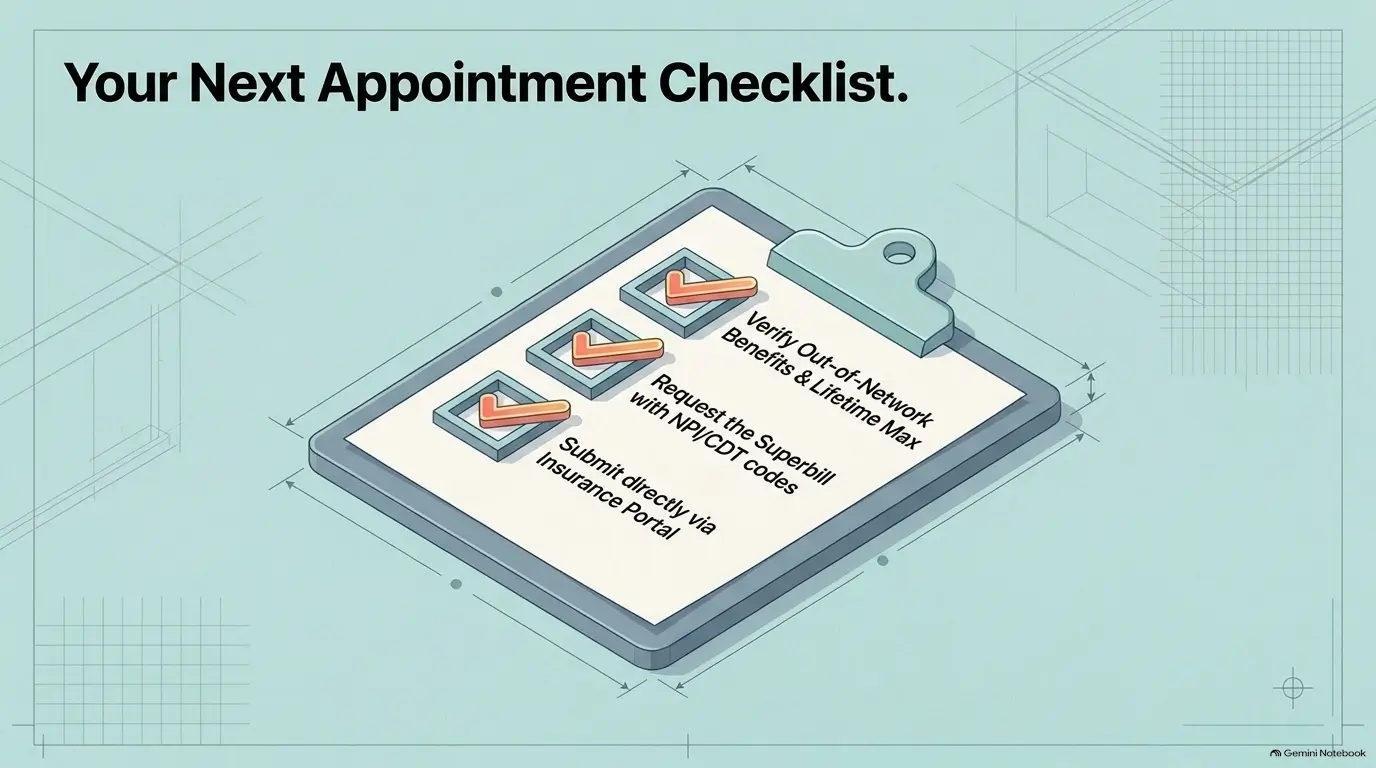
If the brace has not yet been delivered, you can reduce much of the uncertainty with one focused phone call.
“I have been prescribed HCPCS code [CODE] by [PRESCRIBER]. The supplier that plans to provide it is [LEGAL SUPPLIER NAME] at [LOCATION]. Is this supplier in network for this brace benefit? Does the item require prior authorization? What is my estimated responsibility if I use this supplier? If the supplier is out of network, which in-network suppliers can provide the same prescribed item, and is there an exception process if none can?”
Write down the representative’s name, date, call-reference number, and answer. If the financial exposure is significant, request confirmation through the member portal or another written channel.
The Bottom Line
An out-of-network brace supplier does not produce one universal result. With some private and Medicare Advantage plans, it may mean higher coinsurance. With others, the supplier may not be covered without an exception. Balance billing may become relevant in some private-insurance situations, while federal or state protections can restrict it in others.
Original Medicare requires a different vocabulary: focus on Medicare coverage requirements, supplier enrollment, assignment, and the Medicare-approved amount rather than assuming Medicare Advantage-style network rules.
The most useful checkpoint happens before the brace leaves the shelf: identify the billing supplier, verify the exact code and network status with the insurer, check authorization, and ask what you are expected to pay. A two-minute supplier check can separate a medically appropriate brace from an unnecessarily complicated bill.
This article provides general educational information for U.S. readers and is not medical, legal, or individualized insurance advice. Coverage and patient responsibility depend on the specific plan, item, supplier, diagnosis, documentation, applicable law, and date of service. For medical decisions, consult the treating clinician; for coverage decisions, confirm current terms with the insurer or Medicare.