

Before you accept a brace or other orthosis that someone says Medicare will cover, confirm seven things: why you need it, exactly what is being supplied, who ordered it, who will bill Medicare, whether special approval is required, what you will owe, and whether the offer is legitimate.
That small pause matters. Medicare Part B can cover medically necessary arm, leg, back, and neck braces when they are ordered by a doctor or other qualified health care provider. But “Medicare covers braces” does not mean every brace, every supplier, every replacement, or every sales offer is automatically covered. The exact orthosis, documentation, supplier status, billing code, and applicable Medicare rules can all affect the claim.
Medicare itself describes covered braces as rigid or semi-rigid devices used to support weak or deformed body parts or restrict movement of an injured body part. Its current coverage guidance for arm, leg, back, and neck braces says Part B coverage depends on medical necessity and an order from a health care provider.
This guide is primarily for people using Original Medicare. If you have Medicare Advantage, the plan must cover Medicare-covered services, but its network, authorization, supplier, and cost-sharing rules can differ. Before accepting equipment under a Medicare Advantage plan, review this site’s Medicare Advantage orthopedic care guide and confirm the rules directly with your plan.
Table of Contents
1. Did My Own Clinician Decide That I Need This Orthosis?
The first question is clinical rather than financial: Why am I getting this brace?
A legitimate Medicare orthosis should begin with an identifiable medical need, not with a marketer discovering that you have a Medicare number. The clinician’s record should make sense alongside the device being ordered. A knee orthosis for instability, for example, should have a clinical story that explains why knee support or motion control is appropriate. A back brace should not simply appear because someone learned that you have back pain.
Ask the ordering clinician what problem the orthosis is intended to address, what function it is expected to improve or protect, how long you should use it, and whether a simpler device or no brace at all would be reasonable. If you are still preparing for the appointment, the site’s orthopedic visit checklist can help you organize symptoms, functional limitations, medications, and questions before the order is written.
A prescription is important, but it does not by itself prove that Medicare will pay every related claim. Coverage can depend on whether the medical record supports the particular device and whether additional ordering, encounter, authorization, or supplier requirements apply.
2. What Exact Orthosis Am I Accepting?
“A knee brace” is not a sufficiently precise description when money and Medicare billing are involved.
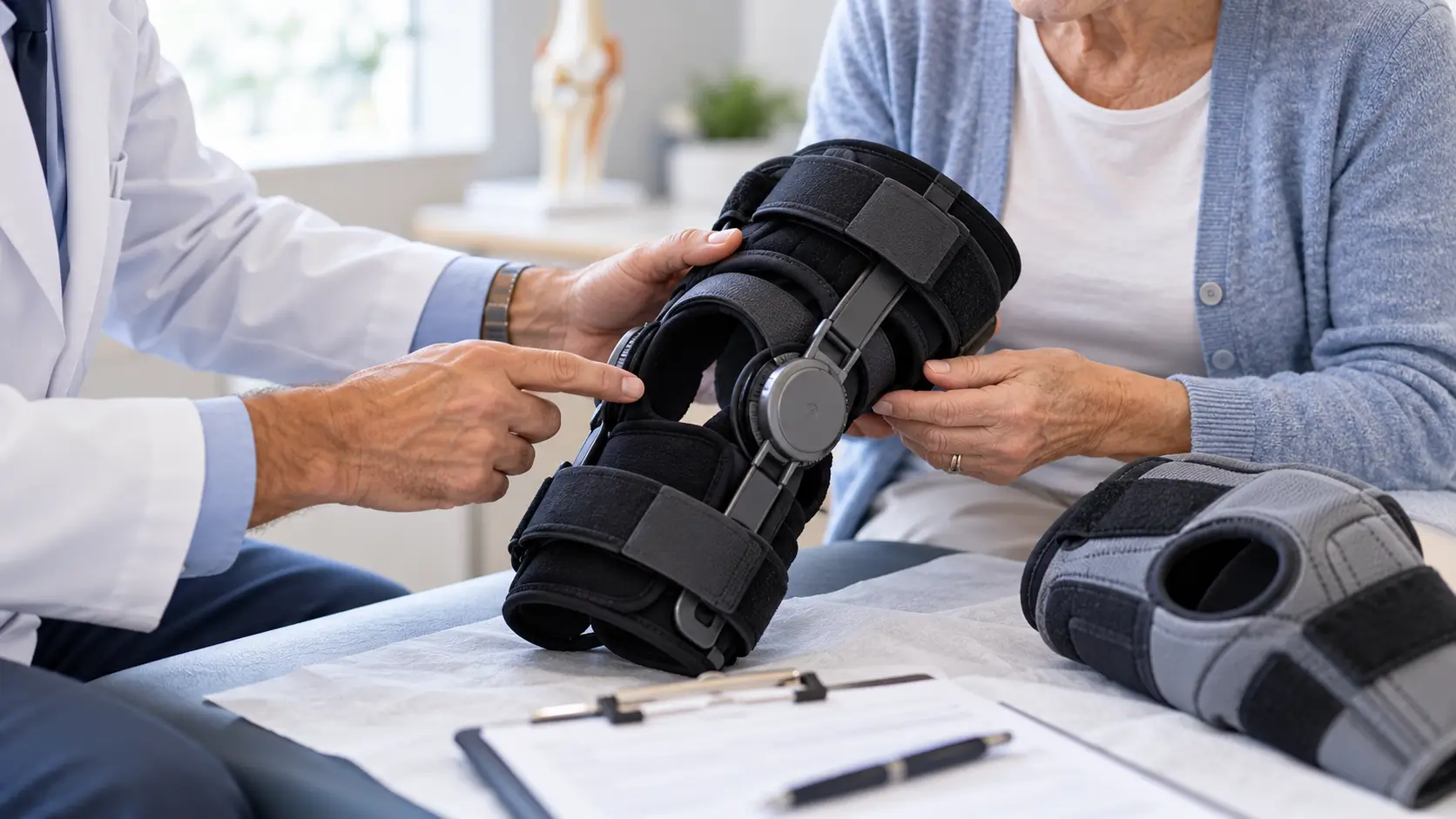
Before delivery, ask the supplier to identify the exact item it intends to provide and, when available, the HCPCS billing code or codes it expects to submit. Also confirm whether the device is being treated as off-the-shelf, fitted, customized, or custom fabricated. Those distinctions can affect documentation, fitting, coding, and payment rules.
This is especially useful when a supplier presents an upgraded-looking device with hinges, additional components, or multiple braces for different body parts. The question is not whether the equipment looks sophisticated. The question is whether the item being billed matches the item your clinician intended and the medical need documented in your record.
If you want a broader pre-purchase coverage workflow, see how to check whether a brace is covered before buying it. Matching the clinician’s order, supplier’s product, and insurer’s coverage rules before delivery is much easier than untangling three different descriptions after a denial.
3. Is the Supplier Properly Enrolled in Medicare, and Does It Accept Assignment?
Do not treat “we work with Medicare” as a complete answer.
CMS requires suppliers that bill Medicare for DMEPOS, which includes durable medical equipment, prosthetics, orthotics, and supplies, to meet Medicare enrollment requirements. CMS also requires accreditation for many DMEPOS suppliers, subject to limited exceptions. You can use Medicare’s medical equipment and supplier search to check Medicare-enrolled suppliers.
Then ask a second, separate question: Will you accept Medicare assignment for this claim?
Assignment means the supplier agrees to accept the Medicare-approved amount as payment for a covered item, leaving you responsible for the applicable deductible and coinsurance rather than an unrestricted supplier charge. Medicare explains the distinction in its guidance on providers and suppliers that accept assignment.
Get the answer before accepting the orthosis. Also ask for the supplier’s legal business name, because the name on an advertisement, phone call, shipping label, clinic desk, or website may not be the same name that appears on a Medicare claim.
This matters when orthopedic care produces bills from several organizations. A brace handed to you during an office visit can still generate a separate equipment claim. The site’s guide to orthopedic bills from multiple providers explains why equipment, professional services, facilities, and other parts of treatment can follow different billing trails.
4. Does This Orthosis Require a Face-to-Face Encounter, Written Order Before Delivery, or Prior Authorization?
This is where Medicare orthosis coverage becomes code-specific.
CMS maintains special requirements for certain DMEPOS items. Depending on the exact HCPCS code, an item may require a qualifying face-to-face encounter, a written order before delivery, prior authorization, or a combination of requirements.
CMS’s current DMEPOS order and face-to-face encounter guidance explains that the standardized written order includes core information such as the beneficiary, item description, quantity when applicable, treating practitioner, order date, and practitioner signature. Certain orthoses are among the items subject to additional encounter and ordering requirements.
Prior authorization is a separate concept. It is not simply another name for a prescription. CMS maintains a Required Prior Authorization List for selected DMEPOS items, including certain orthoses.
As of September 28, 2026, some orthosis codes are already subject to Medicare prior-authorization requirements. CMS has also announced additional DMEPOS changes scheduled to take effect on October 28, 2026, including requirements affecting additional orthoses. That makes the exact code and date of service important. A statement such as “Medicare does not require prior authorization for braces” or “all braces need prior authorization” is too broad to rely on.
Ask the supplier whether the exact code requires prior authorization, a qualifying encounter, or a written order before delivery, and ask whether those requirements have actually been completed. “We’ll take care of it later” is not equivalent to confirmation.
5. What Will I Actually Have to Pay?
A Medicare-covered orthosis is not necessarily a free orthosis.
For covered arm, leg, back, and neck braces under Original Medicare Part B, Medicare states that after the Part B deductible is met, the beneficiary generally pays 20% of the Medicare-approved amount. Your actual responsibility can be affected by assignment, other insurance, Medigap coverage, the supplier, and the way the claim is processed.
Before accepting the device, ask the supplier for an estimate of your expected responsibility and ask whether the estimate assumes Medicare coverage and assignment. An estimate is not a guarantee of claim payment, but it forces an important distinction between the supplier’s retail price, Medicare’s approved amount, Medicare’s share, and your expected share.
If you have Medicare Advantage, do not automatically apply Original Medicare’s 20% figure. Medicare Advantage plans may use their own copayments or coinsurance and may require use of plan-network suppliers or prior authorization. Contact the plan using the number on your member card and ask about the exact orthosis and supplier.
If the supplier believes Medicare is unlikely to cover an item and asks you to accept financial responsibility, read any notice carefully before signing it. Do not treat a form as meaningless checkout paperwork simply because the device is already sitting on the counter.

6. Has Someone Explained the Fit, Use, Adjustment, and Follow-Up Plan?
Coverage is only half of the decision. The orthosis must also make clinical sense when it meets your body.
CMS DMEPOS quality standards distinguish among different types of orthotic products and include requirements relevant to assessment, appropriate device selection, safety, fitting, beneficiary instructions, and follow-up for applicable orthotic services. Not every off-the-shelf orthosis is governed by exactly the same fitting requirements as a custom device, which is another reason to know what category of orthosis you are receiving.
Ask how the brace should sit, how tightly it should be worn, how long you should wear it each day, whether it should be removed for sleep or skin checks, how it should be cleaned, what activities should be avoided, and who handles adjustments or defects.
Also ask what symptoms require prompt clinical advice and which require emergency care. New pressure marks, skin injury, increasing discomfort, or a shifting brace need timely assessment rather than tighter straps. A suddenly cold, pale, or blue limb, severe rapidly worsening pain, or new marked weakness or loss of sensation needs urgent emergency assessment; do not wait for a routine fitting appointment. Follow your clinician’s instructions on removing or loosening the brace, and do not change prescribed immobilization or weight-bearing restrictions on your own.
An orthosis should have a purpose, not merely a shipping label. If neither the supplier nor the clinician can explain what improvement or protection is expected, that uncertainty is worth resolving before the device becomes yours.
7. Did I Actually Ask for This Brace?
This may be the most important question in the article.
The HHS Office of Inspector General has repeatedly identified fraud, waste, and abuse involving orthotic braces. Its 2024 review of Medicare and off-the-shelf orthotic braces described concerns including orders involving beneficiaries without established treating relationships and prohibited supplier solicitation.
The warning remains relevant. Federal enforcement actions in 2026 have continued to involve schemes in which Medicare beneficiaries were targeted for orthotic braces they did not need or had not meaningfully requested.
Be particularly cautious when an unexpected caller tells you that you qualify for a “free” knee brace, back brace, ankle brace, or package of multiple supports and then asks you to confirm your Medicare number. Medicare’s own fraud guidance says to protect your Medicare number and personal information and notes that Medicare does not call beneficiaries to sell them products.
If an unwanted orthosis arrives, do not assume that keeping it costs nothing simply because you did not receive an invoice. Check your claims. Original Medicare beneficiaries can review the Medicare Summary Notice or their Medicare.gov account to see what suppliers billed. Medicare provides instructions for reporting suspected Medicare fraud and abuse, including calling 1-800-MEDICARE.
Do not send an unsolicited device to an address supplied by the same suspicious caller without first confirming the appropriate procedure with Medicare or the legitimate supplier. Keep the packaging, shipping information, paperwork, and notes from any calls until the issue is resolved.
What If You Already Accepted the Orthosis and Medicare Denied It?
A denial does not automatically mean the orthosis was medically inappropriate, and it does not automatically mean Medicare made an error. The problem could involve medical-necessity documentation, the order, the billed code, prior authorization, supplier eligibility, replacement rules, or another claim requirement.
Start with the actual denial reason rather than asking everyone involved a broad question such as “Why didn’t Medicare cover my brace?” Compare the denial with the clinician’s order, medical record, supplier paperwork, and Medicare Summary Notice. If information was submitted incorrectly or incompletely, the clinician or supplier may be able to correct the claim. If the coverage determination itself is disputed, formal appeal rights may apply.
The site’s guide to appealing a denied brace or orthopedic support explains how to turn the denial into a more specific question about the missing document, rule, code, or coverage criterion.
The Best Time to Ask These Questions Is Before Delivery
Once an orthosis has been fitted, opened, modified, shipped, or billed, the situation can become harder to unwind. Asking a few precise questions beforehand gives the clinician, supplier, Medicare, and patient a chance to catch different assumptions while they are still inexpensive to fix.
The central idea is simple: do not accept a Medicare orthosis merely because someone says you qualify for one. Confirm the medical purpose, exact device, ordering practitioner, supplier, coverage requirements, expected cost, fitting plan, and legitimacy of the offer.
A genuine brace should fit into a genuine care plan. When the medical story, paperwork, supplier, and billing story all describe the same device for the same reason, you are on much firmer ground.
This article provides general information about Medicare and orthotic equipment and is not individualized medical, legal, or insurance advice. Medicare coverage can depend on the specific device, HCPCS code, documentation, supplier, date of service, and whether you have Original Medicare or a Medicare Advantage plan.
Last updated: October 15, 2026