
Original Medicare and Medicare Advantage can both cover medically necessary orthopedic equipment, but they may get you to that coverage through very different doors. Original Medicare generally follows national Part B coverage rules and Medicare supplier requirements. Medicare Advantage must cover medically necessary services and supplies that Original Medicare covers, but a private plan may add network requirements, plan-specific cost sharing, and prior authorization.
The practical question is therefore not simply, “Which one covers braces or walkers?” Both may. The more useful questions are: Which supplier can I use, do I need approval first, how much will I owe, and what happens if coverage is denied?
There is one more wrinkle worth understanding before comparing them: “orthopedic equipment” is not a single Medicare benefit category. A walker may be durable medical equipment, while a knee or back brace may fall under Medicare’s orthotic benefit. Prosthetic limbs follow still another set of rules. That classification can affect documentation, supplier requirements, and payment.
Table of Contents
The Short Comparison
| Issue | Original Medicare | Medicare Advantage |
|---|---|---|
| Core Medicare-covered equipment | Covered under applicable Part B rules when Medicare requirements are met | Must cover medically necessary Part A and Part B benefits covered by Original Medicare |
| Supplier choice | Generally broader access to Medicare-enrolled suppliers; assignment matters for cost | Plan network and contracted supplier rules may apply |
| Prior authorization | Not required for most Medicare services, but certain DMEPOS items do require it | May be required for equipment or related services under plan rules |
| Patient cost | For many Part B items, generally 20% of the Medicare-approved amount after the Part B deductible, subject to the specific benefit and supplier rules | Plan-specific copays, coinsurance, deductibles, and network rules |
| Annual Part A/B out-of-pocket limit | No general annual limit under Original Medicare alone | Medicare Advantage plans have a yearly limit for covered Medicare services |
| Medigap | May be used with Original Medicare if eligible and enrolled | Cannot be used to pay Medicare Advantage cost sharing |
| Denial route | Original Medicare appeals process | Plan coverage decision and Medicare Advantage appeal process |
Medicare’s official Original Medicare versus Medicare Advantage comparison confirms the central distinction: Medicare Advantage plans must cover medically necessary services covered by Original Medicare, but they can use networks, different cost-sharing structures, and prior authorization requirements.
First, Identify What Kind of Orthopedic Equipment You Need
Medicare does not process every orthopedic item under the same benefit. That matters because two products sitting on the same shelf at an orthopedic clinic may have different coverage rules.
- Durable medical equipment: walkers, rollators, crutches, canes, wheelchairs, scooters, and certain other reusable equipment.
- Orthotics: medically necessary arm, leg, back, and neck braces.
- Prosthetics: artificial limbs and certain other devices that replace a body part or function.
- Related supplies or accessories: coverage depends on the equipment, benefit category, and applicable Medicare requirements.
For DME, Medicare defines covered equipment around characteristics such as durability, medical purpose, repeated use, suitability for use in the home, and an expected useful life of at least three years. The Medicare DME coverage guide lists examples including canes, crutches, walkers, wheelchairs, and scooters.
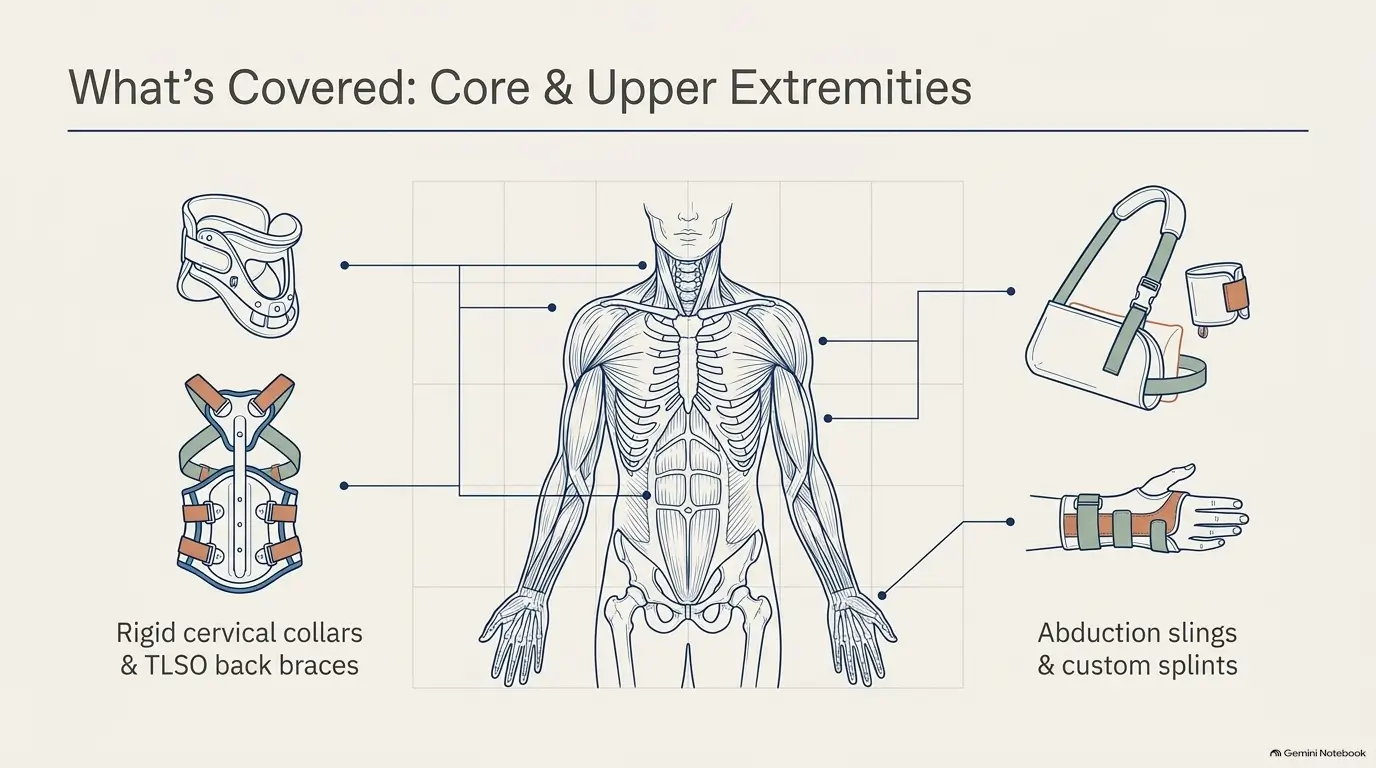
Braces sit slightly differently in the Medicare rulebook. Medicare Part B covers medically necessary arm, leg, back, and neck braces when ordered by a doctor or other qualified health care provider. Medicare’s official brace coverage page describes these as rigid or semi-rigid devices used to support a weak or deformed body part or restrict movement of an injured body part.
If a brace is being handed to you during an orthopedic appointment, do not assume the clinic itself is necessarily the billing supplier. The separate guide to orthopedic brace insurance coverage explains why the legal entity supplying and billing for the device can matter just as much as the clinician who prescribed it.
How Original Medicare Handles Orthopedic Equipment
With Original Medicare, Part B is the starting point for many medically necessary orthopedic devices. For DME, a doctor or other treating provider generally must order the equipment for use in the home, and Medicare supplier requirements must be satisfied.
For common equipment such as walkers, Medicare states that Part B covers medically necessary equipment prescribed for home use. Its walker coverage guidance also emphasizes that the doctor and supplier should be enrolled in Medicare.
The 2026 cost baseline
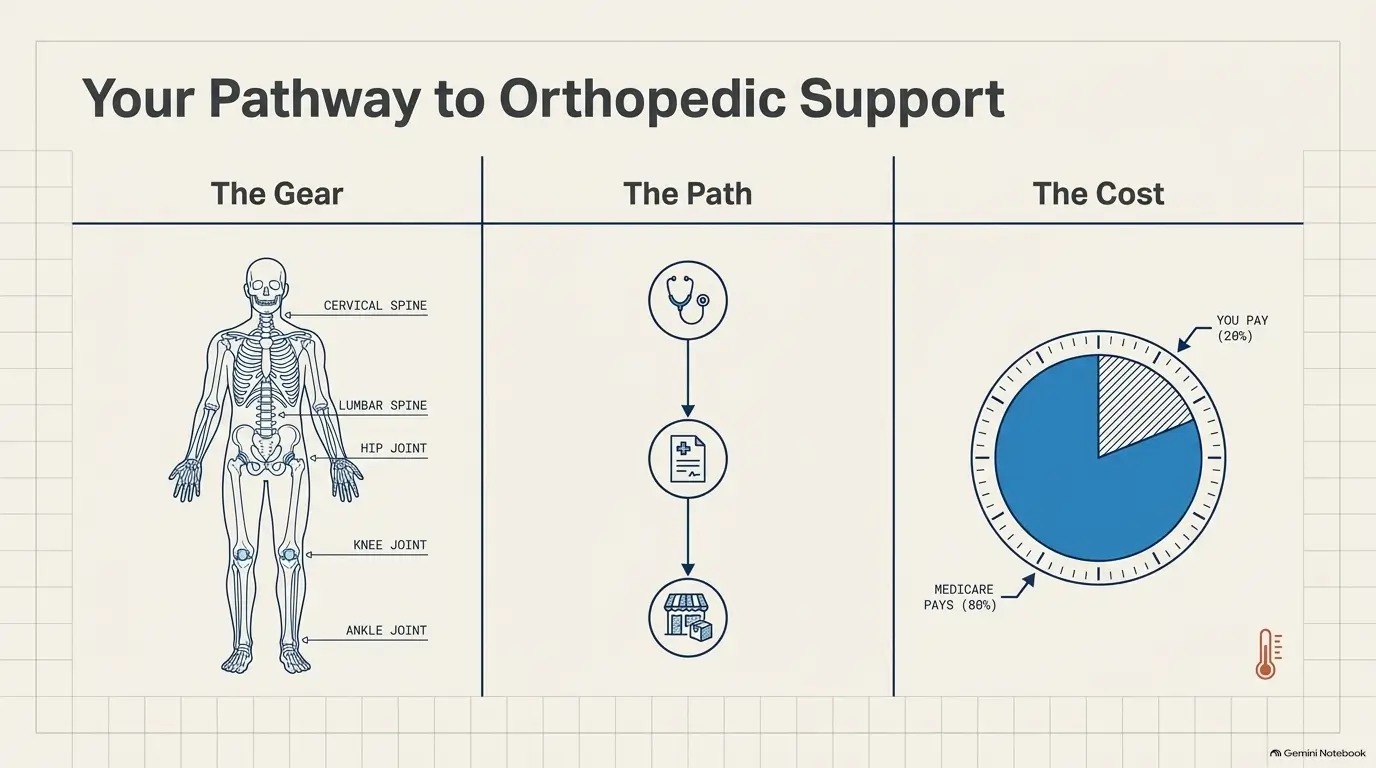
For 2026, the Medicare Part B annual deductible is $283. For many Part B-covered DME and orthotic items, the beneficiary generally pays 20% of the Medicare-approved amount after meeting the deductible when the applicable coverage conditions are satisfied. CMS published the 2026 deductible in its 2026 Medicare Part A and Part B premium and deductible update.
That 20% is a useful baseline, not a universal final bill. Other insurance, Medigap coverage, whether the supplier accepts assignment, and the exact benefit rules can change what you actually pay.
Assignment can matter almost as much as coverage
Under Original Medicare, do not stop at asking, “Do you take Medicare?” For DME, ask whether the supplier is enrolled in Medicare and whether it accepts assignment for the item.
When a participating supplier accepts assignment, it agrees to the Medicare-approved amount under the applicable rules. Medicare specifically advises beneficiaries to verify supplier enrollment and assignment before obtaining DME.
This becomes especially important when equipment is supplied through a clinic but billed by another company. The site’s guide to orthopedic bills involving multiple providers explains how braces, boots, slings, walkers, and other equipment can create a separate billing trail from the orthopedic visit itself.
How Medicare Advantage Changes the Equipment Path
A Medicare Advantage plan does not get to erase a medically necessary Medicare benefit simply because it is administered by a private insurer. Medicare states that Medicare Advantage plans must cover medically necessary services that Original Medicare covers.
But the administrative route may be different. Your plan may specify which DME or orthotics suppliers you should use, what cost sharing applies, whether out-of-network equipment is covered, and whether the item needs prior authorization.
This is why a beneficiary can hear two apparently contradictory statements: “Medicare covers walkers” and “your plan requires you to get the walker from another supplier.” Both can be true. The first describes the underlying Medicare benefit. The second describes how the Medicare Advantage plan administers that benefit.
If your orthopedic care involves more than equipment, the internal guide to Medicare Advantage orthopedic care walks through the wider chain of specialist networks, imaging, therapy, authorization, and other plan checkpoints.
Cost sharing is plan-specific
Do not automatically apply Original Medicare’s 20% Part B cost-sharing model to a Medicare Advantage equipment claim. A plan may use its own copay or coinsurance structure for covered benefits, subject to Medicare rules and the plan’s Evidence of Coverage.
One potentially important structural difference is that Medicare Advantage plans have a yearly limit on out-of-pocket spending for covered Medicare Part A and Part B services. Original Medicare by itself does not have the same general annual out-of-pocket ceiling, although a beneficiary may have Medigap, Medicaid, retiree coverage, or other supplemental protection.
Prior Authorization: Medicare Advantage Does Not Have a Monopoly on It
It is tempting to reduce the comparison to “Original Medicare has no prior authorization, Medicare Advantage does.” That is too simple.
Original Medicare generally uses less prior authorization than Medicare Advantage, but CMS has a required prior authorization program for selected Durable Medical Equipment, Prosthetics, Orthotics, and Supplies, commonly shortened to DMEPOS.
CMS maintains a DMEPOS prior authorization program covering selected items. As of September 2026, CMS has also announced additional orthoses and other DMEPOS codes that are scheduled to become subject to prior authorization beginning October 28, 2026, with some upper-limb orthosis requirements being phased in geographically.
Power mobility equipment is a familiar example. Medicare’s wheelchair and scooter coverage guidance states that power wheelchairs and scooters require a face-to-face examination and written prescription, and certain power wheelchairs require prior authorization.
Medicare Advantage plans may impose their own prior authorization procedures for covered equipment. Before accepting a device, ask whether authorization is required and whether it has actually been approved. “The doctor ordered it” and “the plan authorized it” are not interchangeable sentences.
If an orthopedic office says it is “working on authorization,” the orthopedic prior authorization checklist provides a practical way to track the request, documentation, supplier, status, and denial reason without relying on a vague verbal update.
The Supplier Question May Decide Whether the Process Is Smooth or Expensive
Consider a patient who receives a prescription for a knee brace after an orthopedic consultation.
- The orthopedic clinician decides the brace is medically appropriate.
- The clinic measures or fits the patient.
- A DME or orthotics company supplies the actual device.
- That company submits the claim.
Under Original Medicare, the important questions include whether the supplier meets Medicare requirements and how assignment applies. Under Medicare Advantage, the question may instead be whether that particular supplier is contracted with the beneficiary’s plan and whether authorization was obtained.
The physical brace has not changed. The billing pathway has.
Original Medicare May Offer More Supplier Flexibility, but Check the Details
Original Medicare generally gives beneficiaries broader access to providers and suppliers that participate in Medicare, rather than tying them to one Medicare Advantage network. That can matter when you travel, move, need a specialized orthotist, or have difficulty finding a local supplier that carries a particular device.
That flexibility does not mean every medical-equipment business will produce the same financial result. Medicare enrollment, participation, assignment, documentation, and item-specific rules still matter.
Medicare Advantage may offer a more structured supplier system. For some people, that network is straightforward. For others, it becomes inconvenient when the orthopedic practice prefers one supplier and the health plan requires another.
When Medicare Advantage May Produce a Different Out-of-Pocket Result
Suppose Original Medicare approves a covered walker at a Medicare-approved amount of $200. Ignoring the deductible for this simplified hypothetical example, 20% coinsurance would be $40.
A Medicare Advantage plan might instead use a fixed copay, a different percentage, or another plan-specific cost-sharing rule. It might also require an in-network supplier. The plan’s figure could be lower or higher than the simplified Original Medicare example.
This is why there is no honest nationwide answer that Medicare Advantage is always cheaper or always more expensive for orthopedic equipment. The relevant number is the cost-sharing rule in your specific Evidence of Coverage for the specific item and supplier.
What to Check Before Accepting a Brace, Walker, or Wheelchair
- What is the exact device? Ask for its description and, when available, the HCPCS billing code.
- Who is prescribing it? Confirm that the required medical documentation and order are complete.
- Who will bill for it? The clinic that fits it may not be the supplier appearing on the claim.
- Original Medicare? Verify Medicare enrollment and ask about assignment.
- Medicare Advantage? Verify the supplier with the plan, not just the clinic.
- Is prior authorization required? Ask for the authorization status rather than assuming the prescription is enough.
- Is it rented or purchased? Medicare treats different DME items differently, and some items are rented before ownership transfers.
- What is your estimated patient responsibility? Ask whether the estimate includes the deductible, copay or coinsurance, fitting, accessories, and recurring rental charges when applicable.
What If the Equipment Is Denied?
A denial does not automatically establish that the equipment can never be covered. Start by identifying the actual reason: medical-necessity criteria, missing clinical notes, an incomplete order, supplier eligibility, network status, prior authorization, coding, or another requirement.
Original Medicare and Medicare Advantage then take different administrative paths. Medicare explains that beneficiaries can appeal refusals to cover or pay for a service, supply, or item. For Medicare Advantage, the initial plan coverage decision is an organization determination, followed by reconsideration and additional appeal levels when applicable. Medicare’s Medicare Advantage appeals guidance explains the formal process and deadlines.
If the denied item is a brace, the internal denied brace insurance appeal guide explains how to separate an actual coverage dispute from a supplier, documentation, coding, or authorization problem before preparing the appeal.
A Better Way to Compare Original Medicare and Medicare Advantage for Equipment
If orthopedic equipment is important to you, comparing only monthly premiums misses much of the story. Instead, compare the pathway you would actually use.
- List your likely equipment needs. For example: knee brace, walker, rollator, wheelchair, prosthesis, or post-operative mobility equipment.
- Identify preferred suppliers. This is especially important if you already work with an orthotist, prosthetist, rehabilitation provider, or mobility-equipment company.
- Check Original Medicare supplier participation and assignment.
- For each Medicare Advantage plan, check its supplier network.
- Read the Evidence of Coverage. Look for DME, prosthetics, orthotics, prior authorization, rental, and cost-sharing provisions.
- Check the plan’s annual Part A/B out-of-pocket limit.
- Consider the rest of your orthopedic care. Equipment may be only one step alongside specialists, imaging, injections, therapy, surgery, and rehabilitation.
That final point matters. Saving money on a walker is useful, but a Medicare choice affects a much larger medical ecosystem. An orthopedic patient who expects repeated specialist visits, physical therapy, imaging, injections, or joint surgery should compare those services along with equipment rather than allowing one brace copay to wag the entire insurance dog.
Bottom Line
Medicare Advantage and Original Medicare can both cover medically necessary orthopedic equipment, but the coverage pathway is not identical.
Original Medicare usually offers a more standardized national Part B framework and broader supplier choice, while Medicare Advantage may use plan networks, authorization requirements, and plan-specific cost sharing. Original Medicare itself can still require prior authorization for selected DMEPOS items, so neither system should be reduced to a one-line rule.
Before taking home a brace, walker, wheelchair, or similar device, identify the exact item, the company that will bill for it, and the coverage rules that apply to your Medicare arrangement. A five-minute verification before delivery is often much easier than untangling the claim after the equipment is already in your hallway.
This article provides general Medicare coverage information and is not a personal coverage determination or medical recommendation. Equipment eligibility depends on medical necessity, documentation, the particular item, supplier requirements, and, for Medicare Advantage members, the terms of the individual plan.