
This site is written from a family-caregiver perspective. The operator is not a medical professional or an insurance, legal or financial adviser. Use this guide to organize questions for the relevant service.
Track the request through delivery
Use this follow-up record alongside the guide below. It does not determine medical suitability, insurance eligibility or legal rights, and it does not guarantee a price.
- Keep together
- Submission reference, outstanding records, decision document, scope and delivery arrangement.
- Unanswered question
- What is still missing, who must provide it and does the decision match the planned item and date?
- Next contact and owner
- Name the supplier contact who will obtain the missing information and confirm the next update.
- Recheck when
- Delivery, order, supplier or decision scope changes.
For each response, record its date, source, reference number and what remains uncertain. Agree the next follow-up date instead of treating silence as confirmation. Use official contact channels and keep identifying health, account and policy information out of public comments.
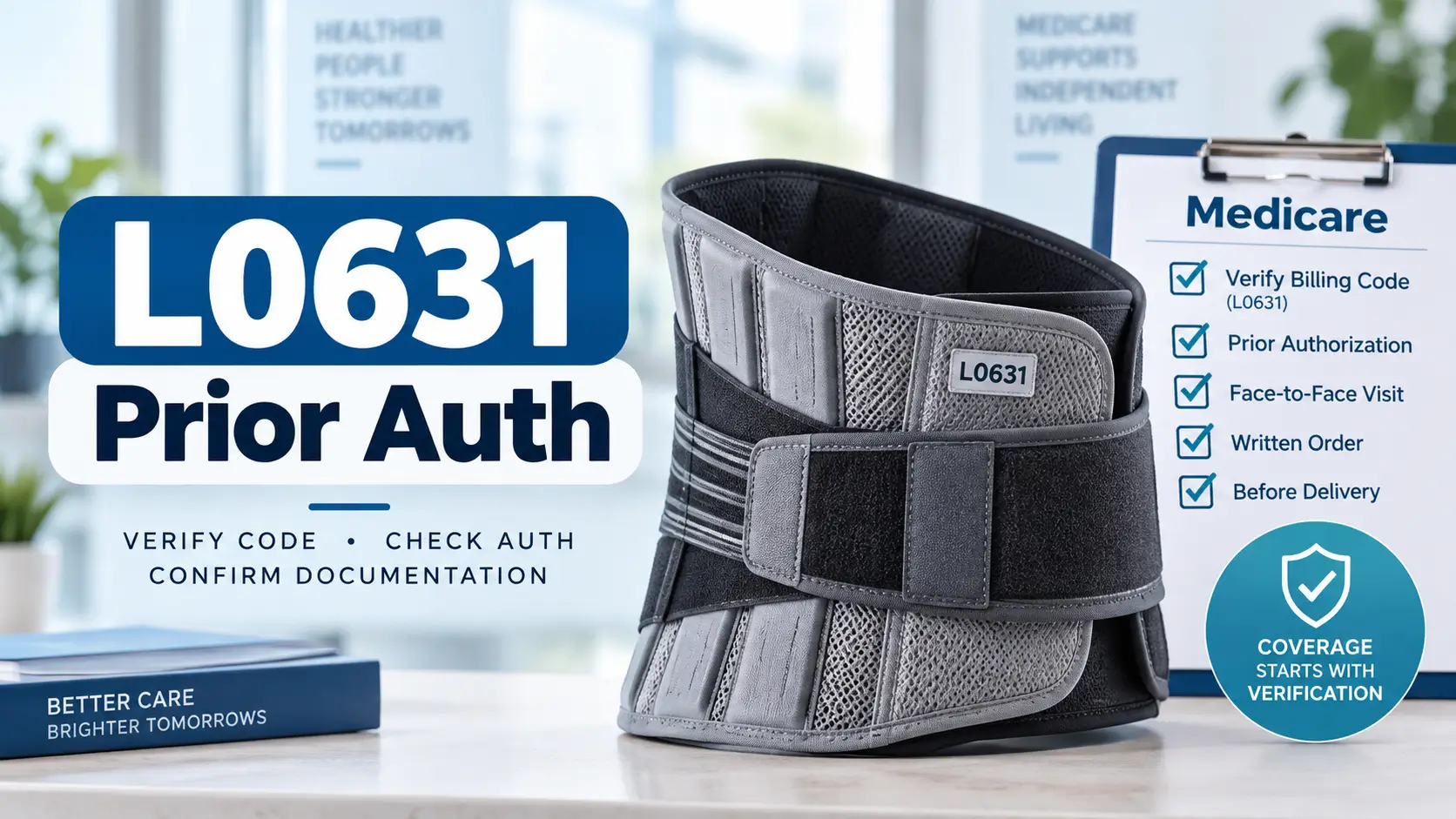
Short answer: Under Original Medicare, HCPCS L0631 is on CMS’s nationwide Required Prior Authorization List. It is a custom-fitted lumbar-sacral back orthosis, and for a supplier that is not exempt from the prior authorization program, Medicare generally expects authorization before the brace is delivered. L0631 also requires a qualifying face-to-face encounter and a written order before delivery.
The first thing to check is not whether your doctor “recommended a back brace.” Ask the supplier which HCPCS code it intends to bill. If the answer is L0631, ask whether you have Original Medicare or Medicare Advantage, whether the supplier is currently exempt from CMS prior authorization, and whether the required documentation has been completed. Those three answers determine the next step.
Table of Contents
What L0631 Actually Means
L0631 is not a generic label for every lumbar support sold as a “Medicare back brace.” It identifies a specific type of lumbar-sacral orthosis with rigid anterior and posterior support that is prefabricated but custom fitted to the individual.
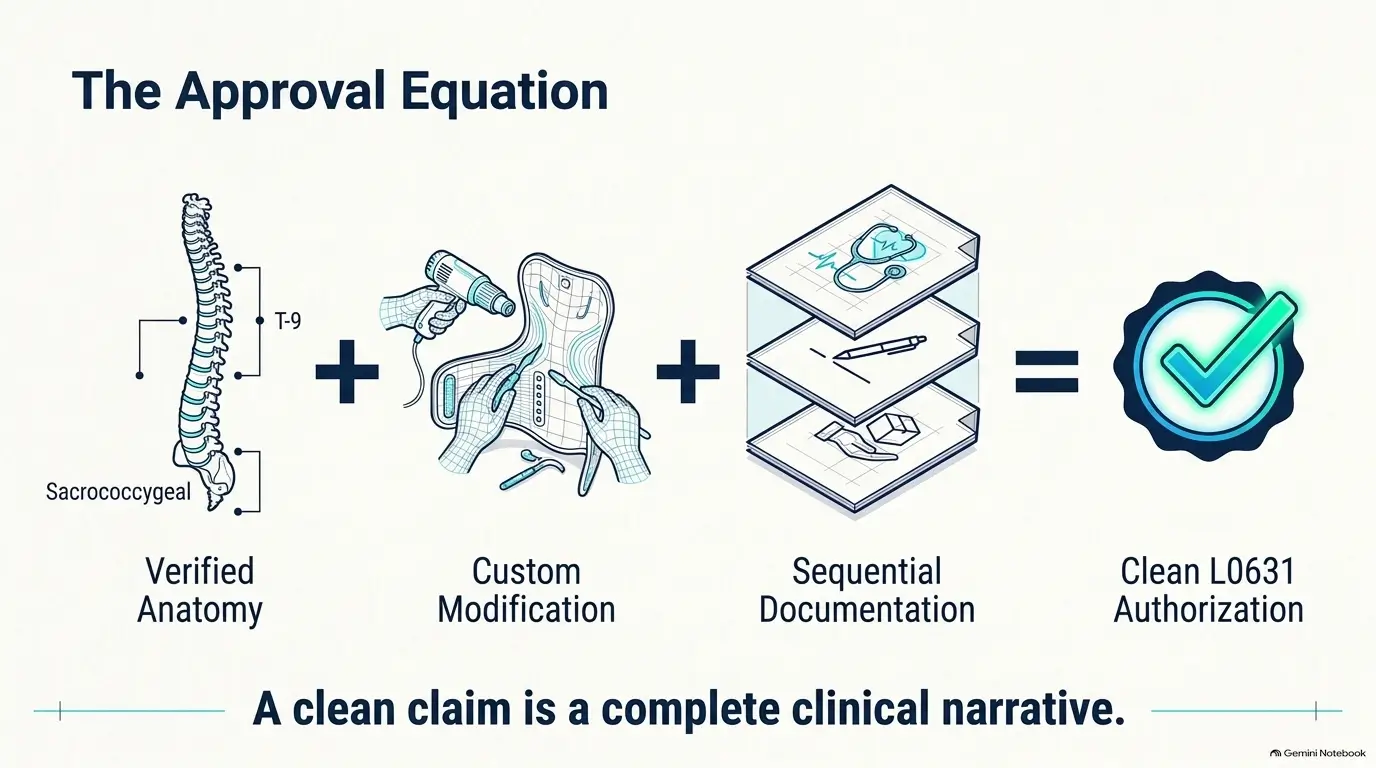
CMS coding rules treat L0631 as a custom-fitted prefabricated orthosis because its final fitting requires more than minimal adjustment by someone with appropriate expertise. The supplier’s records should describe why those modifications were necessary and what was actually done during fitting.
| Question | L0631 Answer |
|---|---|
| What is it? | A rigid lumbar-sacral back orthosis |
| Is it simply an off-the-shelf brace? | No. L0631 represents a prefabricated brace requiring more-than-minimal custom fitting |
| Does Original Medicare require prior authorization? | Yes, nationwide, subject to limited exceptions and the supplier exemption program |
| Is a face-to-face encounter required? | Yes |
| Must the order be completed before delivery? | Yes |
There is an especially useful coding distinction here. CMS pairs L0631 with L0648 for similar prefabricated orthosis types differentiated by how the final fitting is performed. L0631 is used when expert customization beyond minimal self-adjustment is performed; L0648 is the off-the-shelf counterpart. Both currently have their own Medicare prior authorization requirements.
If a brace arrives in a box, someone tightens an ordinary strap, and you are told it will be billed as L0631, asking how the brace was custom fitted is reasonable. The billing code should describe what was actually furnished and fitted, not merely which code has the larger reimbursement.
What Medicare Needs Before an L0631 Brace Is Delivered
For L0631, paperwork is not an ornamental layer sitting on top of medical necessity. Medicare uses the order, clinical record, fitting information, and prior authorization process to determine whether the item meets its coverage and coding rules.
A qualifying face-to-face encounter
For DMEPOS items subject to this requirement, CMS requires a qualifying face-to-face encounter within the six months before the written order. The record should contain patient-specific subjective and objective information connected to the condition for which the brace is being ordered.
A chart containing little more than “back pain, brace ordered” may leave the supplier with less support than a record describing the functional problem, examination findings, treatment context, and reason the orthosis is medically necessary.
A written order before delivery
L0631 also requires a Written Order Prior to Delivery. CMS’s standardized order elements include the beneficiary’s name or Medicare identifier, a description of the item, quantity when applicable, the treating practitioner’s name or NPI, the order date, and the practitioner’s signature.
Medical records supporting why the brace is needed
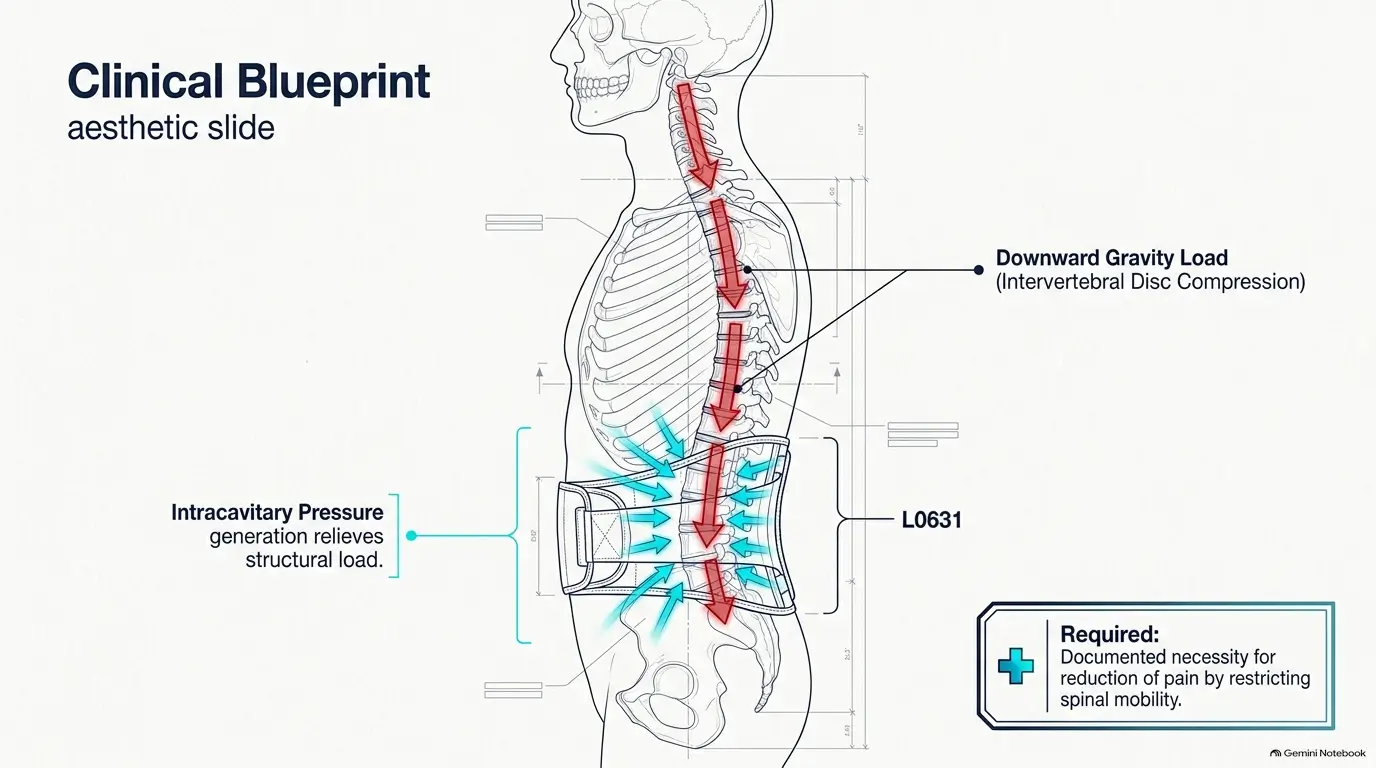
Medicare’s spinal-orthosis coverage policy generally recognizes a spinal brace when it is ordered to reduce pain by restricting trunk movement, facilitate healing after a spinal or related soft-tissue injury, facilitate healing after spinal surgery, or support weak spinal muscles or a deformed spine. A diagnosis by itself does not automatically establish that every brace or every billing code is medically necessary.
If you are preparing for an orthopedic authorization request, the broader orthopedic prior authorization checklist can help you organize the documentation questions before the supplier submits anything.
Who Submits the L0631 Prior Authorization Request?
In ordinary practice, the DMEPOS supplier handles the prior authorization request and gathers the required records from the treating practitioner. A Medicare beneficiary can submit a request, but CMS expects beneficiaries generally to work through the supplier because the supplier manages the coding, documentation, delivery, and eventual claim.
This makes one question surprisingly powerful: “Has the L0631 prior authorization request been submitted, and what is its current status?”
If the answer is vague, follow with: “Are you exempt from the CMS prior authorization requirement?” That second question matters more in 2026 than many older Medicare articles suggest.
Why an L0631 Supplier May Legitimately Have No Prior Authorization Request
CMS introduced a supplier exemption process for certain DMEPOS prior authorization requirements. The first exemption cycle began June 1, 2026. Suppliers that qualify for an exemption are instructed not to submit prior authorization requests during their exemption period.
That creates an important 2026 distinction. “There is no prior authorization request” does not automatically mean the supplier has skipped Medicare rules. It may mean the supplier is currently exempt.
| Supplier Situation | What It Means for You | What to Ask |
|---|---|---|
| Supplier is not exempt | L0631 ordinarily requires a prior authorization decision before delivery | “What is the PAR status?” |
| Supplier is currently exempt | The supplier should not submit the usual PAR during its exemption period | “Can you confirm your CMS exemption applies to this claim and jurisdiction?” |
| Supplier cannot explain | The billing path is unclear | Pause delivery until the supplier verifies the requirement |
You do not need to audit the supplier’s Medicare enrollment file yourself. You do need a coherent answer before accepting an expensive brace under a billing arrangement you do not understand.
How Long Does Medicare Take to Review an L0631 Request?
CMS’s current DMEPOS operational guidance gives the DME Medicare Administrative Contractor up to five business days, not to exceed seven calendar days, after receiving complete documentation for an initial request. The same timeframe applies to a resubmission. When an expedited review is warranted because delay could jeopardize the beneficiary’s life or health, the contractor makes reasonable efforts to decide within two business days.
The clock is therefore only half the story. A request sitting in a supplier’s office while it waits for a missing progress note is not the same thing as a complete request already under Medicare review.
If a brace is delayed, ask which stage is actually stalled: the practitioner’s documentation, the supplier’s submission, or the Medicare contractor’s review.
For covered orthoses under this program, an affirmative prior authorization decision generally remains valid for 60 days. If delivery does not occur within the applicable authorization period, the supplier may need a new request.
What an Affirmed or Non-Affirmed Decision Actually Means
A provisional affirmation means Medicare’s reviewer has made a preliminary finding that the future claim is likely to meet the applicable coverage, coding, and payment requirements based on the information reviewed. It is useful protection, but it is not a blank check.
The eventual claim can still encounter a problem involving information that was unavailable during prior authorization or a technical claim requirement that could only be evaluated after submission.
A non-affirmation means the submitted material does not yet support approval under the applicable rules. The decision letter should identify the deficiency. CMS permits resubmission after the problem is corrected, and its current operational guidance allows unlimited resubmissions.
| Status | What It Means | Sensible Next Move |
|---|---|---|
| Provisionally affirmed | The documentation reviewed appears to satisfy the relevant requirements | Confirm delivery will occur within the authorization period |
| Non-affirmed | A coverage, coding, or documentation requirement was not adequately supported | Get the specific reason and correct the request before resubmission |
| No decision when PA is required | A resulting claim may be denied for failing the prior authorization condition | Do not assume delivery can simply proceed |
If you have already reached the denial stage, the practical problem changes from authorization to evidence and appeal. The denied brace insurance appeal guide explains how to organize the next round without treating every denial as the same problem.
Original Medicare and Medicare Advantage Do Not Use the Same Authorization Path
This is the decision hinge many patients miss. CMS’s DMEPOS Required Prior Authorization List discussed above is an Original Medicare fee-for-service process. A Medicare Advantage member receives Medicare benefits through a private Medicare-approved plan, which can use its own network and prior authorization procedures.
| Your Coverage | Who Controls the Authorization Process? | First Call |
|---|---|---|
| Original Medicare | CMS and the applicable DME Medicare Administrative Contractor rules | The Medicare-enrolled brace supplier |
| Medicare Advantage | Your Medicare Advantage plan’s coverage, network, and authorization process | The plan and the supplier |
| Original Medicare plus Medigap | Original Medicare rules determine primary Medicare coverage; Medigap may help with eligible cost sharing | The supplier, then your supplemental insurer if needed |
Medicare Advantage plans must cover Medicare-covered benefits, but they may require authorization and use provider or supplier networks. Do not assume an Original Medicare authorization number substitutes for your plan’s process. Medicare describes these structural differences when comparing Original Medicare with Medicare Advantage.
If you are enrolled in Part C, use the Medicare Advantage orthopedic care guide to check the network and plan-authorization layer separately.
Your 10-Minute L0631 Verification Check
Before delivery, call the supplier and work through the following questions. You are not trying to become a Medicare billing specialist over coffee. You are looking for mismatches while they are still cheap to fix.
- What exact HCPCS code will you bill? Confirm that the answer really is L0631.
- Why is L0631 appropriate instead of an off-the-shelf code? Ask what expert customization will be performed during fitting.
- Am I being billed under Original Medicare or a Medicare Advantage plan?
- If Original Medicare applies, are you currently exempt from required prior authorization?
- If you are not exempt, has the prior authorization request been submitted? Ask whether it is pending, affirmed, or non-affirmed.
- Was my qualifying face-to-face encounter within six months before the order?
- Has the supplier received the Written Order Prior to Delivery?
- If the request was affirmed, when does the authorization period expire?
- What do you expect me to owe? Ask whether the supplier accepts Medicare assignment and whether secondary coverage has been considered.
This check also helps separate coverage from cost. Medicare Part B generally covers medically necessary arm, leg, back, and neck braces, with the beneficiary typically responsible for Part B cost sharing after the deductible when Medicare coverage requirements are met. Prior authorization does not mean the brace is free.
For the broader cost and coverage questions, see the orthopedic brace insurance coverage guide.
What to Do if the Supplier Says “Medicare Won’t Approve It”
Do not jump directly from “authorization problem” to “I guess I have to pay cash.” First identify the actual failure point.
- Missing practitioner records: ask exactly which clinical note or element is missing and have the supplier request it.
- Medical necessity not supported: ask what coverage criterion the submitted record failed to establish. The practitioner, not the supplier, determines what treatment or brace is clinically appropriate.
- Wrong or unsupported billing code: ask the supplier to verify that L0631 accurately reflects the brace and fitting being furnished.
- Medicare Advantage authorization problem: obtain the plan-specific denial reason rather than applying Original Medicare procedures to the case.
- Supplier is exempt: there may be no traditional PAR to “approve.” Confirm that the exemption actually applies.
A cash purchase can make sense when you knowingly want an item Medicare will not cover or when you deliberately choose not to use insurance. It is poor problem-solving when the real issue is a missing note, an incorrect code, a network mistake, or an incomplete authorization request.
When Can an L0631 Brace Be Furnished Urgently?
CMS’s September 2026 operational guidance includes a limited acute-situation pathway for L0631 and certain other orthoses. When the applicable requirements are met and the claim is properly billed with the ST modifier to indicate urgent furnishing, the ordinary prior authorization requirement may be suspended. Such claims remain subject to heightened prepayment review.
This is not a consumer shortcut for avoiding a waiting period. The supplier and treating professionals must determine whether the facts support the appropriate billing pathway. Asking someone to mark an ordinary order “urgent” merely to skip prior authorization can create a new claim problem instead of solving the old one.
L0631 Medicare Prior Authorization FAQ
Does an L0631 prior authorization approval mean Medicare will pay 100%?
No. Authorization addresses coverage, coding, and payment requirements reviewed before the claim. It does not erase the Part B deductible, coinsurance, or other applicable cost sharing. Medigap, Medicaid, employer coverage, or another secondary payer may change what you ultimately owe.
Can Medicare deny the claim after prior authorization was affirmed?
Yes, although an affirmation is valuable. CMS describes it as a preliminary finding that the future claim is likely to satisfy applicable requirements. A later claim can still fail because of a technical requirement or information that was not available during the prior authorization review.
What if my L0631 request is non-affirmed twice?
A second non-affirmation does not automatically end the process. CMS currently permits additional resubmissions. The productive move is to compare the decision letter against the revised documentation rather than repeatedly sending essentially the same packet.
Does Medigap eliminate L0631 prior authorization?
No. Medigap supplements eligible Original Medicare cost sharing; it does not replace Original Medicare’s primary coverage rules. If Original Medicare’s prior authorization requirement applies to the supplier and item, Medigap does not make that requirement disappear.
Can I accept the brace while authorization is still pending?
For a non-exempt supplier using the ordinary Original Medicare L0631 pathway, that is a warning sign worth resolving before delivery. Ask the supplier to identify the exact Medicare rule or exception it is relying on. Do not assume a pending request will eventually be approved.
Run This Check Before the Brace Is Delivered
Call the supplier and ask one compact question: “You plan to bill L0631. Am I under Original Medicare or Medicare Advantage, do you need a prior authorization for this claim, and if not, what exception or supplier exemption applies?”
Then confirm the face-to-face date, written order, authorization status when required, and expected out-of-pocket amount. Ten minutes spent resolving those four points can prevent the more exhausting version of this problem: a brace already delivered, a claim already denied, and three offices politely explaining why the other office should fix it.
Last reviewed: 2026-10
- CMS: L0631 Medicare Requirements — Prior Authorization, Face-to-Face Encounter & Written Order
- CMS: Prior Authorization Process for Certain DMEPOS Items
- CMS: DMEPOS Face-to-Face Encounter and Written Order Requirements
- CMS: Spinal Orthoses Medicare Coverage, Coding & Documentation Requirements
- Medicare.gov: Medicare Coverage for Back, Neck, Arm and Leg Braces
Targeted editorial update: October 21, 2026. Added a topic-specific follow-up record and recheck triggers, revised the title and search description, and removed unverified first-person claims or clarified selected wording where found. The existing body was retained. This update is not a complete legal, coverage or clinical review; confirm current rules and individual decisions with the relevant official source or service.