
This site is written from a family-caregiver perspective. The operator is not a medical professional or an insurance, legal or financial adviser. Use this guide to organize questions for the relevant service.
Turn a verbal answer into a usable record
Use this follow-up record alongside the guide below. It does not determine medical suitability, insurance eligibility or legal rights, and it does not guarantee a price.
- Keep together
- Order, exact item, supplier details, coverage type and estimated patient responsibility.
- Unanswered question
- What assumptions support this estimate and which requirements remain unresolved?
- Next contact and owner
- Ask the supplier or plan for the relevant written information and a contact for discrepancies.
- Recheck when
- The item, supplier, benefits or delivery date changes.
For each response, record its date, source, reference number and what remains uncertain. Agree the next follow-up date instead of treating silence as confirmation. Use official contact channels and keep identifying health, account and policy information out of public comments.
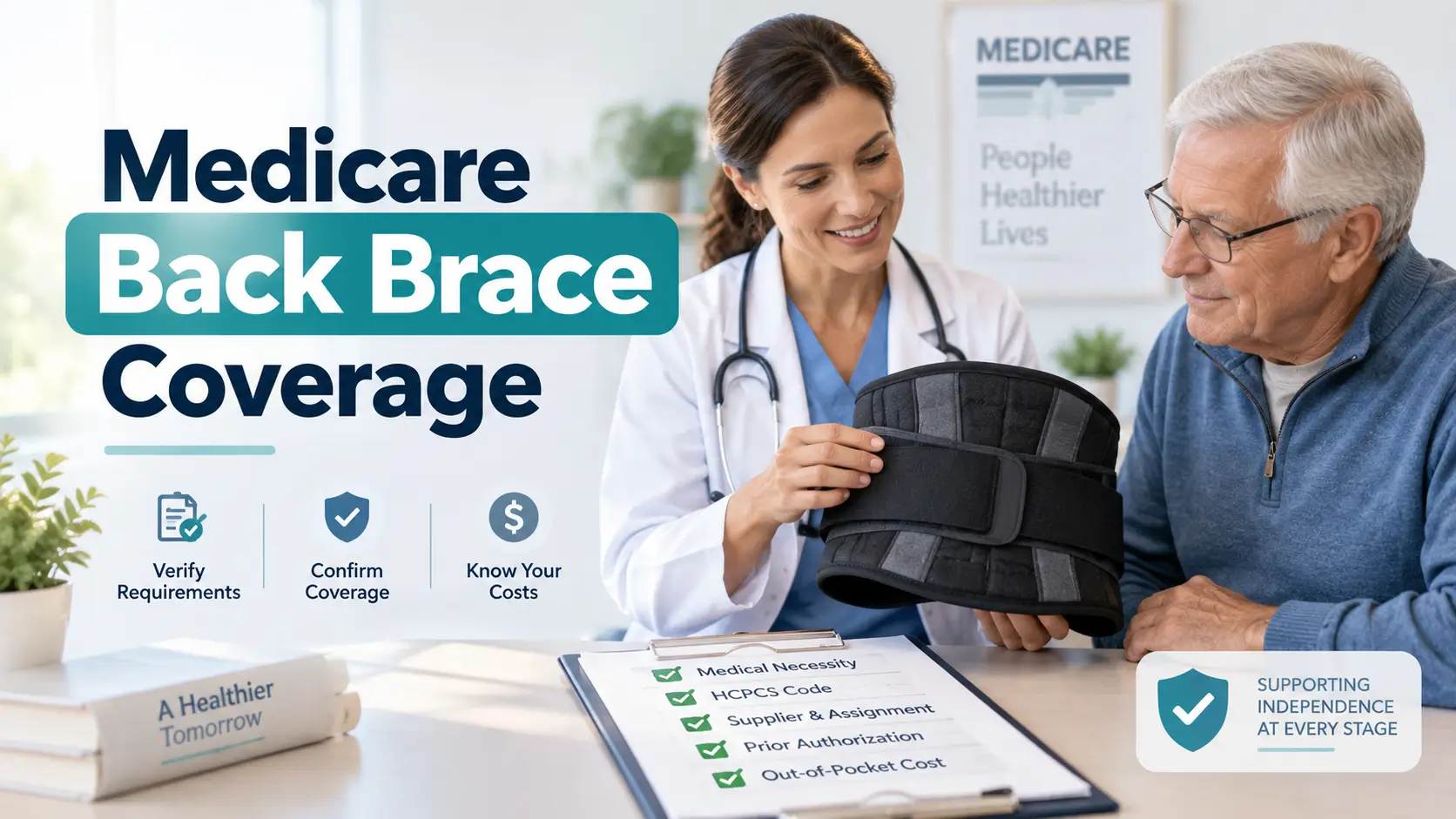
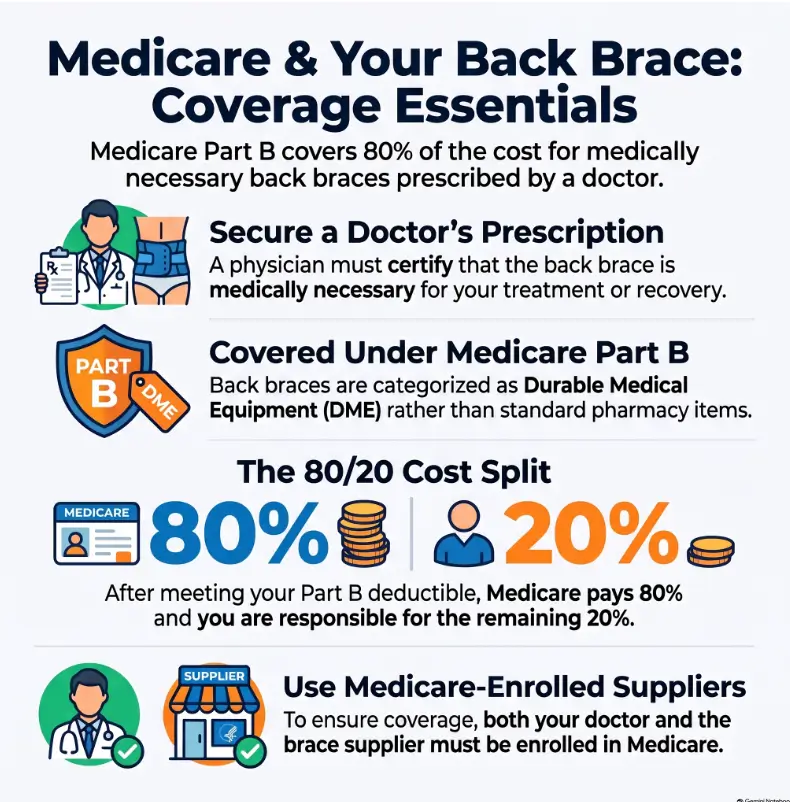
Medicare Part B can cover a back brace when it is medically necessary and ordered by a doctor or other qualified health care provider. Coverage is not automatic simply because you have back pain or a prescription. The brace must meet Medicare’s definition and coverage requirements, the medical record must support why it is needed, and the supplier must meet Medicare billing requirements.
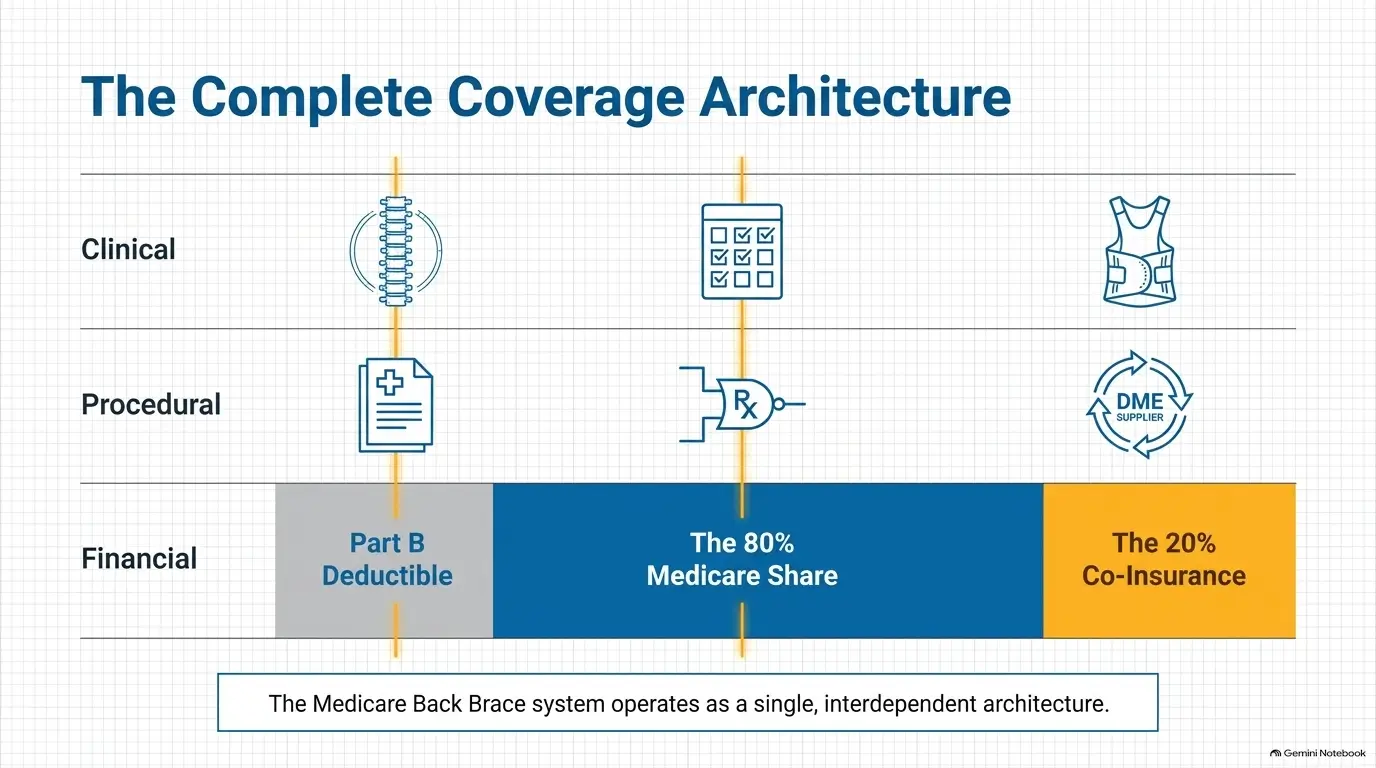
With Original Medicare, you generally pay the Part B deductible and then 20% of the Medicare-approved amount. The most useful first step is not to shop for a brace. Ask the supplier for the exact brace being ordered, its HCPCS billing code, whether Medicare requirements have been met, and whether the supplier accepts Medicare assignment. Some spinal braces also require prior authorization.
Table of Contents
When Medicare Part B Covers a Back Brace
Medicare treats qualifying back braces as orthoses under the Part B braces benefit. According to Medicare’s current brace coverage information, Part B covers back braces when they are medically necessary and ordered by a doctor or other health care provider.
The critical distinction is medical necessity, not simply ownership of a Medicare card. Buying a lumbar support because your back feels sore is different from receiving a spinal orthosis ordered to treat a documented medical problem.
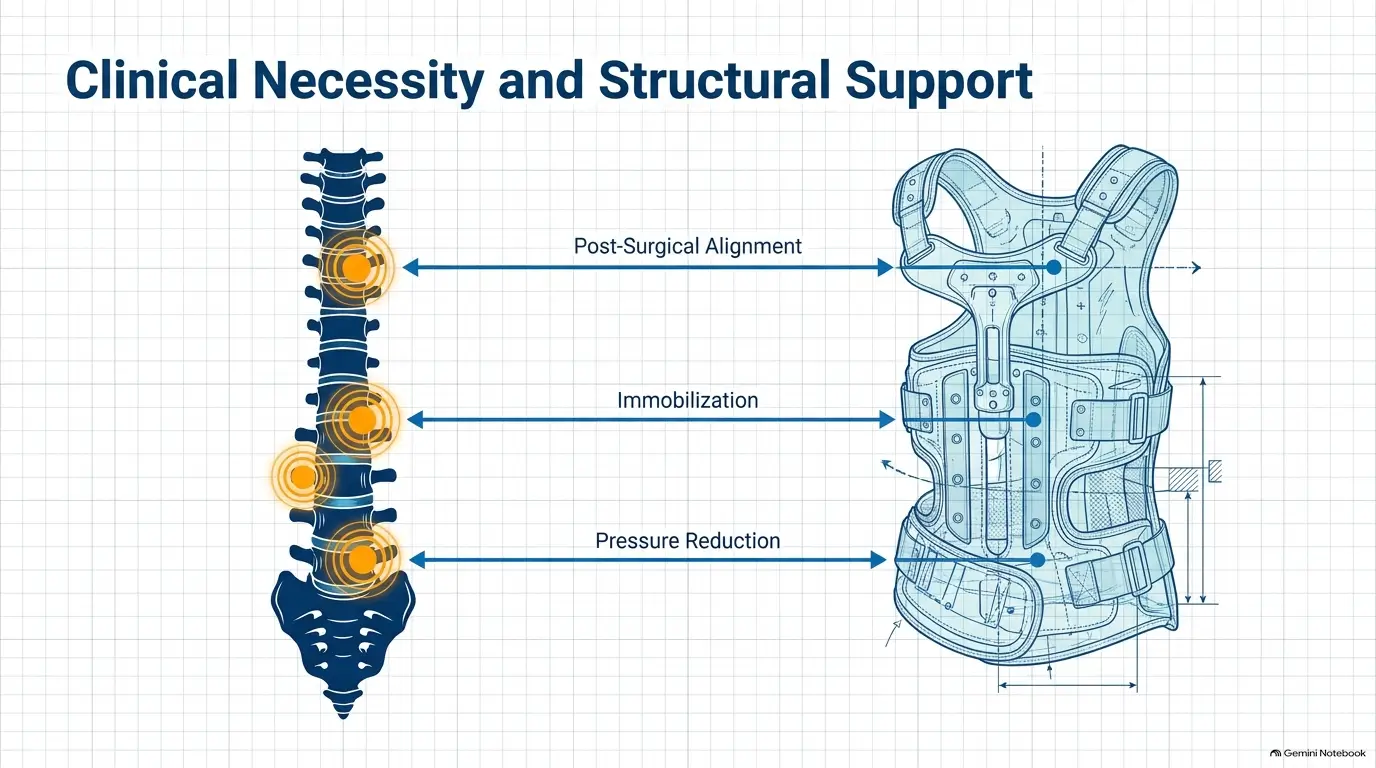
Medicare’s current spinal orthosis coverage policy identifies several situations in which a qualifying lumbar-sacral orthosis or thoracic-lumbar-sacral orthosis may be covered. These include using the brace to:
- reduce pain by restricting movement of the trunk,
- help healing after an injury to the spine or related soft tissue,
- help healing after spinal surgery or related soft-tissue surgery, or
- support weak spinal muscles or a deformed spine.
Those are Medicare coverage categories, not instructions to begin bracing on your own. Your treating practitioner determines whether a brace is clinically appropriate, while Medicare or your Medicare Advantage plan determines whether the claim satisfies coverage rules.
If you want the technical Medicare criteria behind those decisions, the CMS spinal orthoses coverage determination describes the current requirements for lumbar-sacral and thoracic-lumbar-sacral orthoses.
A Prescription Alone Does Not Guarantee Payment
A common and expensive misunderstanding is that a signed prescription automatically makes the brace payable by Medicare. It does not.
The order is one piece of the claim. Depending on the brace, Medicare may also require medical-record documentation supporting the need for the orthosis, correct coding, a properly completed written order, proof of delivery, and possibly prior authorization or additional documentation requirements.
| What you have | What it means | What still needs checking |
|---|---|---|
| A doctor’s recommendation | The brace may be clinically useful | Whether it meets Medicare coverage criteria |
| A written order | The supplier has an important billing document | Documentation, coding and any prior-authorization requirements |
| A Medicare-enrolled supplier | The supplier can potentially bill Medicare | Whether the supplier accepts assignment |
| A Medicare-covered brace code | The product falls within a potentially covered category | Whether your medical situation satisfies the code’s requirements |
This is why the question to ask is not merely, “Does Medicare cover back braces?” A much more useful question is, “Does Medicare cover this exact brace, under this billing code, for my documented medical need?”
If you are comparing a broader range of braces or trying to understand how private insurance differs, the site’s guide to orthopedic brace insurance coverage addresses that wider question.
How Much Does a Medicare-Covered Back Brace Cost?
Under Original Medicare, after the Part B deductible is satisfied, Medicare generally leaves you responsible for 20% of the Medicare-approved amount for a covered brace. In 2026, the annual Part B deductible is $283. Your actual bill can change if some of that deductible remains unpaid, the supplier does not accept assignment, or you have secondary coverage such as Medigap.
Medicare’s current deductible and coinsurance amounts are published in its 2026 Medicare cost information.
Illustrative example
Suppose the Medicare-approved amount for a covered brace were $600. This is an illustration, not a quote for a particular brace.
- If your Part B deductible had already been met, 20% of $600 would be $120.
- If $100 of your deductible remained, that $100 would first apply, leaving $500 subject to coinsurance. Twenty percent of $500 is $100, making the example patient responsibility $200.
- Medigap or another secondary payer could change what you ultimately owe.
The important number is the Medicare-approved amount, not the retail price printed on a supplier’s website or invoice.
Why Accepting Medicare Assignment Matters
Before accepting the brace, ask whether the supplier is enrolled in Medicare and whether it accepts assignment for your claim. Those are separate questions.
When a participating supplier accepts assignment, it agrees to accept the Medicare-approved amount as the basis for payment. Your responsibility is then tied to Medicare’s deductible and coinsurance rules rather than an unrestricted retail charge.
A supplier that is not participating may still accept assignment for a particular claim. If it does not accept assignment, your financial exposure may be greater. Do not rely on the phrase “we take Medicare.” Ask specifically:
- Are you currently enrolled as a Medicare DMEPOS supplier?
- Will you accept Medicare assignment for this exact brace?
- What is the HCPCS code?
- What is the Medicare-approved amount or estimated allowed amount?
- What do you expect me to owe?
You can also use Medicare’s medical equipment supplier directory to check suppliers rather than relying solely on a salesperson’s assurance.
Some Back Braces Require Prior Authorization
Prior authorization is now particularly important because Medicare does not treat every spinal orthosis the same way. The exact HCPCS code can change the process.
As of September 2026, several lumbar-sacral orthosis codes are already subject to nationwide Medicare Fee-for-Service prior authorization requirements. These include certain braces billed under codes such as L0631, L0637, L0639 and L0651. Additional thoracic-lumbar-sacral orthosis codes are scheduled to enter Medicare’s required prior-authorization program on October 28, 2026.
CMS maintains the controlling information on its DMEPOS prior-authorization program page. Because the list changes, the supplier should check the current requirement using the actual HCPCS code rather than guessing from the words “lumbar brace” or “back support.”
Prior authorization does not mean every back brace needs special approval. It means certain specified items do. If your brace is among them, the supplier typically works with the treating practitioner to submit the required documentation.
Before delivery, ask, “Does this HCPCS code require Medicare prior authorization today, and if so, has Medicare issued a decision?” The site’s orthopedic prior authorization checklist can help you organize that conversation.
Your 10-Minute Medicare Back Brace Coverage Check
Before paying a deposit, signing delivery paperwork, or letting someone ship the brace, run through this sequence. It is designed to catch the expensive problems before the box reaches your doorstep.
- Identify the exact brace. Get the product description and HCPCS code in writing.
- Confirm who ordered it. Make sure the order came from a practitioner involved in your care and that the practitioner knows why you need the brace.
- Ask what medical need is documented. A vague notation such as “back pain” may not tell you whether the documentation supports the specific orthosis being billed.
- Confirm Medicare enrollment. Verify that the supplier is eligible to bill Medicare for the item.
- Ask about assignment. Do not settle for “we accept Medicare.” Ask whether the supplier accepts Medicare assignment for this claim.
- Ask whether prior authorization applies. The supplier should check the HCPCS code against current Medicare requirements.
- Get your expected patient cost. Ask for the Medicare-approved or expected allowed amount, remaining deductible, coinsurance and any charge Medicare may not cover.
- Do not substitute a retail brace without checking. A cheap online lumbar support may be perfectly adequate for some personal uses, but purchasing it yourself does not transform it into a Medicare-covered orthosis.
If the supplier cannot tell you the billing code, who ordered the brace, or why Medicare is expected to pay, that is a good reason to stop the transaction until those questions are answered.
When Paying Cash May Be Reasonable
Using Medicare is not automatically the best economic choice for every brace. A simple retail support may sometimes cost less than going through an insurance billing process, particularly when the item you want is not medically necessary under Medicare or when you are buying it for comfort rather than treatment.
That does not mean you should replace a prescribed spinal orthosis with the cheapest brace online. The two products may serve very different purposes. A brace prescribed after spinal surgery, for instability, or for controlled restriction of trunk movement deserves a clinical conversation before you substitute another product.
A practical spending rule is:
- A low-cost retail support may be enough when you are buying an optional comfort product and no clinician has said you need a particular medical orthosis.
- Using the Medicare pathway becomes more important when a practitioner has ordered a specific brace to restrict movement, support healing, or provide medically necessary spinal support.
- Paying more becomes rational when the additional cost reflects medically required customization, fitting, materials, documentation or clinical needs rather than branding alone.
If the supplier expects Medicare not to cover a normally covered item under your circumstances, Original Medicare rules may require an Advance Beneficiary Notice of Non-coverage, or ABN. Read the reason and estimated cost before signing. An ABN should not be treated as routine paperwork to wave away.
Medicare Advantage Back Brace Coverage Can Work Differently
If you have Medicare Advantage rather than Original Medicare, do not assume the Original Medicare 20% cost formula is your final price. Medicare Advantage plans must cover Medicare-covered Part A and Part B benefits, but their provider networks, supplier networks, authorization procedures and member cost-sharing can differ.
Before getting the brace, call the plan or use its member portal and ask:
- Is this HCPCS code covered for my diagnosis and circumstances?
- Do I need prior authorization?
- Must I use a specific in-network DMEPOS or orthotics supplier?
- What is my copayment or coinsurance?
- Has authorization already been approved, or is it merely pending?
A Medicare Advantage plan can also issue a coverage determination before you proceed. If you already use Medicare Advantage for orthopedic care, the site’s guide to Medicare Advantage orthopedic care explains the broader network and authorization issues.
Be Careful With Unsolicited “Free Medicare Back Brace” Offers
An unexpected caller offering a “free Medicare back brace” deserves skepticism. Orthotic braces have repeatedly appeared in federal fraud cases involving aggressive telemarketing, questionable orders and equipment beneficiaries did not need.
The HHS Office of Inspector General has specifically warned Medicare beneficiaries about fraud involving supposedly free orthotic braces. Recent federal enforcement actions in 2026 have continued to involve unnecessary orthotic braces and telemarketing schemes.
Do not give an unexpected caller your Medicare number merely because the caller already knows your name, age or medical complaint. A safer route is to end the call, contact your own treating clinician, and independently locate a Medicare supplier if a brace is actually needed.
An unneeded brace can create more than clutter. A fraudulent or unnecessary claim placed in your Medicare history can complicate later claims for equipment you genuinely need.
What to Do if Medicare Denies the Back Brace
A denial does not automatically mean the brace was medically inappropriate. Claims can fail because of medical-necessity documentation, missing orders, prior-authorization problems, supplier errors, coding errors or other Medicare requirements.
Start by finding the denial reason. Do not begin an appeal with a generic letter before you know what Medicare says went wrong.
- Read the Medicare Summary Notice or plan denial notice.
- Identify the exact brace and HCPCS code.
- Ask the supplier whether the claim was submitted correctly.
- Ask the treating practitioner whether the medical record documents the need for that specific orthosis.
- Determine whether missing prior authorization or another procedural requirement caused the denial.
- If the decision appears incorrect, follow the appeal instructions and deadline shown on the notice.
If you have reached this stage, the site’s guide to a denied brace insurance appeal focuses specifically on what to review after coverage has been refused.
Frequently Asked Questions
Does Medicare cover a back brace for ordinary lower back pain?
It can, but back pain alone does not guarantee coverage. Medicare looks at whether the specific spinal orthosis is medically necessary and whether its coverage, ordering, documentation and supplier requirements are satisfied.
Can I buy a back brace online and send the receipt to Medicare?
Do not assume reimbursement will work that way. Medicare coverage depends on the item, medical necessity, ordering requirements and the supplier’s Medicare status. Buying first and investigating coverage afterward can leave you responsible for the entire price.
Does Medigap pay the 20% Medicare leaves behind?
Some Medigap policies can pay some or all applicable Part B coinsurance for Medicare-covered services, depending on the policy and other circumstances. The underlying item generally must first qualify for Medicare coverage. Check the specific Medigap policy rather than assuming every supplement works identically.
Can Medicare cover a custom-fitted back brace?
Potentially. Medicare recognizes different types of spinal orthoses, including off-the-shelf, custom-fitted and custom-fabricated items. Coverage depends on the exact code and whether the documentation supports that item. A supplier should be able to tell you which category and HCPCS code it intends to bill.
What if a brace company says Medicare has already approved me?
Ask what “approved” means. A salesperson may be referring only to Medicare eligibility, while true prior authorization for a particular item is a separate process. Request the exact HCPCS code and, when prior authorization is required, confirmation of the authorization decision before accepting delivery.
Run This Check Before the Brace Is Delivered
Take the order or supplier quote and locate four things: the HCPCS code, the ordering practitioner, the supplier’s Medicare status, and your estimated responsibility. Then ask whether that code requires prior authorization under your current coverage.
If any of those pieces is missing, do not let urgency push you into an avoidable bill. Ten minutes spent verifying the claim before delivery can be far more useful than discovering after the fact that the brace, supplier or paperwork did not satisfy Medicare’s rules.
Last reviewed: 2026-10
Targeted editorial update: October 21, 2026. Added a topic-specific follow-up record and recheck triggers, revised the title and search description, and removed unverified first-person claims or clarified selected wording where found. The existing body was retained. This update is not a complete legal, coverage or clinical review; confirm current rules and individual decisions with the relevant official source or service.