
This site is written from a family-caregiver perspective. The operator is not a medical professional or an insurance, legal or financial adviser. Use this guide to organize questions for the relevant service.
Separate estimate type from payment responsibility
Use this follow-up record alongside the guide below. It does not determine medical suitability, insurance eligibility or legal rights, and it does not guarantee a price.
- Keep together
- Document date, issuer, included services and whether each amount is a charge, rate or patient estimate.
- Unanswered question
- Which assumptions produced this number and which services or benefits are not represented?
- Next contact and owner
- Have the issuer explain unclear labels and confirm the patient-share question with the plan.
- Recheck when
- Claim assumptions, benefits or services change.
For each response, record its date, source, reference number and what remains uncertain. Agree the next follow-up date instead of treating silence as confirmation. Use official contact channels and keep identifying health, account and policy information out of public comments.
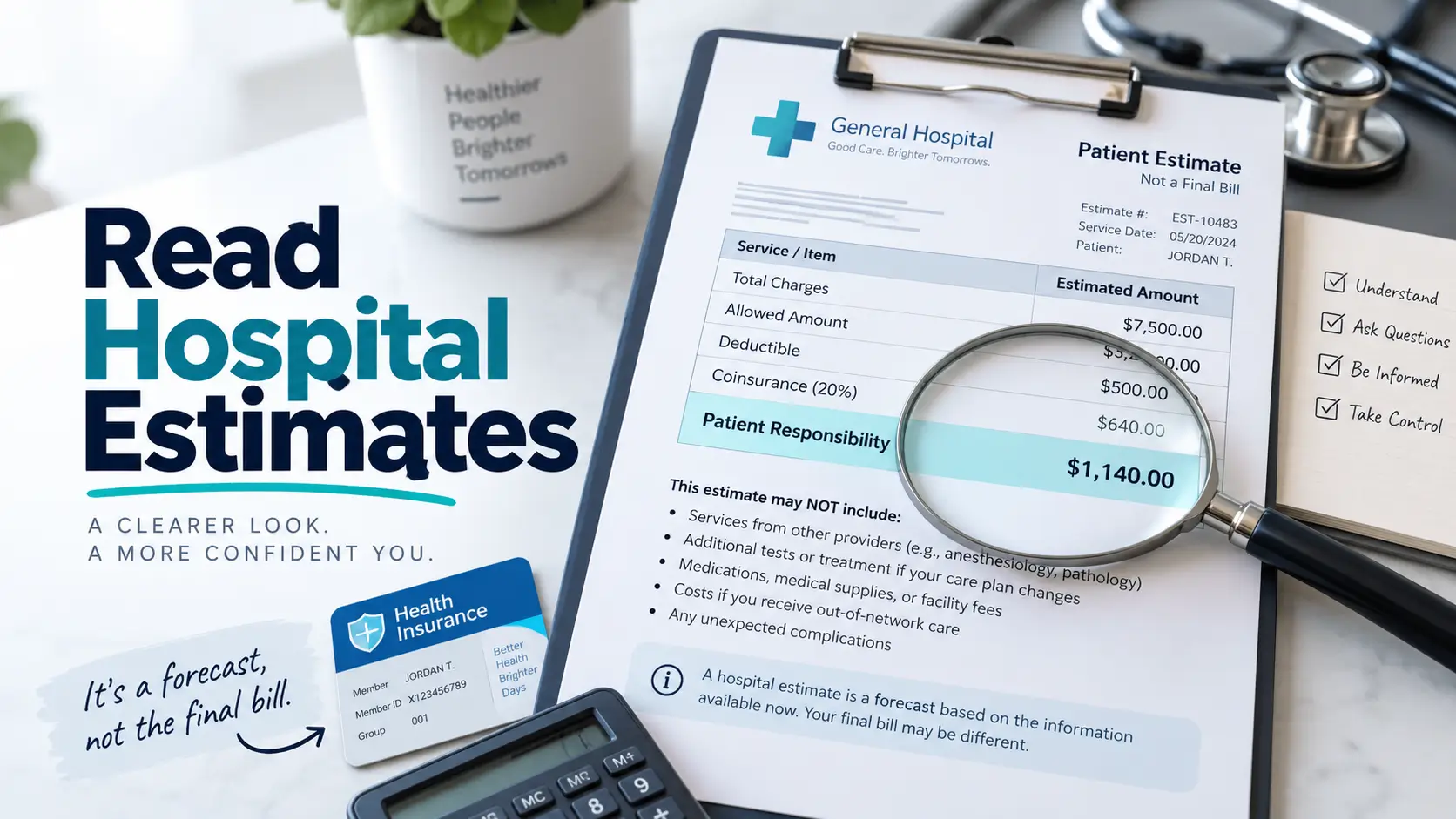
A hospital price estimate is a forecast, not necessarily the amount you will finally owe. For a U.S. patient with insurance, the most useful number is usually the estimated patient responsibility, but only after you confirm the estimate used the correct health plan, network status, procedure, and remaining deductible. If you are uninsured or intentionally paying without insurance, determine whether the document is a formal Good Faith Estimate, because federal protections can apply if the eventual bill is substantially higher.
Your first move is simple: do not start with the hospital’s largest dollar figure. Find the service being priced, the negotiated or allowed amount, what insurance is expected to pay, and what the estimate says you may owe. Then check what the estimate excludes.
Table of Contents
First, Identify What Kind of Estimate You Have
Three documents can look similar while answering different questions. Knowing which one you are reading prevents one of the most common pricing mistakes: treating a hospital charge, an insurance estimate, and a self-pay estimate as interchangeable.
| Document or Number | What It Tells You | What It Does Not Necessarily Tell You |
|---|---|---|
| Hospital price estimate | The hospital’s expected charge or your estimated responsibility for planned care | The final amount after every claim is processed |
| Health plan cost estimate | Your estimated cost sharing based on plan benefits, network rates, and current deductible information | Charges for services that were not included in the request |
| Good Faith Estimate for uninsured or self-pay care | Expected charges for scheduled or requested care when you are not using insurance | A guarantee that no medically necessary additional service will ever be needed |
| Hospital’s published price | A standard charge, negotiated price, discounted cash price, or other required price-transparency information | Your personal out-of-pocket cost |
U.S. hospitals generally must publish pricing information for their services, including a consumer-friendly display or qualifying price-estimator function for shoppable care. CMS explains the distinction between published hospital charges and consumer estimates in its hospital price transparency guidance for consumers.
The Number You Owe Is Usually Not the Hospital’s Gross Charge
A hospital estimate may display several large numbers. The highest one may be a gross or standard charge rather than the amount used to calculate your insured cost.
If you have insurance, look for language such as negotiated rate, allowed amount, plan allowance, or eligible expense. The allowed amount is generally the amount your plan recognizes for a covered service, rather than the provider’s unrestricted sticker price.
Then locate patient responsibility, estimated out-of-pocket cost, or similar wording. That figure may incorporate your deductible, coinsurance, copayment, and benefit information available when the estimate was created.

Read These Seven Fields Before Trusting the Estimate
You can usually determine whether an estimate is useful by checking seven fields. If one is missing or wrong, ask the hospital or insurer to rerun the estimate before making a financial decision.
- Patient and insurance information. Confirm the member, insurer, plan, and effective coverage are correct.
- Procedure or service description. Make sure the estimate is actually for the care being scheduled.
- Billing code. When available, compare the CPT, HCPCS, DRG, or other billing code with what the scheduling or clinical office expects to use.
- Place of service. Hospital outpatient, inpatient, ambulatory surgery center, and physician-office care can be priced differently.
- Network status. Confirm the facility and relevant clinicians are treated as in-network under your specific plan.
- Estimated allowed or negotiated amount. This is often more useful to an insured patient than the gross charge.
- Estimated patient responsibility. Check how much is attributed to deductible, coinsurance, copayments, or other cost sharing.
CMS also requires most applicable health plans and insurers to provide consumer price-comparison information for covered items and services. When available, compare the hospital estimate against your insurer’s own cost estimator. CMS describes these tools in its health plan price transparency guidance.
How Deductible and Coinsurance Produce the Patient Estimate
For insured care, the hospital’s estimated patient amount is often driven less by the hospital’s gross charge than by your plan’s allowed amount and your remaining cost-sharing obligations.
Illustrative example
Assume the plan recognizes an allowed amount of $4,000 for the service. You still have $1,000 of deductible remaining, and your plan applies 20% coinsurance after that deductible.
- Allowed amount: $4,000
- Remaining deductible: $1,000
- Amount remaining after deductible: $3,000
- 20% coinsurance on $3,000: $600
- Illustrative patient responsibility: $1,600
This example assumes the service is covered, in-network, subject to that deductible, and processed in that order. Real plans can apply different benefit structures, separate deductibles, copayments, exclusions, or other rules. Your accumulated deductible and out-of-pocket amounts may also change between the date of the estimate and the date the claim is processed.
Separate total responsibility from the remaining balance. A forecast of $1,600 in total patient responsibility is not necessarily a request for another $1,600 after a deposit. In a hypothetical account with a $500 payment already credited to the same provider and no other changes, $1,600 minus $500 leaves $1,100. Ask the billing office whether its displayed figure is before or after credited payments, and keep receipts for each separately billing organization.
After care, compare the provider’s bill with the matching claim’s EOB rather than adding the two totals together. The CMS guide to reading an Explanation of Benefits explains that an EOB is not a bill and may not reflect amounts you have already paid. Match the provider, service date and claim number, then ask the provider to resolve missing credits or a discrepancy.
CMS provides plain-language definitions of deductible, coinsurance, allowed amount, network status, and related terms in its health insurance terms guide.
The Most Important Question Is Often What the Estimate Leaves Out
A seemingly precise estimate can still be incomplete. Before comparing two hospitals, ask whether both estimates include the same services and professionals.
Depending on the procedure and how the facility bills, additional charges may come from physicians or other professionals involved in the care. Examples can include anesthesia, radiology interpretation, pathology, surgical services, laboratory testing, implants, medications, or follow-up services. Do not assume every one of these is excluded, but do not assume they are bundled either.
| Check | Why It Matters | Question to Ask |
|---|---|---|
| Facility fee | The hospital’s charge may be only one component | “Does this estimate include all facility charges?” |
| Physician services | A physician may bill separately | “Which professional fees are included?” |
| Anesthesia | Often involves a separate clinician or group | “Is anesthesia included, and is the anesthesia provider in-network?” |
| Imaging or pathology interpretation | The technical test and professional interpretation may be distinct | “Are interpretation fees included?” |
| Implants, drugs, or supplies | Actual use may depend on what happens during treatment | “Which supplies or medications are assumed in this estimate?” |
| Follow-up care | Post-procedure services may not be bundled | “Does this include routine follow-up visits or testing?” |
Why the Final Bill Can Differ From the Estimate
An estimate can change for legitimate reasons even when nobody made a billing error. The procedure performed may differ from what was originally scheduled, additional services may become medically necessary, or the insurer may process the claim differently from the assumptions used when the estimate was created.
Common variables include changes in diagnosis or procedure codes, length of stay, supplies used, additional testing, multiple providers, current deductible status, coverage rules, network determinations, and whether prior authorization or another plan requirement was satisfied.
This is why an estimate should be treated as a decision document, not a promise of the final adjudicated claim unless a specific law or contract gives it greater effect.
Use a Two-Estimate Check If You Have Insurance
For planned insured care, one of the strongest checks is to compare the hospital’s estimate with your health plan’s estimate for the same service, provider, and location. A large discrepancy is a reason to investigate before paying a substantial deposit or choosing a facility.
- Ask the hospital for the exact procedure or billing code used for its estimate.
- Enter that service and facility into your insurer’s price-comparison tool, or call the insurer.
- Confirm that the hospital is in-network for your exact plan, not merely that it “accepts” your insurance company.
- Ask whether the relevant physician, anesthesia, imaging, pathology, or other professional services have been included.
- If the estimates differ materially, ask each party what assumption created the difference.
“We accept your insurance” is not the same question as “Are you an in-network provider under this specific plan?” Network status can materially affect what you owe.
If You Are Paying Cash, Compare the Cash Price With the Insurance Route
A discounted self-pay price can sometimes be attractive, but the lowest visible cash number is not automatically the cheapest financial choice. Compare the full episode of care and ask what happens if you choose not to submit the service to insurance.
In particular, ask your insurer whether a self-paid service would receive any credit toward your deductible or out-of-pocket limit. Do not assume it will. Also confirm whether the quoted cash price includes the same facility and professional services as the insured estimate.
You probably do not need to pay more simply because one hospital has a higher list price. Price becomes meaningful only after you compare equivalent services, clinical suitability, provider network, expected quality, included charges, and your actual out-of-pocket responsibility.
Self-Pay Patients Have an Important Good Faith Estimate Protection
If you do not have health insurance or you choose not to use it for the care, federal Good Faith Estimate rules may provide stronger protections than an ordinary informal estimate. In most cases, a provider or facility must give an uninsured or self-pay patient a Good Faith Estimate when the patient requests one or schedules eligible care at least three business days in advance.
The estimate should identify expected charges for the scheduled items and services. Current CMS guidance also makes an important limitation clear: a Good Faith Estimate may cover charges from a particular provider or facility rather than automatically consolidating every provider involved in the episode of care. Read CMS guidance on Good Faith Estimates before assuming one document covers the entire treatment.
If an eligible uninsured or self-pay patient later receives a bill from a provider that is at least $400 above that provider’s Good Faith Estimate, a federal patient-provider dispute process may be available. Eligibility and procedural requirements matter, so preserve the estimate and the final bill rather than relying on memory or a phone quote.
Your Five-Minute Estimate Check
Before you approve a planned procedure or make a substantial payment, run this short check. It catches many of the differences that turn a reassuring estimate into an unexpected bill.
- Correct procedure: Does the description and code match what is scheduled?
- Correct location: Is the estimate for the actual hospital or outpatient site?
- Correct plan: Did the hospital use your current insurance plan and member information?
- Network confirmed: Did you verify network status with the insurer, not only the hospital?
- Deductible current: Is the remaining deductible reasonably current?
- Included services listed: Does the estimate specify facility and professional components?
- Excluded services listed: Are anesthesia, pathology, imaging, implants, medications, or follow-up charges potentially separate?
- Estimate date: Is it recent enough that your benefits and accumulated cost sharing have not materially changed?
Clarify any unresolved item that could materially change your cost before making a major financial decision. A single incorrect network designation or missing facility charge can matter; counting unclear answers is not a reliability test.
When a Higher Price May Still Be Rational
Price shopping works best when the clinical alternatives are genuinely comparable. Paying more may be reasonable when a different facility or clinician is medically appropriate, your physician recommends a setting because of clinical complexity, a lower-priced option is out-of-network, or the cheaper estimate omits services that the higher estimate includes.
The patient’s job is not to choose treatment based on a spreadsheet alone. A clinician determines what care is medically appropriate, the health plan determines how a claim is covered under the plan, and the estimate helps you understand the likely financial consequences before care occurs.

FAQ
Is a hospital price estimate the amount I am guaranteed to pay?
Usually not. An ordinary hospital estimate is based on assumptions about the planned services, insurance benefits, network status, and other information available at the time. The final claim can change if the care or claim processing changes. A formal Good Faith Estimate for uninsured or self-pay patients has separate federal protections.
Which number should I compare between hospitals?
If you are insured, compare estimated patient responsibility for the same procedure, location, network status, and included services. Comparing gross charges alone can be misleading. If you are paying without insurance, compare the discounted self-pay price and confirm what it includes.
What should I do if my insurer’s estimate and the hospital’s estimate disagree?
Verify that both estimates use the same procedure code, facility, date, and network status. Then ask whether one estimate excludes professional fees or uses different deductible information. For insured care, the health plan is the party that ultimately applies the plan’s coverage and cost-sharing rules to the claim.
Can I dispute a bill simply because it is higher than the hospital estimate?
Not every estimate creates the same dispute right. The federal patient-provider dispute process specifically provides protection in qualifying uninsured or self-pay Good Faith Estimate situations, including the applicable $400 threshold. Insured patients may have other billing, claim, appeal, state-law, or No Surprises Act protections depending on the circumstances.
Your Next 10 Minutes
Put the hospital estimate beside your insurance card or self-pay documentation and circle four things: the procedure, network status, allowed or cash price, and estimated patient responsibility. Then call or message the hospital with one question: “What charges connected with this procedure are not included in this estimate?”
If you have insurance, run the same procedure through your plan’s price-comparison tool and resolve any large difference before the appointment. If you are self-pay, save the written Good Faith Estimate with your scheduling documents. Those few minutes give you something far more useful than a single reassuring number: a price estimate you actually understand.
Last reviewed: 2026-10
- How to Read an Orthopedic Good Faith Estimate
- How to Read an Orthopedic Surgery Cost Estimate
- How Facility Fees Affect Your Medical Bill
- Why One Procedure Can Produce Bills From Multiple Providers
- Orthopedic Billing Terms: Deductibles, Coinsurance and Patient Costs
Targeted update: 17 October 2026. Distinguished total responsibility, credited payments and remaining balance; clarified EOB comparison and removed an arbitrary two-item reliability threshold. Other sections retain their existing review scope.
Targeted editorial update: October 21, 2026. Added a topic-specific follow-up record and recheck triggers, revised the title and search description, and removed unverified first-person claims or clarified selected wording where found. The existing body was retained. This update is not a complete legal, coverage or clinical review; confirm current rules and individual decisions with the relevant official source or service.